Contemplative Inquiry

This blog is about contemplative inquiry

Tag: contemplative spirituality

MIDSUMMER DREAMING 2024

In the original edition of The Dreampower Tarot (1) The Sleeper is an androgyne figure in a field of corn and poppies. Their face is turned towards the flowers. Their right arm is outstretched, with palm and fingers turning a little towards the ground. Their forefinger hints that we should look to the earth and underworld for healing and inspiration. The whole image evokes deep evening slumber.

In this midsummer period, I’m in a regime of going to bed early, before the light has gone. It reminds me of delicious childhood moments and I feel comforted. During this period I have tended to dream of abstract images and unfathomable events, with background sounds so soft that I can barely hear them.

In these dreams, I have no language and can make no real sense of anything. I’m OK about this, because I’m aware of being aware and safe in awareness without the slightest ability to formulate a sentence like this one. The recognition is primal and wordless. At times, I experience a push towards understanding of a sort, but it is not (yet?) agitated or dominant in consciousness. I seem, in this dreaming (as perhaps once in pre-natal life), to be in realm of divinely simple potential.

When I wake up in the early morning. at this time of year, I find light again, and a different feeling of wonder. Using my resources of language and culture, I am able to make cognitive sense of my world once more. The gift of the dream is that my everyday experience feels, for a while, strange and new. It makes room for the luminosity and magic that I can easily forget in my ‘waking’ hours. The morning light outside my window confirms their presence here. They nourish me, and I am porous to the world.

(1) R. J. Stewart The Dreampower Tarot: The Three Realms of Transformation in the Underworld London: The Aquarian Press, 1993 Illustrated by Stewart Littlejohn

BOOK REVIEW: STOLEN FOCUS

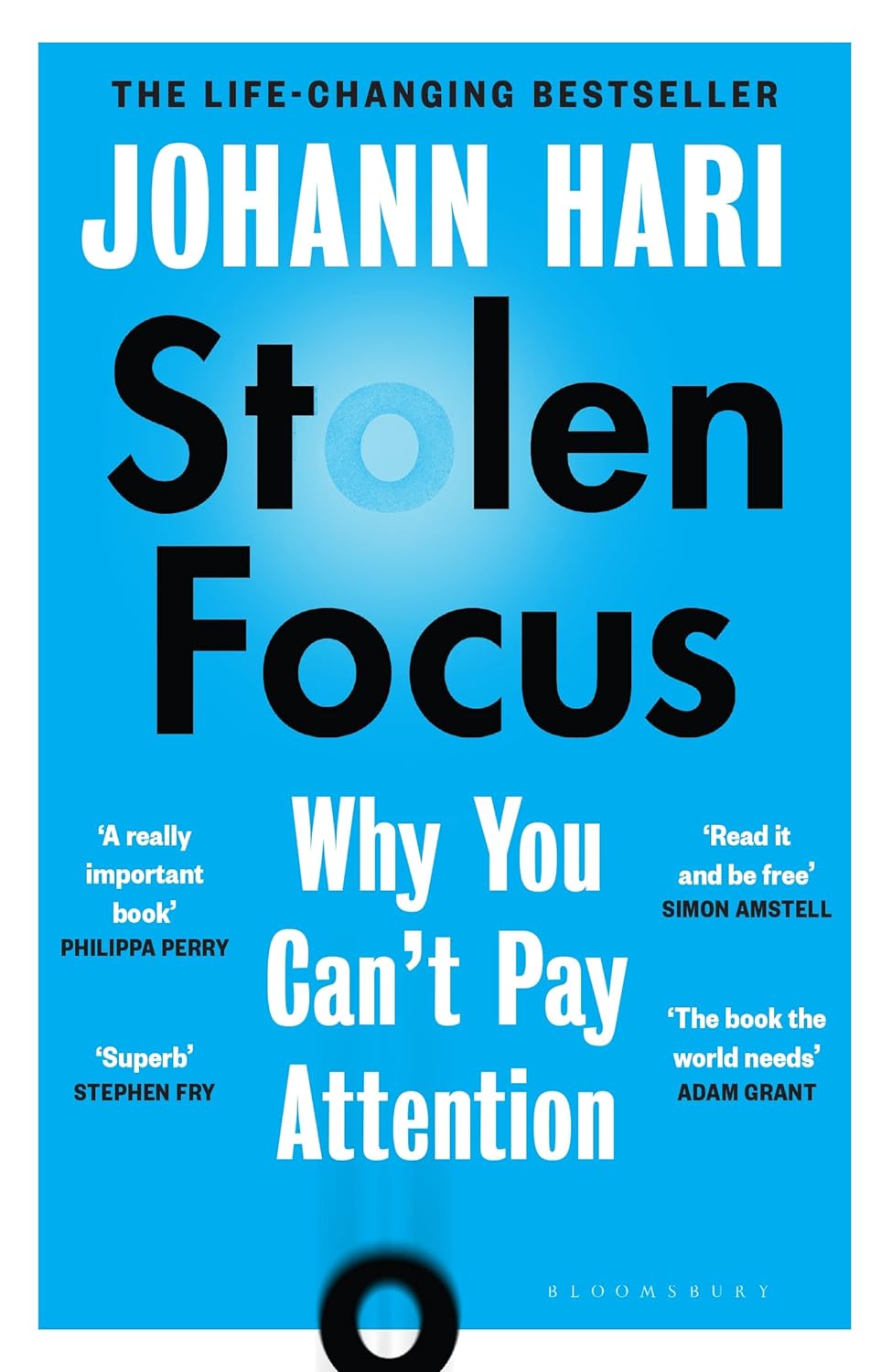
Highly recommended to anyone interested in states of attention, how culture shapes them, and the implications of this shaping. Johann Hari’s Stolen Focus: How You Can’t Pay Attention (1) shows that our diminished capacity to focus is a collective cultural issue and not just a matter of individual willpower. In this book, Hari identifies 12 causes of ‘stolen focus’, developing these themes partly through telling his personal story and partly through conversations with experts in the relevant areas of knowledge. The causes are:

1: Increase in Speed, Switching and Filtering. If we go too fast, and switch between tasks to rapidly, we overload our abilities, and they degrade.

2: Crippling of Flow States Fragmented focus interrupts flow. “Fragmentation makes you … shallower, angrier”, whereas “Flow makes you deeper … calmer”.

3: Rise in Physical and Mental Exhaustion The average amount of time a person sleeps is reducing, damaging our focus. If we stay awake for 19 hours straight we become as cognitively impaired as if drunk.

4: Collapse of Sustained Reading Fewer people are reading books, especially novels. Yet they train focus and encourage empathy. “Very few things worth saying can be explained in 280 characters.”

5: Disruption of Mind-Wandering, seen here not as a form of distraction but as a way of slowly making sense of the world that supports creativity and long-term decisions. Distractions undermine this process.

6: Tec That Can Trap and Manipulate You Big Tec’s business model depends on ‘engagement’ (eyes on screen) to facilitate exposure to advertising and the harvesting of personal data, to be used by the Tec companies themselves and also sold on to other would-be persuaders. Internet services are designed specifically to serve ‘engagement’ in this sense. Traffic is more readily stimulated by exposure to angry rather than calm content. Hence ‘surveillance capitalism’ engineers reactivity, anger and division.

7: Rise of ‘Cruel Optimism‘, a term for offering, in upbeat language, simplistic individual solutions to major social problems – like obesity and addiction. Internet addiction agitation and associated cognitive decline are looked at in the same way.

8: Surge in Stress and Triggering of Vigilance Research shows the top causes of stress for the working population of the USA to be “a lack of health insurance, the constant threat of lay-offs, lack of discretion and autonomy in decision-making, long working hours, low levels of organisational justice and unrealistic demands”. A cause of stolen focus is again linked to powerful external conditions..

9: Deteriorating Diets A widespread switch to supermarket bought processed foods has been “bad for our waistlines and our hearts” and is also “stealing large parts of our ability to pay attention”.

10 Rising Pollution We know that air pollution causes asthma and other breathing problems. There is also “growing evidence to suggest that this pollution is seriously damaging our ability to focus”.

11 ADHD and Our Response to It There has been a huge rise in diagnosed ADHD in school students in the last 30 years. It has been treated largely as a biological disorder, though this is now contested. Personal experiences and environmental conditions are being considered more seriously.

12 Confinement of Children – Physical and Psychological In the western world, children no longer roam free in their own world. Play is indoors and either supervised by adults or located on screens. Schools are largely concerned with preparing and drilling children for tests. This has serious consequences for both learning and focus.

In exploring ‘stolen focus’ and its causes, Johann Hari casts his net wide. In his conclusion, he talks about four levels of now-weakening attention: spotlight, when we focus on immediate actions; starlight, when we focus on projects and longer-term goals; daylight, which makes it possible to know what our longer-term goals are in the first place; and stadium lights, that let us see each other, hear each other, and work together to formulate and fight for common goals. Hari sees all of these lights being dimmed by stolen focus.

Hari advocates for an ‘attention rebellion’ in the manner of XR. Its three main demands would be: to ban surveillance capitalism, because people being “hacked and hooked” can’t focus’; to introduce a four-day week, because people who are chronically exhausted can’t pay attention; rebuild childhood around “letting kids play freely – in their neighbourhoods and at school” to promote a healthy ability to pay attention. He understands that this will be uphill work – the logic of economic growth demands more and more of our time devoted to producing and purchasing. Yet given the crises facing us, especially the climate crisis, we cannot afford the destruction of our attention and ability to think clearly.

This book is not just about big tec and social media. I like the range and quality of the information that Stolen Focus brings to the description and analysis of stolen focus. Hari is clear that self-help solutions – though they may help some people – are not enough. I believe that communities informed by deep ecology, spiritual and therapeutic insights can be oases of sanity and contribute to solutions. But without their being able to influence the mainstream, their impact is bound to be limited. Stolen Focus raises awareness very effectively. Whether or not an ‘attention rebellion’ is the right way forward,, Hari’s recommendations deserve to be taken seriously.

(1) Johann Hari Stolen Focus: Why You Can’t Pay Attention London: Bloomsbury Publishing, 2022 (Kindle edition 2023)

See also: https://contemplativeinquiry.blog/2024/06/13/stolen-focus-speed-switching-and-filtering/

STOLEN FOCUS: SPEED, SWITCHING AND FILTERING

“I went to see the Mona Lisa in Paris, only to find that she is now permanently hidden behind a rugby scrum of people from everywhere on earth, all jostling their way to the front, only for them to immediately turn their backs on her, snap a selfie, and fight their way out again. On the day I was there, I watched the crowd from the side for more than an hour. Nobody – not one person – looked at the Mona Lisa for more than a few seconds.”

Johann Hari’s Stolen Focus: Why You Can’t Pay Attention (1) explores states of attention, how culture shapes them, and the implications of this shaping. I like Hari’s insistence that this is a collective issue and not just a matter of individual willpower. In this book, Hari identifies 12 causes of ‘stolen focus’. I plan to write a review of Stolen Focus soon. This post is about the first cause, which he describes as an increase in speed, switching and filtering.

Speed

According to Hari, modern culture overvalues speed. “People talk significantly faster now than they did in the 1950’s, and in just 20 years, people have started to walk 20% faster in cities” and “the original Blackberry advertising slogan was ‘anything worth doing is worth doing faster'”. But, argues Hari, “if you go too fast, you overload your abilities, and they degrade”. He reminds us that if we engage in deliberately slow practices, like yoga, or tai chi, or meditation … they improve our ability to pay attention by a significant amount.

Switching

Cognitive speeding has been made worse by the myth of multitasking, a term taken from 1960’s computing, when machines began to have more than one processor and could literally do two or more things at once. The human brain doesn’t have that capacity. It is naturally single-minded and isn’t going to change. So when we ‘multitask’, we are actually switching between different tasks, though we may not notice our switching.

The cost of switching is a degradation of our ability to focus, and a decline in our performance. Hewlett- Packard looked at the IQ of some of their workers in two situations. At first they tested their IQ when they were not being distracted or interrupted. Then they tested their IQ when they were receiving emails and phone calls. “The study found that ‘technological distraction’ – just getting email and calls – caused a drop in the workers’ IQ by an average of 10 points … twice the knock to your IQ that you get when you smoke cannabis”. Overall, if you spend your time switching a lot, the evidence suggests “you’ll be slower, you’ll make more mistakes, you’ll be less creative, and you’ll remember less of what you do”.

Filtering

“Think of your brain as a nightclub where, standing at the front of that club, there’s a bouncer. The bouncer’s job is to filter out most of the stimuli that are hitting you at any given moment – the traffic noise, the couple having an argument across the street, the cellphone ringing in the pocket of the person next to you – so that you can think coherently about one thing at a time.” The bouncer in our brain is the pre-frontal cortex, and it is becoming overwhelmed. There are too many stimuli and in many environments noise pollution in particular is interfering more insistently with the flow of our thoughts.

The crisis in attention that Hari outlines is a threat to our quality of life. It weakens our ability to think creatively or deeply. It tends to make us agitated as well as distracted. This is not a good place from which to build healthy relationships or solve complex problems at either the personal or the public level. I experience my contemplative inquiry as a valuable antidote to ‘stolen focus’. But it doesn’t get me everywhere, because loss of focus is a pervasive cultural problem. Beyond writing a review of the whole book, I intend to delve more deeply into the questions that Stolen Focus raises from a personal and a collective point of view.

(1) Johann Hari Stolen Focus: Why You Can’t Pay Attention London: Bloomsbury Publishing, 2022 (Kindle edition 2023)

See also https://contemplativeinquiry.blog/2024/06/17/book-review-stolen-focus/

INSIDE LOOKING OUT

I spend time inside looking out. The sky changes a lot. Its shifts are rapid and dramatic. The trees change too, but over longer periods of time. The high levels of rain this year have encouraged an exceptional verdancy and abundance. Looking out, I can almost forget that I am in a block of newish flats in an old urban area. The person walking on the pavement below seems dwarfed by the splendour of the leaves. The road is very quiet for a late morning. The wheel of the year turns, approaching its summer zenith in this part of the world.

I am settling in to a higher number for my official age. In social gerontology, there are (or have been) three kinds of ‘old’: young-old (50-64), middle-old (65-74) and old-old (75+). I am now old-old and statistically immune from premature death. These classifications don’t quite fit my lived experience, but they are a sort of landmark all the same.

Elaine and I have been together for nine days following her repatriation and subsequent stay in a local hospital. We are learning how to live a new phase of our relationship where she has high needs and is housebound, and I am in a ‘caring’ role in the institutional sense of that term. We are learning as we go along and doing our best to be conscious about our experience as well as practical in an ‘activities of daily living’ sense. I think we are doing OK. We are establishing new patterns of day to day life and Elaine’s capacity is increasing.

Mostly I leave the flat only for shopping and other practical tasks and, because we are so well situated, these don’t take long. On Saturday Elaine and I both felt comfortable and confident with me going out on a one hour recreational walk. I continue with a regular practice and journaling. I still practice within a Druid circle (grove) and I find this healing and re-energising. At the same time my work has been referenced more to five personal commitments rather than to tribal membership, religious devotion or spiritual metaphysics. Recently I have been contemplating my commitments and checking out whether they still work for me. These are:

1. I will work from the stillness of the centre.

2. I will cultivate good will towards self, others, and the wider web of being.

3. I will cultivate positive health and well-being, within whatever constraints may apply.

4. I will cultivate discernment, creativity and wisdom, to the best of my understanding and capacity.

5. I will cultivate a life of abundance in simplicity, living lightly on the earth.

I do see a danger in lists like these: they can become a frozen and pious – an internal rhetorical performance. For me, contemplative inquiry keeps my commitments alive, suggesting revisions if necessary. This is my direction, going forward, in the unfolding chapter of my life.

FESTIVE MOMENT

On 12 May I wrote: “I hope soon to get some sense of how soon Elaine will come home, and what resources we will need for our lives going forward. It’s my 75th birthday on 25 May, and my best present would be to have Elaine home by then.” (1) Today is 25 May, and my wife Elaine is indeed coming home from the Gloucester Royal hospital. It has felt like a long absence for both of us and we are glad to move into a new chapter of our lives.

Yesterday evening I went Alney Island, a Gloucester wetland, for a brief contemplative walk. The footbridge near Gloucester docks has been repaired and after many months the island is easy to reach again. Back on the island, I loved its sense of growth and abundance in the summer evening light. I felt care-free. I had almost forgotten how much experiences like this nourish me.

This is a festive moment in my life: a significant birthday, Elaine’s return, celebrating a moment in the year that makes me glad to be alive. I feel refreshed, heartened and re-energised.

(1) https://contemplativeinquiry.blog/2024/05/12/unsought-journey/

SEEING BEYOND SIGNS

“A sign is what characterises the appearance of something, its form. If we recognise things based on their sign, we may think that this cloud is different from that cloud, the oak tree is not the acorn, the child is not the parent. At the level of relative truth, these things are helpful. But they may distract us from seeing the true nature of life, which transcends these signs.

” ….

“You are always changing form. You are browsing through a family photograph album, and come across a photo of yourself as a young child. Where is that little child now? You know that it is you. You have the same name, and yet it doesn’t look like you. Are you still that child or are you someone else? This is a practice of contemplating your own signlessness. Today you look, speak, act and think differently. Your form, feelings, perceptions and consciousness are all very different. You are not fixed and permanent. You are not the same person, but you are not a totally different person either. When you are no longer caught in specific images or appearances, you can see things more clearly. You can see that the little child is still alive in every cell of your body. It is possible still to listen and take care of the little boy or little girl in you at any time.” (1)

(1) Thich Nhat Hanh The Art of Living London: Penguin Random House UK, 2017

UNSOUGHT JOURNEY

Ego sets me up, in both a narcissistic and rational way, to be the hero of my own journey. But it’s at least equally valuable to have a support role in someone else’s. On Monday 8 April my wife Elaine flew to Gran Canaria with her sister Glynis for a restful and undemanding holiday. It worked brilliantly for nearly three days. On Thursday 11 April Elaine had a fall resulting in a fractured femur. Instead of a restful and undemanding holiday, they were in a health disaster overseas.

Elaine was duly admitted to hospital. Other health complications – a characteristic of we older people – meant it took 9 days for Elaine to have a successful operation: not ideal given the problem being addressed. Glynis was the support person and champion at this stage. But soon it became evident that Elaine would not be well enough for repatriation for some time. An original plan for me to be the person who organised things at home was ditched, and I flew to Gran Canaria on 28 April allowing Glynis to go home.

In a way it wasn’t hard. But I was knocked around by Elaine’s predicament, which might have been fatal, and by the culture shock of being in a new place where, but for the kindness of strangers, I had the verbal and communication skills of, at best, a chimpanzee. I also had to be, or at least appear to be, competent in managing (influencing?) the hospital and insurance companies’ relationship both with Elaine and each other. A completely unfamiliar situation for me, and not one that I would want to be in again.

We managed somehow. Elaine and I know and love each other. We supported each other in our respective roles. I liked my hotel though its amenities were largely wasted on me. Its great virtue was in being 15 minutes easy walking distance from the hospital. I spent several hours a day with Elaine, but also had several on my own. I needed to be away from stimulation for a good deal of time. I did enjoy the warmth, and especially at sundown, the sky over Gran Canaria’s south coast.

The repatriation, when it came, felt almost sudden. We flew back, together with a wonderful paramedic and minder sent over for the purpose, on Friday 10 May. Elaine, whose left leg is not weight bearing at all, was trolleyed and chaired both on an off a commercial flight where she got her own row of three seats. The cabin crew were great.

The repatriation process ended with an ambulance journey to the Gloucester Royal hospital, where our paramedic had organised Elaine’s admission in advance and Elaine was wheeled straight onto the orthopaedic ward where she now is. This is also in walking distance from our home. At the moment she is largely being monitored and tested. A new phase will begin when the physiotherapists show up on Monday. I hope soon to get some sense of how soon Elaine will come home, and what resources we will need for our lives going forward. It’s my 75th birthday on 25 May, and my best present would be to have Elaine home by then.

This post has been a simple story, without much obviously contemplative, reflective or overtly ‘spiritual’ content. But I don’t in my own life and practice make much distinction between the spiritual and mundane, and I do know that this has been a life-changing event. A pilgrimage, of sorts.

AN TUAGH: SONG OF AMERGIN

The Song of Amergin, here sung in Old Irish Gaelic, is the oldest known extant song in the Atlantic Archipelago*. The performers here are An Tuagh, whose core focus is the Gaelic-Norse traditions of northern Scotland. They have a YouTube channel, a Facebook page and an Instagram presence. The Song of Amergin is featured in their album Bard and Skald, as is a Beith-Luis-Nun Ogham chant. If you subscribe to the An Tuagh YouTube channel, there are commentaries on both pieces. The one for the Song of Amergin includes both Irish and English texts. However versions vary widely and An Tuagh have copyrighted theirs. I have included an open source English version below, to give some impression of what is being sung.

I am the sea blast
I am the tidal wave
I am the thunderous surf
I am the stag of the seven tines
I am the cliff hawk
I am the sunlit dewdrop
I am the fairest of flowers
I am the rampaging boar
I am the swift-swimming salmon
I am the placid lake
I am the summit of art
I am the vale echoing voices
I am the battle-hardened spearhead
I am the God who inflames desire
Who gives you fire
Who knows the secrets of the unhewn dolmen
Who announces the ages of the moon
Who knows where the sunset settles

I have listened to An Tuagh’s rendition of the Song of Amergin a number of times, sinking into a sense of shared presence with something preciously archaic and other. An Tuagh are the intermediaries, helping me to catch an after echo of that time. I don’t have fully to understand it, but simply respond. I am grateful both to the old culture, and to skillful modern bards.

*British Isles until all too recently

See also https://contemplativeinquiry.blog/2024/09/13/an-tuagh-helvegen/

IMAGES FROM A TOWN GARDEN

Tumbledown gatehouse

Unbothered to impress:

You draw my eyes.

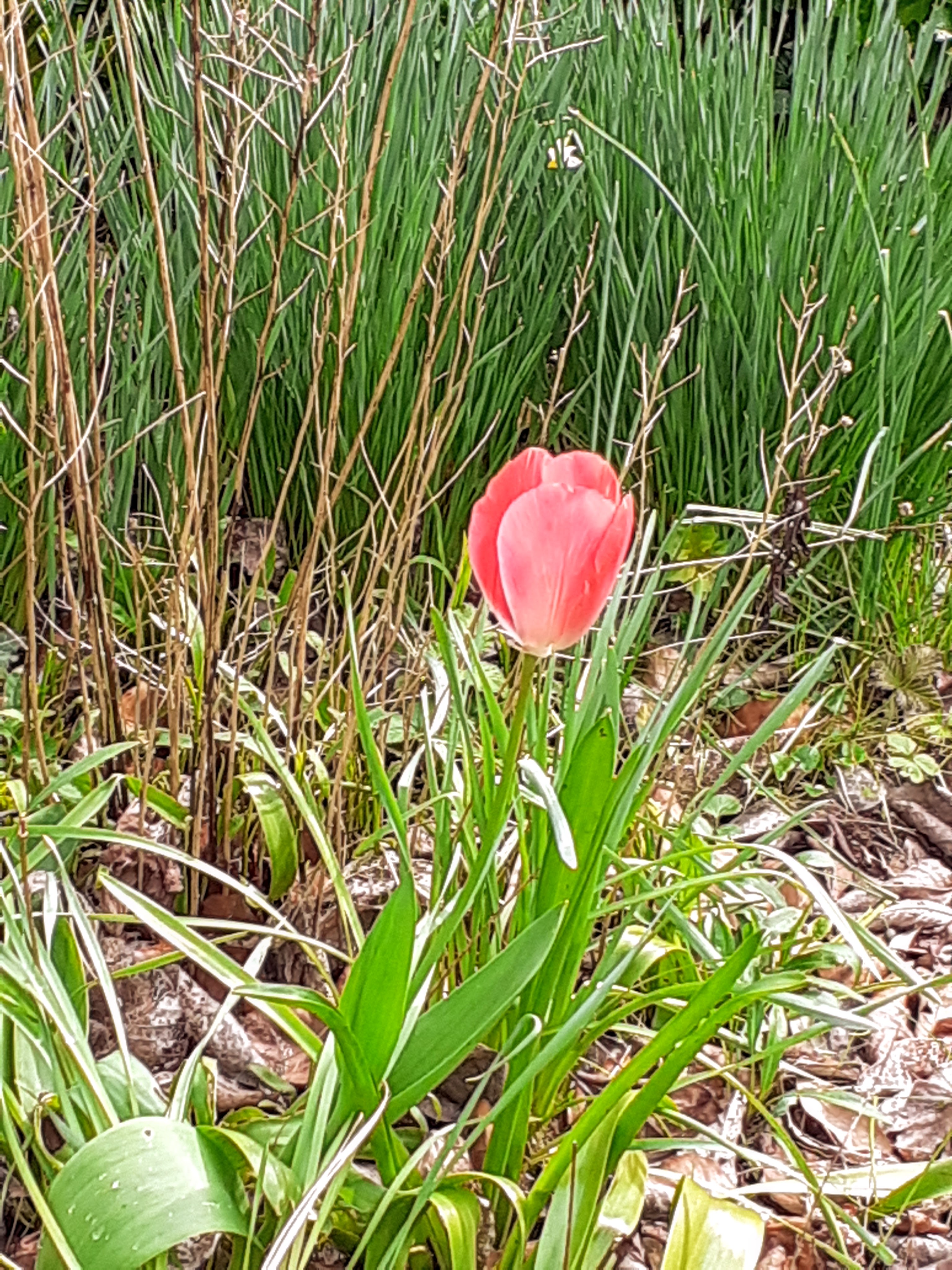
A single bloom

Among spiky grasses

Insists on beauty.

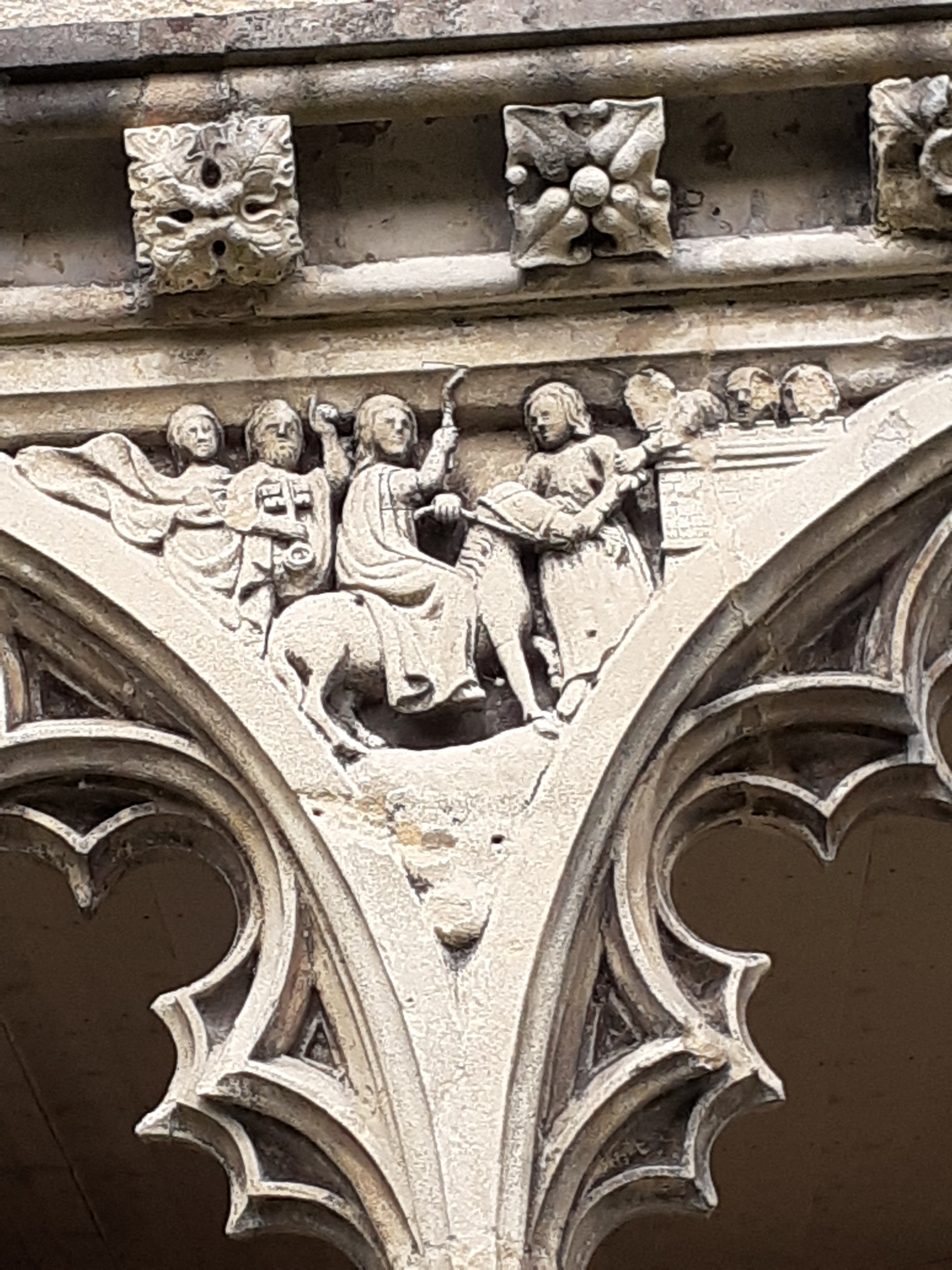
Six hundred years

In the life of this carving:

How much has changed?

Across the road,

Restrained elegance.

Here, a bursting life.

The lushness of spring:

Who can resist

Its fleeting appearance?

NOTE: At the beginning of April I discovered Hillfield Gardens – a little outside the centre of Gloucester, yet still in easy walking distance (or an easy bus ride) from where I live. Originally the gardens of a large house, Hillfield Gardens are about 1.6 hectares in extent. They are managed by a Friends Group on behalf of Gloucestershire County Council. For me the gardens are a tranquil space, different in feeling-tone from other local parks. Beyond that I don’t yet have a narrative about the gardens – more a set of discreet impressions. The pictures and words above are an attempt to share these impressions. The third picture is a detail from an 18th century gazebo using architectural details from a 14th century market house in Westgate Street demolished in 1780.

GREEN RESURRECTION

I am walking among trees, feeling refreshed and renewed after a long winter. This feeling is anchored by the return of leaves. I am present in, and to, the presence of new green. It comes every year, at slightly different times. I’m noticing the beginning of a beautiful verdant period. It’s re-appeared a little early this year and I experience this as a great blessing.

Where I live, the early spring has been wet and windy, often with dull skies. Nature has been alive and active throughout this period, but I have remained wintry in important respects. This weekend has changed me. I am aware of new green leaves and a strengthening sun. The latter may be visually dimmed by frequent of heavy cloud, but the leaves reassure me of its power in the rising year. Although we are still far from a full canopy in the woods, the life-force – in modern Druidry often called nwyfre – is strong. It’s a time for celebration.

Earth Eclectic

music that celebrates Earth and speaks to the heart

Sarah Fuhro Star-Flower Alchemy

Follow the Moon's Cycle

Muddy Feet

Meeting nature on nature's terms

Rosher.Net

A little bit of Mark Rosher in South Gloucestershire, England

Becoming Part of the Land

A monastic polytheist's and animist’s journal

selkiewife

Selkie Writing…

Charlotte Rodgers

Images and words set against a backdrop of outsider art.

Prof Jem Bendell

living with metacrisis and collapse

Towint

The pagan path. The Old Ways In New Times

The Druids Garden

Spiritual journeys in tending the living earth, permaculture, and nature-inspired arts

The Blog of Baphomet

a magickal dialogue between nature and culture

This Simple Life

The gentle art of living with less

Musings of a Scottish Hearth Druid and Heathen

Thoughts about living, loving and worshiping as an autistic Hearth Druid and Heathen. One woman's journey.

Wheel of the Year Blog

An place to read and share stories about the celtic seasonal festivals

Walking the Druid Path

Just another WordPress.com site

anima monday

Exploring our connection to the wider world

Grounded Space Focusing

Become more grounded and spacious with yourself and others, through your own body’s wisdom

The Earthbound Report

Good lives on our one planet

Hopeless Vendetta

News for the residents of Hopeless, Maine