Contemplative Inquiry

This blog is about contemplative inquiry

Tag: contemplative practice

TOWARDS A CONTEMPLATIVE NOTE: REFLECTIONS ON 3 OCTOBER

I sense that we are finding a contemplative note in Druidry. To an extent we have had it for a while, but it’s becoming more assured. Last Saturday we had an open contemplative day in Stroud for Druids and fellow travellers willing to join us. I worked with Elaine Knight and Nimue Brown as co-facilitators. Some of the participants travelled a considerable distance for the event. Many of those present were new to each other. Some were new to this kind of event.

Yet the day felt very cohesive. For me, the group note resonated strongly though also softly. The vibration was a subtle one, interwoven with silence and stillness, whilst also clear and distinct. Building community together, and working together, we were more than the sum of our parts. We created a group identity, and sounded our note. I understand this as our small contribution and offering to the Oran Mor, the great song of what is.

I’ve been reflecting on how this happened, and on lessons to take forward. The main single factor has to be that everyone in the group understood the offer, was open to the experience, and wanted it to work. This is such an obvious aspect of a success that it can go unrecognised, like the so-called ‘placebo’ effect in healing: people engage their good will, almost unconsciously, and it has a strong positive effect.

On the facilitator side, there are several things we got right and that I want to remember. Having a record will help that.

We made a good choice of venue for the occasion, and this was supplemented by the blessing of a golden autumn day. The programme relied on activities, which someone at another of our events named as “simple but profound”. This choice is definitely part of our note. The building of our ritual container, whist still ‘lean’, was just a little bit more elaborate than in our local group. It clearly marked our sacred space and our expectations about how we would work in it.

I also found myself casting our circle in ‘the contemplative grove of druids’. This time I was careful to avoid the term ‘grove of contemplative druids’.  I have found naming ‘contemplative druidry’ to be a useful way of classifying a sub-set of interests within druidry. But I now believe that to think of people themselves as ‘contemplative druids’, a separate species within larger druid genus, is potentially divisive and doesn’t allow individuals to have inconveniently multiple interests. At the same time, when we join together in a contemplative event, we are indeed being intentional about contemplative practice. I have come to think of Contemplative Druid Events as a vehicle for a latent grove, a grove which constellates during our events and therefore deserves to be named. This grove provides space for our emerging note.

The note was considerably enriched when Nimue led a session that involved us in finding simple personal sounds and vocalising them over an extended period of time. After a while we could sense those diverse and discordant seeming sounds (our individual notes) come together as a collective sound where people spontaneously worked together. So the group note was worked for, discovered and explored in an absolutely literal way – and one which changed the atmosphere of the room. Later in the day, Elaine took the group through a version of an energy body exercise that went on to identify and reinforce the energetic connections between people, linking us as a group at subtle levels before moving into an animistic exercise. In my experience as a participant, these sections of the day were simple, profound and powerful too.

We made sure that we varied the pace of the day. Some of the work was relatively intense, but we had more leisurely and relaxed spaces as well, enjoyed time outside and made sure of an abundant supply of refreshments. For me, 3 October 2015 was a step forward in the evolution of our work. My heartfelt thanks to everyone involved.
THE PEACE OF SOPHIA

This post is about contemplation and peace – peace as lived experience, rather than as hope or idea. I am discovering the peace of Sophia.

In my practice I experience Sophia as a psychopomp or inner guru. Conventionally she is a guide of light. Actually she is a guide of dark as well. Either way she points beyond herself. Generally using a method of subtle prompts and suggestions, she opens my way to a deeper nature.

Just recently she has been showing me a way to peace as an inner space, like a well-spring at the core of being. This is not a new idea, nor yet a new experience. But there’s more clarity around it, more definition – also, in a felt sense, more weight.

It began with an intense vision of braided threads – black, white and red, the traditional goddess colours. I felt nudged to identify the colours with peace, joy and love. Peace had some primacy. Although this is a triadic image, I began to see it as a four: black, white, red and black. Here the peace of the Goddess is defining. It is linked both to origin and return, and to spaces within and between other forms of experience. It may seem like simple negation. But it is an active force, like the ‘emptiness’ in some Asian traditions.

The good news is that ‘peace’ does not depend on external conditions. It can be accessed and developed within, both individually and collectively. This is why, to a certain extent, practices like meditation can be a protective or resiliency factor in relation to bad outside conditions. The trick here is to avoid a descent into the wrong kind of magical thinking and expect too much. Challenges still have to be dealt with at their own level: it’s just that having a baseline of inner peace tends to make practitioners more resourceful in dealing with the busy apparent world.

Cultivating the peace of the Sophia is currently centre stage in my solo work. In his foreword to Contemplative Druidry Philip Carr-Gomm quoted the well-known line “Deep peace of the quiet Earth”. My extension of that thought, based my current experience, is to say ‘as without, so within’. I believe this double recognition is necessary. To the extent that I am a nature mystic, the aspect of nature with which I am most concerned is me, in particular a deeper nature behind the surface personality.  Only by attending to both this nature within and nature around and beyond me can I refine the relationship between them and so identify any gift I might have for the world.

CONTEMPLATIVE DRUIDRY: MEME OR MOVEMENT?

On 3 October Contemplative Druid Events (CDE) – see http://contemplativedruidevents.tumblr.com – will hold its last planned event for 2015. This will be a Contemplative Day, in Stroud, Gloucestershire, England. The facilitators will be James Nichol, Elaine Knight and Nimue Brown. Our programme is designed for a group of up to 15 people, and 12 are already committed. With just over a month to go we have a comfortable size of group, with room for a few more.

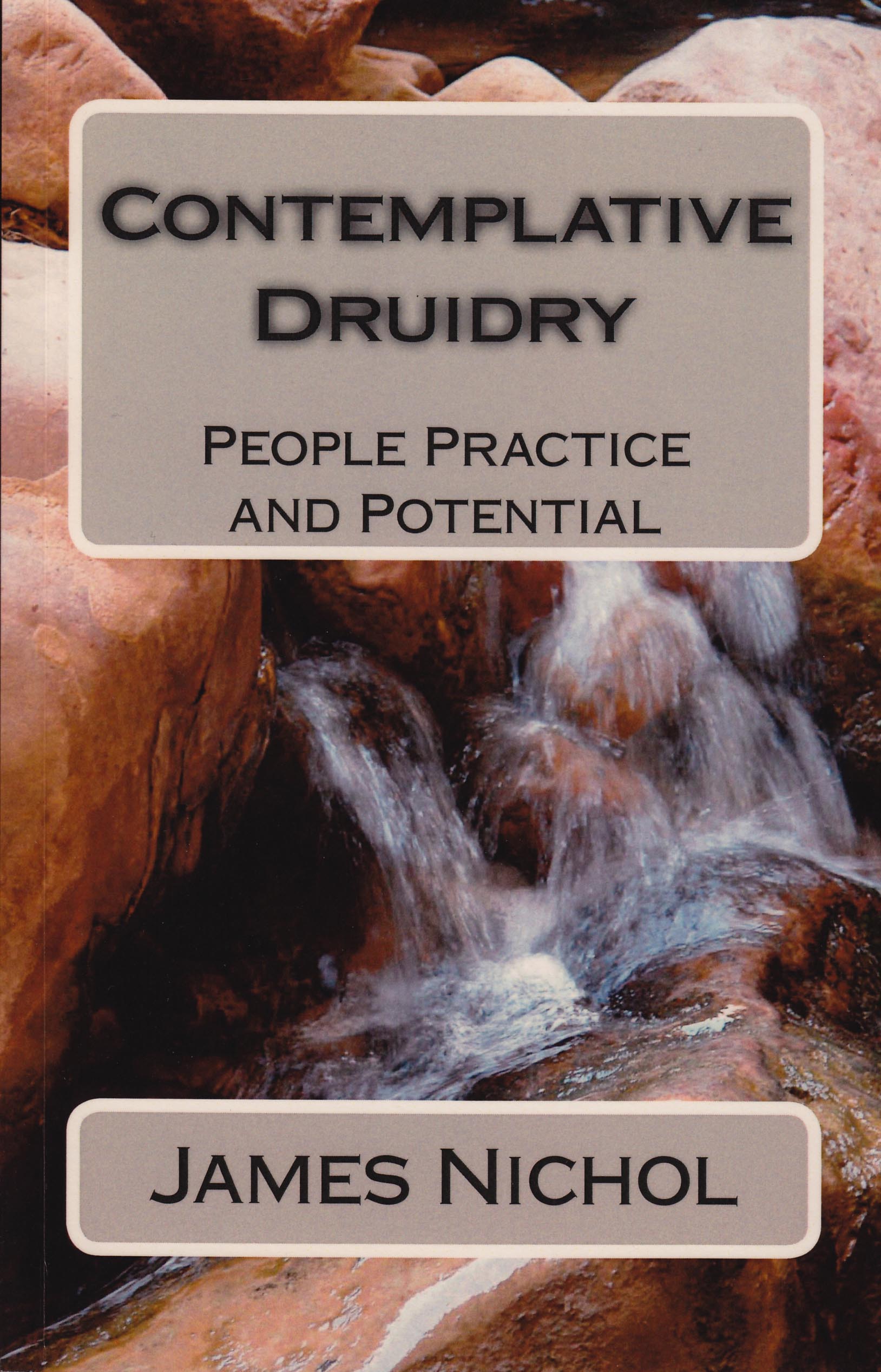
CDE offerings are built around insights from the book Contemplative Druidry: People Practice and Potential about the kinds of contemplative work that most seemed to resonate for the present generation of Druids. We offer sitting meditations of based both on a bare attention and on active imagination. We have outdoor walking meditations and opportunities simply to be, with awareness, in natural settings. We use methods that draw on creative arts. We have developed ‘Awen space’ as a group opening to, in and as Spirit. We build our repertoire as we gain in experience.

Is CDE spearheading Contemplative Druidry as a movement? I don’t see it that way. CDE was created as a minimal level of organisation for a single purpose. This is to offer a particular kind of event to small groups of Druids and fellow-travellers willing to join us. In doing this, we also promote the contemplative Druid meme, which now seems to be well recognised in modern Druid culture. But the CDE brand does not exhaust the possibilities of contemplative Druidry and we wouldn’t want it to. Modern Druidry, which is in some senses a postmodern Druidry, has a strong commitment to free exploration and diversity. The contemplative meme will find its place within that wider cultural framework. For better or for worse, we will never, as a collective, be organised around a Druid ‘four noble truths’. Contemplative Druidry will mean different things, and inspire different journeys, for different Druids.

SOPHIAN CONTEMPLATION

I have begun a series of Sophian contemplations. They are built around brief passages from texts that I treat as being in her tradition, passages that have drawn and excited me and continue to resonate beyond their initial impact. This is the first.

I am the light within the light.

I am the remembrance of Forethought.*


I sit, eyes closed. I say: I am the light within the light. I get the image of someone holding up a lantern. It’s like the Hermit’s lantern from Tarot, except that Sophia is holding it. Then there’s the image of the candle inside the lantern, and I briefly become the flame. I am surrounded by protective walls of glass, safe and steady. I know that the glass will enhance my radiance.

Back outside, I as observer notice that the lantern offers a pool of light in a deep twilight setting. This light is not aggressive or overwhelming. It hardly disturbs the magic of the gloaming, which is also somewhat lit by moon and stars. The contribution of the lantern is that it helps to illuminate a path. Sophia is holding up the lantern so that people can walk somewhere a bit more easily.

Sophia holds the light and points the way. Sophia does not ask for prayers. She does not ask to be loved, though love is in the air. She does not even ask to be followed, or for a path to be followed. Rather she says to me, in my observer position, “now you do it”. To become a lantern bearer, a lantern, and the flame within, is her worship. It begins with the flame within, or there is no light. At a level, it also ends with the flame. From the perspective of the lantern there is no path; just illumination.  From the external perspective, there is a path, and a role of lantern bearing guide. Yet there is only one experience, which can be seen in different ways.

I continue to sit, eyes now half open, soft focus, panoramic vision. I say: I am the remembrance of Forethought. I notice that I feel very comforted by the word ‘remembrance’. I’ve always had a sense of memory beyond memory, predating me and beyond personal. I am not thinking in terms of past lives or other forms of existence. But I do think that if those had a meaning and I could access them, this ‘remembrance’ would be there too. It’s not a memory of any identity or event – it’s just ‘remembrance’. It’s a very deep intuitive sense, and I believe that I share it with others, though the specific experience and ways of attempting to language it will vary. It has the feeling-tone of home. The old Gnostics used the term Pistis Sophia (faith-wisdom), which is the wisdom of deciding to have faith in the value of experiences like this, rather than dismissing them. There’s a decision to build life and meaning around them and to stand by the images, words, metaphors and practices that emerge – though not without examination and inquiry. ‘Forethought’ also has its own special resonance. In this context it’s anything so concrete of definite as ‘forward planning’. Rather, it derives its meaning as a contrast to ‘the Word’. It suggests a prior latency before the beginning that was the Word – a bit like the ain soph of the Kabbalah. As such, I can appreciate that language is being stretched beyond its reasonable reach and is dissolving into Mystery. Yet somehow, all the same, it stands for something I can recognise and assent to. Sophia’s invitation to me is to take ownership of these lines, and taste their reality as fully as I can.

I am the light within the light.

I am the remembrance of Forethought.*

*These lines come from a Gnostic text called The Secret Book of John. The book is a Nag Hammadi text and now available in a number of English translations. This one is taken from The Secret Teachings of Jesus: Four Gnostic Gospels translated with an introduction and notes by Marvin W. Meyer, New York: Vintage Books, 1986.

CONTEMPLATIVE TASTER AS PROMISED

In my last post I promised to share my Rainbow Druid Camp 2105 taster session. Its aim was to interweave elements of mindfulness, extended sensory perception and celebration, and also to show how silent meditation and group sharing can act together to raise contemplative awareness.

This session was tightly timed to fit with its placement in a larger event – the timing was handled through the use of bells. In a different environment this practice could be run more spaciously, with longer periods devoted to each section of the meditation and space for writing and drawing or indeed simple time out between the sections. It’s a highly malleable programme.


START Welcomes and check-in round of names, including why we are here, how we feel right now, and any expectations we have.

Overview. The purpose of the session is to introduce Contemplative Druid Events and to share some of its working methods. This session aims to interweave aspects of mindfulness, extended sensory perception and celebration.

Entry into sacred space through lean ritual Facilitator leads, saying “we are here today in the strength of heaven, light of sun, radiance of moon, splendour of fire, speed of lightning, swiftness of wind, depth of sea, stability of earth and firmness of rock.   May there be peace in the 7 directions – east, west, north, south, below, above, within; may the spirits of place flourish here; may we be present in this space”.

Meditation in 5 three minute stages:

  • Becoming aware of our body and senses, scanning and finding something specific we appreciate or through which we feel blest
  • Becoming aware of our feelings, thoughts and images, scanning and finding something specific we appreciate or through which we feel blest
  • Becoming aware of the space around us, including each other, scanning and finding something specific we appreciate or through which we feel blest
  • Becoming aware of any other levels of presence or being, scanning and finding something specific we appreciate or through which we feel blest; alternatively extending and intensifying the previous section if nothing specific to this section emerges
  • Resting in awareness of everything that has come up in this meditation so far.


Sharing of experience – In groups of three, each person speaks in turn for three minutes each, with aware, supportive listening in silence, without dialogue or interaction. When everyone has had their turn, there is an opportunity for six minutes conversation in the group. On return to the main group, each person briefly reports back to the whole group.

Exit from sacred space through lean ritual. The facilitator says: “May the 7 directions be thanked for their blessings. May the spirits of place flourish here.  May this work inspire our lives.  We stand today in the strength of heaven, light of sun, radiance of moon, splendour of fire, speed of lightning, swiftness of wind, depth of sea, stability of earth and firmness of rock.”

Any questions? Anything left unsaid? END

CELEBRATIONS: THE SONG IN THE HEART IN THE SONG OF THE WORLD

Within my contemplative practice, I use a process called ‘celebrations’.

It is not a meditation as I use that term, because it includes discursive thinking and reflection.

It is not prayer: no being or presence or energy is addressed or born in mind as an auditor.

It is not lectio: it is based on a text I wrote myself, which I revise in the light of continuing inquiry and experience.

It is not simple ‘affirmation’ – because it works with an edge and can bring up ‘negative’ feelings and experiences of alienation, as well as being pleasurable and affirming.

The sequence, which can take variable amounts of time to work through, goes like this:

Celebrating body and senses.

Celebrating life energy.

Celebrating feelings, thoughts and images.

Celebrating the space inside the breath, and the healing in that space.

Celebrating the song in the heart in the song of the world:

Living presence, in a field of living presence,

Always enough; always at home.

I don’t say ‘I celebrate my …’. In this practice I use the gerund ‘celebrating’ and leave out ‘my’ so as to keep the focus processual and thereby avoid turning it in to a ‘who am I?’ practice. Such practices are widely available and are designed to disidentify practitioners from the body, senses, life energy, feelings, thoughts, images, ‘I-ness’ (or ego), finally to rest in an observer position, which, despite the residual dualism in the whole notion of observation, is often seen as the threshold of an enlightenment or theosis. In this practice I want to stay immersed in the process, and leave the ‘I’ question out.

I owe ‘celebrating’ to my background in humanistic psychology and co-counselling in particular. In a therapeutic context a phrase like ‘celebrating body’ could easily provide an ample agenda for a weekend workshop, given the level of negative body image and negative body experience that people find themselves dealing with  – but also given the joy and liberation that come with healing. For the invitation to ‘celebrate’ paradoxically evokes distress, where the way of ‘celebration’ at best seems artificial and a worst a cruel mockery. The work is to stay with the notion of celebration, to give the distress its due and then let it go, and find a place where there is something authentically to celebrate. In the therapeutic context, a number of methods may be used to assist this process. In the contemplative context, aware contemplation itself can have a transmuting effect.  When I turn my attention to my body and run through what’s going on throughout my body and five senses, I generally find myself noticing the strains, anxieties and discomforts of the moment and then moving to a celebration of embodiment itself, the sheer gift of being in this world, in this way, at this time and with this experience. The same is true of life energy, feelings, thoughts and images.

At the fourth line, ‘Celebrating the space inside the breath, and the healing in that space’ I find a change in feeling tone, since the practice tends to become naturally celebratory – though this is not always the case, since I may feel cut off from the power of contemplative practice itself. For this is an affirmation of meditative states in their therapeutic aspect, and I tend to drop in to a fully meditative state during this phase, letting go for a while of the words and celebration, indeed of the exercise itself for a period.

At the fifth line, I move to my sense of the Oran Mor (the song in the heart in the song of the world), which celebrates my sense of the numinous, of my connection to or involvement in Mystery. The last two lines introduce no new celebration. They are an elaboration of ‘celebrating the song in the heart in the song of the world’.  I said in a recent post that I experienced the Goddess dissolving into the Oran Mor. In this practice I may likewise almost experience the ‘song in the heart’ dissolve into ‘the song of the world’. I can certainly visualise and intuit this. Terms like ‘song in the heart’, Goddess, Oran Mor, become porous and hard to distinguish. Yet here too, in this section of the practice, I can also experience dis-connection and alienation. If I find myself needing to accept this as my actual state, then the celebration is of the words themselves and the recognition that I wrote them myself, with integrity, at an earlier time: it is me who is reminding myself of what becomes available in a state of openness and celebration.

CONTEMPLATIVE DRUIDRY: BOOK REVIEW BY MARIA EDE-WEAVING

I like the way in which the reviewer takes the discussion forward whilst also saying nice things about my book!

ContemplativeDruidry copy

A review by Maria Ede-Weaving of  ‘Contemplative Druidry: People, Practice and Potential’ by James Nichol

Modern Druidry is an evolving spirituality; each of its practitioners is continually adding to the breadth and depth of this path through their experiences. What gives a spirituality its power is it practices and approaches, and these are far from static – they live and breathe, grow and change, as we do. For a path to flourish and mature, it requires that we engage, question and explore, remaining open to the possibilities of change whilst honouring the wisdom already shared. James Nichol’s Contemplative Druidry: People, Practice and Potential is a wonderful example of this process in action.

Nichols has gathered a group of Druids to discuss their experiences of contemplative practice. Fifteen Druids share their thoughts about both their solo and group encounters with contemplative meditation and how these have impacted upon their Druidry and wider lives.

The book is in three main sections: ‘People, Practice and Potential’ with contributors not only reflecting on what drew them to contemplative Druidry and how such is expressed in their spiritual practice, but also posing the question of how such approaches might manifest in the wider Druid community, should they be more readily explored.

It is clear from these accounts that sitting meditation is only one part of this approach; mindful walking, chanting, daily offices, communion with nature/the divine and creative activities also play a part in keeping contributors present and connected. There is a real sense that each – for want of an established Druid-based contemplative framework – has been quietly experimenting, acting as pioneers exploring their own frontiers in order to find what works.  In doing so, they have been planting the seeds of a tradition that could potentially flourish into a valid and inspiring area of Druidry, one that until now has been rather ignored. Many have taken their inspiration from other spiritualities such as Buddhism and Christianity, however, their practices have developed a flavour that is distinctly Druidic. It’s a fascinating read and interesting to see how meditative practices give depth to Druid concepts such as the Awen and Nwyvre;  how Druid contemplation and mindfulness might  help to shape, transform or deepen a connection to life and self.

In the Neo-Pagan movement and the Western Mystery Tradition there has been a dominant focus on what might be perceived to be ‘active’ meditation techniques; the use of visualisation and path-working holding a dominant place. The Eastern approach to meditation has often been assumed to facilitate a removal of self from the world in an attempt to transcend its illusions. As such it might be perceived to be at cross purposes with the Druid world view where life and earthly experiences are celebrated. Most of us understand  Druid spiritual practices to be a gateway to deepen one’s involvement with earthly life, as opposed to escaping it via ascetic disciplines, however, what Nichol’s book illustrates is that the contemplative approach, explored from a Druid perspective, can be a tool that moves us into a richer and deeply felt relationship with nature, community and self.

Reading through the book’s many thought-provoking accounts I had that sense of excitement you get when a long-held suspicion about something is validated by another’s experience. My first encounter with meditation came years ago via the practice of Yoga. For me, regardless of how one might interpret the philosophy of Yoga, what its practices illustrated was that these techniques of mindful movement, breath and contemplation could actually help me to feel more embodied and present on this planet. They were immensely practical and useful , not only in aiding my physical well-being but also in creating a healthier flow between my body, mind and emotions, and in doing so, opening the door to my spiritual journey. The book’s examples makes it clear that I am not alone in my view that these techniques are not ring-fenced by any religion or path but are open for all to use. I see no contradiction in including them as part of my Druid practice. It is true that each spiritual path will approach these techniques through their own spiritual lens – and even each individual within each path will bring their own unique focus to bear – but Nichol’s books suggests that there is a rich seam of spiritual nourishment to explore here, and that even if such practices are not for us, then the debate about them can only deepen and widen what Druidry has to offer.

There is much here that gives food for thought. Contemplative Druidry is a valuable springboard for further discussion and a great starting place for those who are interested in including contemplative meditation in their practice. Nichol’s book encourages us to really think about what a contemplative Druidic practice might be. What is clear from each contributor’s experience is that it is an approach that is nature and body affirming, one that offers us a means to engage more fully with self and the world around us. In time, as this discussion deepens, as more people engage with these practices and share the results, I feel sure that many more benefits will become apparent. All this can only add to the richness and diversity of the Druid path.  – Maria Ede-Weaving

James’ book is available from Amazon and will shortly be available from the OBOD shop.

Earth Eclectic

music that celebrates Earth and speaks to the heart

Sarah Fuhro Star-Flower Alchemy

Follow the Moon's Cycle

Muddy Feet

Meeting nature on nature's terms

Rosher.Net

A little bit of Mark Rosher in South Gloucestershire, England

Becoming Part of the Land

A monastic polytheist's and animist’s journal

selkiewife

Selkie Writing…

Charlotte Rodgers

Images and words set against a backdrop of outsider art.

Prof Jem Bendell

living with metacrisis and collapse

Towint

The pagan path. The Old Ways In New Times

The Druids Garden

Spiritual journeys in tending the living earth, permaculture, and nature-inspired arts

The Blog of Baphomet

a magickal dialogue between nature and culture

This Simple Life

The gentle art of living with less

Musings of a Scottish Hearth Druid and Heathen

Thoughts about living, loving and worshiping as an autistic Hearth Druid and Heathen. One woman's journey.

Wheel of the Year Blog

An place to read and share stories about the celtic seasonal festivals

Walking the Druid Path

Just another WordPress.com site

anima monday

Exploring our connection to the wider world

Grounded Space Focusing

Become more grounded and spacious with yourself and others, through your own body’s wisdom

The Earthbound Report

Good lives on our one planet

Hopeless Vendetta

News for the residents of Hopeless, Maine