TWILIGHT AT TW0 PM
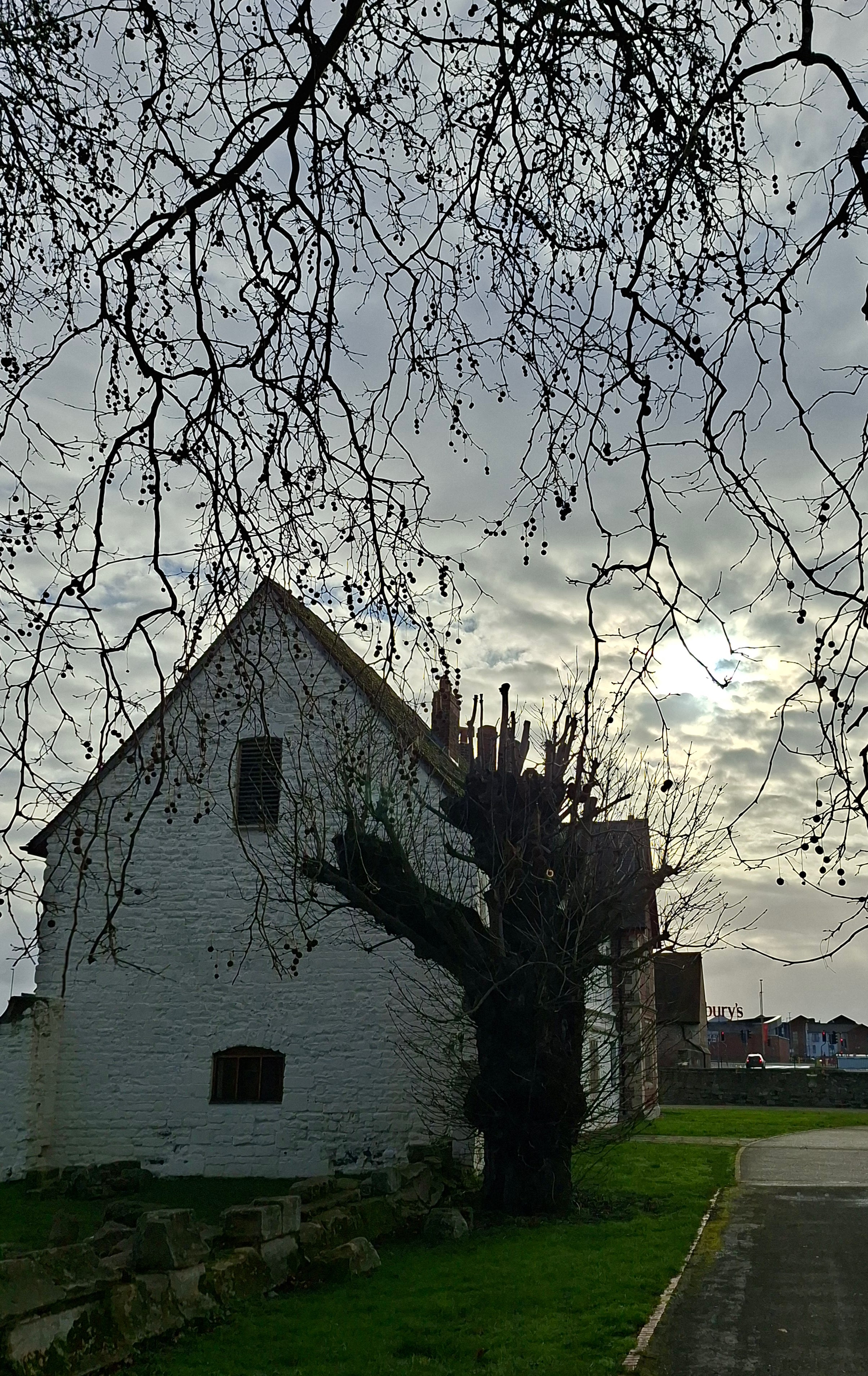
old wall, old tree – both in shade
clouds constrain the sun
and there’s stillness in the land

old wall, old tree – both in shade
clouds constrain the sun
and there’s stillness in the land

cold and bright an azure sky
frames the slender masts
affirming light in winter.
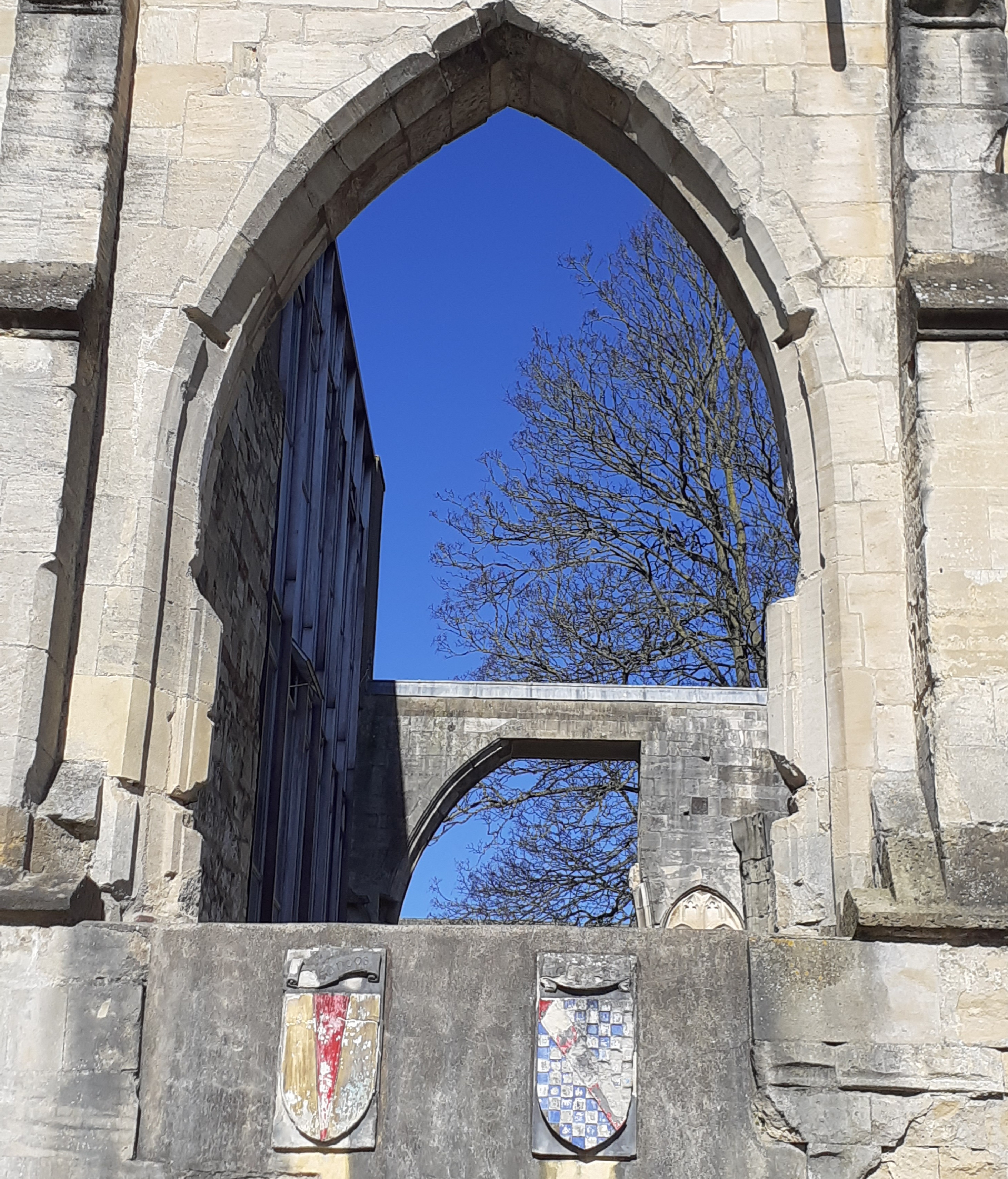
within the Priory ruins
this weathered arch
frames a living sky.
Note: The priory is the Greyfriars Priory, Gloucester, England

29 July, 9.20 pm.
Gloucester, UK.
The dog days.
Humid.
In the reducing evening light,
I gaze at a twilit horizon
with its promise of a deepening dark.
Then I notice the house lights below
and their brick-bound interior life.
Like mine.
I prepare, standing in my balcony door,
for the improbable heat of the night.

Tick Tock sounds the clock
Marking the passage of Time
As does the silence.
It is a calendar month since Elaine came home from the Gloucester Royal hospital, after her hip fracture in Gran Canaria on 11 April (1). She is slowly recovering, but still housebound.
Two days before her accident I attended a meeting that signed off on a collection of poetry by local writers (2) to which we had both contributed. Elaine’s haiku below is part of that collection.
(1)See: https://contemplativeinquiry.blog/2024/05/12/unsought-journey/ and https://contemplativeinquiry.blog/2024/06/03/inside-looking-out/ (para 3)
(2) Random Writings by the Wrandom Writers Wroclaw, Poland: Amazon Fulfillment, 2024 (Editorial Copyright J.D. Warner; individual poems copyrighted by the authors).
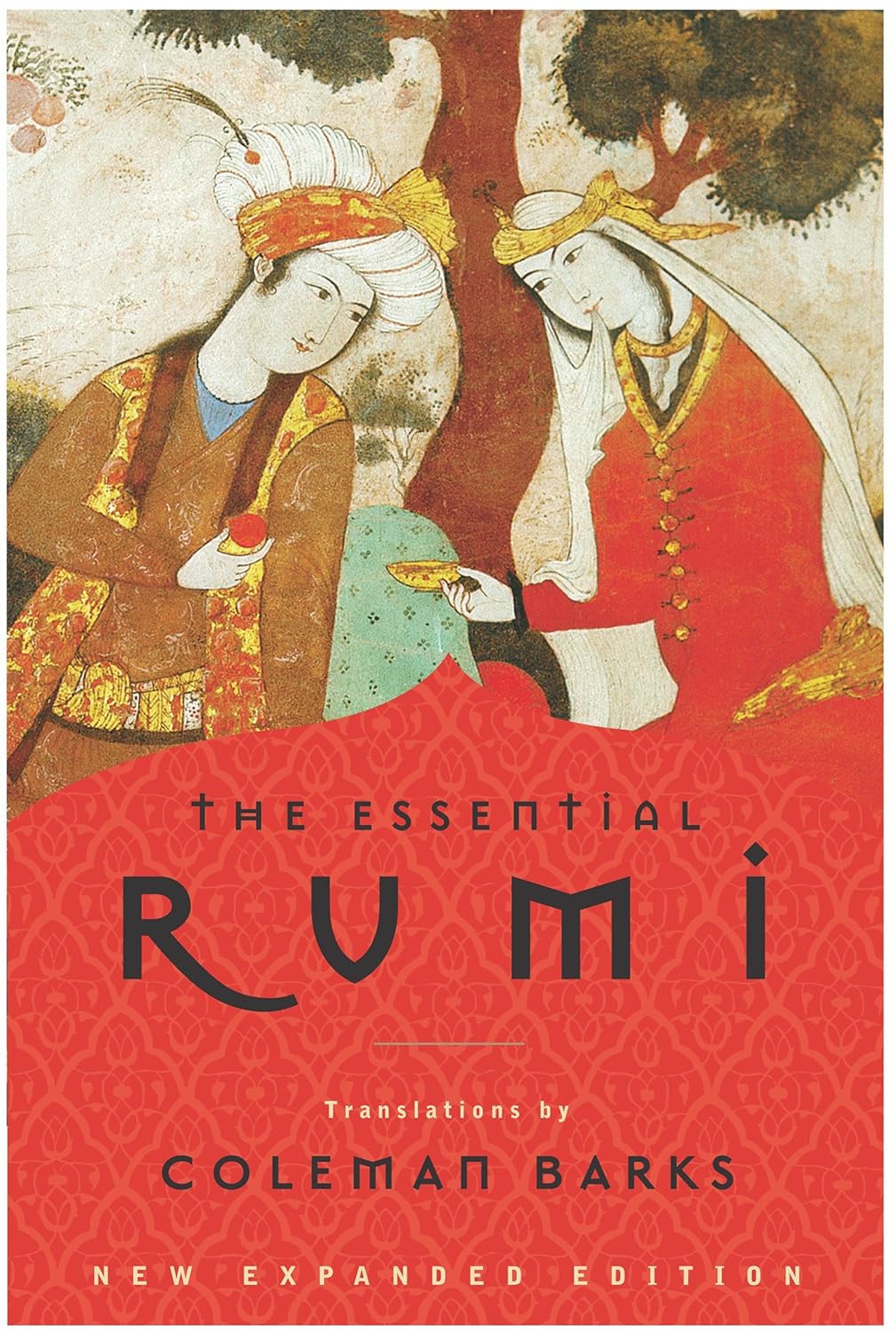
I have long been an admirer of Rumi’s poetry and have recently been dipping into my copy of Coleman Barks’ accessible English translations in his The Essential Rumi (1). This is a substantial volume of poetry and teaching – with the two aspects not really distinguishable.
It is not a new book. My edition is from 2004, and still in print. Coleman Barks provides good information about Rumi in the context of his life and spiritual path as a Sufi Dervish (2), which I have condensed into a note at the end of this post. I think that Barks’ translation works well for people on a spiritual journey, not necessarily Sufis themselves. This seems fitting because Rumi reached out well beyond the world of religious scholars and jurists. He was remarkably ecumenically minded, in a culture where people of many faiths lived side by side.
The poem I offer here is Solomon’s Crooked Crown. Here the archetypal wise ruler, who is also anyone and everyone, learns from his own errors. Solomon doesn’t represent wisdom through being right all the time. He isn’t. He needs to be called out on occasions by his ‘crown’, or higher power. He is wise because he recognises inconvenient truth and answers the call.
“Solomon was busy judging others,
when it was his personal thoughts
that were disrupting the community.
His crown slid crooked on his head,
He put it on straight, but the crown went
awry again. Eight times this happened.
Finally he talked to his headpiece.
‘Why do you keep tilting over my eyes?’
‘I have to. When your power loses compassion,
I have to show what such a condition looks like.’
Immediately Solomon recognised the truth.
He knelt and asked forgiveness.
The crown centered itself on his crown.
When something goes wrong,
Accuse yourself first.
Even the wisdom of Plato or Solomon
can wobble and go blind.
Listen when your crown reminds you
of what makes you cold towards others,
as you pamper the greedy energy inside.”
NOTE (taken largely from Coleman Barks’ introduction, On Rumi)
Rumi was born on September 30, 1207, in Balkh, Afghanistan. Iranians and Afghans call him Jelaluddin Balkhi. At that time, Balkh was part of the increasingly hard-pressed Abbasid Caliphate. Fleeing from invading Mongol armies, his family emigrated to Konya, in modern Turkey, sometime between 1215 and 1220.
The name Rumi means ‘from Roman Anatolia’, now in modern Turkey and already by Rumi’s day long lost to the Romans and their Byzantine successors. Rumi’s father was a theologian, jurist and mystic. On his death Rumi took over the position of sheikh in his dervish (2) learning community in Konya. Rumi’s life seems to have been a fairly normal one for a religious scholar – teaching, meditating, helping the poor – until 1244 when he met the wandering dervish Shams of Tabriz. Shams had spent years travelling throughout the Middle East searching and praying for one who could ‘endure my company’.
Their encounter, and the mystical friendship that ensued, influenced Rumi into becoming the artist we remember. “He turned into a poet. began listening to music, and sang, whirling around, hour after hour” (1). Shams disappeared in 1248. He was most likely murdered with the connivance of one of Rumi’s sons and other disciples. They thought of Shams as a bad influence on Rumi as well as themselves feeling excluded by Rumi and Shams’ relationship.
After the heartbreak of Shams’ death, Rumi went on to compose the Mathnawi, “that great work that shifts so fantastically from theory to folklore to jokes to ecstatic poetry (1)”.
(1) The Essential Rumi Translated by Coleman Barks, with Reynold Nicholson, A. J. Arberry, John Moyne. New York, NY: HarperOne, 2004 expended edition
(2) Dervish – member of a Muslim, specifically Sufi, religious order who has taken vows of poverty and austerity. Dervish orders first appeared in the 12th century CE. The Mevlevi Order of Whirling Dervishes was founded by followers of Rumi.
We had a theory. It meant travelling westward.
At first, simple. We each had resources.
We lost most of them on the Straits of Hormuz;
our boatman betrayed us to pirates.
Perhaps that was the moment to turn back
after we’d bargained our release for gold and incense
leaving only a few coins sewn into an old hat.
But we had come so far
and a theory
can become a story you would wander the world to tell.
We were in trouble, sometimes, misunderstood,
always there for each other – always walking westward,
taken on by an Ethiopian eunuch, even though by then
only one of us was fit to work – slipping away
by night when we sensed we were near.
He was a philosopher and carried his own coffin;
we raided it for myrrh. Took millings
from the edge of one of his ingots,
saved a last joss-stick. We had read our Isaiah.
And we had a theory
that a some place under a setting star
three gifts could be exchanged for peace
passing all understanding. What we ended up giving
were some much-needed hints on run-routes
for a family of refugees.
From the collection Losing Ithaca by Christopher Southgate Nottingham: Shoestring Press, 2023
In the Christian year, the twelve days of Christmas are over. 6 January is the festival commemorating the Epiphany, the manifestation of Christ to the the three Magi, the wise men from the east who came to pay homage to him. Their story is told in the Gospel of Matthew Chapter 2, verses 1-12.
Christopher Southgate is described as “a bio-chemist, a house-husband, a chaplain in university and mental health contexts, and a teacher of theology. He lives with his wife Sandy on the edge of Dartmoor and works at Exeter University”. Elaine and I attended an event at Gloucester Cathedral on the evening of 6 January this year, where he read a selection of his poems, naturally including this one.
The title references T. S. Eliot’s poem on the same theme, Journey of the Magi, but in other ways I find them very different. Southgate’s companions-with-a-theory have a considerably harder time than Eliot’s magisterial Magi. They arrive like refugees and meet with a family about to become refugees. Matthew describes King Herod’s efforts to eliminate any potential rival, as he sees it, to his throne, and the families’ consequent flight to Egypt.
I like the way in which Southgate shows how a somewhat transactional attempt at acquiring a “peace passing understanding” runs up against the realities of the world we live in. I also like the way he doesn’t invalidate the companions’ intent or their journey. They still had a gift to offer, sharing their experience and opening their hearts. Peace was present in that shared space.
If I must die,
you must live
to tell my story
to sell my things
to buy a cloth
and some strings
(make it white with a long tail)
so that a child, somewhere in Gaza
while looking heaven in the eye
awaiting his dad who left in a blaze –
and bid no-one farewell
not even to his flesh,
not even to himself –
sees the kite,
my kite you made, flying up
above
and thinks for a moment an angel is there
bringing back love
let it bring hope
let it be a tale.
Refaat Alareer (23 September 1979 – 7 December 2023)
NOTE: Refaat Alareer was a native of Gaza City who from 2007 taught world literature, comparative literature, and both fiction and non-fiction creative writing at the Islamic University of Gaza. He had an MA in Comparative Literature from University College London and a PhD in English Literature at the Universiti Putra in Malaysia. He was one of a group of Palestinian poets who wrote in the English language. He was killed at home, together with his family, in an Israeli bombing raid on 7 December. The University in which he worked has been completely destroyed.
For me this is an extraordinary example of a poet bearing witness, acting as a voice for his culture in the most extreme conditions – yet retaining a light touch and a certain gentleness even when doing so.
See also American Friends* Service Committee website at: https://afsc.org/author/refaat-alareer
*Friends = Quaker
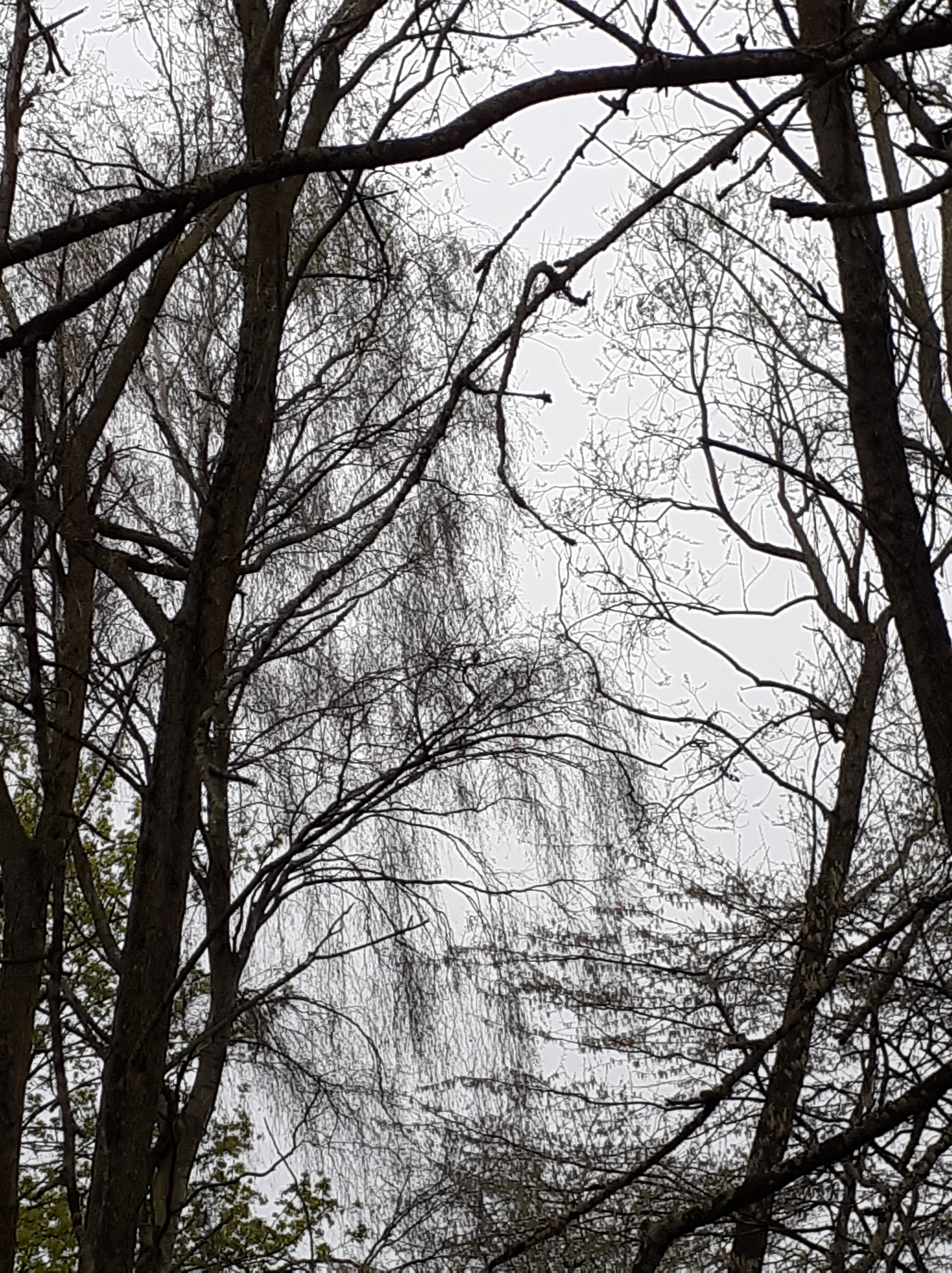
I look at the picture with fresh eyes. It is already a record of the past, and it is much too still. Yet I feel drawn towards this image. I enjoy the tree shapes in their starkness. I sense resilience in the plant life pictured here. I am writing now with sunlight intermittently on my shoulder, and the sounds of wind and rain beyond my strong glass doors.
I am also reflecting on writing as a practice. Natalie Goldberg (1,2) writes books about this and her description of ‘writing practice’ seems to me to have two entirely compatible meanings. The first is that it trains people for the writing of poems, stories and novels. The second points to a form of life practice flowing from the view that “writing is the crack through which you can crawl into a bigger world, into your wild mind” (1).
In Wild Mind: Living the Writer’s Life Natalie Goldberg compares writing practice with journaling. “Journal writing has a fascination with the self, with emotion and situation. It stops there. Writing practice lets everything else run through us; in writing practice, we don’t attach to any of it. We are aware that the underbelly of writing is non-writing. Journal writing seems to be about thought, about rumination and self-analysis. … We want to get below discursive thought to the place where mind – not your mind or my mind but mind itself – is original, fresh. It’s not you thinking. Thoughts just arise impersonally from the bottom of our minds. That is the nature of mind – it creates thoughts. It creates them without controlling them or thinking them … Writing practice knows this, knows how we are not our thoughts, but lets the thoughts, visions, emotions run through us and puts them on the page.” (1)
In her earlier book, Writing Down the Bones: Freeing the Writer Within, Natalie Goldberg quotes Jack Kerouac as saying that a writer should be ‘submissive to everything, open, listening’. She also recommends that “we stay in the trenches with attention to detail”, avoiding escape into abstraction. She points to poetry in particular, “because it brings us back to where we are. It asks us to settle inside ourselves and be awake”. She reproduces the famous William Carlos Williams poem:
“So much depends
upon
a red wheel
barrow
glazed with rain
water
beside the white
chickens.”
I remember this poem from my childhood. I liked it a lot, but couldn’t find anything to say about it in the class room when it was expected that I would. I was embarrassed then. I wouldn’t be now.
Natalie Goldberg also practices Zen Buddhism, with Katagiri Roshi until his death and more recently as an ordained member of the Order of Interbeing founded by Thich Nhat Hanh. She acknowledges the role of Zen in developing her insights into the creative process. I find her approach, including her practical exercises, very helpful.
(1) Natalie Goldberg Wild Mind: Living the Writer’s Life New York, NY: Open Road Integrated Media, 2011 (first published 1990)
(2) Natalie Goldberg Writing Down the Bones: Freeing the Writer Within Boulder, CO: Shambhala, 2016 (30th anniversary edition)
music that celebrates Earth and speaks to the heart
Follow the Moon's Cycle
Meeting nature on nature's terms
A little bit of Mark Rosher in South Gloucestershire, England
A monastic polytheist's and animist’s journal
Selkie Writing…
Images and words set against a backdrop of outsider art.
living with metacrisis and collapse
The pagan path. The Old Ways In New Times
Spiritual journeys in tending the living earth, permaculture, and nature-inspired arts
a magickal dialogue between nature and culture
The gentle art of living with less
Thoughts about living, loving and worshiping as an autistic Hearth Druid and Heathen. One woman's journey.
An place to read and share stories about the celtic seasonal festivals
Just another WordPress.com site
Exploring our connection to the wider world
Become more grounded and spacious with yourself and others, through your own body’s wisdom
Good lives on our one planet
News for the residents of Hopeless, Maine
 Contemplative Inquiry