Contemplative Inquiry

This blog is about contemplative inquiry

Tag: Contemplative Druidry

HEART LANGUAGE

I tend to feel most centred and empowered when using heart language. By ‘heart’ I don’t mean the physical heart, or even the heart chakra, but the mystical Great Heart, a place of ultimate stillness, where the microcosm of the human heart opens to the macrocosm. Some people, for example in the tradition of Kashmir Shaivism, think of this as the consciousness that underlies all forms, the divine mind, the Self (1).

There are those, like the Sufi teacher Kabir Edmund Helminski (2) who, for the very best reasons, make a separation between Heart as “the subconscious/superconscious mind and all the faculties that are non-intellectual” and the thinking mind activated by will and reason. For me this creates a separation and dualism. In my world Heart includes the reasoning mind, and continues to hold it at some level, even though the existential angst of the reasoning mind itself may defensively lose connection with the greater whole.

I do however share the view that Heart is accessed through the growth of a sensitive awareness that allows us to be receptive and whole by entering in to a more spacious ‘I’, a more integrated quality of presence. Through a fine balance of passive and active attention we can view the present moment through the eye of eternity, a viewpoint from which many wounds can be healed, many mistakes forgiven, many losses accepted. Whilst Great Heart cannot be grasped or understood through consciousness alone, “we can see with its eyes, hear with its ears, act with its will, forgive with its forgiveness, and love with its love” (2).

1: Sally Kempton (2011) Meditation for the love of it: enjoying your own deepest experience  Boulder, Colorado: Sounds True

2: Kabir Edmund Helminski (1992) Living presence: a Sufi way to mindfulness and the essential self   New York, New York: Penguin Putnam

ANCESTORS

I generally meditate in a Druid circle sitting in the northern quarter, facing south. It is early morning and my eyes are open, ideally with a soft and panoramic gaze. There is a curtained window in the south east, so I am alerted to the coming of the light. At one level, subtle shifts in the quality of light are just passing phenomena. At another level I experience myself in a liminal, numinous space, not entirely of this world, as I slowly re-engage with daily life.

According to the archaeologist Francis Pryor my positioning, and to an extent perhaps its meaning, is deeply traditional. In the long transition from ‘neolithic’ to ‘bronze age’ culture, north was the direction of the dead and the ancestral realm, and materially marked by stone; south was the domain of the living and the everyday world, and materially marked by wood. So I’m working with a spiritual sense of direction which in some ways echoes theirs, without being the same. It would make sense to me if this were true, for I am here on the same part of the earth, with the same relationship to the sun, as my ancestors of this period.

Talking in more detail about Avebury and Stonehenge specifically, Pryor proposes (1) that the great stone complexes, when fully developed in stone, were a place of the ancestors, of the dead. The place of the living, the place of wood, was to their south. Here is how he describes it:

“The second main period of ritual landscape development at Avebury recalls that at contemporary Stonehenge. Again we see the henge suddenly ‘harden’, with the construction of the great outer circle of massive stones, spaced around the inside of the henge ditch and two (actually three) inner circles of stones. This marks Avebury’s change into a new monument. The domain of the living would have been south of the Kennet, and access to the no man’s land between it and the realm of the ancestors would have been via the river and the great complex of great timber circles and enclosures  recently excavated by a team directed by Alasdair Whittle. From this ‘reception’ area funeral parties would move to the West Kennet Avenue. Turning right, to the south, would bring them to the Sanctuary, which had also ‘hardened’ from a timber to a stone circle by this time. … Most parties visiting the ritual landscape in ancient times would have taken the processional route northwards, leaving the vast bulk of Silbury Hill on the left, a silent outpost on the edge of the next world. Eventually they would pass through the enormous portal stones that still guard Avebury’s southern entrance into the West Kennet Avenue. They were then within the circle of the ancestors.

“If travel, or some form of symbolic progression from one state to another, did play a significant part in the way ritual landscapes were experienced, it may also have been important to look backwards and forwards at the same time: backwards towards previous or existing states of being, and ahead towards worlds that were yet to come. Maybe that was why certain key transitional places, such as the Sanctuary or the King’s Barrow ridge at Stonehenge, were so important. To be able to look both ways can be a humbling experience, but it can also sharpen one’s sense of self and appreciation of the here and now. Archaeologists, in their natural enthusiasm to explain the workings of prehistoric minds and the landscapes they inhabited, should be aware that we will never explain all aspects of past spiritual experiences. There will always be lost dimensions of meaning and mystery – which is one of the things that make the subject so addictive.”

I don’t have the knowledge or standing to say whether Francis Pryor is right in his hypothesis, which as he says himself can only be tentative and provisional. I do deeply appreciate him for being willing to risk using his imagination, whilst informing that imagination with the best evidence that he can muster. He looks back to ancestors who in their turn show a high level of imaginative engagement with their own. We can read what he writes in our here and now and thus, within that here and now, are able to anchor a sense of continuity and connection, through our own imaginative openness. The people who built those monuments were essentially like us. They were mortal like us, and they knew it like us. They had a relationship with the earth, sun and stars like us. They had imagination like us. And they had a relationship with death and the unknown like us. Something to do with these characteristics that we share moved them to change their physical landscape. Those are the things that connect us, more importantly than details of custom or belief – rightfully fascinating though they are.

  1. Pryor, Francis Britain BC: life in Britain and Ireland before the Romans HarperCollins e-books (Hardback first published 2003)

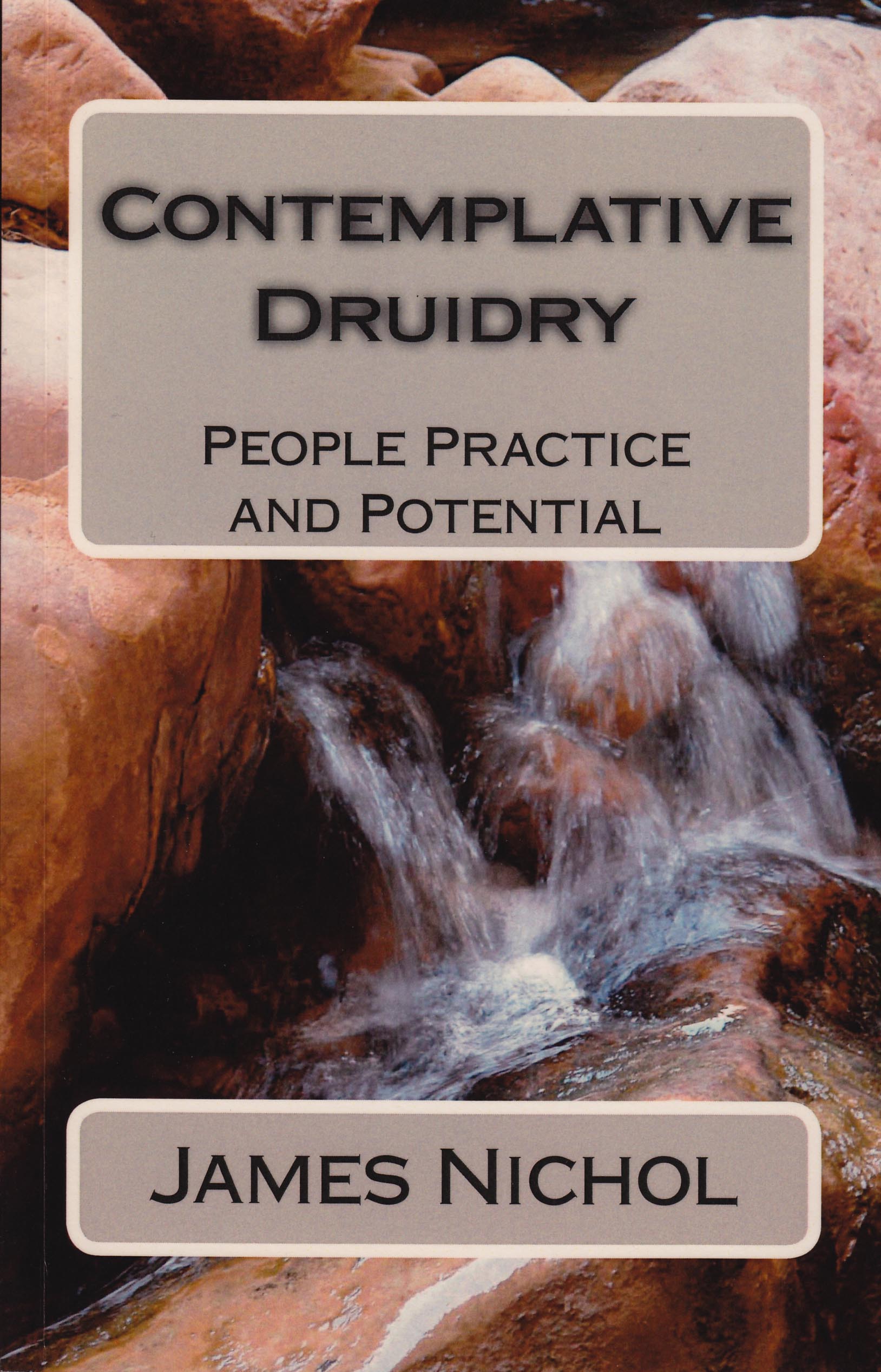
CONTEMPLATIVE DRUIDRY: BOOK REVIEW BY MARIA EDE-WEAVING

I like the way in which the reviewer takes the discussion forward whilst also saying nice things about my book!

ContemplativeDruidry copy

A review by Maria Ede-Weaving of  ‘Contemplative Druidry: People, Practice and Potential’ by James Nichol

Modern Druidry is an evolving spirituality; each of its practitioners is continually adding to the breadth and depth of this path through their experiences. What gives a spirituality its power is it practices and approaches, and these are far from static – they live and breathe, grow and change, as we do. For a path to flourish and mature, it requires that we engage, question and explore, remaining open to the possibilities of change whilst honouring the wisdom already shared. James Nichol’s Contemplative Druidry: People, Practice and Potential is a wonderful example of this process in action.

Nichols has gathered a group of Druids to discuss their experiences of contemplative practice. Fifteen Druids share their thoughts about both their solo and group encounters with contemplative meditation and how these have impacted upon their Druidry and wider lives.

The book is in three main sections: ‘People, Practice and Potential’ with contributors not only reflecting on what drew them to contemplative Druidry and how such is expressed in their spiritual practice, but also posing the question of how such approaches might manifest in the wider Druid community, should they be more readily explored.

It is clear from these accounts that sitting meditation is only one part of this approach; mindful walking, chanting, daily offices, communion with nature/the divine and creative activities also play a part in keeping contributors present and connected. There is a real sense that each – for want of an established Druid-based contemplative framework – has been quietly experimenting, acting as pioneers exploring their own frontiers in order to find what works.  In doing so, they have been planting the seeds of a tradition that could potentially flourish into a valid and inspiring area of Druidry, one that until now has been rather ignored. Many have taken their inspiration from other spiritualities such as Buddhism and Christianity, however, their practices have developed a flavour that is distinctly Druidic. It’s a fascinating read and interesting to see how meditative practices give depth to Druid concepts such as the Awen and Nwyvre;  how Druid contemplation and mindfulness might  help to shape, transform or deepen a connection to life and self.

In the Neo-Pagan movement and the Western Mystery Tradition there has been a dominant focus on what might be perceived to be ‘active’ meditation techniques; the use of visualisation and path-working holding a dominant place. The Eastern approach to meditation has often been assumed to facilitate a removal of self from the world in an attempt to transcend its illusions. As such it might be perceived to be at cross purposes with the Druid world view where life and earthly experiences are celebrated. Most of us understand  Druid spiritual practices to be a gateway to deepen one’s involvement with earthly life, as opposed to escaping it via ascetic disciplines, however, what Nichol’s book illustrates is that the contemplative approach, explored from a Druid perspective, can be a tool that moves us into a richer and deeply felt relationship with nature, community and self.

Reading through the book’s many thought-provoking accounts I had that sense of excitement you get when a long-held suspicion about something is validated by another’s experience. My first encounter with meditation came years ago via the practice of Yoga. For me, regardless of how one might interpret the philosophy of Yoga, what its practices illustrated was that these techniques of mindful movement, breath and contemplation could actually help me to feel more embodied and present on this planet. They were immensely practical and useful , not only in aiding my physical well-being but also in creating a healthier flow between my body, mind and emotions, and in doing so, opening the door to my spiritual journey. The book’s examples makes it clear that I am not alone in my view that these techniques are not ring-fenced by any religion or path but are open for all to use. I see no contradiction in including them as part of my Druid practice. It is true that each spiritual path will approach these techniques through their own spiritual lens – and even each individual within each path will bring their own unique focus to bear – but Nichol’s books suggests that there is a rich seam of spiritual nourishment to explore here, and that even if such practices are not for us, then the debate about them can only deepen and widen what Druidry has to offer.

There is much here that gives food for thought. Contemplative Druidry is a valuable springboard for further discussion and a great starting place for those who are interested in including contemplative meditation in their practice. Nichol’s book encourages us to really think about what a contemplative Druidic practice might be. What is clear from each contributor’s experience is that it is an approach that is nature and body affirming, one that offers us a means to engage more fully with self and the world around us. In time, as this discussion deepens, as more people engage with these practices and share the results, I feel sure that many more benefits will become apparent. All this can only add to the richness and diversity of the Druid path.  – Maria Ede-Weaving

James’ book is available from Amazon and will shortly be available from the OBOD shop.

ORPHIC HYMN TO NIGHT

Today, where I live, we changed our clock time. Yesterday’s 7 p.m. is today’s 6 p.m. and the evenings get dark. This introduces the Samhain season for me and all that it brings. Here is a Hymn to Night, conventionally ascribed to Orpheus. According to translator and editor Apostolos Athanassakis, they were most likely written in their present form in the early third century AD in Pergamum, a city in modern Turkey .

I shall sing of Night,

mother of gods and men;

We call Night Kypris,

she gave birth to all.

Hear, O Blessed Goddess,

jet-black and starlit, for you delight in the quiet

and slumber-filled serenity.

Cheerful and delightful, lover

of the nightlong revel, mother of dreams,

you free us from cares,

you offer us welcome respite from toil.

Giver of sleep, beloved of all,

you gleam in the darkness as you drive your steeds.

Ever incomplete, terrestrial,

and then again celestial,

you circle around in pursuit

of sprightly phantoms,

you force light into the nether world,

and then again you flee

into Hades, for dreadful Necessity

governs all things.

But now, O blessed one – beatific,

desired by all – I call on you

to grant a kind ear

to my voice of supplication,

and to come, benevolent,

to disperse the fears that glisten in the night.

Apostolos Athanassakis  talks about Orphic hymns as instances of a devotional mysticism that uses “the power of clustering epithets” for the creation of “an emotional and spiritual crescendo that might raise our human spirit and help us approach the divine”. They remind him of Vedic hymns, Rumi’s verses within the Islamic Sufi world, and aspects of his own Orthodox Christian background. The hymns are beautiful to read – and it is worth remembering that they are designed for group practice in a charged, incense laden atmosphere, with repetition upon repetition, perhaps accompanied by swaying, movement or dance of various kinds.

DRUID CHANTS

Nimue Brown shares a chant that she offered in our Gloucestershire group and talks about chanting more broadly. Her chanting changed the space in the room, as resonant chanting does.

Nimue Brown's avatarDruid Life

Music has always been a big part of my life, and I’m deeply attracted to the bardic threads in the Druidic weave. I’m also interested in meditation and contemplation. Unshockingly, this has led to time spent chanting. I even run the odd workshop on subverting and messing about with chants to make group singing more collaborative and playful. Let’s face it, there’s only so many times a bunch of people can sing ‘we all come from the goddess’ until it tails off in awkward silence. We are more likely to fall into tedium than reverie, if my experience in circles is anything to go by. I’ve long been interested in finding ways of changing that experience, for myself and for those around me.

I’ve been blessed with some excellent chanting experiences, too – most notably those led by JJ Middleway. His ‘enchanting the void’ sessions offer room for creative exploration…

View original post 247 more words

CONTEMPLATIVE DRUID RETREATS

Following the publication of ‘Contemplative Druidry’* I have been working on a residential retreat programme.  It is likely that three of us from the Gloucestershire group (discussed in the book) will be offering a pilot next April, sponsored by OBOD (the Order of Bards, Ovates and Druids).  The proposed venue will take up to 20 people, which will allow us to do some real relationship and community building as well as sharing some of our practices. We don’t simply want to roll out a programme. Indeed, we hope to enrich our own work by learning from participants and extending our circle to include them if they wish it.

For me, the only way to strengthen the contemplative thread in Druidry is to build our work in a spirit of open inquiry and sharing, as well as holding a space for tranquillity and renewal through the practices themselves. This is why we are extending the work cautiously. We also hope to offer something at Druid Camp, Lughnasadh 2015, since many of the people in our local group and in the book are involved in The Druid Network. It’s not just an OBOD thing. Samhain this year will be the third anniversary of my commitment to a contemplative inquiry within Druidry. I’m looking forward to what the fourth year may bring.

*Contemplative Druidry is an Amazon CreateSpace and Kindle Direct Publishing venture, involving me in learning a variety of new skills, and is mostly based on interviews with people involved in Druid contemplative practice. It includes a foreword by OBOD’s Philip Carr-Gomm.

AWEN MANTRA MEDITATION

As part of my solo practice, I sometimes do Awen mantra meditation. Aah comes in with the inbreath and wen goes out with the outbreath. Classically, I have followed these two syllables into a felt sense of what has been called the Shakti of the mantra, the power of the mantra, its inner pulsation and grace. In my embodied poetry of practice, Awen resonates like the primal breath and energy of the Cosmos, a subtle vibration underlying the apparent world, welling from a paradoxically creative emptiness. Visually, if my eyes are shut, the world tends to dissolve into a river of tiny lights, set wide apart from each other. If they are open, my visual experience of space changes and boundaries become more porous. This tends to be a place of deep receptivity and renewal.

Just lately I have been experiencing Awen mantra meditation differently. I believe this relates to being more active in the world – paradoxically through the contemplative Druidry project itself, with its relationship building, writing and now publicising ‘Contemplative Druidry’, and the beginning of plans for retreats beyond the local group level. I like this side of things more than I anticipated, because it connects me in a different way. And I also find that, in these times, the Awen mantra meditation becomes more focused and directional. I start to have the traditional understanding of Awen, as creative inspiration, more in mind.

So working with the mantra takes on a sense of dedication and intent, and also an aspect of invocation. There is still a receptiveness in there, of making myself available to Awen, as a vehicle for it. But it’s not in the manner of possession or channelling, or any obvious sense of psychism. I have to keep my wits absolutely about me, hold my intent actively, use discrimination and make decisions.

When my contemplative work became a project as well as a practice, I feared that I would saw off the meditative branch that I am sitting on, and fall into a sort of repetitive busyness syndrome. Now I see a greater range of possibilities. Life and awareness are always moving, always in process, and require different means of grounding and centring at different times.

CONTEMPLATIVE DRUIDRY: PEOPLE PRACTICE AND POTENTIAL

Since last February I have been working with others on a book about contemplative Druidry. It has now been published and it is available on Amazon.com and Amazon.co.uk in paperback and on Kindle.

‘Contemplative Druidry: People Practice and Potential’ was written to show that contemplative approaches are growing in modern Druidry, and to look at ways in which they might be fostered. Practices discussed include solo and group meditation, contemplation in natural settings and contemplative arts.

In my approach to this project, I decided to take a snapshot of contemplative Druidry in a particular place and time. The place is England, with a particular (though not exclusive) focus on a Druid contemplative group meeting in Gloucestershire. The time is March-July 2014, where 15 Druids responded to a questionnaire either through face-to-face interviews or in writing.

The questionnaire was designed to let respondents talk freely about their understanding of ‘contemplative Druidry’ and its value in their lives. They first discuss relevant aspects of their early lives, such as love of the outdoors, the literatures that fed them, and forms of numinous and psychic experience that they had but could not language or contextualise. They talk about their spiritual questing, often in the arenas of Paganism, Shamanism and Earth spirituality more widely, as well as their specific attraction to Druidry. Then they discuss their contemplative practice and influences on it, in some cases, from other traditions such as Buddhism, neo-Gnosticism and mystical Christianity. Overall there is the sense of an identifiable contemplative thread within Druidry (or Druid thread within contemplative spirituality). There is a sense of a form of spiritual expression to nurture and develop.

The idea of a book offering a variety of voices was further strengthened by Philip Carr-Gomm, who has led the Order of Bards Ovates and Druids (OBOD) since 1988.  His foreword ‘Deep Peace of the Quiet Earth: the Nature Mysticism of Druidry’ is a significant contribution in its own right, speaking of a contemplative turn in Druidry as “an idea whose time has come”.

With the permission of the posters and commenters, the book includes two threads from the Contemplative Druidry Facebook Group – ‘Contemplation and Mysticism’ and ‘Pilgrimage’ as Appendices. These are more international in flavour, and date from August 2012.

The people who joined me in responding to the questionnaire were: David Popely, Elaine Knight, Eve Adams, JJ Middleway, Joanna Vander Hoeven, Julie Bond, Karen Webb, Katy Jordan, Mark Rosher, Nimue Brown, Penny Billington, Robert Kyle, Rosa Davis and Tom Brown. My heartfelt thanks to all of them and everyone else who has supported this book and the work that stands behind it.

THE WOODCHESTER ORPHEUS

I went on a walk this morning, a two mile autumn stroll, mellow sunlight, leaves now turning, to Woodchester. I wanted to visit the old churchyard there. There is no church now, but an extensive walled graveyard and a significant history.

To get into it I stumbled, rather than walked, down a short set of crumbling steps, my eyes on fallen yew berries, lush red against the pale green grass, and absolutely not for eating. Raising my eyes I saw the oddly squat and almost bristling avenue of yews that leads to a stone arch now free of any building. Brambles are still producing blackberries, and together with ivy they cover some of the substantial stone tombs in the graveyard, whilst leaving others alone. These others are weathered and mossy, their eighteenth and earlier nineteenth century inscriptions now almost illegible. Most of the tombs are heavy and rectangular, though one sports a pyramid resting on a circular block mounted on a hexagonal one. The whole place is pleasingly unkempt, and removed from the demands of the everyday world. Yet I wouldn’t call it tranquil – certainly that is not its gift to me.

My special interest, on this walk, was in a large and largely empty declivity within the graveyard. I walked to the centre, where there was a scattering of small, sad, bird feathers, mostly white and brown. I took a sample and discussed it later with my partner Elaine and we think they perhaps came from a young owl. Some way beneath my feet was Woodchester’s Orpheus mosaic, originally covering the main reception room of a Roman Villa. It was made in around AD 325 (1) by a dedicated mosaic shop in Corinium (Cirencester) that specialised in Orphic themes. The Villa estate had easy access to the benefits of a relatively urbanised culture, with Cirencester and Glevum (Gloucester) each less than 15 miles away and Aquae Sulis (Bath) less than 30.  Corinium was the largest city in Roman Britain apart from Londinium (London) and capital of the then province of Britannia Prima, which covered Wales and South West England (2). It boasted stone carvers, glass makers and goldsmiths as well as the bakers and blacksmiths you would hope to find in any town. Orphic themes were popular throughout the Roman Empire of the day and there is no surprise in finding him popular with the Romano-British aristocracy. What was there not to like about the archetypal Bard whose music charmed animals, caused trees to dance and energised the very stones; a walker between the worlds, destined ultimately to become a talking head speaking prophesies?

The centre of the Woodchester mosaic (damaged over the last 300 years by gravediggers and antiquaries)* is likely to have featured a small fountain fed by water from local springs. This was likely placed within a central octagon with a star radiating out from the fountain, surrounded by fishes. Next out is a circle of birds including pheasants, peacocks and doves, also incorporating Orpheus, his lyre and his hunting dog. Around it is a band of laurel leaves circled by a guilloche or plait. Then comes the animal circle, combining those then common in Britain – bear, stag, horse and boar – with exotic ones only seen in the amphitheatre – leopard, elephant, tiger and lion. There is also a mythological beast, a gryphon.

In the outermost group, towards the edge of the mosaic, we find the face of Neptune god of the sea. Flowing from him on either side in a complete circle is a beautiful acanthus roll which symbolises the restless movement of the waves. The whole circle is squared by four pairs of water nymphs, placed in the spandrels. A blue background represents their watery environment, also emphasised by water weeds.

This water theme is the imagery that draws me most. I link it to Orpheus’ role as the non-warrior Argonaut, whose job it was to work with the seas, negotiating passage with them.  For “the Argo was the first craft built to sail the deep, untraveled sea” (3) instead of hugging the coast and going from port to port. “Nothing like her had been seen or imagined before. Her hull timbers came from oaks and pines that Orpheus had charmed from the woods; they carried his liberating life in them and she leapt in the sea, like a deer”.  The deep sea was as new to him as to everyone else, a vastness that boiled and foamed, white on blue, like a whirlpool, the ‘end of the earth, the beginning of all’, an abyssos much like chaos before creation came.  In the Hymns conventionally attributed to Orpheus, the depths of the ocean “‘glossy’ and ‘black’ like Night herself, writhed with potential and with new forms swimming into life”. Roped fast in the pitching, heaving bow, Orpheus would fling out his hymns to the mounting walls of the waves. “Note by note he would urge them lower, resist them, coax them, until his music streamed down in foam and they deflated, slowly, to a cradling quiet. His spirit lay on the sea then, pressing it level like a band of light.”

I don’t know this aspect of the story particularly well. I grew up with Jason and the Argonauts. I’ve known a certain amount about Orpheus, especially the story of Orpheus and Eurydice. But not this. Certainly this is what took me to Woodchester today. To stand close to a resonant piece of ancestral craftsmanship, local in place and time yet also universal and timeless in reference, there in its original location, which I experience as an odd and slightly otherworldly place on any terms.  And I think about what Joseph Campbell, also with Orpheus in mind, says in his Creative Mythology, where the role of creative mythology is to renew “the act of experience itself … restoring to existence the quality of adventure, at once shattering and reintegrating the fixed, already known … as it is in depth, in process, here and now, inside and out”. (4)

  1. Cull, Reverend John (2000) Woodchester: its villa and mosaic Andover, Hampshire, UK: Pitkin Unichrome (Pitkin Guides)
  2. White, Roger (2007) Britannia Prima: Britain’s last Roman province Stroud, Gloucestershire, UK: Tempus Publishing
  3. Roe, Ann (2011) Orpheus the song of life London: Jonathan Cape
  4. Campbell, Joseph (1968) The masks of God: creative mythology Harmondsworth, Middlesex: Penguin

*The mosaic hasn’t done well out of its 12 exposures in the last 300 years or so and was reburied in 1973 for an indefinite period. A replica exists, though no longer for public display, and the mosaic has been very well drawn and photographed.

ACTIVE IMAGINATION: BEYOND MICHAELMAS

In my Active Imagination post on 18 August this year, I wrote about an image of a wild park, a tree, deep twilight, the moon, a river, a gorge, and a bridge, a city of lights, a messenger and a message. I owned every feature of the image as part of myself.

I’ve had another one, loosely connected to the first and also numinous for me, and compelling. I’m in a walled garden, now within the city of lights. It’s as if I’ve got the message and crossed the bridge. So there’s an element of journeying in the process after all, hidden behind the images themselves.

The city is surprisingly spacious and offers a sweet slowness as well. It could also be described as a little run down and depopulated. But an easy place to be, not a stressful one. The specific place in which I find myself seems familiar, though subtly changed.  I am in Sophia’s Garden, with its unmistakeable fountain in the centre surrounded by red and white rose beds. And there are fruit trees – apple, pear and plum – trained around the walls. In memory it is a noon time place where bright sunlight shines on the scene and strikes the dazzling water of the fountain.

Now it is late afternoon and the sunlight is muted.  The water from the fountain cascades from its bubbling centre, and individual drops – each the whole of H20 – fly out for their moment in the sun before falling into a pool below. The fountain seems eternal. Its water seems eternal. The roses seem eternal. The rest of the garden is in an advanced autumnal stage – certainly beyond Michaelmas. At best, a limited time (overtime?) left for harvesting. The Goddess is dispersed in everything, as everything. I as observer am very much involved. In this realm I am her eyes and must stand as her wisdom too. There is no one else to do it.  For there is a sense in which, like Neo in The Matrix, we are each the One in our own Universe.

Earth Eclectic

music that celebrates Earth and speaks to the heart

Sarah Fuhro Star-Flower Alchemy

Follow the Moon's Cycle

Muddy Feet

Meeting nature on nature's terms

Rosher.Net

A little bit of Mark Rosher in South Gloucestershire, England

Becoming Part of the Land

A monastic polytheist's and animist’s journal

selkiewife

Selkie Writing…

Charlotte Rodgers

Images and words set against a backdrop of outsider art.

Prof Jem Bendell

living with metacrisis and collapse

Towint

The pagan path. The Old Ways In New Times

The Druids Garden

Spiritual journeys in tending the living earth, permaculture, and nature-inspired arts

The Blog of Baphomet

a magickal dialogue between nature and culture

This Simple Life

The gentle art of living with less

Musings of a Scottish Hearth Druid and Heathen

Thoughts about living, loving and worshiping as an autistic Hearth Druid and Heathen. One woman's journey.

Wheel of the Year Blog

An place to read and share stories about the celtic seasonal festivals

Walking the Druid Path

Just another WordPress.com site

anima monday

Exploring our connection to the wider world

Grounded Space Focusing

Become more grounded and spacious with yourself and others, through your own body’s wisdom

The Earthbound Report

Good lives on our one planet

Hopeless Vendetta

News for the residents of Hopeless, Maine