Contemplative Inquiry

This blog is about contemplative inquiry

Tag: Contemplative Druidry

DAVID ABRAM: RECIPROCITY
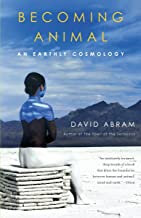
“Wander over to that oak, or a maple, or a sycamore, reach out your hand to feel the surface of a single many-pointed leaf between your thumb and fingers. Note the coolness of that leaf against your skin, the veined texture your fingertips discover as they roam across it. But notice, too, another slightly different sensation: that you are also being touched by the tree. That the leaf itself is gently exploring your fingers, its pores sampling the chemistry of your skin, feeling the smooth and bulging texture of your thumb even as the thumb moves upon it.

“As soon as we notice than our hands are being included within the tactile world, we are forced to notice this reciprocity: whenever we touch any entity, we are also being touched by that entity.

…..

“Such reciprocity is the very structure of perception. We experience the sensuous world only by rendering ourselves vulnerable to that world. Sensory perception is this ongoing interweavement: the terrain enters into us only to the extent that we allow ourselves to be taken up within that terrain.”

David Abram Becoming Animal: An Earthly Cosmology New York: Vintage Books, 2010
WORLD TREE: A HOLOTROPIC VISION

“The unified field of cosmic energy that I had experienced before now became a massive tree of radiant energy suspended in space. Larger than the largest galaxy, it was composed entirely of light. The core of the tree was lost to the brilliant display but limbs and leaves were visible around its edges. I experienced myself as one of the leaves, the lives of my family and close friends were clustered around me on a small branch. All of our distinguishing characteristics, what made us the individuals we were, appeared from this perspective to be quite minor, almost arbitrary variations of this fundamental energy.

“I was taken around the tree and shown how to move from one person’s experience to another and it was ridiculously easy. Different lives around the globe were simply different experiences the tree was having. … At this point, I was the tree. Not that I was having the full range of its experience, but I knew myself to be this single, encompassing Consciousness. I knew that its identity was my true identity. … To experience my true Identity filled me with a profound sense of numinous encounter”.

The above experience is reported by one of Stanislav Grof’s research subjects in his inquiry into “non-ordinary states of consciousness”. As a young psychiatrist in Soviet era Czechoslovakia Grof pioneered the therapeutic use of LSD. The authorities welcomed ‘progressive’ chemical treatments as an alternative to the bourgeois introspection of psychoanalysis. Seeking greater freedom, and given an opportunity to work in the USA, Grof became a Professor in the John Hopkins University School of Medicine. He continued his clinical and research work until it was banned in 1967 due to a moral panic about psychotropic drugs. His response was to invent holotropic breathing, a ‘natural’ and legal method of giving people access to the same states. Grof became a founder of the Transpersonal Association, which affirmed the place of spirituality in the therapeutic domain. Grof also developed a close association with the Esalen Institute in Big Sur, California, and became a leading figure in the counter-culture of the day.

Grof disliked the limitations he perceived in conventional scientific culture, in particular the view that “our boundaries were defined by the surface of the skin, and consciousness was seen as nothing more than the product of that thinking organ known as the brain”. He thought that scientific culture had developed in an ethnocentric way and was irrationally closed to information gained in non-ordinary states. For him, there was a limiting conflation of ‘objective reality’ and ‘consensus reality’. Anything referenced beyond this was open to dismissal “as the product of an overly active imagination or a mental disorder”, and thus delegitimised in conventional scientific discourse. Grof became interested in archetypal images like the world or cosmic tree because he found them coming up frequently in sessions, as phenomena inviting “numinous encounter”.

For me, reports of this kind add strength to the image of the world tree, though my personal experience of it is different. Some images, like that of the the world (or cosmic) tree, or tree of life, appear in many different cultures and historical periods. They are widely thought of as universal. But the specific ways in which they appear, and the meanings ascribed to them, vary with place, time and culture.

Stanislav Grof The Holotropic Mind: the Three Levels of Human Consciousness and How They Shape Our Lives San Francisco, CA: HarperSanFrancisco, 1993 (Written with Hal Zena Bennett)

NATURAL AND RITUAL PATTERNING

At the winter solstice, I began a year of enhanced attention to the wheel of the year. I have re-introduced the circle as container for my morning practice. The directions and elements are conventional for my location and tradition. The references are all naturalistic – with ‘heaven’ as the dome of the sky.

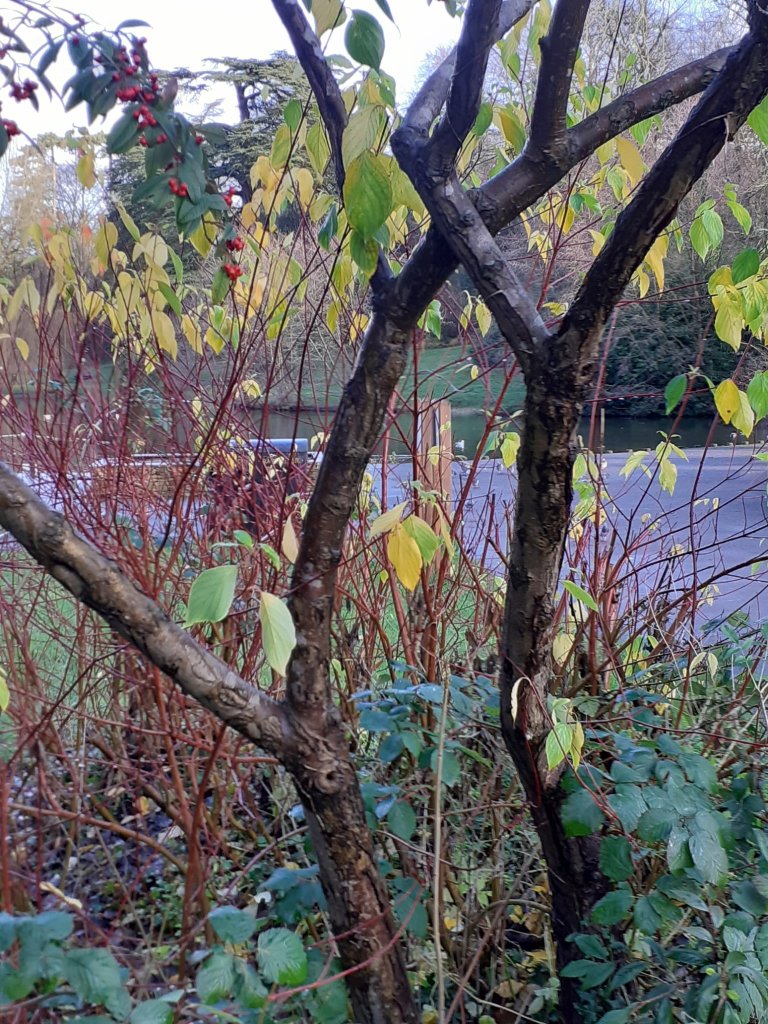
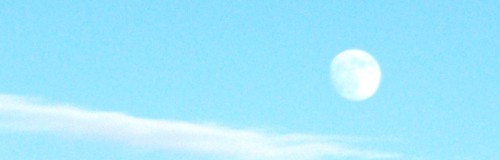
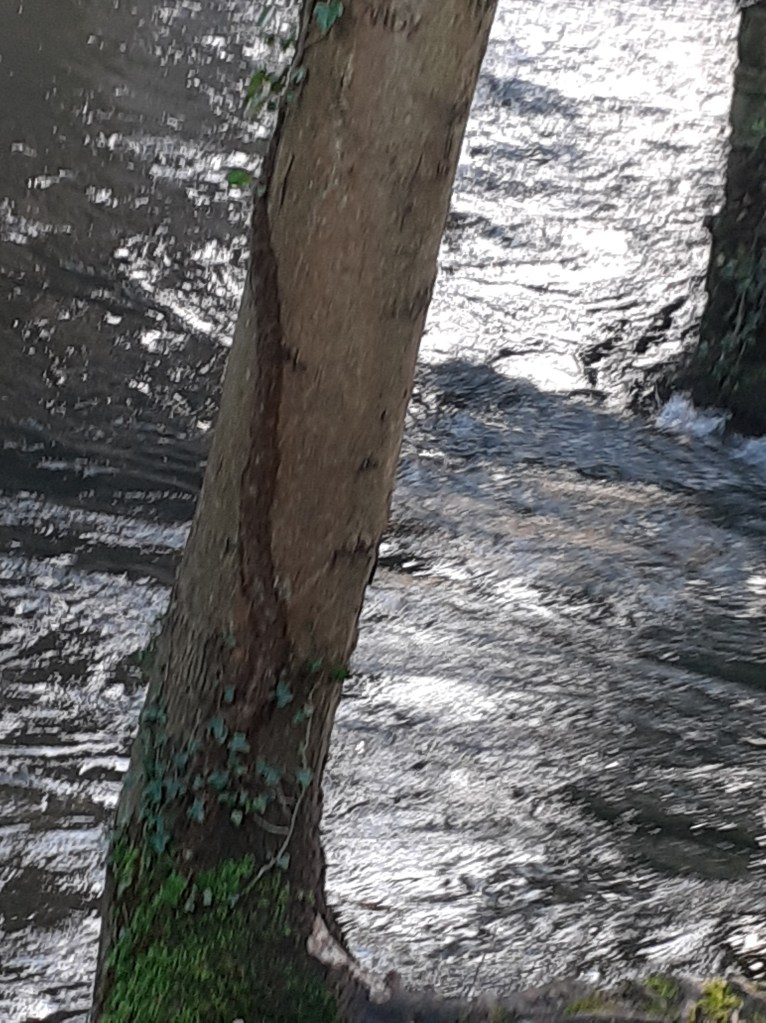
The journey around my circle begins and ends at the midwinter moment, in the north, domain of the powers of earth. The patterning is minimalist, though it still took awhile to get a language that feels just right. Now it grows in power and resonance with familiarity and repetition. For me, ritual patterning scarcely competes with complexity and flow of natural patterning, as I look at the pictures above and below. Compared with these, it is something of an abstraction. Yet I value it all the same. This simple patterning embodies my commitment. It will walk with me through the year.

I stand, north, facing south, ring my bells and say: I arise today through the strength of heaven, light of sun, radiance of moon, splendour of fire, speed of lightning, swiftness of wind, depth of sea, stability of earth and firmness of rock.

North, facing outwards: I greet the powers of the north, element of earth, season of winter, time of dying and regeneration. Hail and welcome!

East, facing outwards: I greet the powers of the east, element of air, season of spring, time of early growth. Hail and welcome!

South, facing outwards: I greet the powers of the south, element of fire, season of summer, time of ripening. Hail and welcome!

West, facing outwards: I greet the powers of the west, element of water, season of autumn, time of bearing fruit. Hail and welcome!

Spiralling in to centre: I greet the power at the centre, the one world tree, giver of life and teacher of wisdom. Hail and welcome! Back north, I begin a full round of the circle, sunwise, and say I cast this circle in the sacred grove of Wisdom. May there be peace throughout the world!

My closing is a reversal of the opening, with an uncasting of the circle, a repetition of the opening words and a final ringing of the bells. In the address to the directions, the words ‘thank and ‘farewell’ replace ‘greet’ and ‘welcome’. I have noticed that the other parts of my morning practice are subtly enriched by this new container.

‘ABOUT’ FOR 2020

A happy New Year to all readers, as we begin to navigate the 2020’s! May we find compassionate and creative ways to flourish in the days ahead.

As my contemplative inquiry evolves, I update the ‘About’ section for this blog. Below is my revision for the beginning of 2020.

“I am James Nichol and I live in Stroud, Gloucestershire, England. The Contemplative Inquiry blog started in August 2012, and includes personal sharing, discursive writing, poetry and book reviews. I began my contemplative inquiry within modern British Druidry and my book, Contemplative Druidry: People, Practice and Potential, was published in 2014.  https://www.amazon.co.uk/contemplative-druidry-people-practice-potential/dp/1500807206/

“Over time my inquiry became a wider exploration of contemplative spirituality, identified for a period as a Sophian Way. It drew on the enduring wisdom of many times and places and I came to experience it as a path of healing, peace and illumination. In particular, my inquiry identified an ‘at-homeness’ in the flowing moment. Such at-homeness is not dependent on belief or circumstance, but on the ultimate acceptance that this is what is given. I have found that, for me, the realisation of this at-homeness has supported a spirit of openness, an ethic of interdependence and a life of abundant simplicity.

“The discovery of at-homeness emerged from an inward inquiry arc: noticing myself perceiving, making meaning, and finding a language to articulate my experience. Now I am on an outward arc. I am turning to a greater focus on relationships, community, culture, and the wider web of life. Druidry, as a modern eco-spirituality receptive to ancient wisdom, is renewing its importance in my life.”

WORLD TREE AND SOPHIA

The World Tree stands at 21, as the final trump in the Wildwood Tarot (1). It also has a specific link to wisdom. For some years I’ve thought of my path as a Sophian Way. So I assumed that the Tree would act as a Sophian card. But it doesn’t. The Tree feels fresh and new. For me, as I contemplate it now, it has nothing to do with Sophia. I knew this on my first significant seeing of the image, without needing to check it out any further or even know how I knew.

Then, in my first reading of the cards, I drew the 3 of Vessels (the water suit). Its placement in the western direction was linked to the question, ‘what do you leave behind you?’ The image shows three cranes dancing together in the air, with three vessels (golden, green and white) on the ground. In the narrative of the deck, the card represents joy, especially a familial or communal joy linked to favourable turns in circumstance. My first uncensored response was ‘no-why-me-it’s-not fair’. The second was ‘ah! They mean attachment to joy and not the experience itself. I know what to do about that.’ It didn’t help. Finally, I saw beyond the card and its narrative to my own deeper experience.

This is about letting go of my hitherto guiding archetypal image. This is about letting go of Sophia. Looking again at the card itself: 3, Vessels, West, Cranes, I found as good a Sophian reference as the pack can afford, given that the World Tree is not providing one. Once I recognised this, I started to recall how my recent attempts to articulate what Sophia means for me have become awkward and strained. If I have a sense of guidance from parts of me that my normal consciousness doesn’t seem to register, why not just say so? If my spirituality is about nurturing and developing a creative wisdom of the heart, why not just make that plain? If my contemplative inquiry is my main practice to this end, why don’t I just say that? Why call it a Sophian Way? Why use an image to point to something when I can point to it directly and make more sense?

I have never engaged wholeheartedly in a devotional religion. There have been times when my ama-aima mantra meditation, addressing Sophia as cosmic mother, has had flavour of this. But those times are gone. I have had to recognise that the image of Sophia has lost its power in my life. Right now, I have no sense of what this image is uniquely pointing to. I did not truly grasp this until the Wildwood Tarot showed me. The year’s journey will be taken without Sophia, and it is not what I expected.

(1) Mark Ryan & John Matthews The Wildwood Tarot Wherein Wisdom Resides London: Connections, 2011. Illustrations by Will Worthington

WORKING WITH TAROT IMAGES

One of my inquiry intentions this year is to live the wheel of the year with heightened attention. For the Innerworld aspect of this journey, I am working with the Wildwood Tarot (1). I like its strong wheel of the year orientation, its choice of imagery and its focus on resiliency.

Tarot images are often described as archetypes. The word is derived ultimately from Plato’s eidos – the ideal forms that he saw as building blocks of the universe. They can be abstract – Justice, Wisdom, Beauty – or concrete – Horse, Wheel, Tree. Without these ideal forms in the mind of a Creator, their worldly approximations could not exist. They are “the absolute changeless objects of knowledge.” (2)

In the early 20th. Century, C.G Jung brought the archetypes into the realm of human history and psychology. June Singer explains how, for Jung, “the term archetype indicates the presence of … a universal and collective image that has existed since the remotest times. Archetypes give rise to images in … tribal lore, in myths and fairy tales, and in contemporary media. They are, by definition, unconscious, and their presence can only be intuited in the powerful motifs and symbols that give definite form to psychic contents.” (3)

The shift from ‘archetype’ to ‘archetypal image’ is a helpful one for me and can be taken further. James Hillman, a modern Platonist, pupil of Jung’s, and founder of an Archetypal Psychology, asks what makes an image archetypal, and concludes that: “any image can be considered archetypal … by attaching archetypal to an image, we ennoble or empower the image with the widest, richest and deepest possible significance.” (4) ‘Archetypal’ is a word that gives value, influencing our own response to an image and the way we treat it, contemplating it carefully, taking it into our hearts, and letting it work with our senses, feelings, intuitions and thoughts arising from it. With this approach, the descent from heaven to earth is complete. We are free to understand archetypal images as products of human consciousness that have the power to move and change us. Extending our imaginations, they extend our realities.

This is how I am going to work with The Wildwood Tarot. I am aware that the images can be mapped onto the Western Mystery tradition’s version of the Kabbalist Tree of Life, a highly conscious and artful meta-archetype, or blueprint for the cosmos. The greater trumps are archetypal images; the classical elements are archetypal images; each number is an archetypal image; key figures in patriarchal royal courts are archetypal images. All are linked together in an elaborate web of archetypal imagery. The architecture and arrangement of the Wildwood Tarot are fairly conventional, if I take the Rider Waite Tarot, understood as the effective origin of the modern form, as my point of comparison. But the concern with the wheel of the year, aspects of the narrative, and much of the imagery point in a somewhat different direction. I feel able to engage in a fresh way that both honours tradition and feels empowered to enter new and unexpected spaces. This process has already begun, and forms part of my inquiry.

(1) Mark Ryan & John Matthews The Wildwood Tarot Wherein Wisdom Resides London: Connections, 2011. Illustrations by Will Worthington

(2) Thomas Mautner The Penguin Dictionary of Philosophy London: Penguin, 1996

(3) June Singer Androgyny: Towards A New Theory of Sexuality London: Routledge & Kegan Paul 1977

(4) The Essential James Hillman: A Blue Fire introduced and edited by Thomas Moore London: Routledge, 1990

VALUES FOR 2020

I want to give my contemplative inquiry for the next year a strong focus and intent. This includes re-stating the values in which it is grounded, updated after some reflection over the last twelve moths.

I  use the word values where others might choose ethics or virtues. I make commitments rather than resolutions or vows. These commitments commit me to ‘cultivate’ a quality or behaviour. Hence, for example, I say “I will cultivate lovingkindness”. I cannot guarantee acting with lovingkindness as a simple act of will. But I can cultivate this quality and help it grow in the rough and tumble of life. I would like lovingkindness to be my default response in the heat of the given moment.

This year I will work with four commitments, listed below with brief commentaries.

  • I will cultivate lovingkindness towards myself, others and the wider world. I find the Buddhist metta meditation  a good working method for this (1). Lovingkindness is different to what I mean by love, more in the territory of good will. Love involves my spontaneous natural affections and needs to be free.
  • I will cultivate positive health and well-being, within whatever constraints may apply. This includes work with diet and exercise, and resiliency factors for mental and emotional health, such as connecting, being active, taking notice, and continuous learning and giving (2).
  • I will cultivate a life of abundance in simplicity. The dance between these terms creates, for me, a specific quality of richness. More widely, it contributes to living lightly on the earth.
  • I will cultivate openness, creativity and wisdom, learning how better to understand these qualities and how to enact them. I am curious about how they can work together.

The commitments give me a set of value words to work with: lovingkindness, health, well-being, abundance, simplicity, openness, creativity, wisdom and cultivation. Part of the work is to develop my understanding and application of such terms in the light of experience and reflection. Although I am making use of abstract nouns, the process of working with values is dynamic and subject to revision. This post is a record of where I stand on the brink of the 2020s.

(1) We extend lovingkindness to beings in this order: ourselves; a person who has benefited us; a person about whom we have no strong feelings; an ‘enemy’ or person with whom we experience difficulties; all beings without exception. We want to be able to say, congruently: may I/you/we be free of danger; happy; healthy; live with ease. – See: Sharon Salzberg & Joseph Goldstein Insight Meditation Correspondence Course Work Book Boulder, CO: Sounds True, 2004 (First published 1996)

(2) These are explained in detail at adrianharris.org/blog/2018/06/five-steps-to-mental-wellbeing/

MIDWINTER MORNING

Happy Yule/Winter Solstice/Alban Arthan! A time I experience as an extended movement over two days starting on 21 December. Midwinter doesn’t have to be bleak and barren. This morning, 21 December 2019, I took these pictures to celebrate and contemplate a bright moment in Stroud. A small miracle of blue sky broke through the rain, cloud and gloom.

APPROACHING THE YEAR’S TURN

We have a small patch of garden at the front of our house, remodelled only a week ago. It has a modestly zen pagan reference, with just a hint of spiral. In the bigger picture, where I live, we are rapidly approaching the turn from an inward to an outer arc of life energy. The Winter Solstice is very close.

I’m not experiencing deep stillness this year. It feels more like an extended pause for breath – a time for taking stock and regrouping. I’m peering in to the 2020s. Calendar numbers might be arbitrary, but they are numbers of power in our culture. They award shape and identity to years and decades. Part of me sees the 2020s as pure science fiction, with an increasingly dystopian tilt. Themes of alarm, determination, resourcing and resilience come up for me at multiple levels.

I have checked out older resources which have been neglected for awhile. One of these is the popular and respected Wildwood Tarot. I bought it years ago but didn’t much engage. Now its time has come round, prompted by an impulsive consultation. It happened in the early hours of a recent morning, at a rare time of sleeplessness. I spent several hours getting to know it. Here it is enough to say that I am drawn by its strong wheel of the year orientation, by its choice of imagery for the major trumps in particular, and by its own focus on resiliency.

I am going to live the year from 22 December with heightened attention to the wheel of the year, and with this resource as my companion. My current warm up process is already changing the way I think and feel about contemplative inquiry and will re-shape how I do it. In the meantime I enjoy the front garden and await the return of the sun.

Mark Ryan & John Matthews The Wildwood Tarot Wherein Wisdom Resides London: Connections, 2011. Illustrations by Will Worthington

EMPTINESS AND INTERBEING

At this point in my inquiry I want to refine my understanding of ’emptiness’. The Buddhist teacher Thich Nhat Hanh is a great help here, in his final commentary on the Prajnaparamita Heart Sutra .

Thich Nhat Hanh discusses Buddha’s teaching that everything is “a manifestation of causes and conditions” and that nothing is permanent or unchanging. This applies to the whole cosmos, and not just to the apparent world. “Whether you call it atman (the soul) or Brahman (ultimate divinity), whether you call it the individual self or the universal self, you cannot find anything there”. Buddha’s teaching was aimed at undermining both of these notions. Nothing has any ‘self-nature’ (we might use the term ‘essence’).

Thich Nhat Hanh pursues this right into the territory of emptiness. “There are still many people who are drawn into thinking that emptiness is the ground of being, the ontological ground of everything. But emptiness, when understood rightly, is the absence of any ontological ground. … We must not be caught by the notion of emptiness as an eternal thing. It cannot be any kind of absolute or ultimate reality. This is why it can be empty. Our notion of emptiness should be removed. It is empty.”

He goes on to say: “the insight of interbeing is that nothing can exist by itself alone, that each thing exists only in relation to everything else … looking from the perspective of space we call emptiness ‘interbeing’; looking from the perspective of time we call it ‘impermanence’ … to be empty is to be alive, to breathe in and breathe out. Emptiness is impermanence; it is change … we should celebrate. … When you have a kernel of corn and entrust it to the soil, you hope it will be a tall corn plant. If there is no impermanence, the kernel of corn will remain a kernel of corn forever and you will never have an ear of corn to eat. Impermanence is crucial to the life of everything”.

This is one side of an age old controversy within spiritualities of Indian origin. In this blog, I have given friendly attention to the other side as well – particularly Direct Path teachers like Rupert Spira and Greg Goode and the Indian influenced Douglas Harding. In the end I don’t make an absolute judgement about it. My Sophian ‘At-Homeness in the flowing moment’ is compatible with both views. But I’m now finding greater energy and aliveness in the framework here presented by Thich Nhat Hanh.

Increasingly, when I do Direct Path exercises I experience a breaking down of assumptions about experience itself, and a tremendous opening out … but no container called ‘Awareness’ to fill a God sized hole. It’s similar for me with the Harding exercises. My experience is broadly the same, but my felt sense has shifted, and my narrative with it. I’m moving away from big picture truth claims about this, because I have become sceptical that exercises like this provide any grounds for them, one way or the other. Rather, I lean in to an evolving personal understanding, always provisional, of my contemplative experiences.

As a shorthand, I can talk about the tension between a ‘Oneness’ framing and an ‘interbeing’ framing of what people call non-duality. The difference can seem subtle – and it may be best to use ambiguous, open-ended words like ‘Tao’ and preserve a sense of mystery. But at this turning of the year, ‘interbeing’ is my preferred term. It fits better with the eco-spirituality which I take from my Druid journey, and affirms the relational basis of my Sophian Way.

(1) Thich Nhat Hanh The Other Shore: a New Translation of the Heart Sutra with Commentaries Berkeley, CA: Parallax Press, 2017

See also: https://contemplativeinquiry.wordpress.com/2017/10/21/the-uses-of-emptiness/ an earlier post that I’ve been able to draw on here.

Earth Eclectic

music that celebrates Earth and speaks to the heart

Sarah Fuhro Star-Flower Alchemy

Follow the Moon's Cycle

Muddy Feet

Meeting nature on nature's terms

Rosher.Net

A little bit of Mark Rosher in South Gloucestershire, England

Becoming Part of the Land

A monastic polytheist's and animist’s journal

selkiewife

Selkie Writing…

Charlotte Rodgers

Images and words set against a backdrop of outsider art.

Prof Jem Bendell

living with metacrisis and collapse

Towint

The pagan path. The Old Ways In New Times

The Druids Garden

Spiritual journeys in tending the living earth, permaculture, and nature-inspired arts

The Blog of Baphomet

a magickal dialogue between nature and culture

This Simple Life

The gentle art of living with less

Musings of a Scottish Hearth Druid and Heathen

Thoughts about living, loving and worshiping as an autistic Hearth Druid and Heathen. One woman's journey.

Wheel of the Year Blog

An place to read and share stories about the celtic seasonal festivals

Walking the Druid Path

Just another WordPress.com site

anima monday

Exploring our connection to the wider world

Grounded Space Focusing

Become more grounded and spacious with yourself and others, through your own body’s wisdom

The Earthbound Report

Good lives on our one planet

Hopeless Vendetta

News for the residents of Hopeless, Maine