Contemplative Inquiry

This blog is about contemplative inquiry

Tag: contemplative Druidry book

CONTEMPLATIVE DRUIDRY IN LONDON

This afternoon my partner Elaine and I are travelling to London, and tomorrow we will be joined by our colleague Julie Bond at the Bonnington Centre in Vauxhall, the venue for our Introduction to Contemplative Druidry. It’s a landmark occasion for us, because it’s our first outing under the banner of ‘Contemplative Druid Events’. We are fortunate to have a maturing and deepening local group in Gloucestershire. We have given talks before, based around the book ‘Contemplative Druidry’. But this is the first time we have offered other people an opportunity to share our practice as well as our ideas. We are expecting ten participants as well as ourselves, a good number for us!

This is happening just as I’m experiencing significant shifts in my own spirituality, partly as a result of my personal work, and partly as a result of important moments with others in the course of this month, especially in Imbolc related activities.. I’m not yet sure where it’s going, in precise terms, but it feels rich and fecund. I find myself quite open and sensitive at this time, balancing this out with the demands of a presenter and facilitation role. The result is that I’m feeling a kind of nervous yet deep confidence about engaging with new people in this work.

Our next venture out will be our retreat from 17-19 April, described in http://contemplativedruidevents.tumblr.com/ and on the ‘Contemplative Druid Events’ Facebook page. That will be a further step up, and a focus in coming weeks.

Elaine and I are returning from London on Tuesday, so I won’t be posting again before Wednesday next week.


UPDATE ON CONTEMPLATIVE DRUID EVENTS

After the publication of Contemplative Druidry last October, I set up Contemplative Druid Events together with my partner Elaine Knight, supported by other members of our local group – particularly Nimue Brown, Julie Bond, JJ Middleway and Karen Webb. Our main purpose is to organise, publicise and run a limited number of contemplative Druid events for the wider Druid community and others of like intent. We will also respond to inquiries from people wishing to join a Druid contemplative group or start one of their own.

We have arranged three events for 2015:

  1. A half day introduction to contemplative Druidry in London on Sunday 22 February
  2. A weekend retreat near Malvern from Friday 17- Sunday19 April
  3. A contemplative Druid day in Stroud on Saturday 3 October

For more information, or to arrange a booking please go to our dedicated blog at http://contemplativedruidevents.tumblr.com/

These events are all in southern England. I am open to going further afield, and other colleagues might be. In this regard I am happy to hear proposals from people who are willing to gather together their own group and to negotiate times, programme and costs.

Overall our vision for the contemplative thread in Druidry is that it will develop organically, with initiatives coming from different sources and taking different forms. We don’t seek to own or manage this development under the banner of Contemplative Druid Events, though we do see a value in offering programmes of our own on a modest scale.

GOOD WILL

Dissolving into the dark, in a deeply receptive state, I find myself entertaining the word ‘will’, which soon morphs into ‘good will’.

Midwinter is traditionally a season of good will. I notice that I do feel largely at peace in my personal world, though distressed by many aspects of the bigger picture. Right now I’m experiencing a state of good will and I’d like to offer my good will to anyone who reads this post.

I’m also thinking about ‘will’, including good will, in another way. After the stasis, the turn. The seed of the turn is in the stasis; an awareness and anticipation of movement even in the moment when the sun seems at rest. A part of me is already looking forward, throwing my imagination before me, consciously willing, crafting intent.

This year my Contemplative Druidry book began to map out some potentials for contemplative practice based in Druidry, as seen by the book’s contributors, and the Contemplative Druid Events blog on www.contemplativedruidevents.tumblr.com is a vehicle to set out what we are offering. There will be more to come – mostly emphasising half day sessions and one-day ‘contemplative days’. Whilst this activity is growing, I want to work more deeply at mapping possible relationships between the contemplative aspect of spirituality and its ritual and magical aspects (however defined) and its ethical (and by extension political) aspects. My starting point is that they all involve the issue of where we choose to put our attention, and how we enact and sustain our choices intentionally. ‘Will’ is a key term, and what we mean by will is a key inquiry.

A CONTEMPLATIVE DRUID EVENT

Thanks to the interest generated by Contemplative Druidry, members of the Gloucestershire contemplative group have set up an entity called Contemplative Druid Events. So far we have a blog at http://contemplativedruidevents.tumblr.com/ and a forthcoming retreat.

The retreat is being held on the weekend of 17-19 April 2015 at Anybody’s Barn, Birchwood Hall, Storridge, Nr. Malvern, Worcestershire WR13 5EZ.  Details of the retreat can be found on the blog.

I am excited by this prospect. It provides the opportunity to work with a larger group of people and to learn from them. Contemplative Druidry doesn’t come with a long specific tradition or an inherited set of practices and teachings. As modern Druids, we are engaged in an exploratory and co-creative enterprise. Events will extend the experience and understanding of participants and facilitators alike.

At the same time we do have a vision of what we are offering, and a sense of how the retreat will work. We will use the Friday evening to enter sacred space and move into introductions and a culture setting process. I consider the way in which we enter into relationship with the space and each other to be a highly significant part of the event and not just a warm up or preamble. It does much to determine the quality of living presence in the space, as important as any practice or activity. As for practices and activities – there will be sitting meditations and an introduction to what our existing local group calls “Awen Space”. Other offerings may include chanting, sacred movement, outside walking meditation and ‘lectio divina’ from the book of nature. We will likely make use of a fire pit on the Saturday evening.

The retreat also gives us the chance simply to be, alone and with fellow travellers, in a beautiful nurturing space. (After the opening process, every activity is an invitation to the participants, rather than a demand on them.) We will work with a maximum of sixteen people, including ourselves – there are five of us with facilitator roles from the Gloucestershire group. This is not the full capacity of the centre we are using, for we wanted a spacious environment on the physical as well as other levels.

I have a strong belief in this way of working and look forward to sharing it with new people.

NATURE LANGUAGE

Philip Carr-Gomm wrote an essay, Deep Peace of the Quiet Earth: the Nature Mysticism of Druidry, as his foreword to Contemplative Druidry (1). Emma Restall Orr talked about her own nature mysticism in a recent radio interview, published on Joanna Vander Hoeven’s Down the Forest Path blog (2). Last year Thich Nhat Hanh, the Vietnamese Buddhist scholar and teacher who leads the ‘Community of Interbeing’ (and is now perhaps near the end of his journey) wrote a deceptively simple-seeming work called Love Letter to the Earth (3), with chapter headings like: We are the Earth, Practices for Falling in Love with the Earth and Ten Love Letters to the Earth.

These prompts have led me to reflect more deeply on how I use Nature language and what, specifically, I mean by it. Thich Nhat Hanh’s starting point (3) is a helpful one: “at this very moment the Earth is above you, below you, all around you, and even inside you. The Earth is everywhere. … The Earth is not just the environment we live in. We are the Earth and we are always carrying her within us. Realizing this, we can see that the Earth is truly alive … we can begin to transform our relationship to the Earth.”  The overall point, familiar enough yet made here with fresh elegance and clarity, is one with which Druids and Buddhists alike can find a ready resonance. But its main effect on me this time round was to get me wondering about the language of Nature.

What do I understand by Nature? For me, the key word is Nature rather than Earth. The Earth is a subset of Nature, larger than you and me who are indeed contained within it, but still a subset. In my understanding, Nature is simply what there is. And ‘what there is’ seems to us, in this culture at this time, to have exploded out of a remarkably fertile emptiness, into the 3D and time-bound reality that our perceptions somewhat mesh with, and of course a great deal more outside our normal range and beyond our range entirely. We humans are wholly natural with all our known and realised potentials – and others too that are but dimly intuited and largely untapped.

We cannot individually encompass the whole of Nature. We must choose, at whatever levels of relative awareness, where to put our efforts and attention. Thich Nhat Hanh is pretty clear about his: he has a strong intent, which involves a mutually sustaining balance of contemplation and action. My key ‘contemplative’ choice, not feeling very accomplished, is to enter more fully into the Heart identity I spoke in my Heart Language post. This seems like a good thing for me, and likely to improve my relationships and connections, particularly with my local world – the Earth and its inhabitants. I could call it extending the human side of human nature, a natural thing for a human to do.

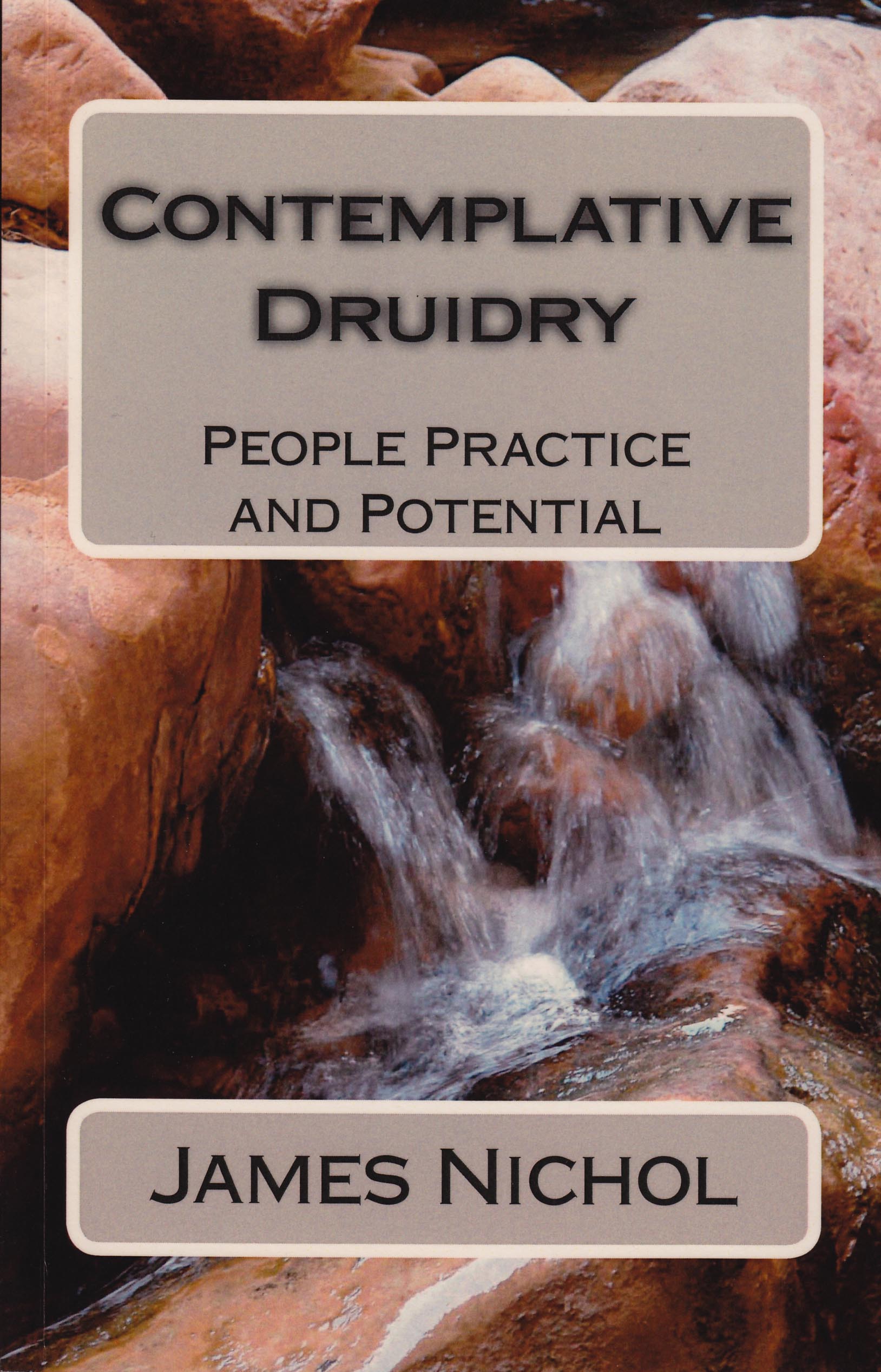
(1) Nichol, James (2014) Contemplative Druidry: People, Practice and Potential Amazon CreateSpace and Kindle Direct Publishing

(2) http://downtheforestpath.wordpress.com/2014/11/07/interview-with-emma-restall-orr/

(3) Thich Nhat Hanh (2013) Love Letter to the Earth Berkeley, California: Parallax Press

CONTEMPLATIVE DRUIDRY: BOOK REVIEW BY MARIA EDE-WEAVING

I like the way in which the reviewer takes the discussion forward whilst also saying nice things about my book!

ContemplativeDruidry copy

A review by Maria Ede-Weaving of  ‘Contemplative Druidry: People, Practice and Potential’ by James Nichol

Modern Druidry is an evolving spirituality; each of its practitioners is continually adding to the breadth and depth of this path through their experiences. What gives a spirituality its power is it practices and approaches, and these are far from static – they live and breathe, grow and change, as we do. For a path to flourish and mature, it requires that we engage, question and explore, remaining open to the possibilities of change whilst honouring the wisdom already shared. James Nichol’s Contemplative Druidry: People, Practice and Potential is a wonderful example of this process in action.

Nichols has gathered a group of Druids to discuss their experiences of contemplative practice. Fifteen Druids share their thoughts about both their solo and group encounters with contemplative meditation and how these have impacted upon their Druidry and wider lives.

The book is in three main sections: ‘People, Practice and Potential’ with contributors not only reflecting on what drew them to contemplative Druidry and how such is expressed in their spiritual practice, but also posing the question of how such approaches might manifest in the wider Druid community, should they be more readily explored.

It is clear from these accounts that sitting meditation is only one part of this approach; mindful walking, chanting, daily offices, communion with nature/the divine and creative activities also play a part in keeping contributors present and connected. There is a real sense that each – for want of an established Druid-based contemplative framework – has been quietly experimenting, acting as pioneers exploring their own frontiers in order to find what works.  In doing so, they have been planting the seeds of a tradition that could potentially flourish into a valid and inspiring area of Druidry, one that until now has been rather ignored. Many have taken their inspiration from other spiritualities such as Buddhism and Christianity, however, their practices have developed a flavour that is distinctly Druidic. It’s a fascinating read and interesting to see how meditative practices give depth to Druid concepts such as the Awen and Nwyvre;  how Druid contemplation and mindfulness might  help to shape, transform or deepen a connection to life and self.

In the Neo-Pagan movement and the Western Mystery Tradition there has been a dominant focus on what might be perceived to be ‘active’ meditation techniques; the use of visualisation and path-working holding a dominant place. The Eastern approach to meditation has often been assumed to facilitate a removal of self from the world in an attempt to transcend its illusions. As such it might be perceived to be at cross purposes with the Druid world view where life and earthly experiences are celebrated. Most of us understand  Druid spiritual practices to be a gateway to deepen one’s involvement with earthly life, as opposed to escaping it via ascetic disciplines, however, what Nichol’s book illustrates is that the contemplative approach, explored from a Druid perspective, can be a tool that moves us into a richer and deeply felt relationship with nature, community and self.

Reading through the book’s many thought-provoking accounts I had that sense of excitement you get when a long-held suspicion about something is validated by another’s experience. My first encounter with meditation came years ago via the practice of Yoga. For me, regardless of how one might interpret the philosophy of Yoga, what its practices illustrated was that these techniques of mindful movement, breath and contemplation could actually help me to feel more embodied and present on this planet. They were immensely practical and useful , not only in aiding my physical well-being but also in creating a healthier flow between my body, mind and emotions, and in doing so, opening the door to my spiritual journey. The book’s examples makes it clear that I am not alone in my view that these techniques are not ring-fenced by any religion or path but are open for all to use. I see no contradiction in including them as part of my Druid practice. It is true that each spiritual path will approach these techniques through their own spiritual lens – and even each individual within each path will bring their own unique focus to bear – but Nichol’s books suggests that there is a rich seam of spiritual nourishment to explore here, and that even if such practices are not for us, then the debate about them can only deepen and widen what Druidry has to offer.

There is much here that gives food for thought. Contemplative Druidry is a valuable springboard for further discussion and a great starting place for those who are interested in including contemplative meditation in their practice. Nichol’s book encourages us to really think about what a contemplative Druidic practice might be. What is clear from each contributor’s experience is that it is an approach that is nature and body affirming, one that offers us a means to engage more fully with self and the world around us. In time, as this discussion deepens, as more people engage with these practices and share the results, I feel sure that many more benefits will become apparent. All this can only add to the richness and diversity of the Druid path.  – Maria Ede-Weaving

James’ book is available from Amazon and will shortly be available from the OBOD shop.

Earth Eclectic

music that celebrates Earth and speaks to the heart

Sarah Fuhro Star-Flower Alchemy

Follow the Moon's Cycle

Muddy Feet

Meeting nature on nature's terms

Rosher.Net

A little bit of Mark Rosher in South Gloucestershire, England

Becoming Part of the Land

A monastic polytheist's and animist’s journal

selkiewife

Selkie Writing…

Charlotte Rodgers

Images and words set against a backdrop of outsider art.

Prof Jem Bendell

living with metacrisis and collapse

Towint

The pagan path. The Old Ways In New Times

The Druids Garden

Spiritual journeys in tending the living earth, permaculture, and nature-inspired arts

The Blog of Baphomet

a magickal dialogue between nature and culture

This Simple Life

The gentle art of living with less

Musings of a Scottish Hearth Druid and Heathen

Thoughts about living, loving and worshiping as an autistic Hearth Druid and Heathen. One woman's journey.

Wheel of the Year Blog

An place to read and share stories about the celtic seasonal festivals

Walking the Druid Path

Just another WordPress.com site

anima monday

Exploring our connection to the wider world

Grounded Space Focusing

Become more grounded and spacious with yourself and others, through your own body’s wisdom

The Earthbound Report

Good lives on our one planet

Hopeless Vendetta

News for the residents of Hopeless, Maine