WINTER SOLSTICE BLESSINGS
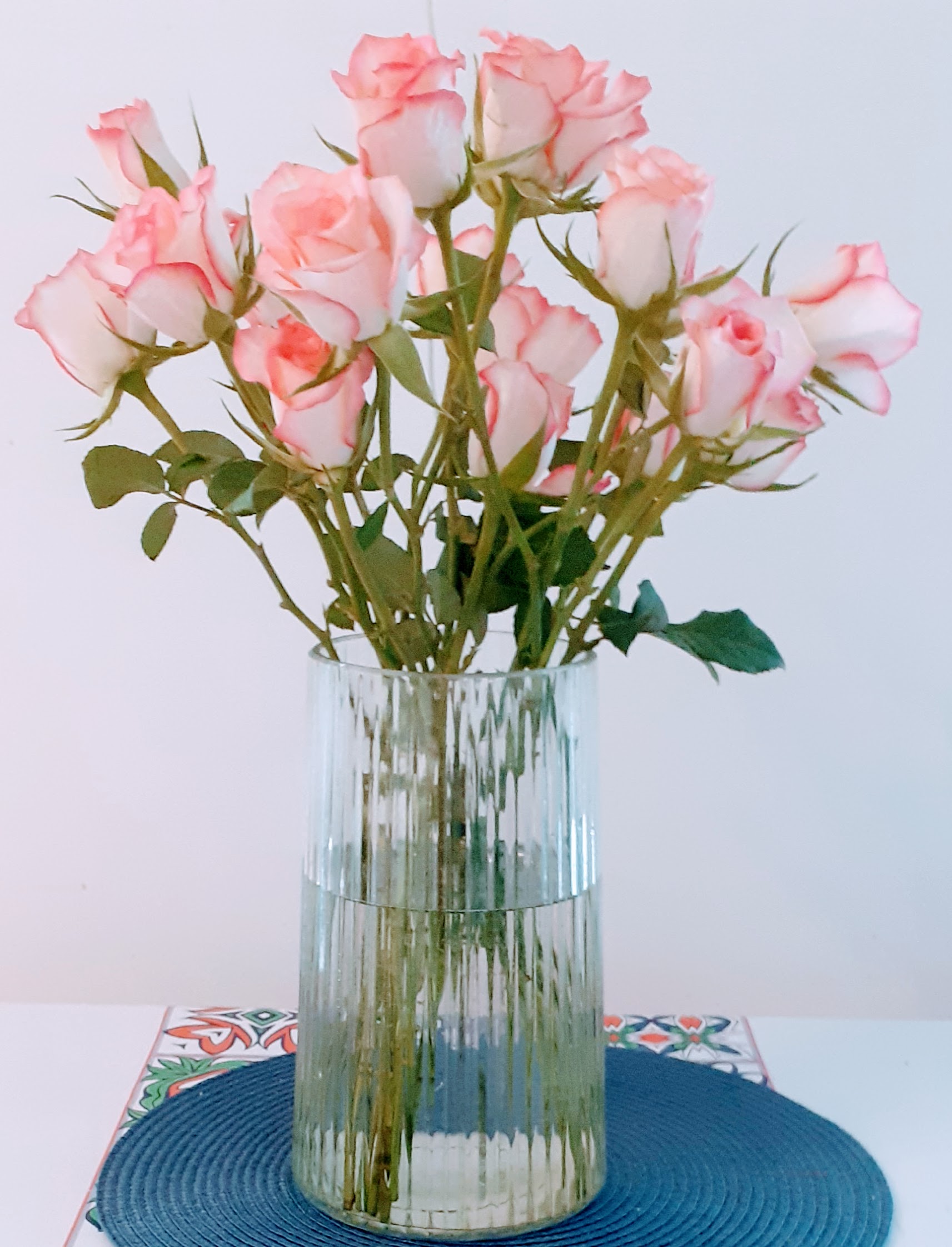
Midwinter roses
with understated elegance
Offer their Solstice blessings.

Midwinter roses
with understated elegance
Offer their Solstice blessings.

It is very close to the turn of the year. The sun is now setting on 2024. The sunset pictures above and below are from 15 December at 4pm, taken from a balcony window. Vivid imagery after long days of sunless grey. It feels weird and alien, almost as if I’m looking out on another planet. 2024 has often felt like that, at times beautiful, at times scary and disorienting, at times a test of endurance.
Looking back at 2024 in a seasonal but non-festive way, I find a hard year with extraordinary moments. Personally, it was dominated by my wife Elaine’s accident in Gran Canaria and her gradual and ongoing recovery. A roller coaster of a year. Currently I feel good about my spiritual inquiry and practice, which I experience as a great blessing. But I do not want to impose any expectations on 2025. Let the new year be what it will.


Stars in a night sky. Candles in a dark room. Cleverly crafted decorations for Yule. These, for me, are ideal images of light in winter. When I came into Druidry, I was moved by the liturgical use of the phrase ‘the illumination of lights’. In a reality of many lights, which can also be a reality of one light and many lamps, the light is not overwhelming.
Darkness makes light bearable when containing a plurality of lights. There is space for freedom here, and likewise space for relationship and connection. This winter, I am not energetically hibernating, as I sometimes do. I find myself going deeply into Innerworld landscapes and connections in a way I have become unused to in recent years. Yet I do not feel alone or self-absorbed. I feel like a little light in a field of lights, each contributing its own individual illumination to the field, whist nested in a nurturing dark. It feels like the right focus for the time of year, and the end of 2024.

Birch bark beauty
Between earth and sky,
Greeting another winter.
In my Druid circle, I associate the northern quarter with faith. The quality and context of faith are not defined. They could simply mean faith in the practice and path. My contemplative inquiry overall has tended towards a stance of ‘sacred agnosticism’ (1), in which faith is not emphasised. This has served me in many ways. I have avoided mixing up the idea of ‘faith’ with affiliation to authoritarian movements, mandated beliefs, or the surrender of self-responsibility and personal discernment. I have been alert to the metaphysical group think and consensus collusion that can show up in any spiritual movement (other kinds of movement too). I have done my best to gather and evaluate information skilfully, when developing principles about how to live ethically and gracefully in an increasingly scary world.
And yet … this is not the whole story, or I would feel spiritually malnourished. In recent months I have experienced a strong felt sense of the divine. When I describe myself as ‘living presence in a field of living presence in a more than human world’ – an animist identification – the identification now seems more than animist, though the animism is still there. I pray more congruently to the Goddess as Ancient Mother and talk, less anthropomorphically, about the ‘bubbling source from which I spring’. The Divine is beyond name, form or description – and some people prefer a specialist, capitalised use of rather abstract terms like Consciousness, Awareness, Void, Ground of Being. But the ones from my own practice are the ones that work for me. They come from the intuitive heart and the imagination. To me they offer a deeper knowing, though I am personally cautious about the use of the word gnosis. For me, it can reduce the sense of mystery, banishing the creative role of faith itself.
I have become a provisional panentheist, experiencing intimations of a divine which is everywhere and no-where, and from which we are not separate. This partly reprises work I did in the earlier days of my inquiry using the framework of non-duality. Now I find panentheism a better term than non-duality for affirming both the divine and the world. The earth spirituality in the Druid tradition is in no way compromised by a panentheist perspective. If anything it is enhanced.
(1) See https://contemplativeinquiry.blog/2024/02/16/sacred-agnos

This post is about Hillfield Gardens (1,2) and the taste of psychic rejuvenation. Just being there, actively opening to the elemental energies of place and time, I felt confident, happy and strong.
The early morning of 20 November was misty and dark in a slushy, miserable kind of way; closed in and confining rather than magical and mysterious. Elaine and I catastrophised together in gloomy harmony about skies made unfriendly by perpetual drizzle and pavements made treacherous by hidden ice. The term stir crazy came up for me. We have begun to expect fresh air and activity outside the home. This time we planned to be in separate spaces. They are good in themselves and healthy for us as a partnership. So the tension of anticipated disappointment was in the air, for a long moment in a dull morning.
Then everything changed, with clear blue sky and sun. After an early lunch, I could wheel Elaine to her creative arts event and then fully stretch my legs in a walk to Hillfield Gardens. When I got there I slowed down again and shifted from a doing mode to a being mode. I became porous to the world – at once disappearing into it and expanding to embrace it. The snow on the ground looked beautiful to me and a crinkly fallen leaf both modified the picture and enhanced the look. William Blake once famously wrote: “if the doors of perception were cleansed, everything would appear as it is, infinite” This brief eternal time (being in two worlds at once) – with the snow on the ground, and the fallen leaf – was like that, or at least something which pointed towards it. I feel tremendous gratitude for the experience. In its afterglow, I found myself feeling confident, happy and strong.

At a reduced level of intensity, I continued my walk. Below, My attention was drawn by a seat, and the snow around it, in a secluded corner of the gardens. Sun shone freely on the buildings, and the bushes, but reached only a small area on the seat.
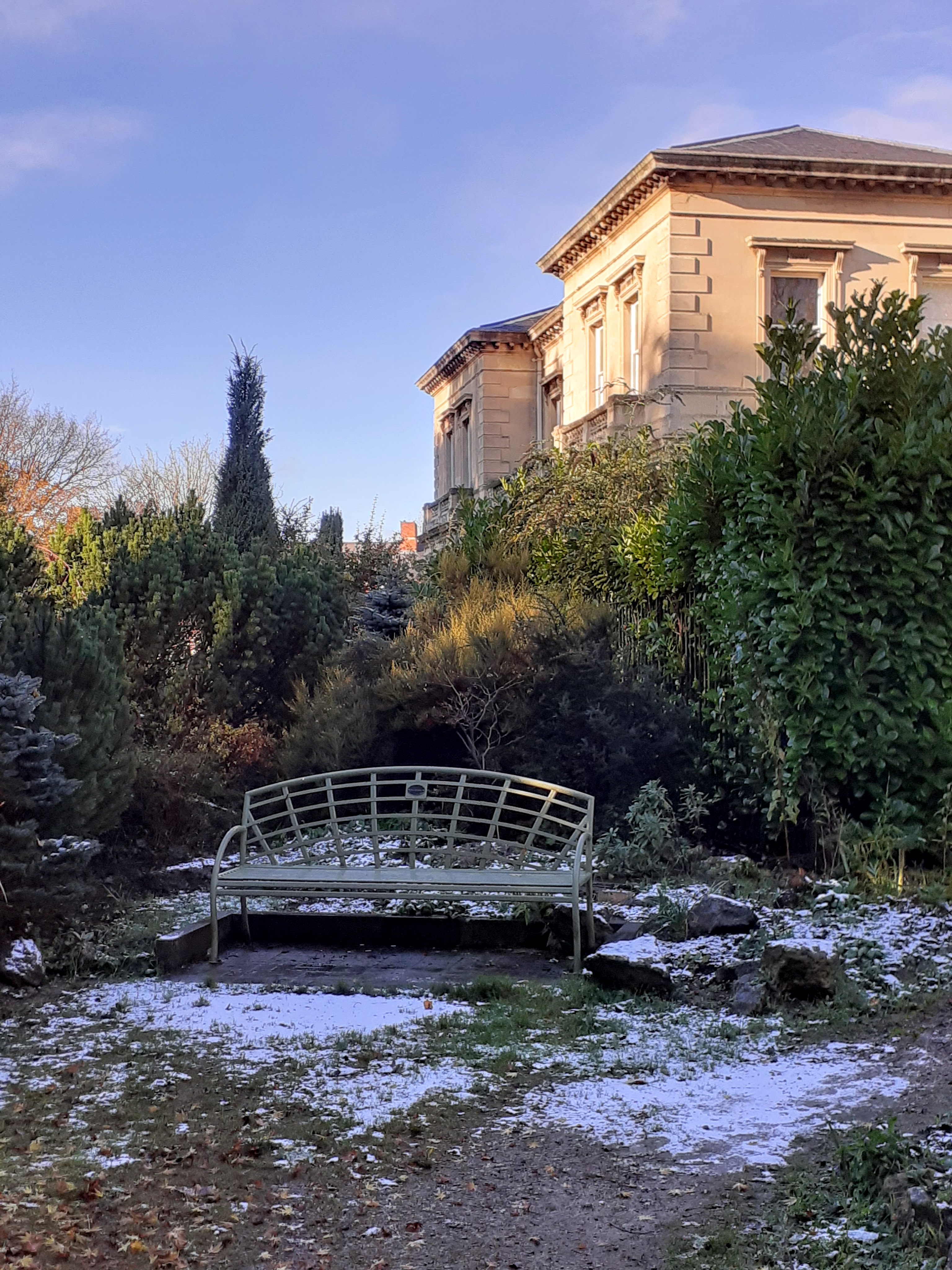
In the most wooded and unmanicured section of the gardens, I found snow still present on a section of cleared space and pathway. Elsewhere there was no trace of it, even in this relatively shadowed space.

On the buildings below – blue sky, sun and shadow. In the picture below snow is just discernible on a rooftop and in a garden. During the period of my walk (1-1.30 pm) the gardens visibly changed. The snow was retreating and shadows continued to shift.

It wasn’t a long walk – twenty minutes each way for the sake of my legs and thirty in the garden. It was enough. I took away the psychic rejuvenation I named at the beginning of this post. The experience was both mystical and ordinary, a place where the ‘spiritual’ and ‘mundane’ are one – and big part of how I live my Druidry.
(1) SEE: https://contemplativeinquiry.blog/2024/04/11/images-from-a-town-garden/
(2) NOTE: At the beginning of April 2024 I discovered Hillfield Gardens – a little outside the centre of Gloucester, yet still in easy walking distance (or an easy bus ride) from where I live. Originally the gardens of a large house, Hillfield Gardens are about 1.6 hectares in extent. They are managed by a Friends Group on behalf of Gloucestershire County Council. For me the gardens are a tranquil space, different in feeling-tone from other local parks.
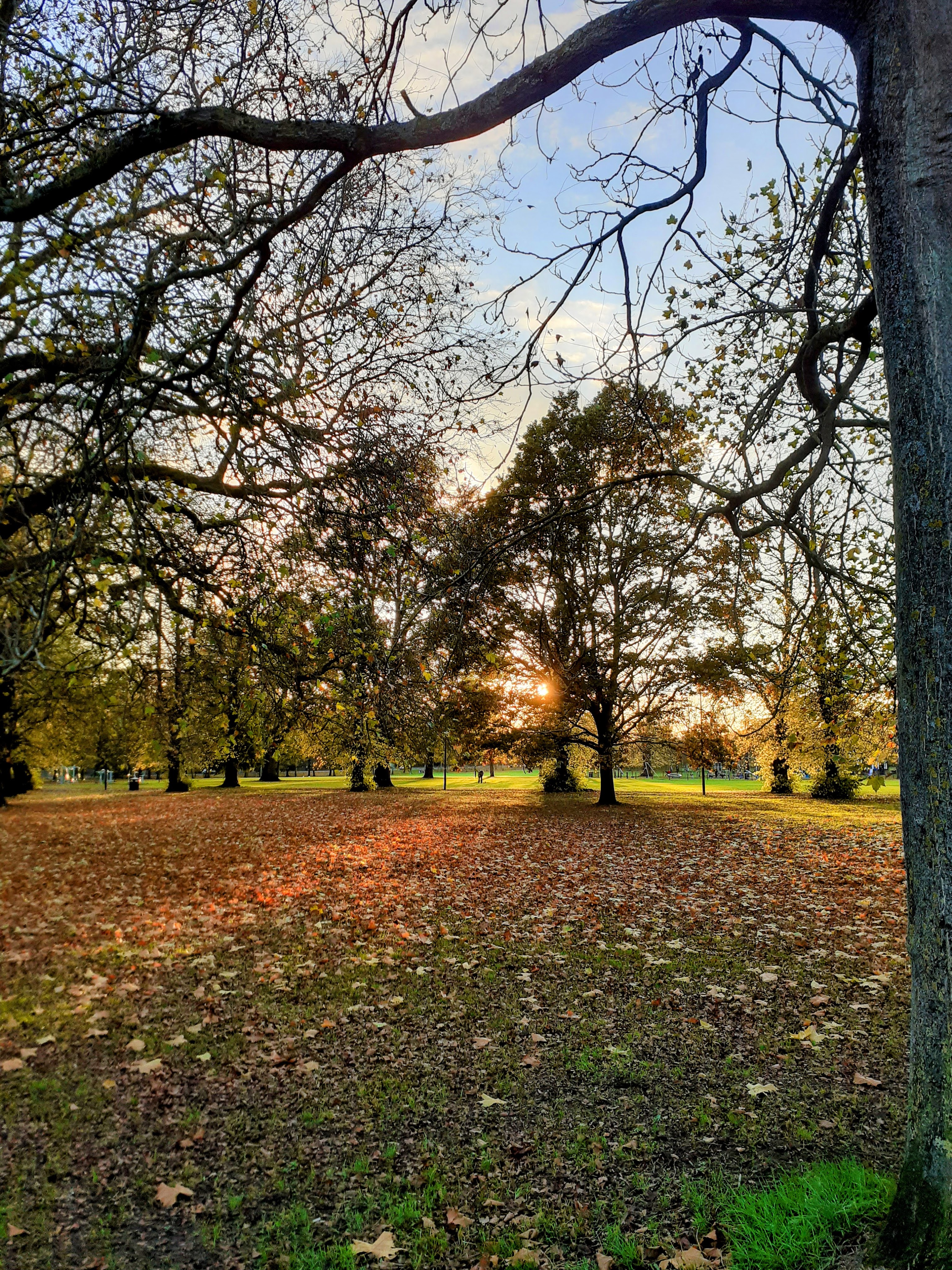
It’s about 3.45 pm on Thursday 14 November. For a few precious days there has been blue sky and a visible sun in my neighbourhood. But the days themselves are short and the sun is already falling in the sky. Its rays are brightly visible and they beautifully catch the leaves – those still on their trees, and those already on the ground. But much of the ground, apart from the carefully tended green lawns, is darker and more shadowy. It feels like a last hurrah of autumn before it gives way to winter.

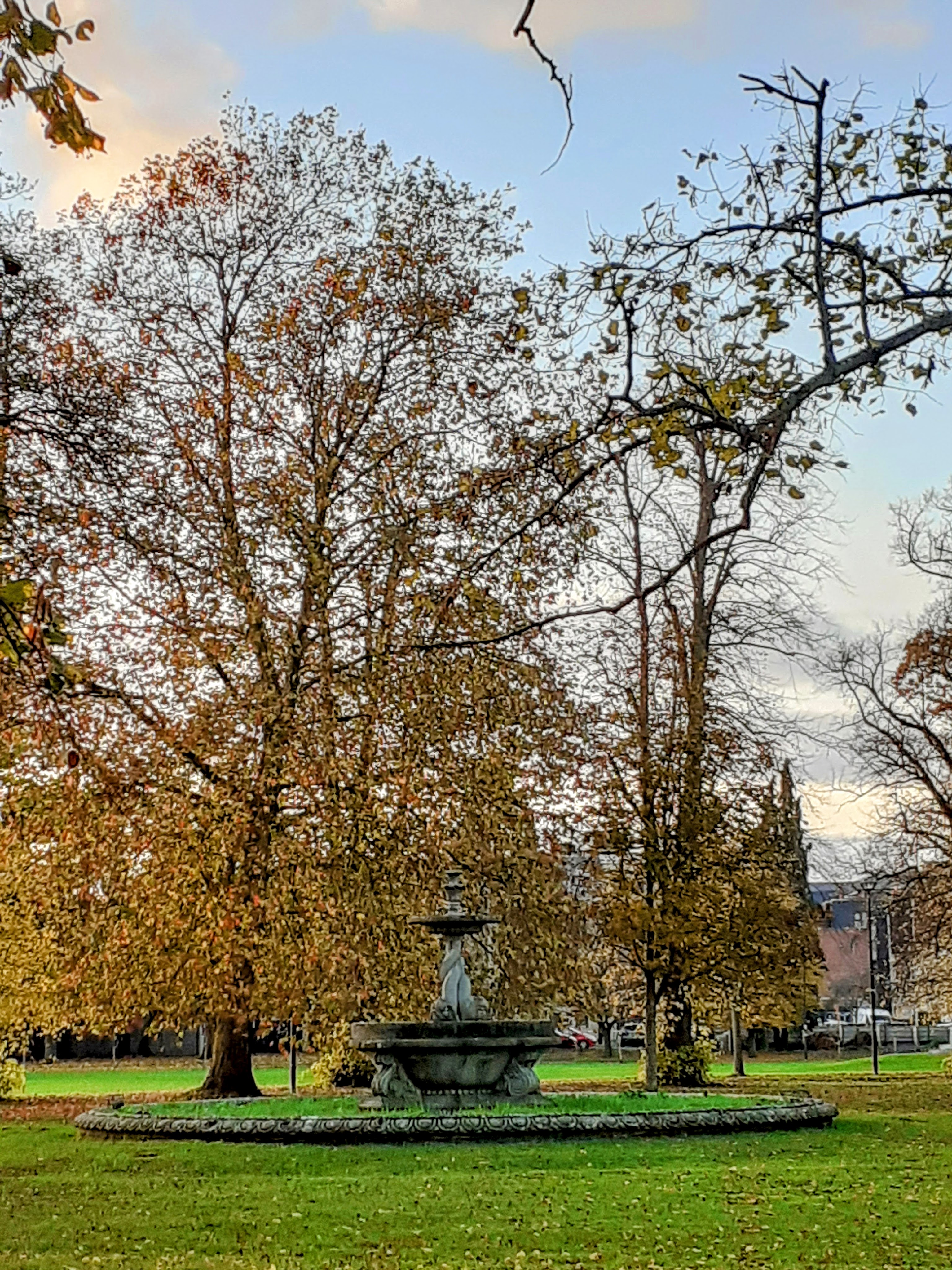
I enjoy the park and the way that it is laid out. It is highly used and valued, and an important lung for the city. I am glad to have it here in Gloucester. Today is a quiet time, good for contemplation. It is easy to walk to from where I live and a good place to be with the land and the trees. My visits don’t require long periods of time or present much physical challenge. This is good for me at a time when I am unavailable for heroic physical journeys but very open to the magic of what is.

“I am the Mabon. I am the child.
I am YR, the Golden Bough.
I am the dart that the yew lets fly
Three pure rays, the pillars of life.
I am the wren, the King of Birds.
I am the Bard and the teller of lies.
I am a song within the heart.
I am the light that will never die.
I am stars within the Void.
I am the eye of the Aeon.” (1)
For more than a decade, my spiritual practice has been mobilised around a contemplative inquiry. For me, this has been successful in its own terms, but I’m conscious now of something missing. It’s as if, for earnest, intelligent and ethical reasons, I have whitewashed the walls in the church of me. Now I want my murals back. So, recently I have started a course correction.
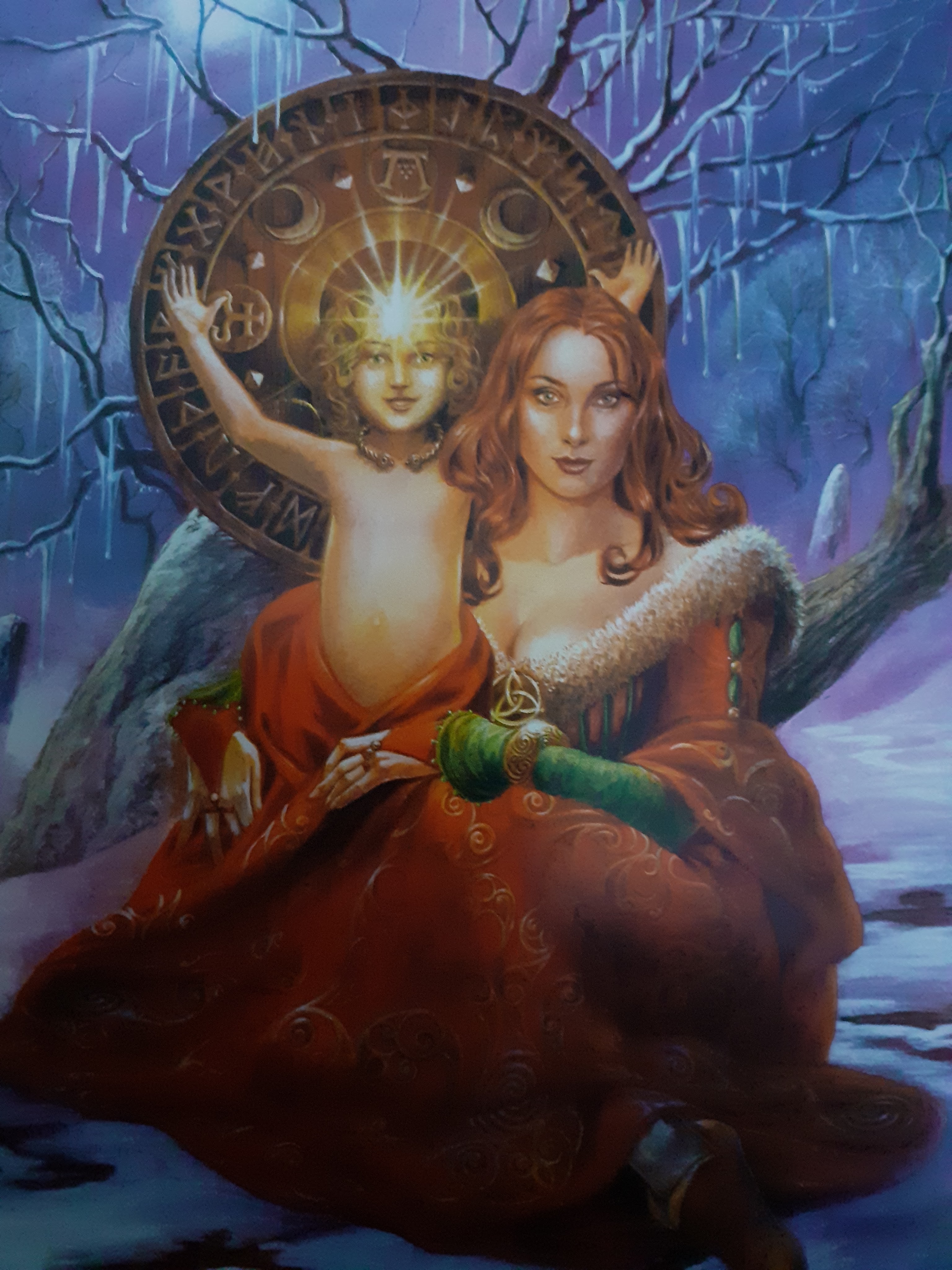
This course correction includes a glance back at my own pre-inquiry practices, happily well documented. The image of Modron and Mabon used to walk with me: Modron as the primal mother and Mabon as the primal child (2). They were archetypal figures, not everyday humans. My understanding was that these names were from a pre-Celtic language, retained in Brythonic speech. I am not sure if this is true, but for me it offered the possibility that even the surviving Celtic stories (3) were not the first. I was free to dream. In this dreaming I was powerfully influenced by the image at the top of this post (received as a midwinter holiday gift from my wife, then partner, Elaine, in 2007) and by the Silver on the Tree song that follows.
I see the child in the image as androgyne, and not in their earliest infancy. In the song, Mabon is not gendered. The mother in the picture is clearly the Goddess as Mother. Different stories can be drawn from this. In my own journey I tilt the child back somewhat to the masculine. In this pairing, She is Zoe, the life eternal. He is Bios, the life that comes and goes and comes again. Like Taliesin (4), transmuting out of his identity as Gwion, Mabon becomes in a sense his own father. So my midwinter picture appears to reference the Christmas story, but in important ways diverges from it. The image shows a magical midwinter child, who will indeed have an illuminating and transformational influence, but who is not exactly a redeemer in the Christian sense. This is drawn out in the Silver in the Tree song, which includes specifically Celtic references and extends beyond them.
Both Mother and Child live strongly within me, in the imaginal realm. I like and use the old language, Modron and Mabon, because of its sense of ancient mystery. But what it points to is universal. Part of my work now is to re-open my contact with them, who after another fashion I also am.
(1) Silver in the Tree in their 1991 album Eye of the Aeon
(2) NOTE: I am aware that there are divergent visions of Mabon. One centred the Autumn Equinox has become powerful and influential in recent years. Happily modern Druidry is not a religion of the Book though it is enriched by its books. This new literature follows the oral tradition practice of allowing stories to evolve and change in divergent directions. I see this as a strength.
(3) Caitlin Matthews Mabon and the Guardians of Celtic Britain: Hero Myths in the Mabinogion Rochester, VT: Inner Traditions, 2002 (Revised edition of Mabon and the Mysteries of Britain, 1987)
(4) If you visit Loch Maben in Dumfriesshire, in south west Scotland, you may find the feeling-tone similar to the much larger Lake Bala, strongly associated with Taliesin, in north Wales.
Last weekend ‘the clocks changed’ as the saying goes in my part of the world. Without any change in the heavens, the dawn and sunset alike were, overnight, officially an hour earlier. It happens every year, as does the reverse process in March. This is now culturally unremarkable. It has been happening for many, many years.
Clock time has had a huge influence in my life, whether I like it or not. I was given my first wrist watch at the age of eight and it seemed like a move toward adult empowerment. I didn’t notice any loss, at first, until it became clear that the empowerment offered was largely a self-regulating capacity for meeting other people’s requirements, especially concerned with some form of work. No actual self-direction was involved.
Since the coming of the mobile phone and its evolution into a multi-purpose device, the regulation of our time has if anything tightened. There is the added sense of being permanently on call and indeed of round the clock surveillance. The wrist watch stands as a quaint form of relative freedom, or at any rate spaciousness. I carry a phone whilst also wearing a wrist watch out of habit, nostalgia and a slight element of defiance.
My watch is old and this year I nearly retired it, in a permanent summer time, to a pleasant space in my home. But I couldn’t do it. I would be losing the companionship it provides. I re-read a poem I wrote some years ago and decided to keep the watch with me on my wrist.
Am I out of date
To wear a wrist watch?
I carry a phone,
after all.
Once you seemed so advanced and ‘digital’,
For you did not tick and tick and tick,
And I did not wind you up.
Over the years,
Batteries have died, and been replaced.
Straps have come and gone.
But your face, just a little scratched,
remains the same,
Old friend,
While time keeps moving on.
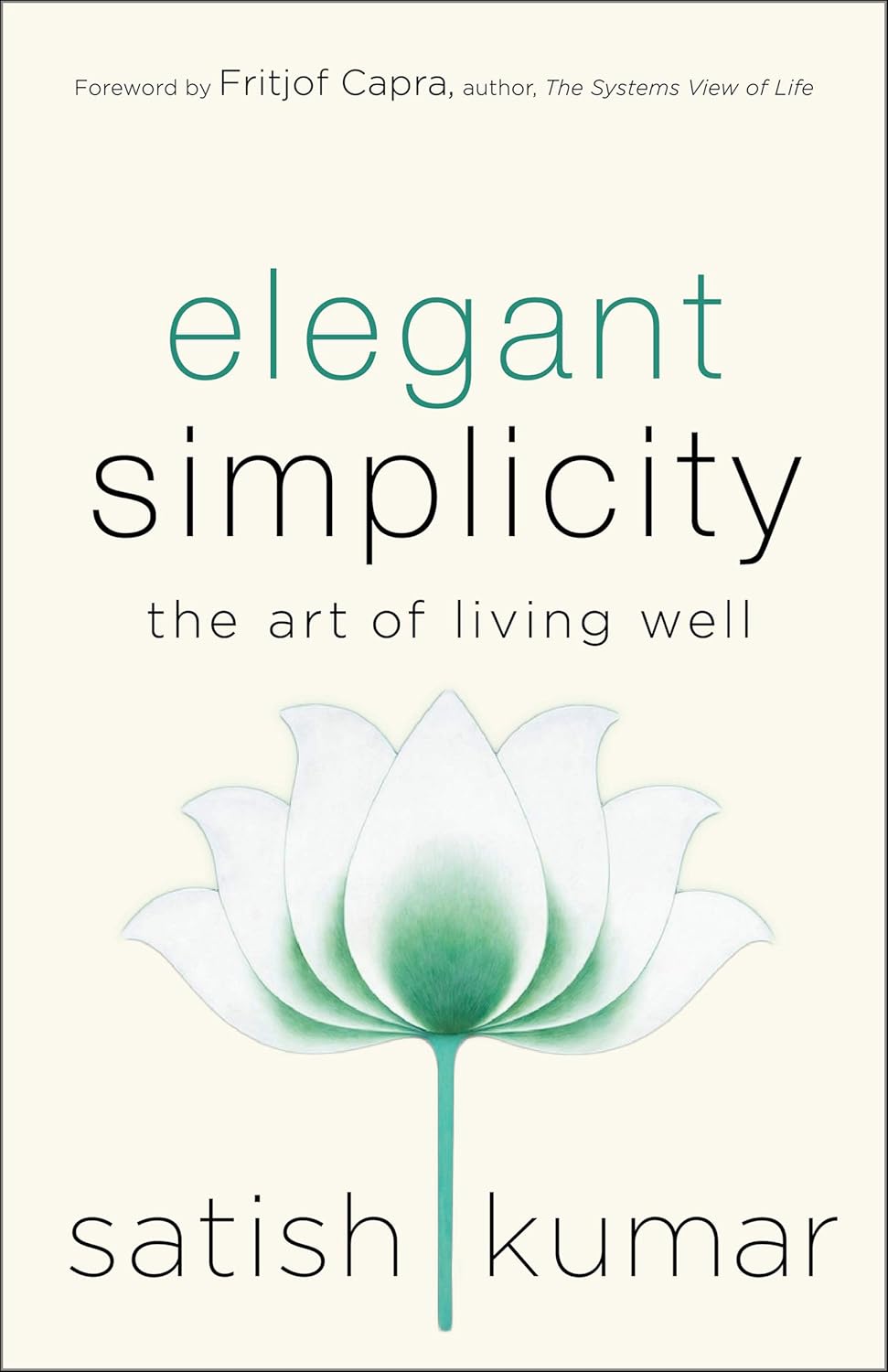
Highly recommended. Satish Kumar (born in 1936) published Elegant Simplicity: the Art of Living Well in 2019 (1). It begins with a foreword by Fritjof Capra and a preface by the author Let’s be Simple which quotes the 1848 Shaker song ‘Tis the gift to be simple, ‘Tis the gift to be free. The book summarises the author’s personal story as well as discussing his values. I have written posts based on some of his other work before (2). I especially recommend this book to anyone interested in knowing more about Satish Kumar’s practice (grounded in Jain spirituality and Gandhi’s non-violent activism) and his influence on deep ecology, creative arts and education.
Elegant Simplicity has a summarising quality, looking back on decades devoted to sacred activism in different forms. It is divided into fourteen chapters: Each is preceded by a brief and relevant quotation from another thinker. The chapter then becomes a meditation on the quote:
1 My Story: Beginnings – ‘True happiness lies in contentment’ Mahatma Gandhi.
2 Simplicity of Walking – ‘All truly great thoughts are conceived by walking’ Friedrich Nietzsche.
3 Life is a Pilgrimage – ‘Faith is not the clinging to a shrine but an endless pilgrimage of the heart’ Abraham Joshua Heschel.
4 Elegant Simplicity – ‘Any fool can make things complicated, it requires a genius to make them simple’ E. F. Schumacher.
5 A Society of Artists – ‘This world is but a canvas to our imagination’ Henry David Thoreau.
6 Yoga of Action – ‘Life is a process not a product’ Brian Goodwin.
7 Learning is Living – ‘Education is not preparation for life; education is life itself’ Thomas Dewey.
8 Right Relationships – ‘We are all related – relationships based on obligation lack dignity’ Wayne Dwyer.
9 Love Unlimited – ‘There is no charm equal to tenderness of the heart’ Jane Austin.
10 Power of Forgiveness – ‘It’s one of the greatest gifts you can give yourself, to forgive. Forgive everybody.’ Maya Angelou.
11 Dance of Opposites – ‘Life and death are one as the river and the sea are one’ Kahlil Gibran.
12 Deep Seeing – ‘To see clearly is poetry, prophecy, and religion, all in one’ John Ruskin.
13 Union of Science and Spirituality – ‘Science is not only compatible with spirituality; it is a profound source of spirituality’ Carl Sagan.
14 Soil, Soul and Society – ‘We live in an interconnected world and in an interconnected time so we need holistic solutions to our interconnected problems‘ Naomi Klein.
Fellow activist and author Vandana Shiva describes Elegant Simplicity as “the distillation” of Satish Kumar’s ideas and actions. “It shows the intimate connections between the inner and the outer world, soil, soul and society, beauty joy and non-violence. It indicates that the solutions to the big problems of our time – climate change, hate, violence, hopelessness and despair – lie in thinking and living with elegant simplicity, reducing our ecological footprint while enlarging our hearts and minds”.
For me, Satish Kumar is an inspiration rather than a direct model. Even in the conditions of the early 1960’s I would not have walked, or aspired to walk, from New Delhi to Washington DC without carrying any money. Yet Satish Kumar and his companion E. P. Menon succeeded and made a huge public impact at the time. Their peace pilgrimage gave oxygen to the campaign for nuclear disarmament. No state gave up its arms, but treaties limiting the numbers and testing of nuclear arms became normalised for some decades. Satish Kumar’s initiatives in deep ecology and education, especially the ‘small school’ and Schumacher College, have changed lives. Directly and indirectly, his influence has awakened many people from the dystopian trance of our dominant cultures. Satish Kumar is a widely revered elder: a peaceful warrior for a more liveable, generous and creative world.
(1) Satish Kumar Elegant Simplicity: The Art of Living Well New Society Publishers (https://www.newsociety.com): Gabriola Island, BC, Canada: 2019
(2) See previous posts:
NEWS OF A DEATH
TWO VIEWS OF THE DIVINE
OUTDOOR WALKING MEDITATION
NOTE: “Satish Kumar (born 9 August 1936)[1] is an Indian British activist and speaker. He has been a Jain monk, nuclear disarmament advocate and pacifist.[3]Now living in England, Kumar is founder and Director of Programmes of the Schumacher College international center for ecological studies, and is Editor Emeritus of Resurgence & Ecologist magazine. His most notable accomplishment is the completion, together with a companion, E. P. Menon, of a peace walk of over 8,000 miles in June 1962 for two and a half years, from New Delhi to Moscow, Paris, London, and Washington, D.C., the capitals of the world’s earliest nuclear-armed countries.[4][5] He insists that reverence for nature should be at the heart of every political and social debate.” (Wikipedia)
music that celebrates Earth and speaks to the heart
Follow the Moon's Cycle
Meeting nature on nature's terms
A little bit of Mark Rosher in South Gloucestershire, England
A monastic polytheist's and animist’s journal
Selkie Writing…
Images and words set against a backdrop of outsider art.
living with metacrisis and collapse
The pagan path. The Old Ways In New Times
Spiritual journeys in tending the living earth, permaculture, and nature-inspired arts
a magickal dialogue between nature and culture
The gentle art of living with less
Thoughts about living, loving and worshiping as an autistic Hearth Druid and Heathen. One woman's journey.
An place to read and share stories about the celtic seasonal festivals
Just another WordPress.com site
Exploring our connection to the wider world
Become more grounded and spacious with yourself and others, through your own body’s wisdom
Good lives on our one planet
News for the residents of Hopeless, Maine
 Contemplative Inquiry