Contemplative Inquiry

This blog is about contemplative inquiry

Tag: contemplation

POEM: PRICELESS GIFTS


An empty day without events.

And that is why

it grew immense

as space. And suddenly

happiness of being

entered me.


I heard

in my heartbeat

the birth of time

and each instant of life

one after the other

came rushing in

like priceless gifts.


Anna Swir (1909-1989). Translated from the Polish by Czeslaw Milosz and Leonard Nathan. From The poetry of impermanence, mindfulness and joy edited by John Brem. (Wisdom, Kindle edition, undated.)


POEM: AU VIEUX JARDIN

I have sat here happy in the gardens,

Watching the still pool and the reeds

And the dark clouds

Which the wind of the upper air

Tore like the green leafy boughs

Of the divers-hued trees of late summer;

But though I greatly delight

In these and the water lilies,

That which sets me nighest to weeping

Is the rose and white colour of the smooth flag-stones

And the pale yellow grasses

Among them.

Richard Aldington in Imagist Poetry edited by Peter Jones London: Penguin, 1972 (Modern Penguin Classics)

The Imagists were a short-lived yet influential movement in early 20th century poetry in the English language. Whilst an organized and at that time mostly young group, they were based in London and included both British and expatriate American members. The Imagist collections of the 1914-17 period include the work of: Ezra Pound; Richard Aldington; H.D. (Hilda Doolittle); Amy Lowell; D.H. Lawrence; William Carlos Williams; Ford Maddox Ford; T.E. Hulme; James Joyce; Marianne Craig Moore; E.E. Cummings; John Gould Fletcher. Years later, T.S. Eliot paid tribute to the Imagists as a formative influence.

The Imagists had three rules, designed to encourage freshness and clarity in observation and precision in expression. For me this gives them contemplative interest. Ezra Pound in particular was fascinated by Chinese and Japanese poetry, then beginning to become available in the West.

  1. Direct treatment of the ‘thing’, whether subjective or objective.
  2. To use absolutely no word that did not contribute to the presentation.
  3. As regarding rhythm: to compose in sequence of the musical phrase, not in sequence of a metronome.

In the poem above, I was particularly moved by the way in which freshness, clarity and precision allowed the poet to both feel and contain strong emotion. For me, contemplative spaces embrace such feelings, whilst also providing a clear space around them.

MAKING PERSONAL VOWS

On Monday I completed a Mindful Self-Compassion (MSC) course (1). It was not strictly Buddhist, but the teachers and all the participants were sufficiently Buddhist influenced to have had existing experience of both of mindfulness and loving-kindness practices. At the same time I believe that the overall approach can offer something for anyone concerned with the issues addressed.

One of these is making and living with vows. In this context, we make the vows to ourselves and there are two key criteria. The first is that the vow anchors an intention, rather than operating as a binding contract. The second is that vows flow out of our core values. Hence, we need to get clear about these values before making any vows.

The process for checking core values is a simple one. Bringing warm-hearted awareness to ourselves and our experience, we imagine being near the end of our lives and looking back. We ask ourselves what has given us the deepest satisfaction, joy and contentment. What values did we embody that gave our life meaning? In other words, what core values were expressed in our lives? Possible examples given by the people who developed the MSC programme are: compassion, generosity, honesty, courage, family, loyalty, service, curiosity and nature.

Having done this, we select a core value that we would like to manifest for the rest of our lives and write it in the form of a vow. In the construction of the vow, ‘May I …’ language is recommended. This strengthens a kind of commitment which is about working towards, and deepening into, the expression of the core value, rather than getting tied up in a drama of binary obedience/disobedience.

When making my own vows, I found it good to remember that they are personal and not set in concrete. They can be further changed and developed – or even dropped, if they cease to sit well. They are tools rather than rules. With the two below, I found that care with language was key to the credibility of the vow. Worded to be both simple and demanding, such vows can allow for degrees of fulfilment, and provide a kind of coaching.

May I be loving and compassionate in my personal interactions

Mindful Self-Compassion begins with ‘self’ but doesn’t – and couldn’t meaningfully – stop there. One of its merits is to resource loving-kindness and compassion to others and in the wider world. It is a preventative measure against cold charity and compassion fatigue. In the context of this vow, loving-kindness and compassion are specific terms. Loving-kindness is a basic stance of positive regard, not necessarily fuelled by natural empathy or emotion beyond a basic inclination to warmth. Compassion is loving-kindness in a situation where the other person or being is suffering. MSC, and the wider culture of Buddhist lovingkindness, provide working methods that include being kind to ourselves when we struggle with the stance of loving-kindness and compassion towards others. In working with this vow, I am not dependent on factors like self-image or passing sentiment. I have practices to support me in making the vow meaningful.

May I experience abundance in simplicity

This vow depends on a dance between two qualities that might be thought of as pulling in opposite directions. To the extent I might experience a tension myself, I am challenged to develop my understanding both of ‘abundance’ and of ‘simplicity’. One synthesis, an important one, finds a path through living lightly on the Earth as a personal witness in the face of world-pillaging and climate crisis. There’s a set of lifestyle choices to be made here, finding riches within apparent frugality. But for immediate experience, I go straight to simplicity. By this I mean slowing down, and opening to the simple now. I immerse myself in the texture of what is abundantly here and freely given. I look out of my window at late summery yellow-green ivy … abundance-in-simplicity comes in and sits on my shoulders. The point of the vow is to remind me of the miracle of being alive and to open me more fully to the gift.

(1) https://centerformsc.org/

AIMLESSNESS

We often talk about our ‘path’ or ‘journey’, and this can have a value. Yet at heart spirituality is about being somewhere rather than getting somewhere – recognising the home we have never left.

“The concentration on Aimlessness means arriving in the present moment to discover that the present moment is the only moment in which you can find everything you’ve been looking for, and that you already are everything you want to become.

“Aimlessness does not mean doing nothing. It means not putting something in front of you to chase after. When we remove the objects of our craving and desires, we discover that happiness and freedom are available to us right here in the present moment.

“We have a habit of running after things, and this habit has been transmitted to us by our parents and ancestors. We don’t feel fulfilled in the here and now, and so we run after all kinds of things we think will make us happier. We sacrifice our life chasing after objects of craving or striving for success in our work or studies. We chase after our life’s dream and yet lose ourselves along the way. We may even lose our freedom and happiness in our efforts to be mindful, to be healthy, to relieve suffering in the world, or to get enlightened. We disregard the wonders of the present moment, thinking that heaven and the ultimate are for later, not for now.

“To practice meditation means to have the time to look deeply and see these things. If you feel restless in the here and now, or if you feel ill at ease, you need to ask yourself: ‘what am I longing for?   What am I searching for? … What am I waiting for?”

Thich Nhat Hanh The art of living London: Rider, 2017

GOOD TASTE AT HOME

An aristocratic Zen perspective from medieval Japan. “Though home is of course merely a transient habitation, a place that is set up in beautiful taste to suit its owner is a wonderful thing. Even the moonlight is so much the more moving when it shines into a house where a refined person dwells in tranquil elegance. There is nothing fashionable or showy about the place, it is true, yet the grove of trees is redolent of age, the plants in the carefully untended garden carry a hint of delicate feelings, while the veranda and open-weave fence are tastefully done, and inside the house the casually disposed things have a tranquil, old-fashioned air. It is all most refined”.

Yoshida Kenko A cup of sake beneath the cherry trees Kindle edition of a Penguin Classic. This is a selection taken from Essays in idleness and probably written around 1329-31 CE. Translated into English by Meredith McKinney.

The son of an administration official, Kenko was born Urabe Kaneyoshi and served as  guards officer in the Imperial palace. He became a Buddhist monk in later life, living in a hermitage within a Zen monastery. He has been seen as the most important Japanese literary figure of his day, retaining something of a secular lens on the world despite his monastic standing.  He also wrote: “it is a most wonderful comfort to sit alone beneath a lamp, book spread before you, and commune with someone from the past whom you have never met.” I like him for writing that sentence, and I like being able to read it.

POEM: I CAN WADE GRIEF


I can wade Grief –

Whole pools of it

I’m used to that –

But the least push of Joy

Breaks up my feet

And I tip –

drunken


Emily Dickinson

POEM: SILENT ILLUMINATION


Silently and serenely, one forgets all words,

Clearly and vividly, it appears before you.

When one realizes it, time has no limits.

When experienced, your surroundings come to life.

Singularly illuminating this bright awareness,

Full of wonder is the pure illumination.

The moon’s appearance, a river of stars,

Snow-clad pines, clouds hovering on mountain peaks.

In darkness, they glow with brightness.

In shadows, they shine with a splendid light.

Like the dreaming of a crane flying in empty space,

Like the clear, still water of an autumn pool,

Endless eons dissolve into nothingness,

Each indistinguishable from the other.


Chan Master Sheng-Yen The Poetry of Enlightenment: poems by ancient Chan Masters New York: Dharma Drum Publications, 1987

This is the first section of a longer piece by Hongzhi (in this text transliterated as Hung Chi), who lived in China from 1097-1157. He developed a version of what we now call mindfulness meditation called Silent Illumination.


BOOK REVIEW: THE CRANE BAG

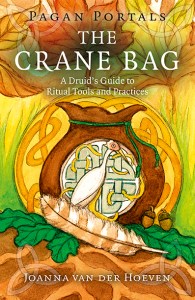
The Craane BagThe Crane Bag, Joanna van der Hoeven’s forthcoming book*, offers an introduction to the ritual tools and practices found in the Druid tradition. It achieves this briefly, simply and with a light touch – as books in the Pagan Portals series are designed to do. Yet it much more than a tick box guide. It provides context and meaning, showing the modern evolution of the Druid tradition itself.

The author makes it clear that she wants readers “to develop their own path in their own time in their own fashion”. Re-enchantment is both path and goal. With proper use, the crane bag “can further the Druid in working with the tides of nature, finding his or her own place in the environment, living in balance, harmony and peace”. The movement overall is “toward reintegration with the natural world”.

At its simplest, the crane bag is the container for Druid ritual tools and as such enables the practices. Bag and tools provide the practitioner with “something tangible to express the spiritual”, acting as a portable “map of the soul”. Behind the crane bag lies an ancient Irish story beginning with the contention between two sisters and the transformation of one of them, Aoife, into a crane. The story is beautifully told and its relevance clearly explained in the first chapter of the book.

In ritual, a period of time and an area of space are set apart and dedicated. This is not to create a lasting duality of sacred and mundane, but a step on the way to experiencing everything as sacred. “Ritual helps us to step back from the busyness, into another way of being. It is a change of consciousness, where we can shift our perception away from a singular view to a more plural view, realising that we are part of an ecosystem”. There is a clear preference for working outdoors, where awareness can shift more readily, though this is not insisted on.

A Druid’s tools will vary with the Druid. The book identifies the following: a silver branch; a staff; cups/bowls/cauldrons; drums; a sickle or knife; robes; altars; fire/candles; incense. People may make or buy them. Ethical sourcing of tools and materials is discussed in some detail, in line with the values of The Crane Bag overall.

What goes into a ritual is explored under the headings of call for peace; preparing the nemeton; honouring spirits of place, three worlds, four directions, ancestors, deities; ritual action; prayers and magic; offerings; eisteddfod; sacrifice; feast; closing. There’s encouragement to practitioners to craft what is right for them from within this set of suggestions and beyond it. The author adds, “I have been in circles with Christian Druids and Buddhist monks, as well as other religions from all over the world”. What matters in ritual is being present and performing the ritual with mindfulness, so that “any words that you speak, any gesture or movement you make will flow more easily, be more graceful and filled with meaning”.

There’s a final chapter on ‘altered states’. I don’t use the term myself, because it makes an ‘altered’ vs ‘normal’ distinction that doesn’t really work for me in my own life. But I recognise it as a term that is widely and usefully employed. Here, it facilitates valuable discussions of meditation, drumming, chanting and song, sensory deprivation, sacred landscape and sitting out. Three kinds of meditation are distinguished: calming the mind and re-tuning the body, journeying and problem solving. Guidance is offered on each kind. Different suggestions are also explored within the other topics. For sensory deprivation, there are two. One is the Celtic version of the sweat lodge, called teach an alais. The other is total immersion in darkness for a considerable period before being brought out into the light. The author refers to early medieval accounts of this, where it was done in aid of Bardic inspiration and prophesy: imbhas forosna.

I found The Crane Bag a very useful contribution to its topic and highly recommend it.


Joanna van der Hoeven The Crane Bag: a Druid’s guide to ritual tools and practices Winchester UK & Washington USA: Moon Books, 2017

*According to the publisher, the book is due for release on 28 July, and can be pre-ordered through Amazon US & UK, Indiebound and Hive.

MYSTERY

“We usually describe the world in terms of trees, mountains, rivers, clouds, cars, houses, people, and so on. But a chemist could say: ‘No, this is not how things truly are! The world is basically composed of molecules which are ceaselessly combining one with another at random’. However, a physicist would reply: ‘Not at all! Reality is actually made up of intermingling fields of energy/matter where the dance of waves/particles takes place ceaselessly’.

“Who is right? Who is wrong? All of them are clearly mere conceptual descriptions that can just supply a relative view of reality. We do not actually live in ‘reality’, but rather in a description of it, that is like a ‘bubble’ of concepts and words all around us, which in time builds up a fictitious view of ourselves and the world. Even non-dualism (as any other -ism without exception) is just a conceptual description of reality, that hopelessly tries to point to the unknowable ‘Whatever it is’: in so far as it becomes an ideology that relies on words and thoughts, it is unable to enjoy the taste of Being.

“So we live in concepts without realizing it. We blindly believe that reality is just as our thought represents it. Science gives us an ‘objective’ description of the material world that, to some extent, can be very useful for the improvement of humankind, however relative and incomplete it is. Non-duality – as far as it still relies on words and thoughts – is just another conceptual description of reality, though its understanding of non-separation can dispel a huge amount of suffering in one’s life. Neither of them is more or less right, and both are useful. But as long as we rely merely on them, we remain trapped in the net of concepts.

“Just as the fisherman’s net can catch only fishes, but not the water that passes through it and even supports it, so the thinking mind can grasp only concepts, but not the awareness that perceives it as an object: the ‘water of awareness’ can never be detected by the net of the thinking mind.

“Indeed, awareness is a paradoxical mystery: on the one hand its evidence is undeniable for the very fact that we are aware of objects, but on the other hand it is unknowable, just as the existence of the eye is undeniable for the very fact that we can see objects, though it always remains invisible, outside the picture. However, even ‘awareness’ is just a concept: through it, we are ultimately confronted with the unknown ‘bottom line’ of any human knowledge. No understanding whatsoever can touch the unknowable Source of everything.

“What if any idea about who I am, including even the idea of ‘consciousness’, totally collapses? What if any idea about reality, including even the idea of ‘non-duality’, totally collapses? What if even these very words you are reading now lose any meaning whatsoever and fall away? What remains when every attempt to understand or to know reality reveals its utter futility? Then, out of frustration, the thinking mind cannot help saying “I don’t know” and finally quits.

But when that “I don’t know” plunges off the head into the heart, the philosopher dies and the mystic is born. It is not a process in time. It is a singularity where all the known collapses and disappears. It is a timeless explosion of pure wonder and awe that blows away everything else. And what remains is a wild, free, spontaneous, and utterly unknowable aliveness, within the glowing darkness of the Mystery that we ultimately are.”

Mauro Bergonzi

ANOTHER SHORE?


My sacred space at home has undergone a complete makeover. I am effectively in a different place. It happened this way. On 7 May, I ordered a statue of Guanyin, partly as a birthday present to myself and partly with reference to ‘the true thought of the heart’. Perhaps the true thought of the heart is the real gift. In a blog post I wrote on that day (1), I described Guanyin as sitting on a crescent moon, playful and androgynous. I said: “it is the note that I am looking for”.

When the statue arrived from China, it was much bigger than I expected. It was over two metres high and quite broad, because Guanyin is sitting on a crescent moon, which takes up space. Caught up in the elegance of the design, I had completely misread the dimensions. No room in my room for the true thought of the heart?

Making room involved a complete clearing and cleaning of the place, and a considerable re-arranging of furniture. During an afternoon, I reshaped the space entirely with Guanyin as the predominant focus. Other imagery is still there. The Western Way is still well represented. A Green Man represents our oneness with the Earth, and our apparent separation from it and need for healing stories. A somewhat Marian (both of them) Sophia is there, imaging sacred fertility, sacramental relationship and the challenge to awaken. So are other familiar objects – a dragon sitting on an egg, an abstract and geometrical mandala picture, a tiny wooden Buddha, (not new) contained and serene. (A hopefully only slightly larger and more expansive laughing one is on his way.) Around the walls I find a C17th map of Somerset, my native county; pictures of Glastonbury Tor and the Eildon Hills; a small painting of a crane; and a painting I commissioned in the early 1990s of the Pictish Dancing Sea Horses from the Aberlemno Stone in Angus.

Yet the defining presence is now Guanyin. It happened as if by itself. The rest of the room is familiar and understood. She by contrast is numinous, dynamic and unknown, as well as large. The relationship is not yet established. Close-up, she is indeed playful and androgynous, but she is much more than that. As Guanyin, s/he hears the cries of the world. In her male aspect, s/he is Avolokitesvara, who shared the wisdom gained from deep practice in The Prajnaparamita Heart Sutra. S/he opens the way to the whole tradition of Mahayana Buddhism and its Vajrayana or Tantric variants. Thich Nhat Hanh reminds us of the seeming riddle of this path. “The Prajnaparamita Sutra says, ‘The Bodhisattva helps row living beings to the other shore but in fact no living beings are being helped to the other shore’ (2). Inevitably, it seems, I am drawn by this proposition. Necessarily, it seems, I am gathering Buddhist resources and accessing Buddhist networks, now attracted to the path as well as the Bodhisattva. I did not anticipate this.

This transcends contemplative inquiry, whilst emphatically including it. The Guanyin Oracle (3) tells me that I am under a God’s protection, and gives me a verse called After the Rain.

“After a long rain, we joyously watch the heavens clear.

The sun and moon grow slowly brighter.

The gloomy days are over, so be happy and joyous.

You will bound through the Dragon Door in one leap.

I am reminded of Penny Billington’s use of the term ‘egrigore’ in Contemplative Druidry (4). In Chapter 4 Druid Identity and Values, she says that spiritual movements have an egrigore, “an inner reality made up not only of the ideas of the members, but also the invisible influences from the other realms that resonate with that ‘flavour’ of spiritual thought; and as Druids we are dedicated to making connections not only in the natural world but on the other planes as well, other states of consciousness.” I certainly find that images and their associations can have a tremendous power if I am open to them, and for me, now, the Guanyin image is one of those. It is focusing my energy and attention, and making a Buddhist inspired matrix of references, aspirations, values, traditions and practices vividly present to me. This kind of process works much faster than ordinary thinking. Assembling a new Chinese statue out of three separate parts, cleansing and reordering a room, took me into a new space, and here I still am.

  • https://contemplativeinquiry.wordpress.com/2017/05/07/sophia-and-guanyin/
  • Thich Nhat Hanh The miracle of mindfulness: a manual on meditation London: Rider, 1991
  • Stephen Karcher The Kuan Yin Oracle: the voice of the Goddess of compassion London: Piatkus, 2009
  • James Nichol Contemplative Druidry: people practice and potential Amazon/KDP, 2014 (Foreword by Philip Carr-Gomm)
Earth Eclectic

music that celebrates Earth and speaks to the heart

Sarah Fuhro Star-Flower Alchemy

Follow the Moon's Cycle

Muddy Feet

Meeting nature on nature's terms

Rosher.Net

A little bit of Mark Rosher in South Gloucestershire, England

Becoming Part of the Land

A monastic polytheist's and animist’s journal

selkiewife

Selkie Writing…

Charlotte Rodgers

Images and words set against a backdrop of outsider art.

Prof Jem Bendell

living with metacrisis and collapse

Towint

The pagan path. The Old Ways In New Times

The Druids Garden

Spiritual journeys in tending the living earth, permaculture, and nature-inspired arts

The Blog of Baphomet

a magickal dialogue between nature and culture

This Simple Life

The gentle art of living with less

Musings of a Scottish Hearth Druid and Heathen

Thoughts about living, loving and worshiping as an autistic Hearth Druid and Heathen. One woman's journey.

Wheel of the Year Blog

An place to read and share stories about the celtic seasonal festivals

Walking the Druid Path

Just another WordPress.com site

anima monday

Exploring our connection to the wider world

Grounded Space Focusing

Become more grounded and spacious with yourself and others, through your own body’s wisdom

The Earthbound Report

Good lives on our one planet

Hopeless Vendetta

News for the residents of Hopeless, Maine