Contemplative Inquiry

This blog is about contemplative inquiry

Tag: contemplation

WORD AND WAY

Sometimes I struggle with language. This struggle is part of my practice upon the Sophian Way. At times I think of it as a distraction, and perhaps a sign of incompetence. I become discouraged. How do I talk about something that can appear to be beyond a tantalising and distant horizon, while also being nothing other than the ground I walk on and the feet that do the walking? How could I ever find a language?

This is the edge of contemplative inquiry. This is the point where contemplation is asked to hold confusion and frustration. I am tempted to write them off as forms of failure or distraction, yet the stand at the heart of the practice. Writing now, I am not reporting on a practice. I am doing it. Sophia is not bought off by a spirituality of easy answers and sweet experiences. She is also not bought off by the line that ‘this is all beyond more words and thinking’, when spoken as a dismissal. That line is true, but it doesn’t let me off the effort of doing what I can to express what I experience. One of my experiences is this very struggle with words.

I once had a self-image that, in the evening of my days, I would be somehow beyond all this. At times I feel I am. In August 2018 I wrote: “Within my Sophian Way, I have found healing and grounding in a flowing now, the site of an unexpected At-Homeness. Everything else grows out of that – personal well-being, right relationship, life and expression in the world. It is the fountain that nourishes them all. All it needs is my attention”. At that time I believed that this blog had run its course. I looked forward to a period of “fruitful silence”, and I went on to have one. Essentially I stand by what I said then, about At-Homeness, and healing and grounding in a flowing now. It is an important practical take-away from my inquiry. But no formula stands eternal, or does everything. By April of this year I was writing again.

As I continue my inquiry, I will be asking myself more about the ways in which sensations, feelings, images, intuitions, thoughts, beliefs and self-image, shape my contemplative experience. I think this particularity matters. I, James, am in a different place from Douglas Harding, when he says: “Without God, Douglas would not exist but without Douglas God would have no awareness of Himself. It’s like light and darkness. You don’t have one without the other. But the Ultimate truth is that there is only God “. If I could only fall into line with this language, I would never have to think again. But I wilt in conditions of mono-cultural monologue. For me, it offers meaning at the price of love, energy and wonder, and the price is far too high.

In his own life, Douglas Harding was by no means short of love, energy or wonder, and he used a language that was entirely congruent with his truth. But I am different. I have a different view and I trust my feelings in this. I experience my personhood a valid in its own right, even though largely constructed and deeply enmeshed in wider systems. The cosmos I know expresses itself to me through its generativity and multiplicity. My own experience of the Headless Way experiments has been about losing the sense of a boundaried and separate self in an immersion, and a deep connection …. which I associate with notions of ‘inter-being’, and web of life … and I know that my language isn’t as clear and definite as Harding’s … and that I have different experiences at different times … and change my mind … and continue to struggle with words. I’m also discovering that I’m at peace with this. My inelegant inquiry is held within the flowing now, and forms part of my At-Homeness.

WINTER MORNING LIGHT

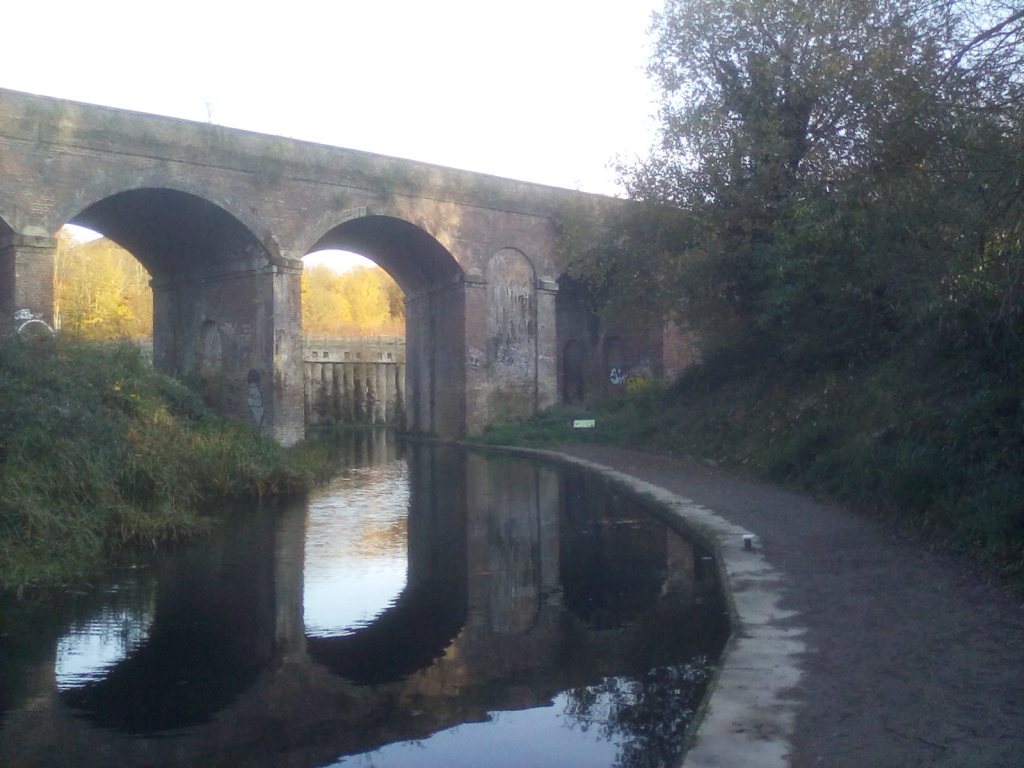
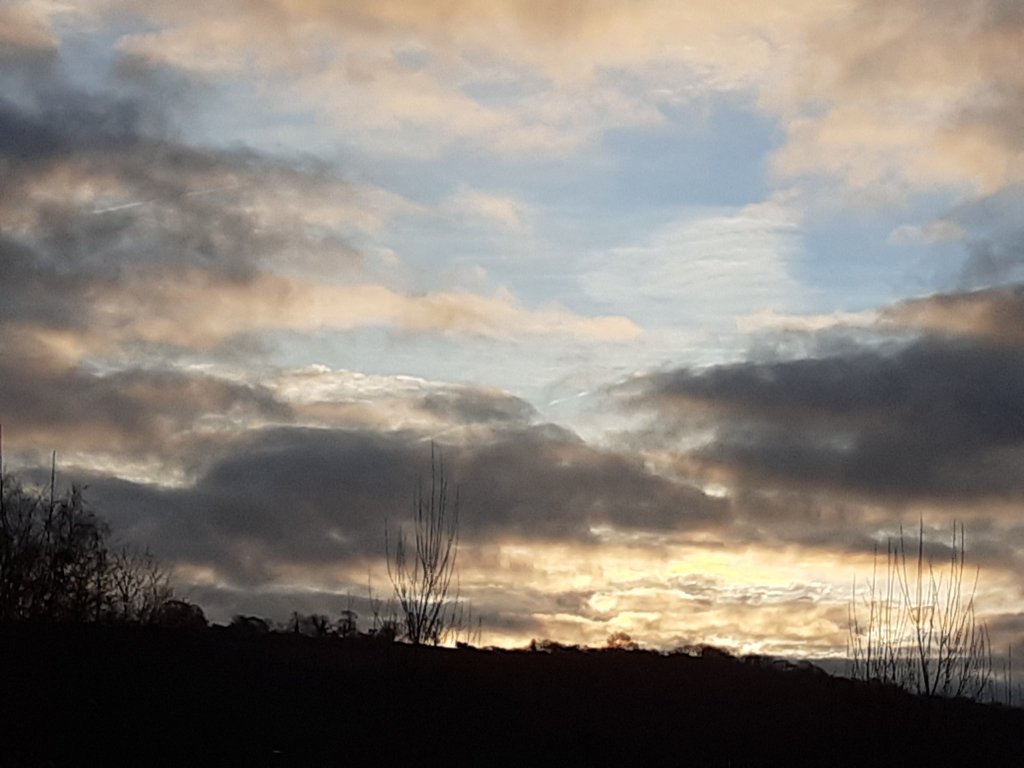
This is 7 December where I live, a little after 8 am, itself a little after the moment of dawn. The sunrise is still early in its process, fifteen days before the turn of the year. I took the pictures on one of my regular canal walks, this time between Stroud and Brimscombe in Gloucestershire, England.

This year I am paying close attention to the dance of place and time. It is part of my re-grounding after my adventures in non-duality, yet retaining the learning they brought. I surrender to the experience of winter sunlight. I breathe it in, and it fills the world, enacting a primal awareness. At the same time I acknowledge the particularity of time and place, of movement and change in nature. I also know that my observation of this winter light, at this time and in this place, is unique. It will never happen again in quite this way. It makes me glad to be alive and here for it. This gift is all the greater, and all the more to be treasured, for that very vulnerability, personal and collective, of which I am also conscious.

INTEGRATION

This is my grail image. I can see a chalice against a formless yet shape-creating background, or I can see two beings, with an enabling space between them. Two worlds; one image. Flicking rapidly between them, there comes a point where I can see them both, in the same place, at the same time.

I see the whole as an image of integration. Myth making just a little, I can point to a primal void, from which I am in no way separate, a cosmic mother, from whom I am distinct yet also in no way separate, and the birth of multiple individual forms of which I am one. With individuality comes otherness – and a world of connection/separation, community/exile, love/hate, joy/fear, generosity/contraction, conflict/co-operation, solidarity/predation. By integration I don’t here mean making the bad stuff go away, though efforts in that direction are immensely important. I am pointing, rather, to a capacity to hold all experience in presence and awareness: the deep experiential acceptance that all of the above, right up to void and creation, are happening here and happening now. They are the reality within which I awaken.

The Christian grail quest, which concerns the healing of the soul and its opening into spirit, partly evolved from older stories about the healing of the land, and maintains a wasteland motif. In Mahayana Buddhism enlightenment makes no sense if any sentient being is left behind. The modern Western Mystery tradition provides ways of bringing these stories together, with more of a tilt at this point in our history towards the collective dimension. I have written before that “for me the grail represents the presence and energy of Sophia”*, and has power for me on my Sophian Way. On this way, the ‘inner’ and ‘outer’ work go hand in hand: these are in any case conventional and limiting terms.

I understand the future as demanding cultures of resilience. Because of that I am glad that I have retained a foothold in Druidry and Paganism, because I see them as cultures of possibility in this regard. My Sophian Way has been a personal one, arising unexpectedly within my Druid education, and given some scope for recognition because of the way my Druid education worked. It fits better into the OBOD community, with its Universalist opening and invitation to learn from all traditions, than into any Christian, Gnostic or New Age community that I know of.

Yesterday I made a symbolic re-connection with OBOD (for I had never really left) by taking out a subscription to its magazine Touchstone after a lapse. Here at least I can name the Sophian Way unequivocally as a Goddess devotion without going through flips and twists about what ‘divine feminine’ might mean. At the same time, the name Sophia does reference insights and influences from other traditions, including secular philosophy, as befits a Goddess of Wisdom. For me, this is another kind of integration, whose fruits will manifest over time.

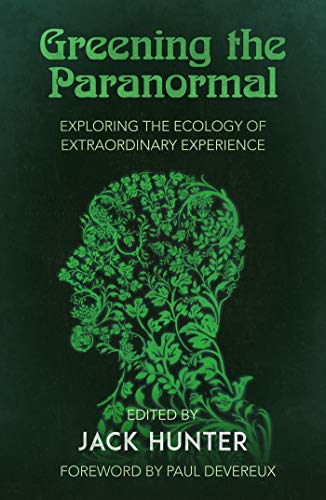
BOOK REVIEW: GREENING THE PARANORMAL

I recommend this book to anyone concerned with deep ecology, animism, or the kinds of phenomena we describe as ‘paranormal’. It opens with two substantial framing pieces, a foreword by Paul Devereux and an introductory chapter by editor Jack Hunter. These are followed by 16 chapters from a diverse range of contributors, mostly seeking to combine direct witness with a workable form of academic analysis. To an extent this book is a story of how to face this difficult challenge. Very early, in his foreword, Paul Devereux shows how the challenge can come from the ‘phenomena’ themselves.

“We were trying to geographically map generations of old accounts of fairy paths we had uncovered in the verbatim records of University College Dublin. Suddenly, standing in the grass, there was a figure, between two and three feet tall. It was anthropomorphic and fully three dimensional (as we could clearly determine while we were drifting slowly past. It had sprung its appearance out of nowhere, and it caught my wife’s and my own transfixed attentions simultaneously.

The figure was comprised of a jumble of very dark green tones, as if composed of a tight dense tangle of foliage rather like the stand of woodland a hundred yards or so beyond the sward of grass. It didn’t seem to quite have a face, just a head with deep set eyes appearing out of the green tangle. It presented a distinctly forbidding appearance. As we crawled past in our car, the figure started to turn its head in our direction, but then vanish.

“Charla called out, ‘Oh, shit!’ We looked at each other, both of us wide-eyed and thoroughly disconcerted. ‘You saw that!’ I asked rhetorically. The whole episode had lasted for only about half a minute or so, but it was unequivocally an actual. if transient, objective observation.”

The running inquiry question throughout the book is, what do we make of experiences like this, if we are determined to honour rather than dismiss them? Devereux senses four major themes in the suggested ‘greening of the paranormal’ in our time. The first is animism, the ‘Big Step for our culture to take’: the sense that the elements of the non-human world are animate in some way – rocks, rivers, soil, as well as plants and living organisms. This involves a deep relationship with the land beyond utility and subsistence. The second theme is the vision quest, a wilderness journey which is more about paying attention and being open to what unfolds, rather than posing questions. The third concerns the ‘liminal’ places that seem to support our breaking through into other-world realms or altered mind states. The fourth is inter-species communion with the animal and plant kingdoms. In the language used by Jack Hunter, we find ourselves dealing with a “profoundly mindful, sentient and agentic world” and the potential re-opening of lost forms of communication and connection.

Many of the contributors believe that we are unlikely to get through the climate crisis if we continue to ignore dimensions of experience from which our cultural filters have exiled us. Some of them live or work in countries that have been colonised by Europeans, but where pockets of traditional indigenous wisdom remain. They recognise that in some cases there are invitations to share in this. There are also concerns about appropriation and the dynamics of the researcher/subject relationship. There is a questioning of the word ‘shamanism’ as currently used – and arguably over-extended and suspect.

This book does not read like a novel. Although I have read it all, there were two or three chapters which didn’t speak to me. Others were riveting. I see it as an excellent book to own and keep for reference. The foreword and first chapter each stand alone and I recommend reading both of them. The other chapters can be cherry picked according to taste or need. Overall there’s a strong invitation to wake up to the aspects of world, life and experience that are being pointed to. The book suggests that they are needed for our personal, social and global healing.


IMAGINING MYSTERY

‘Imagining mystery’ is the title given by Ursula K. Le Guin for Chapter 25 in A Book About the Way and the Power of the Way, her English rendition of the Tao Te Ching.

“There is something

that contains everything

Before heaven and earth

it is.

Oh, it is still, unbodied,

all on its own, unchanging.

“all-pervading,

ever moving.

So it can act as the mother

of all things.

Not knowing its real name,

we only call it the Way.

“If it must be named,

Let its name be Great.

Greatness means going on,

going on means going far,

and going far means turning back.

“So they say, ‘the Way is great,

heaven is great, earth is great;

four greatnesses in the world,

and humanity is one of them’.

“People follow earth,

earth follows heaven,

heaven follows the Way,

the Way follows what is.”

Ursula Le Guin comments: “I’d like to call the ‘something’ of the first line a lump – an unshaped, undifferentiated lump, chaos, before the Word, before Form, before Change. Inside it is time, space, everything; in the womb of the Way. The last words of the chapter, tzu jan, I render as ‘what is’. I was tempted to say, ‘The Way follows itself’, because the Way is the way things are; but that would reduce the significance of the words. They remind us to see the way not as a sovreignty or a dominion, all creative, all yang. The Way itself is a follower. Though it is before everything, it follows what is.”

She also owns to a piece of creative editing. “in all the texts, the fourth verse reads: So they say, ‘the Way is great/heaven is great;/earth is great;/and the king is great./Four greatnesses in the world/and the king is one of them’.” Yet in the next verse, which is the same series in reverse order, instead of ‘the king’, it is ‘the people’ or ‘humanity’. I think a Confucian copyist slipped the king in. The king garbles the sense of the poem and goes against the spirit of the book. I dethroned him.”

I share Ursula Le Guin’s lens, and editorial calls like this are the reason I am drawn to her version more than any other. The text as a whole speaks to our experience of moving between non-duality, dualities, and the multiplicity of the 10,000 the things. For me, the work Ursula Le Guin has done, in reframing traditional understandings of A Book About the Way and the Power of the Way, makes her a teacher in her own right.

She calls the first chapter of her version Taoing, emphasising process and flow, and the need to stay open to uncertainties and ambiguities. The text both acknowledges that words over-define experience (thus limiting and distorting it) and understands the need to use them (otherwise why write it?) When taoing, we hold such points of tension. For they are the key to imagining mystery.

“The way you can go

isn’t the real way,

The name you can say

isn’t the real name.

Heaven and earth

begin in the unnamed:

name’s the mother

of the ten thousand things.

So the unwanting soul

sees what’s hidden,

and the ever-wanting soul

sees only what it wants.

Two things, one origin,

but different in name,

whose identity is mystery,

Mystery of all mysteries!

The door to the hidden.”

Lao Tzu Tao Te Ching: A Book About the Way and the Power of the Way Boston & London: Shambhala A new English version by Rrsula K. Le Guin, with the collaboration of J. P. Seaton, Professor of Chinese, University of North Carolina, Chapel Hill.

A PICTURE ON THE WALL

I imagine a fairly distant future. People are living underground or in domed settlements. The population, though nothing like today’s, is recovering. It is gaining in confidence and ambition. They hope that by continuing their own genetic modification, and terra-reforming the planet, they will be able to live outside again. They have museums, and the stretch of wall above is a prized artefact from a half-legendary pre-apocalyptic time.

What do observers make of it? What, if anything, do they know about birds? Can they name and recognise a ‘duck’ without expert input? If so, do they have any idea of why the representation on the wall is not entirely naturalistic? What about the conventions of thought bubbles and question marks? Would even the curators know about graffiti, and their role in late pre-apocalyptic culture? How do they stand with the notion of ‘humour’?

Conceivably, they know little about us and our intentions. The memory of us may be disturbing to them. This image may be seen as a riddle and a mystery – somewhat magical, somewhat uncanny. It may create a mixture of fascination and unease, ensuring its place as a guaranteed magnet for visitors.

What stories do our remote descendants tell, when contemplating this relic of the past? What, for them, does the picture on the wall say about us? Would we want to know?

NOVEMBER REFLECTIONS

In recent years, I have experienced November as a special month. Moving on from Samhain, it begins winter, and where I live it sees most of the fall. It is a reorientation towards darkness and inwardness. I began my contemplative inquiry, at first limited to OBOD, then to Druidry more widely, finally becoming universal, in November 2011 following a Samhain ritual.

I find November calmer than December, where I tend to feel jangled by the agitated dominance of capitalist consumerism and its appropriation of a Christian festival, itself the appropriation of a Pagan one. The old festivals had an offer for everyone, at least in principle. Now you have to have money to participate, and increasing numbers of people don’t. So I find December an awkward, uneasy time, a ‘festive season’ that, collectively, doesn’t quite ring true.

This sense of a problematic December has made the whole month of November special to me, and powerful for my inquiry. This year I have rejigged my daily practice and replaced a long morning session with shorter sessions in the morning and evening. In the morning I wake up and greet the day with a slightly ritualised (thanks to Druidry) set of exercises. Before going to bed I do a yoga nidra meditation, listening to an audio download. Both practices are grounded in what I would now call a sacrament of presence, and awareness that every experience points towards a source of being from which I am not separate. In this intersection of time and eternity I find my home. I don’t need special ‘spiritual’ experiences. This spirituality doesn’t require them: the work is to enhance my capacity to welcome any experience, including my resistance to negative ones, and find ways to respond. Hence I look to simple, regular practices that provide pragmatic benefits and also remind me of this core insight.

I find that the inquiry aspect of my contemplative inquiry is shifting its focus to personal life, relationships, culture and nature. What’s going on? How am I placed? How am I responding? What difference does my Sophian Way – with contemplative inquiry as its main expression – actually make? These are my November reflections for 2019.

SACRED SOUNDSCAPES

“Concepts of animism can take many forms. … The idea of the land being capable of speaking to humans was probably widespread in ancient sensibility. Sacred soundscapes were simply a natural corollary.

“The basic notion of the land having speech, or being read like a text, was lodged deeply in some schools of Japanese Buddhism – in early medieval Shingon Esoteric Buddhism, founded by Kukei, for instance. He likened the natural landscape around the Chuzenji temple and the lake at the foot of Mount Nantai, near Nikko, to descriptions in the Buddhist scriptures of the Pure Land, the habitation of the buddhas. Kukei considered that the landscape not only symbolised but was of the same essence as the mind of the Buddha. Like the Buddha mind, the landscape spoke in a natural language, offering supernatural discourse: ‘Thus, waves, pebble, winds, and birds were the elementary and unconscious performers of the cosmic speech of buddhas and bodhisattvas,’ explains Allan Grapard (1994).

” …. ….

“Throat singers in Tuvan, an autonomous republic within the Russian Federation, developed their vocal art originally as a means of communicating with their natural environment, not for entertainment. Throat singing involves the production of resonant sounds, overtones and whistles within the throat, nasal cavities, mouth and lips, and was used to provoke echoes or imitate natural sounds like waterfalls or wind. The master throat singers can select precise locations inside caves where the resonances are exactly right to maximise the reverberations of their songs. They even wait until atmospheric conditions are perfect for the greatest effect. It is in essence a technology of echoes. At one locale, where a singer called Kaigal-ool performed in front of a cliff face, ethnomusicologist Theodore Levin reported that ‘the cliff and surrounding features sing back to the musician in what Kaigal-ool calls a kind of meditation, a conversation I have with nature‘ (Levin & Suzukei, 2006).

“It is only in our modern culture that we have stopped listening to the land within a spiritual context. If we could fashion a modern, suitably culturally-ingrained animistic model, we would treat the environment with much more respect.”

Paul Devereux, in his Foreword to Greening the Paranormal: Exploring the Ecology of Extraordinary Experience August Night Press, 2019. Edited by Jack Hunter. See: http://www.augustnightpress.com

BOOK REVIEW: Y DAROGAN ANNWN

The image above is the cover for Lorna Smithers’ new collection of poems, Y Darogan Annwn, and it illustrates the themes of the collection. Lorna Smithers explains: “Daronwy, the Brythonic World Tree, is falling. Beneath its boughs appears Y Darogan Annwn, a child-prophet, who prophecies the end of the Age of Man. She must find the source of the poison, outwit the scientists of Gwydion, and release the destructive fury of the spirits of Annwn. Her ultimate decision will be whether to become one with her prophecy.”

Prophecy, like poetry, is a gift of awen, the inspirational energy of Brythonic culture. To be awenydd, open and dedicated to this gift, is to accept its demands. Y Darogan is a child of the gods and a daughter of dragons. She is a shape-shifter who can move through multiple identities, the most poignant of which is that of a little girl. She will never grow up. Her individual life will last for less than a year.

The collection contains 50 poems in all. Two are introductory and the others are arranged in seven sections providing a narrative structure: Lock and Key; The Forest of Daronwy; The Fisher King; The Golden Ring; Doomsday; The End of Days; and The Hereafter. Together they present a wasteland story for our times, drawing on British Celtic and Arthurian themes whilst subverting the patriarchal assumptions of the old texts. The individual poems are each relatively short, and likely to have most impact on people who have some familiarity with the Mabinogion and the Brythonic mythos in which it is embedded. However the wasteland confronted is that of our own times: its military industrial complexes based on a perverted science, and the current slide into climate catastrophe.

For her self-introduction in the first verse, the infant Y Darogan uses pithy lines of power, reminiscent of The Book of Taliesin*, though with updated cultural references.

I have been a fallen star

and a tear in a river of tears

flowing through Annwn.

I have been hydrogen,

oxygen, carbon, nitrogen,

helium burning in the sun.

****

I have been dark matter

I have not been found by

the scientists of Gwydion.

By contrast, Doronwy, the Brythonic World Tree, is introduced in a prose poem, one of the longer individual pieces in the book. Together, these introductory pieces provide a point of departure for the story that builds over the seven main sections. Y Darogan’s mission of cleansing is itself a path of destruction, and “no Champion’s Light stands out on her forehead, just the darkness of the black hole”. Only at the very end is there a regenerative (rather than ‘redemptive’) note. The material demands verbal resilience in the face of multiple and unavoidable stresses, and even at its bleakest, there is power and magic in Lorna Smithers’ writing.

Oh Breath of the Wind

don’t leave me leave me please!”

She does not know how long

she has been wandering Pennant Gofid,

the Valley of Grief through ghosts and mist,

only that she found the treasure, became

the answer, and it’s harder to bear

than the weight of the crow.

The howling of wolves loudens.

The sky blackens with ghost-wings.”

Overall, I believe that Y Dorogan Annwn is a significant contribution to the re-visioning of the world’s great stories as we confront unprecedented challenges on our collective journey. I am grateful for the opportunity to read and review it.

Lorna Smithers’ blogs at https://lornasmithers.wordpress.com/ using the title At Peneverdant. Her About section describes her calling as an awenydd and devotee of Gwyn ap Nudd, God of the Brythonic underworld Annwn, of the dead, and of the Wild Hunt. The Y Darogan Annwn collection is now for sale as a PDF, see link:

https://lornasmithers.wordpress.com/2019/10/12/y-darogan-annwn/

  • The Book of Taliesin in The Four Ancient Books of Wales Forgotten Books, 2007 (Originally published in 1868, when the original material was translated and edited by William F. Skene)

A NEW WINTER

I’ve been in transit to winter for the last three weeks. Today is the day that I got here. The part of me that senses this movement is aware of only two seasons, summer and winter. There is a debatable zone twice a year, over varying lengths of time depending on events on the ground. I notice that the heavens are less important – sun, moon and stars impact only through the way they look and feel to me, and the way they affect my light. I am not, in this mode, a maker of calculations.

I’m not bringing in cattle for preservation or slaughter, the classic harbinger of Samhain. So I look for other signs. This year’s process began on my visit to Yeovil, where I was born and lived with my parents many decades ago. They are long gone, but I have naturally been thinking about them, and the life that we had there. Our old home is desolate and the picture above is a shop front from the same street. The Unknown sign is from well after my time, presumably once a catchy name for a modest business. Now it too is stripped out and empty, so that I don’t even know what Unknown once meant. This unknown is scripted only as a single word, a fuller story hard to find.

Yet there the sign is – Unknown – on the door, and I cannot help but wonder about it. Imaginatively I entered that door when I took the picture, in the limited sense that I’ve been conscious of it for the last three weeks, and it has flavoured my experience. I knew that I would write about it at some point. I’ve had dreams of disconnection, dislocation and dissolution. They haven’t stimulated anything so gothic as terror, but they have created a low level discombobulation, a sense of the times being out of joint. Two people close to me have had to weather unexpected misfortunes. There has been a theme of grey skies and heavy rain, interspersed though with jewel-like periods of sunshine in the continuing fall.

I recognised the decisive shift to winter when I saw ice today, outside the kitchen door. I embraced winter, and surrendered to it: a simple act of will, as I responded to the sight of ice. To some extent, during today, I have felt, briefly, the reassurance of being in a ‘season’, where the world follows its appointed course. Winter is here. It happens every year. But I still see that bleak door marked Unknown. The much celebrated wheel of the year, with its times and seasons, basis for a bedrock practice in modern Druidry and Paganism, is itself volatile and perceptibly changing. I don’t find much comfort or certainty there. I feel as if I have been woken out of a trance – and am called to a fuller relationship with unknowns and unknowing.

Earth Eclectic

music that celebrates Earth and speaks to the heart

Sarah Fuhro Star-Flower Alchemy

Follow the Moon's Cycle

Muddy Feet

Meeting nature on nature's terms

Rosher.Net

A little bit of Mark Rosher in South Gloucestershire, England

Becoming Part of the Land

A monastic polytheist's and animist’s journal

selkiewife

Selkie Writing…

Charlotte Rodgers

Images and words set against a backdrop of outsider art.

Prof Jem Bendell

living with metacrisis and collapse

Towint

The pagan path. The Old Ways In New Times

The Druids Garden

Spiritual journeys in tending the living earth, permaculture, and nature-inspired arts

The Blog of Baphomet

a magickal dialogue between nature and culture

This Simple Life

The gentle art of living with less

Musings of a Scottish Hearth Druid and Heathen

Thoughts about living, loving and worshiping as an autistic Hearth Druid and Heathen. One woman's journey.

Wheel of the Year Blog

An place to read and share stories about the celtic seasonal festivals

Walking the Druid Path

Just another WordPress.com site

anima monday

Exploring our connection to the wider world

Grounded Space Focusing

Become more grounded and spacious with yourself and others, through your own body’s wisdom

The Earthbound Report

Good lives on our one planet

Hopeless Vendetta

News for the residents of Hopeless, Maine