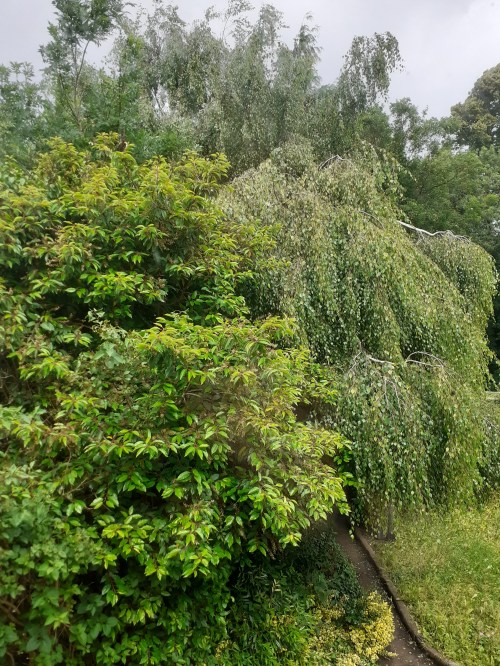
When I say ‘oneness’, I mean interbeing rather than singularity. I am talking about the web of life, the great song, a field of living presence. Singularity allows only an I. Interbeing has room for I and You and We and They. This recent picture of a half-hidden corner in our garden, taken by my wife Elaine, makes the point. The fact that she took it also reminds me that the mature recognition of ‘you’ is the foundation of true relationship.
This oneness of interbeing does not need a myth of origin to sustain it. Interbeing just is. I’m an intuitive idealist, fascinated by metaphysical questions, including questions of origin, and the systems of myth and metaphor which address them. But I am not spiritually dependent on answers. That is the advantage of Druidry as a practice rooted in nature. Today is a day for celebrating the natural side of my path.
There is wisdom in this slender poem. Mediating wisdom is a traditional task of the Druid. This includes recognising wisdom in others and passing it on. For my own Druid path, the invitation to “be what you want, know it in your heart” has always had a resonance. The poem as a whole points to a more grounded stance in our lives.
Jeff Foster’s words are the product of recovery journey that led him out of debilitating levels of depression and suicide risk. This involved in inward turn, away from external markers for success in the wider world, that paradoxically enabled his true ability to connect. Hence his complete reframe of ‘abundance’. Elsewhere in the same book (1) he says: “abundance is your connection to each breath, how sensitive you are to every flicker of sensation and emotion in your body … the feeling of the afternoon breeze on your cheeks, the sun warming your face. It is meeting others in the field of honesty and vulnerability, connecting beyond the story, sharing what is alive”.
He also says that it is “knowing yourself as presence, the power that creates and moves worlds”. This has become a crucial understanding within my renewed and consolidated practice of Druidry. It is an insight common to the perennial wisdom traditions, and so a place where many paths converge. It aligns Jeff Foster with R. J. Stewart’s view, recently explored in this blog, that “we are the tree of life” and “the stars are within us” (2,3).
(1) Jeff Foster The Way of Rest: Finding the Courage to Hold Everything in Love Boulder, CO: Sounds True, 2016
(2) R. J. Stewart TheMiracle Tree: Demystifying the Qabalah Franklin Lakes, NJ: New Page Books 2003
(3) R. J. Stewart The Way of Merlin: the Prophet, the Goddess and the Land London: The Aquarian Press, 1991
My wife Elaine created this midsummer cauldron fire, now ten days ago. It was fuelled in part by dry dead leaves. She chose the evening of the day itself rather than the traditional eve. The point about midsummer (24 June) is that the sun is on the move again after its moment of stasis, clearly beginning its decline. It acts as the polar opposite of the Sol Invictus or Christmas festival in late December. The Church gives 24 June to John the Baptist, decapitated at the wish of his nemesis Salome.
In our neighbourhood, there is a paradox about July. It is the quintessential summer month, in which the light begins to diminish. At the moment, sunrise is at about 4.50 am., with sunset at 9.20 pm. By Lughnasadh, it will be rising at 5.25 am and setting before 8.50 pm. In August, the process will accelerate while the earth and sea remain warm by North Atlantic standards. Getting up an hour or so after sunrise I am tending to find a dull and cloudy sky. There can be a stillness in the air, disturbed perhaps by blackbird pair flying low amongst the trees. I have a sense of latency.
The inquiry phase beginning at the 2019 winter solstice has settled a number of issues. I am re-confirmed in a modern Druid practice that is held within a circle and seven directions (E, S, W, N, below, above, centre), and is mindful of the wheel of the year. I also settled my approach to ethics at the beginning of this inquiry year (1) drawing on the work of modern Pagan philosopher Brendan Myers with his re-visioning of ancient Greek ‘virtue’ ethics (2). I have deepened in my experience of an at-homeness in the flowing moment, and its therapeutic benefits, which I wrote about last year (3). Fully established in my life, these are no longer fundamental inquiry issues. The uncertainties I formerly had with them are like dead leaves, now safe to burn.
For all that I have gained from other paths – Tantra, Tao, Zen, other forms of Buddhism, and Christian Gnosticism – I know that I will not be practising or following them. I will continue to appreciate their literatures and cite them in this blog, but this will be from the perspective of the appreciative outsider. Here too the active inquiry is over. Uncertainties have shrunken into dead leaves, and are safe to burn.
I know that, in the turbulent, airy mental realm, I have contending gnostic and agnostic energies. They are co-arising twins, and neither is going away. I still have work to do to find a settled home for them both. I am also concerned about how, more elegantly, to fit an ‘emptiness’ understanding into an earth pathway. A feeling about myth, and the truth and beauty of myth, is tied up with this. In the coming phase, I will look again at R. J. Stewart’s Merlin work for help with these questions. This reprise is also part of my older person’s looking back, recalling what I have valued, and asking what role it can still play. It sets my direction for the second half of the year.
Scotland’s Merlin: A Medieval Legend and its Dark Age Origins, by Tim Clarkson Edinburgh: John Donald, 2016. I find this book a useful resource. Author Tim Clarkson says of Merlin that, “like King Arthur and Robin Hood, he is both familiar and mysterious – an enigmatic figure who seems to stand on the shadowy frontier between history and myth”. Clarkson is firmly on the historical side of that frontier, working clearly and accessibly through the early literature as he quests for the source of the legend. Some of it is a proto-Merlin literature in which the central figure bears other names: Lailoken for the wild man of the Caledonian woods; Emrys for the young prophet of Snowdonia. Myrddin Wyllt is the name given in a group of early Welsh poems to the Scottish Lailoken, and Geoffrey of Monmouth goes on to create the medieval Merlin out of these and other disparate sources. Clarkson provides extensive extracts from the literature, showing how the Merlin of Arthurian literary legend was able to emerge.
Clarkson’s main interest is in the Merlin who, traumatised by his experience of the Battle of Arfderydd, flees to the forest. The battle was an historical event, was fought in C. E. 573 and is well covered by Clarkson, who earned his PhD with a study of warfare in early historic (i.e ‘dark age’) northern Britain. Historically, there is real difficulty in knowing who was fighting against whom, and what their motivations were. In a Scottish hagiography of St. Kentigern, Lailoken is simply a veteran of the battle. Its context is not discussed, and little is said about Lailoken himself, beyond describing his broken wildness. He has occasional encounters with St. Kentigern, who eventually blesses him. Shortly after this he suffers a threefold death, as he himself had prophesied, by falling down the banks of the Tweed onto a sharp stake with his head bent into the water. Everyone praises St. Kentigern for enabling Lailoken’s salvation by blessing him in time.
By contrast, Geoffrey’s Merlin (1) recovers, and he becomes a contemplative forest hermit together with his sister Ganieda. His madness has been a journey, not just a torment. A threefold death is prophesied by Merlin, and occurs. But it is not his own death. Instead, Merlin gets a new lease of life revolving around summers in the woods and winters in an observatory that has been built for him. He is able to have erudite and wide-ranging conversations with his visitor Taliesin, presented as a colleague and peer. But the setting is the same, a specific landscape in south west Scotland, where early British place names are still found – Loch Mabon, the River Nith and Caer Laverock (on Solway Firth at the mouth of the Nith) being three of them, with two ancient god forms thereby remembered. For me, the written records are a demonstration of how culture, and cultural agendas, change over time. Fragments of stories are pressed into the service of new cultural imperatives. The deeper past keeps its secrets, even whilst new understandings are crafted around its after-image.
There is no sense here of the what R. J. Stewart calls the Mystery of Merlin (2) – no suggestion of a local connection with the youthful prophet, though local Mabon names point to one. The Romano-Celtic world (including this region, immediately north of the wall) had Apollo Maponus as a significant deity. Clarkson is good at orienting readers to the general culture of early historic Scotland, and relating his Merlin story to a specific local landscape – with a good selection of maps and plates. He explains that, in the context of the sixth century, ‘Britain’ names an island without any political connotations. The terms ‘British’ or ‘Britons’ describe the native Celtic people who once inhabited the whole island. The story is set in what later Welsh literature described as Hen Ogledd (The Old North), which Clarkson takes to be southern Scotland below the Forth Clyde isthmus, “together with some adjacent parts of what is now England”. He notes that, by 800 C.E., on the eve of the Viking invasions, the British ruled in only three areas: Cornwall, Wales and the Valley of the Clyde.
Clarkson is the author of The Men of the North (4) and The Picts (5) which between them cover much of Scotland in the early historic period. He believes that a kernel of the Merlin/Lailoken story – about battle trauma and flight to the woods – is about an historic individual who took part. He also acknowledges that the story may preserve a memory of early shamanic practices in the locality. Merlin lives on in many different ways.
(1) Mark Walker Geoffrey of Monmouth’s Life of Merlin: A New Verse Translation Stroud: Amberley, 2011
(2) R. J Stewart The Way of Merlin: the Prophet, the Goddess and the Land London: The Aquarian Press, 1991
(3) Tim Clarkson The Men of the North: The Britons of Southern Scotland Edinburgh: Birlinn, 2010
(4) Tim Clarkson The Picts: A History Edinburgh: Birlinn, 2012
By simply looking out from my bedroom window, I can enjoy the abundance of high summer, as the year moves on from the solstice. The lush foliage speaks of ease and fulfilment. ‘Summertime and the living is easy’, says the old song. In a customised version of the Buddhist lovingkindness meditation, I say: ‘A blessing on my life. May I be free from harm; may I be healthy; may I be happy; may I live with ease’ … gradually extending the circle of care through my loved ones through wider circles of acquaintance, eventually including all beings throughout the cosmos. But what does living with ease add to freedom from harm, or to health and happiness?
In my experience, this comes from my experience of ‘at-homeness in the flowing moment’. I treat the flowing moment as a quality of experience rather than a unit of time. Otherwise I might be tempted to measure the right length of a moment’ to be ‘present’ or ‘flow’ in. It would have to be brief, but long enough to register experientially. Even so, I would probably find myself lying in wait for such a moment in the hope of catching one before it went. This would not be a skilful means of living with ease.
Instead, I enter the flowing moment, intentionally, by slowing down and taking notice. Eyes open, I take in the world visually, in all its riches, and check out my sensations, feelings, thoughts and any internal imagery that might override the physical view. I am not identified with any of these experiences. They are not me. I am empty and at home in the flow of sensation and perception. In this state, I ideally avoid stories like ‘there are trees on the other side of this window’. If I enter such a story, that is just another passing experience, a bubble in the flowing moment. It is in my empty core that the flowing moment becomes my home. In a sense, it is the emptiness itself that is the home. But it feels most like home when a world of sensation and perception appears to fill the space. Emptiness and form are interdependent. They need each other to flourish.
The flowing moment is not my default setting in daily life. Other states of attention come to the fore. The flowing moment, which I can enter and leave at any time, is available as a home to go to when I want or need it: hence my phrase ‘at-homeness in the flowing moment’. Entering and leaving is a conscious, careful decision, though it does not require retreat conditions or labelling as a formal spiritual practice.
‘At-homeness in the flowing moment’ can work in bad times as well as good. For the emptiness at my core can also be full and loving. It does not judge distressed and negative reactions. It does not try to smooth over feelings of dismay about the wider world. It holds them in peace and lovingkindness. In my morning circle, I ask for peace in the four directions, in the below, the above and throughout the world. But the centre is different. I stand in the peace of the centre, at the heart of living presence. This is the source of my ease, the nurturing emptiness that stands behind my at-homeness in the flowing moment .
On a recent evening I watched lightning, heard thunder, and waited for the rain. It came quickly, fast and hard. It changed my sense of the year. It was as if, at least for some part of me, the blessings of the solstice moment were threatened with cancellation. I remembered autumn and winter last year, and what seemed like relentless wetness. Was our sun kissed respite, itself made strange by Covid-19 and the lockdown, to be so brief?
The wheel of the year, moving through familiar seasons, was once a comfort. Bad things could and did happen. There were big variations from year to year. Yet on a human timescale there seemed to be a pattern. The ritual year told us that nature was reliable within certain limits. The gathering pace of climate change has undermined this perception. In different ways, throughout the globe, the old patterns are being disrupted without settling into new ones – greater changes are to be expected.
The sun will rise at the solstice as it always does. Here in England, I would never have expected to predict the weather of the day. But this year I do feel a raw anxiety about the future. Happily, my at-homeness in the flowing moment is strong enough to hold this anxiety. I accept and welcome it as the experience I am given, mine to live even within the act of resistance itself. Self-compassion and thence a wider compassion arise from this. Yet, as I link my contemplative inquiry to the theme of ageing, I wonder about harvesting and legacy in my own life. Do such notions even make sense?
For the last six months I have rebuilt a specifically Druid practice, restoring the pattern of the circle and four directions, restoring height and depth dimensions, affirming a strong centre. I am working with levels of experience I describe as physical, psychic and causal. I want my spiritual life, which is all my life, to be a coherent witness to my experience and values. In spite of threatening clouds, I remain fired up for this, by an ever rejuvenating sun within, as I approach the decline of the year.
Image from R. J. Stewart’s The Merlin Tarot, illustration by Miranda Grey Aquarian Press, 1992
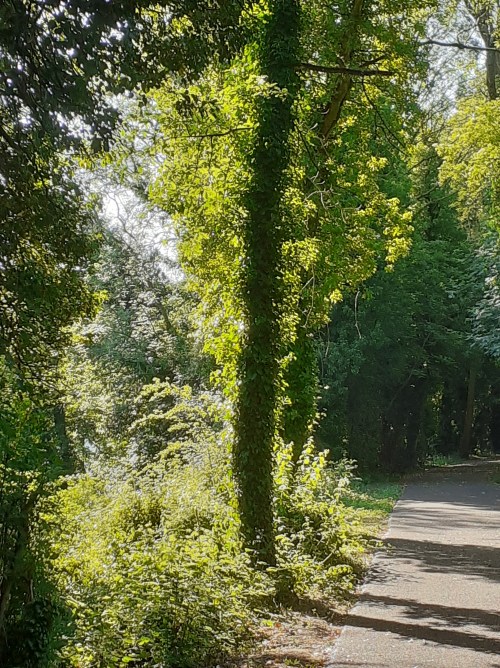
The picture shows the power of sunlight on trees to an observer – me, using my sight and my phone camera. I am not sure what it is like for the trees themselves, but I imagine it to be a positive experience.
This post is about the effects of the same power in my own psychic life. In a personal meditation, “I find myself in a walled garden. It has a fountain at the centre, surrounded by four flower beds of alternating red and white roses. There are fruit trees, apple, pear and plum, trained around the walls. It is a warm and radiant midsummer morning. The full bright sunlight strikes the dazzling water of the fountain, warming and illuminating each drop as it falls. I can hear the plashing of the fountain, and birdsong a little further off. My bare feet are on the lush grass. The air is sweet. The sun is at my back, recharging my energy, in particular activating the sun in my heart”. From that point, the meditation can continue and deepen in a number of ways.
This garden is the Garden of Wisdom, the Wisdom of William Anderson’s Green Man poem (1), a poem of 13 four-line verses, where each line covers a week. Though the Green Man has a lover in the spring, Wisdom is named, as Wisdom, in only one verse.
26 Oct-1 Nov: The reedbeds are flanking in silence the islands
2 Nov–8 Nov: Where meditates Wisdom as she waits and waits.
9 Nov-15 Nov: ‘I have kept her secret’, say the Green Man.
16 Nov -22 Nov: ‘I have kept her secret’, says he.
But at the present time of year, the focus is on the transformation of the Green Man himself, his head having been offed between 25 May and 7 June.
8 June – 14 June: Green Man becomes grown man in flames of the oak
15 June-21 June: As its crown forms his mask and its leafage his features
22 June -28 June: ‘I speak through the oak’, says the Green Man,
29 June – 5 July: ‘I speak through the oak’, says he.
Late in 2019, I stopped calling my inquiry path a ‘Sophian Way’ and re-centred it in Druidry. It was the right decision, and I have found it very fruitful. But at the psychic, Innerworld level, I have experienced a sense of loss concerning aspects of the Sophian Way, especially the space I called Sophia’s Garden. Now, thankfully, I have found that a simple re-naming as Wisdom’s Garden has been enough to re-integrate it within my current Druid practice. A more specific link with William Anderson’s Pagan, earth-centred poem also helps. Wisdom speaks through the wheel of the year, and acts as a companion and guide within my Druid path, on both the physical and psychic levels. She is also Zoe, the life beyond time, and the Green Man Bios, the life which is born, dies and is born again. It seems to me that we are both of them. Perhaps that is Wisdom’s secret.
(1) William Anderson Green Man: Archetype of Our Oneness with the Earth: London and San Francisco: HarperCollins, 1990 (Photography by Clive Hicks)
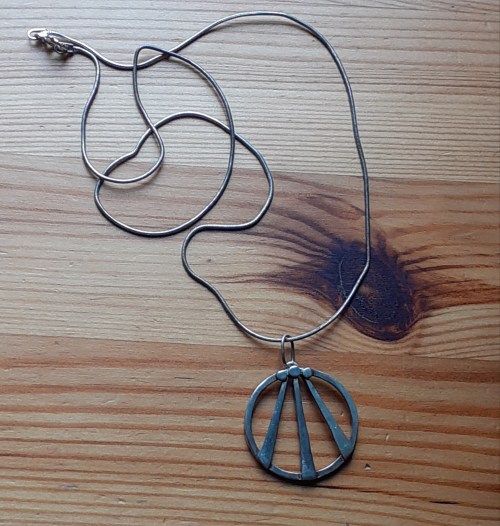
“If you want the truth, I’ll tell you the truth. Listen to the secret sound, the real sound, which is inside you (1) .” When I work with Awen in chanting and meditation, Awen, as a sound, stands for the Oran Mor, “the ancient ‘music behind the world’ that has always been woven into the daily awareness of the adherents of various Celtic traditions” (2). Awen invites me to immerse myself in its pulse and vibration, and to find a unique note within them.
This note, which in practice may manifest also as a felt sense, image or insight, forms the basis of my individual voice when connected to Awen. If truly connected, it speaks with the tongue that cannot not lie, the words flowing from authentic experience. Provided this condition is met, the voice can make use of my limitations as well as my strengths. It draws on my natural desire to communicate, whilst serving a collective purpose. I am not a specialist in the fields of bardistry or seer-ship, not one of the awenyddion. Awen has guided me down a Druid contemplative path in the form of an open inquiry. It is here that my spiritual energy has been ignited, providing me with a story to live and to tell.
Celtic spirituality has been described as “an ongoing initiation into a life of beauty and a mindful preparation for the passage of death … a dynamic orientation to the ebb and flow of the seasons, daily practices that foster an awareness of the passage of our lives, and of thanatology (a vision and study of our death and dying)” (3). It also has an inward pull – to dreams, the Otherworld and back to Source, which is why my practice embraces the physical, psychic and causal domains and the capacity to move between them. I am now clearer about adjusting my inquiry to devote more attention to my journey into later life (4) and its distinctive contexts in nature, culture, place and time.
(1) Sally Kempton Meditation for the Love of it: enjoying your own deepest experience Boulder, CO: Sounds True, 2011 (Foreword by Elizabeth Gilbert). Kabir was a poet-singer and mystic from fifteenth century India. In Indian Vedantic/Tantric culture, OM is the primal originative sound. AUM (so like Awen) is its feminine form, the creative energy or Shakti of the cosmos giving shape and substance to the material world.
(2) Frank MacEowan The Celtic Way of Seeing: Meditations on the Spirit Wheel Novato, CA: New World Library, 2007 (Foreword by Tom Cowan)
(3) Frank MacEowan The Mist-Filled Path: Celtic Wisdom for Exiles, Wanderers and Seekers Novato, CA: New World Library, 2002 (Foreword by Tom Cowan)
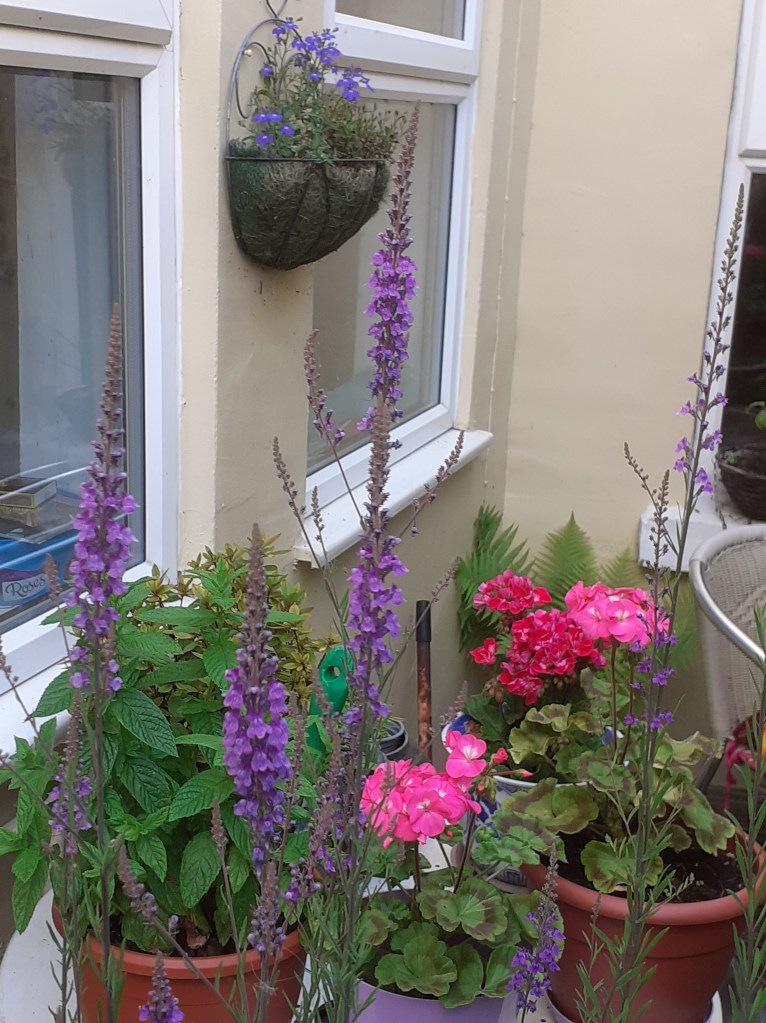
On 2 June I enjoyed a simple, senior day. A picture anchors its feeling-tone and will prompt my memory in times to come. On this day, I went nowhere. On this day, I did no inquiring. In this day, I could hardly tell the difference between thinking and looking out of the window.
The day was both ordinary and unique, tied to a cherished space and with its own distinctive features. It was the day before the weather broke, the last of a warm, dry and sunny spell that has blessed us during the lockdown. But the break was clearly coming and that, too, would be welcomed.
More importantly, my day was an extended moment of companionship with my wife Elaine (sometimes in separate spaces, sometimes sharing one). In part we were just there. In part I was time conscious, looking forward to Elaine’s coming birthday, not long after my own – and then our relationship anniversary in the coming June days. As the wheel turns, anticipation flavours the now. Memory flavours the now too, and I want to remember this day, and the value of its simple, senior pleasures.
My world is now in full summer, rich in life and growth, palpably drawn towards the solstice moment. Even in the middle of the woods the solar influence is evident, vivifying both light and shade. The power and clarity of midsummer’s day will be balanced by the different energy, conceivably more disturbing, of the midsummer night’s dream.
Sometimes it is easy to see the path behind, but not the one ahead. In the first half of this inquiry year I have refined my personal Druid practice and strengthened my contemplative inquiry. Giving more energy to this blog has helped. I am clear that, whilst not mobilised around deity and devotion, I also do not accept current positivistic science as a complete account of lived experience. I incline to a ‘consciousness first’ view of cosmos because it offers the richest contextualisation of the ‘at-homeness in the flowing moment’ experience now at the core of my own life. But the map is not the territory, and I have stayed away from adopting this as a doctrine. It feels good to have clarity here, and also to remain appreciatively at ease with other points of view and their protagonists.
My recent awen inquiry has stirred up a range of feelings, thoughts, images and intuitions. I do not see a path ahead very clearly. But I intuit that my future direction may be explicitly age-related, at least to some degree. I had my 71st birthday last week. So now I’m not just 70: I’m ‘in my 70’s’. As a contemplation I am using a passage from James Hillman’s The Force of Character and The Lasting Life (1). As I get to know it better, I will discover what inspiration it offers.
“T. S. Eliot wrote that ‘Old men ought to be explorers’; I take this to mean: follow curiosity, inquire into important ideas, risk transgression. According to the brilliant Spanish philosopher Jose Ortega y Gasset, ‘inquiry’ is our nearest equivalent to the Greek alethia (2), … ‘an endeavour … to place us in contact with the naked reality … concealed behind the robes of falsehood.’ Falsehood often wears the robes of commonly accepted truths, the common unconsciousness we share with one another … we must become involved wholeheartedly in the events of ageing. This takes both curiosity and courage. By ‘courage’ I mean letting go of old ideas and letting go to odd ideas, shifting the significance of the events we fear.”
(1) James Hillman The Force of Character and the Lasting Life Milson’s Point, AUS: Random House Australia, 1999
(2) As in alethiometer, for readers of Philip Pullman’s His Dark Materials trilogy






 Contemplative Inquiry