A highly recommended illustration of spirituality in support of political action. In The Burning House: A Buddhist Response to the Climate and Ecological Emergency (1), author Shantigarbha affirms that ‘the ecological crisis is nothing if not a spiritual crisis, a crisis of meaning and direction for our civilisation’. Most Druids would say the same, and see value in his approach.
Shantigarbha (Seed or Womb of Peace) (2) is a teacher of Buddhism and Nonviolent Communication (NVC). He has also trained members of Extinction Rebellion (XR) in nonviolence and de-escalation skills. He believes that we cannot wait to change our lives before we change the world, or to change the world before we change our lives: we have to do the best we can with both, together, now. He sees the climate crisis as primarily one of ’empathy, connection and community’ and says that ‘when we use our energy to cultivate our own vitality, we naturally use the abundance we discover in the service of life’.
The book title The Burning House references a traditional Buddhist story about a father trying to get his children out of a burning house. There is no time to pick them up individually, so he simply commands them to leave. But they are busy playing with their toys and ignore him. He has to find a skilful means of getting them out. In his anguish (but also inspiration) he tells them that there are even more wonderful and exciting toys outside. In the parable the burning house stands for a life of samsara and unawareness. Outside there is the opportunity for awareness and the tools to develop it.
The book looks first at the climate crisis and ways it can be understood. There follow chapters on how Buddhist ethics support environmental ethics, and how compassionate action based on wisdom can enable the transformation we need. There are chapters on aspects of emotional intelligence. How to transform anger is the first – rather than acting out our anger or repressing it, we can identify and mobilise ‘the life in it’. Hatred, by contrast, is characterised as always toxic and self-harming. There are chapters on ecological grief and its potentially heavy weight – and also on gratitude for what we do still have. There is a beautiful quote from Francis Weller: ‘How much sorrow can I hold? That’s how much gratitude I can give. If I carry only grief, I’ll bend toward cynicism and despair. If I have only gratitude, I’ll become saccharine and won’t develop much compassion for other people’s suffering. Grief keeps the heart fluid and soft, which helps make compassion possible’ (3).
Later chapters focus more specifically on nonviolent social change, on being the change, and on the role of nonviolent disruption in the pursuit of climate justice. Practical examples draw on UK experience in 2019, mostly in London and Bristol. Whilst illuminating, they are limited in place and time. The last chapter, Final thoughts: the beauty and terror, summarises what we can do both individually and collectively. It sees some grounds for hope – if we treat the climate and ecological emergency as an emergency. Shantigarbha draws on Sraddha, ‘the Buddhist equivalent of hope’, better translated as confidence or trust. It is not faith or hope in the ordinary sense. ‘Sraddha represents a higher or broader perspective, our connection with vision. It signifies an emotional response to our ideals. In terms of the burning house it represents the father’s cry of inspiration’. We are invited to have the courage and confidence to do what we can, and let the effects ripple out. It is what we can do, and all we can do.
The Burning House offers valuable perspectives both on Buddhist political engagement and on climate action. Each chapter contains a link to a guided meditation, offered as a resource to readers.
(1) Shantigarbha The Burning House: A Buddhist Response to the Climate and Ecological Emergency Cambridge: Windhorse Publications, 2021 (https://www.windhorsepublications.com)
(2) See: https://www.SeedofPeace.org
(3) See: https://www.thesunmagazine.org/issues/478/the-geography-of-sorrow)
Here, indeed, is no ordinary spot:
no place on the map, in the cosmos,
is anything like it.
This still Centre is the one spot
where energy is actually discovered
welling up out of Nothing.
All the irresistible torrents
which swirl and roar through every other place
rise silently in this place,
never ruffling its perfect calm.
Douglas Harding Everyday Seeing: daily meditations on the One within. London: The Shollond Trust, 2019 (Quotations selected by Richard Lang)
The image is of two modern stained glass panels in Hereford Cathedral, commissioned in honour and remembrance of the seventeenth century priest, poet and mystic Thomas Traherne. The Anglican Church has dedicated 10 October to his memory. Here is the first verse of Desire, one of his poems:
“For giving me Desire,
An Eager Thirst, a burning Ardent Fire,
A virgin Infant Flame,
A Love with which into this World I came,
An Inward Hidden Heavenly Love,
Which on my Soul did work and Move,
And ever, ever me Enflame,
With restless longing Heavenly Avarice,
That never could be satisfied,
That incessantly a Paradice
Unknown suggest, and som thing undescried
Discern, and bear me to it; be
Thy Name for ever praised by me.” (1)
(1) Denise Inge (ed.) Happiness and Holiness: Thomas Traherne and His Writings London: The Canterbury Press Norwich, 2008 (Canterbury Studies in Spiritual Theology)
NOTE: Thomas Traherne (1636-74) was the son of a prosperous Hereford shoemaker – big house, numerous resident apprentices. He grew up during the civil war (1642-49) and England’s republican experiment (1649-1660) in a naturally royalist area. He entered Brasenose College, Oxford, in 1652 (16 being a normal age at the time) under a strictly Puritan head, took a BA in 1656 and was appointed minister at the Herefordshire Parish of Credenhill by the Commissioners for the Approbation of Public Preachers in 1657. As soon as Charles II returned to England Traherne arranged to be ordained as Credenhill’s Anglican vicar, developed strong links with the renewed life of Hereford Cathedral, and also found time to be Chaplain to Sir Orlando Bridgeman, Charles’ Lord Privy Seal. Denise Inge* describes Traherne as “distinguished from his seventeenth century peers by the fact that he is blissfully untroubled by the tensions, doubts, anxieties that (we are repeatedly told) mark the age in general”.
*Thomas Traherne Poetry and Prose London: Society for Promoting Christian Knowledge, 2002. (Selected and introduced by Denise Inge for the series The Golden Age of Spiritual Writing)
“Besides the countless particular miracles that we comprise, there is that supreme irregularity – the fact that anything exists at all. Most unnaturally, there is not just Nothing. How adroit for It to happen! How deserving of our congratulations It is, for having arranged its quite impossible existence! After that, what are a few billion universes more or less.”
These words are from Douglas Harding’s epilogue to The Hierarchy of Heaven & Earth (1) published on the recommendation of C. S. Lewis, distinguished scholar and Inkling. Lewis’ introduction places it among “philosophies that have some of the same qualities as works of art”, and he is reminded in that respect of Hermann Hesse’s Glass Bead Game.
Harding describes his work as “an unconventional attempt to discover, for myself and in my own way, what I am and what I amount to in the universe. What am I? That is the question. Let me answer it as honestly and simply as I can, forgetting the ready-made answers.”
Harding also has the courage to declare that he has not found an answer. Instead, he has entered a state of “amazed reverence” that reveals his whole inquiry as both “absurd” and “a needful absurdity”. He finds that “because all my roots are in the Undiscoverable, I also am undiscoverable: I will not bear inspection, and can never make head or tail of myself. Self-knowledge is the smouldering wick that is left after the light of wonder has been put out. … If this book quenches the feeblest flame of awe, of direct awareness, in myself or anyone else, then it were better never to have written it”.
Harding did not end his inquiry with The Hierarchy of Heaven & Earth. Instead, he went on to become a midwife of direct awareness, and The Headless Way (https://www.headless.org) was born. Where The Hierarchy of heaven & Earth is concerned with exuberant yet disciplined system building, Harding’s later work challenges each of us to ‘look for yourself’ using a set of experiments, now accessible on The Headless Way website. I reported an early, intensive experience of them on return from a four day retreat with the Headless Way in 2016 – https://contemplativeinquiry.blog/2016/07/28/look-for-yourself/ Interestingly, my wrap-around commentary, especially the post-workshop phase, would now be a little different from the one in that post, while my report of the direct experience remains the same. In my current practice, I particularly draw on a seven point version of the experiments presented in Head Off Stress (2).
I never met Douglas Harding in person – my discovery of the Headless Way is too recent. But his writing and recorded material show never-ending wonder at the miracle of existence. They also show his passion for facilitating a transformative recognition of who we really are, and then to live from that recognition.
“I certainly don’t find myself
on the brink of a bottomless abyss,
trying to make up my mind
whether to let go and take that dreadful plunge.
I am already clear of the brink
and free-falling,
and have never been otherwise.
To see this,
all I have to do is look for myself,
and fail to find myself, and find instead
the treasure that has no name
in the well
at the world’s end.”
(1) D. E. Harding The Hierarchy of Heaven & Earth London: The Shollond Trust, 2011 Introduction by C. S. Lewis. (Abridged edition – original edition published by Faber & Faber in 1952)
(2) D. E. Harding Head Off Stress: Beyond the Bottom Line London: The Shollond Trust, 2009 (Originally published by Arkana in 1990)
(3) Douglas Harding Everyday Seeing: daily meditations on the One within London: The Shollond Trust, 2019 (Quotations selected by Richard Land)
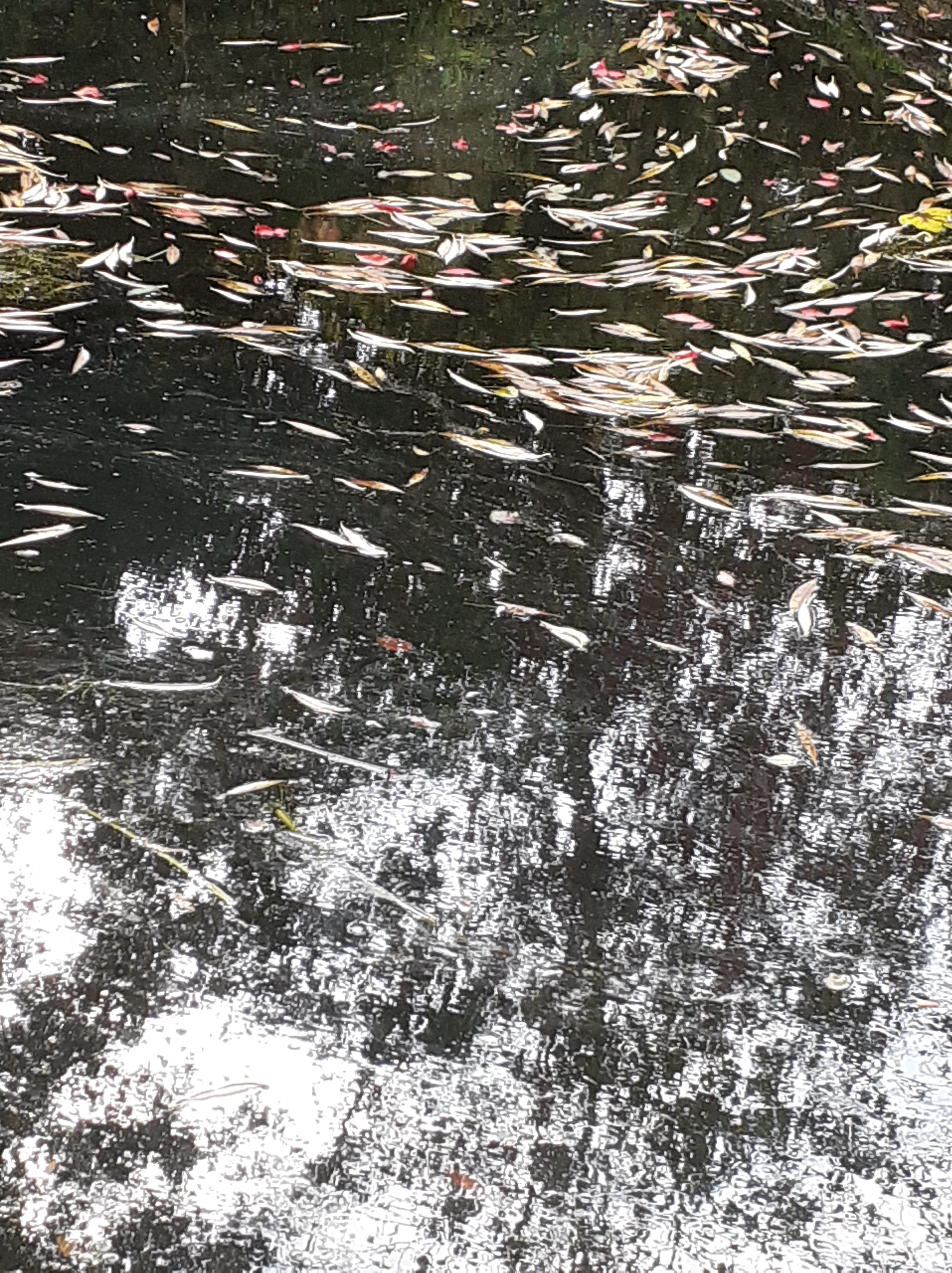
I am looking downwards into water, identifying patterns, on a surface that swirls and moves and changes. I have the same impulse to identify patterns in my contemplative life. In essence, contemplative experience is simple, still, and drawn from wordless depths. But there’s a surface swirl that’s more agitated, largely driven by worries over naming and explaining, clarifying where my inquiry sits within human communities, and accurately representing spiritual philosophies. Here too, I am giving the surface swirl the attention it seeks. I do not ask the swirl to stop swirling, because swirling is what it does. There is value in the swirl.
I centre myself in modern Druidry, but my self-presentation from 2012 as a ‘contemplative Druid’ is slightly misleading – too narrow. I champion the value of a contemplative current within Druidry, and I am happy to describe my blog as a contemplative inquiry. But I also have a strong commitment to the life of the world and opportunities for the flourishing of all beings, within both the constraints and the opportunities of our interconnectedness. I am concerned with our planet and its biosphere; with human history and culture; with ethics and engagement; with beauty as well as truth and goodness; and with issues of wounding and healing. They are part of my inquiry. I cannot separate them from my contemplative commitment.
I also celebrate the influence of ‘nondual’ currents outside Druidry. Nondual is a translation of advaita (not-two) in classical Sanskrit philosophy. It describes the divine/human relationship. Its original home is the Advaita Vedanta path in India, but there are nondualists in other world religions, including the Abrahamic ones: Sufi currents in Islam, Jewish Kabbalah, contemplative Christianity. In Christian terms, you would say that we are all essentially Christs – in a creation of one Light and many lamps. In some interpretations, nonduality does not apply only to humans, but to all lives in the cosmos. Some iterations of nonduality – Mahayana Buddhist and Taoist in particular – avoid the language of divinity, preferring terms like ‘true nature’ or the deliberately undefinable ‘Tao’.
I have engaged with current nondualist teachings for some years, most recently with the Eckhart Tolle community – https://www.eckharttolle.com. I have learned a lot from them. In this blog’s About section, I say: “My inquiry process overall has helped me to discover an underlying peace and at-homeness in the present moment, which, when experienced clearly and spaciously, nourishes and illuminates my life. It is not dependent on belief or circumstance, but on the ultimate acceptance that this is what is given”.
I could maintain this stance as a humanist or existentialist, but my deepest intuition is that the ‘present moment’ (or eternal now), fully experienced, links my passing personal identity to a cosmic one, a ground of being that is my true nature. Belief has come in: ‘willingness to follow one’s deepest intuition’ is one definition of faith, and I have surprised myself by becoming a person of faith in this sense. The purpose of continuing inquiry is to keep me open to new experiences, understandings, and connections, as well as teaching me how best to live from the peace and at-homeness of the centre.
My inquiry is a self-directed enterprise that welcomes input from multiple sources. But I draw on two main centres of community wisdom and support. The first is OBOD Druidry (https://www.druidry.org), with its embrace of the earth and its loyalty to the world of space and time, nature and culture. For many of us this includes the sense of a living cosmos and a divine ground. The second is the specifically nondualist Headless Way, based on the work of the late Douglas Harding (https://www.headless.org). I have started to think of myself as a Headless Druid, in a modern kind of way, whilst also aware of older traditions in which decapitation is indeed the gateway to a larger life:
‘It’s off with my head’, says the Green Man,
‘It’s off with my head’, says he.
Green Man becomes grown man in flames of the oak
As its crown forms his mask and its leafage his features;
‘I speak through the oak’, says the Green Man.
‘I speak through the oak’, says he.
William Anderson Green Man: Archetype of Our Oneness with the Earth Harper Collins: London & San Francisco, 1990.
See also: https://contemplativeinquiry.blog/2021/6/14/tree-mandala-oak and https://contemplativeinquiry.blog/2017/05/11/poem-green-man
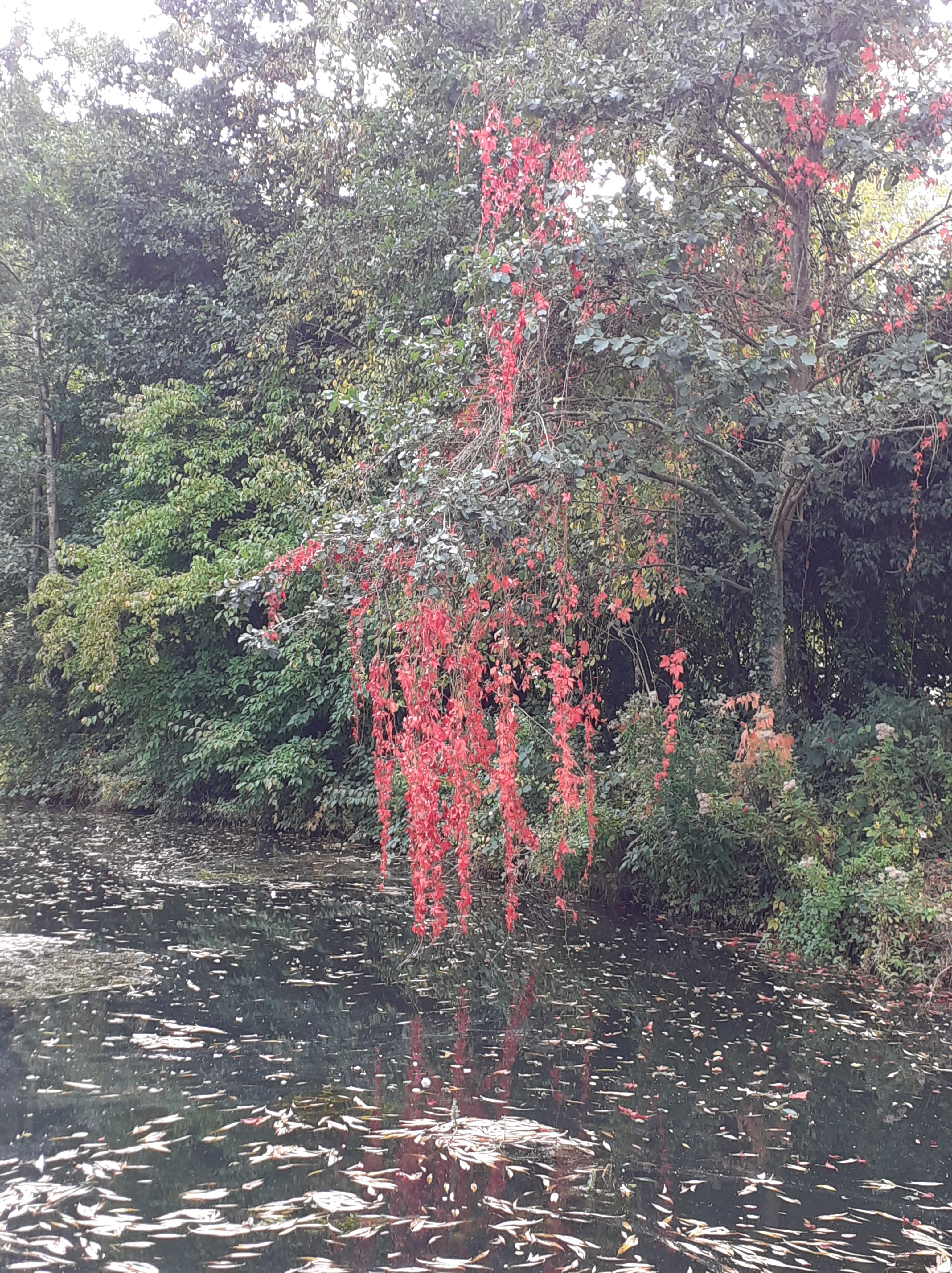
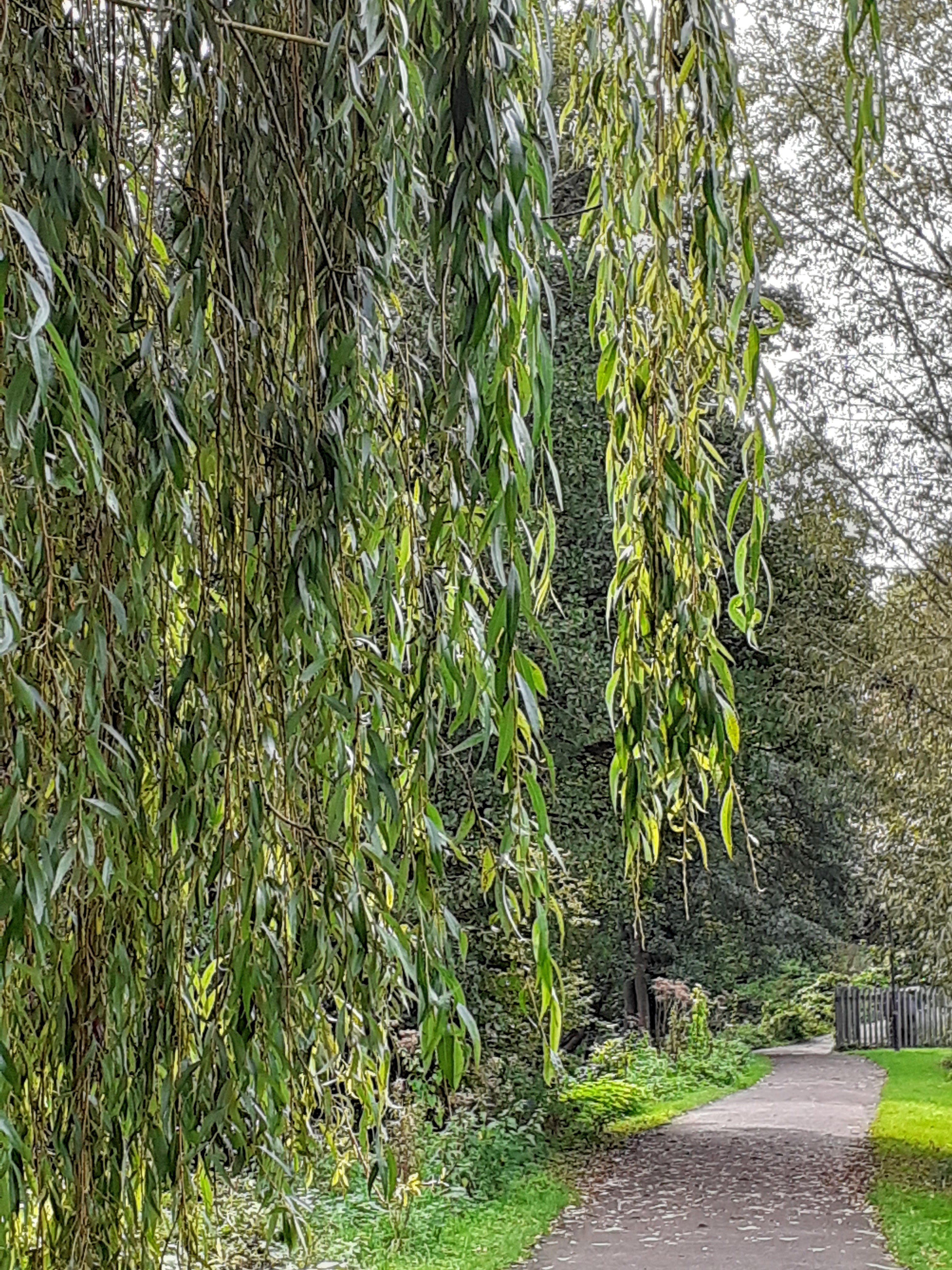
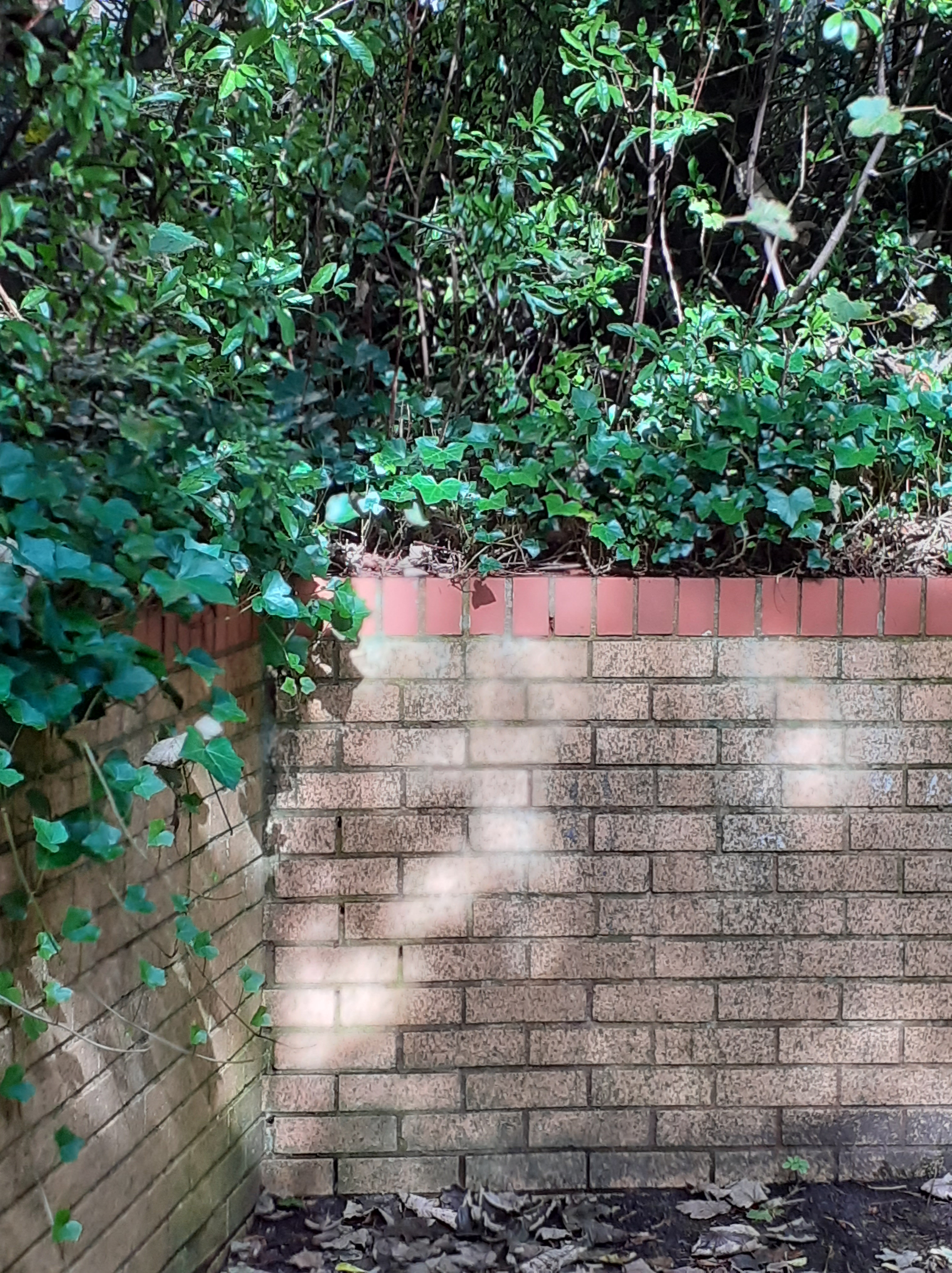
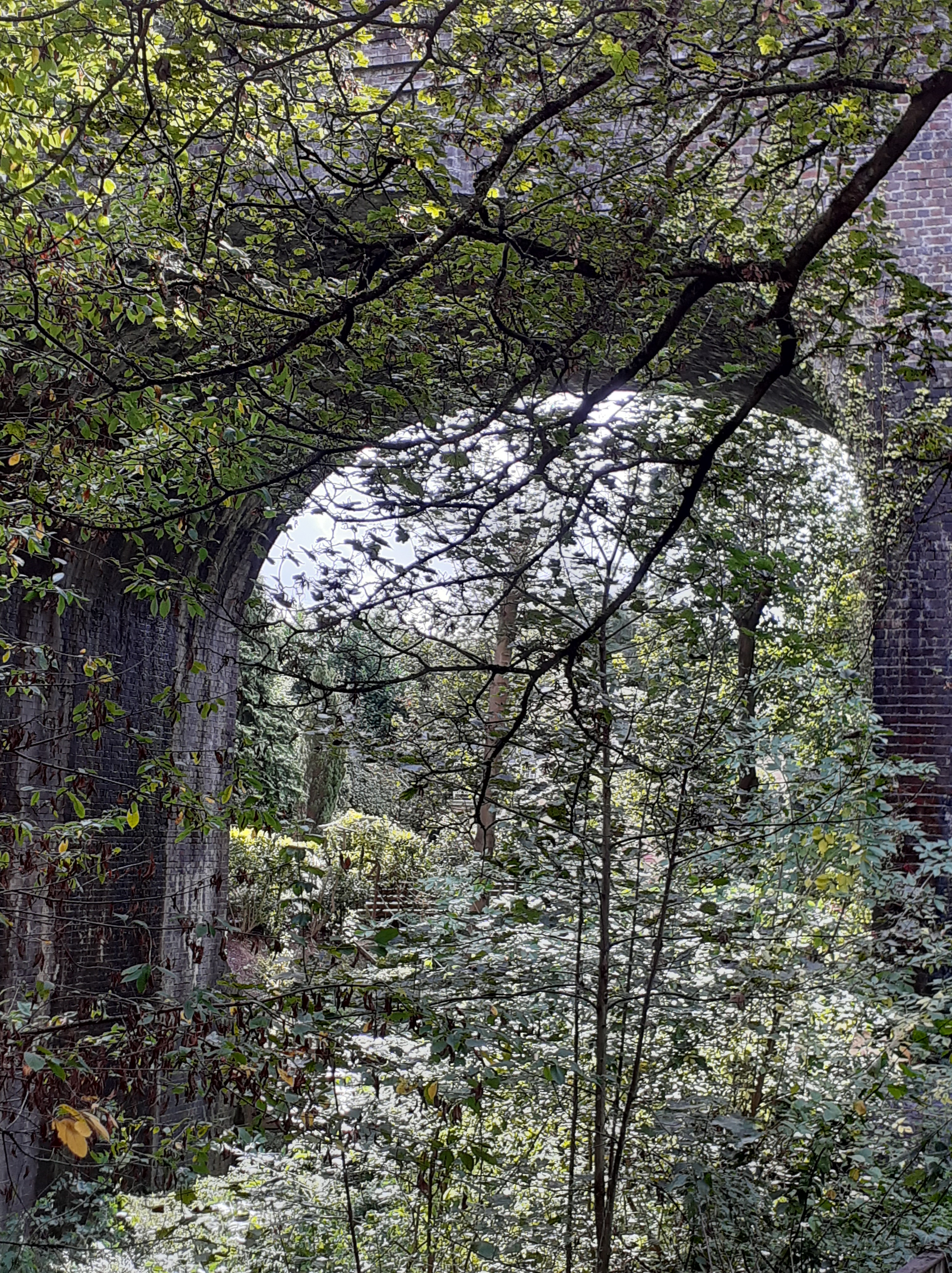
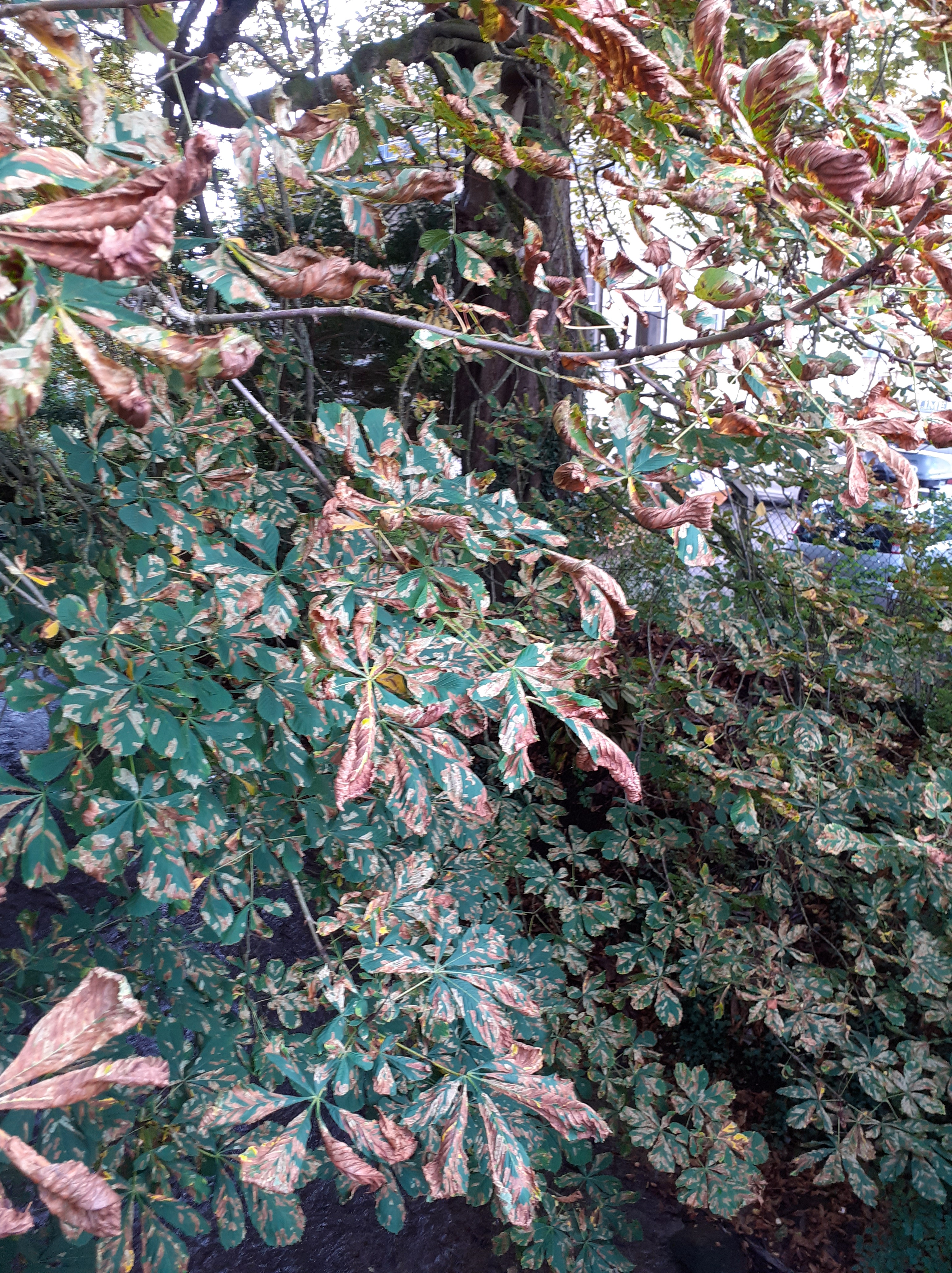
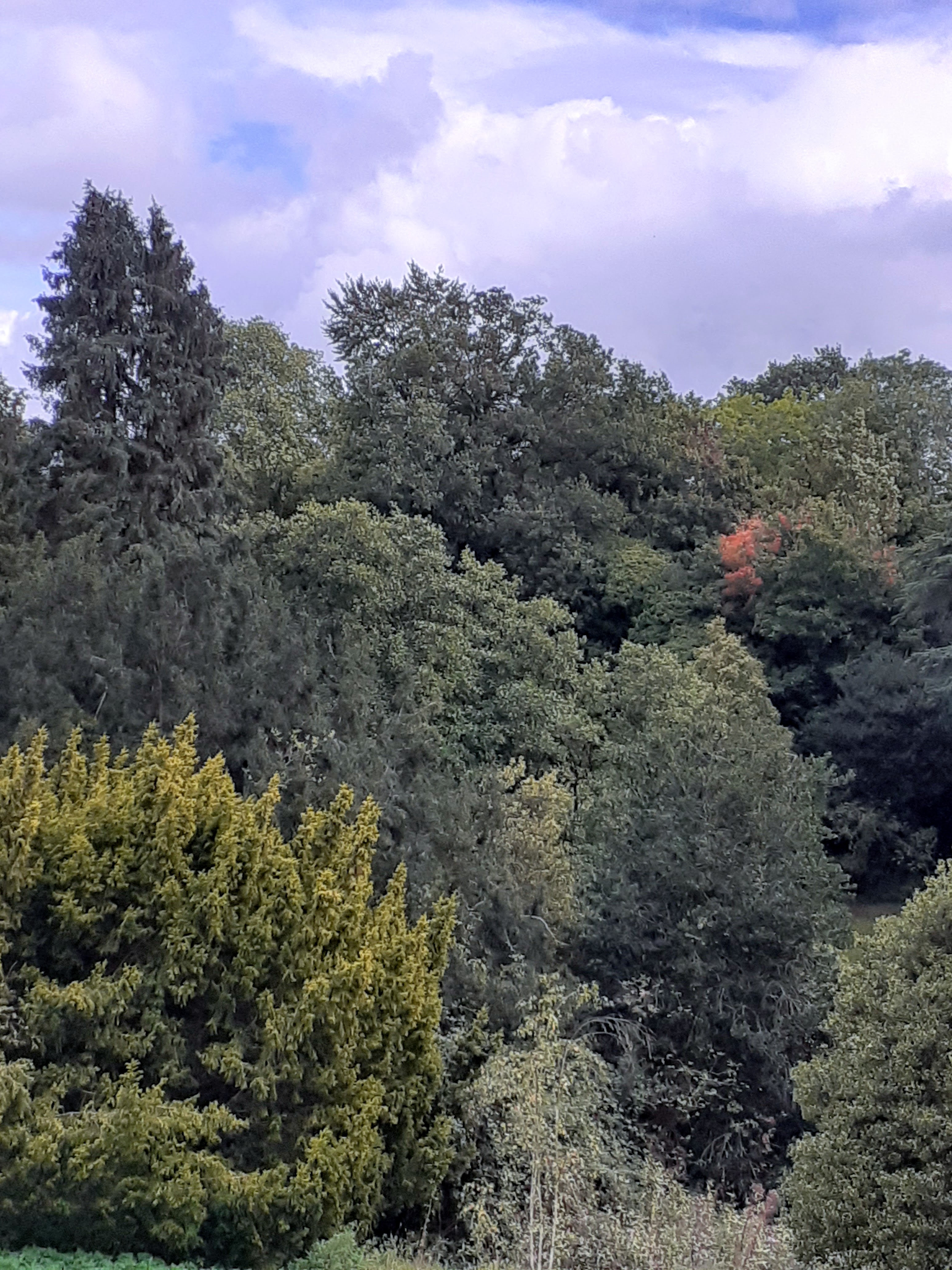
After the equinox comes a deepening of autumn. Light, colour, texture – my sense of the world is different. Images of this moment in the year shape my sense of time as well as of place. I savour the turning of the wheel. All time is transitional, yet every time has its own uniqueness.
Contemplating images like this is for me a way of sustaining what modern Druids sometimes call a re-enchantment with and of the world. Simple attention to the living world is a renewing experience, and protects the heart from what can seem like the half-life of a Wasteland culture. Opening to a living cosmos, I plead guilty, with pride, to the charge of Romanticism.
It is after 9 a.m. on Sunday 26 September, Locally I enjoy orange as a colour of ripening, rich and shiny with life, as the season of bearing fruit moves on.
There are trees whose leaves have already turned, but will stay on their branches for awhile, giving these woods a more mixed, autumnal appearance.
But there is still a preponderance of green, some of it surprisingly fresh. Here it provides a canopy of green light and shade.
The season is also asserting a downward pull, towards the earth and dissolution – a process, however, still in its early stages. The broken fence seems almost to be sharing this, beginning a return to the land.
Then there is the undergrowth, with its mix of living and dead wood, living and dead leaves, and the soil that holds them. The evergreen leaves are defiantly vivid. Taking pictures, I celebrate the time of year.
music that celebrates Earth and speaks to the heart
Follow the Moon's Cycle
Meeting nature on nature's terms
A little bit of Mark Rosher in South Gloucestershire, England
A monastic polytheist's and animist’s journal
Selkie Writing…
Images and words set against a backdrop of outsider art.
living with metacrisis and collapse
The pagan path. The Old Ways In New Times
Spiritual journeys in tending the living earth, permaculture, and nature-inspired arts
a magickal dialogue between nature and culture
The gentle art of living with less
Thoughts about living, loving and worshiping as an autistic Hearth Druid and Heathen. One woman's journey.
An place to read and share stories about the celtic seasonal festivals
Just another WordPress.com site
Exploring our connection to the wider world
Become more grounded and spacious with yourself and others, through your own body’s wisdom
Good lives on our one planet
News for the residents of Hopeless, Maine