Contemplative Inquiry

This blog is about contemplative inquiry

Tag: contemplation

NORTHWARD MIGRATION

For the last week I have been on Tyneside in North East England. My wife Elaine and I have been considering a northern migration for some while. It is too early to say whether and when this will happen. At the time of writing the prospects look good.

From a Druid perspective this is an opportunity for relationship with a new history and landscape. I enjoy the thought of this, even though I also like the locality I am in.

One aspect will be closer proximity to the sea. The pictures are of Tynemouth and what is left of its priory and castle, bravely facing the North Sea, whilst also overlooking an adjacent beach.

STOPPING FOR THE ANCESTORS

“I remember one morning contemplating a mountain in the early light of dawn. I saw very clearly that not only was I looking at the mountain, but all my ancestors in me were looking at the mountain as well.

“As dawn broke over the mountain peak we admired its beauty together. There was nowhere to go and nothing to do. We were free. We needed only to sit there and enjoy the sunrise. Or ancestors may never have had the chance to sit quietly, peacefully, and enjoy the sunrise like that.

“When we can stop the running, all our ancestors can stop at the same time. With the energy of mindfulness and awakening, we can stop on behalf of all our ancestors. It is not the stopping of a separate self alone, but of a whole lineage. As soon as there is stopping, there is happiness. There is peace.” (1)

When Thich Nhat Hanh tells this story, he shows us ‘mindfulness’ as an art of living. He stops, looks at a mountain at dawn. His contemplation becomes a relationship, and the relationship is extended to the ancestors. For him, mindfulness sits together with interbeing, his word for interconnectedness. It is not a personal accomplishment, but the portal to an expanded, more inclusive, experience of life.

Thich Nhat Hanh was a great advocate and teacher of formal sitting meditation. But he didn’t fetishise it. The Mahayana Buddhist world view, and particularly its ethics, mattered more. I once heard a senior Vietnamese follower (also a psychiatrist) say that she was cautious about teaching meditation in Vietnam. She said that even in the 21st century, decades after the Japanese, French, American and Chinese wars, with elements of civil war thrown in, many people in Vietnam are too traumatised to benefit from meditation. What works best is participation in the Buddhist community and its ceremonial life, in a spirit of generosity and compassion. Mindfulness is essentially a value, not a contemplative technique.

I stop for my own ancestors, of both blood and other inheritances. I become aware of holding them in my heart. I let them in as I let in the world around me, and I experience that world with them and for them. We share a brief period of deep peace, and then let it go. For me, it feels mindful, Druidic, and very natural. Something to return to, whenever the moment feels right.

(1) Thich Nhat Hanh The Art of Living London: Rider, 2017 (Rider is an imprint of Penguin Random House UK)

HADEWIJCH THE BEGUINE

How could I believe this

If I had not found it true?

The soul that wanders in free nakedness

Births all that is and will be,

Participates in ecstasy

In engendering the Son

In creation and re-creation

Of all the worlds.

In sublimest mystery

All words drown.

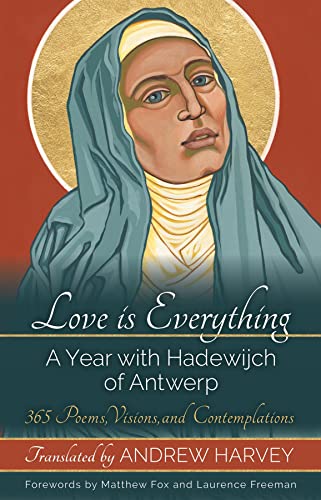
From: Andrew Harvey (translator) Love is Everything: A Year with Hadewijch of Antwerp: 365 Poems Singapore: Medio Media, 2002 (Forewords by Matthew Fox and Laurence Freeman)

Hadewijch of Antwerp lived in the 13th. century. She was a Beguine, part of a women’s lay order who took no religious vows beyond promising not to marry “as long as they lived as Beguines”. They could leave at any time. For a period, they flourished in the Low Countries, France, and the Rhineland. The only definitely known Beguine community (Beguinage) in England was in Norwich in the 15th. century, well after the time of Hadewijch or indeed the English anchoress Julian. Beguines stressed voluntary poverty (though they could keep their own property), care for the sick, and a life of devotion. They worked in the world, for example in the woollen and silk industries, and in laundries. Leading figures such as Hadewijch also wrote for the wider community and effectively developed their own theology.

Andrew Harvey salutes Hadewijch as “one of the most incandescent and inspired of all Christian mystics” and sees her now as pointing the way to an “evolutionary transformation into embodied divinity” that “our devastating global dark night is both urgently demanding and making possible”. Literate in Latin and French as well as the middle Dutch in which she wrote, Hadewijch was well acquainted with with the literature of Christian mysticism and also the works of the troubadour tradition with its own philosophy of love. She is known to have written 31 letters, 14 visions, 45 poems and stanzas, and 16 poems in couplets, initially circulated in the Flemish lowlands and in the Rhineland.

Hadewijch was influential on the historically better known mystics of the 14th. century – particularly Jan Ruusbroec, who acknowledged her influence in his own work, and probably also Meister Eckhart. But she herself was forgotten by the end of the 15th. century and not rediscovered until the middle of the 19th. It is only in recent decades that she has once more received widespread attention.

The church and society of Hadewijch’s day were at best ambivalent about the Beguines and their relative independence. Hadewijch was able to flourish for a time, but “the intensity of her witness to Christ consciousness aroused bitter opposition from both church clerics and from within her own community”. She may have spent time in prison and possibly lived her last years serving and sleeping as an unpaid helper in a leprosarium.

By the early 14th. century, attitudes had become even harder. The French Beguine Marguerite de Porete was burned at the stake in Paris in 1310, as a ‘relapsed heretic’. In her widely popular book The Mirror of Simple Souls, she had written that “a soul, annihilated in the love of the creator could, and should, grant to nature all that it desires”. Her view was that such a soul could desire nothing but good, and was incapable of sin. But her words were interpreted as an invitation to ignore the moral law, and to suggest that one had no need for the Church and its sacraments or its code of ethics.

In 1311-12, the Council of Vienne attacked the Beguines for their alleged tendency to “dispute and preach about the highest Trinity and the divine essence and introduce opinions contrary to the Catholic faith concerning the articles of faith and the sacraments of the Church”. Although the Beguines continued to function, they became more cautious, more mainstream for their time and more likely to be aligned to other Orders. There were no more influential writers that I am aware of. Their wings had been clipped. They were no longer a threat.

I am drawn to Hadewijch’s writing for its eloquence in evoking profound contemplative experiences. Her spiritual boldness and unswerving commitment earn my deepest respect. She reveals the power in contemplative culture. Though not on the same path as Hadewijch, I am sensitive also to the heartbreaking gender, theological and institutional issues raised by her life and work.

My personal take-away is that innovative spiritual movements, however contemplative and mystical, are also part of the social world. They need to develop supportive communities, however precarious and marginal. They are effectively co-creating new culture, and it needs to be nurtured and protected. They also need to avoid turning entirely inwards and degenerating into cults. The Beguines seem to have got this balance about right, despite the highly repressive conditions of their time. This is a source of inspiration in itself.

THE GATEWAY TO TWILIGHT

High summer becomes late summer, in my world, with a gentle movement into the evening of the year. In the picture above, taken a little after 8 pm, I at first feel, as much as see, a suggestion of muting light. On looking up, the blue of the sky seems influenced by a subtle greying effect that is independent of the clouds. Looking down, the buildings are shadowy and their reflections in the water are set within a gathering darkness.

The picture below was taken at 9 pm on the following day. The grey in the sky owes everything to clouds, whereas the orange and yellow are connected to sunset. The latter is reflected in the water, and electric lighting is now also present. The day is changing, but not yet into night. This is an in-between time, twilight. It is its own, extended moment, quietly shifting in the physical world, profoundly influential in my psychic world.

I feel joy with an edge of melancholy. It is a familiar feeling that stretches deeply into my early life, prior to language, older than memory itself. It seems to come from deep time, and to be pre-personal, not just about ‘me’. I am any finite being, moving from day towards night, from summer towards winter, from life towards death. Having shifted decisively away from the zenith, I find myself, for now, in a beautiful moment. The Gloucester docks provide me with a magical space for walking, standing still, experiencing and recording this time.

POEM: CONFRONTED BY CHRYSANTHEMUMS

For his morning tea

A priest sits down

In utter silence –

Confronted by chrysanthemums.

Matsuo Basho The Narrow Road to the Deep North and Other Travel Sketches London: Penguin Books, 1966 (translated with an introduction by Nobuyuki Yuasa)

The introduction names Matsuo Basho (1644-94) as one of the greatest figures in Japanese literature, and describes his life and work. A younger son of a minor samurai family, at nine years old he was sent to the Todo family as page and study-mate for Yoshitada, its eleven year old heir. Yoshitada, born with a delicate constitution, was more interested in literary than in military arts, and he and Basho studied the fashionable art of linked verse under the poet Kigin.

When Yoshitada died at the age of 25, Basho left the service of the Todo family by running away to Kyoto where he spent five years studying Japanese and Chinese classics at Buddhist temples. Later he based himself in the younger city of Edo (now Tokyo) where he felt greater freedom to find his own direction as a poet.

Dissatisfied with the, to him, superficial culture of Edo’s ‘floating world’, Basho turned to Zen and learned meditation from the Zen priest Buccho. Poetry still came first for Basho, but his understanding and practice changed. He wrote of his own work: “What is important is to keep our mind high in the world of true understanding, and returning to the world of our daily experience to seek therein the truth of beauty. No matter what we may be doing at a given moment, we must not forget that it has a bearing upon our everlasting self which is poetry”. Basho is a pen name, and the name of a species of banana tree about which Basho said: “the big trunk of the tree is untouched by the axe, for it is utterly useless as building wood. I love the tree, however, for its very uselessness … I sit underneath it, and enjoy the wind and rain that blow against it”.

Discussing the relationship between the poet and nature, he wrote: “go to the pine if you want to learn about the pine, or to the bamboo if you want to learn about the bamboo. And in doing so, you must leave your subjective pre-occupation with yourself. Otherwise you impose yourself on the object and do not learn. Your poetry issues of its own accord when you and the object have become one – when you have plunged deep enough into the object to see something like a hidden glimmering there. However well phrased your poetry might be – if the object and yourself are separate – then your poetry is not true poetry but merely your subjective counterfeit.”

By the time Basho came to write travel sketches, mixing haiku and prose in the genre known as haibun, he had spent some years casting away his material attachments. Now he had “nothing else to cast away but his own self which was in him as well as around him. He had to cast this self away, for otherwise he was not able to restore his true identity (what he calls ‘the everlasting self which is poetry’ in the passage above). … He left his house ‘caring nought for his provisions in the state of sheer ecstasy'”.

I love the haiku at the top of this post. I love the freshness and naturalness of the priest’s encounter with a flower that is steeped in the formal (and auspicious) symbolism of both Buddhist tradition and Japanese national culture, but is offered here in its simple yet extraordinary essence.

I cannot claim real understanding of traditional Japanese Zen culture and its relationship to creative arts. I have a smattering of knowledge and an awareness of some principles. But I am sure that much is lost in translation. What I do have is the capacity to open myself up to the words and images. Here I find the resonance of a richer experience of being, better grounded whilst also more spacious.

For his morning tea

A priest sits down

In utter silence –

Confronted by chrysanthemums.

LUGHNASADH 2022: RE-ENCHANTING TIME

A familiar sight at this time of year: a family of swans, adolescent cygnets with their parents. A superficial glance at the picture gives me a satisfying sense of near completion, of an annual cycle showing its results. It is a still image, literally a snapshot. Nothing in it can change.

Yet when I took the photo, the swans were highly mobile, constantly shifting their relative positions while sometimes gliding elegantly along the canal and sometimes pausing to investigate its banks. I also foresaw their likely passage through a more extended time. Soon enough, the cygnets will be grown up and on their own. A new beginning enabled by an ending.

I live in southern England, where daylight hours have begun noticeably to shorten. Lughnasadh (Lammas) marks the beginning of August. This festival initiates a quarter that moves through the autumn equinox and ends at Samhain. These three months embrace decline, decay and eventually death, whilst also celebrating grain and fruit harvests and (in past times) the culling of livestock to see us through the winter. The themes belong together.

I treasure this attunement to cycles of time. Part of my contemplative life rests in the timeless. Another part, more worldly, enriches my experience of time. By contrast mainstream western culture characterises time as a limited resource to be measured and priced; to be ‘spent’ productively and not ‘wasted’. The phrase ‘time is money’ comes to mind. This time hurtles onwards like a runaway train into a future always packaged as better, even redemptive, but now looking increasingly dystopian.

But any time we can know is a matter of human perception, and therefore malleable. There are, and have been, many ways for humans to live in time. For me, living the cyclical time of the eightfold wheel of the year, widely practised in Druid and Pagan culture, continues to be a re-enchanting experience.

MEDITATION, AND A BILLION-YEAR-OLD SENSE OF BEING

I enjoyed a recent piece on meditation by poet and spiritual teacher Jeff Foster. He is not talking about a traditional practice regime – whether of a mindfulness, pathworking, or energy-focused kind. Rather, he describes an encounter with the sacred in everyday life. Initially, this meditation attends to the flow of ordinary, embodied experience. It is informal, and not dependent on a dedicated environment or special conditions. As it develops, it sets free a healer in the heart, who stands by and resources the meditator rather than fixing their problems.

Meditation becomes as a ‘field of love, an ever-present ground of safety, presence and stillness’. It is personified through references to a ‘loving friend in the breath’, a ‘mother in the motherless places’, and a ‘billion-year-old sense of Being’. This is not meditation as generally understood. But I notice that I am nourished by Foster’s recommended approach, and I find myself responding to his impassioned language. Part of me wants to resist such intensity, but then happily melts on immersion in the process. Here is his piece in full:

“Meditation is not about getting yourself into altered states. Altered states do not last. It’s about becoming intimate with this state – this present moment, this day, this Now, its textures, tastes, vibrations, contractions and aches.

“Meditation is not an out-of-body experience. It’s the opposite. It’s a full experience of the body and its ever-changing sensations, its amorphous clouds of shivers, tickles, undulations and pulsations, throbbings, fizzles, its pain and its pleasure, its opening and closing, its ever-changing form.

“Meditation does not always make you feel ‘good’. In meditation, you feel exactly as you feel, and you learn to love that, or at least to allow it, or at least to tolerate it a little more than you did yesterday. Meditation makes you feel more like… you.

“Meditation is not about getting anywhere. It’s about discovering that there is nowhere to get to. That you are already home, and your body is the ground of all grounds. It is about discovering true safety in the feet, in the hands, in the pit of the belly. It is about finding a sanctuary in your chest, a sacred shrine between your eyes, a loving friend in the breath, a mother in the motherless places.

“Meditation is not something that you do with your mind. In meditation, the mind relaxes into the heart, seeking relaxes into finding, and even the most intense anxiety finds its home. You cannot make it happen, but you can fall into it.

“Meditation is not for experts, or the ones who know. Meditation is for absolute beginners, those who are willing to face their present experience with wide open, curious eyes.

“Meditation is a field of love, an ever-present ground of safety, presence and stillness, that you remember, or forget, or remember again.

“Meditation never leaves you. It whispers to you in the stillness of the night. And even in the midst of an activated nervous system, a full-on panic attack, suffocating claustrophobia or the urge to get out of your body… meditation is right there, holding you, loving you, gently kissing your forehead, willing you on.

“It will not abandon you, and ultimately, you will not abandon it.

“And closing your eyes to sleep at night, meditation is there, snuggling right up to you.

“Your soft pillow, the rising and falling of your own delicious breath, a light breeze coming in from the window, that billion-year-old sense of Being…

“You are safe in your own body, my love. You are safe.”

– Jeff Foster http://www.lifewithoutacentre.com/

INNERWORLD HARVESTING

The Innerworld has its own times and seasons. When I attune myself carefully, it speaks to me through images in the DruidCraft Tarot (1). Today (20 July) I encountered the 7 of Pentacles (above), with its image of winter harvest. A Druid, equipped with a golden sickle, takes mistletoe from a tree. Where is the wisdom here? What am I being told?

‘Take note of the obvious’ is an early thought. ‘Be willing to state it’. After ten years of contemplative inquiry, I am still anchored in Druidry. Yes: my practice forms are idiosyncratic and contemplatively inclined. Yes: my inquiry process is personal and self-directing. Yes: I continue to learn from other traditions and sources outside the traditions. But what I do comes out of an immersive OBOD training of many years and would not be the same without it. I continue to belong to the Order and identify with the modern Druid tradition. Being clear about this is a fruit of my inquiry.

The form of words that we know as the St. Patricks’ Prayer, alternatively as the Cry of the Deer, runs: “I arise today through the strength of heaven, light of sun, radiance of moon, splendour of fire, speed of lightning, swiftness of wind, depth of sea, stability of earth and firmness of rock”. In my own usage I think of ‘heaven’ simply as a sky or firmament word, majestically naturalistic. But my greatest sense of support comes from the words ‘stability of earth and firmness of rock’. The 7 of Pentacles Tarot image includes seven pentacle signs carved on to mossy rock. It is a strongly earth-related image. I feel grounded and affirmed by this powerfully Pagan imagery.

There is much more to be learned from the 7 of Pentacles image, but these obvious recognitions, easily taken for granted and thus overlooked, are a good place to start. They have allowed me to identify some fundamental understandings that my inquiry has provided, and to clarify its direction for the future.

(1) Philip and Stephanie Carr-Gomm The DruidCraft Tarot: Use the Magic of Wicca and Druidry to Guide Your Life London: Connections, 2004 (Illustrated by Will Worthington)

FLIGHT FROM THE SHADOW

“There was a man who was so disturbed by the sight of his own shadow and so displeased with his own footsteps that he determined to get rid of both. The method he hit upon was to run away from them.

“So he got up and ran. But every time he put his foot down there was another step, while his shadow kept up with him without the slightest difficulty.

“He attributed his failure to the fact that he was not running fast enough. So he ran faster and faster, without stopping, until he finally dropped dead.

“He failed to realize that, if he merely stepped into the shade, his shadow would vanish, and if he sat down and stayed still, there would be no more footsteps.”

Thomas Merton (1965 & 2004) The Way of Chuang Tzu Boston & London: Shambhala, 2004. (First published 1965 by New Directions Publishing Corporation.)

Chuang Tzu, one of the great figures of early Taoism, lived around 300 BCE. The frontispiece of this edition says: “He used parables and anecdotes, allegory and paradox, to illustrate that real happiness and freedom are found only in understanding the Tao or Way of nature, and dwelling in its unity. The respected Trappist monk Thomas Merton spent several years reading and reflecting on four different translations of the Chinese classic that bears Chuang Tzu’s name. The result is this collection of poetic renderings of the great sage’s work.”

REFLECTIONS IN A PRIORY GARDEN

In my formative years, high summer presented me with a world of manicured green. Mown grass dominated both private and public spaces. Garden lawns, parks, tennis courts, cricket grounds, golf courses, bowling greens: all highly managed. Much water was lavished on their severely cropped verdure, given its enhanced tendency to dry up in hot weather.

This is still happening, but fashions have changed to a degree. The photos above and below show the grounds of the Llanthony Secunda priory in Gloucester. In line with new custom, space is now given to a limited urban rewilding. I am inspired by this small miracle of growth and abundance.

This is an odd summer for me. I am at ease in a congenial place. My wife Elaine and I have moved house successfully. I have stabilised after a period of illness. But this is a transitional period. We are not at our destination, and anticipate more upheaval in the second half of the year. I am divided between here-and-now enjoyment of my surroundings, and concern over possible futures, strategising next steps and feeling the tensions of uncertainty.

In the ABOUT section of this blog, I write of “an underlying peace and at-homeness in the present moment, which, when experienced clearly and spaciously, nourishes and illuminates my life”. That statement is a fruit of my inquiry – it wasn’t there at the beginning. That is the nature of contemplative inquiry: my understanding changes over time, in line with deepening experience.

I am finding that my peace and at-homeness have room for both my day-to-day contentment and my anxiety about possible futures, personal and collective. I don’t strip out my ‘future’-based concerns (themselves part of my present time experience) to tidy up my mental and emotional states. That seems like a superficial understanding of here-and-now acceptance. I find, rather, an invitation to embrace the turbulence too, as part of what is given. The peace arising from innermost being makes room for turbulence, for such peace is not just another passing state. In some hard-to-understand way, it has the capacity to be infinitely spacious, and present in the flux of time and events. All I have to do is trust this peace and let it in.

I do not think of myself as a person of faith. I am more of a ‘philosophical’ Druid rather than a religious one, though I don’t believe that we have to choose between the two. But trusting the peace of innermost being is certainly, in part, a matter of faith, where ‘faith’ involves harmonising with my deepest intuition rather than signing up to statements of belief.

OBOD liturgy includes the words: “deep within my innermost being may I find peace”. This resonates powerfully with me, but I have recently let go of the word ‘my’, because ‘innermost being’ no longer feels exactly personal – it seems, experientially, to be more like being resourced from a timeless, unboundaried dimension from which I am not separate. This realisation, if it is a realisation, is now at the core of my spirituality. I am reluctant to make metaphysical truth claims about it, but it is firmly implanted in my experience. The opportunity, now, is to give it the freedom to grow, within my inquiry and my life.

Earth Eclectic

music that celebrates Earth and speaks to the heart

Sarah Fuhro Star-Flower Alchemy

Follow the Moon's Cycle

Muddy Feet

Meeting nature on nature's terms

Rosher.Net

A little bit of Mark Rosher in South Gloucestershire, England

Becoming Part of the Land

A monastic polytheist's and animist’s journal

selkiewife

Selkie Writing…

Charlotte Rodgers

Images and words set against a backdrop of outsider art.

Prof Jem Bendell

living with metacrisis and collapse

Towint

The pagan path. The Old Ways In New Times

The Druids Garden

Spiritual journeys in tending the living earth, permaculture, and nature-inspired arts

The Blog of Baphomet

a magickal dialogue between nature and culture

This Simple Life

The gentle art of living with less

Musings of a Scottish Hearth Druid and Heathen

Thoughts about living, loving and worshiping as an autistic Hearth Druid and Heathen. One woman's journey.

Wheel of the Year Blog

An place to read and share stories about the celtic seasonal festivals

Walking the Druid Path

Just another WordPress.com site

anima monday

Exploring our connection to the wider world

Grounded Space Focusing

Become more grounded and spacious with yourself and others, through your own body’s wisdom

The Earthbound Report

Good lives on our one planet

Hopeless Vendetta

News for the residents of Hopeless, Maine