Contemplative Inquiry

This blog is about contemplative inquiry

Tag: Climate Crisis

BOOK REVIEW: BOURNEBRIDGE OVER TROUBLED WATERS

Highly recommended, especially for readers interested in local initiatives to address the climate crisis. Bournebridge over Troubled Waters (1) is a sequel to Tony Emerson’s Unlikely Alliances, which I reviewed in October 2022  – (https://contemplativeinquiry.blog/2022/10/27/book-review-unlikely-alliances/). Although the new book stands on its own, I think it works best after reading Unlikely Alliances, now republished as Creating Hope in the Valley of the Bourne. The setting continues to be a fictional community  on England’s south coast.

In the new book, we have reached the year 2030. The publisher’s blurb describes it as ‘a story of love and friendship’ as well as commitment to climate action. On my reading, the ways in which people do ‘love and friendship’ are integral to the action itself.

This is shown in a group of leading characters who gradually assemble together in an old rectory building. This is less by design than the need for decent housing and a belief that larger dwellings should be fully occupied. But the rectory evolves into a strong base for its residents’ flourishing.

In many ways they are a diverse group. But they all, sometimes with a little tlc, reveal themselves as naturally affectionate and ethically grounded. The culture of the house nurtures these co-operative qualities.  It is a creative and supportive place to live. As part of the life of the house, the residents develop a system of peer mentoring for their work in the wider world. There’s also a concern, for some of them, about a progressive Christianity that honours the world and the flesh and is ecologically aware. I am reminded of Matthew Fox’s use of the term ‘original blessing’.

As was the case in Unlikely Alliances, the government is committed to climate action. The earlier book describes their Climate Action Plan, which has put  serious wealth taxes in place, rationed fuel and food (especially meat), placed restrictions on air travel, created  a Civilian Community Service Corps to provide training and jobs for the unemployed and 2 years national service for school and college leavers. Housing policy is not all about new build, but also addresses better use of existing resources.

The fields covered by our band of rectory activists and their colleagues include agriculture, hospitality, renewable energy, relevant university research, transport, housing, trades union development, clothing (new and renewed), second hand shops, and renovation, repair and maintenance services of various kinds. These are practical needs and also model a cultural shift away from throwaway consumerism. All of this work is depicted as dynamic and gaining momentum.

Temperatures are continuing to rise, and there is an unprecedented level of flooding to contend with. At the same time, vested interests and violent climate deniers, branded as ‘True Britannia’, continue to undermine the Climate Action Plan. Life goes on. Lovers get together. Children are born. Older people die and are lovingly remembered. Music is made. Rugby is played. Hospitality is exchanged. Events are organised and enjoyed. People maintain contact with family members further away, travelling throughout Britain and Ireland, though rarely further than that. It is not clear what the future will hold, but there are some grounds for optimism.

When I finished reading Bournebridge over Troubled Waters I felt as if pitched back into my own timeline. It’s as though my 2025 couldn’t be the one that led to their 2029-2034. I didn’t feel that way even when I read Unlikely Alliances in 2022. My reading of books like this seems to depend not only on who I am but when I am. If I become timeless, I can respond to these books as parables reminding us that we have the power to be better than we are. We just don’t use it enough. That’s a call to respond to whatever the outward circumstances or likely outcomes.

(1) Tony Emerson Bournebridge over Troubled Waters UK: The Conrad Press, 2O24 (www.the conradpress com)

PARK TREES IN A DRY SEASON

Yesterday evening I went to my local park and was struck by changes in the trees. I seemed to have walked into a premature autumn. Trees were shedding leaves. To me, the trees in the picture above appeared distressed.  Looking at them again now, I wonder about disease as well as simple unseasonal shedding.

In the park, I found beauty too, with new colours becoming manifest. In my part of the world, the latter part of August has always included intimations of Autumn. But 2025 feels unusually dramatic and unusually early. Some trees, like the horse chestnut below,  seem to be shedding their leaves particularly fast.

Other trees seemed to be weathering this period more easily, like these medlars now  bearing their fruit –  bringing autumn into August in an apparently unstressed way.

Standing back, I could see new patterns in the no longer quite so green Greenwood. They illustrate new conditions and are, for better or worse, harbingers of a new time. There will be more changes. I hope that the trees will continue to adapt and stay in place for many years to come. But nothing is certain, in this time of climate crisis and the rise of willed ignorance about its severity.

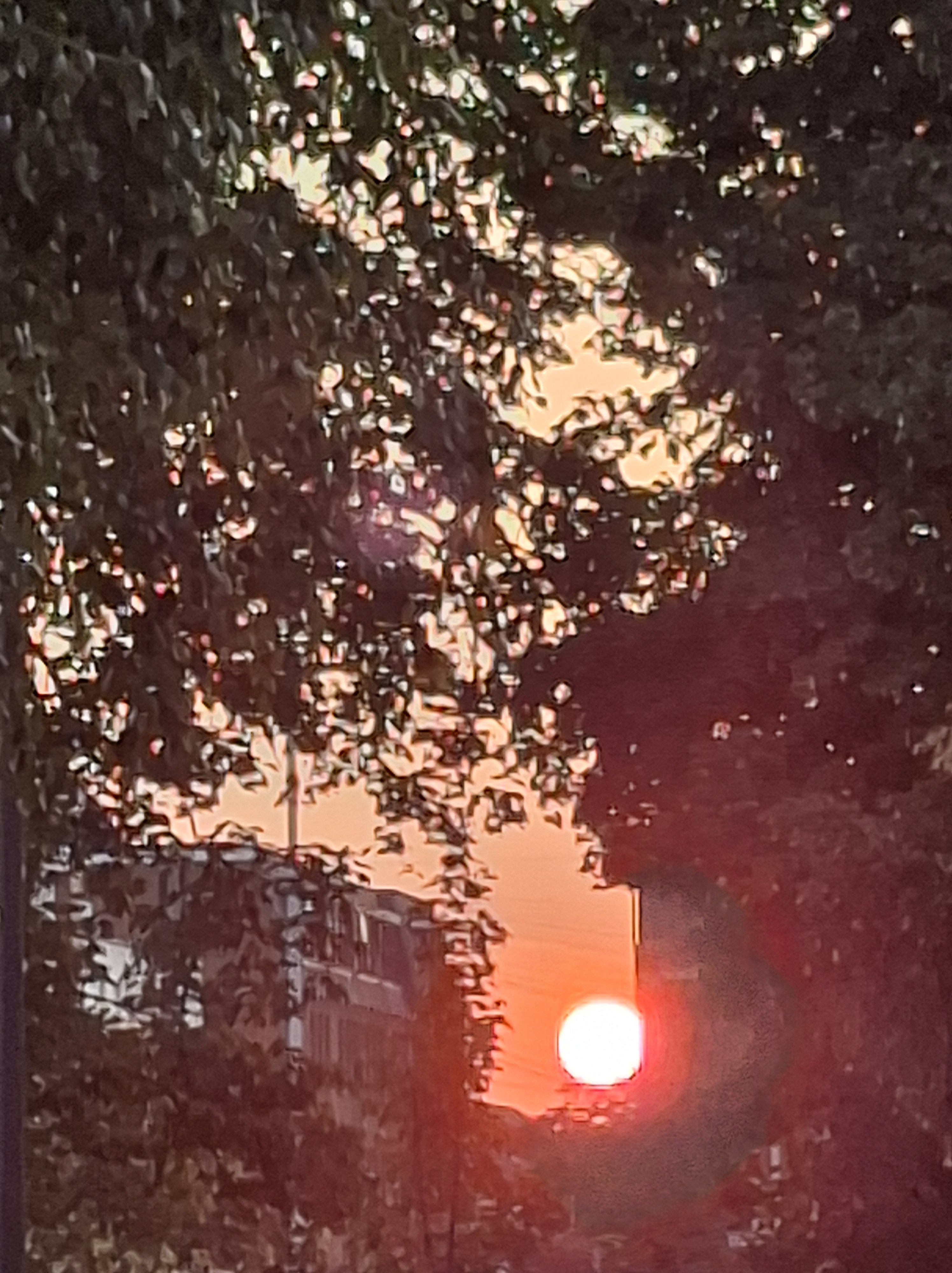
The sunsets continue to get earlier. I walked into one as I left the park. The sun asserted it’s power in a late stage of its descent. It’s been a hot summer as well as a dry one. I took this  powerful, almost too powerful, late summer solar image with me as I walked back to my home.

BOOK REVIEW: THE 15-MINUTE CITY

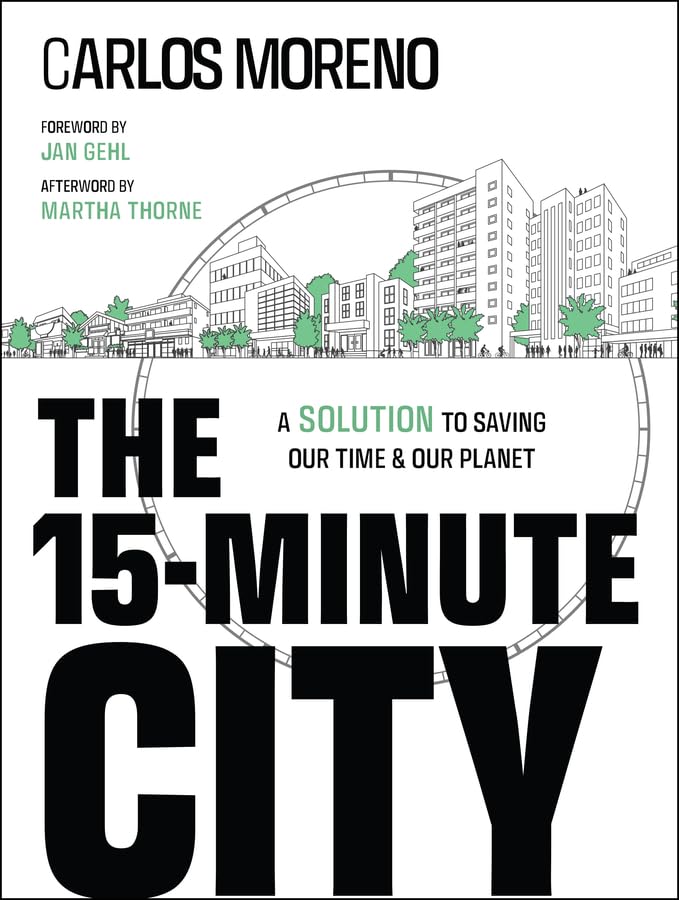
The 15-Minute City: A Solution for Saving Our Time and Our Planet (1) advocates that everyday destinations like schools, stores, and offices should only be a short walk or bike ride away from home. The intention is to make cars far less necessary for contemporary city-dwellers, and thereby “to reinvent our life-styles and rethink our relationship with space and time”. Its key values are proximity, interconnectedness and fulfilment.

This book is about how cities are run, who they are predominantly run for, and how they could be run more inclusively. It provides an inspiring store of information for people concerned with these issues, not least urban Druids. It has 21 chapters:

Chapter 1 is a call to action, emphasising “the urgency of reimagining urban ecosystems in the light of contemporary challenges”.

Chapters 2 to 4 discuss the ‘fragmentation’ of cities over time, especially due to city roads and zoning.

Chapter 5 is about learning lessons for “a more inclusive urban future”.

Chapters 6 & 7 look at changes beginning with the 1973 oil crisis and moving on to the “challenges and realisations of 2020”.

Chapters 8 to 11 focus on Paris, where the ’15-Minute City’ was invented.

Chapters 12 to 19 cover particular locations and their complex histories: Milan, Italy: Portland, Oregon, USA; Cleveland, Ohio, USA; Buenos Aires, Argentina; Sousse, Tunisia; Melbourne, Australia; Busan, South Korea.

Chapter 20 looks at the notion of the 20-Minute Territory as applied in Scotland and on the Ile de France.

Chapters 21 discusses the role of new technologies and summarises the book.

By 2050, 68% of the human population will be urban. Changes are needed in the ways that urban ecosystems work for people’s health and wellbeing, now more than ever because of the climate crisis. Author Carlos Moreno writes, “urban life is the heart of the problem, but it is also the solution if we enable it to be. Never in the history of humanity has survival been so compromised by lifestyle”.

Moreno also believes: “our journey through these cities is also an exploration of ourselves. By offering an urban setting that is conducive to conviviality and proximity, we can rediscover the value of mutual cooperation and sharing. We are nourished by authentic interaction and the solidarity of a reinvented urban life “

It may be that it is now too late to save the kind of civilisation in which  we are living. From a seemingly uninvolved and above-the-battle standpoint we may even see advantages in its fall. But I have come to think that it is better to work from the opposite point of view – that there is something worth working for, despite the apparent odds. The work itself can be a spiritual discipline, taken on for its own sake. Carlos Moreno offers us one neighbourly way of addressing our apparent spiral into a dystopian world.

(1) Carlos Moreno The 15-Minute City: A Solution to Saving Our Time and Our Planet Wiley, 2024. Foreword by Jan Gehl. Afterword by Martha Thorne.

‘I SWIM WITH THE SALMON’

“The hazels are rocking the cups with their nuts

As the harvesters shout when their last leaf is cut;

‘I swim with the salmon says the Green Man,

‘I swim with the salmon’, says he.” (1)

‘I swim with the salmon’ is a bold, clear statement. It evokes powerful images that leap out of their place in the flow of William Anderson’s poem. Green Man as a whole takes us on a wheel-of-the-year journey beginning on 22 December, successively featuring thirteen trees for four weeks each. The hazel is the ninth tree, whose time runs from 3-30 August. As the poem indicates, this is a harvest period, and the last month that fully belongs to the summer. It is also a time when you may find Atlantic salmon swimming home to spawn, though spawning doesn’t begin until October.

In this post I celebrate salmon naturalistically, through an account of their extraordinary life cycle. I am especially aware of the River Tay in Scotland, mostly thanks to a 90 minute documentary The River: a Year in the Life of the Tay (2). My personal experience of the Tay is limited to visits to Dunkeld, Perth and Dundee, where I nonetheless fell in love with the river and its powerful energy.

Salmon begin their lives in mountain streams, as far upstream as their parents have been able to reach in their autumn/early winter spawning period. The new generation undergoes a remarkable series of transformations (3), hatching as alevin or sac fry when the water warms in spring, and growing into parr with camouflaging vertical stripes. They remain in the same environment for two or more years, by which time, as smolts, they have developed a bright silvery colour with scales that easily rub off. Driven by growth hormones, the 10% of smolts who survive to this stage experience the mutations necessary to become salt water fish and make their journey to the ocean.

They spend another two or more years in the North Sea, travelling north into Norwegian waters, becoming sexually mature, with a darkening of the silvery scales, before embarking on their homewards 120 mile journey up the river to its headwaters. They are much larger than they were when on their way out. The largest salmon ever caught in the Tay, in the 1920’s, was over five feet long.

To return to their own birth-place (remembering exactly where they come from) they have to navigate waters that include rapids and waterfalls, evade osprey and human anglers, and achieve the feats of leaping for which they are famous. “The salmon is able to jump upstream not by fighting against the current, but by utilizing its knowledge of the reverse current which flows beneath the surface current” (4). They are returning to their native headwaters in order to spawn and begin the cycle again. 98% of Atlantic salmon spawn only once and die soon afterwards: their adult bodies, equipped for a salt water life, never fully re-adapt to fresh water and this makes them vulnerable.

Swimming with the salmon is not for the faint-hearted. At the present time the population of Tay salmon is in severe decline (70% in the 30 years to 2019) although the river is relatively clean and is now managed to prevent over-fishing. The effects of the climate crisis in the Atlantic are the most likely cause for the decline of Tay salmon, as for Atlantic salmon in general. Yet even in decline they remain magnificent. Long before the Celtic Iron Age, during it, and for long afterwards, they were abundant in the rivers of Britain, Ireland, and other Atlantic maritime countries. With their complex shape-shifting capacity, their far-journeying years at sea, their uncanny homecoming knowledge and their extraordinary leaps, they seem marked out for another life, in human song and story. I would like to think that the salmon’s mythic reputation can help to save it in this interconnected world.

”’I swim with the salmon says the Green Man,

‘I swim with the salmon’, says he.”

(1) From:  William Anderson Green Man: Archetype of our Oneness with the Earth Harper Collins: London & San Francisco, 1990 See also: https://contemplativeinquiry.blog/2017/05/11/poem-green-man/

(2) The River: A Year in the Life of the Tay 90 minute documentary made for BBC4 in 2019. Presented by writer and naturalist Helen MacDonald. See: https://youtu.be/ZEmAXQIrDeg?si=wlaI0bNtM6YWevAf The film is well worth watching, covering the journeys of the salmon and much more.

(3) Salmon Wikipedia

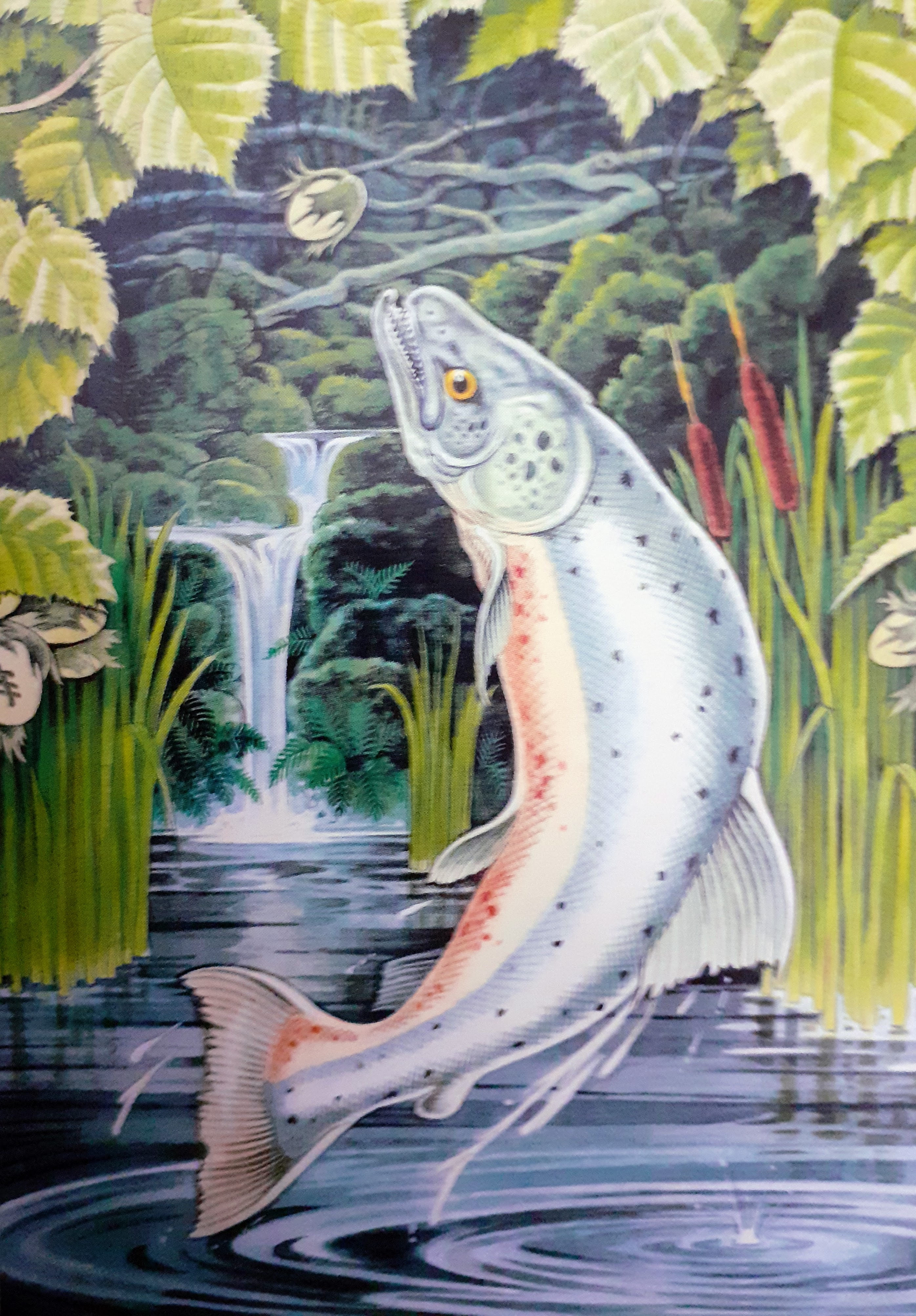
(4) Philp and Stephanie Carr-Gomm The Druid Animal Oracle: Walking with the Sacred Animals of the Druid Traditions Fireside: London, 1994 Illustrated by Will Worthington. The face of their salmon card is pictured at the top of this blog.

BOOK REVIEW: UNSEEN BEINGS

Highly recommended. Unseen Beings: How We Forgot the World Is More Than Human (1) is about the many beings we humans have actively ‘unseen’ and the consequences of our human-centric lens. Author Erik Jampa Andersson describes his book as a diagnostic exploration of the roots of the climate crisis, itself an extreme consequence of a much wider malaise. Whereas the common view of ‘saving the planet’ tends to be one of ‘guarding the storehouse’, a better focus would be on ‘supporting the welfare of living beings’.

Andersson has a background in Tibetan Buddhism and Tibetan medicine. In the manner of Buddhism’s Four Noble Truths, and of his medical training, he divides his book into four parts: Diagnosis, Causes and Conditions, Prognosis, Treatment.

Diagnosis concerns “our ecological disease”. Andersson reminds us of what the climate crisis is, how far it has been allowed to go, and the “fanciful stories” with which we have soothed our fears: “full of human exceptionalism, divine protection, techno-fixes and post-apocalyptic salvation”. For Andersson, the foundational root cause is “the sundering of human and non-human beings, and our perceptual separation from ‘Nature’. He refers to “the poison of anthropocentricity”. He reviews the evidence for plant and fungal sentience and awareness as well as that of the animal kingdom. He concludes that Nature is not a place, but “a tightly knit community of interconnected beings, some seen, many unseen, all engaged in their own affairs and with their own experience of reality”. He describes this relational approach to the living world as “what most scholars now call ‘animism’ … neither a religion nor a system of belief, but a paradigm of more-than-human relationship”. He sees this stance toward the world as “our natural state”.

Causes and Conditions A mini-ice age some 13,000 years ago interrupted an early agricultural period in some places and prompted a series of innovations. The domestication of the horse was especially significant. Andersson sees a move away from our ‘natural state’ beginning at this time. But it is not fully evident to us until the age of written philosophy and scripture. The Greek philosophers Plato and Aristotle declare a hierarchy of sentience from plants up to animals and then humans at the top, uniquely endowed with a rational soul. In the Hebrew book of Genesis, God gives dominion over the Earth and its animals to man for his use. In the Western Christianity of the 13th century CE, Thomas Aquinas says that Christians have no duty of charity to non-humans because they are resources, not persons. In the 17th century CE, early in the West European led colonial era, Descartes holds public vivisections of dogs and other animals declaring that they are soulless automata and that their apparent distress is meaningless. In the mid 19th century CE, Darwin restores other beings as our ancestors and cousins, but but without much sense of kinship or empathy.

Prognosis Here Andersson introduces two concepts from Tibetan medicine: ‘provocation’ and ‘spirit illness’. The provocation of other sentient beings is a health risk. He discusses the origins of the recent Covid-19 pandemic in these terms, as human become ever more invasive of our remaining wild spaces. In cases of deforestation, pollution, and any disruption of air, water, soil and trees, there is a price to pay for the wounding of other spirits, whether seen by the eye, seen through a microscope and normally unseen but recognised by tradition. (‘Supernatural’ is an unhelpful word here – everyone is part of nature). In Tibetan tradition, the cultivation of a clear mind is highly prized and works within human psychology, but not for disruptive events like these. There is a need to make amends. Rituals are held in sensitive and damaged places. The damage caused in these circumstances and the resultant chronic collective disease can only be addressed by learning how to care for eachother, non-human beings and the planet itself.

Treatment Using the Buddhist 8-fold path as a structure, Andersson recommends ‘cultivating care’ over a system of rules and regulations aimed at a ‘sustainability’ which tries to restore the old status quo. We cultivate care of the Earth, one another and non-human beings. Hence: 1 right view is a return to our ‘natural state’, as described under Diagnosis; 2 right intention describes commitment to a path of rewilding and regeneration; 3 right speech is the use of “life-affirming language” (e.g. using ‘they’ as an alternative to ‘it’ for non-human beings); 4 right action is causing as little harm as possible to other beings; 5 right livelihood means adopting principles of authentic sustainability and non-exploitation; 6 right diligence is based on “the durability of the heart-felt ethic; 7 right mindfulness means “paying attention to nature’s vitality”; 8 right concentration involves imaging a new future with “authentic myth-making”.

Concerning 8 above, Andersson has been profoundly moved by the work of J. R. R. Tolkien from his later childhood onwards. As a result, he developed a high valuation of authentic myth-making and enchantment. In this realm, the non-human is essential. Tolkien had his own life-changing moment of enchantment when, as a student, he first read the Old English words: Eala earendel engla beorhtast, ofer middangeard monnum sended. (Hail Earendel brightest of angels, above the middle-earth sent unto men). Of this evocation of Venus arising as the morning star, in the old language, Tolkien later wrote: “there was something very remote and strange and beautiful about these words, if I could grasp it, far beyond ancient English”. For Andersson, authentic myth and authentic science work together in support of a redemptive animist vision. By contrast, the form of discourse to worry about is ‘fallacy’ – a complete dissociation from the truth. Andersson again quotes Tolkien: “if men were ever in a state in which they did not want to know or could not perceive truth (facts and evidence) then Fantasy would languish until they were cured. If they ever get into that state (it would not seem at all impossible) Fantasy will perish and become morbid delusion”. For Andersson, this too has become a symptom of our current ecological disease, making the need for honest and healthy communication all the more urgent.

For me, Andersson has made a valuable addition to a growing literature about the current crisis, whose most alarming symptom is climate breakdown. He goes to the root of the problem, offering a clear and coherent view about how to stand in the face of it. It is a well-researched, well-crafted and compassionate contribution to the genre.

(1) Erik Jampa Andersson Unseen Beings: How We Forgot the World is More Than Human Carlsbad, CA & New York City; London; Sydney; New Delhi: Hay House, 2023

I attach a links to conversations between the author and Andrew Harvey below. It adds considerably to what I can present in a review:

DEEP ADAPTATION AND CRITICAL WISDOM

In recent months I have felt an increasing pull towards better understanding our current ecological, cultural and political crises. From a Druid perspective, I am mindful of my commitments to nature and all beings, and accountability to all our ancestors and descendants. From a contemplative perspective, I am bearing witness to the world in which I breathe: any ‘beyond’ is accessible only from within. From an inquiry perspective there is much to inquire about.

So Jem Bendall’s new book, Breaking Together: a Freedom Loving Response to Collapse (1), is important for me both to learn from and to write about. In this post I describe two concepts that I see as driving the book: ‘deep adaptation’ and ‘critical wisdom’. Bendall explains these concepts in a way that gives me questions to ask and tools to use. Boiled down, they are not complicated. The words that follow are his, not mine.

Deep Adaptation

“Deep Adaptation refers to the personal and collective changes that might help us to prepare for – and live with – a collapse of the societies we live within. Unlike mainstream work on adaptation to ecological and climate change, it doesn’t assume that our current economic, social and political systems can be resilient in the face of rapid climate change. The ethos is one of curious and compassionate engagement with this new reality, seeking to reduce harm and learn from the process, rather than turn away from the suffering of others and nature.

“There is an emphasis on dialogue, with four questions to help people explore how to be and what to do if they have this deep outlook on the future.

“What do we want to keep and how is a question of resilience.

“What do we need to let go of, so as not to make matters worse, is a question of relinquishment.

“What could we bring back to help us with these difficult times, is a question of restoration.

“With what and who shall we make peace as we awaken to our mutual mortality, is a question of reconciliation.”

Critical Wisdom

“What I term ‘critical wisdom’ is the elusive capability for understanding oneself in the world that combines insight from mindfulness, rationality, critical literacy, and intuition.

“A capability for mindfulness involves our awareness of the motivations for our thought, including our mind states, emotional reactions and why we might want to ‘know’ about phenomena.

“A capability for rationality involves an awareness of logic, logical fallacies and forms of bias.

“A capability for critical literacy involves awareness of how the tools by which we think, including linguistically constructed concepts and stories, are derived from, and reproduce, culture, including relationships of power.

“A capability for intuition involves awareness of insights from non-conceptual experiences including epiphanies and insights from non-ordinary states of consciousness.”

For me, Jem Bendall provides an invaluable set of questions to ask and tools to use under the headings of Deep Adaptation and Critical Wisdom. The questions refine my understanding of Deep Adaptation. The combination of understandings that lead to wisdom are, as a set, new to me, though I was already aware of the individual elements. ‘Critical Wisdom’ reframes my sense of wisdom, more clearly experienced as a dynamic processes of wise-ing.

(1) Jem Bendell Breaking Together: A Freedom-Loving Response to Collapse Bristol: Good Works, 2023 (Good Works is an imprint of the Schumacher Institute – see also https://www.schumacherinstitute.org.uk). I can certainly recommend this book now, on the grounds of both its wide knowledge and deep wisdom. I may write a full review in future.

NB: Jem Bendell is a world-renowned scholar on the break-down of modern societies due to environmental change. A full Professor with the University of Columbia, he is a sociologist specialising in critical integrative interdisciplinary research analysis on topics of major social concern. His Deep Adaptation paper influenced the growth of the EXtinction Rebellion movement in 2018, and he created a global network to reduce harm in the face of societal collapse (the Deep Adaptation Forum). Although recognised as a Young Global Leader by the World Economic Forum in 2012, Bendell has been increasingly critical of the globalist agenda on sustainable development.”

BOOK REVIEW: FORGIVING HUMANITY

Forgiving Humanity (1) is an extended essay rather than a book. I found it easy to read and hard to work with. Author Peter Russell is highly skilled at distilling data and making his case. His conclusion is that the near term extinction of the human species is inevitable, and not unnatural or to be faulted. “We are coming to the end of our species’ journey, spinning faster and faster into the center of an evolutionary spiral.”

Russell points to what he sees as our our natural-born drive for exponential growth and development. A dance of genetic and behavioural change led us to an enhanced brain, bi-pedal walking, manual dexterity, and a shift in the position of the larynx to enable complex speech. Cultural evolution then led to organised hunting with the throwing spear and, later, the bow. Later still, at an increasing rate of change, came agriculture, metallurgy, the industrial revolution (from steam to atomic power in not much more than a century) and, most recently, the accelerating information revolution now leading to the rise of AI. Quantum computing is on the horizon.

The problem according to Russell is that exponential growth is inherently predestined to run out of control. This is “the curse of exponential change.” Exponential growth is not like the linear growth that we can more comfortably imagine. In the domain of economics, for example, 3% annual growth rate in the world’s GDP, compounded over 100 years, would lead to a consumption of energy and resources at 20 times today’s rate. Russell started thinking about this problem as a young and gifted mathematician at the end of the 1960s. On his analysis, we would be fatally fouling our own nest even without the specific problem of the climate crisis. Climate change simply exacerbates and dramatises our predicament, hastening the process of breakdown.

Russell is aware of systemic injustices in our socio-economic system, but this book does not explore political mitigations. He expects major breakdown in this century. A remnant population in reduced circumstances will carry on for a while longer. But this human triggered extinction event, which has already claimed many other species, will still be rapid in planetary terms. In the immediate future, Russell sees a likelihood of continuing technological breakthroughs for some decades, in the midst of extensive cultural breakdown and a diminishing global population. I am not certain that he is right, but I fear that he may be. And I find him hard to read, trying to imagine what it would be like for different people in different places, and stepping into their boots down here in the trenches where embodied human life is lived until it’s gone.

Whilst the earlier sections of Forgiving Humanity are presented as if from the perspective of a distant cosmic scientist, there is a later turn to human experience and how to live in the new conditions. Peter Russell becomes one of us and shares his long-held view of consciousness and its possibilities, especially the affirmation that: “beneath our day-to-day experience lies a deeper sense of being, unperturbed by the goings on in the world, and our hopes and fears about them … meditative and self-enquiry processes … lead to greater calm and self-awareness, and … the more in touch we are with our inner being, the more considerate, compassionate, and caring we become – qualities that could prove invaluable in meeting the challenges ahead.” I also like his idea of remaining in service to the earth whenever we can, continuing to do our best for it even when knowing that our species is waning and likely to wink out. The notion of persevering with restorative efforts allows for limited local successes, seems like a healing process in itself and preserves a sense of positive agency in hard times. I am sure that people will continue to work in these ways whenever given half a chance.

For Russell, psycho-spiritual practices and communities are a key resiliency factor for navigating through heart-breaking conditions. We need to “find the acceptance that allows us to move into the unknown with courage and an open heart”. Russell says that facing our collective extinction is like facing our personal deaths, only more so because we are looking at the end of our kind. He borrows from a well-known map of how to work through five stages of grief – denial, anger, bargaining and depression – to a final acceptance. I have to note some reservations about schemes based on normative ideas about how we work through distress. People are very different – though many, it is true, are reassured by maps of this kind. I would also not want these suggestions to be misunderstood as an injunction to put on a mask of serenity when something else is going on in our body/mind. For me, the deeper acceptance is to recognise and accept our confusion and turbulence, if confusion and turbulence are what is happening. The spaciousness of deep acceptance then keeps company with them, avoiding both the false mask of serenity on the one hand, and immersed identification with our distress on the other. Nothing is denied.

I am not sure about the suggestion of ‘forgiving humanity’. If I take ‘humanity’ as simply the name of a species, I don’t feel that it’s my place either to forgive or withhold forgiveness from a species of which I am a member. If I take ‘Humanity’ as an idealised abstraction, or construct, then there’s no-one there to forgive outside my own imagination. For me, working as best as I can at deep acceptance and loving kindness, accepting with self-compassion that I will likely be wayward and inconsistent in my endeavours, is the better way to go. It keeps me in the world of lived interactions with other sentient beings and feels like a more engaged and grounded aspiration.

Despite some reservations, I value this work highly and recommend it to anyone concerned with the issues raised in it. We need voices like this, who move beyond deep adaptation to face into the possibility of no adaptation. Forgiving Humanity offers a distinctive lens on the crisis we are in, and it does so in a concise, readable and sadly persuasive way.

(1) Peter Russell Forgiving Humanity: How the Most Innovative Became the Most Dangerous Las Vegas, NV: Elf Rock Productions, 2023

NB Peter Russell studied mathematics and theoretical physics at the University of Cambridge but later changed to experimental psychology. After learning transcendental meditation (TM) with Maharishi Mahesh Yogi in India, he took up the first academic post ever offered in Britain on the psychology of meditation. He also has a postgraduate degree in computer science. In the 1970s he pioneered senior corporate management courses on meditation, creativity, stress management and sustainable development. Later he coined the term ‘global brain’ with the 1980’s best seller of that name in which he predicted the Internet and the impact it would have on humanity. I have reviewed a more recent book Letting Go of Nothing at:

COLOURS OF AUGUST, 2023

The haws are red and shiny on their hawthorn bushes. Blackberry remains tentative, its pale green fruit visible but still unripe. I see green leaves now leaning towards yellow. I am walking in a scrap of local woodland, bounded by a canal* on my left and housing some distance to my right. It is around 7.30 pm on 13 August, and I am opening up to the colours of late summer as they show themselves this year.

Looking up, I see a healthy crop of crab apples at different stages of ripening on their tree. The ripest apples are red, though their red is softer than that of the haws. The leaves of the apple tree are shinier than those in the background. I am aware of a light grey sky.

Nature in various forms finds a niche everywhere. This time has its own flowers, and again I see yellow. I am not the greatest botanist. and I cannot name with certainty these plucky if slightly battered blooms, saying hello from behind a fence. But I imagine them as poor relations of even the lesser celandine, and therefore almost certainly official weeds**. I hope and pray they remain safe here in these woods.

Below, looking at tangled leaves, I find a truly autumnal scene, in the yellowing and browning of leaves. It feels a bit early for this neighbourhood. The wheel of the year is still following its seasonal course, so far, but is becoming more erratic and unpredictable than in the past. I wonder about the future of the jet stream – and indeed the Gulf stream too. But in the moment, my heart opens and I love this pattern of plant life moving through its cycle and gradually, subtly, changing in appearance.

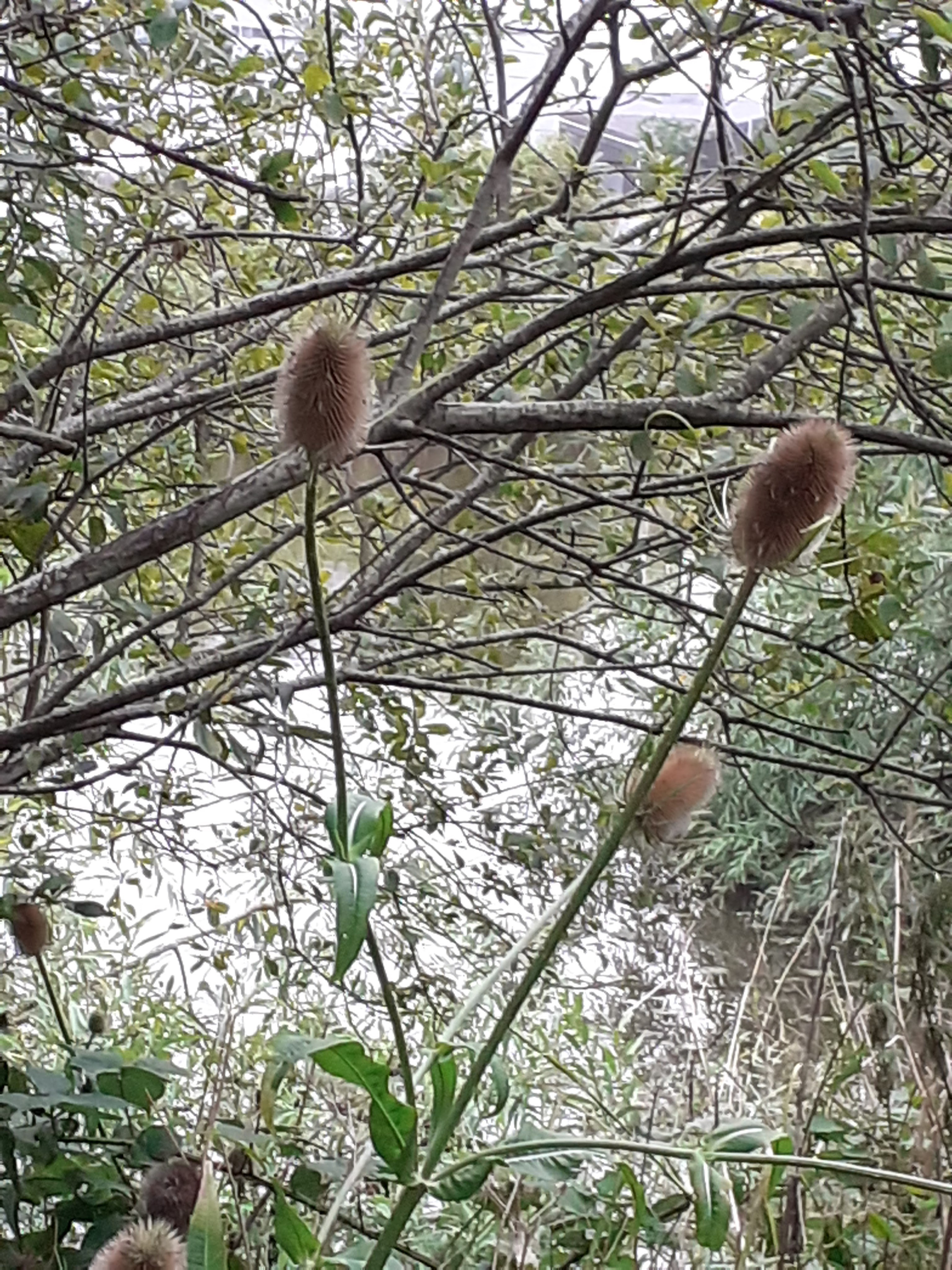
I photograph two teazel stalks, below, because I enjoy their shapes, because they are a further illustration of the browning theme, and also because of the visibility of the canal behind them. They don’t live in the canal, like bullrushes, but they like to be close. The image also includes an almost ghostly barge on the water below.

After leaving the woods, I am confronted (below) with the sky. I am facing west, across the Llanthony Priory gardens. I see dark stormy clouds, whose edgy brooding energy is somewhat modified by a blue opening in the distance. This dark grey, and the rain and storm it sometimes brings, have certainly been a feature of summer this year. There’s a strong contrast with last year at this time, when there was a heat wave, which for us still means C 30-35/F 86-95 with anything more being exceptional. In July 2022 part of the country briefly reached over C40/F 104 for the first time since records began. This year the grass is still green. Last year it burned up and the ground was parched and cracked.

Following the wheel of the year carefully, as it turns, is a valuable discipline for modern Druids, among others concerned with deep ecology (sacred ecology?) and the climate crisis. We don’t confine ourselves to celebrating our seasonal festivals, though we enjoy them too. For we now know experientially that the world is changing. The traditional rhythms of nature are not an eternal verity to rely on.

In some ways I find small personal observations emotionally more impactful than my limited knowledge of climate science and deep time geology. These are very helpful for context and framing, but personal experience is more immediate than these. It is also more deeply immediate, though less dramatic and disturbing, than reports of disaster elsewhere. Following the wheel of the year, we are doing more than making observations. We are celebrating and bearing witness to the life that surrounds us, offering our attention and energy to its continued flourishing. Blessings on the land.

*The Gloucester-Sharpness canal, England. Beyond the Gloucester docks, but not yet out of the city.

** A reader comments: “I think your mystery plant is ragwort, a much maligned ‘weed’ the destruction of which is encouraged by the UK government as it can be harmful to grazing animals yet is actually one of the best forage plants for pollinators”.

MARCH 2023: WINTER PUSHES BACK

Where I live, March has so far been a contest between the coming of spring and a winter that won’t let go. The city of Gloucester has been relatively insulated, but we have still had sub zero nights and low day time temperatures. There has been snow that didn’t settle, cold hard rain and occasional high winds. There have also been frequent periods of sunshine – still cold, still rainy, yet a joy to be out in. Underneath this changeability, the period of daylight grows longer.

A canal side walk shows a more subdued world than last year, and a sense of latency, as though life is waiting to see what will happen next. The wheel of the year turns as ever. What to expect on the ground has become less certain. The climate crisis is visibly in process, with the consequence of vast changes in the arctic now making themselves felt here. We could say that the Cailleach is angry and mobilising. But what this means for our day-to-day weather isn’t always clear.

As I experience these shifts (not so dramatic in themselves in the here and now) I can’t help thinking about culture as well as nature. Climate has moved down the formal political agenda – again. Outright denialism and repression of information about relevant topics still aren’t over. Sir David Attenborough, who has been making nature programmes since the beginning of broadcast TV, will not be having his most recent one (6th and last of a new series) shown live by the BBC. It will be available only on iPlayer.

Supported by groups like WWF (World Wildlife Federation) and RSPB (Royal Society for the Protection of Birds), this programme highlights the destruction of nature in Britain and looks at rewilding as part of the solution. There are allegations that the restricted availability of this content stems from a fear of offending Conservative politicians and the right wing press. The BBC has issued denials but I have not seen any other plausible reason put forward. Yet this is about conservation: in older meanings of ‘conservative’, the protection of nature and the exploration of rewilding could readily have become a conservative cause. They have been, in the past – think about Theodore Roosevelt and the National Parks movement in the USA.

From a Druid and Earth spirituality perspective, the desacralisation of nature, and the emergence of a wasteland culture, lie at the heart of this problem. This is not new. It has being going on for a long time, for many reasons – religious, economic and political – driven by people with widely different projects and motivations. I know that there is much creative work going on to develop better understandings and positive projects. But it still saddens me that the balance of power and resources, especially in a renewed time of wars and the threat of wars, remains so troubling.

In my personal life I am happy and optimistic. I can feel sad about what is going on around me without being defined or disabled by my grief. Moments of fear and sparks of anger, too. They need not be driven away. They too have an honoured place at the table. They are part of the larger whole, and, lived with emotional intelligence, a way of bearing witness and a spur to action in the world.

BOOK REVIEW: THE CIRCLE OF LIFE IS BROKEN

Highly recommended. Brendan Myers’ The Circle of Life is Broken (1) is subtitled “an eco-spiritual philosophy of the climate crisis”. Myers is a Pagan identified author and a professional philosopher who teaches at Heritage College, Gatineau, Quebec. His Paganism is naturalistically oriented, and animist in a sense that “the things of the natural world are in some hard-to-express manner alive and spiritually present”.

The book begins with an view of the Earth from outside, through the loving eyes and words of astronauts. “It is as if the Earth as a whole was only discovered in 1968, when Apollo-8 astronaut William Anders shot the famous Earthrise photograph; the image of the Earth coming out from behind the edge of the moon”. This ‘overview effect’ is balanced at the end of the book by an invitation to immerse ourselves more fully and awarely within the world, through the practices of a weekly green sabbatical and an annual ecological pilgrimage.

Between this beginning and ending there are three main sections, each addressing a ‘root question’. Each question is rigorously explored, before receiving a carefully formulated answer.

The first question asks: what is the circle of life? A key understanding is that ecologists today do not see the Earth as “an aggregate of individuals competing for resources and survival”. Rather, they “are teaching us to see the Earth as a complex system in which everything is directly or indirectly involved in all the life around it, and in which symbiosis and cooperation, across multiple levels, keep the system as a whole flourishing”. This is the circle of life that is now breaking down. “It isn’t simply changing form. It is also short-circuiting; it is falling apart”.

The second root question asks: who faces the circle of life? This concerns humans and how we deal with realities of a higher order than our own. The exploration includes a look at how people see the world at different life stages. Myers wants to know “what becomes of the human reality when cast in terms of the encounter with the Circle of Life as the ultimate reality?” He notes that the Circle goes almost unmentioned in the history of Western philosophy, and also explores a perceived a tension between our ‘being-ecological’ and our ‘being-free’.

The third root question asks: can the circle be healed? Myers quotes a saying of the philosopher Hegel: “the owl of Minerva takes its flight only when the shades of night are gathering”. When things are bad, new ideas and possibilities can emerge and philosophers especially are challenged to think big. Myers looks at the political and cultural obstacles to any healing process, with good sections on ‘eco-fascism’ and the ‘gatekeepers of human nature’. He also makes a number of specific positive proposals.

Although written in plain English as far as possible, The Circle is Broken is not a book to read in one sitting. Myers’ thinking is holistic, with room for scientific information, complex argument, deep feeling, contemplation and engagement. It is written with love and a sense of wonder, generously drawing on personal experience. I think of it as a long-term companion, a gift to anyone concerned with the climate crisis and creative responses to it.

(1) Brendan Myers The Circle of Life is Broken: An Eco-Spiritual Philosophy of the Climate Crisis Winchester UK & Washington USA: Moon Books 2022 (Earth Spirit series)

(2) For other posts about Brendan Myers’ work, see:

https://contemplativeinquiry.blog/2015/05/22/the-worship-of-the-gods-is-not-what-matters/ (Reblog from Naturalistic Paganism)

BOOK REVIEW: THE EARTH, THE GODS AND THE SOUL

BOOK REVIEW: RECLAIMING CIVILIZATION

ETHICS AND ‘CIVILIZATION’

BRENDAN MYERS: A FOREST ENCOUNTER

Earth Eclectic

music that celebrates Earth and speaks to the heart

Sarah Fuhro Star-Flower Alchemy

Follow the Moon's Cycle

Muddy Feet

Meeting nature on nature's terms

Rosher.Net

A little bit of Mark Rosher in South Gloucestershire, England

Becoming Part of the Land

A monastic polytheist's and animist’s journal

selkiewife

Selkie Writing…

Charlotte Rodgers

Images and words set against a backdrop of outsider art.

Prof Jem Bendell

living with metacrisis and collapse

Towint

The pagan path. The Old Ways In New Times

The Druids Garden

Spiritual journeys in tending the living earth, permaculture, and nature-inspired arts

The Blog of Baphomet

a magickal dialogue between nature and culture

This Simple Life

The gentle art of living with less

Musings of a Scottish Hearth Druid and Heathen

Thoughts about living, loving and worshiping as an autistic Hearth Druid and Heathen. One woman's journey.

Wheel of the Year Blog

An place to read and share stories about the celtic seasonal festivals

Walking the Druid Path

Just another WordPress.com site

anima monday

Exploring our connection to the wider world

Grounded Space Focusing

Become more grounded and spacious with yourself and others, through your own body’s wisdom

The Earthbound Report

Good lives on our one planet

Hopeless Vendetta

News for the residents of Hopeless, Maine