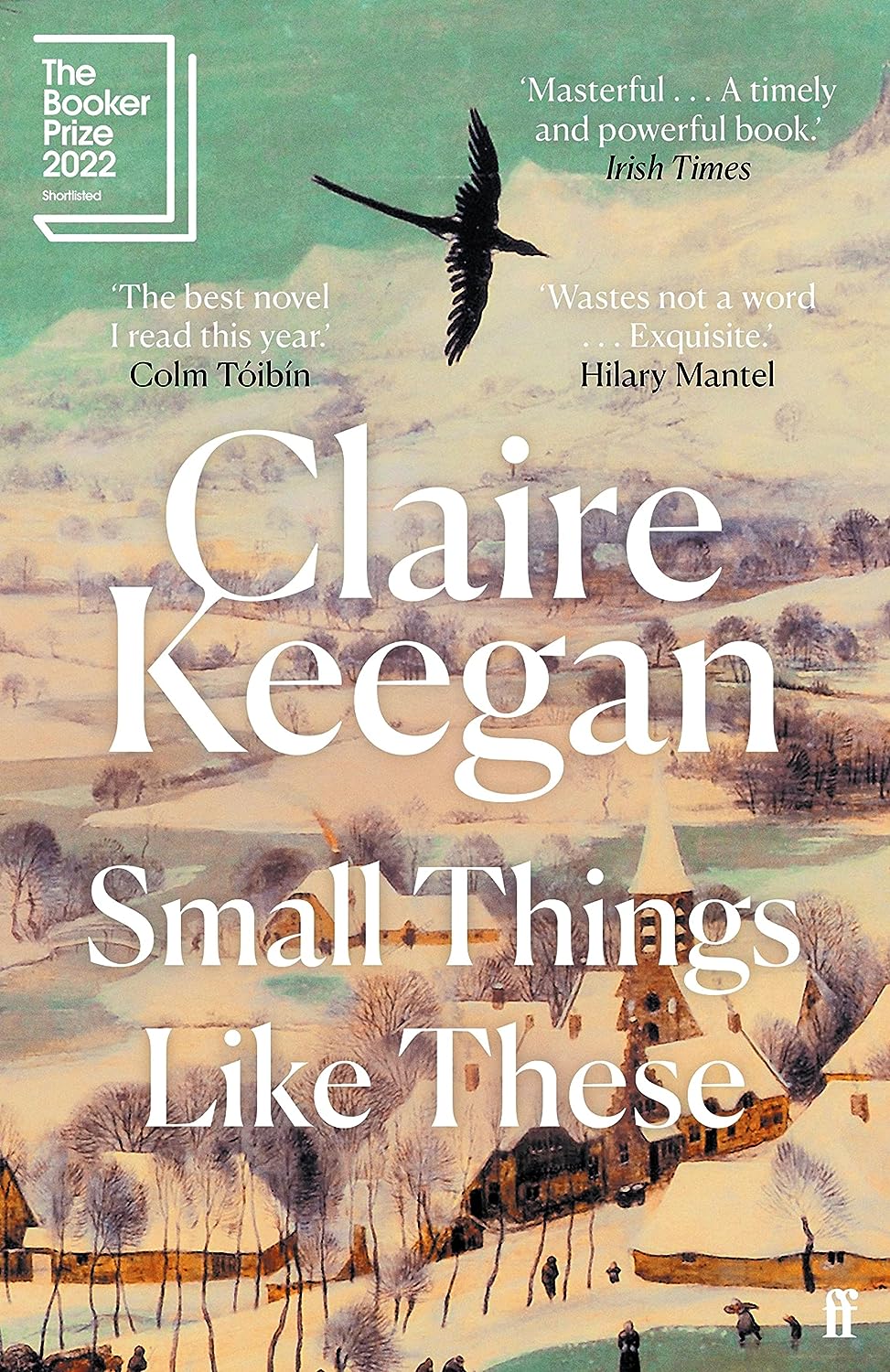
Beautifully written, and highly recommended. Claire Keegan’s Small Things Like These (1) is a novella set in the small Irish town of New Ross in the cold December of 1985, “a December of crows”. New Ross is in many ways a strong community, but business is bad. There are closures, poverty and emigration. The central, point-of-view character is Bill Furlong, a coal and timber merchant, adequately prosperous and very busy at this time of year. Born on 1 April 1946, he is a pillar of his community, a regular if tepid church goer, married with five daughters. The older of these are at St. Margaret’s, “the only good school for girls in town”.
But Bill is also something of an outsider. His father is unknown. ‘Furlong’ is his mother’s family name. She herself becomes pregnant at the age of 16, whilst working as a maid for the Protestant widow Mrs. Wilson, comfortable on a military pension and a decent sized farm. Mrs. Wilson chooses to keep her on and takes an interest in the boy. This interest continues after his mother’s sudden death when he is 12. Technical School leads to an opportunity at the coal yard where he works his way up and subsequently becomes the owner. When he gets engaged to Eileen, Mrs. Wilson gives him some thousands of pounds to establish himself. He enjoys being a family man and a good provider. The Christmas season, with its time at home, rich food and present giving is a welcome opportunity to celebrate.
Bill is naturally generous, refuses to judge people harshly and is prone to spontaneous acts of kindness, the “small things like these” of the title. The main action of the novella begins when he personally delivers a Christmas coal and wood order to the local convent, a powerful-looking place on the hill, where the nuns run both a “training”, or possibly “reforming”, school for girls” and a popular laundry business. There is some lack of clarity over the detail. They might be involved in arranging adoptions as well. Although a little set apart, it is one of the major institutions of the town.
Arriving in the dark at the covent coal house door Bill finds the bolt stiff with frost and has to force it open. There he finds a young girl, Sarah, who has clearly been locked in there for some time. She asks him to take her away or at least ask the whereabouts of her 14 month old baby who has been taken from her. The Mother Superior becomes involved and embarks on an unconvincing performance of compassion involving tea and cake for both Bill and the girl, and a story about Sarah’s incarceration as the result of a game with other girls.
Bill, going home, realizes that he forgot to ask about the baby. He recollects the numerous locks in the convent buildings and broken glass on the tops of walls. He is unhappy and misses his way home, fetching up in a remote spot he doesn’t recognize. In one of the novella’s occasional fairytale moments, he asks an old man with a billhook: “will you mind telling me where this road will take me?” The old man replies: “this road will take you wherever you want to go, son”.
On his return he tells Eileen and, separately, two friends his story. They are keen to talk him out of any public comment or further action. The convent is powerful. Other church institutions would rally round it. It is also his largest customer with the capacity to influence others. Bill has worked very hard to get where he is. Why risk financial disaster? But he is strongly affected by his encounter with Sarah. He finds himself becoming reluctant even to attend mass, let alone take the sacrament. He thinks of what Mrs. Wilson did for him, particularly since he is now fairly sure that his father was not one of her own relatives.
Late on Christmas Eve he goes back to the convent on foot, unbolts the coalhouse door, finds Sarah, and begins the walk through town to his home, “the excitement in his heart matched by the fear of what he could not yet see but knew he would encounter”. On this journey, he also recognizes a “fresh, new, unrecognisable joy in his heart … some part of him was going wild, he knew … never once in his whole and unremarkable life had he known a happiness akin to this”. The narrative ends when he reaches the door of his family home. On the other side of that door lies the beginning of another story, and another day.
(1) Claire Keegan Small Things Like These London: Faber & Faber, 2021
The author has dedicated this story to the women and children who suffered time in Ireland’s mother and baby homes and Magdalen laundries. In a note on the text she adds: “Ireland’s last Magdalen laundry was not closed down until 1996. It is not known how many girls and women were concealed, incarcerated and forced to labour in these institutions. Ten thousand is the modest figure; thirty thousand is probably more accurate. Most of the records from the Magdalene laundries were destroyed, lost or made inaccessible. Rarely was any of these girls’ or women’s work recognised or acknowledged in any way. Many girls and women lost their babies. Some lost their lives. Some or most lost the lives they could have had. … These institutions were run and financed by the Catholic Church in concert with the Irish State. No apology was issued by the Irish government until Taoiseach Enda Kelly did so in 2013”.



 Contemplative Inquiry