The year has moved on from its midwinter moment. I am just beginning to feel the pull of Imbolc (Candlemas in the Christian year). This feast marks the returning light and early signs of spring. I recently saw a local picture showing a newborn lamb.
In the Gaelic traditions Imbolc/Candlemas (1 February) is dedicated to Brigid/Bride. The lines below are from the Scottish Highlands and Islands. They seek protection and are not specifially seasonal.
“The genealogy of the holy maiden Bride
Radiant flame of gold, noble foster- mother of Christ.
Bride the daughter of Dugall the brown,
Son of Aodh, son of Art, son of Conn,
Son of Crearar, son of Cis, son of Carmac, son of Carruin.
Every day and every night
That I say the genealogy of Bride,
I shall not be killed, I shall not be harried,
I shall not be put in a cell, I shall not be wounded,
Neither shall Christ leave me in forgetfulness.
No fire, nor sun, nor moon shall burn me,
No lake, no water nor sea shall drown me,
No arrow of fay nor dart of fairy shall wound me,
And I under the protection of my Holy Mary,
And my gentle foster-mother is my beloved Bride.”
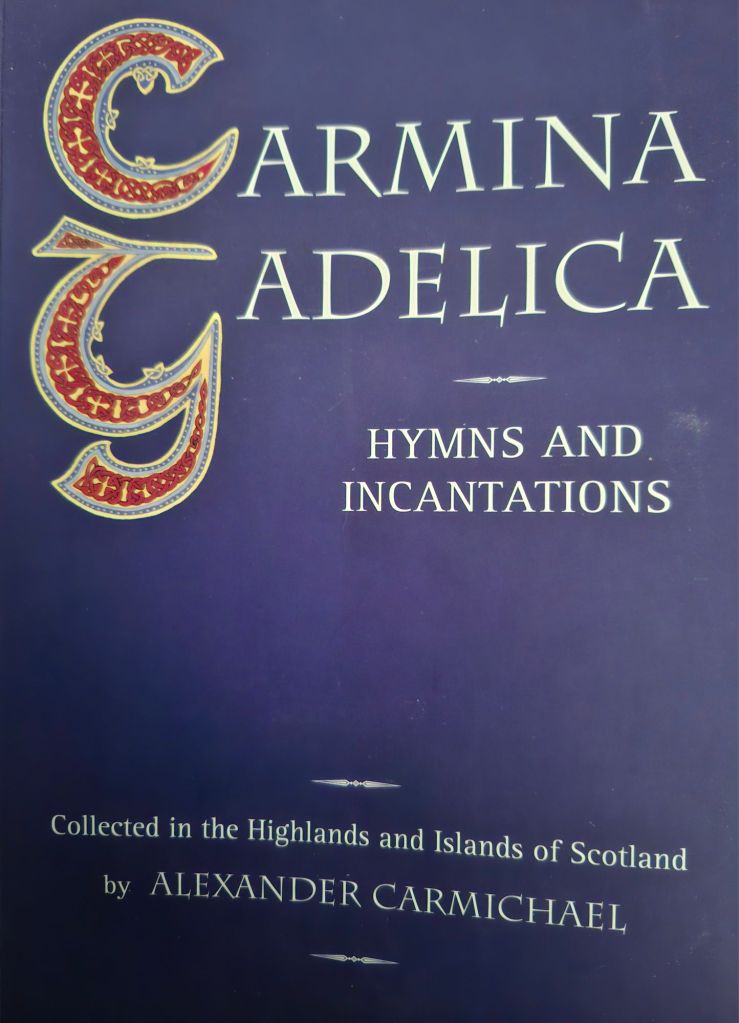
Carmina Gadelica: Hymns and Incantations collected by Alexander Carmichael. 1994 edition by Floris Books, Edinburgh, edited by C. J Moore.
The work is an anthology of poems and prayers from the Gaelic oral tradition in Scotland. They come from all over the Scottish Highlands and Islands. Alexander Carmichael compiled the collection in the second half of the nineteenth century, thereby creating a lasting record of a culture and way of life which has now largely disappeared.
And here winter wends again, as by the way of the world it ought,
Until the Michaelmas moon has winters boding brought.” (1)
Even today, deep autumn opens the door to winter. This was even more the case in the North Staffordshire and Derbyshire regions of 14th century England, where Sir Gawain and the Green Knight was written. Even in castles, people were less sheltered from the growing cold and damp than we are. So readers and listeners of the period are reminded that the coming of winter is both natually and divinely ordained.
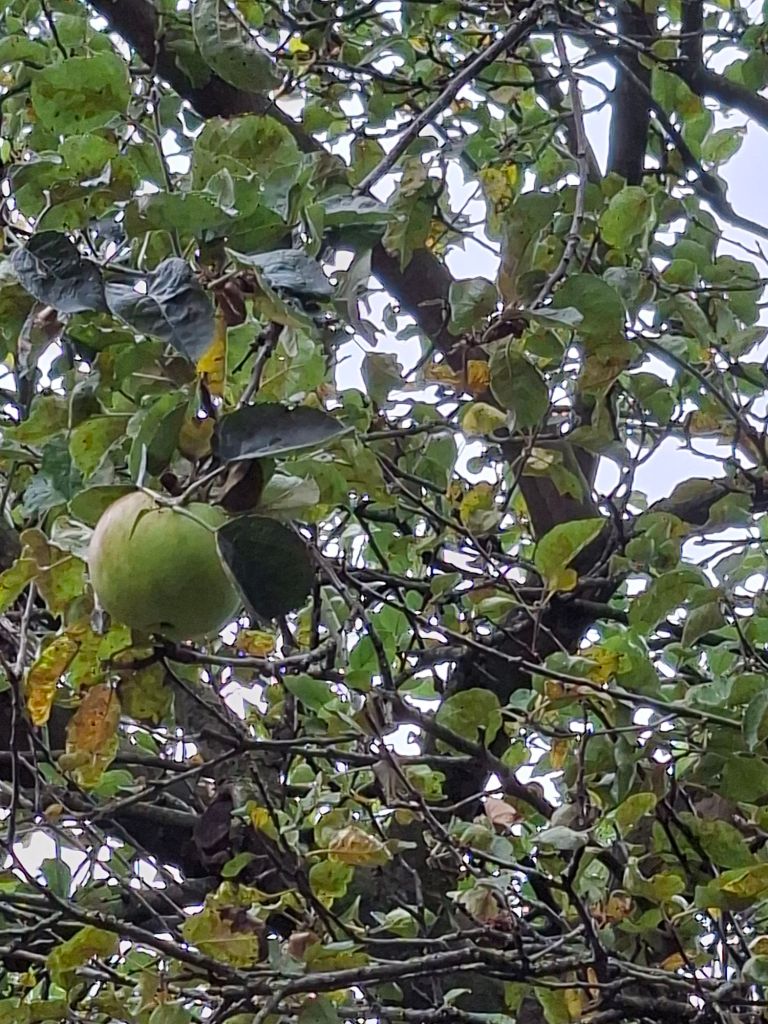
Here and now, the sight of the apple harvest in its later stages (pictured above) seems quite different than in the early ones (2) – less bright, less novel, less shiny. Rotting apples lie on the ground, now fallen outside the wall of Gloucester Cathedral’s orchard. From Nature’s exuberant perspective, this is all part of the plan. Waste is built in.
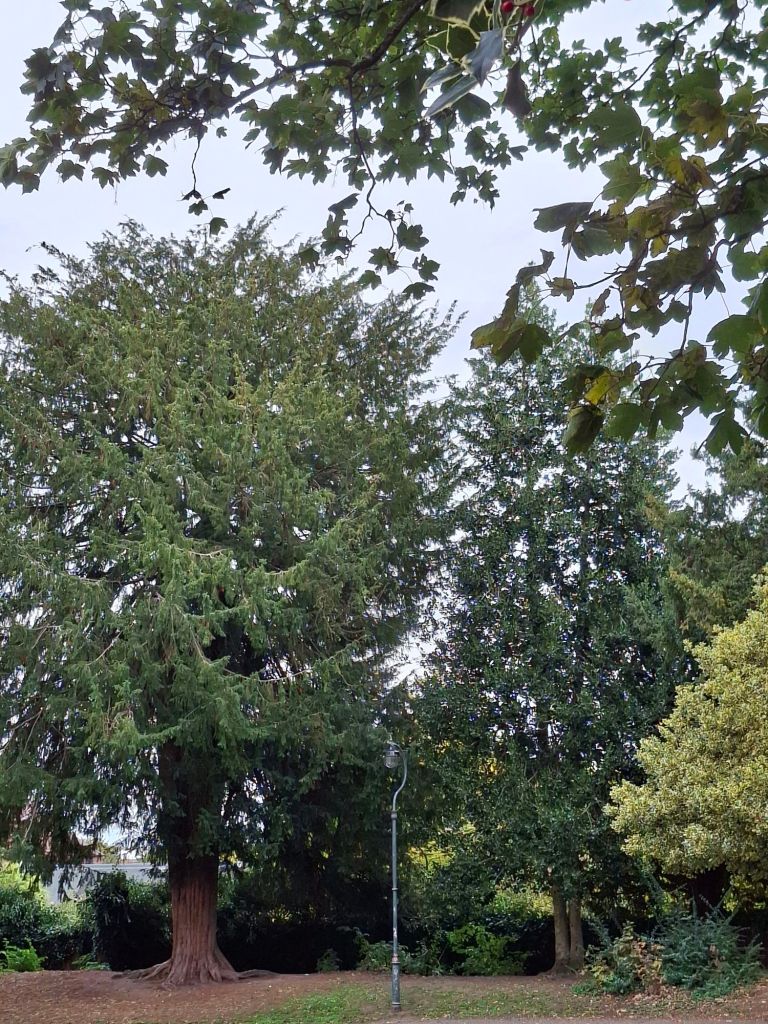
This time draws me further into the declining year. I am in the cathedral’s grounds, now looking at a yew tree and its associations with death. I’m thinking of the approach of Samhain (aka Halloween/All Hallows) at the turn of the month. Once it marked the 3rd harvest of the year – the blood harvest, where animals were slaughtered in preparation for winter. Now it is more a time to remember our ancestors, and our dead more widely.
Yet the seasonal moment, and the yew, can also be linked to wisdom and transformative change in life. I launched my contemplative inquiry at Samhain 2011. Like many people, I find that this period can be a resonant and creative time.
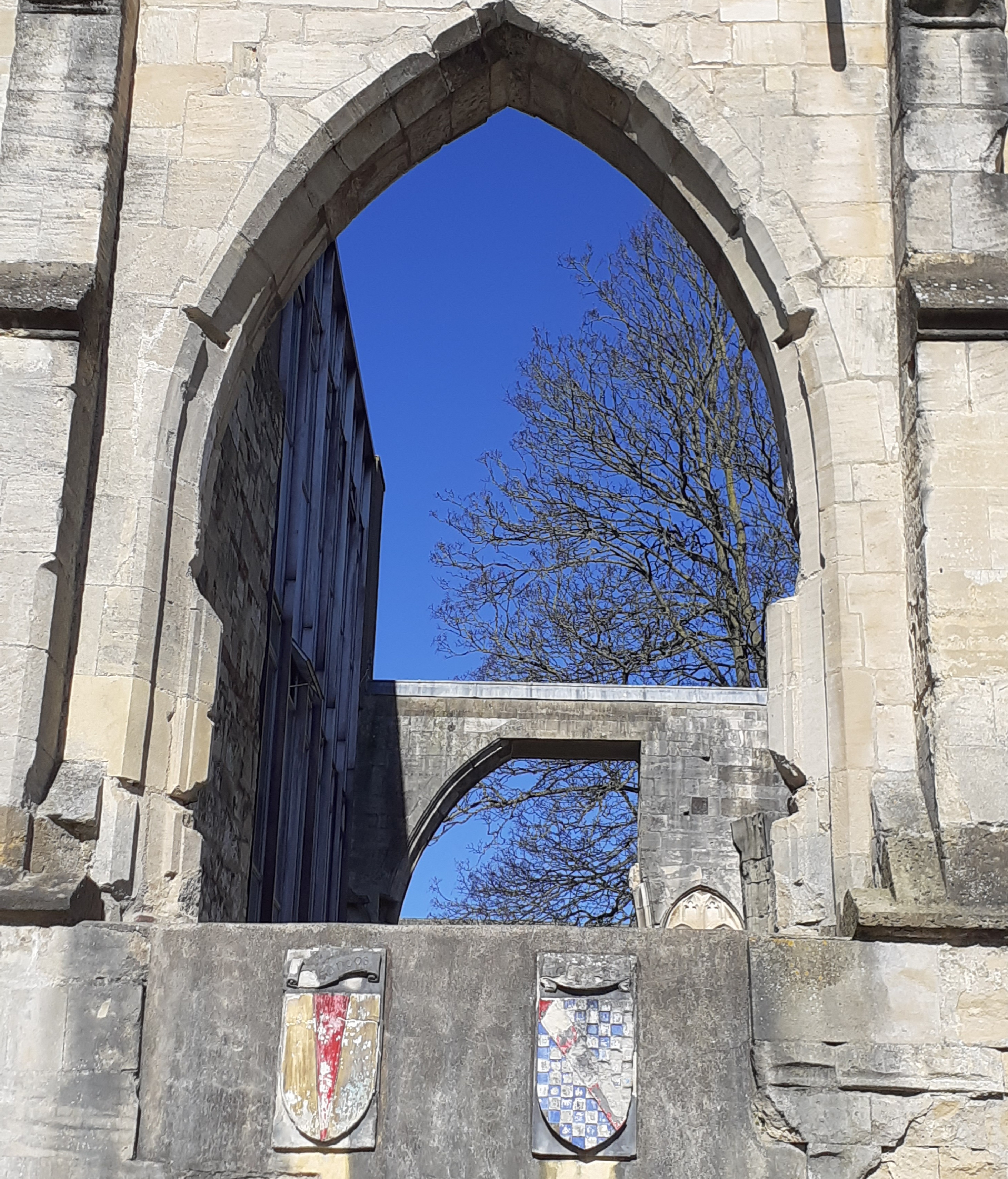
Below the yew, I have included a section of the cathedral itself. I have old personal associations linking medieval Gothic architecture with the feeling-tone of the declining year. I am also aware that this building is linked to the trees I picture and discuss. Gloucester Cathedral was a monastery when Sir Gawain and the Green Knight was written but many of its features were already in place.
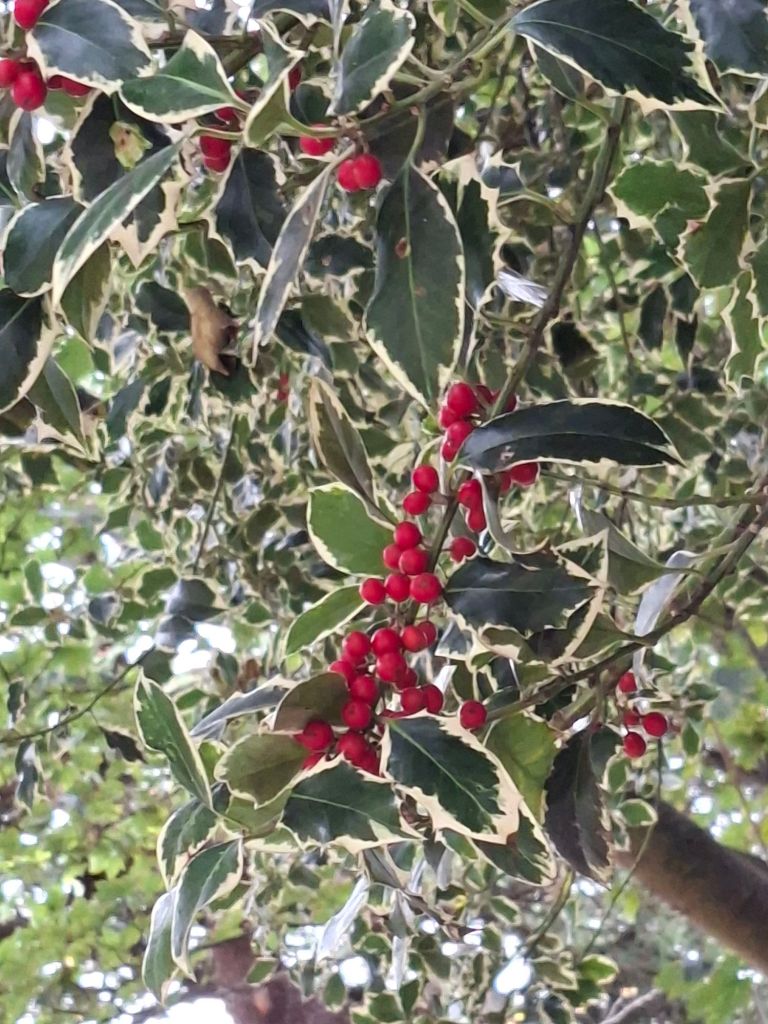
In the same space, I find both holly and ivy, with berries on the holly tree. I immediately thought of the Christmas carol The Holly and the Ivy. It is an ancient folk carol, which interweaves Christian themes and others that belong with the land. The version which is now popular was collected by Cecil Sharp in 1909 in Gloucestershire from Mary Clayton.
Many people think that the indigenous Pagan themes are the oldest, and that the central focus here is on the holly. The authors of The Green Man Tree Oracle say: “Holly’s connection with the Green Man is especially strong. In his guise as the Holly King – an ancient giant and symbol of fertility – the Green Man makes a notable appearance in the 14th century poem Gawain and d the Green Knight. Here he takes the form of a fearsome knight, who comes to King Arthur’s court to offer a midwinter challenge, carrying a club of holly and wearing a holly crown (as symbols of his true identity).” This challenge happens every year, where the Green Man/Holly King demands that we encounter him through our dealings with the natural world.
Elaine and I went to the Gloucester Cathedral Close and its surroundings on Saturday afternoon 18 October to outrun an extended period of gloom, wind and rain. We are now in it, so the lessons of the trees in deep autumn, anticipating the coming of winter, are not lost on us. The dark of the year is on its way.
(1) J.R R. Tolkien(translation of anonymous texts) Sir Gawain and the Green Knight, Pearl, Sir Orfeo New York: Ballantine Books, 1980.
My last post was about working with ancient texts. Here I look at the term ‘gnosis’ in the Gospel of Thomas. I am indebted to the commentary of translator Jean-Yves Leloup. Here he reflects on logion 5, whose text I include in a note below.
“Gnosis is not a system, not another ideology through which we are to interpret and understand the world. On the contrary, it means opening our eyes to what we are already looking at, right in front of us, not searching somewhere else.
” … Things are not hidden in themselves; they are open – the veils hiding them are in the habits of our own vision, so crude, so overloaded with memories and assumptions about reality, distorting what is before us …
“Gnosis is a long-term work of recognition, of purity of attention so as really to see what is in front of us. The consequence of this attention is that we become what we see and what we love … If we look at chaos, we will reflect chaos. If we look at light, we will reflect light.” (1)
I am glad that this commentary provides more than scholarly exegesis. Leloup says in his introduction that he wants to offer “a meditation that arises from the tilled earth of our silence. It is my belief that it is from this ground, rather than from mental agitation, that these words can bear their fruit of light “. In this way Leloup dreams the myth onwards for our time, and passes the baton to his readers. Both a blessing, and a responsibility.
(1) Commentary on Logion 5, The Gospel of Thomas: The Gnostic Wisdom of Jesus Rochester, VT: Inner Traditions, 2005
(Text translated from the Coptic with commentary by Jean-Yves Leloup; foreword by Jacob Needleman. English translation by John Rowe Original French edition published 1986).
The translated logion reads:
“Yeshua said:
Recognize what is in front of you, and what is hidden from you will be revealed.
There is nothing hidden that will not be revealed.”
Highly recommended, especially for readers interested in local initiatives to address the climate crisis. Bournebridge over Troubled Waters (1) is a sequel to Tony Emerson’s Unlikely Alliances, which I reviewed in October 2022 – (https://contemplativeinquiry.blog/2022/10/27/book-review-unlikely-alliances/). Although the new book stands on its own, I think it works best after reading Unlikely Alliances, now republished as Creating Hope in the Valley of the Bourne. The setting continues to be a fictional community on England’s south coast.
In the new book, we have reached the year 2030. The publisher’s blurb describes it as ‘a story of love and friendship’ as well as commitment to climate action. On my reading, the ways in which people do ‘love and friendship’ are integral to the action itself.
This is shown in a group of leading characters who gradually assemble together in an old rectory building. This is less by design than the need for decent housing and a belief that larger dwellings should be fully occupied. But the rectory evolves into a strong base for its residents’ flourishing.
In many ways they are a diverse group. But they all, sometimes with a little tlc, reveal themselves as naturally affectionate and ethically grounded. The culture of the house nurtures these co-operative qualities. It is a creative and supportive place to live. As part of the life of the house, the residents develop a system of peer mentoring for their work in the wider world. There’s also a concern, for some of them, about a progressive Christianity that honours the world and the flesh and is ecologically aware. I am reminded of Matthew Fox’s use of the term ‘original blessing’.
As was the case in Unlikely Alliances, the government is committed to climate action. The earlier book describes their Climate Action Plan, which has put serious wealth taxes in place, rationed fuel and food (especially meat), placed restrictions on air travel, created a Civilian Community Service Corps to provide training and jobs for the unemployed and 2 years national service for school and college leavers. Housing policy is not all about new build, but also addresses better use of existing resources.
The fields covered by our band of rectory activists and their colleagues include agriculture, hospitality, renewable energy, relevant university research, transport, housing, trades union development, clothing (new and renewed), second hand shops, and renovation, repair and maintenance services of various kinds. These are practical needs and also model a cultural shift away from throwaway consumerism. All of this work is depicted as dynamic and gaining momentum.
Temperatures are continuing to rise, and there is an unprecedented level of flooding to contend with. At the same time, vested interests and violent climate deniers, branded as ‘True Britannia’, continue to undermine the Climate Action Plan. Life goes on. Lovers get together. Children are born. Older people die and are lovingly remembered. Music is made. Rugby is played. Hospitality is exchanged. Events are organised and enjoyed. People maintain contact with family members further away, travelling throughout Britain and Ireland, though rarely further than that. It is not clear what the future will hold, but there are some grounds for optimism.
When I finished reading Bournebridge over Troubled Waters I felt as if pitched back into my own timeline. It’s as though my 2025 couldn’t be the one that led to their 2029-2034. I didn’t feel that way even when I read Unlikely Alliances in 2022. My reading of books like this seems to depend not only on who I am but when I am. If I become timeless, I can respond to these books as parables reminding us that we have the power to be better than we are. We just don’t use it enough. That’s a call to respond to whatever the outward circumstances or likely outcomes.
(1) Tony Emerson Bournebridge over Troubled Waters UK: The Conrad Press, 2O24 (www.the conradpress com)
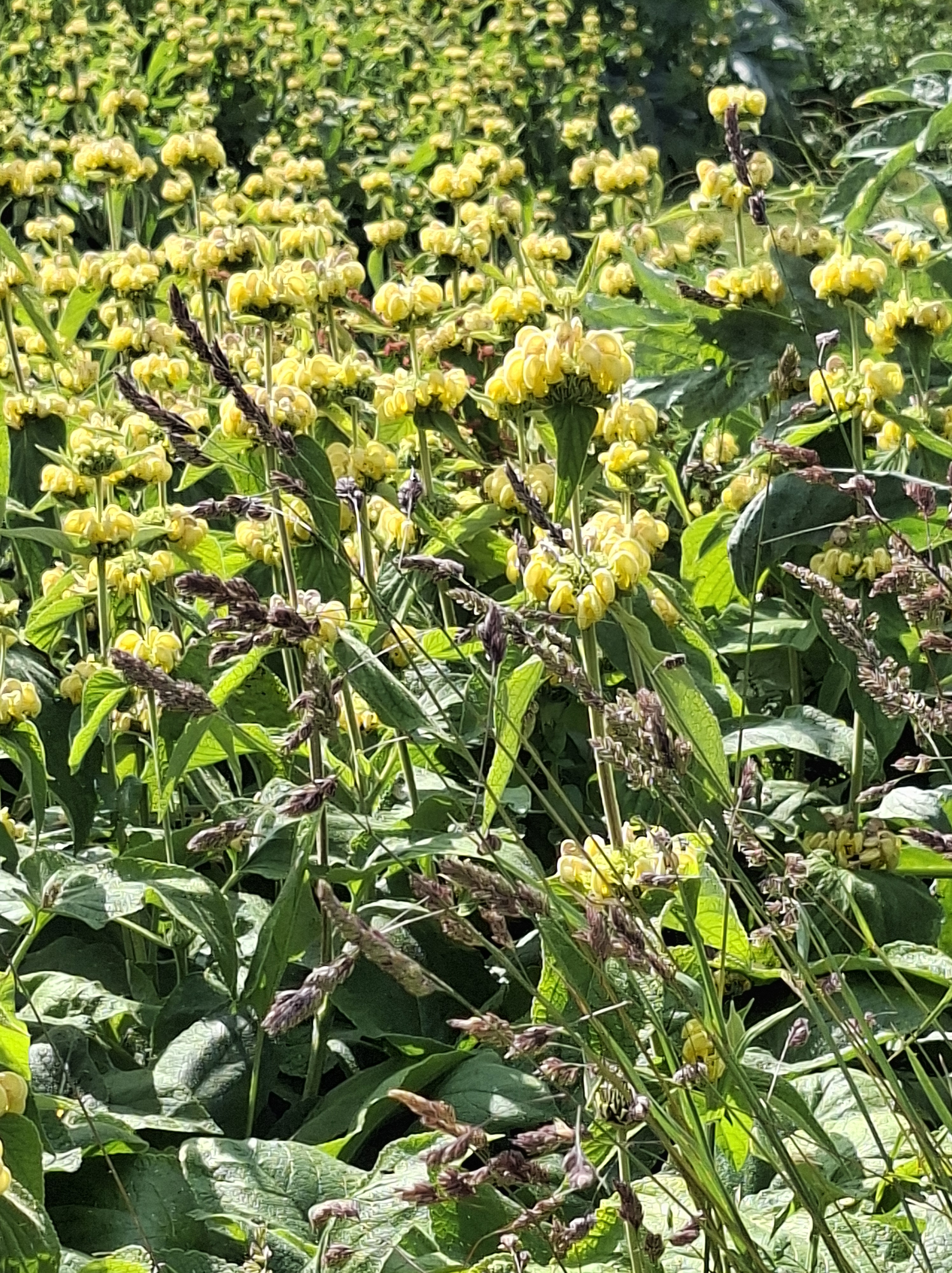
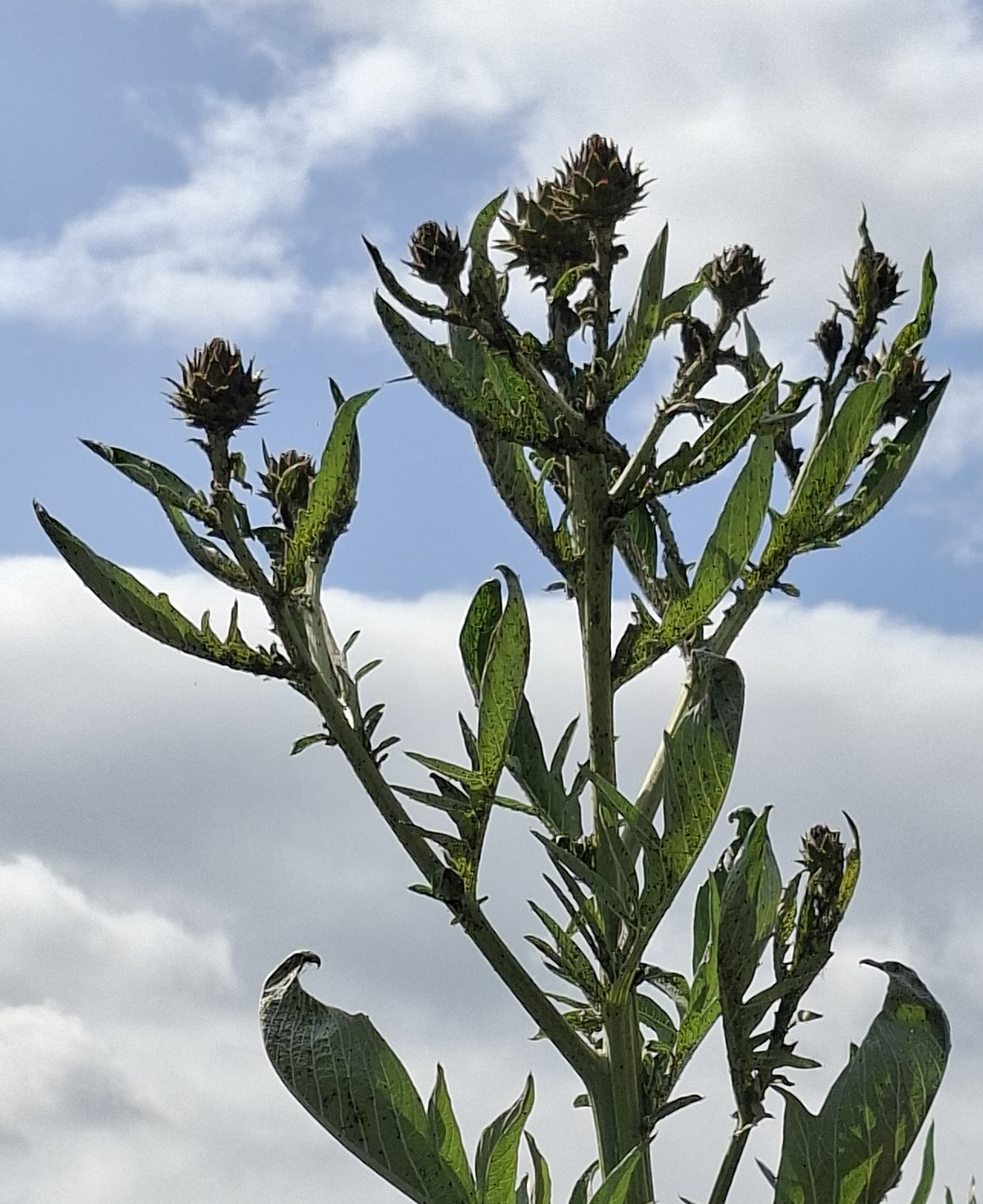
The garden in Gloucester Cathedral’s close is currently a magnificent riot. I was on a walk there with Elaine and we particularly noticed two powerful seeming plants that we couldn’t identify. We simply sat with them, unnamed, and bathed in their energy. It was a glorious 1 June, the first day of our official meteorological summer, and one to savour and enjoy. Only later did we do any research.
We are fairly sure that the plant above is yellow archangel and the plant below, looking like a giant thistle, is cardoon (canara cardunculus) aka prickly artichoke. Friendly feedback from readers on these identifications is welcome. If we are right both plants have long been recognised as sources of power and healing.
In our older traditions, yellow archangel was a symbol of harmony between flora and fauna. A custodian of wildlife, it fostered a bond that transcends mere survival. Herbalists still use this plant to relieve gout, sciatica and other pains of the joints and sinews. It has also been used to draw out splinters and thorns, clean and heal persistent sores, and to dissolve tumours. Yellow archangel can be used as food, in salads, soups and teas. In the wheel of our year, yellow archangel flowers fully after the bluebells die away.
Cardoon is also a plant of power. Traditionally associated with Mars, it has the virtues of strength, protection and abundance. It is has been credited with the power to ward off evil spirits. It is also connected to ideas of nourishment, the riches of nature and, latterly, sustainable gardening. The plant can grow to 2.5 metres in height. Its thick stalks are used as a vegetable. Its full flowering is in late summer and autumn, with thistle-like purple flowers.
These plants, in this garden, are a celebration of values as well as of nature and healing. I see our world through the lens of Modern Druidry and Paganism. The custodians of this space will have a Christian lens. I am happy to note that in this context they seem to be much the same. When in this space, I feel that I am in a beautiful and energising oasis in the city.
Modern Druids is the most recent public lecture (2 April 2025) presented by Professor Ronald Hutton in his tenure as Professor of Divinity at Gresham College, London. I provide a link below (1). This is the second of two posts about the lecture, focusing on Modern Druid movements in Britain from 1781. The first, concerning Hutton’s take on early modern perceptions of ancient Druidry, is published at https://contemplativeinquiry.blog/2025/04/08/ . It distinguishes four understandings, named by Hutton as Nationalist, Green, Demonic and Confessional.
Turning to modern Druid movements, Hutton also distinguishes four different kinds, emerging from the later eighteenth century up to the present:
Masonic Druids The Ancient Order of Druids was launched in London in 1781, as a closed society with initiation rites, secret memberships, signs and passwords, loosely modelled on Masonry. Its purpose was to give working men opportunities for participation in the performing arts. By 1820 it had become a huge success, moving beyond London to the Midlands and North of England. Some members wanted more focus on the insurance side of friendly society life, and in 1833 the United Ancient Order of Druids was formed, splitting off from the AOD. The UAOD lasted until the late twentieth century. The original AOD still exists.
Theosophical Druids emerged in the period from 1910 as an esoteric spiritual group. It followed the ideals of the Theosophical Society and worked towards the recovery of ancient mystical wisdom from all religions and philosophies. Founded by George Watson MacGregor Reid, and originally called the Order of the Universal Bond, the new group mixed Egyptian, Greek, Zoroastrian, Muslim, Jewish and Buddhist ideas with Irish and Welsh literature and using Druid names, roles and status. In 1912 a group of members went to Stonehenge to celebrate the Winter Solstice. Increasingly identified as The Ancient Druid Order they continued their association with Stonehenge for over 70 years. Always unpopular with the archaeologists of that period, the ADO sometimes had the support of the government and site administrators and sometimes not. In 1985 the festival that had grown up on the site was banned under Margaret Thatcher.
New Age Druids is the name Hutton gives to the Order of Bards Ovates and Druids (OBOD). The first iteration of OBOD was a split-off from the ADO in 1964 led by Ross Nichols, who took the new group to Glastonbury for their public ceremonies. On his death in 1975, the Order went into hibernation until 1988, when Philip Carr-Gomm, who had been a youthful apprentice of Ross Nichols, re-awakened it. By 1988 the human potential movement, and a new Celtic revival strand in western alternative spiritualty, were both gathering in strength. True to its Theosophical roots, OBOD declared itself to be a spirituality rather than a religion and opened itself up to people of all religions and none. The bulk of the membership identified as either Pagan, Christian or Buddhist. OBOD declared an aim of “uniting humans with the natural world and their own true selves”, to “heal the disorientation implicit for many in an urbanised and atomised social existence” and “to give peace”. Hutton goes on to mention The British Druid Order (BDO) and The Druid Network (TDN) but doesn’t say much about them. Although they hived off from OBOD, dual or multiple membership is common.
Counter Cultural Druids When the Stonehenge Festival was banned in 1985, many people felt they had lost a clergy and a temple as well as a festival. Some wanted to fight for a religion they saw as under attack. (Hutton does not specifially mention the ‘Battle of the Beanfield’.) The single most prominent leader who arose was Arthur Pendragon, ex-soldier, ex-biker gang leader, and mystic. He was prominently associated with the Glastonbury Order of Druids (GOD), the Secular Order of Druids (SOD) and the Loyal Arthurian Warband (LAW). These groups campaigned for civil liberties and preservation of the countryside. They held demonstrations against laws that limited the former, and organised protest camps on the routes of controversial road and building schemes. Arthur was frequently prosecuted and invariably acquitted by juries. Hutton identifies Arthur as part of a long tradition of working class protest, in which the use of costume and theatre is used to make disempowered people visible. Arthur himself had a more mystical view of his mission. Once, while looking for a sign, he noticed an attractive ceremonial sword in a local shop. Asked where it had come from, he was told that it had been Excalibur in the movie of that name.
Modern Druidry in Britain continues to mutate and develop, but Hutton ends his analysis at this point. I recommend readers to visit the link below and draw their own conclusions.
Modern Druids is Ronald Hutton’s most recent public lecture (2 April 2025) in his role of Professor of Divinity at Gresham College, London. I provide a link below (1). This is the first of two posts about the lecture, summarising Hutton’s take on early modern perceptions of ancient Druidry. The lecture goes on to describe the Modern Druid movements that have come out of an already existing inspiration. That will be the focus of my next post.
Most of what we have believed ourselves to know about the ancient Druids is derived from comments by a limited number of Roman authors. The most prominent of these are Julius Caesar, Tacitus and Pliny. According to Hutton, recent scholarship has tended to undermine the reliability of these sources. Both Caesar and Tacitus are known to have invented material for their histories. Pliny wrote after the Druids in both Britain and Gaul (= much of modern France, parts of the Netherlands and the Rhineland) had been repressed. Nonetheless, what these authors said has strongly influenced later beliefs about Druids. Fascination with Druids, as custodians of lost ancient knowledge, has been a feature of Northwestern European culture from the sixteenth century onwards.
Over this period, Hutton identifies eight distinct ways of imagining Druids and Druidry. The first four are visions of the Celtic Druid past. In his analysis Hutton names them as Nationalist, Green, Demonic and Confessional. They are all projections onto the past from somewhat different groups of people, which also speak to contemporary British concerns of the seventeenth, eighteenth and nineteenth centuries. I describe these four ways below. (I will cover the remaining four ways, concerned with Modern Druid movements, in my next post.)
Nationalist Druids (favourable) They are understood as patriotic, as defenders of the nation, representatives of piety and wisdom, and a link to tradition and the past. However, in a UK context, or even within the island of Britain, there are questions about what the nation is and whose traditions are being celebrated. By the end of the eighteenth century, a time when most Welsh people still spoke the Welsh language, Wales was the nation that most strongly identified with Druid heritage. A key figure in this was Iolo Morganwg, who I have written about in other posts (2,3).
Green Druids (favourable) Druids are associated with woods, caves and natural spaces. They are therefore an antidote to industry, urbanisation, modernity and forms of ‘civilisation’ about which many people had strong misgivings. (My own observation is that this early modern image of ancient Druidry, in its late modern deep ecology form, is the most influential current in 21st century Druidry – JN)
Demonic Druids (unfavourable) The ancient Druids were said to be a despotic heathen priesthood who practiced human sacrifice and ruled through fear, ignorance and superstition. The Romans did the Celts a service by breaking their power. This account appealed to imperialists and evangelical Christians whilst also being a gift to Gothic fiction.
Confessional Druids (favourable): The story here is that, sometime between the days of Noah and Abraham, wise men, inspired by God, set forth from Palestine to Britain to teach a pure religion. These were the original Druids. British Christianity was therefore, in a sense, both native and ancient. William Stukeley (1687-1765) Druid enthusiast, Church of England priest, and the first scientific archaeologist, held this view.
I am grateful to Ronald Hutton for his analysis. By understanding the cultural soil out of which modern Druid movements, beginning as least as far back as 1781, emerged, he helps to explain why some people over the last 250 years have chosen to claim the name for ourselves. More about that in my next post (4).
In 1986, at the age of 50, Satish Kumar (1) went on an extended pilgrimage of British sacred sites. When staying overnight as a guest of the Bishop of Lincoln, he initiated a dialogue on divinity. In this discussion, divinity is described as God, and masculine language is used throughout. (In other contexts Satish Kumar has been happy to use Goddess references and language.) My own practice is largely non-theistic, yet I am Pagan enough to have been jolted by this limitation. Diverse images, stories and beliefs about the divine continue to inform my heart, mind and imagination. The two views articulated here (both eco-friendly in their way) point to very different experiences and understandings of the divine, and of the world: dualist and non-dualist in formal terms.
“‘It is with great pleasure that I welcome you, Satish, to Lincoln and my house, the Bishop said. ‘Going on a pilgrimage is an ancient tradition, but walking for four months around Britain to its sacred places is not so common.’
“‘I am honoured to be your guest,’ I said. ‘I have been inspired and renewed by being within many churches and cathedrals, but increasingly I am finding all places sacred and the presence of the divine everywhere.”
“‘The Bishop heard my comment with thoughtful silence, and then said, ‘For us, God is above and beyond his creation. We aspire to reach God, but God and the world are not the same.’
“‘In the Hindu tradition the world is understood to be the dance of the God Shiva, and the yet the dance and the dancer cannot be separated. The world is not like a painting, a finished object which when complete is seen as separate from the painter. The universe is a living dance and God in in the heart of all beings and things. We do not separate God and the world.’
“The Bishop pondered and in a gentle voice said, ‘I believe that the world is God’s creation and therefore it is sacred. Human beings must act as responsible guardians and caring stewards. We must love the land and look after the earth in its glorious diversity. We have no right to plunder, pollute, exploit, destroy, kill or in anyway disrespect God’s creation. Like in a family, God is the Father and we are his children, and all members of the family should live in harmony with each other. God’s family includes the animals and the natural world. If we are sensitive and caring, we can live with nature rather than against it. The advance of science and technology requires that human beings live with greater sensitivity than ever before, since we are now equipped with extremely powerful and destructive tools. This destructive impulse is not part of God. God is good and good only.’
“‘For me, Divinity is neither good nor bad,’ I said. ‘It is like pure water and pure air. The human soul is also pure. Good and bad is a matter of perception. For example, from nature’s point of view creeping buttercups and nettles are fine wherever they are; they will grow where the soil is ripe for them. From the human perspective, however, a gardener struggles to remove the buttercups and nettles; he regards them as weeds, and complains when they overtake flowers. The rose and the thorn are part of the same plant – we cannot have one without the other. The analytical mind attempts to separate the good and evil, the decorative and ugly, the useful and non-useful, the weed and the flower. I have seen during my journey people pulling out foxgloves in one area and carefully planting them in another. If we are to live in harmony with God’s family, we need to love the wilderness, the weeds and the wet.'”
From: Satish Kumar No Destination: Autobiography of a Pilgrim Cambridge: Green Books, 2014 (extended 4th edition – first edition 1992)
(1) “Satish Kumar (born 9 August 1936)[1] is an Indian British activist and speaker. He has been a Jain monk, nuclear disarmament advocate and pacifist.[3]Now living in England, Kumar is founder and Director of Programmes of the Schumacher College international center for ecological studies, and is Editor Emeritus of Resurgence & Ecologist magazine. His most notable accomplishment is the completion, together with a companion, E. P. Menon, of a peace walk of over 8,000 miles in June 1962 for two and a half years, from New Delhi to Moscow, Paris, London, and Washington, D.C., the capitals of the world’s earliest nuclear-armed countries.[4][5] He insists that reverence for nature should be at the heart of every political and social debate.” (Wikipedia)
23 June 2024, around 8.15 pm. I’m enjoying my first contemplative walk for some days. I’m looking at an old wall, once part of the Llanthony Priory estate in Gloucester. The day has been one of rising temperatures and humidity. Even now, as the shadows deepen, I feel an energy and expectancy in the evening light.
The Priory here was for a time the largest landlord in the city and its surrounding district. In those days, midsummer was celebrated on 23/24 June. The Church celebrated the birth of John the Baptist, at the opposite end of the year from that of Jesus. (His beheading is remembered on 29 August). Popular celebrations on the evening/night of 23 June involved bonfires, and local festivities could be attributed to the saint, the season, or both.
In many cultures, the year has been divided into two contending halves, whether at the solstices, the equinoxes, or with the Beltane/Samhain division. Traditional Christianity flirts with this theme. I might think of summer and winter kings, king-slaying and the Goddess. I might also think of John, Jesus, and their respective human fates. In the case of John, Salome and her royal mother Herodias are a presence, along with their fateful demand for his head. These stories are not the same, but in the European Christian imagination they have at times been interwoven.
I might also think of the Green Man maturing to the point where he can “speak through the oak”, as “its crown forms his mask and its leafage his features” (1). To speak through the oak is to speak at another level, or from another dimension, a developmental moment that occurs at the year’s zenith (life’s zenith?) This maturation flows from from a willingness to surrender to a greater power. The purely personal direction can only be towards winter and death. But that’s not the whole story, even to a ‘sacred agnostic’ like me (2.) This is the midsummer evening’s tale that intrigues me the most.
The image below comes from a small patch in Llanthony Priory’s current garden, on the site of the original physic garden. I simply found it beautiful.








 Contemplative Inquiry