Contemplative Inquiry

This blog is about contemplative inquiry

Tag: Celtic spirituality

ANCESTORS

I watched the BBC series The Celts: Blood, Iron and Sacrifice recently and felt depressed – addicted as well, but depressed. My problem? I didn’t feel connected to anybody in the story. I couldn’t fully empathise. I acknowledge descent from people like them – probably in a humbler station of life than those who got the attention. I could offer gratitude and respect for their fecundity/virility, for their resilience, for doing the best they could with the life on offer. I felt uneasy at the display of their mortal remains on TV. But connection? Not really.

So where would I look for living ancestry? If we take the Eurasia of the time as a whole we find, as part of the cultural mix, an acute consciousness of something painful and awry in the military-aristocratic cultures of the day, perhaps in the very cosmos itself. We can follow this as a persistent theme in powerful emergent literatures. Such indeed was the revulsion that some teachers and writers became world and life denying. But that’s not true of everyone. The words below, attributed to the early Chinese Taoist Lao Tzu, seem grounded enough:

Brim-fill the bowl,

It’ll spill over.

Keep sharpening the blade,

You’ll soon blunt it.

Nobody can protect a house full of gold and jade.

Wealth, status, pride

Are their own ruin.

To do good, work well, and lie low

Is the way of the blessing. (1)

In Athens, a little closer to home, Socrates suggested that our highest good lies in our moral centre and best self, and that all external goods, such as bodily pleasure, health and social reputation are correspondingly of subordinate value. Essential good was to be sought within rather than in externals. Socrates himself was famous for the simplicity of his way of life. His ascetic follower Diogenes, a kind of crazy wisdom master described by Plato as “Socrates gone mad”, is said to have had a late life encounter with the young Alexander of Macedon, soon to become ‘the Great’. Alexander asked Diogenes if there was anything he could do for him, reckoning that if Diogenes came up with something it would establish a relationship of patronage and dependency. Diogenes was sitting against a wall and had been enjoying the sunshine until Alexander came along and loomed over him. So he requested the King to stand away from his sun. Alexander went on to fight his way through the Persian Empire all the way to India. There he cornered a group of gymnosophists (= naked sages, either Jain or Yogi) and happily repeated his pattern of asking clever questions and receiving sagely answers.

I am not a follower of Lao Tzu, Socrates or Diogenes, but I do feel connected to them. I have involved them in my contemplative inquiry. In this sense they are my ancestors. Edited and mythologised though they may be, they speak to me over the centuries. I realize that literary wisdom comes out of older, oral traditions. Humans are capable of wisdom and it doesn’t depend on writing. The Tao Te Ching is an anthology of verses passed from teachers to pupils who were expected to memorise them. I understand that their initial recording and publication were controversial in their day. Socrates and Diogenes didn’t care much for writing: they left that to others. I do not doubt that there were paths and people of wisdom in the Celtic-speaking lands – people who stuck by the way of personal relationship and oral transmission in their teaching: this is, after all, the rumoured way of the Druids. I just doubt that we would find them amongst the princes, warriors and court Druids presented in The Celts: Blood, Iron and Sacrifice.

So my Samhain thoughts this year turn to exemplars, teachers and sharers of wisdom – firstly and obviously those who are publicly known and remembered; secondly and perhaps more importantly with those who remain unknown but whose invisible influence has leavened the life of the world.

  1. Lao Tzu: Tao Te Ching: a book about the Way and the Power of the Way (New English version by Ursula K. Le Guin, with the collaboration of J. P. Seaton, Professor of Chinese, University of North Carolina, Chapel Hill) Shambhala: Boston & London, 1998.
BOOK REVIEW: THIS ANCIENT HEART

A good book review of This Ancient Heart, copied from A Bad Witches Blog – http://www.badwitch.co.uk

 This Ancient Heart: Landscape, Ancestor, Self is a new compilation of essays on subjects at the core of many pagans’ spiritual beliefs – the relationship between the landscape, our ancestors and ourselves.

“Edited by Caitlín Matthews, author of dozens of books including Singing the Soul Back Home and Celtic Visions, with druid and activist Paul Davies, This Ancient Heart offers ten different perspectives on how our place of birth, the country we live in, those who have lived before us and those we share the land with now, can inspire and affect our spirituality.

“It starts with beautiful and inspiring writing from Emma Restall Orr and Philip Shallcrass (Bobcat and Greywolf) and ends with an afterword by celebrated historian Professor Ronald Hutton, author of Pagan Britain. The words of other luminaries grace the pages in between.

“Emma offers an impassioned call to respect the bones of those who have died – for them to remain buried rather than be dug up by archaeologists and put in museums. She has long campaigned for this as a founder of Honouring the Ancient Dead, and in her essay here she explains her thoughts and feelings on this subject. I know her writing is powerful because it made me question how I had thought about this in the past.

“Questioning is good. This is, overall, a book that makes you question preconceived ideas, not a book that reaffirms comfortable complacency. Professor Ronald Hutton, at the end of the book, states that some may feel aggrieved over this, ‘but they should not, if they really intend this book to have some effect on readers.’

“The essays are extremely wide-ranging in their subjects and styles. Greywolf talks about his connection with a tribe of wolf spirits – how that came about where it led him, including his own questioning of whether to eat a venison feast offered to him despite previously having been vegetarian.

“Jenny Blain looks at how the ‘spiritual ways of ‘seidr’ might give some insight to an understanding of the interaction of place and human-person, and how in turn relationships with wights [land spirits] and ancestors form part of how seidr is worked’.

“Robert J Wallis offers an evocative description of falconry on a cold winter morning and how it fits into the world-view of a heathen archaeologist.

“Caitlin Matthews, as well as co-editing the book, has written a chapter called Healing the Ancestral Communion: Pilgrimage Beyond Time and Space. This offers a practical guide to spiritually connecting with the land in which one lives and also the land of one’s birth. As Caitlin points out, these can be very different. She provided meditative and sensory exercises to heal the rift of disconnection.

“Camelia Elias offers a eulogy for a modern ancestor of tradition, Colin Murray. Throughout the 1970s and 80s Murray was responsible for the revival of all things Celtic in a way that was quite unprecedented”

“Pagans are not the only ones who find meditating on nature can be a spiritual practice. Quaker Sarah Hollingham offers examples and practical exercises in Tuning into the Landscape, that people of all spiritual paths and none could learn from.

“Science is addressed in How Genetics Unravels the Role of the Landscape in the Relationship Between Ancestors and Present by Luzie U Wingen.

“David Loxley looks at linguistics and how the way we frame sentences affects our view of the past, present and future.

“In The Heart of the Land: The Druidic Connection, Penny Billington looks at the importance of keeping balance – symmetry – between literal reality and spiritual yearning. She asks the reader to ‘imagine yourself for a moment on a hill at sunset, with the quiet buzzing of the insects invisible in the soft light.’ She continues: ‘From your vantage point you look over the dark lake to the west, where the molten streaks of light reflect in a shimmering water-path leading to you, and with the quiet stars appearing in the deep blue overhead. This momentary turning of our attention to the world of nature, even in the imaginal realm, can prompt a surprising sense of relaxation that slows our breathing and our over-busy brains’. She points out: ‘Science backs up these instincts’.

“Perhaps that is the overall message of the book; that it is good for us to feel a connection with the landscape and with those who have gone before us. Whether we follow a religion or spiritual path, or whether we are atheists, it is good to know where we are and where we come from, and spending time in the natural world can be healing.

This Ancient Heart: Landscape, Ancestor, Self is published by Moon Books

ANAM CARA

This post is about the anam cara, or spiritual friend in Gaelic tradition, and about the use of language. Recently I wrote about allowing more space and using fewer words. This wasn’t a renunciate view of language, which I value highly. My hope was that “more space” would allow “something new to emerge”, and that my words, though fewer, would be better chosen.

I am starting to see some fruits from this strategy. I’ve also recently said that I experienced Sophia “as a psychopomp or inner guru”. Now I would say, “anam cara”. This term is known from the early days of Christian monasticism in Ireland and is in current use within the Scottish-based Celie De – see http://www.ceilede.co.uk/

It is a mentoring relationship, not a peer one, but it includes the sense of a real personal connection, not just a role. People speculate about whether it is an inheritance from indigenous Druidry. Subjectively, my relation with Sophia feels like this: much more than psychopomp or inner guru. In my understanding ‘anam cara’ is gentler, subtler and less formal.

The Sophia I experience is not a rhetorical device (personification) or a glove puppet arbitrarily selected by me. She is also not – in my sense of things – a mind independent celestial being. Rather she is the felt presence, the voice, and at times the image of a deeper nature – and my inner link with the Oran Mor (the song of what is). From a personality perspective, this deeper nature is ‘not me’ and not owned and controlled by ‘me’, so I have to work at relationship.

From the perspective of deeper nature, the separation doesn’t exist. At times Sophia can point beyond herself and then I may enter the subjectivity of deeper nature and experience the world differently. The little ‘I’ and the anam cara are as one, beyond separation and immersed in the song. But most of the time that’s not how it is in my subjective life world, and a link to that fuller reality is provided by Sophia and her nudgings and promptings.

I don’t make any fundamental distinction between nature and spirit. All, for me, is contained in the word nature (or terms like the Oran Mor).  Nothing is lost. Cosmos, relationship and practice remain the same. But the use of a nature language is truer to my experience.

POEM: TALIESIN

Poem by Ross Nichols, who founded OBOD in 1964.  I like his seamless interweaving of naturalistic, mythic and theosophical themes – because for him they are one integrated experience. For me the poem reads like the work of someone who needed to live it in order to write it.

Here the Fish enters

The world of dark water

Pre-birth waters

Waterworld Elysium

Lake Tegid and the magic weir.

Much does he grow,

Many his transformations.

Warm are the waters,

The dark waters of Tegid,

And they swiftly flow

Downwards as he grows.

Talisin is found in the weir:

Elphin finds him

In a bag of leather

Where the waterworld dams,

Where the womb-waters

Are falling terribly

At the weir of birth.

The entering fish

Was the spirit of Taliesin:

His transformations

Were the many souls and bodies of Taliesin:

Leading him gently, drifting him slowly

Into the bodily definition of Taliesin,

His bag of leather,

His separated skin.

And Taliesin, after his separated life,

His songs and his wonders. His challenges and his fame,

Shall enter again as a Fish,

Shall know again sufferings and transfigurations

And the waters of Tegid.

For Taliesin was ever upon earth,

Knew all things, suffered all things.

And Taliesin shall be

In many wonderful shapes,

A grain of wheat and a hare

Sown and running

While there are fields, and the spirit of men,

Leaping alive at a harvest,

Or silver in the waters of time.

This poem can be found in the collection Prophet Priest and King: the Poetry of Ross Nichols edited and introduced by Jay Ramsay Lewes: Oak Tree Press, 2001.

CONTEMPLATIVE DRUIDRY: MEME OR MOVEMENT?

On 3 October Contemplative Druid Events (CDE) – see http://contemplativedruidevents.tumblr.com – will hold its last planned event for 2015. This will be a Contemplative Day, in Stroud, Gloucestershire, England. The facilitators will be James Nichol, Elaine Knight and Nimue Brown. Our programme is designed for a group of up to 15 people, and 12 are already committed. With just over a month to go we have a comfortable size of group, with room for a few more.

CDE offerings are built around insights from the book Contemplative Druidry: People Practice and Potential about the kinds of contemplative work that most seemed to resonate for the present generation of Druids. We offer sitting meditations of based both on a bare attention and on active imagination. We have outdoor walking meditations and opportunities simply to be, with awareness, in natural settings. We use methods that draw on creative arts. We have developed ‘Awen space’ as a group opening to, in and as Spirit. We build our repertoire as we gain in experience.

Is CDE spearheading Contemplative Druidry as a movement? I don’t see it that way. CDE was created as a minimal level of organisation for a single purpose. This is to offer a particular kind of event to small groups of Druids and fellow-travellers willing to join us. In doing this, we also promote the contemplative Druid meme, which now seems to be well recognised in modern Druid culture. But the CDE brand does not exhaust the possibilities of contemplative Druidry and we wouldn’t want it to. Modern Druidry, which is in some senses a postmodern Druidry, has a strong commitment to free exploration and diversity. The contemplative meme will find its place within that wider cultural framework. For better or for worse, we will never, as a collective, be organised around a Druid ‘four noble truths’. Contemplative Druidry will mean different things, and inspire different journeys, for different Druids.

POEM: PRIMARY CHIEF BARD

Gnostic Bardistry from The Book of Taliesin? These are just five of the verses, selected by me from one poem. What interests me is not so much working out what to us seems like a set of puzzles, but how something new and dialogical is created by interweaving indigenous material and biblical references. I say a few words in italics after each verse.

Primary Chief Bard

Primary Chief Bard

Am I to Elffin

And my native country

Is the region of the summer stars.


The first statement is a statement of identity. It begins with a local (though important) role, and goes on to the cosmic and transcendent. This taps into a sense of belonging somewhere else (whether perceived as a place or state). It makes me think that statements like ‘being here now, in the present’ and ‘my native country is the region of the summer stars’ only seem contradictory: meaning depends so much on context and the work that words are doing. If the two statements are separated and polarised, they diminish into limiting slogans. Taken together, they can lead us to a different quality of experience.

I was full nine months

In the womb of the hag Ceridwen.

Before that I was Gwion

But now I am Taliesin.

Taliesin’s current personal identity is explained in terms of a second birth, in this life, triggered by the actions of Ceridwen. This second birth fits him to be a Bard and take the Bardic name ‘Radiant Brow’, one that bespeaks major shifts in energy and consciousness. It also allows the sense of the summer stars as his ‘native country’ to be real within him. It orients him to his true home.

I was patriarch

To Elijah and Enoch.

I was there at the crucifixion

Of the merciful Mabon.

Elijah and Enoch ascended to heaven without dying. They have deep roles in Jewish mysticism. They are in the tradition of so-called ‘ascended Masters’. If we treat these metaphors (insofar as they are metaphors) as concerned with enlightenment, then – as their ‘Patriarch’ – Taliesin is claiming primacy over them. He is in some sense a Christ figure and so can be present at the crucifixion of another Christ figure, referred to here by the name of the magical child of British tradition ‘the Mabon’.


I was at the cross

With Mary Magdalene.

I received the Awen

From Ceridwen’s cauldron.

The poem presented here is a product of the later Middle Ages, likely as late as the fourteenth century. Traditions giving Mary Magdalene the role of major teacher and possibly spouse of Jesus were deep underground, but everyone in Christendom Knew of her witnessing role at both the crucifixion and the resurrection, and so as privileged in some way. She also shares her name with Mary the mother. The two couplets together bring the idea of Christ’s transformation through death on the cross with Taliesin’s transformation from Ceridwen’s cauldron, and the critical role of a feminine power in each.

I was in the larder

In the land of the Trinity

And no one knows whether my body

Is flesh or fish.

Despite all the above, Taliesin remains an enigma – a shape shifter and trickster. He defies definition and description and won’t fit into any box that attracts unwanted piety. Other readers may understand this verse much better than I do, but I see it as very tough minded and unwilling to let me parcel up this poem and tie it with a neat bow. To the extent that I get a sense of medieval Welsh literature, this seems very characteristic. However, in the most obvious ‘Land of the Trinity’ (Western Christendom) people want to know where everyone stands. The accepted narrative is that we’re with Jesus the avatar of Pisces and through the sign of the fish we know him. And yet the old Celtic world has many trinities and many fish, including the salmon of wisdom. And Taliesin’s body might be flesh after all. So we are thrown back on our resources, with riddling words and ambiguous images to reflect them.


The complete poem can be found in Taliesin: Shamanism and the Bardic Mysteries in Britain and Ireland by John Matthews London: The Aquarian Press, 1991.

POEM: ARTHUR

Behind storm-fretted bastions gray and bare

Flame-crested warriors of Cunedda’s line

Feast in a gold ring, – their targes shine

Along the wall and clang to gusts of air;

And in the shadow, torches blown aflare

Reveal a chief, half human, half divine,

With brooding head, starred by the Dragon Sign,

Hung motionless in some undreamed despair.

But when he starts, three torques of twisted gold

Writhe on his breast, for voices all men fear

Wail forth the battle-doom dead kings have borne;

And as the mead-hall fills with sudden cold,

Above the wind-tossed sea his heart can hear

The strange gods calling through their mystic horn.

Arthur is one of Six Celtic Sonnets written by Thomas Samuel Jones and included in From the Isles of Dream: Visionary Stories and Poems of the Celtic Renaissance, selected by John Matthews and with a foreword by Robin Williamson (Floris Books, 1993).

Thomas Samuel Jones (1882-1932) came from Welsh and Irish stock and was born in Oneida County, New York State, near the Adirondack Mountains. Each of the six sonnets reflects a facet of Celtic tradition. They were originally published in 1930 as part of the collection Aknahton and Other Sonnets. For those of us who resonate with Druid and Celtic spirituality, they are part of our modern cultural ancestry.

POEM: MAY UPON ICTIS

Far out at sea beneath rich Tyrian sails

The merchants watch a ghostly mountain spread

Terrific dawn-wings fired with cloudy red,

And cease their barter over purple bales;

Wild headland flames to headland; in the dales

Hushed warriors wait, for now torqued chief may tread

That dim white forest where the vanished dead

Gather like birds before the spume-drenched birds.

Around the mount barbaric trumpets cry;

Then Ictis thunders through her altar-stone

Long-cloven by a god’s mysterious rune;

And pinnacle between the earth and sky

Her savage prophet stands, majestic, lone,

Helmed with the sun and girdled with the moon.

May upon Ictis is one of Six Celtic Sonnets written by Thomas Samuel Jones and included in From the Isles of Dream: Visionary Stories and Poems of the Celtic Renaissance, selected by John Matthews and with a foreword by Robin Williamson (Floris Books, 1993). Ictis, or Iktin, is or was an island described as a tin trading centre in the Bibliotheca Historica of the Sicilian-Greek historian Diodoris Siculus, writing in the first century BC. While Ictis is widely accepted to have been an island somewhere off the southern coast of what is now England, scholars continue to debate its precise location. Candidates include St Michael’s Mount and Looe Island off the coast of Cornwall, the Mount Batten peninsula in Devon, and the Isle of Wight further to the east.

Thomas Samuel Jones (1882-1932) came from Welsh and Irish stock and was born in Oneida County, New York State, near the Adirondack Mountains. Each of the six sonnets reflects a facet of Celtic tradition. They were originally published in 1930 as part of the collection Aknahton and Other Sonnets. For those of us who resonate with Druid and Celtic spirituality, they are part of our modern cultural ancestry.

POEM: A DRUID TOWN

A sunless maze of tangled lanes enfold

The magic dwellings of the forest race,

Whose hidden shapes are flames that leave no trace

At mid-moon when the Druid’s dream is told;

The shadows of enchanted orchards hold

Red thatch of wings and woad-stained doors that face

The wandering stars, and guard the sacred place

Where faery women thread their warps with gold

The dragon knight shall lose his strength of hand

Nor ever raise his long leaf-shapen shield,

If he but follow where the white deer roam;

And never will the mariner reach land

When harps ring seaward as the dawn fires yield

The golden caer upon the ninth wave’s foam.

A Druid Town is one of Six Celtic Sonnets written by Thomas Samuel Jones and included in From the Isles of Dream: Visionary Stories and Poems of the Celtic Renaissance, selected by John Matthews and with a foreword by Robin Williamson (Floris Books, 1993).

Thomas Samuel Jones (1882-1932) came from Welsh and Irish stock and was born in Oneida County, New York State, near the Adirondack Mountains. Each of the six sonnets reflects a facet of Celtic tradition. They were originally published in 1930 as part of the collection Aknahton and Other Sonnets. For those of us who resonate with Druid and Celtic spirituality, they are part of our modern cultural ancestry.

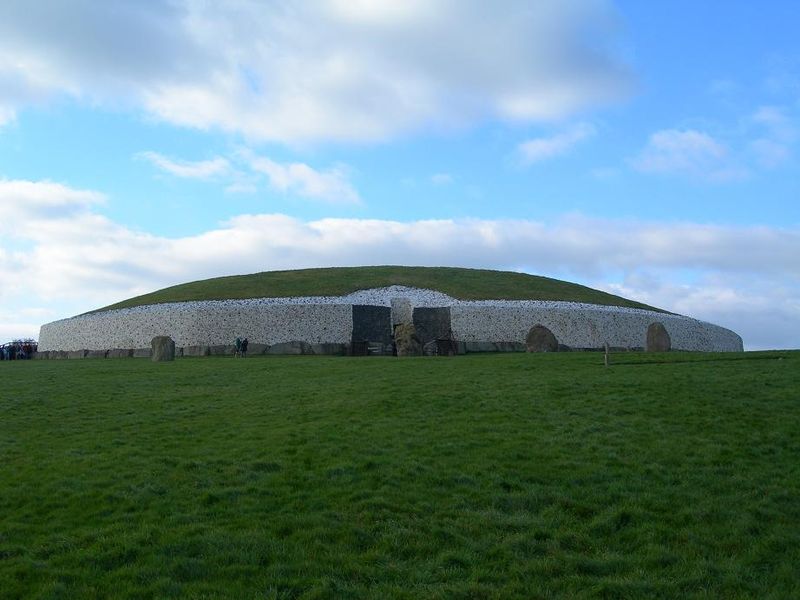
POEM: NEW GRANGE

800px-Newgrange

Picture cc by 2.5 pl – originally uploaded by Shira-commonswiki

The golden hill where long-forgotten kings

Keep lonely watch upon their feasting-floor

Is silent now, – the Dagda’s harp no more

Makes sun and moon move to its murmurous strings;

And never in the leafy star-led Springs

Will Caer and Angus haunt the river shore,

For deep beneath an ogham-carven door

Dust dulls the dew-white wonder of their wings.

Yet one may linger loving the lost dream –

The magic of the heart that cannot die;

Although the Rood destroy the quicken-rods;

To him through earth and air and hollow stream

Wild music whines, as two swans wheeling cry

Above the cromlech of the vanished gods.

New Grange is one of Six Celtic Sonnets written by Thomas Samuel Jones and included in From the Isles of Dream: Visionary Stories and Poems of the Celtic Renaissance, selected by John Matthews and with a foreword by Robin Williamson (Floris Books, 1993).

Thomas Samuel Jones (1882-1932) came from Welsh and Irish stock and was born in Oneida County, New York State, near the Adirondack Mountains. Each of the six sonnets reflects a facet of Celtic tradition. They were originally published in 1930 as part of the collection Aknahton and Other Sonnets. For those of us who resonate with Druid and Celtic spirituality, they are part of our modern cultural ancestry.

Earth Eclectic

music that celebrates Earth and speaks to the heart

Sarah Fuhro Star-Flower Alchemy

Follow the Moon's Cycle

Muddy Feet

Meeting nature on nature's terms

Rosher.Net

A little bit of Mark Rosher in South Gloucestershire, England

Becoming Part of the Land

A monastic polytheist's and animist’s journal

selkiewife

Selkie Writing…

Charlotte Rodgers

Images and words set against a backdrop of outsider art.

Prof Jem Bendell

living with metacrisis and collapse

Towint

The pagan path. The Old Ways In New Times

The Druids Garden

Spiritual journeys in tending the living earth, permaculture, and nature-inspired arts

The Blog of Baphomet

a magickal dialogue between nature and culture

This Simple Life

The gentle art of living with less

Musings of a Scottish Hearth Druid and Heathen

Thoughts about living, loving and worshiping as an autistic Hearth Druid and Heathen. One woman's journey.

Wheel of the Year Blog

An place to read and share stories about the celtic seasonal festivals

Walking the Druid Path

Just another WordPress.com site

anima monday

Exploring our connection to the wider world

Grounded Space Focusing

Become more grounded and spacious with yourself and others, through your own body’s wisdom

The Earthbound Report

Good lives on our one planet

Hopeless Vendetta

News for the residents of Hopeless, Maine