
Contemplative Inquiry

This blog is about contemplative inquiry

Tag: Celtic spirituality

BOOK REVIEW: THE CRANE BAG
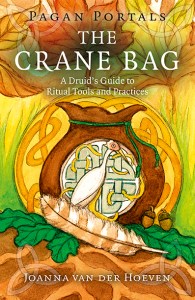
The Craane BagThe Crane Bag, Joanna van der Hoeven’s forthcoming book*, offers an introduction to the ritual tools and practices found in the Druid tradition. It achieves this briefly, simply and with a light touch – as books in the Pagan Portals series are designed to do. Yet it much more than a tick box guide. It provides context and meaning, showing the modern evolution of the Druid tradition itself.

The author makes it clear that she wants readers “to develop their own path in their own time in their own fashion”. Re-enchantment is both path and goal. With proper use, the crane bag “can further the Druid in working with the tides of nature, finding his or her own place in the environment, living in balance, harmony and peace”. The movement overall is “toward reintegration with the natural world”.

At its simplest, the crane bag is the container for Druid ritual tools and as such enables the practices. Bag and tools provide the practitioner with “something tangible to express the spiritual”, acting as a portable “map of the soul”. Behind the crane bag lies an ancient Irish story beginning with the contention between two sisters and the transformation of one of them, Aoife, into a crane. The story is beautifully told and its relevance clearly explained in the first chapter of the book.

In ritual, a period of time and an area of space are set apart and dedicated. This is not to create a lasting duality of sacred and mundane, but a step on the way to experiencing everything as sacred. “Ritual helps us to step back from the busyness, into another way of being. It is a change of consciousness, where we can shift our perception away from a singular view to a more plural view, realising that we are part of an ecosystem”. There is a clear preference for working outdoors, where awareness can shift more readily, though this is not insisted on.

A Druid’s tools will vary with the Druid. The book identifies the following: a silver branch; a staff; cups/bowls/cauldrons; drums; a sickle or knife; robes; altars; fire/candles; incense. People may make or buy them. Ethical sourcing of tools and materials is discussed in some detail, in line with the values of The Crane Bag overall.

What goes into a ritual is explored under the headings of call for peace; preparing the nemeton; honouring spirits of place, three worlds, four directions, ancestors, deities; ritual action; prayers and magic; offerings; eisteddfod; sacrifice; feast; closing. There’s encouragement to practitioners to craft what is right for them from within this set of suggestions and beyond it. The author adds, “I have been in circles with Christian Druids and Buddhist monks, as well as other religions from all over the world”. What matters in ritual is being present and performing the ritual with mindfulness, so that “any words that you speak, any gesture or movement you make will flow more easily, be more graceful and filled with meaning”.

There’s a final chapter on ‘altered states’. I don’t use the term myself, because it makes an ‘altered’ vs ‘normal’ distinction that doesn’t really work for me in my own life. But I recognise it as a term that is widely and usefully employed. Here, it facilitates valuable discussions of meditation, drumming, chanting and song, sensory deprivation, sacred landscape and sitting out. Three kinds of meditation are distinguished: calming the mind and re-tuning the body, journeying and problem solving. Guidance is offered on each kind. Different suggestions are also explored within the other topics. For sensory deprivation, there are two. One is the Celtic version of the sweat lodge, called teach an alais. The other is total immersion in darkness for a considerable period before being brought out into the light. The author refers to early medieval accounts of this, where it was done in aid of Bardic inspiration and prophesy: imbhas forosna.

I found The Crane Bag a very useful contribution to its topic and highly recommend it.


Joanna van der Hoeven The Crane Bag: a Druid’s guide to ritual tools and practices Winchester UK & Washington USA: Moon Books, 2017

*According to the publisher, the book is due for release on 28 July, and can be pre-ordered through Amazon US & UK, Indiebound and Hive.

TEMPLE OF SOPHIA

My ‘Temple of Sophia’ recollects the active imagination work I did when practising Druidry and the Way of Sophia as a fusion path. The Temple keeps the work alive for me, though its presentation lacks the dynamism of the original set of practices when I was working them. The Temple structure owes something to the ‘art of memory’ of the ancient Greeks This was a system of impressing ‘places’ and ‘images’ on the mind, which continued into the dawn of modernity. Late practitioners included Giordano Bruno and the English alchemist Robert Fludd (1).

Here is how the visualisation goes.

“[I am] …on the water of a lake, in a rowing boat … mooring on the western shore … walking eastwards on a path between carved stones … on the left hand a Pictish ‘dancing seahorse’ … on the right hand, a Levantine image (a pomegranate tree, serpent coiled around the base, dove at the top) … moving up to the western door of the Temple of Sophia, a domed stone building, half hidden in extensive tree cover … basically round but with arms extended in each of the 4 cardinal directions to create an equal armed cruciform shape.

“I enter the temple through a porch at the western end, over which are written two lines from Primary Chief Bard, in the Book of Taliesin (2): I stood at the cross with Mary Magdalene; I received the Awen from Ceridwen’s cauldron. I find myself facing the eastern wing. Its most striking feature is a rose window at the back. It also has an altar whose white cloth is embroidered with a golden gnostic cross, and strewn with white and red rose petals. At the centre stands a chalice, white candles on either side. Looking around me I see steps spiraling downwards to a crypt, left (northern extension) and steps spiraling upwards to an upper room, right (southern extension).

“The main body of the temple is lit by chandeliers hanging from the ceiling as well as natural light from the windows. On the floor is a large mosaic given definition by the golden outline of a circle, crossed at the cardinal points by golden lines which merge at the centre within a fully golden circle, which includes 3 white seed pearls in a triangular cluster at the centre.

“Just outside the outer circle, around the wheel of the year, are depictions of 16 trees: yew, north-west; elder, north-north-west; holly, north; alder, north-north-east; birch, north-east; ash & ivy, east-north-east; willow, east; blackthorn, east-south-east; hawthorn, south-east; beech & bluebell, south-south-east; oak, south; gorse, south-south-west; apple, south-west; blackberry & vine, west-south-west; hazel, west; rowan, west-north-west. Each representation of a tree on the mosaic offers a portal for further communication with the tree. If I visualize myself standing on the image, then I may enter another imaginal landscape for a fuller experience – whether through sensing or communicating with the tree in question, or indeed becoming it.

“Moving in to the delineated quarters of the main circle, I find: north, a seated white hart in a yellow square; east, an eagle with wings outstretched, in a blue circle; south, a mottled brownish adder in a red triangle; west, a silver salmon over a silver crescent moon. These positions, too, are potential portals into an Innerworld landscape. If I visualize myself standing on an image, it has the power to take me to another imaginal landscape, and to forms of engagement – whether simply connecting, communicating or indeed journeying there. At the golden centre of the circle, the cluster of three white pearls recollects the three drops of inspiration distilled from Ceridwen’s cauldron and the visionary power of Awen. There are also other trinities – the triple goddess; the orthodox Christian trinity; or the divine mother, father and child; or the singularity of Tao becoming the two, three and 10,000 things. This is more a place for simple contemplation.

“Spiraling again out of the circle, and exiting north, I descend into the crypt. Here I find an empty sarcophagus dimly lit by candles. Two or three steps below the sarcophagus is a small, warm pool, lit by night lights – a ‘birthing pool’, perchance a re-birthing pool. There is an image of a coiled serpent at the bottom of the pool and a red ankh painted at the centre of the ceiling. I can spend time lying within the sarcophagus, contemplating change, death and dissolution. I can also move on to the birthing pool, and taste the experience there.

“Leaving the crypt and moving across the temple, I climb the steps to the upper room, which has a meditation chair at its centre, with a chalice, or grail, on a small table in front of it. There is a white dove painted on the ceiling; otherwise the room is plain. If I centre myself and drink from the chalice, saying, my heart is home to Sophia, I may find myself in a Garden. It has a fountain at the centre, surrounded by four flower beds of alternating red and white roses. There are fruit trees, apple, pear and plum, trained around the walls. Sometimes, full bright sunlight shines on the scene and strikes the dazzling water of the fountain, warming an illuminating each drop as it falls. At other times, I am in moonlit or starlit night, and I hear as much as see the fountain. Either way, I open myself to the experience of the Garden. Sophia herself as psychopomp may or may not appear. Indeed, there is no ultimate distinction between Sophia, the Garden and me.

“On coming back from the vision of the garden, I sit and rest for a while. Eventually I leave the upper room, and, descending into the main body of the temple. I walk to the south point of the circle and from there move, spiralling, into the centre. I face the altar at the east, bowing and giving thanks before I leave the temple.”

(1) Frances A. Yates The Art of Memory London: Pimlico, 1966

(2) John Matthews Taliesin: Shamanism and the Bardic Mysteries in Britain and Ireland London: The Aquarian Press, 1991

MODRON

An unlocatable darkness, beyond deep time, beyond even the metaphysics of origin. Almost detecting, or so it seems, an ultimate motherhood. A motherhood beyond name and gender, beyond being, beyond even latency. The possibility, perhaps, of Modron. No Word. No Bang. No Mabon.

When Mabon ap Modron (Youth, Son of Mother) appears in Celtic culture, he is in fact already archaic. He can only be traced at all through the memory of the oldest animal – the Salmon of Llyn Lliw (1). Mabon and Modron are embedded in the old Brythonic language, but pre-date it. They may well come from a time when paternity was unknown, and the male primarily recognized as a son.

In a previous post (2) I have described working with prayer beads and saying Ama-Aima. This is an Aramaic phrase, which I got from the Sophian Fellowship (Ecclesia Pistis Sophia). For them, as Christian gnostic kabbalists, there is a reference to Sophia as Binah on the tree. As Ama, – not quite Goddess, not quite Shekinah – she is in her maiden, or latent state; as Aima, she becomes the one who is impregnated, bringing form into being.

Working with the beads, I find myself losing this mythic structure and separating Ama-Aima from Sophia. Both name and experience feel more primal. I take ‘Ama’ to belong to a simple and culturally widespread family of sounds like ‘Ma’ and ‘Mama.’ I don’t feel infantilized by using the term. But it does take the practice beyond meditation, beyond prayer, beyond even devotion. It seems, rather, like an act of recognition, or alignment, and a will to relate to a source beyond existence itself. At a more personal and animal level, I suspect that I am also aligning my conscious self with pre-linguistic and ultimately pre-natal levels of being. These do form part of my physical existence and, however remotely, memory. Here I am at cause with the mystery and miracle of the life I have woken into, often in a simple state of gratitude for the opportunity to be human.

If there is a Sophian connection here, it is indicated in images like ‘The Maiden’ in R.J. Stewart’s Dreampower Tarot (3). As Maiden, she who appears in translucent white, as “the still and pure potential which is ever renewed out of the Mother Deep”, her virginity “a spirit of renewal rather than a physical condition”. The primal Mother within The Maiden, from whom she comes, is shown by a Sheela-na-gig behind her. It is a very faint figure, barely visible, but it seems as if the translucent maiden has appeared out of the vagina. This old image is found in Celtic regions, carved upon stones and early churches. “It is an ancient representation of the Mother of All, with her open vagina from which all comes forth and into which all enters and returns.”

In a sense, Sophia is the whole image. But for me Ama-Aima is more the Sheela-na-gig, herself dissolving into empty invisibility. Sophia is more like Stewart’s Maiden, mostly concerned with “stilling and guarding life energies” and learning to direct them inwardly in new forms of illuminating capacity. This is very much the Wisdom I am working with at the present phase of my life

  • The Mabinogion Sioned Davies (translator) Oxford: OUP, 2007 (The reference is to How Culhwch Won Olwen.)


  • J. Stewart The Dreampower Tarot London: Aquarian Press, 1993 (Paintings by Stuart Littlejohn)

AWEN AND CONTEMPLATIVE DRUIDRY

A Contemplative Druidry (1) reader has asked me to say more about Awen, which had a chapter in the book. Introducing interview extracts in my Awen chapter, I wrote, “Awen is classically seen in Druidry as the power of inspiration, and in particular the creative force for poetry and prophecy. It is what transformed the boy Gwion – though not before further trials and transformations – into Taliesin, the radiant browed Bard. Many of the participants in this work uphold this tradition in its conventional form. Others seek to extend the traditional meaning better to express their own experiences and aspirations. Some don’t connect with Awen experientially and treat it as a convention – mainly as a shared chant, which brings Druids together”.

My self-criticism here is that the chant is itself an experience, frequently state-altering for both the chanters and in a sense for the space. I might have done better to say, ‘some don’t connect with it conceptually’. I see from my interview questions appendix that the Awen question was about meaning. If I did this work again, I would start with the sound, the feeling, and senses of occasion, and work out from those.

Pondering Awen afresh, I find myself drawn to deep human ancestry, and especially the early emergence of speech and music. These brought a new kind of identity: new experiences, new awareness, new feelings, new understanding, new forms of connection and solidarity – new worlds. Unsurprisingly, many cultures have subsequently developed creation stories linking origin with sound. In India, the phrase Nada Brahma tells us that God is sound/the world is made of sound. OM is the primordial sound form, the vibratory essence from which the universe emanates – and the universe needs to emanate only the smallest step (if any) to get to us. Kabir said, “if you want the truth, I’ll tell you the truth. Listen to the secret sound, the real sound, which is inside you” (2). A major philosophical school, Kashmir Shaivism, is referred to as ‘the doctrine of vibration’ (3). It talks of ‘spanda’ as “the primordial vibration at the root of all manifestation, a form of Shakti” (a term equally meaning ‘power’ or ‘goddess’).

Welsh Bardistry gives us Awen and the Taliesin story, which can be read as working with related themes, whilst diverting our main attention to the Bard as trickster/hero. In the old Gaelic world, we have the term Imbhas, equivalent to Awen, and a more touching story about the eating of the salmon of wisdom, in which the old Bard (as I read it) sets himself up to pass on the true nourishment to a promising youth. We also have the notion of the Oran Mor (Song of the World). Frank MacEowan (4) writes: “a conscious knowing of the ancient ‘music behind the world’ has always been woven into the daily awareness of the adherents of various Celtic traditions. In the words of Stuart Harris-Logan, a Gaelic healer, scholar, and author of Singing with Blackbirds, ‘out on the Isle of Barra, the people have long spoken of the Oran Mor as one of the old names of God. The Oran Mor is the Great Song from which all things have arisen’”.

Jason Kirkey (5), an associate of Frank MacEowan, treats ‘Oran Mor’ and ‘Divine Ground’ as synonymous both with each other and with David Bohm’s ‘implicate order’, in which the world of space, time and individual particles are enfolded into an undifferentiated wholeness that provides the holographic pattern (each part contains the pattern of the whole) by which reality unfolds. In Ireland, a sense of the Oran Mor could legitimately continue into Christian times. St. John’s Gospel begins, “In the beginning was the Word, and the Word was with God and the Word was God.” (6) This greatly moved John Scotus Eriugena, the great Irish philosopher/theologian of the ninth century – the time of Viking invasions in north west Europe. In his commentary on the Gospel he says, “John, the theologian – ascends beyond all visible and invisible creation, passes through all thought and intellect, and deified, enters into God who deifies him … John, the observer of the inmost truth, in the paradise of paradises, in the very cause of all, heard the one Word through which all things are made … Therefore, most confidently he cried out, ‘in the beginning was the Word.” (7) True knowledge and experience of the primal Word are divinizing – a remarkable statement for a western Christian of the day. John Scotus had learned Greek at a monastic school in his native Ireland (then not an available option elsewhere in western Europe) and was familiar with neo-Platonist thought. Perhaps that and his indigenous culture together allowed an understanding that the Word calls us to recognize our own divinity.

Modern Druidry was Universalist before it was Pagan, and retains a willingness to learn from other traditions. I believe that we can use the wider cultural history I’ve identified to inform our sense of what we are invoking when we chant the Awen. This chanting is something which Druid contemplative practitioners share with other Druids. Our unique practice is the ‘Awen space’ that follows the chant. Like other Druids, we do not require people to gather together under the umbrella of a common cosmology. It is OK to have different understandings, and it is OK for us to change and develop our personal understandings over time. That said, I end this piece with a reflection about the broad intentions behind our inherited Celtic spirituality, to provide a cultural context for Awen/Imbhas and where they might fit. It’s from Frank MacEowan (8): “The ancient Celts … were … ever yearning to connect with divine inspiration (imbhas), and ever longing to live a life of beauty imbued with connection and spirit. We are also on this path, and the fulfillment of our collective task as a human community lies in the process of actualizing a deeper communion with these same life-affirming powers. Celtic spirituality is an ongoing initiation into a life of beauty and a mindful preparation for the passage of death. The ancient spirituality of the Celtic peoples has always been a dynamic orientation to the ebb and flow of the seasons, daily practices that foster an awareness of the passage of our lives and of thanatology (a vision and study of our death and dying). This vision is of a life ending in a wondrous death journey to a home we have all been away from. When death is really an experience of going home, what is there to fear?”.

(1) James Nichol Contemplative Druidry: people, practice and potential Amazon/KDP, 2014 (Foreword by Philip Carr-Gomm)

(2) Sally Kempton Meditation for the love of it: enjoying your own deepest experience Boulder, CO: Sounds True, 2011 (Foreword by Elizabeth Gilbert)

(3) Mark S.G. Dyczkowski The Doctrine of vibration: an analysis of the doctrines and practices of Kashmir Shaivism Delhi, India: Divine Books, 1987

(4)Frank MacEowan The Celtic way of seeing: meditations on the spirit wheel Novato, CA: New World Library, 2007 (Foreword by Tom Cowan)

(5) Jason Kirkey The Salmon in the spring: the ecology of Celtic spirituality San Francisco, CA: Hiraeth Press, 2009 (Foreword by Frank MacEowan)

(6) Holy Bible (authorized version)

(7) The voice of the eagle: John Scotus Eriugena’s homily on the prologue to the gospel of St. John Great Barrington, MA: Lindisfarne Books, 2000 ed. (Translated by Christopher Bamford, foreword by Thomas Moore)

(8) Frank MacEowan The mist-filled path: Celtic wisdom for exiles, wanderers and seekers Novato, CA: New World Library, 2002 (Foreword by Tom Cowan)

FULLNESS

Yesterday I spent 90 minutes watching trees, their branches now bare, against a steadily darkening sky. I forgot myself in the scene, feeling filled with it. The core experience was fullness.

I suppose that this is what I mean by the ‘sacrament of the present moment’ – though this experience was of the flowing present, extended over time, noticing and enjoying change in nature. On later reflection, I was less reminded of mystics and meditators than of poets, particularly John Keats and his ‘negative capability’. He contrasted this with another type of response, which he called “the Wordsworthian or egotistical sublime”. Negative capability is “everything and nothing – it has no character – it enjoys light and shade; it lives in gusto, be it foul or fair, high or low, rich or poor, mean or elevated – It has as much delight in conceiving an Iago as an Imogen. What shocks the virtuous philosopher delights the chameleon poet”. (1)

‘Everything and nothing’ can be experienced as empty or full. I’m increasingly finding fullness. This has the effect of holding me in nature and time, in my unique human life soon enough to be over. This is where I want to be, with the important qualification that ‘fullness’ gives me a additional sense of being resourced by a larger well-spring of life than I might otherwise recognise. Experienced fullness doesn’t come simply from trees and sky. It comes also from the receptive openness I access when my senses are attuned. I find myself feeling a stillness underneath and within all movement; hearing a silence underneath and within all sound; seeing a soft luminescence underneath and within all colour and form, and in darkness too. These are the keys to fullness – a fullness where everything stills and slows down yet doesn’t stop.

Largely this is what I now mean (for myself) by a ‘contemplative’ state. Its development reflects a magpie approach to learning and my felt sense of what is right for me. I discovered the stillness through Buddhist breath meditation (movement of the breath as the belly rises and falls; yet stillness within). But I am not a Buddhist. I learned the silence through listening to the Oran Mor (Song of the World), though I don’t currently work within Gaelic traditions. I discovered (what should I call it?) primordial luminescence within the Headless Way (2). But I’m not continuing with the Headless path, because the headless trope itself now feels tedious and I don’t entirely share the Harding world view. Fullness has a link to Sophian Gnosticism, of all these traditions the closest to my heart, under the Greek name Pleroma. But my ‘fullness’ has come out of direct experience and I’m being careful to keep it that way. I like the resonance of the English word fullness, and it helps to maintain a degree of separation from the ancient view. Yet even whilst maintaining my inner authority, I am grateful for these inputs from the world’s spiritual heritage. I remain indebted whilst crafting my own path.

I’m not Keats and, for me, negative capacity for fullness tends to come as an alloy. It is generally interspersed with a certain amount of egotistical sublime, in my case as an upgraded stream of consciousness or monkey mind narrative. In my universe, that’s fine too, and all part of the fullness. I would like more skill in switching between the two modes at will, and I believe this to be achievable. At another level, it doesn’t really matter.

(1) Keats selected poems and letters Oxford: Heinemann Educational Publishers, 1995 (Selected by Robert Gittings; edited by Sandra Anstey)

(2) http://www.headless.org

BOOK REVIEW: THE BROKEN CAULDRON

14606507_342051356186231_2360625875228974566_nHighly recommended. Author Lorna Smithers describes The Broken Cauldron as “a fragmentary collection of essays, stories and poems”. Yet I experienced this book as a unity, a poet’s meditation even when presenting technical information about fracking and nuclear power. For it is built around a compelling core image, made visible in Tom Brown’s striking cover illustration.

At its fullest and most majestic, that image is “a cauldron full of stars”, the womb of Ceridwen, Old Mother Universe, and traditionally the source of inspiration, wisdom and rebirth. Yet here the cauldron lies shattered, the universe is fragmented, and the world is out of kilter. Smithers takes myth out of archetypal romance and into the wounded world of history, making it awkward, jarring – and dynamic. She confronts us with where we are and transmits a warning wake-up call from gods and storytellers.

In her introduction, Smithers explains how she was led into a quest to understand the significance of the broken cauldron in ancient British history. The myths she studied were penned in medieval Wales but are rooted in an older oral tradition. All tell the story of the cauldron. When it is broken or stolen, cataclysmic consequences are unleashed. Smithers was particularly drawn “to the violence of Arthur’s raid on Annwn (the Otherworld) and assault on its inhabitants. The moment Lleog thrusts his flashing sword into the cauldron came to symbolize the patriarchal world view … founded on oppression of the Other”. In her poem about this she writes:

“The sinking blade lit like lightening.

Reflected in it faces of a million million souls,

Eyes melting, disintegrating like shadows

Into pure white light.”

Lleminog, another of Arthur’s companions, carries the broken prize away:

“Lleminog scooped the cracked cauldron

Into his hand,

Escaped like a thief into the night

With moon, stars, sun, broken pieces

Of Old Mother Universe jangling in his pocket.”

Smithers works under the aegis of Gwyn ap Nudd, a god “who haunts the peripheries of the Bardic tradition”. His world is Annwn – an Otherworld described as ‘not-world’ and ‘the deep’. There he keeps a cauldron that is whole and filled with stars, “the infinite reflection of the womb of Old Mother Universe, Ceridwen”. Much of our inherited Bardic tradition is seen as problematic. In particular, “Taliesin epitomizes all that is questionable and dislikeable” about it. The poet of The Broken Cauldron.is an outsider “watching with horror as Gwion escapes with the Awen and Gwyddno’s horses perish in the poison” – paying the terrible price for three drops of inspiration. The Gwion who becomes Taliesin pays little attention to this and becomes a sycophantic court Bard as kingdoms fall.

Gwyn offers the possibility of fixing the broken cauldron by gathering the poison back into it from the land, and Lorna Smithers supports this work by telling the stories of “marginalized figures – the overshadowed, the oppressed and the slaughtered”. The Broken Cauldron is divided into five sections: The Broken Cauldron and The Flashing Sword, Ridiculous, Drowned Lands, Operation Cauldron and Uranium.  The urgency of myth trying to reconstruct itself for are times is conveyed in a number of ways. One is the striking language of set piece poems, as in Dumb Man:

You come mouthing words.

There are burnt out cities in your mouth.

The vocabulary of sign language

Cannot convey the stories

You need to tell.

There are the cumulative effects of the giant Diwrnach’s repeated death in slightly variant stories from different regions of Celtic Britain, as he defends a cauldron in a feasting hall and is slain by his own sword. Smithers describes this back-to-backing of versions as a ‘montage’. There is dark whimsical fantasy in The Day I Raised the Dead, which takes place in The Court of the Sons of the King of Suffering – a “joyless place”. There is a realistic account of a journey to find out about, and find, the drowned Porth Wyddno, once one of “the three chief ports of the island”, which Smithers places in Lancashire rather than at Borth in west Wales. There is a discussion of uranium and the nuclear power station at Sellafield aka Windscale aka Calder Hall, and its inclusion in the myth of the “cauldron which is filled with stars” and dangerously toxic when messed with.

Most poignant, for me, is the story of Morfran, which straddles time. His mother, “a scientific genius with a meticulous eye for detail” runs an award winning chemical plant. Growing up gawky and ugly as a cormorant, he has been nick-named Afagddhu (utter darkness) by a mother who is determined to fix him and make him presentable. Events occur, though not to him. At the end of his story, he muses “perhaps that’s where I’ll go, down into the deep where there is no ugliness and no perfection, surface with a fish for a clean breath or air before her child is born and the cycle begins again.”

There is much more. The Broken Cauldron is a wonderful example of the re-visioning of myth, fully immersed in the old traditions, yet bringing out new meanings and new possibilities for our time.


Lorna Smithers The Broken Cauldron King’s Lynn, Norfolk: Biddle’s Books, 2016 Cover art by Tom Brown.

SOPHIA AND THE ORAN MOR

Who is Sophia for me, here and now? To do the question full justice, I want to back up and look again at her presence in Eurasian culture.

In the old cosmologies, she is ‘Wisdom’ in three spiritually influential languages – Sophia (Greek), Hokhmah (Hebrew) and Prajna (Sanskrit). She has attracted titles like Goddess, Mother of Angels, Saint, and Mother of Buddhas. In the Mahayana Buddhist world, she is related to bodhisattvas such as Tara and Kuan Yin. She has resonances with the Shakti power of Kashmiri Shaivism and with ‘spirit of the valley’ and water imagery in the Tao Te Ching.

In the Hellenistic culture of the Roman orient, especially Alexandria with its large Greek and Jewish communities, she has clear resemblances to Isis (already somewhat remodelled by the Greeks from an indigenous original) and to Asherah, the lost goddess of Israel, and her continuing half-recognition as Shekinah. Sophia is also a key figure in certain iterations of Christian Gnosticism, in some of which Mary of Magdala has been understood as her human incarnation. She is sometimes a cosmic mother, but never exclusively an earth mother, though that aspect can be included. Her main role  is to complete our spiritual knowledge and understanding by imbuing us with compassion. The result is wisdom.

I am inspired by these ancient traditions. But I am not directly guided by them. I look more to my own experiences and sense-making, together with input from contemporary teachers. As I write, I sense Sophia as a body-feelings-mind wisdom, a systemic presence greater than my linguistic/narrative identity. It is as if she nudges me from all sorts directions. I might call some of these intuition; others, synchronicity.  Embarking on a Way of Sophia was part of a plan. Discovering the Headless Way, and finding that its methods worked, was not. It came at me in a very odd, sideways manner, that I had not thought of at all, and I just went for it.

In the past I have sometimes thought of Sophia as a cosmic mother, representing the whole world of form. I no longer have this sense. For me she operates at a more personal and human level. To name the world of form, and its relationship to empty awareness, I would rather work with the old Gaelic term Oran Mor (Great Song). Here – adopting auditory language – I am personally an ephemeral note, perhaps a brief tune, in the Great Song. Yet ultimately I, like you, am the timeless aware silence that contains the whole song, and which the song so beautifully fills.

And what is the The Way of Sophia? It is learning to live from the eternal silent centre, and lovingly offering my unique if passing note to the Oran Mor.

BOOK REVIEW: BRIGID

jhp563383c26ba72

Timely and highly recommended. Brigid: Meeting the Celtic Goddess of Poetry, Forge and Healing Well is shortly due for release in Moon Books’ Pagan Portals series. Author Morgan Daimler describes it as “a resource for seekers of the pagan goddess specifically”, offering “both solid academic material and anecdotes of connecting with Brigid in a format that is accessible and designed to be easy to read”. On my reading, this is an accurate description, and in my estimation Brigid takes its place as a valuable addition to modern pagan literature.

As Daimler points out, the Celtic Goddess Brigid is well known and popular. In the Gaelic-influenced world, she has an alter ego as a powerful Christian saint. Yet what we know, or think we know, is selective and potentially confusing for today’s pagan seeker. “The lore of the Catholic saint is attributed to the pagan Goddess, and some people see shadows of the Goddess in the saint. For many people new to Brigid, or to studying Celtic or Irish mythology, it can be extremely confusing to try to sort out the old beliefs from the modern, to tell the Irish from the Scottish. The end result is that some people who are drawn to honor the Goddess Brigid find themselves lost in a seemingly endless assortment of possibilities”. Yet, in an intentionally short and simple book, Daimler does a great deal to sort out potential points of confusion and help her readers to find their way. She also includes an important chapter on Brigid by Other Names – which include the Brythonic Brigantia, the Gaulish Brigandu and the name Ffraid in Welsh.

Brigid devotes considerable attention to mythology, and to traditional lore and festivals (including a reference to the American groundhog day). But, as a modern Polytheist Pagan, she also has a lot to say about Brigid as she is today, including modern versions of practices like the making of offerings, flame-tending, the creation of altars, divination, meditation and prayer. There is a complete chapter on Prayers, Chants and Charms. Above all, Daimler shares something of her own journey, and the numinous experiences she has had through her Brigid connection from the beginning of adolescence to a present in which she is devising Imbolc rituals with her children. Standing as she does in Irish Reconstructionist Polytheism, she says that “I do not think that the religious framework we use to connect to the Gods matters as much as the effort to honor the old Gods itself. I think that we can all do this respectfully and with an appreciation of history without the need for any particular religion”. Brigid: Meeting the Celtic Goddess of Poetry, Forge and Healing Well amply fulfills its author’s aim of helping its readers to benefit from time spent “getting to know Brigid”.


WESTERN WAYS: DRUIDRY AND SOPHIA

In my world, Druidry and the Way of Sophia are linked, though not the same. In The Western Way (1,2) authors Caitlin and John Matthews made a distinction between a ‘Native’ Tradition and a ‘Hermetic’ one, which act as “complementary opposites”. The Native Tradition is “the inward spiral of a maze which leads into the heart of ancestral earth-wisdom”. The Hermetic Tradition is the outward spiral of the same maze: a path of evolving consciousness which is informed by the inner resources of our ancestral roots, “augmented in a macrocosmic way” (2).

My original interest in a ‘Celtic’ spiritual thread, developing from the 1980s, wasn’t specifically Druid or Pagan. It came mostly through Celtic and Celtic influenced literature. Although a long tradition in its own right, it post-dates the demise of institutional Druidry and Paganism in Celtic speaking regions. Most of it has been written with at least an element of Christian reference and influence. So we get verses like this from the medieval Welsh Book of Taliesin:

I was at the cross

With Mary Magdalene.

I received the Awen

From Ceridwen’s cauldron. (3)


What I intuitively liked about this was the sense of a culture working to integrate diverse influences rather than attempting to be ‘pure’. Pure culture (or the attempt at it) narrows horizons and banishes possible resources, becoming limited and inflexible in my view. Sophia is both an image of the divine and expresses a blending of Jewish and Greek wisdom traditions. She came to prominence in Alexandria, the largest city of Roman Egypt. She is cosmopolitan. In the verse above Mary Magdalene (an incarnation of Sophia in some gnostic traditions) and Ceridwen (not a traditional Celtic goddess from Pagan times) both have Sophian roles in relation to male figures seen in different ways as light bringers.

Some of the Celtic-derived stories from the medieval period are clearly breaking new cultural ground whilst using resources from the Celtic past. They belong to a realm of creative mythology, as Joseph Campbell called it, whose purpose is “the opening … of one’s own truth and depth to the depth and truth of another in such a way as to establish an authentic community of existence” (4). Twelfth century Western Europe sought to renew itself by drawing on its classical heritage (native in Italy) and Geoffrey of Monmouth drew on it in his Mystic Life of Merlin (5), for example by dedicating a contemplative ‘Observatory’ to the owl deity Minerva, Roman Goddess of Wisdom. It also drew on Celto-Germanic heritage, with the Arthurian mythos – the matter of Britain – taking a prominent place. This mythos does not name Sophia. But it does have the image of the grail and the story of the grail quest. For me the grail represents the presence and energy of Sophia, and Caitlin Matthews has described it as “a prime symbol of Sophia” (6).  Perceval, the grail winner, has to encounter the divine in a new way for himself. At one level his role is to honour and heal the land, renewing its tantric energy. But the Grail Goddess, whilst enabling that traditional collective healing, adds a new and more individuated depth of wisdom and compassion. So although I have always been moved by the scenes and images of the more archaically oriented Peredur (7), I have found a more compelling narrative in Parzival (8). It is the innovative aspect of the story that engages me and the grail image that nourishes me.

In the Gnostic Gospel of Thomas, (9) Jesus of Nazareth asks three leading followers to say what they think he is like. Peter, traditionally Jewish, says “you are like a just messenger” (or righteous angel in other translations). Matthew, familiar with Graeco-Roman ways, says “you are like a wise philosopher”. Thomas says, “my mouth is utterly unable to say what you are like”. The teacher responds, ‘I am not your TeacherBecause you have drunk, you have been intoxicated from the bubbling spring that I have tended’.  As I read this text, it is a confirmation that a lived spirituality is beyond packaging.

In this sense, terms like Druidry, Way of Sophia or Western Way have only a limited use. Joseph Campbell said “the best things cannot be told; the second best are misunderstood; after that comes civilised conversation”. The problem is real yet I believe he overstates his case. I think it is worth the effort of finding words, making distinctions and enabling affiliations in full awareness of the difficulties. Civilised conversation with moments of … something more … feels like an honourable pursuit.

  1. Caitlin & John Matthews (1985) The Western Way: A Practical Guide to the Western Mystery Tradition: Volume 1 – the Native Tradition London: Arkana
  2. Caitlin & John Matthews (1986) The Western Way: A Practical Guide to the Western Mystery Tradition: Volume 2 – the Hermetic Tradition London: Arkana
  3. John Matthews (1991) Taliesin: Shamanism and the Bardic Mysteries in Britain and Ireland London: The Aquarian Press (with additional material by Caitlin Matthews)
  4. Joseph Campbell (1976) The Masks of God: Creative Mythology Harmondsworth: Penguin
  5. R. J. Stewart (1986) The Mystic life of Merlin London: Arkana 
  6. Caitlin Matthews (1986) Sophia Goddess of Wisdom, Bride of God Wheaton, IL: Quest Books
  7. The Mabinogion (1976) Harmondsworth: Penguin (translated with an introduction by Geoffrey Gantz)
  8. Wolfram von Eschenbach, W. (1980) Parzival Harmondsworth: Penguin (translated by A. T. Hatto)
  9. The Gospel of Thomas: the Hidden Sayings of Jesus (1992) San Francisco, CA, USA: Harper San Francisco (translation with introduction, critical edition of the Coptic text and notes by Marvin Meyer; with an interpretation by Harold Bloom)

CONTEMPLATING SOUL

What do we mean by soul? Why does it matter? For me, soul is a bandwidth of experience rather than a detachable entity. James Hillman described it as “a world of imagination, passion, fantasy, reflection, that is neither physical nor material on the one hand, nor spiritual and abstract on the other, yet bound to them both. By having its own realm psyche has its own logic, psychology – which is neither a science of physical things nor a metaphysics of spiritual things”. As Jung’s successor, he believed that “psychological pathologies also belong to this realm. Approaching them from either side, in terms of medical sickness or religion’s suffering, sin and salvation, misses the target of soul”.

As a champion of soul, Hillman is contrastingly a bit grumpy about spirit, another bandwidth of experience, which according to him “always posits itself as superior, operates particularly well in a fantasy of transcendence among ultimates and absolutes … strait is the gate and only first or last things will do … if people choose to go that way, I wish they would go far away to Mt. Athos or Tibet, where they don’t have to be involved in the daily soup … I think that spiritual disciplines are part of the disaster of the world … I think it’s an absolute horror that someone could be so filled with what the Greeks called superbia to think that his personal, little, tiny self-transcendence is more important than the world and the beauty of the world: the trees, the animals, the people, the buildings, the culture”.

Hillman’s sense of soul is deeply intertwined with “a style of consciousness – and this style should not even be called polytheistic, for, strictly, historically, when polytheism reigns there is no such word. When the daimones are alive, polytheism, pantheism, animism and even religion do not appear. The Greeks had daimones but not these terms, so we ought to hold from monotheistic rhetoric when entering that imaginative field and style we have been forced to call polytheistic”. Then, he says, soul can show its patterns through imagery, myth, poetry, storytelling and the comedy and agony of drama – releasing “intuitive insight” from the play of “sensate, particular events”.

A universe of soul is a pluralistic universe, a world of Eaches rather than the One or the All. For Hillman oneness can only appear as the unity of each thing, being as it is, with a name and a face – ensouled by and within its very uniqueness. He quotes William James as saying: “reality may exist in distributive form, in the shape of not of an all but of a set of eaches, just as it seems to be … there is this in favour of eaches, that they are at any rate real enough to have made themselves at least appear to everyone, whereas the absolute (wholeness, unity, the one) has as yet appeared immediately only to a few mystics, and indeed to them very ambiguously”.

For me this is where the terms Oran Mor (Great Song) and Web of Wyrd – from the Celtic and Northern traditions respectively – come into their own. The diversity and uniqueness of every note in the song, of each position within the web, are fully honoured and acknowledged. But these metaphors do also speak of a song and a web. Their unity is a unity of interconnectedness and relationship. Our current scientific metaphor of the Big Bang is a bit similar, in giving us a vast universe (or multiverse) bursting from a point at which time and space themselves originate. This image will doubtless change and may come to be seen as a ‘local’ presence/event (?) within a yet ‘larger’ system (?) ‘beyond’ our knowledge. But it offers a sense of being of the same stuff, and having a common source which in time bound 3D terms we come from and in eternal terms we simply are. Some non-dualists make much of this second aspect and frame it as an affirmation of divinity. But I see such an ultimate unity-at-source as a weak aspect of any identity I can usefully lay claim to and I’m agnostic veering sceptical about any evolutionary teleology or ‘as-if’ intentional drive. The gift  – a gift, certainly, evoking deep gratitude even in the absence of a discernible giver – is my precious, vulnerable, fleeting human life, time and space bound though it is. That’s why I value Hillman’s lens of ‘soul’, whilst also choosing to incorporate ‘spiritual’ disciplines into my own life.

  1. Hillman, James The Essential James Hillman: A Blue Fire London: Routledge, 1990 (Introduced and edited by Thomas Moore)
Earth Eclectic

music that celebrates Earth and speaks to the heart

Sarah Fuhro Star-Flower Alchemy

Follow the Moon's Cycle

Muddy Feet

Meeting nature on nature's terms

Rosher.Net

A little bit of Mark Rosher in South Gloucestershire, England

Becoming Part of the Land

A monastic polytheist's and animist’s journal

selkiewife

Selkie Writing…

Charlotte Rodgers

Images and words set against a backdrop of outsider art.

Prof Jem Bendell

living with metacrisis and collapse

Towint

The pagan path. The Old Ways In New Times

The Druids Garden

Spiritual journeys in tending the living earth, permaculture, and nature-inspired arts

The Blog of Baphomet

a magickal dialogue between nature and culture

This Simple Life

The gentle art of living with less

Musings of a Scottish Hearth Druid and Heathen

Thoughts about living, loving and worshiping as an autistic Hearth Druid and Heathen. One woman's journey.

Wheel of the Year Blog

An place to read and share stories about the celtic seasonal festivals

Walking the Druid Path

Just another WordPress.com site

anima monday

Exploring our connection to the wider world

Grounded Space Focusing

Become more grounded and spacious with yourself and others, through your own body’s wisdom

The Earthbound Report

Good lives on our one planet

Hopeless Vendetta

News for the residents of Hopeless, Maine