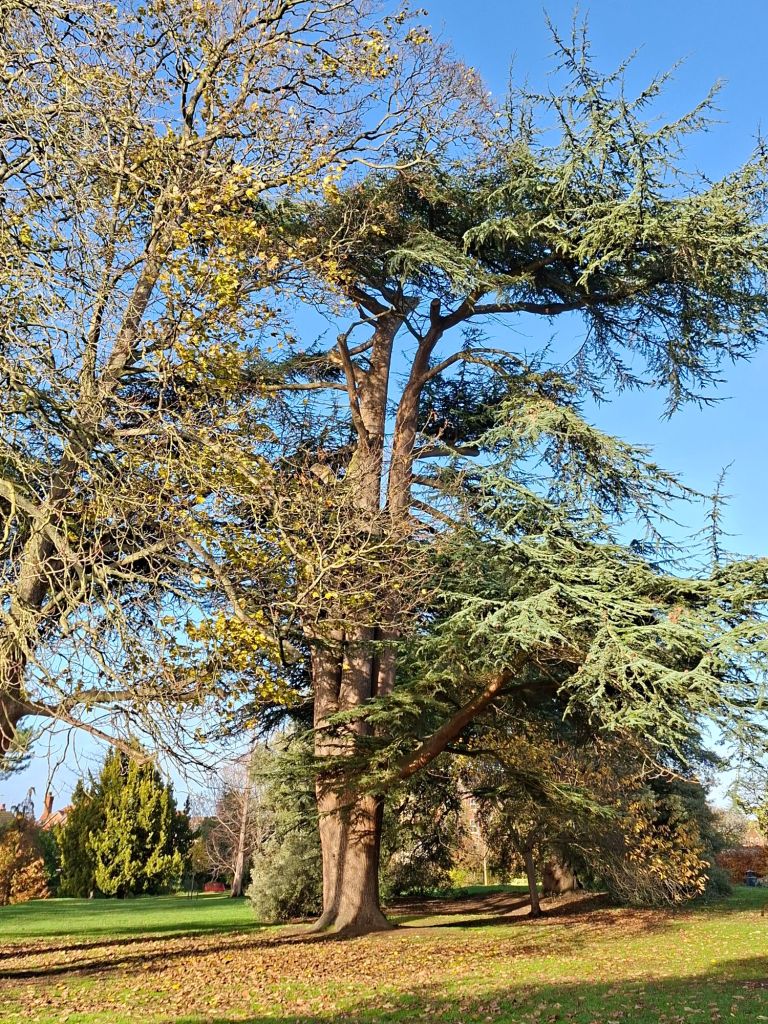
A Scots pine in Hillfield Gardens (1), 28 November, 10.32 am. It stands out both as a tall tree and an evergreen. It asks me to look up and pay attention to it, and beyond it, almost losing sight of its deciduous neighbour. For me, this representative of the ‘eternal green’ has a commanding presence.
The Scots pine is one of the oldest trees native to Britain. It is also one of the trees associated with ogham lore (2), where the Scots pine is linked to the wisdom of overview. According to The Green Man Tree Oracle, ancient shamans of many traditions would literally climb to the top of a central tent pole or tree and “from this vantage point they could see clearly into the spirits’ inner world and come back with knowledge for the tribe or family they served” (2).
For me as for many people, the end of the calendar year is a time for reflection and taking stock. New year resolutions are a possible modern version of this process, but mine never really worked. They were overprescriptive and a way of setting myself up to fail.
‘Overview’ asks for a less driven and more contemplative approach, one more connected with Spirit. This is a good reminder as I start to wonder about how I am going to navigate 2026: divining what my contributions and satisfactions might look like as the Wheel continues to turn.
An Interview with Frank McEowen (1) is the latest offering in Philip Carr-Gomm’s This Magical Life podcast. The overall aim of This Magical Life is to explore the intersection of Druidry, Psychology and Wisdom. Philip is a clinical psychologist and led OBOD (the Order of Bards, Ovates and Druids) for some 30 years. Frank is the author of, among other works, The Mist-Filled Path: Celtic Wisdom for Exiles, Wanderers and Seekers.
This wide-ranging interview covers three main topics: Celtic bards, Chinese hermit poets and politics in America today. All of these are tied into Frank’s journey and service. He was born in Mississippi, USA, of Irish, Scottish, Welsh and English ancestry. At an early age he experienced mystical encounters with the other world. These later prompted him to work with indigenous elders in North America, and later with teachers in Britain and Ireland, especially Ireland, opening himself also to the spirit(s) of place. He speaks of his journey as a whole as one of ‘soul retrieval’. His early books – The Mist-Filled Path, Meditations on the Irish Sprit Wheel, and The Spiral of Memory and Belonging, come out of this experience.
For reasons explained in the interview, Frank then made a decision to ‘disappear inward’, becoming a hermit and poet. As well as working in Celtic spirituality, Frank was also a student of Zen. He had a natural attraction to Chinese and Japanese wayfaring hermit poetry and modelled the life style as well as the art, adjusted to a different time and culture. This period led to three books of poetry published under the name of Frank LaRue Owen: The School of Soft Attention,The Temple of Warm Harmony and Stirrup of the Sun and Moon.
Like Philip, part of Frank’s service is in the field of psychological healing and personal development, principally as a student of Arnold Mindell. Mindell coined the term ‘Dream Body’ – a psycho-spiritual approach that is also Earth reverencing. It is within this framework that they talk about American politics today. First they identify distressed energies within the national psyche which the current President has uncorked and used in a darkly charismatic and disinhibited way. The discussion takes off from there, looking at issues of grief, loss (of democracy) and possible hope. Connecting this predicament to the bard/poet vocation, Frank quotes Ukrainian poet Ilya Kaminski: “the project of Empire is to dull the senses. The project of the poet is to wake up the senses”. Projects of Empire are not unique to the USA. There is something to reflect on for us all.
I recommend this podcast as a rich and varied conversation, covering a lot of ground in its 36 minutes.
(1) The YouTube post spells Frank’s surname as McEowen and the covers of his early books use MacEowen. I don’t know if he has altered the spelling over time.
It is September. I am thinking about my Druid name Muin (blackberry). The plant is flourishing as it always does when given half a chance. But the fruits are less plentiful now and fairly small: thin pickings for the wayside walker. In the human world, we have largely moved on to the making of jam and wine from our existing harvest.
Today, I am thinking about my psychic and imaginal connection to Muin, and why I am standing by this name. For me, a Druid name is neither an alter ego nor a simple add-on to my other names. It is the name that calls me into my Druid identity and practice. In this context, I ask myself: as Muin, who am I? what do I stand for? who might I become? As I asked these questions in an imaginatively opened state, these lines came up. In a way, I believe, Muin is talking to James, whilst being an aspect of him (me) and anyone else who wants to listen.
A circle is cast on sand. It is almost complete. The image is that of the Wheel, tenth major trump in the Druidcraft Tarot (1). Arianrhod, as Goddess associated with the Wheel and the Milky Way, is casting the Circle of Life. The adjacent cave has resonances of both womb and tomb. The seashore is a liminal space. The Celtic Otherworld is often linked to the sea and what lies underneath its surface. This image as a whole is associated with harvesting. Arianrhod carries a flail as well as a wand and a symbolic eight-spoked wheel.
It is Lugnasadh/Lammas, the first harvest-related festival of 2023. I am sitting with the notion of ‘winnowing’ in my inquiry. In agriculture, winnowing involves blowing a current of air through grain to remove the chaff remaining after threshing. We find a reference to winnowing towards the end of the medieval Welsh poem The Hostile Confederacy from The Book of Taliesin (2):
“I have been a grain discovered,
Which grew on a hill.
He that reaped me placed me,
Into a smoke hole driving me.
Exerting of the hand,
In afflicting me,
A hen received me,
With ruddy claws, (and) parting comb.
I rested nine nights.
In her womb, a child,
I have been matured,
I have been an offering before the Guledig.
I have been dead, I have been alive.
A branch there was to me of ivy,
I have been a convoy.
Before God, I have been poor.”
It seems that winnowing (or being winnowed) is far from an end point to our journeys. The processes of life go on, very likely in unexpected ways. Any state of peace has to be found within these processes, rather than in efforts to halt or break out of them.
At Lughnasadh 2023 I find myself at ease within Druidry, though I do also continue to refine lessons from other paths that enrich my practice of Druidry. The most significant, and the best embedded, is ‘interbeing’ as a spatial relationship and its temporal equivalent ‘impermanence’. It is like a kernel of grain I have winnowed from Mahayana Buddhism to grow into another life in my Druidry. The Druid soil is fertile for this purpose, as indicated through the image of the Wheel drawn on sand, and the passage from The Hostile Confederacy in The Book of Taliesin. For me, Thich Nhat Hanh simply provides a particularly persuasive languaging of this perspective.
He says (3): “The insight of interbeing is that nothing can exist by itself alone, that each thing exists only in relation to everything else … looking from the perspective of space, we call emptiness ‘interbeing’ [NB ’emptiness’ here = empty of a separate self] ; looking from the perspective of time we call it ‘impermanence’ … to be empty is to be alive, to breathe in and breathe out. Emptiness is impermanence, it is change. …When you have a kernel of corn and entrust it to the soil, you hope it will be a tall corn plant. If there is no impermanence, the kernel of corn will remain the kernel of corn forever and you will never have an ear of corn to eat. Impermanence is crucial in the life of everything”.
There is another level to this year’s inquiry harvest. Recently I have engaged more fully with the challenge of Thich Nhat Hanh’s understanding of the Mahayana emptiness teachings, which stand behind the interbeing/impermanence insight. In the light of this understanding he finds neither an individual nor a cosmic self – and hence no ultimate reality or ground of being. “Our notion of emptiness should be removed. It is empty”. Many teachers I have worked with in the past are on the other side of this debate, finding the Divine in ‘Presence’ (Eckhardt Tolle), Pure Awareness (Rupert Spira), and the ‘Clear Awake Space’ of Douglas Harding’s Headless Way. They find God as ‘No-Thing’. For Thich Nhat Hanh, no-thing is simply nothing.
I have been all over the place on this question, developing a language and practices compatible with both views, as I slipped and slid between them. This is fine in its way, but I have wanted some kind of resolution, if only to avoid the energy drain of uncertainty around something that matters to me and to many spiritual traditions. Tomas Sander, co-writing with Greg Goode (4) has also explored the Mahayana ’emptiness’ texts. He reports that “as a person who had been seeking truth and ultimate reality” he finds a “greater sense of ease” in the approach of these texts. Unlike Thich Nhat Hanh, he does not take away an active disbelief in a cosmic ground of being. Instead, he arrives at a relaxed unknowing, a place of ‘joyful freedom’. He says: “spiritual teachings tend to have notions of absolutes, which by their very nature seem to trump everything else. None of them can claim to have an absolute, transcendent truth on their side”.
Tomas Sander finds that “it was a wonderfully freeing moment to recognize that there is no one way that reality ‘really’ is, and therefore no way to miss out on it”. So he adopts different criteria for evaluating spiritual paths. “They need to prove themselves on the level of ordinary, conventional reality with practical questions like: who does the view serve and who is being marginalized? Is the view helpful, compassionate or humane?’ I have known of and entertained this view for some time, but it has only recently clicked with me as a good way of settling this question. Metaphysical speculation will no longer be part of my inquiry. This does indeed feel like winnowing, like blowing away the chaff. The promised harvest? Druidry as joyful freedom.
(1) Philip and Stephanie Carr-Gomm The Druidcraft Tarot: Use the Magic of Wicca and Druidry to Guide Your Life London: Connections, 2004 (Illustrated by Will Worthington)
(2) William F. Skene The Four Ancient Books of Wales Forgotten Books, 2007 (First published in Edinburgh 1868
(3) Thich Nhat Hanh The Other Shore: A New Translation of the Heart Sutra with Commentaries Berkeley, CA: Parallax Press, 2017
(4) Greg Goode and Tomas Sander Emptiness and Joyful Freedom Salisbury: Non-Duality Press, 2013 (Section written by Tomas Sander)
Highly recommended for anyone interested in Brighid, Celtic spirituality and the evolving culture of modern Paganism. In The Torch of Brighid, Erin Aurelia eloquently describes her flame tending path as a devotee of the Goddess Brighid. For her, this is a path of celebration, contemplation, creativity and deep personal change. Her book shares the fruits of a remarkable journey.
The author makes clear that she is not reconstructing a past Pagan practice. No such practice is known. She references a Christian history dating from 480 CE, where nuns maintained a sacred flame at Kildare in Ireland. This was documented as still in place in the later 12th century CE by Gerald of Wales in his History and Topography of Ireland. It was repressed by the English King Henry VIII – who also ruled Ireland – as part of his violent religious revolution of the 1530s and 40s. On 1 February 1993, flame tending was revived both by Catholic Brigantine sisters in Kildare by the neo-Pagan Daughters of the Flame in Vancouver, BC. Both groups were influenced by Gerald of Wales’ description.
Erin Aurelia has been a flame tender for 20 years. She began in the Daughters of the Flame and then founded her own Order, the Nigheanan Brigde Flametending Order, going on to lead it for eight years. The original model involved moving through cycles of twenty days, in which nineteen flame tenders take a day each to tend the flame, leaving the Goddess to take care of the twentieth. Erin found that she wanted an intensified practice and a closer fellowship with other Brighid devotees. During those years, she writes: “Brighid inspired me to develop guided meditations to use during vigils, seasonal feasts, and lunar phases”. Later came “the template for a whole new way to practice flame tending: the way that the flame tending cycle matches with the twenty letters of the traditional Irish tree ogham alphabet, in which each alphabet letter is denoted by a tree and infused with esoteric meaning”. She describes herself as “enthralled and excited” by this discovery, which lead on to daily communing with Brighid and a fuller development of her work.
She found the process transformative, and learned that “growth is not only made through obtaining wisdom, but by implementing it. And Brighid showed me that I can effectively implement it by embodying her own skills as Shaper, Healer, Seer, and Transformer. Through embodying her skills, I became empowered”. In the narrative of her own journey, Erin shows her willingness to innovate, take initiatives, lead when called to do so, and also step back from leadership. Her relationship with ancient culture is to be inspired by it without being bound by it. I see her as modelling the best of modern Pagan practice in these respects.
Erin provides extensive information on her flame tending vigils, and how to set them up. She shares prayers, meditations and path workings. She includes her unique approach to ogham work, and also her own way of working energetically with the traditional ‘three cauldrons’ (of warming, vocation and knowledge). She shares her ways of working through the four Irish fire festivals from Imbolc (1 Feb.) to Bealtaine (1 May} to Lughnasadh (1 Aug.) to Samhain (1 Nov.). She has an Imbolc advent practice centred around the four Sundays prior to Imbolc – because it starts the year in this tradition and is specifically dedicated to Brighid. Her book is a powerful addition to the growing literature about Brighid as a much loved Goddess.
I shall not be put in a cell, I shall not be wounded …
No fire, no sun, no moon shall burn me,
No lake, no water, no sea shall drown me.” (1)
Brigid has a long history, stretching back in Gaelic traditions to at least the pagan Celtic iron age. The words above come from the Western Highlands of Scotland, in this form probably dating to the traumatising early modern period. Caitlin Matthews suggests that, even though the the words are addressed to ‘St. Bride’ rather than the Goddess of poets, they still have the talismanic power to preserve life.
More recently, Brigid has been successfully revived as a Pagan Goddess, where, according to an affirming Imbolc self-dedication story by Morgan Daimler (2) she has lost none of her capacity to protect her devotees.
“When I decided that it was essential for me a self-dedication to the pagan path, just like all my books talked about, I chose Imbolc to do it on. At that point the holiday to me was on the 2nd, the same day as America celebrated Groundhog Day, and was about cleansing and blessing of the self, so it seemed ideal for a self-dedication. I got everything together and when the night of the ritual arrived I was excited to take such a life changing step. At 13, coming from a non-religious background, doing something like this was momentous and I felt like I was ready to commit myself to the spirituality I had been studying.
“I went out alone into the bitter cold, without a winter coat on, and tried to do the ritual the way I had learned how to, but it was hard to focus. February in Connecticut is frigid and the darkness on that particular night was total, without any moon to light my way. It was Brigid’s holiday, so I automatically started calling on her, asking for her help, for the strength to do what I planned to do. At the same time it was almost a reflex to call on a Goddess I associated with warmth a light under those circumstances. It was important to me to make a declaration of my religious path, the books I’d read at that point had emphasized the need to be outdoors, and I was too stubborn to let the cold weather stop me. So I prayed to Brigid.
“It’s funny the way, as children, we simply take experiences in our stride, without considering them at all out of the ordinary. I don’t remember ever feeling Brigid’s presence or having a sense of the numinous, but I prayed and then I was warm. The cold simply ceased to be something I noticed, as if everything around me had become an indoor room temperature. I took the usual half hour or so kneeling on the cold ground to do my ritual, dedicating myself to the Irish Gods and to pagan spirituality. And then I got up, collected my supplies and went back inside, feeling euphoric.
“At the time it never even registered that what I did was dangerous or that I was risking frostbite and hypothermia. And I never stopped and thought that it should seem at all remarkable to pray to Brigid for warmth and then be warm. It all seemed entirely natural and normal.
“We speak, and the Gods really do listen. Sometimes they even answer.” (2)
(1) Alexander Carmichael Carmina Gadelica Edinburgh: Scottish Academic Press, 1972 (Cited in Caitlin Matthews The Element of the Celtic Tradition Shaftesbury: Element Books, 1989)
(2) Morgan Daimler Pagan Portals – Brigid: Meeting the Celtic Goddess of Poetry, Forge, and Healing Well Winchester UK & Washington USA: Moon Books, 2016. Daimler identifies as a reconstructionist polytheist pagan working in the Irish tradition.
It was 26 November 2022, 11 a.m. I was at the Gloucester end of the Gloucester-Sharpness canal. I found myself accepting the arrival of winter. I was observing three cygnets, now without their parents but still keeping company with each other. The underlying temperature was around 7 C (44.6 F) and good for walking, But I was feeling the pinch of a cold wind. In memory I am feeling it now. The water and sky looked grey. The trees were starting to feel skeletal, whilst still retaining some leaves. My lingering sense of autumn had finally drained away.
To accept winter’s arrival in the presence of swans felt numinous. Swans are otherworldly birds in Celtic tradition. The three together, not yet in their full adult plumage, seemed auspicious. They suggested coming opportunities for creativity, love and celebration. Winter can be a preparation for renewal, both as season and as state of mind. My acceptance goes with a faith in winter’s regenerative darkness, and the riches this can bring.
According to Kristoffer Hughes, the three ray symbol for Awen, as it appears today: “is mostly inspired by the efforts of one individual, a Welsh bard of the late eighteenth and early nineteenth centuries called Edward Williams, who took the bardic name of Iolo Morganwg*”.
Hughes goes on to tell us something of Iolo’s story: “I touch briefly on the Awen-filled story of this remarkable individual, for it sings loudly of the power of Awen to transform, not just an individual, but the future. His symbol for the Awen has become directly associated in Neopaganism with Cerridwen, making an exploration of his influence a valuable exercise in our understanding of Awen in the modern world.
“Iolo Morganwg was a stonemason from South Wales, an imaginative, poetic genius who made elaborate claims of ancient documents and wisdom that he had discovered and preserved for the world to see. Blighted by ill health, he was addicted to the narcotic laudanum for over fifty years of his life, spending most of his days in a drug-induced state, and yet poems in their thousands fell from his frenzied mind onto scraps of parchment. He composed elaborate poetry, inspired prose, but falsely claimed that some of the poems were written by ancient bards. … And yet through all of the accusations of forgery and deception, Iolo dreamed something into being that those in the different streams of Celtic spirituality today, both monotheistic and polytheistic, are descendants of. He dreamed a new mythology into being and planted seeds that would gestate a profound wisdom in the future.
“In a time of great social crisis, he dreamed an identity for the Welsh that took as its foundation that the bardic tradition of Wales was a direct line to the ancient Druids of Britain, who he perceived as the true ancestors of the Welsh. He longed for his people to connect to the might and power that the Romantic movement imagined the Druids to express. And, in doing so, he deliciously imagined a new identity that the Welsh could be proud of: he blended fact with fiction, legend with history, myth with reality. His bewildering array of notes and journals continue to baffle modern academics who strive to make sense of this enigmatic figure.”
Reflecting on Iolo’s story, Hughes concludes that, “in a profoundly logocentric world where new thoughts and ideas were expected to be substantiated by manuscripts, Iolo simply invented a past that we, as the Welsh, could be proud of . … He carried the seeds of Awen and profoundly influenced a future he could not have imagined. In the twenty-first century, those drawn to the Cerridwen and Taliesenic mysteries (2) who may artistically express, understand, or wear the symbol of the Awen all carry the dream of Iolo Morganwg. He is testament to the Awen’s consistent stream and how it too changed its countenance to meet the needs of different people at different times. The period he occupied was a cauldron of new ideas, with the new era of bardic tradition in its infancy and occult fascination among the learned of the time increasing in popularity”.
(2) See also: John Matthews Taliesin: Shamanism and the Bardic Mysteries in Britain and Ireland London: Aquarian Press, 1991. It includes a complete English translation of the Hanes Taliesin (Story of Taliesin) and English translations of the major poems of Taliesin Pen Beirdd from The Book of Taliesin as well as other medieval Welsh and Irish material. In the Taliesin story, the three rays of Awen become three drops from the brew in Cerridwen’s cauldron).
*NOTE: Iolo Morganwg (=Ned of Glamorgan, his native county). In his own words, the Awen sign /|\ is “a symbol of God’s name from the beginning”. He goes on to say: “from the quality of this symbol proceed every form and sign of voice, and sound, and name, and condition”. It is when God pronounced his Name that “all the universe leapt together into existence of life, with the triumph of a song of joy. The same song was the first poem that was ever heard, and the sound of the song travelled as far as God and His existence are, and the way in which every other existence, springing in unity with Him, has travelled for ever and ever. And it sprang from inopportune nothing; that is to say, so sweetly and melodiously did God declare his name, that life vibrated through all existence, and through every existing materiality”. J. William Ab Ithel (editor) The Bardas of Iolo Morganwg: A Collection of Original Documents, Illustrative of the Theology, Wisdom, and Usages of the Bardo-Druidic System of the Isle of Britain Forgotten Books, 2007 http://www.forgottenbooks.org (First published 1862, from notes and journals left by Iolo on his death at 79 years of age in 1826).
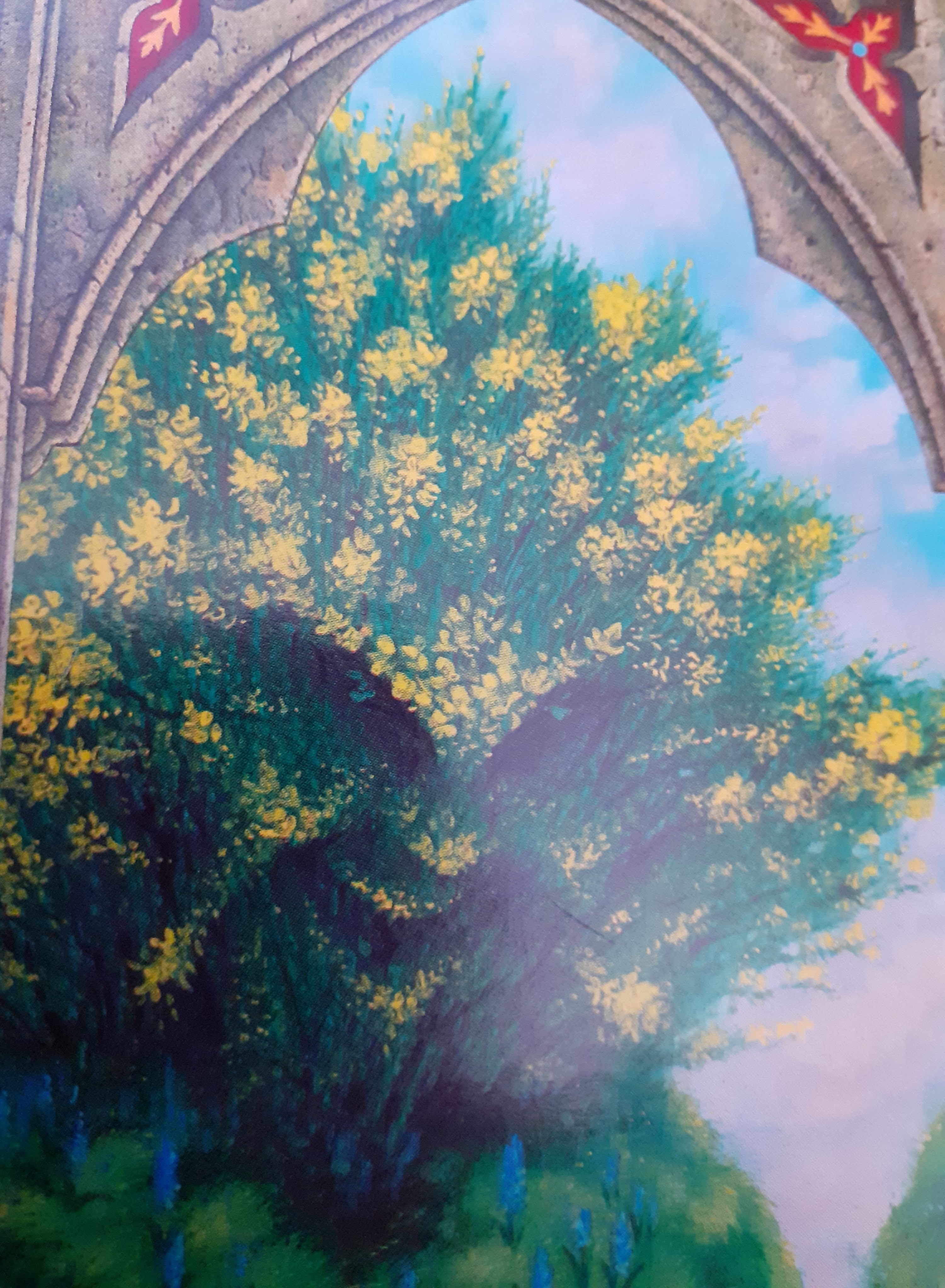
In my wheel of the year tree mandala (1), gorse covers the period from 9-31 July. It is the last tree of the summer quarter, handing over to apple at Lughnasadh/Lammas on 1 August. The illustration is from The Green Man Tree Oracle (2).
I know from my childhood that gorse can make a tame, gently sloping hill seem wild and edgy. Navigating through gorse requires an eye to self-care. Flowering gorse is not confined to summer, but for me it is anchored to summer in memory. Seen from afar, gorse was a vivid harbinger of the summer holidays with days of warmth (rising to heat) and freedom to roam. It carried a hint of adventure and disinhibition. Sometimes the promise was fulfilled. Sometimes there was a hot heavy dullness broken by only storms, and a degree of frustration. July days were unpredictable.
Gorse (ogham name Onn) was sacred to the Irish god Lugh, and thus to light, to all manner of skills, and to the fire in the head of ecstatic creativity. Lugh has a trickster aspect, and can be seen in certain lights as more a god of lightning than of the sun. He has a cousinship with the Brythonic Lleu Llaw Gyffes, the warrior magician of the fourth branch of the Mabinogi. He has also been linked to the Norse Loki, for tricksterism is an aspect of the smouldering fertile mind.
Gorse makes good fuel and so has an obvious role in fire festivals. In Brittany, 1 August was marked by the Festival of the Golden Gorse and gorse has has strong associations with the faery folk. It is a plant of power. We cannot make assumptions about how we stand with it. A wary respect might be wise.
NOTE: This post brings to an end a year in which I have featured the sixteen trees in this mandala. I began on 16 July 2020 with an out-of-sequence Rowan (3), because I had had a vivid encounter with a rowan tree in the woods. (Its time in the mandala is 9-31 October.). Then I moved on to apple(4) and blackberry (5). From the Autumn Equinox (1) the enterprise became more systematic. As a blogger, I won’t be repeating the cycle in the same way in the coming year. Once for the record feels enough.
(1) This mandala is based on my personal experience of trees in the neighbourhood as well as traditional lore. Moving around the summer quarter from Beltane, 1 May, the positions and dates of the four trees are: Hawthorn, south-east, 1-23 May; Beech & Bluebell, south-south-east, 24 May – 15 June; Oak, south, 16 June – 8 July; Gorse, south-south-west, 9 – 31 July. The autumn quarter then starts with Apple at Lughnasadh/Lammas. For a complete list of the sixteen trees, see https://contemplativeinquiry.blog/2020/autumn-equinox-2020-hazel-salmon-awen/
(2) John Matthews & Will Worthington The Green Man Tree Oracle London: Connections, 2003
As its crown forms his mask and its leafage his features;
‘I speak through the oak’, says the Green Man.
‘I speak through the oak says he'” (1)
In my wheel of the year tree mandala (2), oak covers the period from 16 June-8 July and thus includes Alban Hefin, the summer solstice. I am starting to bring it in. The oak has many associations – regal strength, for example – but for me the sense of the green man, the archetype of our oneness with the earth, speaking through the oak, is the most numinous. At Dodona in ancient Greece (3) an oak shrine was “guarded by priestesses who interpreted the future from the rustling of leaves on the great tree, the voice of the sacred spring that rose at its root and the behaviour of birds in its branches”. Celtic tradition describes a number of sacred oak trees, themselves roosting places for sacred birds. I like the sense that the oak does not stand alone and autonomous in these stories. For leaves to rustle, the wind is needed. Birds and springs may also participate in the ecology, of a distributed wisdom – a wisdom of interdependence, of interbeing. The oak’s great branches are matched by still greater roots, and therefore an underground network of communication and exchange that we now know sustains a mature forest (4).
The ogham name for oak, duir, means door in both Sanskrit and Gaelic (5). This can bespeak solidity and protection, for the oak can survive lightning. It was sacred to Taranis, the Celtic god of lightning and storms, to Thor in the Nordic pantheon. and to Zeus among the Greeks. But a door isn’t just defensive. It is there to be opened as well, with a sense of welcome and relationship. Dagda, father god of Ireland, was associated with the oak and never failed to give hospitality to those who asked for it.
For Druids (whose name means ‘oak wisdom’) oak was the central tree in their mysteries. There is a theme, in these mysteries, of communication between worlds, with a sensed Otherworld being less than a heart beat away. The power of the oak combines strength and sensitivity. My mandala links oak to the period in which the light has its greatest expression, and then gives way, at first very slowly, to its necessary descent into the dark. The tree bears witness as the wheel continues to turn.
(1) William Anderson Green Man: Archetype of Our Oneness with the Earth Harper Collins: London & San Francisco, 1990.
(2) This mandala is based on my personal experience of trees in the neighbourhood as well as traditional lore. Moving around the summer quarter from Beltane, 1 May, the positions and dates of the four trees are: Hawthorn, south-east, 1-23 May; Beech & Bluebell, south-south-east, 24 May – 15 June; Oak, south, 16 June – 8 July; Gorse, south-south-west, 9 – 31 July. The autumn quarter then starts with Apple at Lughnasadh/Lammas. For a complete list of the sixteen trees, see https://contemplativeinquiry.blog/2020/autumn-equinox-2020-hazel-salmon-awen/
(3) John Matthews & Will Worthington The Green Man Tree Oracle London: Connections, 2003.






 Contemplative Inquiry