Contemplative Inquiry

This blog is about contemplative inquiry

Tag: Celtic Paganism

POEM: PRIMARY CHIEF BARD

Gnostic Bardistry from The Book of Taliesin? These are just five of the verses, selected by me from one poem. What interests me is not so much working out what to us seems like a set of puzzles, but how something new and dialogical is created by interweaving indigenous material and biblical references. I say a few words in italics after each verse.

Primary Chief Bard

Primary Chief Bard

Am I to Elffin

And my native country

Is the region of the summer stars.


The first statement is a statement of identity. It begins with a local (though important) role, and goes on to the cosmic and transcendent. This taps into a sense of belonging somewhere else (whether perceived as a place or state). It makes me think that statements like ‘being here now, in the present’ and ‘my native country is the region of the summer stars’ only seem contradictory: meaning depends so much on context and the work that words are doing. If the two statements are separated and polarised, they diminish into limiting slogans. Taken together, they can lead us to a different quality of experience.

I was full nine months

In the womb of the hag Ceridwen.

Before that I was Gwion

But now I am Taliesin.

Taliesin’s current personal identity is explained in terms of a second birth, in this life, triggered by the actions of Ceridwen. This second birth fits him to be a Bard and take the Bardic name ‘Radiant Brow’, one that bespeaks major shifts in energy and consciousness. It also allows the sense of the summer stars as his ‘native country’ to be real within him. It orients him to his true home.

I was patriarch

To Elijah and Enoch.

I was there at the crucifixion

Of the merciful Mabon.

Elijah and Enoch ascended to heaven without dying. They have deep roles in Jewish mysticism. They are in the tradition of so-called ‘ascended Masters’. If we treat these metaphors (insofar as they are metaphors) as concerned with enlightenment, then – as their ‘Patriarch’ – Taliesin is claiming primacy over them. He is in some sense a Christ figure and so can be present at the crucifixion of another Christ figure, referred to here by the name of the magical child of British tradition ‘the Mabon’.


I was at the cross

With Mary Magdalene.

I received the Awen

From Ceridwen’s cauldron.

The poem presented here is a product of the later Middle Ages, likely as late as the fourteenth century. Traditions giving Mary Magdalene the role of major teacher and possibly spouse of Jesus were deep underground, but everyone in Christendom Knew of her witnessing role at both the crucifixion and the resurrection, and so as privileged in some way. She also shares her name with Mary the mother. The two couplets together bring the idea of Christ’s transformation through death on the cross with Taliesin’s transformation from Ceridwen’s cauldron, and the critical role of a feminine power in each.

I was in the larder

In the land of the Trinity

And no one knows whether my body

Is flesh or fish.

Despite all the above, Taliesin remains an enigma – a shape shifter and trickster. He defies definition and description and won’t fit into any box that attracts unwanted piety. Other readers may understand this verse much better than I do, but I see it as very tough minded and unwilling to let me parcel up this poem and tie it with a neat bow. To the extent that I get a sense of medieval Welsh literature, this seems very characteristic. However, in the most obvious ‘Land of the Trinity’ (Western Christendom) people want to know where everyone stands. The accepted narrative is that we’re with Jesus the avatar of Pisces and through the sign of the fish we know him. And yet the old Celtic world has many trinities and many fish, including the salmon of wisdom. And Taliesin’s body might be flesh after all. So we are thrown back on our resources, with riddling words and ambiguous images to reflect them.


The complete poem can be found in Taliesin: Shamanism and the Bardic Mysteries in Britain and Ireland by John Matthews London: The Aquarian Press, 1991.

POEM: ARTHUR

Behind storm-fretted bastions gray and bare

Flame-crested warriors of Cunedda’s line

Feast in a gold ring, – their targes shine

Along the wall and clang to gusts of air;

And in the shadow, torches blown aflare

Reveal a chief, half human, half divine,

With brooding head, starred by the Dragon Sign,

Hung motionless in some undreamed despair.

But when he starts, three torques of twisted gold

Writhe on his breast, for voices all men fear

Wail forth the battle-doom dead kings have borne;

And as the mead-hall fills with sudden cold,

Above the wind-tossed sea his heart can hear

The strange gods calling through their mystic horn.

Arthur is one of Six Celtic Sonnets written by Thomas Samuel Jones and included in From the Isles of Dream: Visionary Stories and Poems of the Celtic Renaissance, selected by John Matthews and with a foreword by Robin Williamson (Floris Books, 1993).

Thomas Samuel Jones (1882-1932) came from Welsh and Irish stock and was born in Oneida County, New York State, near the Adirondack Mountains. Each of the six sonnets reflects a facet of Celtic tradition. They were originally published in 1930 as part of the collection Aknahton and Other Sonnets. For those of us who resonate with Druid and Celtic spirituality, they are part of our modern cultural ancestry.

POEM: A DRUID TOWN

A sunless maze of tangled lanes enfold

The magic dwellings of the forest race,

Whose hidden shapes are flames that leave no trace

At mid-moon when the Druid’s dream is told;

The shadows of enchanted orchards hold

Red thatch of wings and woad-stained doors that face

The wandering stars, and guard the sacred place

Where faery women thread their warps with gold

The dragon knight shall lose his strength of hand

Nor ever raise his long leaf-shapen shield,

If he but follow where the white deer roam;

And never will the mariner reach land

When harps ring seaward as the dawn fires yield

The golden caer upon the ninth wave’s foam.

A Druid Town is one of Six Celtic Sonnets written by Thomas Samuel Jones and included in From the Isles of Dream: Visionary Stories and Poems of the Celtic Renaissance, selected by John Matthews and with a foreword by Robin Williamson (Floris Books, 1993).

Thomas Samuel Jones (1882-1932) came from Welsh and Irish stock and was born in Oneida County, New York State, near the Adirondack Mountains. Each of the six sonnets reflects a facet of Celtic tradition. They were originally published in 1930 as part of the collection Aknahton and Other Sonnets. For those of us who resonate with Druid and Celtic spirituality, they are part of our modern cultural ancestry.

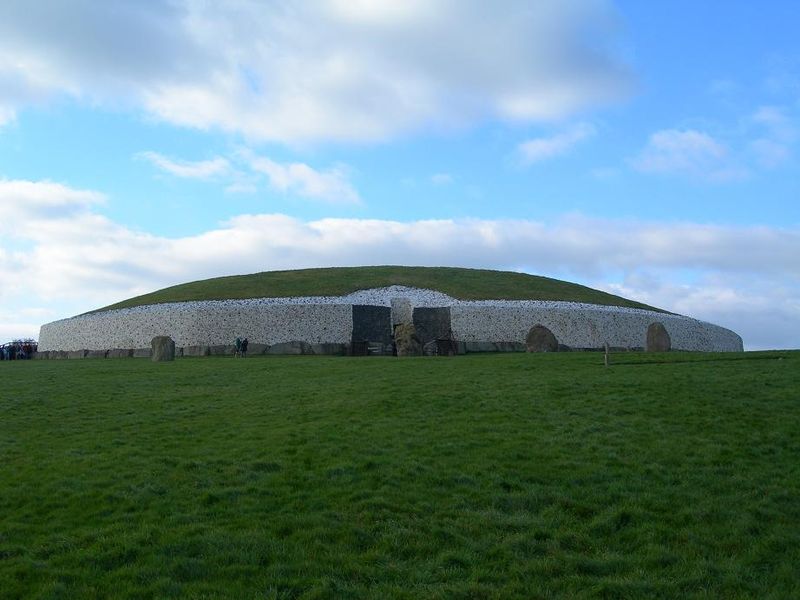
POEM: NEW GRANGE

800px-Newgrange

Picture cc by 2.5 pl – originally uploaded by Shira-commonswiki

The golden hill where long-forgotten kings

Keep lonely watch upon their feasting-floor

Is silent now, – the Dagda’s harp no more

Makes sun and moon move to its murmurous strings;

And never in the leafy star-led Springs

Will Caer and Angus haunt the river shore,

For deep beneath an ogham-carven door

Dust dulls the dew-white wonder of their wings.

Yet one may linger loving the lost dream –

The magic of the heart that cannot die;

Although the Rood destroy the quicken-rods;

To him through earth and air and hollow stream

Wild music whines, as two swans wheeling cry

Above the cromlech of the vanished gods.

New Grange is one of Six Celtic Sonnets written by Thomas Samuel Jones and included in From the Isles of Dream: Visionary Stories and Poems of the Celtic Renaissance, selected by John Matthews and with a foreword by Robin Williamson (Floris Books, 1993).

Thomas Samuel Jones (1882-1932) came from Welsh and Irish stock and was born in Oneida County, New York State, near the Adirondack Mountains. Each of the six sonnets reflects a facet of Celtic tradition. They were originally published in 1930 as part of the collection Aknahton and Other Sonnets. For those of us who resonate with Druid and Celtic spirituality, they are part of our modern cultural ancestry.

BOOK REVIEW: STALKING THE GODDESS

jhp4ec2908d688eb_9781780991733_Stalking%20The%20Goddess_72Stalking the Goddess by Mark Carter was published by Moon Books in 2012 and is a critical examination of Robert Graves’ iconic The White Goddess. Carter has done a thorough job and I strongly recommend the book to anyone interested in the subject specifically, or in modern Druid and Pagan culture more widely.  He painstakingly examines Graves’ sources of inspiration, sources of information, working methods and conclusions. He also looks at the extraordinary impact of The White Goddess over the period since its publication in 1948, especially on the growing neo-pagan community – much of it surprising to Graves himself. Stalking the Goddess (a title I have to say I don’t much care for) is of course dependent on The White Goddess for its interest and very existence, so I find I can’t talk about the one without the other.

What was Graves doing in The White Goddess that mattered so much?

Firstly, he took up suggestions from 19th and earlier 20th century literature (The Golden Bough being the single major source) about a primal religion based on sacrificial kingship. He linked it to ideas of an early political matriarchy that pre-dated human knowledge of paternity and began to weaken thereafter. In bronze and iron age times, Graves saw Europe from Bulgaria to Ireland subject to struggles and migrations in which increasingly patriarchal warrior peoples put a steadily intensifying pressure on opponents who, whilst themselves less and less likely to have matriarchal political systems, nonetheless preserved conservative features like strong Goddess traditions, matrilineal succession, and a view of the feminine as representing sovereignty over the land.  He also followed writers like Charles Leland and Margaret Murray in understanding medieval witchcraft as an underground pagan tradition in conscious struggle with the fully Romanised Christian church as aggressively representative of a wholly comprehensive expression of patriarchy in both religion and politics.

Graves also suggested that, in Celtic lands, there was a second dissident group that survived well into the medieval period and indeed beyond.  These were the Bards, descendants of the Pagan Druids, preserving their secrets within often obscure poetry based on a little known or understood set of mythic references, and a magical system of writing, the ogham (itself with early origins in South East Europe). The ogham was not just a script, it was also a hand signalling system – and had its own set of magical correspondences, of which those with a group of sacred trees were the most potent.  The Bards as poets were in service to The White Goddess of the title. Graves believed that all true poets are in such service, whether they know it or not – citing more recent poets like Keats as an example. Graves placed himself in such a line, and used the inspired technique of ‘analeptic memory’ to extend his understanding when his sources didn’t give him all the answers he needed. He wanted to show that he was up with the relevant scholarship and that he could make a logical and evidence based case. But in the last analysis he wasn’t bound by these. He was (although he didn’t use this term) one of the awenydd, the inspired ones, not a philosopher or academic.

Carter’s contribution, in Stalking the Goddess, is the rigorous application to The White Goddess and some of Graves’ other work (for example The Greek Myths and King Jesus), of a critique which is itself now quite well known. Based on more recent (though not necessarily much more recent) scholarship than that available to Graves, it tells us that neither the approach of The Golden Bough, nor the view of matriarchy and its purported link to early Goddess worship, nor its overthrow, are supported by good evidence. Especially when dealing with pre-history (history before written records) modern scholars are tentative about what we can say that we know. There’s just not enough there for a powerful unifying story, partly at least because the evidence basis just isn’t suited to providing such a story, and partly perhaps because the actual stories may be much more diverse. In the case of medieval witchcraft, the available records concerning victims don’t fit the profile of Pagan Goddess devotees. In the case of Celtic Bards, the evidence shows ogham as an exclusively Irish writing system, created for the carving of simple messages, in use for a fairly short period in the 4th and 5th centuries CE. It may be that it was used, in a spirit of self-conscious antiquarianism, as a largely mnemonic device for the Bards of later centuries.  In terms of Graves’ reading of key works in the Welsh tradition – the Hanes Taliesin and Cad Goddeu in particular – Carter suggests that Graves “bent them to support his views”.

I am sure that this critique is essentially correct, simply because it is based on better information than the alternatives and argued plainly. I can’t of course vouch for every detail because I haven’t done any individual work. But I do have to recognise that Graves’ own approach involves a considerable element of dogmatic intuitionism and interpretative high-handedness. For me, in a context of advocacy, the latter characteristics weaken a case rather than strengthening it.

And yet … true criticality like this, using effective and ethical working methods, is its own kind of homage. Stalking the Goddess will not, and should not, demolish The White Goddess. It will help to keep it alive and rightly so.  When T.S. Eliot decided to accept The White Goddess for publication by Faber & Faber after several rejections from other publishers, he described it as “a prodigious, monstrous, stupefying, indescribable book”. Yet he published it all the same. I for one am glad that he did. With that health warning from the original Faber catalogue, alerted to not taking The White Goddess entirely on its own terms, I am free to let it into my spiritual imagination. I can walk to my favourite spot at Woodchester (the old churchyard). I can stand in the avenue of yews, knowing that most of the ogham trees are in easy distance, and that Orpheus lies underground nearby, in the form of an early fourth century Romano-British mosaic. It was custom made for the villa on that site by a specialist mosaic workshop in Cirencester (Corinium) notable for its work on Orphic themes. Orpheus was from the Rhodope Mountains in Thrace (once thought of as ‘Mount Haemus’). Graves thought that the ogham first came from Thrace, believing Orpheus’ dance of trees to be a “dance of letters”.  So here, now and in Woodchester is the lyricist who could charm animals, cause trees to circle dance, animate a new ship for a deep sea voyage, descend to the underworld and return, be torn to pieces by maenads and continue on as a talking head, uttering prophecies for Apollo. Rich themes for Romano-British people, perhaps also seeing resonances with their own native stories. Inspired and inspiring myth can survive any attempt to explain it, explain it away, or package it in overdetermined forms.

CONTEMPLATIVE INQUIRY, THE ORAN MOR, AND FARE-WELLING DEITY

I want to say three in things in this post. The first is to clarify what I mean by contemplative inquiry, the name of this blog, and outline the implications of calling it contemplative inquiry rather than contemplative Druidry. The second is to describe my recent contemplations on the Oran Mor, or Great Song, the metaphor which has become central in how I experience my world. The third is to explain my decisive shift to a non-theistic spirituality.

Contemplative inquiry, for me, is a living process and the heart of my spiritual identity. My Druidry itself is subject to the inquiry, and in consequence my contemplative life doesn’t work through marinating me in a received tradition and leading me into experiences that are declared to be the appropriate fruits of the practice. That’s why I’m glad to be in a young tradition, where the jelly still hasn’t set. I work with feelings, thoughts, insights and intuitions arising from my practice and reflection. I’ve abandoned the high language of ‘gnosis’ because it suggests pre-mapped attainments, privileged cosmic knowledge already somehow present and waiting to be discovered in the experience of the practitioner. That’s not what happens for me: everything is tentative and provisional and the aim, if it is an aim, is to sit within an expanded story of being, one that has integrity and can frame abundant life.

How does this apply to the Oran Mor, an auditory metaphor which takes in all my senses and synaesthetically extends them? I can enjoy the sound of a sunrise, the felt resonance of trees, and the lingering note of a caress.  All are encompassed in the Oran Mor. My experience of the Oran Mor confirms for me the felt sense of not being separate or alone. Behind the Oran Mor, and interweaving it, is a silence – not a cold silence, but a warm silence of fecund latency. The Oran Mor points beyond itself as a sensory experience to that underlying substrate of energy, that pulse and vibration of the cosmos, whose fruits include the privilege of our time-bound 3D being. I am the Oran Mor, currently a distinct though passing note within the greater pattern of the Song. So are you. Many forms of communion are available within the Oran Mor.

The invitation to us is to sing our own note within the Song. For all that we are interconnected and interdependent, the way in which we sing the note involves something distinct and individual, a personal existential choice: this at least is the human experience. It works best if we are awake to the rest the Song, as manifested in other notes, in the greater patterns, and the silence. This is why I’ve started to use the word ‘attunement’, despite its hackneyed New Age ring: it’s an accurate description of something I want to do.

As I’ve deepened into this sense of the Oran Mor and how it shapes me, there are certain words that are becoming more pertinent and powerful. In my morning practice I have for some years used the words known either as St. Patrick’s prayer or the cry of the deer:

‘I arise today through the strength of heaven, light of sun, radiance of moon, splendour of fire, speed of lightning, swiftness of wind, depth of sea, stability of earth and firmness of rock.’

I experience this as a summarising the Oran Mor – that which is – in a way that has a contemplative and prayerful aspect, makes good liturgy, and is not a petitionary prayer. I do not pray to the Oran Mor. I do not think of the Oran Mor as our Celtic ancestors did, as a name for God. I do not use it a translation of what is often meant by ‘Spirit’. The ‘I’ who arises is as much included in the Oran Mor as the sun, moon, fire, lightning, wind, sea, earth and rock. In the experience of the Oran Mor, there is no distinction between ‘Spirit’ and ‘Nature’. There’s a sense in which, despite their pragmatic value in everyday use, both terms become redundant.

I’m also continuing to work with the Ceile De fonn A Hu Thi (ah – hoo – hee), using simple breath and silent sounding, first described in an earlier post at https://contemplativeinquiry.wordpress.com/2015/3/6/. For me this continues to describe and enact the eternally-co-creative aspect of the Oran Mor. I find in my world that the A sets up a sense of latency, a subtle pulse and vibration on the brink of becoming. I feel it in the quality of my inbreath, as a kinaesthetic song. Hu the outbreath feels more vigorous and intentional; there’s a real sense of movement, expressed as exhalation – the breath moves out from my body, through my nostrils. Thi breathed in feels like the delighted expression of a new reality, the world born again in every moment.

The last effect of my continuing engagement with the Oran Mor concerns Brighde as Goddess and it is very recent. Essentially, the Goddess dissolves into the Oran Mor and I find myself fare-welling deity in my poetry of practice. The sense of the Goddess (under different names) as both cosmic birther and mentoring intermediary, which I have had throughout the whole period of my association with Druidry and Paganism, has died. This is not a matter of ultimate belief, where I have always had a form of non-dual view, but rather in a sense of a shift in archetypal poetics and psychology, of imaginal perception. It gives me a sense both of mourning and of release, of loss and of spaciousness.

I am aware of talking about language and imagery, about subjective experience. I do not presume to make statements about the cosmos or recommend ‘beliefs’ to others on the strength of my work or its evolution, or to use it either to question or to validate anyone else’s path. I’m in the throes of letting go a profoundly significant image and concept, one that has had a defining role in my spirituality, and I find it a very considerable attachment to let go of. I did not expect this. It will take a bit of getting used to, actually a lot of getting used to. It is a very significant change. Yet it is the fruit of honest inquiry – of meditative and contemplative practice, and reflection thereon. My trackless path, it seems, is wholly non-theistic.

GWYN, GWYTHYR AND CREIDDYLAD: A STORY FROM THE OLD NORTH

This post reblogged from Peneverdant looks at the traditional stories of the northern British (especially in north west England and southern Scotland) and surviving material from these stories in later Welsh literature.

Lorna Smithers's avatarThe Sanctuary of Vindos

Cherry BlossomCulhwch and Olwen is one of the oldest and most fascinating repositories of ancient British mythology. It originates from two texts; a fragmented version in The White Book of Rhydderch (1325) and full version in The Red Book of Hergest (1400). The main narrative centres on Culhwch’s quest to win Olwen for which he enlists the help of Arthur and his retinue; a medley of historical and mythological characters.

Embedded within it we find fragments of other tales which may be of older origin and have stood alone. These include the hunt for the legendary boar Twrch Twryth and release of Mabon from imprisonment in Gloucester. Most significantly for me as someone who venerates Gwyn ap Nudd, we find the story of his rivalry with Gwythyr ap Greidol for the love of Creiddylad and their battle for her every May Day.

This story is central to understanding Gwyn’s mythology. Because…

View original post 2,230 more words

BOOK REVIEW: THE SALMON IN THE SPRING

41-SK1+8TrL__BO2,204,203,200_PIsitb-sticker-v3-big,TopRight,0,-55_SX324_SY324_PIkin4,BottomRight,1,22_AA346_SH20_OU02_This is the review of Jason Kirkey’s Salmon in the Spring which I wrote for Amazon in 2010 (and for Touchstone, the OBOD in-house journal). It was the book that introduced me to The Great Song/Oran Mor – earlier explored in Frank MacEowen’s The Celtic Way of Seeing and The Mist-Filled Path. MacEowen wrote the foreword for Kirkey’s book. Kirkey revises the traditional sense (in the Christian centuries)  of the Oran Mor as a name for God. He says, rather, that “immanent in material processes is the implicate order of the cosmos: spirit, divine ground, Oran Mor (Great Song)”. I will say more about what this has meant both experientially and conceptually for me in future posts.

The review was a 5 star review and I strongly recommend it, as a book that manages both to be clear and to accommodate complexity.

“At the age of 12, Jason Kirkey had one of those ‘light bulb’ moments that can set a direction for life. A relative told him ‘nature does not require our belief. It is right there for us to experience’. Jason is from Massachusetts, of partly Irish ancestry and over time his new found awareness lead him to discover the ‘interplay of nature, story and ancestry’ as a practitioner of ‘Irish Earth-based spirituality and shamanism’.

“Jason presents personal story a thread within a larger, collective story; one in which spiritual traditions are moving through a process of re-imagination – of integration into the new story of the 21st century’. He describes going through a ‘dark night of the soul’ when an over-identified ‘attachment’ to his own tradition became narrow and constraining. He found resolution through the practice of sitting meditation and study at the Naropa University in Colorado. It wasn’t a matter of moving from one tradition to another, but of integrating the qualities of both.

“The Salmon in the Spring explores traditional stories – including the second battle of Maigh Tuireadh, Connla’s Well and the Song of the Silver Branch – in a process of creative revisioning for Celtic spirituality. It is a pioneer’s book and I recommend it to anyone interested in the possible futures of Celtic spirituality, Druidry and other paths in which the old stories are coming alive in new ways.”

Jason Kirkey The Salmon in the Spring: the Ecology of Celtic Spirituality San Francisco, CA, USA: Hiraeth Press, 2009

FUINN II: THE POETRY OF PRACTICE

I’m a Pagan Druid, happily placed in a tradition that values poetry and seership over dogma and system building. I experience my practice as a sort of poetry. In this poetry of practice, I am held in a compelling myth of origin, an ever-now origin, and I have found a new way of working with it.

My new collection of Fuinn (Ceile De chants in Scottish Gaelic) includes a very simple one which goes A Hu Thi (ah – hoo – hee) repeated over and over again. The Ceile De interpretation, a Celtic Christian one, is that this chant “represents the three stages of the unfolding of creation … A– the Great Mystery draws in its breath … Hu – that breath is breathed out, and creation is born from out of the Mystery … God becomes matter … Thi – the Divine nature, beingness and intention acts within the field of intention … Some Ceile De would say that this final stage represents Christ Consciousness.”

It’s a bit different for me. I’ve been working with this Fonn daily for a couple of weeks now.  I don’t chant. I use slow deep breathing with a silent awareness of the sounds. I find that for me, the A sets up a sense of latency, a subtle pulse and vibration on the brink of becoming. I feel it in the quality of my inbreath, as a kinaesthetic song. Hu the outbreath feels more vigorous and intentional; there’s a real sense of movement, expressed as exhalation – the breath moves out from my body, through my nostrils. Thi breathed in feels like the delighted expression of a new reality, one that I share in, distinct yet inseparable as a sentient being. This generally brings up feelings exhileration, gratitude and joy. It leads me on to the use of another Fonn as a contemplative and devotional prayer, which I wrote myself using my collection of Fuinn as a model.

A Brighde, A Brighde, solus an domhain; A Brighde, A Brigdhe, Brighde mo chridhe

A Vree-jah, A Vree-jah, solus an dowan; A Vree-jah, A Vree-jah, Bree-jah mo cree

Brighde, Brighde, light of the world; Brighde, Brighde, Brighde my heart

Brighde is the breath, the practice and the Fuinn. When writing my Fonn I wanted to build a felt sense of Brighde as cosmic birther, initiator into being, with a seat in my heart.  Her name evokes power and the prayer invokes relationship – identified as She is with primal generativity and the deep powers of life and land, and also One who inspires skill and accomplishment in those She supports and fosters. Through my experience of relationship and connection, deep levels of feeling and intuition are satisfied, in some way met. I feel empowered, with a sense of having more resources available to me. Why would this be? I don’t really know. What I do know is the value of practice as poetry, and the magic it holds.

The Ceile De can be found on http://www.ceilede.co.uk

IMBOLC LIGHTS

I’m reflecting on the difference between ‘Light’ and ‘lights’.  Yesterday evening my partner Elaine and I had an Imbolc ritual. We’ve decided to move through the seasonal festivals in this way, customising a joint practice as we go.

I reflect now on our time in the festive circle as in part a feast of lights. Not ‘Light’, but lights. We can have Light at the throw of a switch, one easy taken-for-granted ‘Let there be Light’ gesture. It’s very powerful and very useful – and effortlessly normal in our culture, at least for the time being.

But it isn’t a feast of lights. A feast of lights requires multiple, small sources. It requires the co-presence of darkness and shadow. It requires variation, degrees of light and darkness. It requires change and play.

We had two basic light sources, during the ritual. The one that attracted my attention most was an array of night lights positioned around the room in various ways. We had nine on the altar (one at the centre, eight at the circumference – with one at each station of the eightfold wheel of the year). And there were others around the room, grouped in threes. Very simple. Very traditional. Very minimal. Very meaningful. Very beautiful. These lights tended to be bright and a high yellow, glinting in some moments, softer and more diffuse at others. Each had its own aura. All tended to flicker in even the smallest current of air. And each had its sphere of influence, fading porously into the surrounding dusk, with no clearly defined or specific boundary – the transitions being so gradual, so gentle. Thus light and darkness were differentiated without being polarised and they cheerfully shared their debatable lands. The play of ambiguity was part of the feast.

The second source was the fire, a wood burner, well-established by the time we began the ritual and happily placed in a north-easterly hearth. Also very traditional. Very simple. Very minimal. Very meaningful. Very beautiful. And for the most part, in this mature phase, a deep red, in a way a dull red, though the word isn’t right. A potent light, a subliminal light, almost a kinaesthetic light. Not a very light sort of light at all. Its presence radiated through the room, bringing our centre of gravity, even in terms of luminosity, closer to the earth.

And that is a feast of lights. It was almost a shock, in the tidying up aftermath of the ritual, to return to the Light.

Earth Eclectic

music that celebrates Earth and speaks to the heart

Sarah Fuhro Star-Flower Alchemy

Follow the Moon's Cycle

Muddy Feet

Meeting nature on nature's terms

Rosher.Net

A little bit of Mark Rosher in South Gloucestershire, England

Becoming Part of the Land

A monastic polytheist's and animist’s journal

selkiewife

Selkie Writing…

Charlotte Rodgers

Images and words set against a backdrop of outsider art.

Prof Jem Bendell

living with metacrisis and collapse

Towint

The pagan path. The Old Ways In New Times

The Druids Garden

Spiritual journeys in tending the living earth, permaculture, and nature-inspired arts

The Blog of Baphomet

a magickal dialogue between nature and culture

This Simple Life

The gentle art of living with less

Musings of a Scottish Hearth Druid and Heathen

Thoughts about living, loving and worshiping as an autistic Hearth Druid and Heathen. One woman's journey.

Wheel of the Year Blog

An place to read and share stories about the celtic seasonal festivals

Walking the Druid Path

Just another WordPress.com site

anima monday

Exploring our connection to the wider world

Grounded Space Focusing

Become more grounded and spacious with yourself and others, through your own body’s wisdom

The Earthbound Report

Good lives on our one planet

Hopeless Vendetta

News for the residents of Hopeless, Maine