The year has moved on from its midwinter moment. I am just beginning to feel the pull of Imbolc (Candlemas in the Christian year). This feast marks the returning light and early signs of spring. I recently saw a local picture showing a newborn lamb.
In the Gaelic traditions Imbolc/Candlemas (1 February) is dedicated to Brigid/Bride. The lines below are from the Scottish Highlands and Islands. They seek protection and are not specifially seasonal.
“The genealogy of the holy maiden Bride
Radiant flame of gold, noble foster- mother of Christ.
Bride the daughter of Dugall the brown,
Son of Aodh, son of Art, son of Conn,
Son of Crearar, son of Cis, son of Carmac, son of Carruin.
Every day and every night
That I say the genealogy of Bride,
I shall not be killed, I shall not be harried,
I shall not be put in a cell, I shall not be wounded,
Neither shall Christ leave me in forgetfulness.
No fire, nor sun, nor moon shall burn me,
No lake, no water nor sea shall drown me,
No arrow of fay nor dart of fairy shall wound me,
And I under the protection of my Holy Mary,
And my gentle foster-mother is my beloved Bride.”
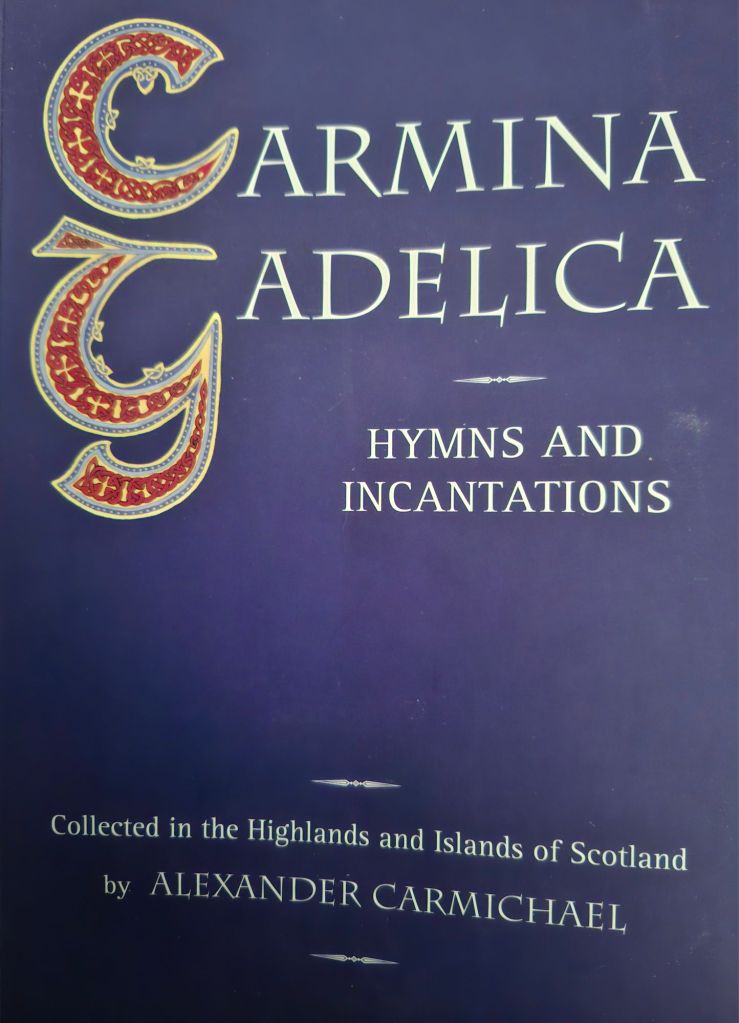
Carmina Gadelica: Hymns and Incantations collected by Alexander Carmichael. 1994 edition by Floris Books, Edinburgh, edited by C. J Moore.
The work is an anthology of poems and prayers from the Gaelic oral tradition in Scotland. They come from all over the Scottish Highlands and Islands. Alexander Carmichael compiled the collection in the second half of the nineteenth century, thereby creating a lasting record of a culture and way of life which has now largely disappeared.
Imbolc/Candlemas is celebrated on either 1 or 2 February as part of the Celtic wheel of the year. It signals the loosening of winter’s grip. Brighid, Goddess of poets, smith-work and healing is its patron. Damh the Bard is a prominent member of OBOD (1), best known for his music. A singer song writer revisioning ancient Bardic tradition for modern times, he has been an inspirational and much loved force in modern Druidry and Paganism. His lyrics for this song are below as presented on YouTube.
There’s a tree by the well in the wood,
That’s covered in garlands,
Clooties and ribbons that drift,
In the cool morning air.
That’s where I met an old woman,
Who came from a far land.
Holding a flame o’er the well,
And chanting a prayer.
(Chorus) Goddess of fire, Goddess of healing,
Goddess of Spring, welcome again.
The told me she’d been a prisoner,
Trapped in a mountain,
Taken by the Queen of Winter,
At Summer’s end,
But in her prison, she heard the spell,
The people were chanting,
Three days of Summer,
And snowdrops are flowering again.
She spoke of the Cell of the Oak,
Where a fire is still burning,
Nineteen priestesses tend the Eternal Flame
Oh but of you, my Lady,
We are still learning,
Brighid, Brigantia,
The Goddess of many names.
Then I saw her reflection in the mirrored well,
And I looked deep in her face,
The old woman gone, a maiden now knelt in her place,
And from my pocket I pulled a ribbon,
And in honour of her maidenhood,
I tied it there to the tree by the well in the wood.
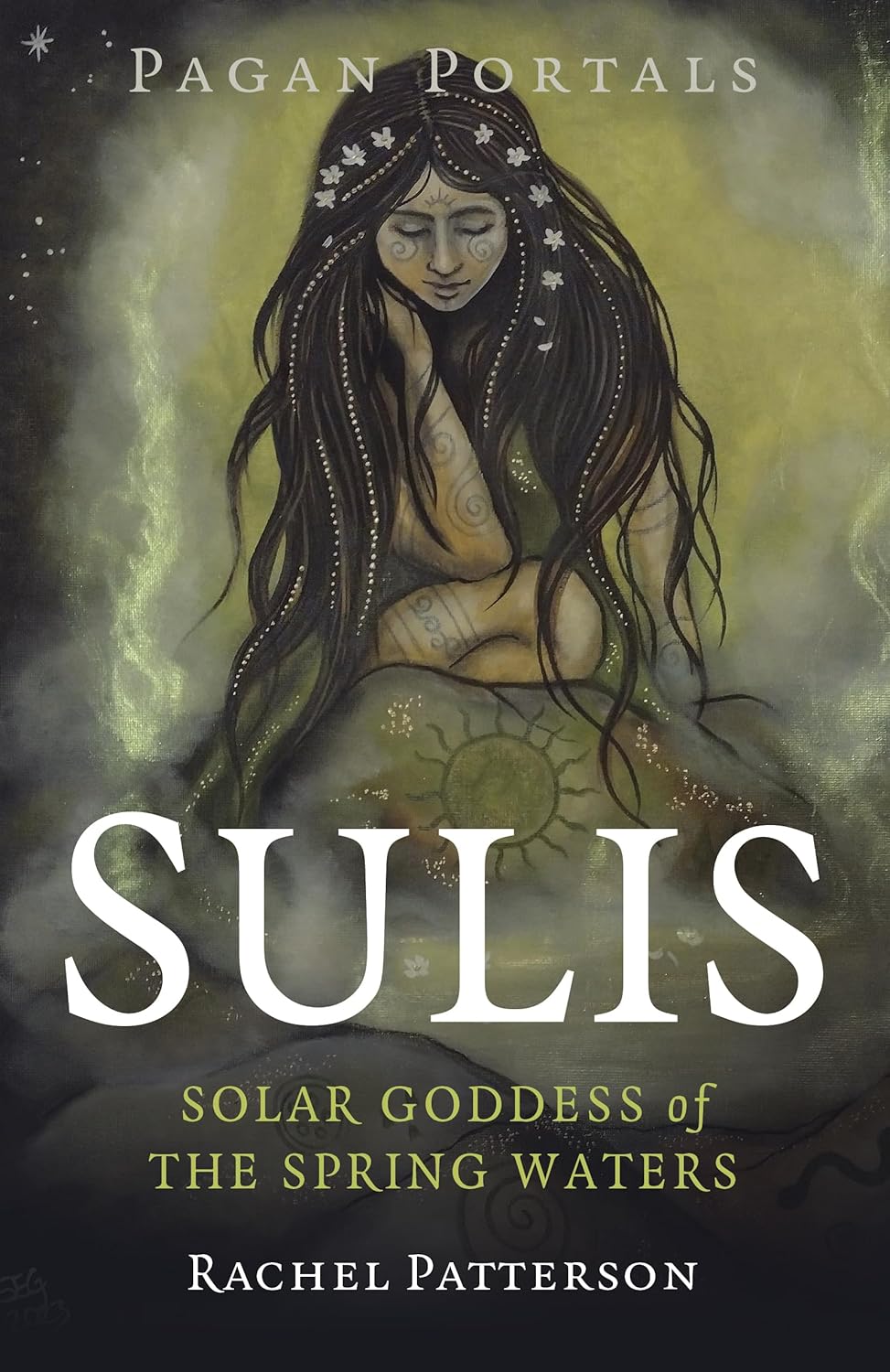
Recommended especially to two overlapping groups: first, readers interested in Sulis (later Sulis-Minerva) the presiding deity of the hot springs at Bath, UK; second, readers interested in polytheist Paganism in Britain, both ancient and modern. Author Rachel Patterson describes her heart as that of an English Kitchen Witch and her craft “a combination of old religion witchcraft, Wicca, hedge witchery and folk Magic”. Hence in this book she focuses not only on the history of Sulis and her springs but also on how to work with Sulis today.
The hot springs at Bath are the only ones in the country, appearing after the last Ice Age around 12,000 years ago. The people who re-settled the land as hunter gatherers began leaving offerings at the springs around 9,500 years ago. They continued to do so for several thousand years until the appearance of farming. We have no record of their beliefs, but for them the numinous power may well have been the living presence of the springs themselves, rather than a presiding deity.
The farmers, when they came, seem to have left the springs alone. But early in the first century CE a causeway of gravel and mud was placed in the main spring pool. Offerings were made, principally of coins minted by the local Celtic tribe, the Dobunni. Pottery was also found but there were no buildings. In 43 CE the Romans invaded Britain and quickly established themselves in the south. The Dobunni chose peace and an accommodation with the Romans, who soon created a spa, building on top of the natural springs. They adopted the local goddess Sulis, now to be known as Sulis Minerva. A town gradually grew up, named Aquae Sulis (The Waters of Sulis). A temple and sanctuary began to be built in 70 CE. The baths are now well-kept after an up-and-down history, and are open to visitors. See http://www.romanbaths.co.uk.
Rachel Patterson describes how the temple worked in the Roman period. Many of the extant records are written curses from people whose clothes and possessions were stolen while they bathed. They asked the Sulis for retributive action in return for offerings and the lost possessions themselves (1). Patterson also describes the decoration of the temple and artifacts from it. The best known was once called the gorgon’s head but is clearly the head of a male figure. He seems to be associated with a god named Belenus, who may in turn be connected with the legendary King Bladud included in Geoffrey of Monmouth’s History of the King’s of Britain (2,3).
The second half of Rachel Patterson’s book is about working with Sulis. It is a thorough and practical guide for readers who may want to go down that path. It includes sections on making candles and altars dedicated to Sulis; on finding Sulis; building a relationship with her; advice on oath-taking; and the development of rituals and meditations dedicated to her. There is relevant advice on the use of herbs, crystals, forms of divination, petitions and curses. There are sections on animal companions and (pigs and wild boar as the Celtic contribution, owls and dolphins related to Minerva). As a Kitchen Witch, Rachel Patterson also provides a number of recipes.
I have lived both the first and most recent 20 years of my life within a forty mile radius of Bath. I don’t go there very often. But I have known it from an early age and bathed in the waters during the more recent period. There is indeed something magical about them. So I’m glad to see Sulis taken more seriously. There is a familiar problem about limited information from the past and Rachel Patterson discusses this in her book But for me there is enough resonance from the old times, here, to dream the myth onwards. I can’t assess the practical guidance offered in Sulis: Solar Goddess of the Spring Waters because I don’t work in the same way. But I do know it is comprehensive and comes from a seasoned practitioner. It feels to me like a timely addition to the Pagan Portals series, and I am grateful to have it.
(1) Further information about religion in Roman Britain, and its rather transactional nature, can be found in Prof- Ronald Hutton’s Gresham College lecture on Paganism in Roman Britain. See https://contemplativeinquiry.blog/22/12/12/paganism-in-roman-britain/ – where a link to the lecture is provided,
(3) For creative treatments of the story of Bladud and the Goddess Sulis, see Kevan Manwaring’s account in The Bardic Handbook and two novels by Moyra Caldecott: The Winged Man and The Waters of Sul
The Song of Amergin, here sung in Old Irish Gaelic, is the oldest known extant song in the Atlantic Archipelago*. The performers here are An Tuagh, whose core focus is the Gaelic-Norse traditions of northern Scotland. They have a YouTube channel, a Facebook page and an Instagram presence. The Song of Amergin is featured in their album Bard and Skald, as is a Beith-Luis-Nun Ogham chant. If you subscribe to the An Tuagh YouTube channel, there are commentaries on both pieces. The one for the Song of Amergin includes both Irish and English texts. However versions vary widely and An Tuagh have copyrighted theirs. I have included an open source English version below, to give some impression of what is being sung.
I am the sea blast I am the tidal wave I am the thunderous surf I am the stag of the seven tines I am the cliff hawk I am the sunlit dewdrop I am the fairest of flowers I am the rampaging boar I am the swift-swimming salmon I am the placid lake I am the summit of art I am the vale echoing voices I am the battle-hardened spearhead I am the God who inflames desire Who gives you fire Who knows the secrets of the unhewn dolmen Who announces the ages of the moon Who knows where the sunset settles
I have listened to An Tuagh’s rendition of the Song of Amergin a number of times, sinking into a sense of shared presence with something preciously archaic and other. An Tuagh are the intermediaries, helping me to catch an after echo of that time. I don’t have fully to understand it, but simply respond. I am grateful both to the old culture, and to skillful modern bards.
A circle is cast on sand. It is almost complete. The image is that of the Wheel, tenth major trump in the Druidcraft Tarot (1). Arianrhod, as Goddess associated with the Wheel and the Milky Way, is casting the Circle of Life. The adjacent cave has resonances of both womb and tomb. The seashore is a liminal space. The Celtic Otherworld is often linked to the sea and what lies underneath its surface. This image as a whole is associated with harvesting. Arianrhod carries a flail as well as a wand and a symbolic eight-spoked wheel.
It is Lugnasadh/Lammas, the first harvest-related festival of 2023. I am sitting with the notion of ‘winnowing’ in my inquiry. In agriculture, winnowing involves blowing a current of air through grain to remove the chaff remaining after threshing. We find a reference to winnowing towards the end of the medieval Welsh poem The Hostile Confederacy from The Book of Taliesin (2):
“I have been a grain discovered,
Which grew on a hill.
He that reaped me placed me,
Into a smoke hole driving me.
Exerting of the hand,
In afflicting me,
A hen received me,
With ruddy claws, (and) parting comb.
I rested nine nights.
In her womb, a child,
I have been matured,
I have been an offering before the Guledig.
I have been dead, I have been alive.
A branch there was to me of ivy,
I have been a convoy.
Before God, I have been poor.”
It seems that winnowing (or being winnowed) is far from an end point to our journeys. The processes of life go on, very likely in unexpected ways. Any state of peace has to be found within these processes, rather than in efforts to halt or break out of them.
At Lughnasadh 2023 I find myself at ease within Druidry, though I do also continue to refine lessons from other paths that enrich my practice of Druidry. The most significant, and the best embedded, is ‘interbeing’ as a spatial relationship and its temporal equivalent ‘impermanence’. It is like a kernel of grain I have winnowed from Mahayana Buddhism to grow into another life in my Druidry. The Druid soil is fertile for this purpose, as indicated through the image of the Wheel drawn on sand, and the passage from The Hostile Confederacy in The Book of Taliesin. For me, Thich Nhat Hanh simply provides a particularly persuasive languaging of this perspective.
He says (3): “The insight of interbeing is that nothing can exist by itself alone, that each thing exists only in relation to everything else … looking from the perspective of space, we call emptiness ‘interbeing’ [NB ’emptiness’ here = empty of a separate self] ; looking from the perspective of time we call it ‘impermanence’ … to be empty is to be alive, to breathe in and breathe out. Emptiness is impermanence, it is change. …When you have a kernel of corn and entrust it to the soil, you hope it will be a tall corn plant. If there is no impermanence, the kernel of corn will remain the kernel of corn forever and you will never have an ear of corn to eat. Impermanence is crucial in the life of everything”.
There is another level to this year’s inquiry harvest. Recently I have engaged more fully with the challenge of Thich Nhat Hanh’s understanding of the Mahayana emptiness teachings, which stand behind the interbeing/impermanence insight. In the light of this understanding he finds neither an individual nor a cosmic self – and hence no ultimate reality or ground of being. “Our notion of emptiness should be removed. It is empty”. Many teachers I have worked with in the past are on the other side of this debate, finding the Divine in ‘Presence’ (Eckhardt Tolle), Pure Awareness (Rupert Spira), and the ‘Clear Awake Space’ of Douglas Harding’s Headless Way. They find God as ‘No-Thing’. For Thich Nhat Hanh, no-thing is simply nothing.
I have been all over the place on this question, developing a language and practices compatible with both views, as I slipped and slid between them. This is fine in its way, but I have wanted some kind of resolution, if only to avoid the energy drain of uncertainty around something that matters to me and to many spiritual traditions. Tomas Sander, co-writing with Greg Goode (4) has also explored the Mahayana ’emptiness’ texts. He reports that “as a person who had been seeking truth and ultimate reality” he finds a “greater sense of ease” in the approach of these texts. Unlike Thich Nhat Hanh, he does not take away an active disbelief in a cosmic ground of being. Instead, he arrives at a relaxed unknowing, a place of ‘joyful freedom’. He says: “spiritual teachings tend to have notions of absolutes, which by their very nature seem to trump everything else. None of them can claim to have an absolute, transcendent truth on their side”.
Tomas Sander finds that “it was a wonderfully freeing moment to recognize that there is no one way that reality ‘really’ is, and therefore no way to miss out on it”. So he adopts different criteria for evaluating spiritual paths. “They need to prove themselves on the level of ordinary, conventional reality with practical questions like: who does the view serve and who is being marginalized? Is the view helpful, compassionate or humane?’ I have known of and entertained this view for some time, but it has only recently clicked with me as a good way of settling this question. Metaphysical speculation will no longer be part of my inquiry. This does indeed feel like winnowing, like blowing away the chaff. The promised harvest? Druidry as joyful freedom.
(1) Philip and Stephanie Carr-Gomm The Druidcraft Tarot: Use the Magic of Wicca and Druidry to Guide Your Life London: Connections, 2004 (Illustrated by Will Worthington)
(2) William F. Skene The Four Ancient Books of Wales Forgotten Books, 2007 (First published in Edinburgh 1868
(3) Thich Nhat Hanh The Other Shore: A New Translation of the Heart Sutra with Commentaries Berkeley, CA: Parallax Press, 2017
(4) Greg Goode and Tomas Sander Emptiness and Joyful Freedom Salisbury: Non-Duality Press, 2013 (Section written by Tomas Sander)
I shall not be put in a cell, I shall not be wounded …
No fire, no sun, no moon shall burn me,
No lake, no water, no sea shall drown me.” (1)
Brigid has a long history, stretching back in Gaelic traditions to at least the pagan Celtic iron age. The words above come from the Western Highlands of Scotland, in this form probably dating to the traumatising early modern period. Caitlin Matthews suggests that, even though the the words are addressed to ‘St. Bride’ rather than the Goddess of poets, they still have the talismanic power to preserve life.
More recently, Brigid has been successfully revived as a Pagan Goddess, where, according to an affirming Imbolc self-dedication story by Morgan Daimler (2) she has lost none of her capacity to protect her devotees.
“When I decided that it was essential for me a self-dedication to the pagan path, just like all my books talked about, I chose Imbolc to do it on. At that point the holiday to me was on the 2nd, the same day as America celebrated Groundhog Day, and was about cleansing and blessing of the self, so it seemed ideal for a self-dedication. I got everything together and when the night of the ritual arrived I was excited to take such a life changing step. At 13, coming from a non-religious background, doing something like this was momentous and I felt like I was ready to commit myself to the spirituality I had been studying.
“I went out alone into the bitter cold, without a winter coat on, and tried to do the ritual the way I had learned how to, but it was hard to focus. February in Connecticut is frigid and the darkness on that particular night was total, without any moon to light my way. It was Brigid’s holiday, so I automatically started calling on her, asking for her help, for the strength to do what I planned to do. At the same time it was almost a reflex to call on a Goddess I associated with warmth a light under those circumstances. It was important to me to make a declaration of my religious path, the books I’d read at that point had emphasized the need to be outdoors, and I was too stubborn to let the cold weather stop me. So I prayed to Brigid.
“It’s funny the way, as children, we simply take experiences in our stride, without considering them at all out of the ordinary. I don’t remember ever feeling Brigid’s presence or having a sense of the numinous, but I prayed and then I was warm. The cold simply ceased to be something I noticed, as if everything around me had become an indoor room temperature. I took the usual half hour or so kneeling on the cold ground to do my ritual, dedicating myself to the Irish Gods and to pagan spirituality. And then I got up, collected my supplies and went back inside, feeling euphoric.
“At the time it never even registered that what I did was dangerous or that I was risking frostbite and hypothermia. And I never stopped and thought that it should seem at all remarkable to pray to Brigid for warmth and then be warm. It all seemed entirely natural and normal.
“We speak, and the Gods really do listen. Sometimes they even answer.” (2)
(1) Alexander Carmichael Carmina Gadelica Edinburgh: Scottish Academic Press, 1972 (Cited in Caitlin Matthews The Element of the Celtic Tradition Shaftesbury: Element Books, 1989)
(2) Morgan Daimler Pagan Portals – Brigid: Meeting the Celtic Goddess of Poetry, Forge, and Healing Well Winchester UK & Washington USA: Moon Books, 2016. Daimler identifies as a reconstructionist polytheist pagan working in the Irish tradition.
This post concerns Ronald Hutton’s Gresham College lecture about Paganism in Roman Britain (1). In it, he summarises our current academic knowledge, and asks: how Romanised was British religion within the Roman Empire? It proves to be a hard question to answer, for three main reasons.
The first is that we know little about British religion immediately before the occupation, apart from the fact that Druids had a leading role in at least some religious activity.
The second is that, although the Romans generally honoured local gods and their worshippers, they made an exception for war gods and religious communities hostile to Roman rule. British Druids belonged to the latter category, so any ongoing British Druid activity is off the record. The Druids were in any case averse to written records about their calling.
The third is that we know the names of only a few people from this period, so get only occasional glimpses of individuals and their practices. Britons of any social standing tended to adopt Roman names, at least for the written record, but the records are too sparse to distinguish between the developing cultures of Romanised Britons and localised Romans. All we have is the Roman names. People who made do without Roman names go unrecorded.
These three limitations mean that we have limited knowledge, and that this knowledge is heavily tilted towards Roman practices and understandings. We do however have the names of a number of indigenous deities from the Roman period, and some understanding of their roles. According to Hutton, such deities tended to be highly localised, and connected to specific activities – like Coventina looking after the sacred spring at Carrowburgh not far from Hadrian’s wall. On the whole Goddesses were linked to the land, hills, rivers, springs and wells. Gods were concerned with war, protection, trade and travel.
Other gods were imported during the centuries of occupation. Continental Celtic culture brought Rosmerta, the Matres and Epona. Widely acknowledged Roman gods included Jupiter, Mars, Silvanus and Mercury. Other parts of the empire contributed Apollo, Bacchus, Mithras, Cybele and Athys, Isis and Serapis.
Hutton finds in both Romans and Celts a very different attitude to deity from that of the later arriving Christian faith. Pagan Gods asked for acknowledgement and respect. Beyond that they were not greatly interested in us. They did not make laws, issue commands or monitor our performance. The Latin word superstitio referred to excessive fear of the divine. Hutton characterises mainstream Roman British religion as largely transactional. Roman priesthood was a job for the local magistrates.
Hence, according to Hutton, there was no theology. If you wanted the gods’ help, and had the support and resources, you built shrines, enacted rituals and offered sacrifice. (Animal sacrifice was required to be swift and painless, or it did not please the gods.) If you looked for a deeper or more intense religious experience, and were deemed eligible, you sought initiation into a mystery school. If you were concerned with speculation about the cosmos and our place in it, or wanted a set of values and practices to live by, you turned to philosophy. The one religious demand made by the state was a public reverencing of the Emperor’s numen (the divine power within him) which the early Christians, other than Gnostics, risked martyrdom rather than acknowledge.
The lecture includes a discussion of hybridised (or ‘twinned’) deities and the high esteem in which they could be held – Sulis Minerva at Aquae Sulis (Bath), Apollo Maponus (with a major shrine a little beyond Hadrian’s Wall at Lochmaben) and Mars (or possibly Mercury) Nodens, at Lydney, close to the River Severn in the Forest of Dean.
Hutton ends with a rare opportunity to acknowledge a real, named person, Magnius. He is known to have been a Briton, a commoner with some resources. He had a tomb erected at Aquae Sulis for his daughter, who had died aged only eighteen months. A tomb for one so young was very rare, and the poignancy of this act reaches across the centuries to us, connecting humans who, from very different times and cultures, are united by the same capacity to love and to grieve. I found this a good note on which to end a lecture which provides some insight into a subject where much will always be unknown.
(1) https://www.gresham.ac.uk/ (Go to browse by series then lecture series 2022-23 then Finding Britain’s Lost Gods. The specific lecture is Paganism in Roman Britain.)
Ronald Hutton is Professor of History at the University of Bristol, a specialist in Pagan and Druid studies, and enjoys a very high reputation within both the academic and Pagan communities.
Bendigeidfran, Bran the Blessed, is a legendary King of the Britons. He is best known to us through the medieval Welsh text The Second Branch of the Mabinogi (1). The primary theme is hope betrayed, most chillingly by Efnysien, Bran’s “brother on his mother’s side”. A marriage feast ends in a series of disasters. But this is not the whole story.
The marriage is between Bran’s sister Branwen and Matholwch the King of Ireland, intended to bring the two kingdoms together in peace and amity. But Efnysien mutilates the Irish party’s horses at the celebration hosted by Bran. It is among the worst things he could do.
In one savage, impulsive act, Efnysien opens the space for an outpouring of resentment, suspicion and hostility – eventually, from both the Irish and the British people. Bran’s efforts to resolve the situation through explanation, consultation and negotiation end in failure. The level of compensation and apology he offers is too much for the British and too little for the Irish. The time comes when Branwen is seriously abused in Ireland. The absolute breakdown of trust between the two countries leads to a bitter, brutal war.
After the war, Bran returns from Ireland with seven surviving companions, his only victory being that he has got them home. Ireland is completely devastated. Bran has been wounded in the foot by a poisoned spear, probably a mortal wound. Bran makes a radical decision, leading to a period of healing and renewal for his companions and a new protective role for his country. “Bendigeidfran ordered his head to be cut off. ‘And take my head’, he said, ‘and carry it to the Gwynfryn in London (the White Mount, now the Tower of London) and bury it with its face towards France. And it will take you a long time; you will feast in Harlech for seven years, with the birds of Rhiannon singing to you. And you will find the head to be as good company as it ever was when it was on me. And you will stay for eighty years in Gwales in Penfro. And so long as you do not open the door to Aber Henfelin, facing Cornwall, you can remain there, and the head will not decay. But as soon as you open that door you can stay no longer. Make for London and bury the head. And now set off across the sea”.
Bran has never been an average human. Too big “to fit inside any house”, he wades across the sea to Ireland “carrying all the stringed instruments on his back”. Later, he bridges the River Liffey by lying down across the river: “hurdles were placed on him, and his men walked on top of him to the other side”. Bran is more than a physical giant. There is something numinous and otherworldly about him, built into his name Bendigeidfran, Bran the Blessed.
The term ‘blessed’ points to something other than it would in the life of a Celtic saint. Caitlin & John Matthews call Bran the Blessed a “titanic god of the Celts … a god of earth and mountain” (2). R. J. Stewart and Robin Williamson describe him as a “primal guardian deity” (3) enacting a role of sacred king traditionally concerned with music, poetry and bridging. In the narrative world of the The Second Branch, such roles are alluded to rather than fully described, but the world is full of magic and spiritually ambiguous, with formal religion little mentioned.
The decapitation of Bran is a magical act. It has two successive effects, both of them benign. The first is when the presence of the head enables an extended period of protected respite for Bran’s companions: the seven years when they feast and hear the birds of Rhiannon (4), and then eighty years as “the Assembly of the Noble Head”. During this time, they forget “all the sorrow they had themselves seen and suffered, [and] … any grief in the world”. Life is pleasurable and delightful and no one seems to age.
It has to end, for the story to continue. The western door is opened, by Heilyn son of Gwyn, driven by curiosity. Grief, loss and ageing return to the companions’ world. They hasten to London to complete their destined task. As long as the head remains buried, no enemy can conquer the kingdom. This is where The Second Branch story ends. Bran, through the agency of his buried head, is confirmed as enduring protector of the land.
There is a coda. It is said that King Arthur dug the head up in later days in the belief that no one but he should protect the country, and that subsequently the head was lost. In later days, the power of the head was transferred to the presence of resident ravens. Bran’s name means raven (also crow), which allows the ravens to take on his power. He is them. They are him. Ravens are kept in the Tower of London to this day, a practice insisted on by Charles II, concerned for the preservation of his country as a kingdom. During World War II the ravens fled after a bombing raid, and every effort was made to ensure that they were swiftly replaced. Seven ravens, the responsibility of Ravenmaster Chris Skaife, live in the Tower now. (5).
(1) The Mabinogion Oxford: the University Press, 2007. (Translated with an introduction by Sioned Davies)
(2) Caitlin & John Matthews The Western Way: A Practical Guide to the Western Mystery Tradition London: Arkana, 1985 (Foreword by Gareth Knight)
(3) R. J. Stewart & Robin Williamson Celtic Bards, Celtic Druids London: Blandford/Cassell plc, 1996 (Colour illustrations by Chris Down)
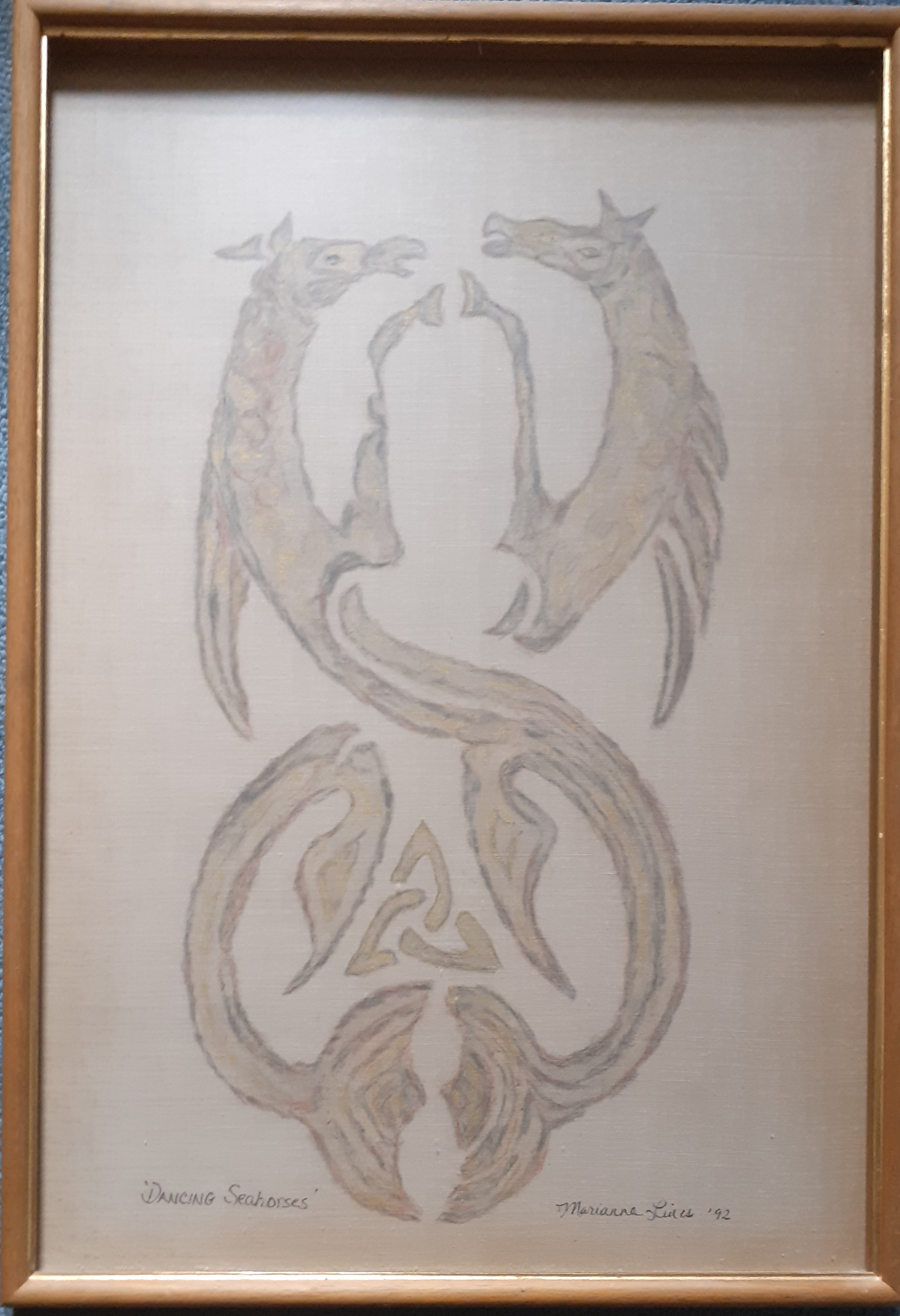
I have already written about the Dancing Seahorses image (1) found on a Pictish stone from Aberlemno in the Scottish county of Angus. After seeing the stone on a visit there, in 1992, I bought Marianne Lines’ painting. I have felt strongly involved with this image ever since. I think of it as a friend and guide. In a sense, this post is about the modern use of archaic images by people, like Druids, who are drawn to them.
I do not know the intentions of the original carver. beyond celebrating beings who are half of this world, half of the otherworld, and who embody powerful water energies for Celtic peoples on the Atlantic coasts of Britain, Ireland and Brittany in ancient times. They are remembered in folklore to this day. I do know that the carving made a strong impression on me, when I first saw it on the stone itself. It stayed in my imagination, and over time has deepened and grown new meanings.
Four years after acquiring the painting, I had the image tattooed on each arm. By that time I knew of the way in which it had influenced the cover design for R. J. Stewart’s The Prophetic Vision of Merlin (2). This variant form was used to refer to the story of the young Merlin at Vortigern’s subsidence prone tower in Snowdonia, prophesying his way out of becoming a human sacrifice, and identifying two contending dragons under the foundations. In the book illustration, there is a yin-yang reference, with a suggestions of interdependent primal forces, each of which already contains the seed of the other, seeking balance and alignment. In the Western Mysteries quest for healing and transfiguration, the energy bodies of the land and of humans are deeply interwoven.
There is another, more recent level of understanding, that I derive from the painting and tattoos, but not evident in The Prophetic Vision of Merlin. I see both the dancing seahorses and a second image, behind and containing the immediately apparent one. As I wrote before, “the space where the horses legs are raised defines a shape, suggesting a head. The very emptiness there is a paradoxical mark of presence. To me it became the head of a goddess, with the seahorses then becoming her body. Still clearly appearing as a water being, her arms – if they are arms – are raised in blessing”. I would now add that in this way, she demonstrates the dance of emptiness and form. They are balanced. Neither is privileged over the other. The Celtic knot points both to interconnection and infinity.
I identified the Goddess whilst gazing directly at the original Dancing Seahorses picture, which hangs of a wall directly above my altar. However I believe I received a subconscious nudge from the High Priestess card in The Druidcraft Tarot (3). She wears the image herself. Her hands are raised. She stands as the Goddess. In the Druidcraft narrative, she “represents the magical power of stillness and depth”. For me, the Goddess in Dancing Seahorses represents the ultimate union of emptiness and form, and the rebirth of the cosmos in each moment. Her representation combines the aware potential of the void and a primal aquatic generativity that can inhabit other elements. The Druidcraft priestess is human, but one who wears an image that bespeaks the divine to me, and her role asks for “stillness and depth”.
In my work, the entry into stillness and depth is, firstly, to enter into I-Thou communion with the primal Goddess (Modron) and then to recognise my own true nature, as (mythically) her divine child (Mabon) – sensitive and busted open to the world. This recognition becomes a prayer of gratitude and a surrender of my passing private concerns to Who I really am.
Words and pictures are not enough, but, cherished and contemplated lovingly over time, together they can point the way..
(2) R. J. Stewart The Prophetic Vision of Merlin London & New York: Arkana, 1986
(3) Philip & Stephanie Carr-Gomm The Druidcraft Tarot: Use the Magic of Wicca and Druidry to Guide Your Life London: Connections, 2004 (Illustrated by Will Worthington)
Highly recommended. Cerridwen: Celtic Goddess of Inspiration (1) is by Kristoffer Hughes, Chief of the Anglesey Druid Order (2) and a prominent figure in modern Druidry and Paganism. His aim in this book is to “provide you an in-depth exploration of Cerridwen, where she came from, the landscape and peoples that perpetuated her, and who she is today”.
Hughes, born in Anglesey and a first language Welsh speaker. is a scholar and practitioner of his inherited tradition. He has also embraced Druidry as an international movement within modern Paganism. He is at ease, too, with the Cerridwen of modern witchcraft. His whole stance is one of cultural generosity and active support for “appropriate appropriation”.
In its quest for Cerridwen, the book combines close reading of Bardic texts dated from the post-Roman period to early modernity; personal sharing of Hughes’ own path; and opportunities for experiential work. Like many people, my introduction to Cerridwen was through Charlotte Guest’s English version of the late-appearing Hanes Taliesin (Hughes provides his own version early in the book). This shows Cerridwen as a noblewoman skilled in the magical arts, not a Goddess. Like many people, I assumed that this was a demotion going back to the Roman period or the coming of Christianity. Hughes does not share this view. He cannot find Cerridwen among the goddesses of Celtic antiquity, but he welcomes her recent apotheosis within neo-Paganism and witchcraft. He is a devotee himself, and writes: “the New Age traditions, whilst inspired by the distant times, do not need or require to be authenticated by the past; it is a living, breathing spirituality … if it works, keep doing it, and the more you do it, the more life you breath into it”.
Hughes sketches out Cerridwen’s history in the early written material. Sometimes her presence is only implicit – glimpsed, perhaps, as the Annuvian sow (hwch) who guides the magician Gwydion to the base of the world tree in the fourth branch of the Mabinogion. Sometimes we find her lauded and identified as the Mam yr Awen (mother of the Awen). Later, after Wales’ loss of independence and the decay of the Bardic tradition, we find her stigmatised as an evil hag with her connection to Awen erased. But when we come to the Hanes Taliesin, her connection to Awen, and to the initiation of Taliesin (radiant brow) is plain and clear. Her best time is now, though her modern strength lies largely outside her country of origin.
For Hughes, Cerridwen (pronounced Ker ID ven) is a goddess “of angular, bending magic”, and her cauldron is “a vessel of inspiration, a transformative device, a vessel of testing”. This Cerridwen is “the divine conduit of transformative, creative, magical inspiration gleaned from the cauldron of Awen”. Awen itself is “the creative, transformative force of divine inspiration that sings in praise of itself; it is the eternal song that sings all things into existence, and all things call to Awen inwardly”. Gwion, who tastes the three drops distilled from the cauldron in Hanes Taliesin, after a series of further trials becomes Taliesin, “the outward expression of the power, magic and action of the Awen”, indicated by his radiant brow. The final section of the book, Stirring the Cauldron: Ritual and Practise, offers readers a chance to meet Cerridwen and work with her Bardic mysteries themselves.
As issues relevant to Cerridwen and what she stands for, the book looks at the meaning of annwfn and its denizens the andedion. ‘Underworld’ and ‘Otherworld’ are not quite accurate as descriptors, and the andedion, though different from us, are not best thought of as ‘supernatural’. Hughes also explains that medieval Wales, except to a limited extent in the border counties, did not share in the English and continental persecution of witches. Swyngyfaredd (enchantment/sorcery/magic) was part of life and its practitioners respected. This changed only with the early modern Anglicisation of culture. Hughes also includes a chapter on Iolo Morganwyg (Edward Williams, 1747-1826) and his ‘awen-filled legacy’. It was he who invented the awen symbol /|\ and much else in modern Druid and Bardic culture. He is often remembered as a literary forger because he presented his contributions as a rediscovery of lost texts. They nonetheless revitalised a dying culture at a time when sensibilities were changing again, and becoming more receptive to the value of old traditions.
With all these riches, Cerridwen: Celtic Goddess of Inspiration is a must-read for anyone with a serious interest in modern Druidry.





 Contemplative Inquiry