Contemplative Inquiry

This blog is about contemplative inquiry

Tag: Celtic Goddesses

LUGNASADH 2023: INQUIRY HARVESTING

A circle is cast on sand. It is almost complete. The image is that of the Wheel, tenth major trump in the Druidcraft Tarot (1). Arianrhod, as Goddess associated with the Wheel and the Milky Way, is casting the Circle of Life. The adjacent cave has resonances of both womb and tomb. The seashore is a liminal space. The Celtic Otherworld is often linked to the sea and what lies underneath its surface. This image as a whole is associated with harvesting. Arianrhod carries a flail as well as a wand and a symbolic eight-spoked wheel.

It is Lugnasadh/Lammas, the first harvest-related festival of 2023. I am sitting with the notion of ‘winnowing’ in my inquiry. In agriculture, winnowing involves blowing a current of air through grain to remove the chaff remaining after threshing. We find a reference to winnowing towards the end of the medieval Welsh poem The Hostile Confederacy from The Book of Taliesin (2):

“I have been a grain discovered,

Which grew on a hill.

He that reaped me placed me,

Into a smoke hole driving me.

Exerting of the hand,

In afflicting me,

A hen received me,

With ruddy claws, (and) parting comb.

I rested nine nights.

In her womb, a child,

I have been matured,

I have been an offering before the Guledig.

I have been dead, I have been alive.

A branch there was to me of ivy,

I have been a convoy.

Before God, I have been poor.”

It seems that winnowing (or being winnowed) is far from an end point to our journeys. The processes of life go on, very likely in unexpected ways. Any state of peace has to be found within these processes, rather than in efforts to halt or break out of them.

At Lughnasadh 2023 I find myself at ease within Druidry, though I do also continue to refine lessons from other paths that enrich my practice of Druidry. The most significant, and the best embedded, is ‘interbeing’ as a spatial relationship and its temporal equivalent ‘impermanence’. It is like a kernel of grain I have winnowed from Mahayana Buddhism to grow into another life in my Druidry. The Druid soil is fertile for this purpose, as indicated through the image of the Wheel drawn on sand, and the passage from The Hostile Confederacy in The Book of Taliesin. For me, Thich Nhat Hanh simply provides a particularly persuasive languaging of this perspective.

He says (3): “The insight of interbeing is that nothing can exist by itself alone, that each thing exists only in relation to everything else … looking from the perspective of space, we call emptiness ‘interbeing’ [NB ’emptiness’ here = empty of a separate self] ; looking from the perspective of time we call it ‘impermanence’ … to be empty is to be alive, to breathe in and breathe out. Emptiness is impermanence, it is change. …When you have a kernel of corn and entrust it to the soil, you hope it will be a tall corn plant. If there is no impermanence, the kernel of corn will remain the kernel of corn forever and you will never have an ear of corn to eat. Impermanence is crucial in the life of everything”.

There is another level to this year’s inquiry harvest. Recently I have engaged more fully with the challenge of Thich Nhat Hanh’s understanding of the Mahayana emptiness teachings, which stand behind the interbeing/impermanence insight. In the light of this understanding he finds neither an individual nor a cosmic self – and hence no ultimate reality or ground of being. “Our notion of emptiness should be removed. It is empty”. Many teachers I have worked with in the past are on the other side of this debate, finding the Divine in ‘Presence’ (Eckhardt Tolle), Pure Awareness (Rupert Spira), and the ‘Clear Awake Space’ of Douglas Harding’s Headless Way. They find God as ‘No-Thing’. For Thich Nhat Hanh, no-thing is simply nothing.

I have been all over the place on this question, developing a language and practices compatible with both views, as I slipped and slid between them. This is fine in its way, but I have wanted some kind of resolution, if only to avoid the energy drain of uncertainty around something that matters to me and to many spiritual traditions. Tomas Sander, co-writing with Greg Goode (4) has also explored the Mahayana ’emptiness’ texts. He reports that “as a person who had been seeking truth and ultimate reality” he finds a “greater sense of ease” in the approach of these texts. Unlike Thich Nhat Hanh, he does not take away an active disbelief in a cosmic ground of being. Instead, he arrives at a relaxed unknowing, a place of ‘joyful freedom’. He says: “spiritual teachings tend to have notions of absolutes, which by their very nature seem to trump everything else. None of them can claim to have an absolute, transcendent truth on their side”.

Tomas Sander finds that “it was a wonderfully freeing moment to recognize that there is no one way that reality ‘really’ is, and therefore no way to miss out on it”. So he adopts different criteria for evaluating spiritual paths. “They need to prove themselves on the level of ordinary, conventional reality with practical questions like: who does the view serve and who is being marginalized? Is the view helpful, compassionate or humane?’ I have known of and entertained this view for some time, but it has only recently clicked with me as a good way of settling this question. Metaphysical speculation will no longer be part of my inquiry. This does indeed feel like winnowing, like blowing away the chaff. The promised harvest? Druidry as joyful freedom.

(1) Philip and Stephanie Carr-Gomm The Druidcraft Tarot: Use the Magic of Wicca and Druidry to Guide Your Life London: Connections, 2004 (Illustrated by Will Worthington)

(2) William F. Skene The Four Ancient Books of Wales Forgotten Books, 2007 (First published in Edinburgh 1868

(3) Thich Nhat Hanh The Other Shore: A New Translation of the Heart Sutra with Commentaries Berkeley, CA: Parallax Press, 2017

(4) Greg Goode and Tomas Sander Emptiness and Joyful Freedom Salisbury: Non-Duality Press, 2013 (Section written by Tomas Sander)
FINDING LOST GODS IN WALES

Professor Ronald Hutton’s fifth lecture in the Gresham College series on early Pagan history in Britain (1) is called Finding Lost Gods in Wales. Hutton’s main focus is on medieval Welsh literature. The language used is a 5th/6th century CE mutation of the Brythonic speech once used throughout Britain, further developed for literary purposes by court bards in the 6/7th century. Hutton describes it as “made for poetry” because of the concentration of meaning in the words. He gives as an example in a literal English translation:

‘Colour light waves spread boiling billows

‘Flood-tide river mouth on sea where nothing waits.’

He contrasts this with an English translation for English ears, demanding more words whilst sacrificing impact and immediacy.

‘Bright as the light that falls on the waves, where the boiling billows spread

That flashes a moment from the meeting of river flood and sea.’

This language was the public voice of a consciously dispossessed people, creating a new sense of Welsh Celtic nationhood in the 9th and 10th centuries, when the English, Scottish Gaels and Vikings had reduced their territory to less that 10% of Britain. It led to a flowering of Bardic culture throughout the medieval period.

Taliesin was celebrated as Wales’ greatest Bard. There is no certainty that he existed, though poems surviving from the 6th century have been attributed to him. There are no recorded statements of his pre-eminence before the 10th century. Later poets inspired by him continued to write in his name for a further 300 years. His link with Awen as the source of inspiration reveals the mystical roots of the whole Bardic tradition. But for instances or echoes of specifically Pagan motifs we are largely reliant on a small group of texts from the 11th -13th centuries: The Black Book of Carmarthen, The White Book of Rhydderch, the Red Book of Hergest, the Book of Taliesin and the Mabinogion, a collection of prose stories. (The full prose Hanes Taliesin is from a much later date.)

In contrast to Irish medieval literature, we do not find Goddesses, Gods or explicitly Pagan characters in these Welsh texts, even in the four branches of the Mabinogi, though these do seem to be set in Pagan times. Several characters have superhuman abilities, without being presented as Gods. However, we do have Annwn, an otherworldly realm of human-like beings who interact with ordinary humans. We also find shape-shifting abilities – people change into animal forms and back again; humans change their appearance; objects change their form.

There is certainly magic and magical poetry, as in the Preiddeu Annwn (The Lute of the Otherworld). This poem, though hostile to monks and their pretensions to scholarship, is overtly Christian. According to Hutton, poems of this kind delight in being difficult, allusive and packed with metaphor, references and wordplay. No one now can say with any certainty what they were originally intended to mean. But this, suggests Hutton, is a gift and invitation to the poets, story tellers and artists of later generations including our own.

On the specific question of deity, Hutton discusses Rhiannon, Cerridwen, Gwyn ap Nudd, and Arianrhod. None is described in this literature as divine and, according to Hutton, we do not find them in that role in Celtic antiquity.

Rhiannon is superhuman and comes from an enchanted world to find a husband of her own choosing. She stays the course despite horrible experiences. She has been thought of as a horse goddess, but this is not suggested in the Mabinogion and there is no indication of a horse Goddess in the archaeology of Iron Age Britain or in Romano-British inscriptions. She has also been seen as a Goddess of Sovereignty, but she does not confer sovereignty on either of her husbands, and there is no record of any sovereignty Goddess in Europe outside Ireland.

Cerridwen begins as a mother skilled in sorcery trying to empower her son but actually empowering a lowly servant boy instead. By the 13th century she has, through her association with Awen, become the muse of the Bards, giver of power and the laws of poetry. In 1809 the scholar Edward Davies made her the great Goddess of ancient Britain and many people have Iolo seen her in that light ever since.

In 11th and 12th century texts Gwyn ap Nudd was one of King Arthur’s warriors, imbued with a degree of magic power. By the 14th century, poets are making him a mighty power of darkness, enchantment and deception. In the 1880’s the scholar Sir John Rhys made him the Celtic God of the dead and leader of the Wild Hunt. This is largely how he is seen today.

In the fourth branch of the Mabinogi, Arianrhod is a powerful, beautiful and selfish enchantress with the capacity to make unbreakable curses. By the 13th and 14th centuries her magical powers are much increased. She can cast a rainbow about a court, and the Corona Borealis is called the Fortress or Arianrhod. In the 20th century she began to be seen as a Star Goddess.

Professor Hutton’s lecture includes a discussion of the Welsh Bardic revival at the end of the eighteenth century, inspired largely by Iolo Morgannwg, here presented as a mixed blessing given his willingness to forge ‘ancient’ documents to advance his cause. Hutton ends with a section on the legend placing Glastonbury as the site of King Arthur’s final refuge and eventual burial, and also the place in which the Holy Grail was buried. Both of these were concocted by the later medieval monks of Glastonbury Abbey as a potential source of patronage and a pilgrimage income. At the same time, post holes linked to a neolithic structure have recently been found near Chalice Well – which may well be a numinous site of great antiquity. Artefacts have also been recently found in the area, including the Abbey itself, from the early post-Roman period in which Arthur’s career has been set. We weave our stories from a mixture of fact, fiction, speculation and deep intuition. Being conscious of this circumstance may make them all the richer.

(1) https://www.youtube.com/watch?v=NTmIEE91D-k

See also: https://contemplativeinquiry.blog/2021/03/26/ for my review of Cerridwen Celtic Goddess of Inspiration by Kristoffer Hughes as an in-depth account of the Goddess and her evolution. He also discusses the Welsh Bardic tradition and the later work of Iolo Morgannwg

BRIGID AT IMBOLC

“Every day and every night

That I say the genealogy of Bride,

I shall not be killed, I shall not be harried,

I shall not be put in a cell, I shall not be wounded …

No fire, no sun, no moon shall burn me,

No lake, no water, no sea shall drown me.” (1)

Brigid has a long history, stretching back in Gaelic traditions to at least the pagan Celtic iron age. The words above come from the Western Highlands of Scotland, in this form probably dating to the traumatising early modern period. Caitlin Matthews suggests that, even though the the words are addressed to ‘St. Bride’ rather than the Goddess of poets, they still have the talismanic power to preserve life.

More recently, Brigid has been successfully revived as a Pagan Goddess, where, according to an affirming Imbolc self-dedication story by Morgan Daimler (2) she has lost none of her capacity to protect her devotees.

“When I decided that it was essential for me a self-dedication to the pagan path, just like all my books talked about, I chose Imbolc to do it on. At that point the holiday to me was on the 2nd, the same day as America celebrated Groundhog Day, and was about cleansing and blessing of the self, so it seemed ideal for a self-dedication. I got everything together and when the night of the ritual arrived I was excited to take such a life changing step. At 13, coming from a non-religious background, doing something like this was momentous and I felt like I was ready to commit myself to the spirituality I had been studying.

“I went out alone into the bitter cold, without a winter coat on, and tried to do the ritual the way I had learned how to, but it was hard to focus. February in Connecticut is frigid and the darkness on that particular night was total, without any moon to light my way. It was Brigid’s holiday, so I automatically started calling on her, asking for her help, for the strength to do what I planned to do. At the same time it was almost a reflex to call on a Goddess I associated with warmth a light under those circumstances. It was important to me to make a declaration of my religious path, the books I’d read at that point had emphasized the need to be outdoors, and I was too stubborn to let the cold weather stop me. So I prayed to Brigid.

“It’s funny the way, as children, we simply take experiences in our stride, without considering them at all out of the ordinary. I don’t remember ever feeling Brigid’s presence or having a sense of the numinous, but I prayed and then I was warm. The cold simply ceased to be something I noticed, as if everything around me had become an indoor room temperature. I took the usual half hour or so kneeling on the cold ground to do my ritual, dedicating myself to the Irish Gods and to pagan spirituality. And then I got up, collected my supplies and went back inside, feeling euphoric.

“At the time it never even registered that what I did was dangerous or that I was risking frostbite and hypothermia. And I never stopped and thought that it should seem at all remarkable to pray to Brigid for warmth and then be warm. It all seemed entirely natural and normal.

“We speak, and the Gods really do listen. Sometimes they even answer.” (2)

(1) Alexander Carmichael Carmina Gadelica Edinburgh: Scottish Academic Press, 1972 (Cited in Caitlin Matthews The Element of the Celtic Tradition Shaftesbury: Element Books, 1989)

(2) Morgan Daimler Pagan Portals – Brigid: Meeting the Celtic Goddess of Poetry, Forge, and Healing Well Winchester UK & Washington USA: Moon Books, 2016. Daimler identifies as a reconstructionist polytheist pagan working in the Irish tradition.

THE SACRED HEAD OF BLADUD

The historic city of Bath is about thirty miles from where I live and – from another direction – thirty miles from where I was born. It has always been part of my psychogeography. This post concerns both its ‘historical’ and ‘legendary’ past.

“A satisfying connection between modern archaeology, ancient legend, sacred kingship and Celtic religion is found at Aquae Sulis, the Roman name for Bath, England. In his legendary Historia Regum Britanniae [History of the Kings of Britain] (1) Geoffrey of Monmouth reports that King Bladud, grandfather of Bran and Branwen, founded the site and taught the druidic arts of ancestor magic and flight, eventually crashing to his death on the site of what is now London (the name Bladud means ‘light-dark’ or ‘bright-shadow’). In his Vita Merlini [Life of Merlin] (2), Geoffrey of Monmouth has Bladud and his consort Aleron (‘wings’) presiding over the hot springs of Bath, which are at the centre of the Bardic universe described by Taliesin to Merlin, forming the gateway to the Otherworld.

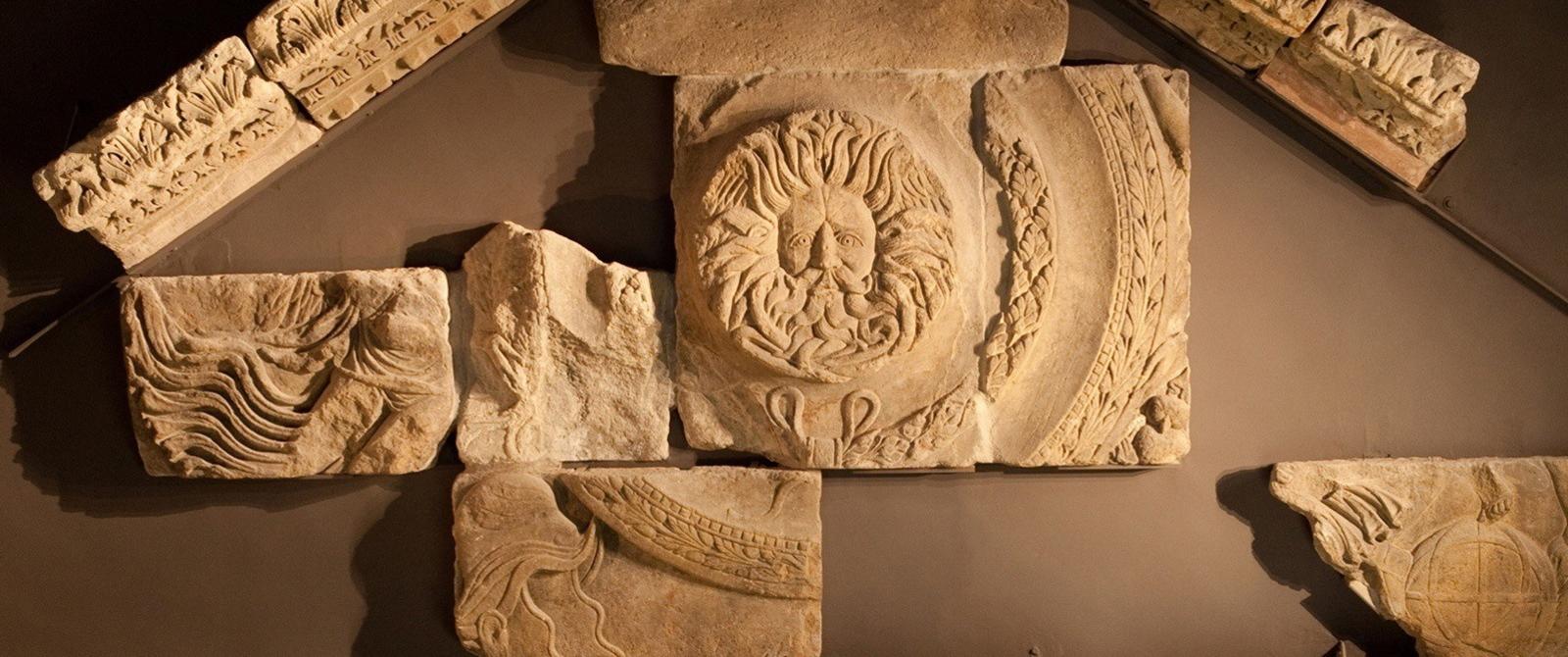
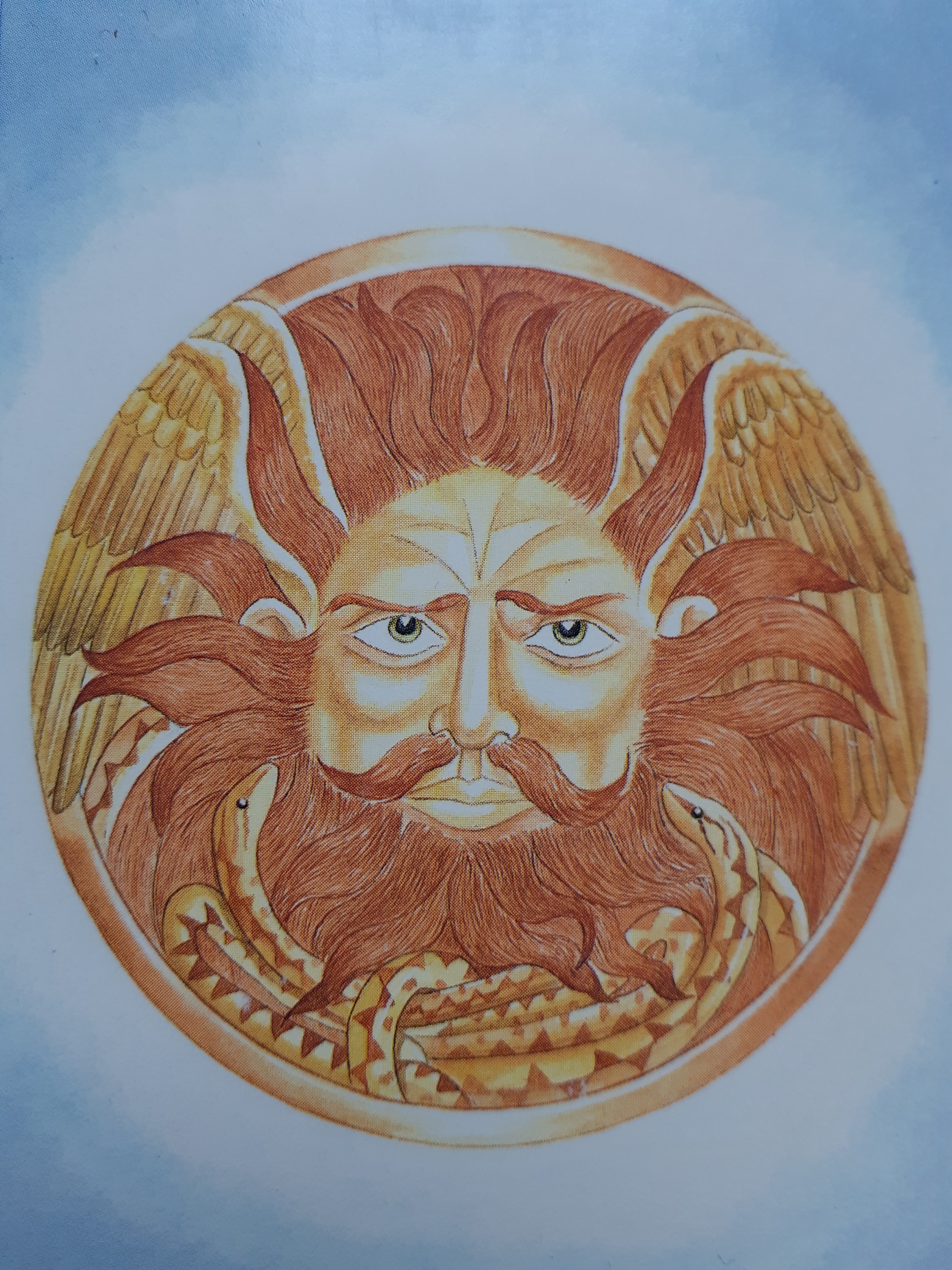
On show in the museum at Bath is a superb Celtic solar head (often inaccurately called a Gorgon’s head). The carving is a circular relief of an imposing male face with wild hair, long moustaches and staring eyes. He has wings on either side of his head and is surrounded by flames. Beneath his chin are two serpents, linked in the manner of a torque, the Celtic symbol of royalty. This solar deity is probably the being called Bladud in the legendary histories, connected to magic, flight and a fall from the heights to the depths. He has upon his brow the mark of the three rays, which are very often described as the primal three powers of universal creation.

The goddess at Bath, presiding over the sacred hot springs, was called Sul or Sulis, which means ‘eye’ or ‘gap’ (with a sexual connotation), for she is a variant of Ceridwen, the goddess of the Underworld. The entire Celtic/Roman complex of Aquae Sulis is an excellent example of ancestral Underworld magic refined by Roman politics into a temple of Minerva.

“The sacred or prophetic head is an embodiment of the relationship between the three worlds, for it is aware in all worlds, through all time. While we may have ideas that an anthropologist would suggest originated in primitive head-hunting magic, the theme of the sacred head becomes an allegory of divine and human perception and declaration.

“There is a further element to the sacred-head theme, for it is also interlinked with beliefs and practices concerning the regeneration of life, particularly with the cauldron. Titanic figures such as Bran, acting as sacred kings and guardians of the land, also partake of the mystery of the sun at midnight, light regenerating out of darkness. And this, after all, is the secret of inspiration, a sudden light born out of fruitful darkness.”

R. J. Stewart and Robin Williamson Celtic Bards, Celtic Druids London: Blandford, 1996

(1) Geoffrey of Monmouth History of the Kings of Britain London: Penguin, 1966 (Translated with an introduction by Lewis Thorpe)

(2) Mark Walker Geoffrey of Monmouth’s Life of Merlin: A New Verse Translation Stroud: Amberley, 2011

NOTE: the first illustration is from R. J. Stewart The Merlin Tarot London: Element, 2003 , illustrated by Miranda Grey. The Bladud image is on the reverse of each card, implicitly re-ascribed to Merlin as embodying the same archetype in a different way. The second illustration can be found on http://www.romanbaths.co.uk – click on discover and then walkthrough.

HARVESTING IN MIXED WEATHER

This picture was taken early one morning, at a moment slightly defended from the heat of early August. I was walking through woods to shelter from the sun.

Those days, intense in their moment, have already receded into the past. After a period of somewhat lower temperatures, and of flashes and rumblings in the sky followed by modest rainfall, we found ourselves in a flash flood on Sunday evening. For a relatively brief period, the A46 (a main road, locally) turned into a fast-flowing river not far from our house. Guttering held, but needs attention.

It was as if, following a period of contest, water had succeeded fire as the prevailing element. Now, the situation is less clear cut. But we are in a cooler and wetter place than we were at the beginning of the month. Daylight hours are reducing. We are leaning in to autumn.

During this time I have been busy with my own harvesting. The meditations presented in my last three posts (1) complete a basic repertoire of formal solo practice in my renewed Druidry. I have been fruitfully indoors during both heat wave (beyond my comfort zone) and the return of rain. I have been inwardly focused.

In my own Innerworld wheel of the year, apple presides over the first three weeks or so of the post Lughnasadh/Lammas quarter. Apple, in many traditions, is a Goddess tree, associated with both wisdom and healing (2). It is linked to a visionary ability to see beyond the surface: perceptions grow wiser and the heart sees further than it might otherwise do.

In Irish myth, Lugh was sent to collect apples from a Tree of Light found in the Otherworld. In Britain, after the Battle of Camlann, Arthur was taken by three Celtic goddesses to be healed on the Isle of Avalon (=Island of Apples).

In a more everyday way, my meditations serve the same goals. The timing of my work on them wasn’t exactly planned. But it doesn’t surprise me that my commitment to living the wheel of the year has led to this result.

(1) Links to the meditations:

MEDITATION: LIVING PRESENCE

MEDITATION: WISDOM’S HOUSE

MEDITATION: ENERGY BODY

(2) See: John Matthews & Will Worthington The Green Man Tree Oracle: Ancient Wisdom from the Greenwood London: Conections, 2003

Earth Eclectic

music that celebrates Earth and speaks to the heart

Sarah Fuhro Star-Flower Alchemy

Follow the Moon's Cycle

Muddy Feet

Meeting nature on nature's terms

Rosher.Net

A little bit of Mark Rosher in South Gloucestershire, England

Becoming Part of the Land

A monastic polytheist's and animist’s journal

selkiewife

Selkie Writing…

Charlotte Rodgers

Images and words set against a backdrop of outsider art.

Prof Jem Bendell

living with metacrisis and collapse

Towint

The pagan path. The Old Ways In New Times

The Druids Garden

Spiritual journeys in tending the living earth, permaculture, and nature-inspired arts

The Blog of Baphomet

a magickal dialogue between nature and culture

This Simple Life

The gentle art of living with less

Musings of a Scottish Hearth Druid and Heathen

Thoughts about living, loving and worshiping as an autistic Hearth Druid and Heathen. One woman's journey.

Wheel of the Year Blog

An place to read and share stories about the celtic seasonal festivals

Walking the Druid Path

Just another WordPress.com site

anima monday

Exploring our connection to the wider world

Grounded Space Focusing

Become more grounded and spacious with yourself and others, through your own body’s wisdom

The Earthbound Report

Good lives on our one planet

Hopeless Vendetta

News for the residents of Hopeless, Maine