Contemplative Inquiry

This blog is about contemplative inquiry

Tag: Celtic Bardism

PRIMARY MATERIALS


“There are seven primary materials of the world: the Blue Bard of the Chair has said it.

“The first, earth, from which are every corporeity and hardness, and every firm foundation;

“The second, water, from which are every humour and freshness;

“The third, air, from which are all respiration and motion;

“The fourth, sun, from which are all heat and light;

“The fifth, nwyfre, from which are all feeling, affection, and wantonness;

“The sixth, the Holy Ghost, from Whom are all understanding, reason, awen, and sciences;

“The seventh, God, from Whom are all life, strength, and support, for ever and ever.

“And from these seven primary materials are every existence and animation; and may the whole be under God’s regulation. Amen.” (1)

The Barddas of Iolo Morganwg,  by J. Williams Ab Ithel, was published in 1862. It was presented as the lore of traditional Welsh Bardistry going back to Druid times, based on the earlier work of Iolo Morganwg (Edward Williams – 1747-1826). Iolo had organised the first Gorsedd of Bards for several hundred years at Primrose Hill, London, on 21 June 1792, thereby initiating the modern Welsh Eisteddfod movement. He was a personal friend of Tom Paine and George Washington subscribed to his first volume of poetry. He is said to have influenced William Blake’s poetry and Robert Graves’ The White Goddess.

Iolo described himself as a Unitarian Quaker in religion, and a revolutionary Welsh nationalist in politics. In the later 1790’s the Glamorgan magistrates sent the yeomanry (a volunteer cavalry force drawn from the property-owning classes) to break up an open-air Gorsedd led by Iolo in that county. The reason given was that it was being conducted in the Welsh language and allegedly included a toast for Napoleon – then admired by radicals as defender of the French revolution. This is also a time of revolt in Ireland and the birth of Irish republicanism.

Culturally, Iolo was, as well as a poet in his own right, “a first-rate forger of literary Welsh; some have commented that his forgeries were as good or better than the real thing. Furthermore, he wrote much of the Barddas under the influence of laudanum (an opium-based medicine which he took for asthma)” (1). In consequence he has been widely dismissed as an embarrassing fraud. My response is more complicated. There is something poignant for me about ‘forgeries’ that are “as good or better than the real thing”. On the forgery question, I am sad that Iolo could not openly be a catalyst for the creation of new culture inspired by an old one, rather than having to pretend, even to himself, that he was recovering an old one as it had been (in his own mind perhaps through psychic means). As for medicinal laudanum, I wonder why this should be stigmatised in Iolo whilst accepted in his contemporary S. T. Coleridge. It may be is because Coleridge’s work was unambiguously original, and therefore seen differently. The issue of new culture creation in Druidry is a significant one to this day and is well discussed in Philip Carr-Gomm’s preface to Contemplative Druidry (2) where the voices of a number of open culture creators are included.

Going back to The Seven Primary Materials of the World, I feel friendly to this text despite its patriarchal language and its statement of a world view significantly different from my own. In my reading, it suggests a seven-step ladder from matter to the divine, with four material elements that point also to non-material qualities, where the the fourth and highest is not on the Earth. Then there are two subtle elements (though the first finds room for ‘wantonness’) and an ultimate ascent to the divine. It is the kind of evolutionary spiritual scheme that many transcendentalists down the ages have related to. Written at the turn of the eighteenth and nineteenth centuries, and edited in mid Victorian times, it seems to me congruent with the outlook of medieval Welsh Bardistry as expressed in The Book of Taliesin (3), and the theology of the ninth century Irish scholar and contemplative mystic John Scotus Eriugena (4). It is a Christian referenced path that is not sin and fear based, and I am sure that many people involved in Druidry and Celtic Spirituality today would be in essential sympathy with it. Made up by Iolo or not, it reads as a clear and simple expression of a universalist and transcendentalist stance within a specific cultural setting. I find nothing fraudulent about it. It is what I would expect from place, time and person.

Indeed, key concepts remain relevant to my own Druid practice. I work with the wheel of the year and with the four classical elements, including fire. I am concerned with the Earth’s relationship to sun and moon. I work with my body and my sense of energy and think of nwyfre as synonymous with prana or chi, now well-known thanks to the popularity of yoga and Chinese energy arts.

At this stage in my personal journey, I am in renewed inquiry with awen. For the Barddas, it is a distinct higher mental faculty, close to the divine source like Coleridge’s primary imagination. In my own work I get a sense of energised and articulated insight. I do not think of awen as a substance in itself, but rather a quality of how we express ourselves when at our most enlivened and ‘on song’. But this inquiry is far from concluded.

Where the Barddas speaks of God, I speak of nature. I think of the web of life, and of our interbeing within it. I also think of the mysteries of quantum events, dimensions that we cannot perceive directly, galaxies flying apart and the possibility of multiple universes. But to me nature’s most extraordinary phenomenon is the gift of aware experiencing, with all the joy and suffering it brings, in the apparent here and now. To this I add the capacity to bear witness to this miracle through words, non-verbal media, silence, celebration and action. Here, I find myself still using most of the key terms from The Seven Primary Materials of the World. In this sense,  I am happy to have The Barddas of Iolo Morganwg as part of my spiritual ancestry.

  1. J. Williams Ab Ithel The Barddas of Ilo Morganwyg, Vol I & II: A Collection of Original Documents, Illustrative of Theology, Wisdom, and Usages of the Bardo-Druidic System of the Isle of Britain Forgotten Books, 2007 www.forgottenbooks.org (First published 1862)
  2. James Nichol Contemplative Druidry: People, Practice and Potential Amazon/Create Space, 2014 (Foreword by Philip Carr-Gomm)
  3. William F. Skene The Four Ancient Books of Wales Forgotten Books, 2007 www.forgottenbooks.org (First published 1868)
  4. https://contemplativeinquiry.blog/2014/07/12/the-eye-of-contemplation/ 
JOHN COWPER POWYS: PORIUS AND TALIESIN

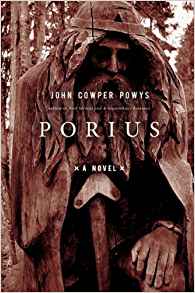
Porius (1) is John Cowper Powys’ last novel. It took him seven years to write, and he completed it in 1949, when he was 77. It is set in the year 499 CE, in North Wales. Porius is a Romano-British prince. Arthur, a suspect foreigner to most local people, reigns as Emperor. Rome is ruled by Goths, but links are maintained with Constantinople. The Saxons are an existential threat. People have to find a way of dealing with the situation in which they find themselves. But the book is at least as much about the inner lives of the characters as it is about the action they take.

Powys thought of Porius as his masterpiece. His publishers did not agree and insisted that he cut it by a third, which he did over two agonising years. Fortunately, a complete edition is available now thanks to modern editors Judith Bond and Morine Krissdottir. In her foreword Krissdottir says, “I am always reminded when I read the novel of these lines: ‘we are always in error, lost in the wood, standing in chaos, the original mess, creating a brand-new world’. Powys was as gloriously lost by the time he had written Porius as the reader sometimes is … but he was still the superb craftsman, who knew that it was the story itself that had the power to shape the forest within and without, that had the power to create a brand-new world”.

Instead of writing a review, I want to focus on one character, Taliesin, and what Powys has to say through him about the creative life. Powys has a number of point of view characters, with a variety of stances. He seems to give them equal air-time, making Porius a genuinely multi-vocal novel. Taliesin is portrayed as a young, mercurial bard, popular thanks to outstanding skill in cooking as well as poetry. (The cover illustration above is of Merlin – old, saturnine, more central to the book as a whole). Powys builds Taliesin’s bardic character, and the idiosyncratic working of his awen, with care.

“Taliesin had indeed worked out for himself, quite apart from his power of expressing it in such assonances and alliterations as had never been heard before, a really startling philosophy of his own. This philosophy depended on a particular and special use of sensation; and its secret had the power of rendering all matter sacred and pleasure giving to the individual soul. And it had the power … of fusing the immense past with the immeasurable future and of doing this, moreover, not by means of an ‘eternity’ beyond experience and imagination, but by means of a quivering vibrating, yet infinitely quiescent moment of real Time.”

Taliesin can rely on an easy fluency with language. More important is his capacity for open creative reverie, based on a deep sensitivity to the perceptions of the moment. He is described as sitting on a four-legged stool in the deepening of a late October evening. As he sits, he feels the full warmth of a fire and is able to see “the glittering path of moonlight on wind-ruffled water”. He can see a hawk’s nest, and the “ancestral sword of Cynan ap Clydno, thrust to the depth of half its blade, in the buried stump of a vanished oak tree”. The sword is reminiscent of a cross. Taliesin muses that “any sort of thing happening near a cross, not to speak of a sword, always seems in some way to be watched – if not heard and guarded against”. J.C. Powys comments, “considering the sword and the cross, the moonlit space between that figure on the four-legged stool and Clydno’s rusty weapon may well have vibrated with dangerous antipathy as the words ‘The Mothers’ and ‘Nothingness’ and ‘Annwfn’ floated away towards the lake. Rather than writing, Taliesin speaks into the darkness. Writing may come later. The piece that follows is lengthy, and eventually settles into a contemplation of “the thing none can utter, the thing inexpressible” yet “known from before the beginning”. Here is the final section:

“I know it from pond slime and

frog spawn and grub spit,

From bracken’s green coral,

white lichen, yellow mosses,

Newts sinking with their arms

out to reedy pools’ bottoms,

Swords rusting in their oak

stumps, wrapped in the long rains,

Eggs rotting in their lost nests,

enjoying the wild mists, I know it from all these, and to

men proclaim it:

The ending forever of the Guilt

sense and God sense,

The ending forever of the Sin

sense and Shame sense,

The ending forever of the Love

sense and Loss sense,

The beginning forever of the Peace paradisic,

The ‘I feel’ without question,

The ‘I am’ without purpose,

The ‘it is’ that leads nowehre,

the life with no climex,

The ‘Enough’ that leads forward

to no consummation

The answer to all things, that

yet answers nothing,

The centre of all things, yet all

on the surface,

The secret of Nature, yet Nature goes blabbing it

With all of her voices from

earth, air, fire, water!

Whence comes it? Whither

goes it? It is nameless; it is

shameless;

It is Time free at last from its Ghostly Accuser,

Time haunted no more by a

Phantom Eternal;

It is godless; but its gods are as

sea sand in number;

It’s the square with four sides

that encloses all circles;

Four horizons hath this Tetrad

that swallows all Triads;

It includes every creature that

Nature can summon.

It excludes from Annwfyn nor

man, beast nor woman!”

The mid twentieth century was a time of considerable interest in the Matter of Britain and Arthurian themes. But generally, then, we find a polished and rather conservative Christian perspective, applicable even to Taliesin. The Inkling Charles Williams wrote two collections of linked verse about him – Taliessin Through Logres and The Region of the Summer Stars (2). The latter collection includes these lines from the poem Taliessin in the Rose Garden:

“I was Druid-born and Byzantium trained.

Beyond Wye, by the Cauldorn of Ceridwen, I saw

the golden cycle flash in the forest, and heard

the pagans mutter a myth; thence by the ocean

dreaming the matter of Logres I came where the heirarchs

patter the sacred names on the golden floor

under the throne of Empire.”

John Cowper Powys, too, was a man of his time. But insofar as his Porius relies on legendary history, he borrows more from archaic Welsh tradition than the better known pan European literature that developed out of it. He himself is much more nature friendly and Pagan in sensibility. I see him as following a broadly emancipatory direction in modern spiritual culture, and we are his heirs.

(1) John Cowper Powys Porius: a Romance of the Dark Ages Overlook Duckworth, 2007. Edited by Judith Bond and Morine Krissdottir, with a foreword by Morine Krissdottir. The first abbreviated edition was published in 1951.

(2) Charles Williams Taliessin Through Logres & The Region of the Summer Stars Berkeley, CA: The Apocryphile Press, 2016. Edited with an introduction by Sorina Higgins. (Taliesin Through Logres first published in 1938; The Region of the Summer Stars in 1944)

BOOK REVIEW: Y DAROGAN ANNWN

The image above is the cover for Lorna Smithers’ new collection of poems, Y Darogan Annwn, and it illustrates the themes of the collection. Lorna Smithers explains: “Daronwy, the Brythonic World Tree, is falling. Beneath its boughs appears Y Darogan Annwn, a child-prophet, who prophecies the end of the Age of Man. She must find the source of the poison, outwit the scientists of Gwydion, and release the destructive fury of the spirits of Annwn. Her ultimate decision will be whether to become one with her prophecy.”

Prophecy, like poetry, is a gift of awen, the inspirational energy of Brythonic culture. To be awenydd, open and dedicated to this gift, is to accept its demands. Y Darogan is a child of the gods and a daughter of dragons. She is a shape-shifter who can move through multiple identities, the most poignant of which is that of a little girl. She will never grow up. Her individual life will last for less than a year.

The collection contains 50 poems in all. Two are introductory and the others are arranged in seven sections providing a narrative structure: Lock and Key; The Forest of Daronwy; The Fisher King; The Golden Ring; Doomsday; The End of Days; and The Hereafter. Together they present a wasteland story for our times, drawing on British Celtic and Arthurian themes whilst subverting the patriarchal assumptions of the old texts. The individual poems are each relatively short, and likely to have most impact on people who have some familiarity with the Mabinogion and the Brythonic mythos in which it is embedded. However the wasteland confronted is that of our own times: its military industrial complexes based on a perverted science, and the current slide into climate catastrophe.

For her self-introduction in the first verse, the infant Y Darogan uses pithy lines of power, reminiscent of The Book of Taliesin*, though with updated cultural references.

I have been a fallen star

and a tear in a river of tears

flowing through Annwn.

I have been hydrogen,

oxygen, carbon, nitrogen,

helium burning in the sun.

****

I have been dark matter

I have not been found by

the scientists of Gwydion.

By contrast, Doronwy, the Brythonic World Tree, is introduced in a prose poem, one of the longer individual pieces in the book. Together, these introductory pieces provide a point of departure for the story that builds over the seven main sections. Y Darogan’s mission of cleansing is itself a path of destruction, and “no Champion’s Light stands out on her forehead, just the darkness of the black hole”. Only at the very end is there a regenerative (rather than ‘redemptive’) note. The material demands verbal resilience in the face of multiple and unavoidable stresses, and even at its bleakest, there is power and magic in Lorna Smithers’ writing.

Oh Breath of the Wind

don’t leave me leave me please!”

She does not know how long

she has been wandering Pennant Gofid,

the Valley of Grief through ghosts and mist,

only that she found the treasure, became

the answer, and it’s harder to bear

than the weight of the crow.

The howling of wolves loudens.

The sky blackens with ghost-wings.”

Overall, I believe that Y Dorogan Annwn is a significant contribution to the re-visioning of the world’s great stories as we confront unprecedented challenges on our collective journey. I am grateful for the opportunity to read and review it.

Lorna Smithers’ blogs at https://lornasmithers.wordpress.com/ using the title At Peneverdant. Her About section describes her calling as an awenydd and devotee of Gwyn ap Nudd, God of the Brythonic underworld Annwn, of the dead, and of the Wild Hunt. The Y Darogan Annwn collection is now for sale as a PDF, see link:

https://lornasmithers.wordpress.com/2019/10/12/y-darogan-annwn/

  • The Book of Taliesin in The Four Ancient Books of Wales Forgotten Books, 2007 (Originally published in 1868, when the original material was translated and edited by William F. Skene)

BOOK REVIEW: THE BROKEN CAULDRON

14606507_342051356186231_2360625875228974566_nHighly recommended. Author Lorna Smithers describes The Broken Cauldron as “a fragmentary collection of essays, stories and poems”. Yet I experienced this book as a unity, a poet’s meditation even when presenting technical information about fracking and nuclear power. For it is built around a compelling core image, made visible in Tom Brown’s striking cover illustration.

At its fullest and most majestic, that image is “a cauldron full of stars”, the womb of Ceridwen, Old Mother Universe, and traditionally the source of inspiration, wisdom and rebirth. Yet here the cauldron lies shattered, the universe is fragmented, and the world is out of kilter. Smithers takes myth out of archetypal romance and into the wounded world of history, making it awkward, jarring – and dynamic. She confronts us with where we are and transmits a warning wake-up call from gods and storytellers.

In her introduction, Smithers explains how she was led into a quest to understand the significance of the broken cauldron in ancient British history. The myths she studied were penned in medieval Wales but are rooted in an older oral tradition. All tell the story of the cauldron. When it is broken or stolen, cataclysmic consequences are unleashed. Smithers was particularly drawn “to the violence of Arthur’s raid on Annwn (the Otherworld) and assault on its inhabitants. The moment Lleog thrusts his flashing sword into the cauldron came to symbolize the patriarchal world view … founded on oppression of the Other”. In her poem about this she writes:

“The sinking blade lit like lightening.

Reflected in it faces of a million million souls,

Eyes melting, disintegrating like shadows

Into pure white light.”

Lleminog, another of Arthur’s companions, carries the broken prize away:

“Lleminog scooped the cracked cauldron

Into his hand,

Escaped like a thief into the night

With moon, stars, sun, broken pieces

Of Old Mother Universe jangling in his pocket.”

Smithers works under the aegis of Gwyn ap Nudd, a god “who haunts the peripheries of the Bardic tradition”. His world is Annwn – an Otherworld described as ‘not-world’ and ‘the deep’. There he keeps a cauldron that is whole and filled with stars, “the infinite reflection of the womb of Old Mother Universe, Ceridwen”. Much of our inherited Bardic tradition is seen as problematic. In particular, “Taliesin epitomizes all that is questionable and dislikeable” about it. The poet of The Broken Cauldron.is an outsider “watching with horror as Gwion escapes with the Awen and Gwyddno’s horses perish in the poison” – paying the terrible price for three drops of inspiration. The Gwion who becomes Taliesin pays little attention to this and becomes a sycophantic court Bard as kingdoms fall.

Gwyn offers the possibility of fixing the broken cauldron by gathering the poison back into it from the land, and Lorna Smithers supports this work by telling the stories of “marginalized figures – the overshadowed, the oppressed and the slaughtered”. The Broken Cauldron is divided into five sections: The Broken Cauldron and The Flashing Sword, Ridiculous, Drowned Lands, Operation Cauldron and Uranium.  The urgency of myth trying to reconstruct itself for are times is conveyed in a number of ways. One is the striking language of set piece poems, as in Dumb Man:

You come mouthing words.

There are burnt out cities in your mouth.

The vocabulary of sign language

Cannot convey the stories

You need to tell.

There are the cumulative effects of the giant Diwrnach’s repeated death in slightly variant stories from different regions of Celtic Britain, as he defends a cauldron in a feasting hall and is slain by his own sword. Smithers describes this back-to-backing of versions as a ‘montage’. There is dark whimsical fantasy in The Day I Raised the Dead, which takes place in The Court of the Sons of the King of Suffering – a “joyless place”. There is a realistic account of a journey to find out about, and find, the drowned Porth Wyddno, once one of “the three chief ports of the island”, which Smithers places in Lancashire rather than at Borth in west Wales. There is a discussion of uranium and the nuclear power station at Sellafield aka Windscale aka Calder Hall, and its inclusion in the myth of the “cauldron which is filled with stars” and dangerously toxic when messed with.

Most poignant, for me, is the story of Morfran, which straddles time. His mother, “a scientific genius with a meticulous eye for detail” runs an award winning chemical plant. Growing up gawky and ugly as a cormorant, he has been nick-named Afagddhu (utter darkness) by a mother who is determined to fix him and make him presentable. Events occur, though not to him. At the end of his story, he muses “perhaps that’s where I’ll go, down into the deep where there is no ugliness and no perfection, surface with a fish for a clean breath or air before her child is born and the cycle begins again.”

There is much more. The Broken Cauldron is a wonderful example of the re-visioning of myth, fully immersed in the old traditions, yet bringing out new meanings and new possibilities for our time.


Lorna Smithers The Broken Cauldron King’s Lynn, Norfolk: Biddle’s Books, 2016 Cover art by Tom Brown.

WESTERN WAYS: DRUIDRY AND SOPHIA

In my world, Druidry and the Way of Sophia are linked, though not the same. In The Western Way (1,2) authors Caitlin and John Matthews made a distinction between a ‘Native’ Tradition and a ‘Hermetic’ one, which act as “complementary opposites”. The Native Tradition is “the inward spiral of a maze which leads into the heart of ancestral earth-wisdom”. The Hermetic Tradition is the outward spiral of the same maze: a path of evolving consciousness which is informed by the inner resources of our ancestral roots, “augmented in a macrocosmic way” (2).

My original interest in a ‘Celtic’ spiritual thread, developing from the 1980s, wasn’t specifically Druid or Pagan. It came mostly through Celtic and Celtic influenced literature. Although a long tradition in its own right, it post-dates the demise of institutional Druidry and Paganism in Celtic speaking regions. Most of it has been written with at least an element of Christian reference and influence. So we get verses like this from the medieval Welsh Book of Taliesin:

I was at the cross

With Mary Magdalene.

I received the Awen

From Ceridwen’s cauldron. (3)


What I intuitively liked about this was the sense of a culture working to integrate diverse influences rather than attempting to be ‘pure’. Pure culture (or the attempt at it) narrows horizons and banishes possible resources, becoming limited and inflexible in my view. Sophia is both an image of the divine and expresses a blending of Jewish and Greek wisdom traditions. She came to prominence in Alexandria, the largest city of Roman Egypt. She is cosmopolitan. In the verse above Mary Magdalene (an incarnation of Sophia in some gnostic traditions) and Ceridwen (not a traditional Celtic goddess from Pagan times) both have Sophian roles in relation to male figures seen in different ways as light bringers.

Some of the Celtic-derived stories from the medieval period are clearly breaking new cultural ground whilst using resources from the Celtic past. They belong to a realm of creative mythology, as Joseph Campbell called it, whose purpose is “the opening … of one’s own truth and depth to the depth and truth of another in such a way as to establish an authentic community of existence” (4). Twelfth century Western Europe sought to renew itself by drawing on its classical heritage (native in Italy) and Geoffrey of Monmouth drew on it in his Mystic Life of Merlin (5), for example by dedicating a contemplative ‘Observatory’ to the owl deity Minerva, Roman Goddess of Wisdom. It also drew on Celto-Germanic heritage, with the Arthurian mythos – the matter of Britain – taking a prominent place. This mythos does not name Sophia. But it does have the image of the grail and the story of the grail quest. For me the grail represents the presence and energy of Sophia, and Caitlin Matthews has described it as “a prime symbol of Sophia” (6).  Perceval, the grail winner, has to encounter the divine in a new way for himself. At one level his role is to honour and heal the land, renewing its tantric energy. But the Grail Goddess, whilst enabling that traditional collective healing, adds a new and more individuated depth of wisdom and compassion. So although I have always been moved by the scenes and images of the more archaically oriented Peredur (7), I have found a more compelling narrative in Parzival (8). It is the innovative aspect of the story that engages me and the grail image that nourishes me.

In the Gnostic Gospel of Thomas, (9) Jesus of Nazareth asks three leading followers to say what they think he is like. Peter, traditionally Jewish, says “you are like a just messenger” (or righteous angel in other translations). Matthew, familiar with Graeco-Roman ways, says “you are like a wise philosopher”. Thomas says, “my mouth is utterly unable to say what you are like”. The teacher responds, ‘I am not your TeacherBecause you have drunk, you have been intoxicated from the bubbling spring that I have tended’.  As I read this text, it is a confirmation that a lived spirituality is beyond packaging.

In this sense, terms like Druidry, Way of Sophia or Western Way have only a limited use. Joseph Campbell said “the best things cannot be told; the second best are misunderstood; after that comes civilised conversation”. The problem is real yet I believe he overstates his case. I think it is worth the effort of finding words, making distinctions and enabling affiliations in full awareness of the difficulties. Civilised conversation with moments of … something more … feels like an honourable pursuit.

  1. Caitlin & John Matthews (1985) The Western Way: A Practical Guide to the Western Mystery Tradition: Volume 1 – the Native Tradition London: Arkana
  2. Caitlin & John Matthews (1986) The Western Way: A Practical Guide to the Western Mystery Tradition: Volume 2 – the Hermetic Tradition London: Arkana
  3. John Matthews (1991) Taliesin: Shamanism and the Bardic Mysteries in Britain and Ireland London: The Aquarian Press (with additional material by Caitlin Matthews)
  4. Joseph Campbell (1976) The Masks of God: Creative Mythology Harmondsworth: Penguin
  5. R. J. Stewart (1986) The Mystic life of Merlin London: Arkana 
  6. Caitlin Matthews (1986) Sophia Goddess of Wisdom, Bride of God Wheaton, IL: Quest Books
  7. The Mabinogion (1976) Harmondsworth: Penguin (translated with an introduction by Geoffrey Gantz)
  8. Wolfram von Eschenbach, W. (1980) Parzival Harmondsworth: Penguin (translated by A. T. Hatto)
  9. The Gospel of Thomas: the Hidden Sayings of Jesus (1992) San Francisco, CA, USA: Harper San Francisco (translation with introduction, critical edition of the Coptic text and notes by Marvin Meyer; with an interpretation by Harold Bloom)

POEM: PRIMARY CHIEF BARD

Gnostic Bardistry from The Book of Taliesin? These are just five of the verses, selected by me from one poem. What interests me is not so much working out what to us seems like a set of puzzles, but how something new and dialogical is created by interweaving indigenous material and biblical references. I say a few words in italics after each verse.

Primary Chief Bard

Primary Chief Bard

Am I to Elffin

And my native country

Is the region of the summer stars.


The first statement is a statement of identity. It begins with a local (though important) role, and goes on to the cosmic and transcendent. This taps into a sense of belonging somewhere else (whether perceived as a place or state). It makes me think that statements like ‘being here now, in the present’ and ‘my native country is the region of the summer stars’ only seem contradictory: meaning depends so much on context and the work that words are doing. If the two statements are separated and polarised, they diminish into limiting slogans. Taken together, they can lead us to a different quality of experience.

I was full nine months

In the womb of the hag Ceridwen.

Before that I was Gwion

But now I am Taliesin.

Taliesin’s current personal identity is explained in terms of a second birth, in this life, triggered by the actions of Ceridwen. This second birth fits him to be a Bard and take the Bardic name ‘Radiant Brow’, one that bespeaks major shifts in energy and consciousness. It also allows the sense of the summer stars as his ‘native country’ to be real within him. It orients him to his true home.

I was patriarch

To Elijah and Enoch.

I was there at the crucifixion

Of the merciful Mabon.

Elijah and Enoch ascended to heaven without dying. They have deep roles in Jewish mysticism. They are in the tradition of so-called ‘ascended Masters’. If we treat these metaphors (insofar as they are metaphors) as concerned with enlightenment, then – as their ‘Patriarch’ – Taliesin is claiming primacy over them. He is in some sense a Christ figure and so can be present at the crucifixion of another Christ figure, referred to here by the name of the magical child of British tradition ‘the Mabon’.


I was at the cross

With Mary Magdalene.

I received the Awen

From Ceridwen’s cauldron.

The poem presented here is a product of the later Middle Ages, likely as late as the fourteenth century. Traditions giving Mary Magdalene the role of major teacher and possibly spouse of Jesus were deep underground, but everyone in Christendom Knew of her witnessing role at both the crucifixion and the resurrection, and so as privileged in some way. She also shares her name with Mary the mother. The two couplets together bring the idea of Christ’s transformation through death on the cross with Taliesin’s transformation from Ceridwen’s cauldron, and the critical role of a feminine power in each.

I was in the larder

In the land of the Trinity

And no one knows whether my body

Is flesh or fish.

Despite all the above, Taliesin remains an enigma – a shape shifter and trickster. He defies definition and description and won’t fit into any box that attracts unwanted piety. Other readers may understand this verse much better than I do, but I see it as very tough minded and unwilling to let me parcel up this poem and tie it with a neat bow. To the extent that I get a sense of medieval Welsh literature, this seems very characteristic. However, in the most obvious ‘Land of the Trinity’ (Western Christendom) people want to know where everyone stands. The accepted narrative is that we’re with Jesus the avatar of Pisces and through the sign of the fish we know him. And yet the old Celtic world has many trinities and many fish, including the salmon of wisdom. And Taliesin’s body might be flesh after all. So we are thrown back on our resources, with riddling words and ambiguous images to reflect them.


The complete poem can be found in Taliesin: Shamanism and the Bardic Mysteries in Britain and Ireland by John Matthews London: The Aquarian Press, 1991.

POEM: ARTHUR

Behind storm-fretted bastions gray and bare

Flame-crested warriors of Cunedda’s line

Feast in a gold ring, – their targes shine

Along the wall and clang to gusts of air;

And in the shadow, torches blown aflare

Reveal a chief, half human, half divine,

With brooding head, starred by the Dragon Sign,

Hung motionless in some undreamed despair.

But when he starts, three torques of twisted gold

Writhe on his breast, for voices all men fear

Wail forth the battle-doom dead kings have borne;

And as the mead-hall fills with sudden cold,

Above the wind-tossed sea his heart can hear

The strange gods calling through their mystic horn.

Arthur is one of Six Celtic Sonnets written by Thomas Samuel Jones and included in From the Isles of Dream: Visionary Stories and Poems of the Celtic Renaissance, selected by John Matthews and with a foreword by Robin Williamson (Floris Books, 1993).

Thomas Samuel Jones (1882-1932) came from Welsh and Irish stock and was born in Oneida County, New York State, near the Adirondack Mountains. Each of the six sonnets reflects a facet of Celtic tradition. They were originally published in 1930 as part of the collection Aknahton and Other Sonnets. For those of us who resonate with Druid and Celtic spirituality, they are part of our modern cultural ancestry.

POEM: A DRUID TOWN

A sunless maze of tangled lanes enfold

The magic dwellings of the forest race,

Whose hidden shapes are flames that leave no trace

At mid-moon when the Druid’s dream is told;

The shadows of enchanted orchards hold

Red thatch of wings and woad-stained doors that face

The wandering stars, and guard the sacred place

Where faery women thread their warps with gold

The dragon knight shall lose his strength of hand

Nor ever raise his long leaf-shapen shield,

If he but follow where the white deer roam;

And never will the mariner reach land

When harps ring seaward as the dawn fires yield

The golden caer upon the ninth wave’s foam.

A Druid Town is one of Six Celtic Sonnets written by Thomas Samuel Jones and included in From the Isles of Dream: Visionary Stories and Poems of the Celtic Renaissance, selected by John Matthews and with a foreword by Robin Williamson (Floris Books, 1993).

Thomas Samuel Jones (1882-1932) came from Welsh and Irish stock and was born in Oneida County, New York State, near the Adirondack Mountains. Each of the six sonnets reflects a facet of Celtic tradition. They were originally published in 1930 as part of the collection Aknahton and Other Sonnets. For those of us who resonate with Druid and Celtic spirituality, they are part of our modern cultural ancestry.

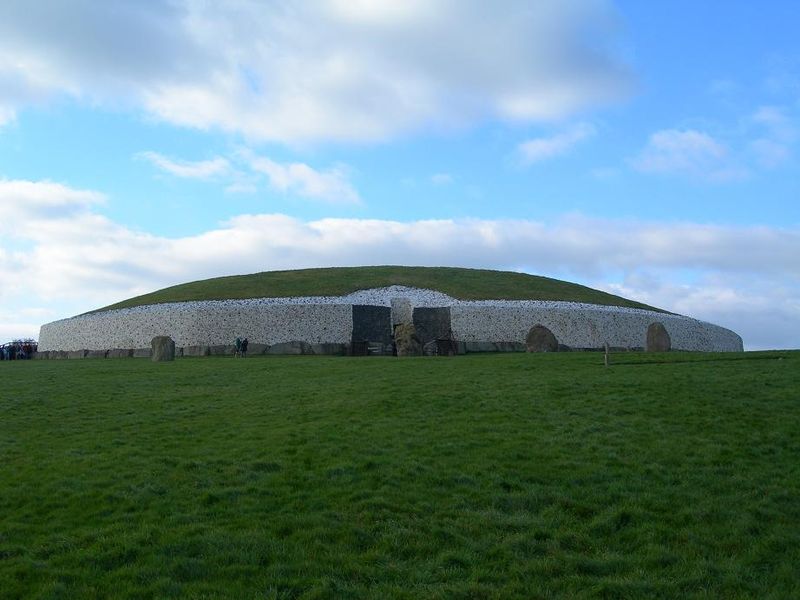
POEM: NEW GRANGE

800px-Newgrange

Picture cc by 2.5 pl – originally uploaded by Shira-commonswiki

The golden hill where long-forgotten kings

Keep lonely watch upon their feasting-floor

Is silent now, – the Dagda’s harp no more

Makes sun and moon move to its murmurous strings;

And never in the leafy star-led Springs

Will Caer and Angus haunt the river shore,

For deep beneath an ogham-carven door

Dust dulls the dew-white wonder of their wings.

Yet one may linger loving the lost dream –

The magic of the heart that cannot die;

Although the Rood destroy the quicken-rods;

To him through earth and air and hollow stream

Wild music whines, as two swans wheeling cry

Above the cromlech of the vanished gods.

New Grange is one of Six Celtic Sonnets written by Thomas Samuel Jones and included in From the Isles of Dream: Visionary Stories and Poems of the Celtic Renaissance, selected by John Matthews and with a foreword by Robin Williamson (Floris Books, 1993).

Thomas Samuel Jones (1882-1932) came from Welsh and Irish stock and was born in Oneida County, New York State, near the Adirondack Mountains. Each of the six sonnets reflects a facet of Celtic tradition. They were originally published in 1930 as part of the collection Aknahton and Other Sonnets. For those of us who resonate with Druid and Celtic spirituality, they are part of our modern cultural ancestry.

GWYN, GWYTHYR AND CREIDDYLAD: A STORY FROM THE OLD NORTH

This post reblogged from Peneverdant looks at the traditional stories of the northern British (especially in north west England and southern Scotland) and surviving material from these stories in later Welsh literature.

Lorna Smithers's avatarThe Sanctuary of Vindos

Cherry BlossomCulhwch and Olwen is one of the oldest and most fascinating repositories of ancient British mythology. It originates from two texts; a fragmented version in The White Book of Rhydderch (1325) and full version in The Red Book of Hergest (1400). The main narrative centres on Culhwch’s quest to win Olwen for which he enlists the help of Arthur and his retinue; a medley of historical and mythological characters.

Embedded within it we find fragments of other tales which may be of older origin and have stood alone. These include the hunt for the legendary boar Twrch Twryth and release of Mabon from imprisonment in Gloucester. Most significantly for me as someone who venerates Gwyn ap Nudd, we find the story of his rivalry with Gwythyr ap Greidol for the love of Creiddylad and their battle for her every May Day.

This story is central to understanding Gwyn’s mythology. Because…

View original post 2,230 more words

Earth Eclectic

music that celebrates Earth and speaks to the heart

Sarah Fuhro Star-Flower Alchemy

Follow the Moon's Cycle

Muddy Feet

Meeting nature on nature's terms

Rosher.Net

A little bit of Mark Rosher in South Gloucestershire, England

Becoming Part of the Land

A monastic polytheist's and animist’s journal

selkiewife

Selkie Writing…

Charlotte Rodgers

Images and words set against a backdrop of outsider art.

Prof Jem Bendell

living with metacrisis and collapse

Towint

The pagan path. The Old Ways In New Times

The Druids Garden

Spiritual journeys in tending the living earth, permaculture, and nature-inspired arts

The Blog of Baphomet

a magickal dialogue between nature and culture

This Simple Life

The gentle art of living with less

Musings of a Scottish Hearth Druid and Heathen

Thoughts about living, loving and worshiping as an autistic Hearth Druid and Heathen. One woman's journey.

Wheel of the Year Blog

An place to read and share stories about the celtic seasonal festivals

Walking the Druid Path

Just another WordPress.com site

anima monday

Exploring our connection to the wider world

Grounded Space Focusing

Become more grounded and spacious with yourself and others, through your own body’s wisdom

The Earthbound Report

Good lives on our one planet

Hopeless Vendetta

News for the residents of Hopeless, Maine