Contemplative Inquiry

This blog is about contemplative inquiry

Tag: Celebration

NEWS OF A DEATH

When is ‘suicide’ something else? At the age of 80 Satish Kumar’s mother decided that her life was over and her duty done. She began a fast that lasted for five weeks before she died. Although suicide is stigmatised in most cultures, this was an honourable death in her Jain community in Rajasthan, India. Kumar, then already living in England, quotes the letter that gave him the news.

“At the age of eighty your mother felt that she had served the family and fulfilled all her duties and that now it was time for her to meet death. She decided to separate herself from her worn-out body by fasting. She believed that only death could bring new life and that she must die to live again. She went round the town, to family and friends, saying goodbye and asking forgiveness for any wrong she may have done. From the next day’s sunrise she took no more food or drink except a little boiled water. The news of your mother’s fast unto death spread by word of mouth. Monks came to bless her and be blessed, since it is considered to be brave and holy to die in this way – to embrace death rather than let it capture you unaware. Hundreds of people came to have her last darshan and to ask for forgiveness. She didn’t talk much but by her look acknowledged the receiving and giving of forgiveness. People sat outside singing songs and praying. After thirty-five days of fasting, your mother died.” (1)

I have written before about Jain ethics, in a review of Philip Carr-Gomm’s Seek Teachings from Everywhere (2). Both he and his Druid mentor Ross Nicholls had an interest in the Jain path with its values of ahimsa (non-violence/harm), aparigraha (non-attachment/possessiveness/acquisition) and anekant (non-absolutism/many-sidedness/multiple viewpoints). From a Jain perspective, Satish Kumar’s mother was in conformity with these principles when she chose death, with fasting (already a familiar practice) as her method. I value her story for its distinctive lens on a contentious subject. The depth of community support she received is for me the most moving aspect of this voluntary death. It became almost a celebration, and a kind of karmic harvesting for someone who believed that she “must die to live again”.

(1) Satish Kumar No Destination: Autobiography of a Pilgrim Cambridge: Green Books, 2014 (extended 4th edition – first edition 1992)

(2) See: https://contemplativeinquiry.blog/2019/10/02/book-review-seek-teachings-everywhere/

NOTE: “Satish Kumar (born 9 August 1936)[1] is an Indian British activist and speaker. He has been a Jain monk, nuclear disarmament advocate and pacifist.[3]Now living in England, Kumar is founder and Director of Programmes of the Schumacher College international center for ecological studies, and is Editor Emeritus of Resurgence & Ecologist magazine. His most notable accomplishment is the completion, together with a companion, E. P. Menon, of a peace walk of over 8,000 miles in June 1962 for two and a half years, from New Delhi to MoscowParisLondon, and Washington, D.C., the capitals of the world’s earliest nuclear-armed countries.[4][5] He insists that reverence for nature should be at the heart of every political and social debate.” (Wikipedia)

COLOURS OF AUGUST, 2023

The haws are red and shiny on their hawthorn bushes. Blackberry remains tentative, its pale green fruit visible but still unripe. I see green leaves now leaning towards yellow. I am walking in a scrap of local woodland, bounded by a canal* on my left and housing some distance to my right. It is around 7.30 pm on 13 August, and I am opening up to the colours of late summer as they show themselves this year.

Looking up, I see a healthy crop of crab apples at different stages of ripening on their tree. The ripest apples are red, though their red is softer than that of the haws. The leaves of the apple tree are shinier than those in the background. I am aware of a light grey sky.

Nature in various forms finds a niche everywhere. This time has its own flowers, and again I see yellow. I am not the greatest botanist. and I cannot name with certainty these plucky if slightly battered blooms, saying hello from behind a fence. But I imagine them as poor relations of even the lesser celandine, and therefore almost certainly official weeds**. I hope and pray they remain safe here in these woods.

Below, looking at tangled leaves, I find a truly autumnal scene, in the yellowing and browning of leaves. It feels a bit early for this neighbourhood. The wheel of the year is still following its seasonal course, so far, but is becoming more erratic and unpredictable than in the past. I wonder about the future of the jet stream – and indeed the Gulf stream too. But in the moment, my heart opens and I love this pattern of plant life moving through its cycle and gradually, subtly, changing in appearance.

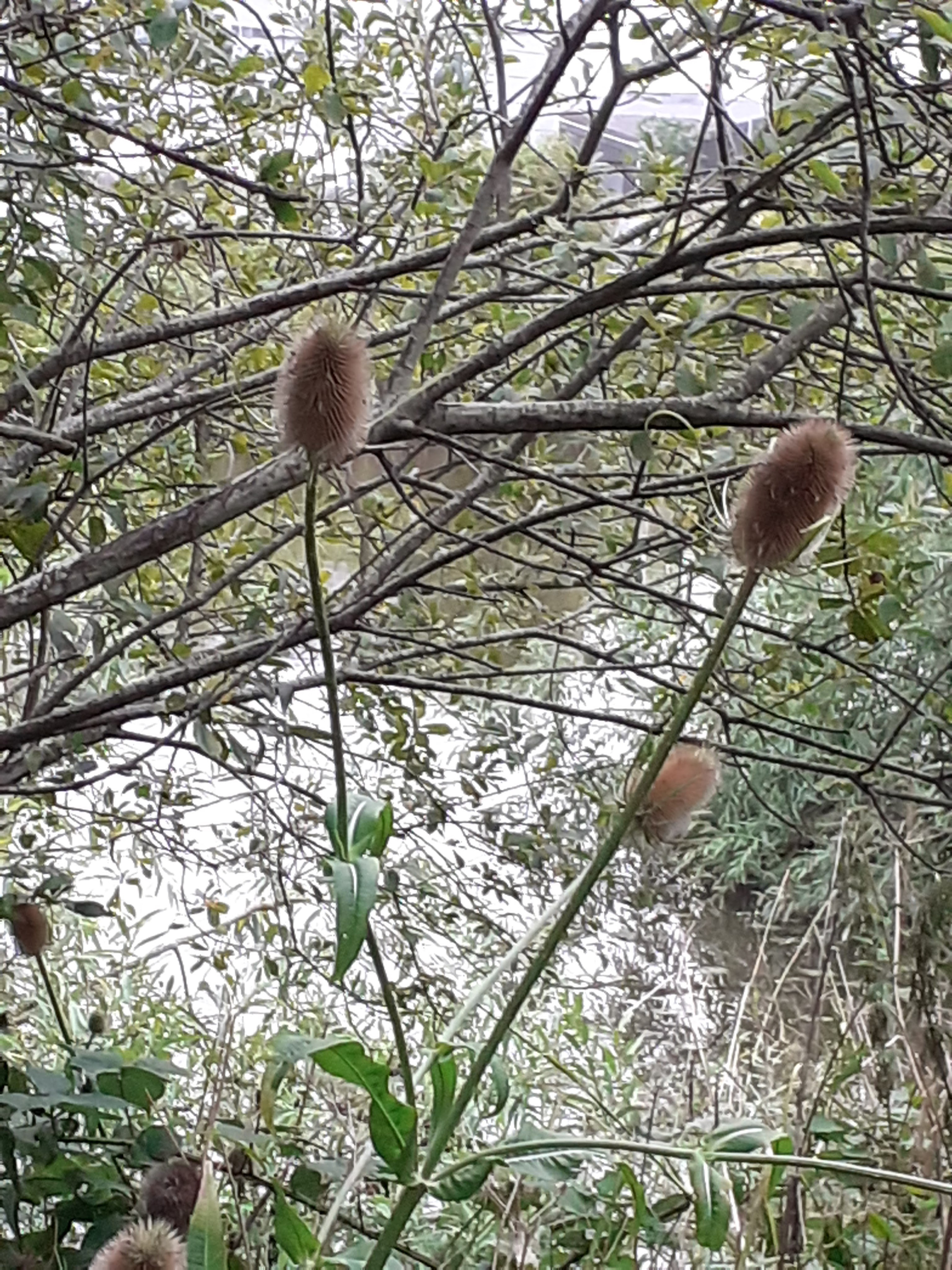
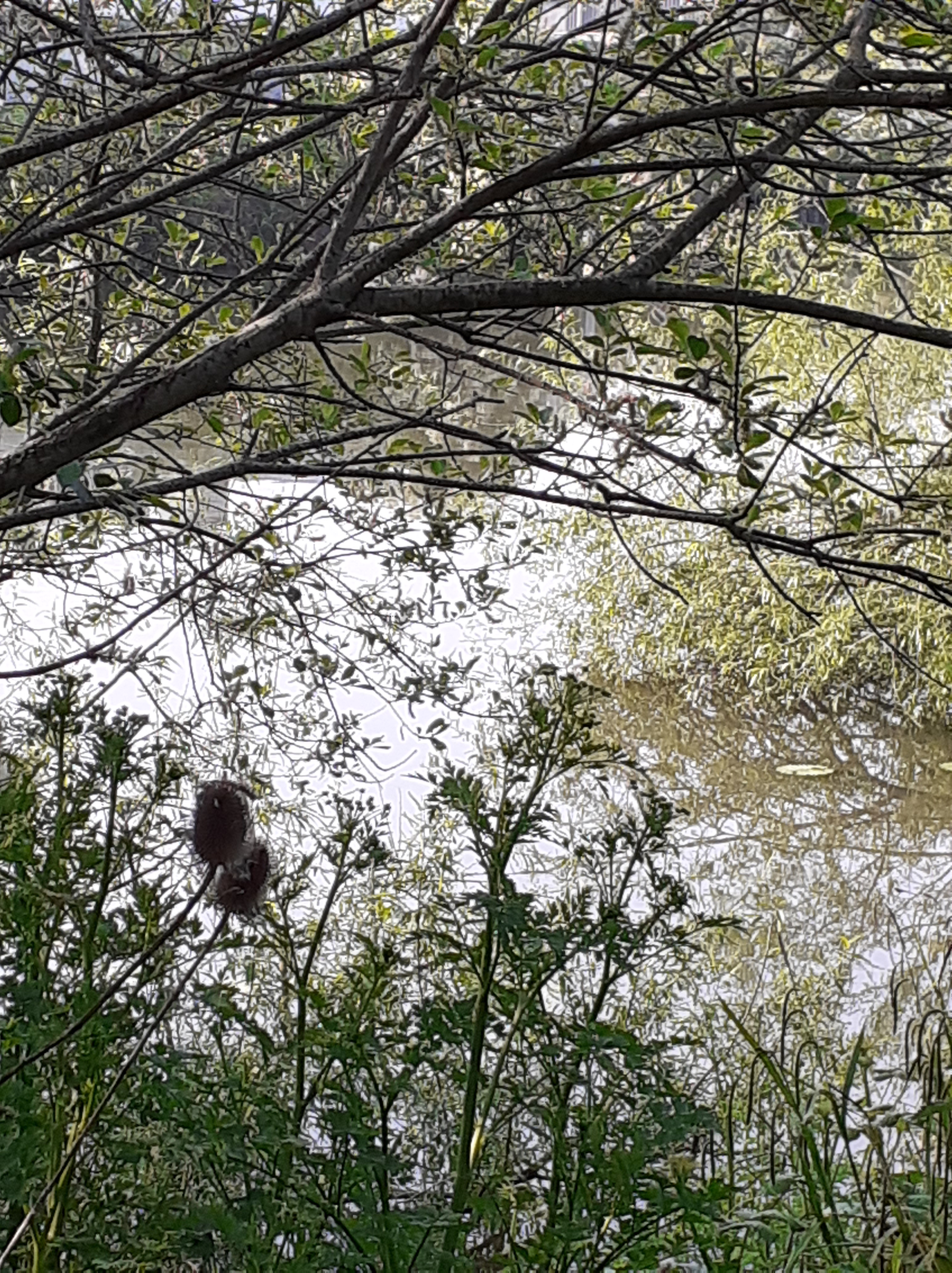
I photograph two teazel stalks, below, because I enjoy their shapes, because they are a further illustration of the browning theme, and also because of the visibility of the canal behind them. They don’t live in the canal, like bullrushes, but they like to be close. The image also includes an almost ghostly barge on the water below.

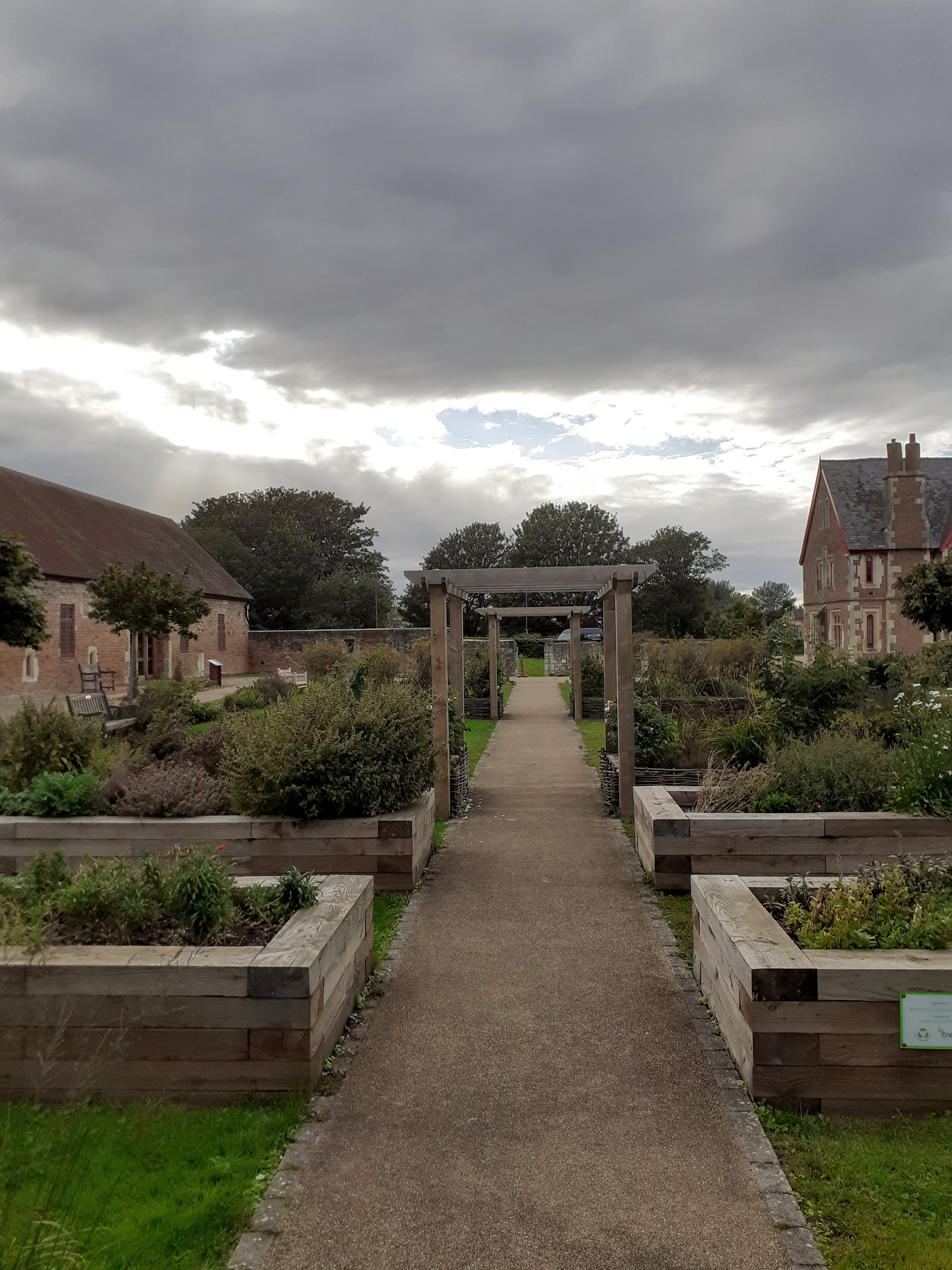
After leaving the woods, I am confronted (below) with the sky. I am facing west, across the Llanthony Priory gardens. I see dark stormy clouds, whose edgy brooding energy is somewhat modified by a blue opening in the distance. This dark grey, and the rain and storm it sometimes brings, have certainly been a feature of summer this year. There’s a strong contrast with last year at this time, when there was a heat wave, which for us still means C 30-35/F 86-95 with anything more being exceptional. In July 2022 part of the country briefly reached over C40/F 104 for the first time since records began. This year the grass is still green. Last year it burned up and the ground was parched and cracked.

Following the wheel of the year carefully, as it turns, is a valuable discipline for modern Druids, among others concerned with deep ecology (sacred ecology?) and the climate crisis. We don’t confine ourselves to celebrating our seasonal festivals, though we enjoy them too. For we now know experientially that the world is changing. The traditional rhythms of nature are not an eternal verity to rely on.

In some ways I find small personal observations emotionally more impactful than my limited knowledge of climate science and deep time geology. These are very helpful for context and framing, but personal experience is more immediate than these. It is also more deeply immediate, though less dramatic and disturbing, than reports of disaster elsewhere. Following the wheel of the year, we are doing more than making observations. We are celebrating and bearing witness to the life that surrounds us, offering our attention and energy to its continued flourishing. Blessings on the land.

*The Gloucester-Sharpness canal, England. Beyond the Gloucester docks, but not yet out of the city.

** A reader comments: “I think your mystery plant is ragwort, a much maligned ‘weed’ the destruction of which is encouraged by the UK government as it can be harmful to grazing animals yet is actually one of the best forage plants for pollinators”.

CELEBRATING THE MONTH OF MAY

The Irish name for May is Bealtaine. Linguistically at least, the May Day festival sets the scene for a calendar month. As I experience the wheel of the year in my own life, this feels right. May, the merry month, has always been special to me. Born towards the end of the month in 1949, I continue to feel newer and fresher in May, with a heightened sense of life. Changes happening around me, in the rest of nature, feed that sense. I’m part of something bigger.

The demarcation of time might be a product of human counting and naming, but it doesn’t feel arbitrary to me. Counting and naming have a powerful magic of their own. On 14 May 2023 I went on a morning walk, reaching a small wooded area at about 7.45 am. It was a time of dispersing mists and strengthening light. A time of warming up. I enjoyed it from the start, but there came a moment when my experience of the walk changed radically.

I see the wood. I stand at its edge. Hawthorn invites me in, decked in the green and white of the May season. I understand this as a moment for slowing down and shifting into a softer, more intuitive connection with the realm I am entering. I am moving into a kind of sacrament – a communion with nature in a unique time and place. I feel a joyful kind of reverence here, free of solemnity and unction. As I continue slowly on the path, sunlight, striking a slender tree trunk, illuminates my way.

Then comes a tanglewood immersion. Variations in wood. Variations in green. Variations in light – especially light. This place could be dark and dank. At times, no doubt, it appropriately is. But it is May now, and wonderfully backlit. There’s a yellowing of green that points to new light and growth rather than their decay. I have a strong sense of participating in a living world. My own vitality is boosted.

I am now drawn towards water. Again, some foliage is shaded. Other foliage is vividly lit up. On the water, the mist is still clearing. It is still fairly early in the day. It is at times like this that I feel most Druidic, very at home and blessed in this quiet connectedness.

A little later, I crouch at the water margin’s edge. Whereas the previous scene had a spacious serenity, this has intimations of activity, a small but crowded world of its own, with thriving plants and and a thriving sub aquatic realm beside them. Even in this small space, life is complex and abundant. The same holds, on a somewhat expanded scale, to this vulnerable scrap of woodland as a whole. I emerge from my sacrament refreshed and renewed, with the imprint of Bealtaine 2023 upon me.

ACCEPTING THE ARRIVAL OF WINTER

It was 26 November 2022, 11 a.m. I was at the Gloucester end of the Gloucester-Sharpness canal. I found myself accepting the arrival of winter. I was observing three cygnets, now without their parents but still keeping company with each other. The underlying temperature was around 7 C (44.6 F) and good for walking, But I was feeling the pinch of a cold wind. In memory I am feeling it now. The water and sky looked grey. The trees were starting to feel skeletal, whilst still retaining some leaves. My lingering sense of autumn had finally drained away.

To accept winter’s arrival in the presence of swans felt numinous. Swans are otherworldly birds in Celtic tradition. The three together, not yet in their full adult plumage, seemed auspicious. They suggested coming opportunities for creativity, love and celebration. Winter can be a preparation for renewal, both as season and as state of mind. My acceptance goes with a faith in winter’s regenerative darkness, and the riches this can bring.

MEETING THE SEASON

In these parts, there is a week at the end of April – St. George’s Day to Beltane Eve – that I would describe as mature spring. The rising year is leaning in to summer, but not quite there. I came close to missing it this year, at least as an outdoors event. I have made a good, if slightly fluctuating, recovery from the COPD flare-up described in recent posts. I met this moment, on this day, in the open air. At every level I feel better for the experience.

The location is Alney Island, now a nature reserve. The river Severn has divided into east and west channels, with Alney Island between them. Most of my pictures were taken near the (lesser) east channel, which flows into the Gloucester waterfront.

On 24 April 2022, I walked through this almost-city water margin. I was moved by its burgeoning growth, noticing the abundance of green in contrasting shades and forms. For awhile I had given up on going out during this delicious period. The experience, however fragile and transient both I and this space might be, was pure celebration. Taking pictures became an act of celebration, and also of giving thanks.

CELEBRATING THE MYSTERY

Yesterday my wife Elaine and I went to visit Gloucester Cathedral, where a beautifully crafted model of the moon has been hung in the body of the church. There were many visitors, most of them clearly drawn to this display and enlivened by it. For everyone there was something special about a scientifically accurate depiction of the moon in a medieval Christian building that continues to be an active space for worship. For some, the presence of the moon would also have suggested Pagan and archetypal references to provide a balancing influence in a splendidly patriarchal setting. It also allowed for a sense of only slightly subdued informality and fun, which I don’t generally associate with Church of England cathedrals. People felt free to enjoy themselves, and I give great credit to the organisers for their achievement.

The concept paid tribute to our age-old human search for meaning, and a sense of place within the cosmos. I was reminded of some reading I’d done only a couple of days before, and I’ve checked out the reference. For me, the image above and the words below show the same attractive spirit, one I find an inspiration for my contemplative inquiry.

“Both science and spirituality reflect our human urge to know – that perennial itch to make sense of the world and who we are. This quest is an essential part of being human. We probe reality as best we can with our tools of understanding – structures, models, theories, myths, beliefs, teachings – but those tools of understanding also define the limits of our knowledge. … There is no ultimate truth. No teacher, no scientist will give us all the answers. Let us simply bow to the intelligence of our hearts, drop into not knowing, keep our minds open, cherish the questions, and let the answers arise and evolve, all the while celebrating this mystery called life.”*

*Zia and Maurizio Benazzo On the Mystery of Being: Contemporary Insights on the Convergence of Science and Spirituality Oakland, CA: Reveal Press, 2019. (Reveal Press is an imprint of New Harbinger Press)

Earth Eclectic

music that celebrates Earth and speaks to the heart

Sarah Fuhro Star-Flower Alchemy

Follow the Moon's Cycle

Muddy Feet

Meeting nature on nature's terms

Rosher.Net

A little bit of Mark Rosher in South Gloucestershire, England

Becoming Part of the Land

A monastic polytheist's and animist’s journal

selkiewife

Selkie Writing…

Charlotte Rodgers

Images and words set against a backdrop of outsider art.

Prof Jem Bendell

living with metacrisis and collapse

Towint

The pagan path. The Old Ways In New Times

The Druids Garden

Spiritual journeys in tending the living earth, permaculture, and nature-inspired arts

The Blog of Baphomet

a magickal dialogue between nature and culture

This Simple Life

The gentle art of living with less

Musings of a Scottish Hearth Druid and Heathen

Thoughts about living, loving and worshiping as an autistic Hearth Druid and Heathen. One woman's journey.

Wheel of the Year Blog

An place to read and share stories about the celtic seasonal festivals

Walking the Druid Path

Just another WordPress.com site

anima monday

Exploring our connection to the wider world

Grounded Space Focusing

Become more grounded and spacious with yourself and others, through your own body’s wisdom

The Earthbound Report

Good lives on our one planet

Hopeless Vendetta

News for the residents of Hopeless, Maine