Contemplative Inquiry

This blog is about contemplative inquiry

Tag: Ceile De

THE WAY OF THE HEART

Sufism is often referred to as the Way of the Heart. Hazrat Inayat Khan was a Sufi teacher and musician from Gujarat, India, who took his teaching to the West in the early 20th century. His combination of spiritual teaching, philosophy and music was normal in this culture and tradition. In his own life and work, Hazrat Inayat Khan created a Universal Sufi movement independent of its Islamic origins, though always inspired by them. Practitioners from his movement created the Dances for Universal Peace.

The image above is the Ace of Cups from Ayeda Husain’s The Sufi Tarot (1). Ayeda Hussain is a teacher in the Ineyatiyya, a global organisation dedicated to Universal Sufism as taught by Hazrat Inayat Khan. She sees Sufism and Tarot as two systems of healing and transformation that can be valuably brought together. She treats Tarot as a vehicle for spiritual teaching, going so far as to include contemplations and affirmations for each card.

Referring to her Ace of Cups, she says: ‘In Sufi poetry, the cup is the heart that must be emptied before the beloved can pour the Divine nectar into it. Just as a cup that is filled cannot be poured into, neither can a heart filled with limiting impressions. The work of the mystic then, is to clear impressions that clutter and cloud the heart, so that it may be able to receive. As the heart opens, we become aware of new offers and opportunities in both love and spiritual growth’.

I came to The Sufi Tarot by an indirect route. When I began working with my Ceile De (2) beads, I didn’t at first expect to use them for mantra meditation and I looked at a collection of fuinn (sacred chants) as an option for working with the beads. Fuinn tend to be brief and I thought that a single fonn might work for me. They are in Scottish Gaelic and frequently use heart language, as in:

Gun tigeadh, solas nan solas

(Goon tee-guch, sol-us nan sol-us)

Air mo chridhe

(Air mo chree)

This translates into English as Come light of lights, to my heart.

I found this fonn beautiful though somehow not right for my purpose. But the phrase air mo chridhe would not leave me. As soon as I heard it, in the old language, it needed no translation, and I felt I had known it forever.

What I did in my own practice, having decided on the Soham mantra for the beads, was to create a version of the modern Druid peace prayer as a love prayer.

Deep within my innermost being, may I find love.

Silently in the stillness of this space, may I nurture love.

Heartfully, in the wider web of life, my I live in love.

Now using this prayer, I felt the desire for friendly guidance in this work of the heart. I felt prompted to search for ‘Sufi Tarot’, and was surprised when came up immediately. When I received the pack, I was quickly reassured that I had had been given what I asked for. I look forward to this new thread within my contemplative inquiry.

(1) Ayeda Husain The Sufi Tarot Carlsbad, CA; New York, NY; London; Sydney; New Delhi: Hay House, 2022. Art team Nazish Abbas, Hassaan Aftab, Momina Khan

(2) https://contemplativeinquiry.blog/2025/01/14

WORKING WITH BEADS

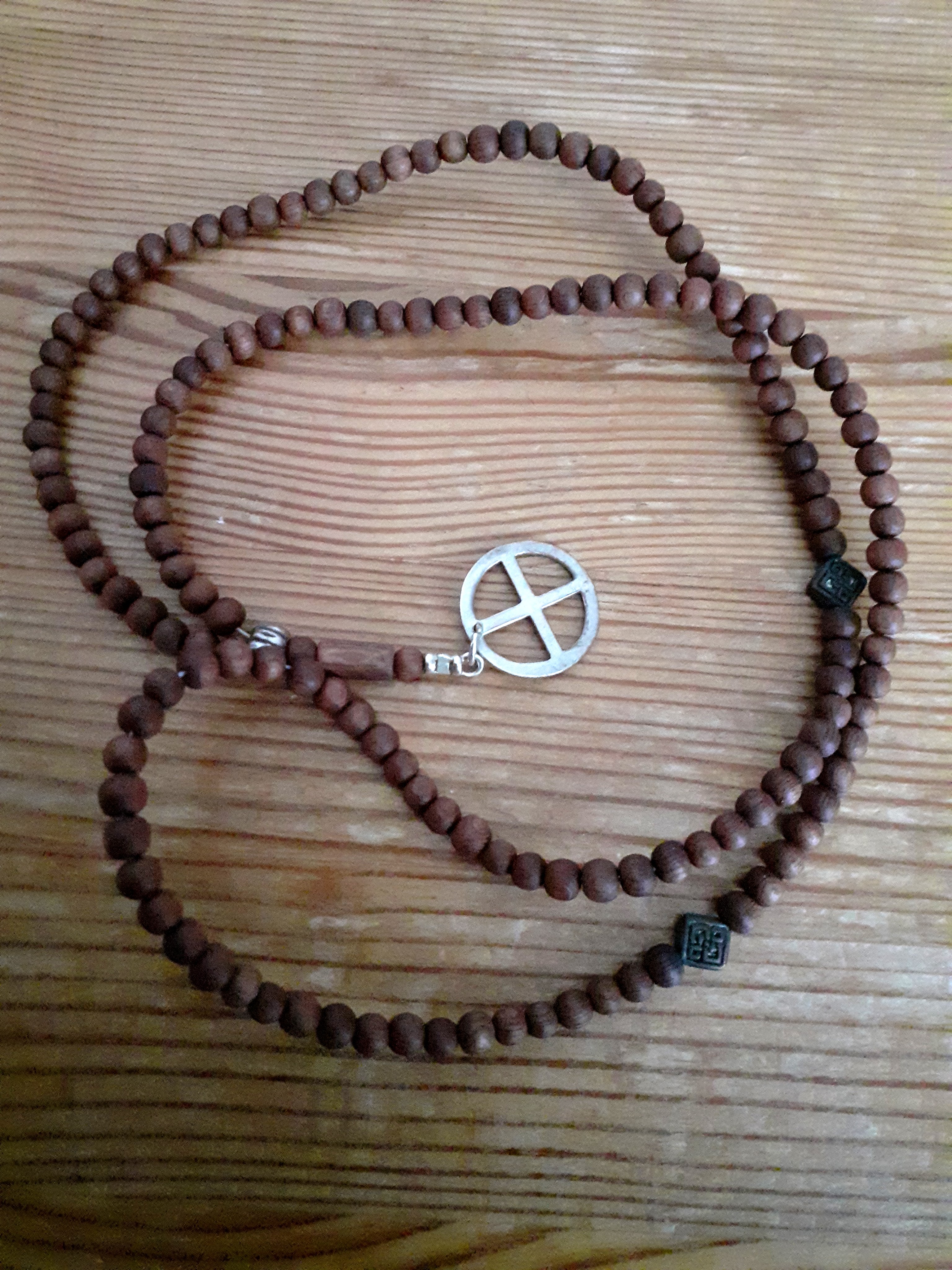
Recently I wrote about the balanced cross (1), linking it to the paidirean (pahj-urinn) prayer beads of the Ceile De (Culdees), a modern monastic order based in Scotland. This post is about the beads and my work with them. Beads like this were part of the original Ceile De tradition and are known to have been used in the days of Columcille (St. Columba).

There are 150 beads, each about 5 mm wide.  They are made of unstained rosewood and were left immersed in rose damask oil for a month.  As well as scenting the beads, the oil gives the beads a pinkish colour. A cross hangs from the beads – at heart level when worn as a necklace.

Each Paidirean is ceremonially strung in Scotland by a Ceile De Order member.  The process takes two hours and involves prayer, meditation and continuous chanting during the stringing.  Then a blessing is spoken over the completed Paidirean which is anointed with water and with oil from a local holy well, used for at least 1500 years. The Paidirean is an object of power as well as beauty. 

I am not a member of the Ceile De, and when I acquired the Paidirean they knew that I would work with the beads in my own way. I bring together meditation and prayer. I work with the Soham mantra, with Satish Kumar’s understanding (2) that it means ‘you are, therefore I AM’. Whilst I am mindful to my breath, to the mantra and to the movements of the beads, mindfulness is a means and not the purpose of the practice.

The purpose is to make an offering to Spirit – an offering from one lamp to the light, one wave to the ocean. After some hesitation and experiment, I have adopted the word Spirit, rather than Goddess or God, to address the Divine. It is more universal and inclusive as, for me, befits a panentheist view. In making my offering, I am aware that Soham also works laterally, including relations between all beings within the web of life, just as the Druid prayer speaks of  ‘the love of all existences’. Ultimately, we are recognising the divinity in each other.

Spirit is not beyond us in some other realm. It is here, now, and everywhere.  When I work with the beads, I am making both an offering and an affirmation.

(1) https://contemplativeinquiry.blog/2025/01/04/the-balanced-cross

(2) Satish Kumar You Are therefore I AM: A Declaration of Dependence Totnes: Green Books, 2002

THE BALANCED CROSS

Twelve years ago (1) I wrote about the paidirean (pahj-urinn) prayer beads of the Ceile De or Culdee movement (2). In its current iteration this is a modern monastic order based in Scotland with a lay following in other parts of the world. It looks back to the early Celtic church once influential in Ireland, Scotland and north-east England. The post referenced above (1) describes my relationship with the beads at the time.

Now, coming back to this beautiful artifact, I am principally focused on the cross – an equal armed and circled silver cross that hangs from the beads – at heart level when worn as a necklace. This form of cross is an ancient symbol, sacred to many people in many cultures, often understood as a sun wheel, and not specific to Celtic Christianity. It is sometimes called the balanced, or peaceful, cross.

For me, this cross is a more fundamental image than the awen symbol, which I can also wear as a pendant, appropriately sitting at the level of my throat. The silver cross maps a whole imaginal world: four directions or winds – east, south, west, north; four powers – light, life, love, law; four elements- air, fire, water, earth; four guardians – hawk, stag, salmon, bear; four qualities – vision, purpose, wisdom, faith; four times of day – sunrise, midday, sunset, midnight; four seasons – spring and early growth, summer and ripening, autumn and bearing fruit, winter, dying and regeneration. Having a liturgy to this effect, casting a circle and calling for peace as a regular practice, marinate me in a certain way of spiritual life. Wearing this cross confirms and declares it.

In my light energy work, the disc becomes a radiant sphere that holds me. For there is a vertical dimension. Horizontally I hold my hands out palms raised and the energy flows out from heart through outstretched arms and to my hands. Vertically it flows in both directions from my heart to my feet and the earth and also to my brow and above my head. But the source of this radiance is the energy behind the heart and the still emptiness behind the energy. This flow is an open system. Energy also comes back. My energy sphere is porous to the world. I like the illustration on the bag below because it shows an empty circle at the centre. This does not feature on the pendant itself, but to me empathises the divine power at the centre from which I am not separate. It is good to reconnect with an carrier of healing and insight which I appeared to have left behind. I am grateful that it was still here for me when I was ready to reconnect.

(1) See: https://contemplativeinquiry.blog/2012/12/30/

(2) See: https://www.ceilede.co.uk

ROSARY: PAIDIREAN (PAHJ-URINN) III

Revising the About section of this blog, I clarified the centrality of the Sophian Way to my spiritual life, whilst emphasising strong elements of continuity in this blog. The same applies to my practices as well.

The Paidirean of the title are the prayer beads of the Ceile De (1), known to have been used by Celtic Christians in the days of Columcille (St. Columba). I have had mine for four years and have written about them previously (2,3). I have not used them recently, but through a strong sense of prompting I picked them up again a week ago.

A devotional practice has rapidly shaped itself. This is an offering to Sophia as Cosmic Mother, an aspect that has only recently moved and engaged me in quite this way. ‘My’ state of awareness, well-being, peace or understanding are therefore not the point. The work is a prayer rather than meditation, though it does not involve asking for anything, whether for self, others or the world.

I work with the beads, saying Ama-Aima which in the Sophian Fellowship (Ecclesia Pistis Sophia) (4) means ‘Dark Mother-Light Mother’, here in the sense of the primal Mother both before and after birthing the material cosmos (5). She cannot be visible until there is someone, a child, to see Her. This practice is such a seeing, an act of recognition.

Ama-Aima involves two full, slow and conscious breaths: Aah (inbreath)-Mah (outbreath), Ae (inbreath)-Mah (outbreath). There are a hundred and fifty beads, and I will work through the whole rosary either once or three times. When doing it three times, I will break for a brief period of walking meditation after the second.

This is not a Sophian Fellowship practice, nor indeed a Ceile De one, though it would not offend the principles of either group. It constellated very quickly in my dedicated contemplative space at home. I could call it a mantra meditation, but I don’t – because for me this would mistakenly place more emphasis on syllables and technique than the intentions of the heart.

I am surprised that I have been so drawn to a practice like this. I am not a religious believer in any traditional sense and I could call my shift into a devotional mode an existential choice, almost a kind of lifestyle aesthetic. But the monkey mind alone would never have selected this option. The image that comes to me is of having fallen asleep in a beached rowing boat, then waking up at sea with the tide going out and yet trusting this new direction. From a Druid perspective, echoes of Taliesin – and yet differences as well.

(1) http://www.ceilede.co.uk/

(2) https://contemplativeinquiry.wordpress.com/2012/12/30/paidirean-pahj-urinn/

(3) https://contemplativeinquiry.wordpress.com/2013/01/04/paidirean-pahj-urinn-ii/

(4) http://www.sophian.org/

(5) Tau Malachi Gnosis of the Cosmic Christ: a Gnostic Christian Kabbalah Saint Paul, MN: Llewellyn Publications, 2005

ANAM CARA

This post is about the anam cara, or spiritual friend in Gaelic tradition, and about the use of language. Recently I wrote about allowing more space and using fewer words. This wasn’t a renunciate view of language, which I value highly. My hope was that “more space” would allow “something new to emerge”, and that my words, though fewer, would be better chosen.

I am starting to see some fruits from this strategy. I’ve also recently said that I experienced Sophia “as a psychopomp or inner guru”. Now I would say, “anam cara”. This term is known from the early days of Christian monasticism in Ireland and is in current use within the Scottish-based Celie De – see http://www.ceilede.co.uk/

It is a mentoring relationship, not a peer one, but it includes the sense of a real personal connection, not just a role. People speculate about whether it is an inheritance from indigenous Druidry. Subjectively, my relation with Sophia feels like this: much more than psychopomp or inner guru. In my understanding ‘anam cara’ is gentler, subtler and less formal.

The Sophia I experience is not a rhetorical device (personification) or a glove puppet arbitrarily selected by me. She is also not – in my sense of things – a mind independent celestial being. Rather she is the felt presence, the voice, and at times the image of a deeper nature – and my inner link with the Oran Mor (the song of what is). From a personality perspective, this deeper nature is ‘not me’ and not owned and controlled by ‘me’, so I have to work at relationship.

From the perspective of deeper nature, the separation doesn’t exist. At times Sophia can point beyond herself and then I may enter the subjectivity of deeper nature and experience the world differently. The little ‘I’ and the anam cara are as one, beyond separation and immersed in the song. But most of the time that’s not how it is in my subjective life world, and a link to that fuller reality is provided by Sophia and her nudgings and promptings.

I don’t make any fundamental distinction between nature and spirit. All, for me, is contained in the word nature (or terms like the Oran Mor).  Nothing is lost. Cosmos, relationship and practice remain the same. But the use of a nature language is truer to my experience.

SOPHIA, GNOSTICISM AND CONTEMPLATION

When I wrote Contemplative Druidry I said that “in many ways this is a story of neo-Pagan sensibility and its growth since World War Two”. In addition to their Druidry, many of the book’s contributors reported involvement in Witchcraft and/or the indigenous Shamanism of other lands.

I also said in many cases this sensibility was modified by other influences, “most notably Buddhist philosophy and meditation, Christian mysticism and other Western Way paths with Gnostic and Hermetic traditions specifically mentioned”. I made the point that such influences are significant for contemplative practice, because to an extent they provide models. In the book I mostly focused on Buddhist influences, because they were the most common. I also paid  attention to the Christian ones, notably the Ceile De, Anglican mysticism in the tradition of Evelyn Underhill, and the partly Franciscan inspiration behind the (Druid and Pagan) Order of the Sacred Nemeton. I didn’t say much about other Western Way traditions, though I mentioned R. J. Stewart as a personal influence on me and also my training at the London Transpersonal Centre. This was essentially Jungian and thus based on a modern Gnostic psychology.

The key images from my last post, Sailing to Byzantium, were images of Sophia and the Holy Fool from The Byzantine Tarot. They made an intense and (in common sense terms) disproportionate impact on me. For they reminded me of my own Gnosticism, a current that qualifies and modifies my Druidry. I am talking about modern Gnosticism, “based in an affirmation of nature and the world and a positive relationship to embodiment, not the classical Gnosticism of world-denial or pure transcendentalism.  It is a gnosis based on bringing the world fully to life, while also enjoying the state of embodiment and sensual pleasure, without excess or obsessive appetite”*.  Thus far, I could be talking about modern Druidry without any need to look elsewhere.

But, to follow Irwin further, Gnosticism also talks of “visionary awakening” through the power of archetypal imagery. From such a perspective, affirmation of the world also requires an affirmation of the World-Soul as “the primary ground of a living and animate nature”. This can inspire “states of unity and participation in the creative founding of human experience”. The key is the “animating vitality” of images, which can arouse “a cascade of energy and potential surpassing the image and leading into a more luminous condition of being and seeing”.

According to Irwin, the traditional fields for study and practice in Western Gnosticism are neo-Platonism, hermetics, alchemy, kabbalah, mystical theology, comparative theology and meditative disciplines: quite a curriculum. But the essence is quite simple. We are invited to work with Being as embodied (through exercise, body awareness and energy work), imaginal (connected to the mundus imaginalis, open to its power) and illuminated (through contemplative practice and insight).  Much of this is offered within Druidry – for example, to anyone who takes full advantage of the OBOD distance learning course. Yet for me, here and now, once again, it is the image and name of Sophia that gives me my orientation and guides me on my path. I’ll explain that resonance and consequences more fully in later posts. In practical terms, for now, I’ve made two small adjustments in my morning practice. One is to cast my circle specifically in the sacred grove of Sophia. The other is to begin sitting meditation, or contemplative communion, by saying “I open my heart to the Light of Sophia”. It doesn’t seem much, but it shifts my centre of gravity to a place where a feel more empowered and more at home.

  • Irwin, Lee Gnostic Tarot: Mandalas for Spiritual Transformation York Beach, ME, USA, 1998 (There is no pack of cards with this book. It’s a set of interpretations emphasising “spiritual transformation and illumined states of awareness”. The Universal Waite Deck and the Ravenswood Tarot Deck have been used as points of reference.)

WITHIN, BETWEEN, BEYOND

In a recent post I wrote of John Heron’s proposed ‘4th wave humanism’, a humanism open to the numinous and welcoming of Mystery. This naming allows Heron say that two out of three previous humanist waves in Western culture (Greek classical and Italian renaissance) have already been like that, with the current post Enlightenment wave a bit of a cultural oddity.

One of the things I like about the approach is the idea that we may find the extra dimension – the one we vaguely, almost helplessly, call ‘spiritual’ – in three places: within, between and beyond.  I’m relating this to practice, and how in my experience works for each domain.

I can speak of ‘within’ with the most confidence. I have a solo practice that works firstly as a therapeutic process: it supports and affirms personal wellbeing. It offers healing and deep peace. But these, although desirable as outcomes, and appreciated as rewards, are not the ultimate aims.  Such states enable a sense of awarely being and loving, in gratitude for the gift of human life and also feeling held within a larger context. This doesn’t happen without times of self-alienation and their call to shadow work. But the tendency of practice is in the direction of opening up and opening out.  The reflections that come from this are about integrity with self, others and the wider world, and how to live my active and relational life.

For the ‘between’ I can speak from the body of experience I’ve had, especially in the last couple of years, in groups working in contemplative Druidry. The groups are quite small and have a form of intimacy that comes from that. But the practices are not designed to create close personal relationships or an orchestrated group mind. We each have our own space in a setting where we also have a concern for each other and opportunities for personal sharing.  The connection is a ‘between’ one, neither frozen by distance nor drowned in euphoria. It owes something to each person’s within, and to the growth of personal connection, but it’s at least as much present in the group atmosphere, the subtle presence of a ‘more-than’. This aspect of the group work has become clearer to me than it was during the writing of Contemplative Druidry.

So it’s my view that ‘within’ and ‘between’ can be cultivated quite effectively – not without ups and downs, but effectively all the same. My sense of the ‘beyond’ is a little different. Beyond is beyond and needs to stay wild. It is true that the Ceile De fonn ‘Sireadh Thall’ (Seek Beyond) names the search, the voyage towards an ever-receding horizon, as in-built in us – for some, a sign of our awakening divinity. But we also need to avoid the colonisation of the numinous and any compulsive holding on to visionary experiences. They are gifts – inspiring, nurturing and transient. Brendan Myers, in his The Earth, the Gods and the Soul, includes a telling paragraph from A. E.’s The Candle of Vision.

“Such is human nature that I still felt vanity as if the vision was mine, and I acted like one who comes across the treasure house of a king and spends the treasure as if it were their own. We may indeed have a personal wisdom, but spiritual vision is not to speak of as ours any more than we can say at the rising of the sun, ‘this glory is mine’. By the subtle uprising of such vanities in the midst of vison I was often outcast, and found myself in an instant like those warriors of Irish legend, who had come upon a lordly house and feasted there and slept, and when they awoke they were on the brown hill-side.”

CONTEMPLATIVE INQUIRY, THE ORAN MOR, AND FARE-WELLING DEITY

I want to say three in things in this post. The first is to clarify what I mean by contemplative inquiry, the name of this blog, and outline the implications of calling it contemplative inquiry rather than contemplative Druidry. The second is to describe my recent contemplations on the Oran Mor, or Great Song, the metaphor which has become central in how I experience my world. The third is to explain my decisive shift to a non-theistic spirituality.

Contemplative inquiry, for me, is a living process and the heart of my spiritual identity. My Druidry itself is subject to the inquiry, and in consequence my contemplative life doesn’t work through marinating me in a received tradition and leading me into experiences that are declared to be the appropriate fruits of the practice. That’s why I’m glad to be in a young tradition, where the jelly still hasn’t set. I work with feelings, thoughts, insights and intuitions arising from my practice and reflection. I’ve abandoned the high language of ‘gnosis’ because it suggests pre-mapped attainments, privileged cosmic knowledge already somehow present and waiting to be discovered in the experience of the practitioner. That’s not what happens for me: everything is tentative and provisional and the aim, if it is an aim, is to sit within an expanded story of being, one that has integrity and can frame abundant life.

How does this apply to the Oran Mor, an auditory metaphor which takes in all my senses and synaesthetically extends them? I can enjoy the sound of a sunrise, the felt resonance of trees, and the lingering note of a caress.  All are encompassed in the Oran Mor. My experience of the Oran Mor confirms for me the felt sense of not being separate or alone. Behind the Oran Mor, and interweaving it, is a silence – not a cold silence, but a warm silence of fecund latency. The Oran Mor points beyond itself as a sensory experience to that underlying substrate of energy, that pulse and vibration of the cosmos, whose fruits include the privilege of our time-bound 3D being. I am the Oran Mor, currently a distinct though passing note within the greater pattern of the Song. So are you. Many forms of communion are available within the Oran Mor.

The invitation to us is to sing our own note within the Song. For all that we are interconnected and interdependent, the way in which we sing the note involves something distinct and individual, a personal existential choice: this at least is the human experience. It works best if we are awake to the rest the Song, as manifested in other notes, in the greater patterns, and the silence. This is why I’ve started to use the word ‘attunement’, despite its hackneyed New Age ring: it’s an accurate description of something I want to do.

As I’ve deepened into this sense of the Oran Mor and how it shapes me, there are certain words that are becoming more pertinent and powerful. In my morning practice I have for some years used the words known either as St. Patrick’s prayer or the cry of the deer:

‘I arise today through the strength of heaven, light of sun, radiance of moon, splendour of fire, speed of lightning, swiftness of wind, depth of sea, stability of earth and firmness of rock.’

I experience this as a summarising the Oran Mor – that which is – in a way that has a contemplative and prayerful aspect, makes good liturgy, and is not a petitionary prayer. I do not pray to the Oran Mor. I do not think of the Oran Mor as our Celtic ancestors did, as a name for God. I do not use it a translation of what is often meant by ‘Spirit’. The ‘I’ who arises is as much included in the Oran Mor as the sun, moon, fire, lightning, wind, sea, earth and rock. In the experience of the Oran Mor, there is no distinction between ‘Spirit’ and ‘Nature’. There’s a sense in which, despite their pragmatic value in everyday use, both terms become redundant.

I’m also continuing to work with the Ceile De fonn A Hu Thi (ah – hoo – hee), using simple breath and silent sounding, first described in an earlier post at https://contemplativeinquiry.wordpress.com/2015/3/6/. For me this continues to describe and enact the eternally-co-creative aspect of the Oran Mor. I find in my world that the A sets up a sense of latency, a subtle pulse and vibration on the brink of becoming. I feel it in the quality of my inbreath, as a kinaesthetic song. Hu the outbreath feels more vigorous and intentional; there’s a real sense of movement, expressed as exhalation – the breath moves out from my body, through my nostrils. Thi breathed in feels like the delighted expression of a new reality, the world born again in every moment.

The last effect of my continuing engagement with the Oran Mor concerns Brighde as Goddess and it is very recent. Essentially, the Goddess dissolves into the Oran Mor and I find myself fare-welling deity in my poetry of practice. The sense of the Goddess (under different names) as both cosmic birther and mentoring intermediary, which I have had throughout the whole period of my association with Druidry and Paganism, has died. This is not a matter of ultimate belief, where I have always had a form of non-dual view, but rather in a sense of a shift in archetypal poetics and psychology, of imaginal perception. It gives me a sense both of mourning and of release, of loss and of spaciousness.

I am aware of talking about language and imagery, about subjective experience. I do not presume to make statements about the cosmos or recommend ‘beliefs’ to others on the strength of my work or its evolution, or to use it either to question or to validate anyone else’s path. I’m in the throes of letting go a profoundly significant image and concept, one that has had a defining role in my spirituality, and I find it a very considerable attachment to let go of. I did not expect this. It will take a bit of getting used to, actually a lot of getting used to. It is a very significant change. Yet it is the fruit of honest inquiry – of meditative and contemplative practice, and reflection thereon. My trackless path, it seems, is wholly non-theistic.

FUINN II: THE POETRY OF PRACTICE

I’m a Pagan Druid, happily placed in a tradition that values poetry and seership over dogma and system building. I experience my practice as a sort of poetry. In this poetry of practice, I am held in a compelling myth of origin, an ever-now origin, and I have found a new way of working with it.

My new collection of Fuinn (Ceile De chants in Scottish Gaelic) includes a very simple one which goes A Hu Thi (ah – hoo – hee) repeated over and over again. The Ceile De interpretation, a Celtic Christian one, is that this chant “represents the three stages of the unfolding of creation … A– the Great Mystery draws in its breath … Hu – that breath is breathed out, and creation is born from out of the Mystery … God becomes matter … Thi – the Divine nature, beingness and intention acts within the field of intention … Some Ceile De would say that this final stage represents Christ Consciousness.”

It’s a bit different for me. I’ve been working with this Fonn daily for a couple of weeks now.  I don’t chant. I use slow deep breathing with a silent awareness of the sounds. I find that for me, the A sets up a sense of latency, a subtle pulse and vibration on the brink of becoming. I feel it in the quality of my inbreath, as a kinaesthetic song. Hu the outbreath feels more vigorous and intentional; there’s a real sense of movement, expressed as exhalation – the breath moves out from my body, through my nostrils. Thi breathed in feels like the delighted expression of a new reality, one that I share in, distinct yet inseparable as a sentient being. This generally brings up feelings exhileration, gratitude and joy. It leads me on to the use of another Fonn as a contemplative and devotional prayer, which I wrote myself using my collection of Fuinn as a model.

A Brighde, A Brighde, solus an domhain; A Brighde, A Brigdhe, Brighde mo chridhe

A Vree-jah, A Vree-jah, solus an dowan; A Vree-jah, A Vree-jah, Bree-jah mo cree

Brighde, Brighde, light of the world; Brighde, Brighde, Brighde my heart

Brighde is the breath, the practice and the Fuinn. When writing my Fonn I wanted to build a felt sense of Brighde as cosmic birther, initiator into being, with a seat in my heart.  Her name evokes power and the prayer invokes relationship – identified as She is with primal generativity and the deep powers of life and land, and also One who inspires skill and accomplishment in those She supports and fosters. Through my experience of relationship and connection, deep levels of feeling and intuition are satisfied, in some way met. I feel empowered, with a sense of having more resources available to me. Why would this be? I don’t really know. What I do know is the value of practice as poetry, and the magic it holds.

The Ceile De can be found on http://www.ceilede.co.uk

FUINN

Elaine and I returned from London yesterday afternoon, feeling pleased about our London venture. I’ll say more about that in a later post. Suffice it to say here that we found a ready interest in the possibilities of Contemplative Druidry and hope to return to London later in the year.

We discovered that the fourth CD of the Ceile De Fonn series had been delivered through the mail in our absence. Fonn is a Gaelic word that simultaneously means song, state of mind and the Land. The Fuinn (plural) are sacred chants which “work on many different levels, they harmonise the three parts of us that relate to the three meanings of the word itself – the spiritual, the otherworldly and the physical”. Indeed the Ceile De tradition “uses the imagery of three worlds that, when healthy, blend harmoniously: … the soulful, the spiritual and the physical and are represented here by the Sea, the Sky and the Land. When we are at one with the One we see that these three worlds are also One; our perception has changed and we have discovered ‘the Kingdom of Heaven'”.

The fourth CD was recorded earlier this month, around the time of Imbolc, and has a strong Brighid theme. I bought it in response to my own strong sense of a Brighid current in my own life and practice during the same period – one that goes well beyond the simple acknowledgement that Imbolc is widely seen as Her time. My spiritual note isn’t quite that of the Ceile De, which currently stands as a form of Celtic Christianity in which Brighid is honoured beyond the level of her customary sainthood. But many of the Fuinn, or words from them, presented here can fully support my own Pagan path through chanting, mantra meditation and contemplative prayer. I have worked with Fuinn before, and also have a paidirean (pronounced pahj-urinn) – a set of rosewood prayer beads with (in my case) an equal-armed gnostic cross bound by a circle. Now, with these new chants, I am coming back to them.

For me, experientially, Brighid is the Goddess of inner alchemy and ruthless compassion, and not quite the figure evoked by the Ceile De, though I can respond to Her gentler manifestations as well. But I feel a strong attraction to Gaelic, and Scottish Gaelic in particular, as a sacred language. I like chanting and listening to chants. I like being reminded that ‘contemplation’ in my own practice interweaves meditative, devotional and energetic elements. During recent weeks I have felt a closer connection to Brighid and I will opening myself more systematically to this connection in the coming period.

The Ceile De can be found on http://www.ceilede.co.uk

Earth Eclectic

music that celebrates Earth and speaks to the heart

Sarah Fuhro Star-Flower Alchemy

Follow the Moon's Cycle

Muddy Feet

Meeting nature on nature's terms

Rosher.Net

A little bit of Mark Rosher in South Gloucestershire, England

Becoming Part of the Land

A monastic polytheist's and animist’s journal

selkiewife

Selkie Writing…

Charlotte Rodgers

Images and words set against a backdrop of outsider art.

Prof Jem Bendell

living with metacrisis and collapse

Towint

The pagan path. The Old Ways In New Times

The Druids Garden

Spiritual journeys in tending the living earth, permaculture, and nature-inspired arts

The Blog of Baphomet

a magickal dialogue between nature and culture

This Simple Life

The gentle art of living with less

Musings of a Scottish Hearth Druid and Heathen

Thoughts about living, loving and worshiping as an autistic Hearth Druid and Heathen. One woman's journey.

Wheel of the Year Blog

An place to read and share stories about the celtic seasonal festivals

Walking the Druid Path

Just another WordPress.com site

anima monday

Exploring our connection to the wider world

Grounded Space Focusing

Become more grounded and spacious with yourself and others, through your own body’s wisdom

The Earthbound Report

Good lives on our one planet

Hopeless Vendetta

News for the residents of Hopeless, Maine