The year has moved on from its midwinter moment. I am just beginning to feel the pull of Imbolc (Candlemas in the Christian year). This feast marks the returning light and early signs of spring. I recently saw a local picture showing a newborn lamb.
In the Gaelic traditions Imbolc/Candlemas (1 February) is dedicated to Brigid/Bride. The lines below are from the Scottish Highlands and Islands. They seek protection and are not specifially seasonal.
“The genealogy of the holy maiden Bride
Radiant flame of gold, noble foster- mother of Christ.
Bride the daughter of Dugall the brown,
Son of Aodh, son of Art, son of Conn,
Son of Crearar, son of Cis, son of Carmac, son of Carruin.
Every day and every night
That I say the genealogy of Bride,
I shall not be killed, I shall not be harried,
I shall not be put in a cell, I shall not be wounded,
Neither shall Christ leave me in forgetfulness.
No fire, nor sun, nor moon shall burn me,
No lake, no water nor sea shall drown me,
No arrow of fay nor dart of fairy shall wound me,
And I under the protection of my Holy Mary,
And my gentle foster-mother is my beloved Bride.”
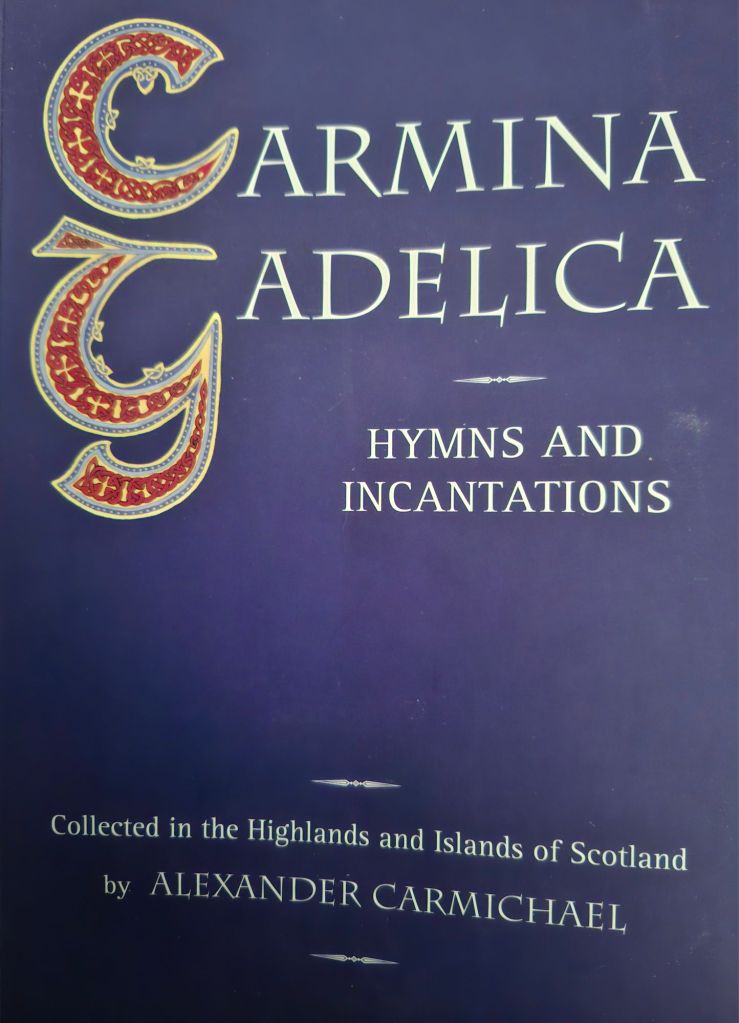
Carmina Gadelica: Hymns and Incantations collected by Alexander Carmichael. 1994 edition by Floris Books, Edinburgh, edited by C. J Moore.
The work is an anthology of poems and prayers from the Gaelic oral tradition in Scotland. They come from all over the Scottish Highlands and Islands. Alexander Carmichael compiled the collection in the second half of the nineteenth century, thereby creating a lasting record of a culture and way of life which has now largely disappeared.
8pm, 25 July. Alchemy on the canal. The evening sun, low and potent in the sky, strikes the flowing water. At points the union of the two creates a molten liquid light, clearly defined in the still image above.
By contrast, the short video below reveals light and water together in movement. Flow, and patterns in the flow, draw my attention. They show me an energised harmony, becoming more than the sum of their parts.
I notice also that when I play the video without sound, I find it contemplative and reflective. When I play it with sound, the birds immerse me in living nature. I value both experiences.
I usually feel a transition into late summer about now, a little before Lammas/Lughnasadh. The days here are still long, though now clearly not as long as they have been. It’s a warm time, often the warmest of the year. Blackberries have appeared on their bushes, a foretaste of autumnal fruit bearing.
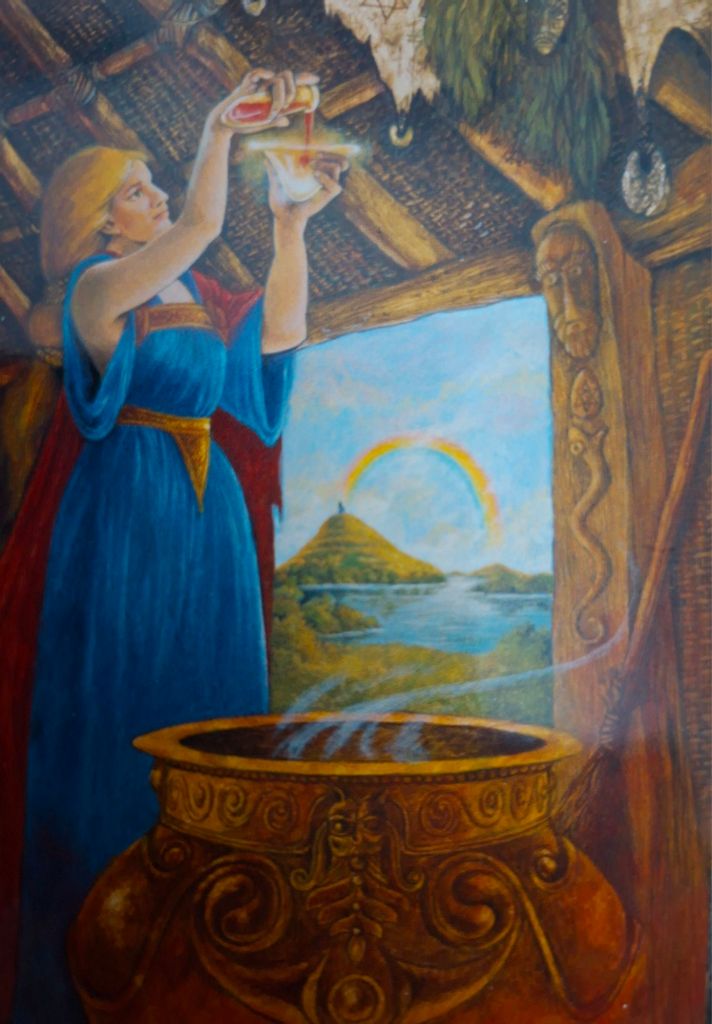
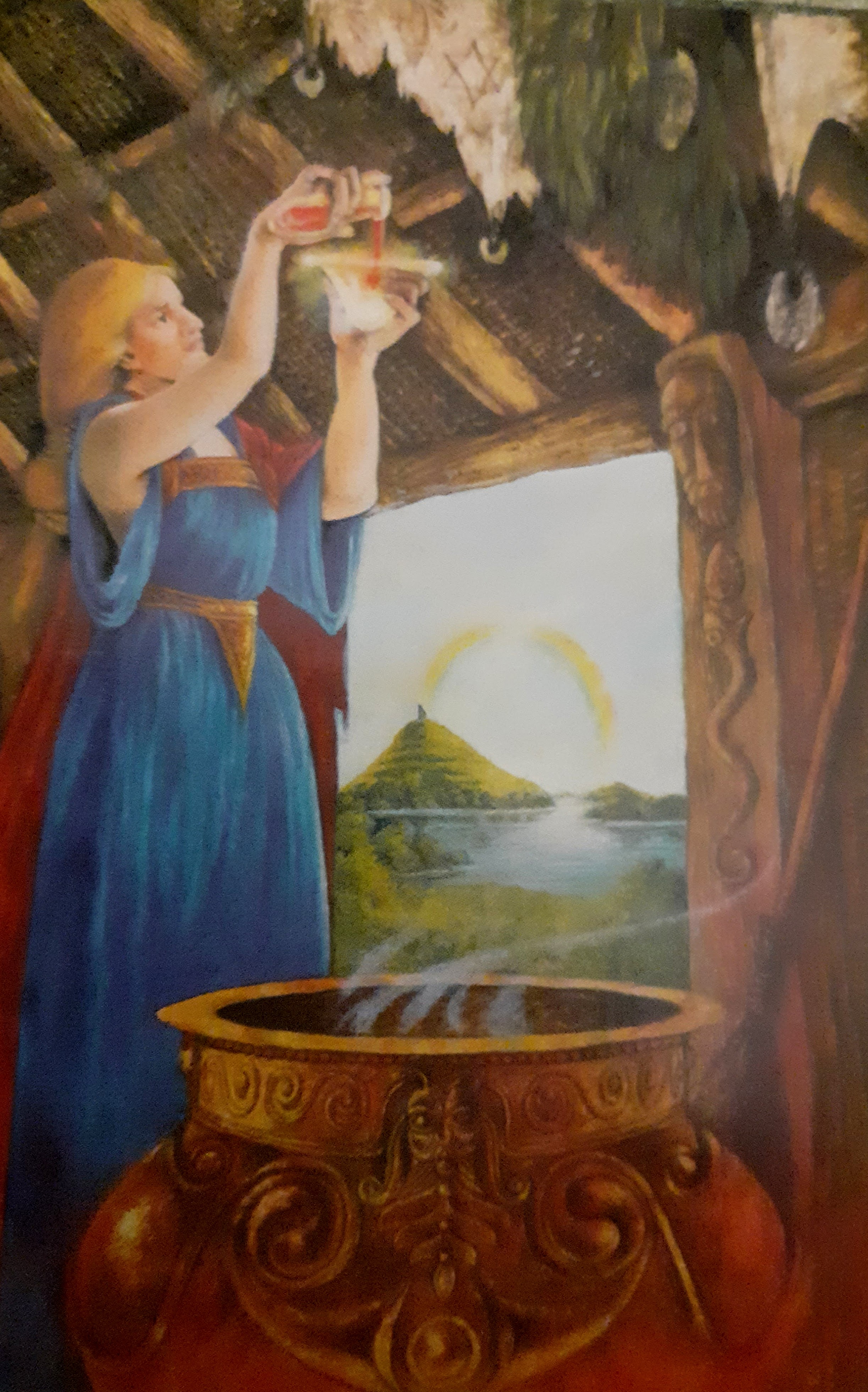
I am reminded, too, of the Fferyllt, the Druid alchemist in OBOD tradition. She is a woman of power and a devotee of Brigid. In the Druidcraft Tarot (1) she is represented by Trump XIV, standing for fluency between worlds, creativity, harmony, peace, alchemy and magic. My canal side encounter with fire on water nudged my imagination towards this figure, who somehow completed it.
(1) Philip and Stephanie Carr-Gomm The DruidCraft Tarot: Use the Magic of Wicca and Druidry to Guide Your Life London: Connections, 2004. Illustrated by Will Worthington.
Imbolc/Candlemas is celebrated on either 1 or 2 February as part of the Celtic wheel of the year. It signals the loosening of winter’s grip. Brighid, Goddess of poets, smith-work and healing is its patron. Damh the Bard is a prominent member of OBOD (1), best known for his music. A singer song writer revisioning ancient Bardic tradition for modern times, he has been an inspirational and much loved force in modern Druidry and Paganism. His lyrics for this song are below as presented on YouTube.
There’s a tree by the well in the wood,
That’s covered in garlands,
Clooties and ribbons that drift,
In the cool morning air.
That’s where I met an old woman,
Who came from a far land.
Holding a flame o’er the well,
And chanting a prayer.
(Chorus) Goddess of fire, Goddess of healing,
Goddess of Spring, welcome again.
The told me she’d been a prisoner,
Trapped in a mountain,
Taken by the Queen of Winter,
At Summer’s end,
But in her prison, she heard the spell,
The people were chanting,
Three days of Summer,
And snowdrops are flowering again.
She spoke of the Cell of the Oak,
Where a fire is still burning,
Nineteen priestesses tend the Eternal Flame
Oh but of you, my Lady,
We are still learning,
Brighid, Brigantia,
The Goddess of many names.
Then I saw her reflection in the mirrored well,
And I looked deep in her face,
The old woman gone, a maiden now knelt in her place,
And from my pocket I pulled a ribbon,
And in honour of her maidenhood,
I tied it there to the tree by the well in the wood.
Highly recommended for anyone interested in Brighid, Celtic spirituality and the evolving culture of modern Paganism. In The Torch of Brighid, Erin Aurelia eloquently describes her flame tending path as a devotee of the Goddess Brighid. For her, this is a path of celebration, contemplation, creativity and deep personal change. Her book shares the fruits of a remarkable journey.
The author makes clear that she is not reconstructing a past Pagan practice. No such practice is known. She references a Christian history dating from 480 CE, where nuns maintained a sacred flame at Kildare in Ireland. This was documented as still in place in the later 12th century CE by Gerald of Wales in his History and Topography of Ireland. It was repressed by the English King Henry VIII – who also ruled Ireland – as part of his violent religious revolution of the 1530s and 40s. On 1 February 1993, flame tending was revived both by Catholic Brigantine sisters in Kildare by the neo-Pagan Daughters of the Flame in Vancouver, BC. Both groups were influenced by Gerald of Wales’ description.
Erin Aurelia has been a flame tender for 20 years. She began in the Daughters of the Flame and then founded her own Order, the Nigheanan Brigde Flametending Order, going on to lead it for eight years. The original model involved moving through cycles of twenty days, in which nineteen flame tenders take a day each to tend the flame, leaving the Goddess to take care of the twentieth. Erin found that she wanted an intensified practice and a closer fellowship with other Brighid devotees. During those years, she writes: “Brighid inspired me to develop guided meditations to use during vigils, seasonal feasts, and lunar phases”. Later came “the template for a whole new way to practice flame tending: the way that the flame tending cycle matches with the twenty letters of the traditional Irish tree ogham alphabet, in which each alphabet letter is denoted by a tree and infused with esoteric meaning”. She describes herself as “enthralled and excited” by this discovery, which lead on to daily communing with Brighid and a fuller development of her work.
She found the process transformative, and learned that “growth is not only made through obtaining wisdom, but by implementing it. And Brighid showed me that I can effectively implement it by embodying her own skills as Shaper, Healer, Seer, and Transformer. Through embodying her skills, I became empowered”. In the narrative of her own journey, Erin shows her willingness to innovate, take initiatives, lead when called to do so, and also step back from leadership. Her relationship with ancient culture is to be inspired by it without being bound by it. I see her as modelling the best of modern Pagan practice in these respects.
Erin provides extensive information on her flame tending vigils, and how to set them up. She shares prayers, meditations and path workings. She includes her unique approach to ogham work, and also her own way of working energetically with the traditional ‘three cauldrons’ (of warming, vocation and knowledge). She shares her ways of working through the four Irish fire festivals from Imbolc (1 Feb.) to Bealtaine (1 May} to Lughnasadh (1 Aug.) to Samhain (1 Nov.). She has an Imbolc advent practice centred around the four Sundays prior to Imbolc – because it starts the year in this tradition and is specifically dedicated to Brighid. Her book is a powerful addition to the growing literature about Brighid as a much loved Goddess.
I shall not be put in a cell, I shall not be wounded …
No fire, no sun, no moon shall burn me,
No lake, no water, no sea shall drown me.” (1)
Brigid has a long history, stretching back in Gaelic traditions to at least the pagan Celtic iron age. The words above come from the Western Highlands of Scotland, in this form probably dating to the traumatising early modern period. Caitlin Matthews suggests that, even though the the words are addressed to ‘St. Bride’ rather than the Goddess of poets, they still have the talismanic power to preserve life.
More recently, Brigid has been successfully revived as a Pagan Goddess, where, according to an affirming Imbolc self-dedication story by Morgan Daimler (2) she has lost none of her capacity to protect her devotees.
“When I decided that it was essential for me a self-dedication to the pagan path, just like all my books talked about, I chose Imbolc to do it on. At that point the holiday to me was on the 2nd, the same day as America celebrated Groundhog Day, and was about cleansing and blessing of the self, so it seemed ideal for a self-dedication. I got everything together and when the night of the ritual arrived I was excited to take such a life changing step. At 13, coming from a non-religious background, doing something like this was momentous and I felt like I was ready to commit myself to the spirituality I had been studying.
“I went out alone into the bitter cold, without a winter coat on, and tried to do the ritual the way I had learned how to, but it was hard to focus. February in Connecticut is frigid and the darkness on that particular night was total, without any moon to light my way. It was Brigid’s holiday, so I automatically started calling on her, asking for her help, for the strength to do what I planned to do. At the same time it was almost a reflex to call on a Goddess I associated with warmth a light under those circumstances. It was important to me to make a declaration of my religious path, the books I’d read at that point had emphasized the need to be outdoors, and I was too stubborn to let the cold weather stop me. So I prayed to Brigid.
“It’s funny the way, as children, we simply take experiences in our stride, without considering them at all out of the ordinary. I don’t remember ever feeling Brigid’s presence or having a sense of the numinous, but I prayed and then I was warm. The cold simply ceased to be something I noticed, as if everything around me had become an indoor room temperature. I took the usual half hour or so kneeling on the cold ground to do my ritual, dedicating myself to the Irish Gods and to pagan spirituality. And then I got up, collected my supplies and went back inside, feeling euphoric.
“At the time it never even registered that what I did was dangerous or that I was risking frostbite and hypothermia. And I never stopped and thought that it should seem at all remarkable to pray to Brigid for warmth and then be warm. It all seemed entirely natural and normal.
“We speak, and the Gods really do listen. Sometimes they even answer.” (2)
(1) Alexander Carmichael Carmina Gadelica Edinburgh: Scottish Academic Press, 1972 (Cited in Caitlin Matthews The Element of the Celtic Tradition Shaftesbury: Element Books, 1989)
(2) Morgan Daimler Pagan Portals – Brigid: Meeting the Celtic Goddess of Poetry, Forge, and Healing Well Winchester UK & Washington USA: Moon Books, 2016. Daimler identifies as a reconstructionist polytheist pagan working in the Irish tradition.
“In the foreground we see Brighid. She is both Brighid Goddess of the Holy Flame and Holy Well, and a woman in her service, a Fferyllt, or Druid Alchemist, who combines the powers of fire and water to create harmony, balance and transformation.
“In the traditions of the nineteenth and twentieth century Druid revival, the Fferyllt were Druid alchemists who were said to live in the magical city of Dinas Affaraon, in the mountains of Snowdonia. Much of the work of DruidCraft can be seen as an alchemical process of uniting and combining different elements of the self to achieve wholeness, illumination and a release of our creative potential.” (1)
The words and illustration above are from The Druidcraft Tarot, where the writers are Philip and Stephanie Carr-Gomm and the illustrator Will Worthington. The card in question is the trump numbered fourteen, conventionally named Temperance. Here, after the manner of C. G. Jung, it points to the work of psycho-spiritual development. Affirming the fundamental unity of spirit and matter, it encourages us to extend the bandwidth of our experience beyond that provided by our early conditioning in modern mainstream culture. This work is placed in the context of modern Druidry and modern Druid training – specifically that offered by OBOD (see http://www.druidry.org/}.
Philip Carr-Gomm discusses this further elsewhere: “Alchemical Magic involves working on yourself. It is called alchemical because in alchemy the idea is to change ‘base metal’ into gold, the ordinary into the extraordinary. Our goal is to do this with our own lives, our own selves. That is much of the purpose of following a path such as Druidcraft. … The idea in alchemy is that you start with the ‘base metal’ that is equivalent to all the raw material that you possess as a personality and a soul. Then, by following a spiritual path, you gradually transform this into a quality of being which literally radiates. That is why people who are on this path often have a quality of youthfulness and life which is almost tangible.” (2)
To this day, I have a section in my regular practice liturgy in which I say: “a blessing on my life; a blessing on the work; a blessing on the land”. My use of ‘work’ is an alchemical reference, invoking the classical alchemical opus as a transformative metaphor. I experience this as among other things a healing work, in a healing container, though it might not always feel that way. We can take the legacy of painful, problematic and confusing experiences and find the hidden gold within them.
There can be another discovery too. Jungian-influenced therapist Matt Licata writes: “through this exploration, we come to discover that although suffering feels and is personal, it is also archetypal and, as the Buddha noted, universal in human experience. The invitation is to allow our broken hearts, confused minds and vulnerable emotional bodies to serve as a bridge to a place where we make embodied, loving contact with the ‘others’ in our lives – not only the external others but the inner others who have become lost along the way.”
(1) Philip and Stephanie Carr-Gomm The DruidCraft Tarot: Use the Magic of Wicca and Druidry to Guide Your Life London: Connections, 2004. Illustrated by Will Worthington.
(2) Philip Carr-Gomm The Magic of Wicca and Druidry Lewes, UK: Oak Tree Press, 2013
(3) Matt Licata A Healing Space: Befriending Ourselves in Difficult Times Boulder, CO: Sounds True, 2020
Erin nighean Brighde* has recently written about ‘Imbolc Advent’. I like this term. Where I live, mid-January could feel cold and dull and flat. It could be a time of post-festive blues, and a very long way from spring. My cure, from the early 1990’s, has been the eight-fold wheel of the year, now lived by many groups within and beyond the modern Pagan community. It has enriched me enormously.
For the last week or so I have been leaning in to Imbolc, the festival that, at the beginning of February (Northern hemisphere), celebrates the return of the light, the appearance of early flowers and traditionally also the birth of lambs. In Druidry, it is strongly linked to the Goddess Brigid. My leaning in to Imbolc this year has been interwoven with the transformation of three initially parched hyacinth bulbs (a late seasonal gift) in a pot of dry earth. The change began when I saw them draw water from a saucer. Its rapid disappearance was like watching a speeded-up film. Within a couple of days, stalks had burst almost alarmingly out of the bulbs, and it was not long before the scented bell-like lavender blue flowers emerged from the spikes. I realize that this was a contrived indoor event, but I have experienced it over the last week as a stunning display of life and growth, and hence an image of Imbolc Advent.
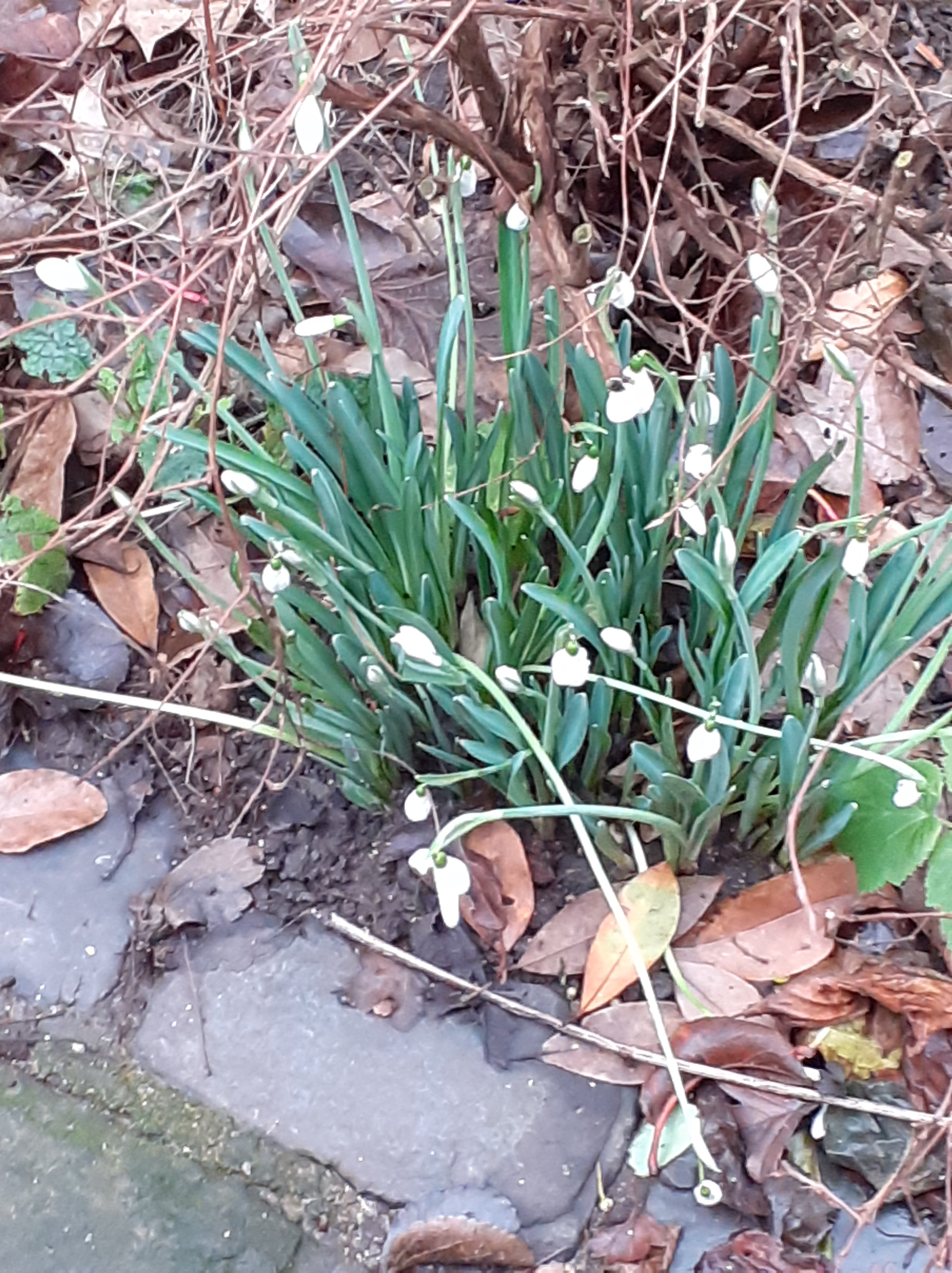
During the life-time of the Druid contemplative group, we tended to meet outside the festival times, partly to avoid clashes with other commitments, and partly to practice tuning into the year at other times. We could do this by taking the previous or following festival as a reference point and notice the mid-term difference, or we could more simply pay attention to the world we were in at the time of meeting. Over time, we developed a greater sensitivity to the rhythms and tides in the year as nature’s unfolding processes, since we were not focusing on the festivals themselves as events. Nonetheless, they remained important markers for our experience. They helped to provide us with a common language and orientation. That being said, I remember something special around Imbolc, out of all the eight festivals. The fire in the hearth, the arrangement and decoration of the space (snowdrops in particular) gave us a powerful experience of Brigid as a presiding energy, making Imbolc one of our most resonant times.
Timely and highly recommended. Brigid: Meeting the Celtic Goddess of Poetry, Forge and Healing Well is shortly due for release in Moon Books’ Pagan Portals series. Author Morgan Daimler describes it as “a resource for seekers of the pagan goddess specifically”, offering “both solid academic material and anecdotes of connecting with Brigid in a format that is accessible and designed to be easy to read”. On my reading, this is an accurate description, and in my estimation Brigid takes its place as a valuable addition to modern pagan literature.
As Daimler points out, the Celtic Goddess Brigid is well known and popular. In the Gaelic-influenced world, she has an alter ego as a powerful Christian saint. Yet what we know, or think we know, is selective and potentially confusing for today’s pagan seeker. “The lore of the Catholic saint is attributed to the pagan Goddess, and some people see shadows of the Goddess in the saint. For many people new to Brigid, or to studying Celtic or Irish mythology, it can be extremely confusing to try to sort out the old beliefs from the modern, to tell the Irish from the Scottish. The end result is that some people who are drawn to honor the Goddess Brigid find themselves lost in a seemingly endless assortment of possibilities”. Yet, in an intentionally short and simple book, Daimler does a great deal to sort out potential points of confusion and help her readers to find their way. She also includes an important chapter on Brigid by Other Names – which include the Brythonic Brigantia, the Gaulish Brigandu and the name Ffraid in Welsh.
Brigid devotes considerable attention to mythology, and to traditional lore and festivals (including a reference to the American groundhog day). But, as a modern Polytheist Pagan, she also has a lot to say about Brigid as she is today, including modern versions of practices like the making of offerings, flame-tending, the creation of altars, divination, meditation and prayer. There is a complete chapter on Prayers, Chants and Charms. Above all, Daimler shares something of her own journey, and the numinous experiences she has had through her Brigid connection from the beginning of adolescence to a present in which she is devising Imbolc rituals with her children. Standing as she does in Irish Reconstructionist Polytheism, she says that “I do not think that the religious framework we use to connect to the Gods matters as much as the effort to honor the old Gods itself. I think that we can all do this respectfully and with an appreciation of history without the need for any particular religion”. Brigid: Meeting the Celtic Goddess of Poetry, Forge and Healing Well amply fulfills its author’s aim of helping its readers to benefit from time spent “getting to know Brigid”.
Truly inspiring! I am greatly moved by Joanna’s eloquent and powerful piece. It’s great when someone else in in the current of a similar yet distinct inspiration.
This is a reblog from my latest blog post at Moon Books. I hope you enjoy it, and do let me know if you’ve had similar experiences. 🙂
I had meditated and tranced for nearly an hour before my altar, to the sounds of the birds outside and Heloise Pilkington on my cd player. http://www.heloisepilkington.com/index.htm My cats joined me, sleeping in their respective spots, their purrs vibrating along my spine. As the incense burned out, I came back to myself, having danced with my goddess, diving in her mysteries and those of my own soul.
I was ready now. Time to go out, to seek her, to seek the awen. I packed a small bag with more incense and some water and made my way out of the house and onto the heath. Taking my time, walking slowly, I feel more graceful after my time spent at my altar…
I’m a Pagan Druid, happily placed in a tradition that values poetry and seership over dogma and system building. I experience my practice as a sort of poetry. In this poetry of practice, I am held in a compelling myth of origin, an ever-now origin, and I have found a new way of working with it.
My new collection of Fuinn (Ceile De chants in Scottish Gaelic) includes a very simple one which goes A Hu Thi (ah – hoo – hee) repeated over and over again. The Ceile De interpretation, a Celtic Christian one, is that this chant “represents the three stages of the unfolding of creation … A– the Great Mystery draws in its breath … Hu – that breath is breathed out, and creation is born from out of the Mystery … God becomes matter … Thi – the Divine nature, beingness and intention acts within the field of intention … Some Ceile De would say that this final stage represents Christ Consciousness.”
It’s a bit different for me. I’ve been working with this Fonn daily for a couple of weeks now. I don’t chant. I use slow deep breathing with a silent awareness of the sounds. I find that for me, the A sets up a sense of latency, a subtle pulse and vibration on the brink of becoming. I feel it in the quality of my inbreath, as a kinaesthetic song. Hu the outbreath feels more vigorous and intentional; there’s a real sense of movement, expressed as exhalation – the breath moves out from my body, through my nostrils. Thi breathed in feels like the delighted expression of a new reality, one that I share in, distinct yet inseparable as a sentient being. This generally brings up feelings exhileration, gratitude and joy. It leads me on to the use of another Fonn as a contemplative and devotional prayer, which I wrote myself using my collection of Fuinn as a model.
A Brighde, A Brighde, solus an domhain; A Brighde, A Brigdhe, Brighde mo chridhe
A Vree-jah, A Vree-jah, solus an dowan; A Vree-jah, A Vree-jah, Bree-jah mo cree
Brighde, Brighde, light of the world; Brighde, Brighde, Brighde my heart
Brighde is the breath, the practice and the Fuinn. When writing my Fonn I wanted to build a felt sense of Brighde as cosmic birther, initiator into being, with a seat in my heart. Her name evokes power and the prayer invokes relationship – identified as She is with primal generativity and the deep powers of life and land, and also One who inspires skill and accomplishment in those She supports and fosters. Through my experience of relationship and connection, deep levels of feeling and intuition are satisfied, in some way met. I feel empowered, with a sense of having more resources available to me. Why would this be? I don’t really know. What I do know is the value of practice as poetry, and the magic it holds.





 Contemplative Inquiry