Contemplative Inquiry

This blog is about contemplative inquiry

Tag: Being

‘BEING’

‘Being’ can be thought of in a number of ways. One is to say that it simply is what it is. I am. The flowers are.  No need for complications. I sympathise with this approach.

Yet when nudged to look at a 2021 post of my own (1), I found the following words based on the work of Eckhart Tolle (2). “Human is form. Being is formless. Human and Being are not separate but interwoven.” A part of my work in contemplative inquiry is to find a balance between human and Being.

For me, ‘Being’ is a way to talk about the divine, whilst keeping a distance from theistic language and its traditional associations. Some people use ‘ground of being’ in this sense. Experientially, silence, stillness, emptiness – the space between thoughts, feeling and things – open me up to Being. Feelings of joy and lovingkindness are likely to enter in. I find that deepening into Being enriches the human dimension itself – with all of its relationships, roles and activities in 3D time bound reality. In older language, it brings heaven to earth.

I like this use of language for its plainness and simplicity. Ultimately its assumptions are a matter of faith within a larger framework of unknowing. It simply describes where I stand within my continuing inquiry. I have also enjoyed being reminded of this use of words by my past self. It’s a personal benefit of having this record.

(1) https://contemplativeinquiry.blog/2021/03/03/spring-clarity/

(2) Eckhart Tolle Oneness with All Life: Awaken to a Life of Purpose and Presence Penguin Random House UK, 2018 (1st. ed. 2008)

‘MYSTERY’ IN A MORE THAN HUMAN WORLD

“Half-way between the certainty of science on one hand, and the supernatural on the other, is mystery …. Mystery is central to enchanted experience because enchantment is not a rational process of recognition, categorization, knowledge, facts or rationalizations. It is, instead, a pure experience of sensing and being.” (1)

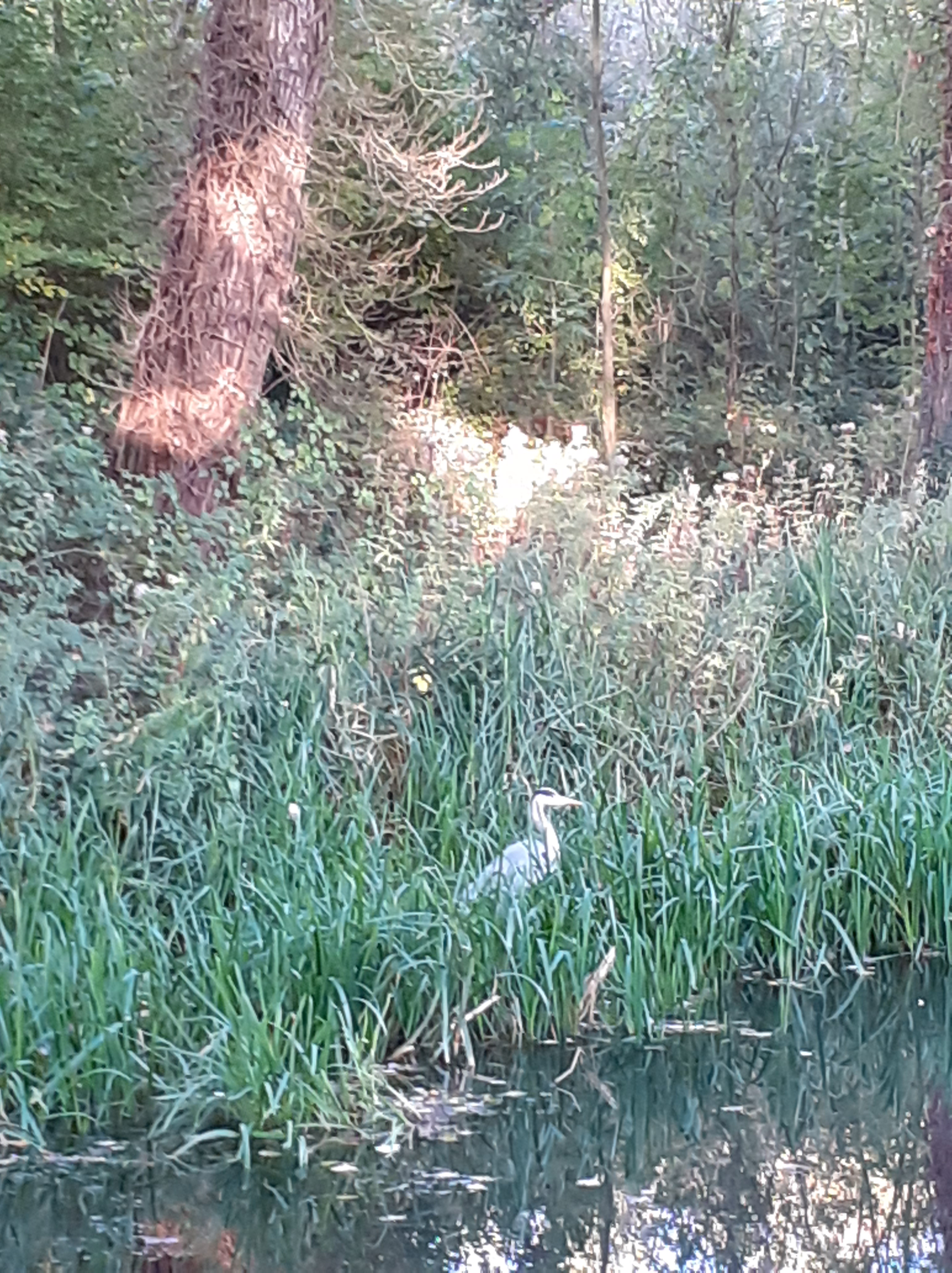
I saw the heron on 11 October 2020, in the first year of the pandemic and just a little after dawn. I had been walking for about forty minutes, beginning in near darkness and experiencing the gradual coming of the light. I described this walk at the time as an “enchanted meander” at a liminal point in that day (2).

My encounter with the heron was unexpected and I responded with “delighted surprise”. Four years later, reflecting on the memory, I note that I was able to experience delighted surprise from within stillness. In that moment I was a still human sharing space with a still heron on a still early morning. So the heron stayed in place, not needing to fly away. Beyond that there was no communing, but this was somehow blessing enough. Stillness of this kind, in contact with our more than human world, allows space for an enhanced bandwidth of experience. It is, perhaps, an opening to what Arran Stibbe calls “mystery”.

On that morning, my enhanced experience was partly displaced into the taking of a picture and also the wider purpose of my walk. That’s fine, a good enough choice. But I wonder what would have happened if I, like the heron, had stayed in place.

(1) Arran Stibbe Econarrative: Ethics, Ecology and the Search for New Narratives to Live By London: Bloomsbury Academic, 2024

(2) https://contemplativeinquiry.blog/2020/10/14/walking-towards-sunrise/

BOOK REVIEW: FORGIVING HUMANITY

Forgiving Humanity (1) is an extended essay rather than a book. I found it easy to read and hard to work with. Author Peter Russell is highly skilled at distilling data and making his case. His conclusion is that the near term extinction of the human species is inevitable, and not unnatural or to be faulted. “We are coming to the end of our species’ journey, spinning faster and faster into the center of an evolutionary spiral.”

Russell points to what he sees as our our natural-born drive for exponential growth and development. A dance of genetic and behavioural change led us to an enhanced brain, bi-pedal walking, manual dexterity, and a shift in the position of the larynx to enable complex speech. Cultural evolution then led to organised hunting with the throwing spear and, later, the bow. Later still, at an increasing rate of change, came agriculture, metallurgy, the industrial revolution (from steam to atomic power in not much more than a century) and, most recently, the accelerating information revolution now leading to the rise of AI. Quantum computing is on the horizon.

The problem according to Russell is that exponential growth is inherently predestined to run out of control. This is “the curse of exponential change.” Exponential growth is not like the linear growth that we can more comfortably imagine. In the domain of economics, for example, 3% annual growth rate in the world’s GDP, compounded over 100 years, would lead to a consumption of energy and resources at 20 times today’s rate. Russell started thinking about this problem as a young and gifted mathematician at the end of the 1960s. On his analysis, we would be fatally fouling our own nest even without the specific problem of the climate crisis. Climate change simply exacerbates and dramatises our predicament, hastening the process of breakdown.

Russell is aware of systemic injustices in our socio-economic system, but this book does not explore political mitigations. He expects major breakdown in this century. A remnant population in reduced circumstances will carry on for a while longer. But this human triggered extinction event, which has already claimed many other species, will still be rapid in planetary terms. In the immediate future, Russell sees a likelihood of continuing technological breakthroughs for some decades, in the midst of extensive cultural breakdown and a diminishing global population. I am not certain that he is right, but I fear that he may be. And I find him hard to read, trying to imagine what it would be like for different people in different places, and stepping into their boots down here in the trenches where embodied human life is lived until it’s gone.

Whilst the earlier sections of Forgiving Humanity are presented as if from the perspective of a distant cosmic scientist, there is a later turn to human experience and how to live in the new conditions. Peter Russell becomes one of us and shares his long-held view of consciousness and its possibilities, especially the affirmation that: “beneath our day-to-day experience lies a deeper sense of being, unperturbed by the goings on in the world, and our hopes and fears about them … meditative and self-enquiry processes … lead to greater calm and self-awareness, and … the more in touch we are with our inner being, the more considerate, compassionate, and caring we become – qualities that could prove invaluable in meeting the challenges ahead.” I also like his idea of remaining in service to the earth whenever we can, continuing to do our best for it even when knowing that our species is waning and likely to wink out. The notion of persevering with restorative efforts allows for limited local successes, seems like a healing process in itself and preserves a sense of positive agency in hard times. I am sure that people will continue to work in these ways whenever given half a chance.

For Russell, psycho-spiritual practices and communities are a key resiliency factor for navigating through heart-breaking conditions. We need to “find the acceptance that allows us to move into the unknown with courage and an open heart”. Russell says that facing our collective extinction is like facing our personal deaths, only more so because we are looking at the end of our kind. He borrows from a well-known map of how to work through five stages of grief – denial, anger, bargaining and depression – to a final acceptance. I have to note some reservations about schemes based on normative ideas about how we work through distress. People are very different – though many, it is true, are reassured by maps of this kind. I would also not want these suggestions to be misunderstood as an injunction to put on a mask of serenity when something else is going on in our body/mind. For me, the deeper acceptance is to recognise and accept our confusion and turbulence, if confusion and turbulence are what is happening. The spaciousness of deep acceptance then keeps company with them, avoiding both the false mask of serenity on the one hand, and immersed identification with our distress on the other. Nothing is denied.

I am not sure about the suggestion of ‘forgiving humanity’. If I take ‘humanity’ as simply the name of a species, I don’t feel that it’s my place either to forgive or withhold forgiveness from a species of which I am a member. If I take ‘Humanity’ as an idealised abstraction, or construct, then there’s no-one there to forgive outside my own imagination. For me, working as best as I can at deep acceptance and loving kindness, accepting with self-compassion that I will likely be wayward and inconsistent in my endeavours, is the better way to go. It keeps me in the world of lived interactions with other sentient beings and feels like a more engaged and grounded aspiration.

Despite some reservations, I value this work highly and recommend it to anyone concerned with the issues raised in it. We need voices like this, who move beyond deep adaptation to face into the possibility of no adaptation. Forgiving Humanity offers a distinctive lens on the crisis we are in, and it does so in a concise, readable and sadly persuasive way.

(1) Peter Russell Forgiving Humanity: How the Most Innovative Became the Most Dangerous Las Vegas, NV: Elf Rock Productions, 2023

NB Peter Russell studied mathematics and theoretical physics at the University of Cambridge but later changed to experimental psychology. After learning transcendental meditation (TM) with Maharishi Mahesh Yogi in India, he took up the first academic post ever offered in Britain on the psychology of meditation. He also has a postgraduate degree in computer science. In the 1970s he pioneered senior corporate management courses on meditation, creativity, stress management and sustainable development. Later he coined the term ‘global brain’ with the 1980’s best seller of that name in which he predicted the Internet and the impact it would have on humanity. I have reviewed a more recent book Letting Go of Nothing at:

MEDITATION, AND A BILLION-YEAR-OLD SENSE OF BEING

I enjoyed a recent piece on meditation by poet and spiritual teacher Jeff Foster. He is not talking about a traditional practice regime – whether of a mindfulness, pathworking, or energy-focused kind. Rather, he describes an encounter with the sacred in everyday life. Initially, this meditation attends to the flow of ordinary, embodied experience. It is informal, and not dependent on a dedicated environment or special conditions. As it develops, it sets free a healer in the heart, who stands by and resources the meditator rather than fixing their problems.

Meditation becomes as a ‘field of love, an ever-present ground of safety, presence and stillness’. It is personified through references to a ‘loving friend in the breath’, a ‘mother in the motherless places’, and a ‘billion-year-old sense of Being’. This is not meditation as generally understood. But I notice that I am nourished by Foster’s recommended approach, and I find myself responding to his impassioned language. Part of me wants to resist such intensity, but then happily melts on immersion in the process. Here is his piece in full:

“Meditation is not about getting yourself into altered states. Altered states do not last. It’s about becoming intimate with this state – this present moment, this day, this Now, its textures, tastes, vibrations, contractions and aches.

“Meditation is not an out-of-body experience. It’s the opposite. It’s a full experience of the body and its ever-changing sensations, its amorphous clouds of shivers, tickles, undulations and pulsations, throbbings, fizzles, its pain and its pleasure, its opening and closing, its ever-changing form.

“Meditation does not always make you feel ‘good’. In meditation, you feel exactly as you feel, and you learn to love that, or at least to allow it, or at least to tolerate it a little more than you did yesterday. Meditation makes you feel more like… you.

“Meditation is not about getting anywhere. It’s about discovering that there is nowhere to get to. That you are already home, and your body is the ground of all grounds. It is about discovering true safety in the feet, in the hands, in the pit of the belly. It is about finding a sanctuary in your chest, a sacred shrine between your eyes, a loving friend in the breath, a mother in the motherless places.

“Meditation is not something that you do with your mind. In meditation, the mind relaxes into the heart, seeking relaxes into finding, and even the most intense anxiety finds its home. You cannot make it happen, but you can fall into it.

“Meditation is not for experts, or the ones who know. Meditation is for absolute beginners, those who are willing to face their present experience with wide open, curious eyes.

“Meditation is a field of love, an ever-present ground of safety, presence and stillness, that you remember, or forget, or remember again.

“Meditation never leaves you. It whispers to you in the stillness of the night. And even in the midst of an activated nervous system, a full-on panic attack, suffocating claustrophobia or the urge to get out of your body… meditation is right there, holding you, loving you, gently kissing your forehead, willing you on.

“It will not abandon you, and ultimately, you will not abandon it.

“And closing your eyes to sleep at night, meditation is there, snuggling right up to you.

“Your soft pillow, the rising and falling of your own delicious breath, a light breeze coming in from the window, that billion-year-old sense of Being…

“You are safe in your own body, my love. You are safe.”

– Jeff Foster http://www.lifewithoutacentre.com/

REFLECTIONS IN A PRIORY GARDEN

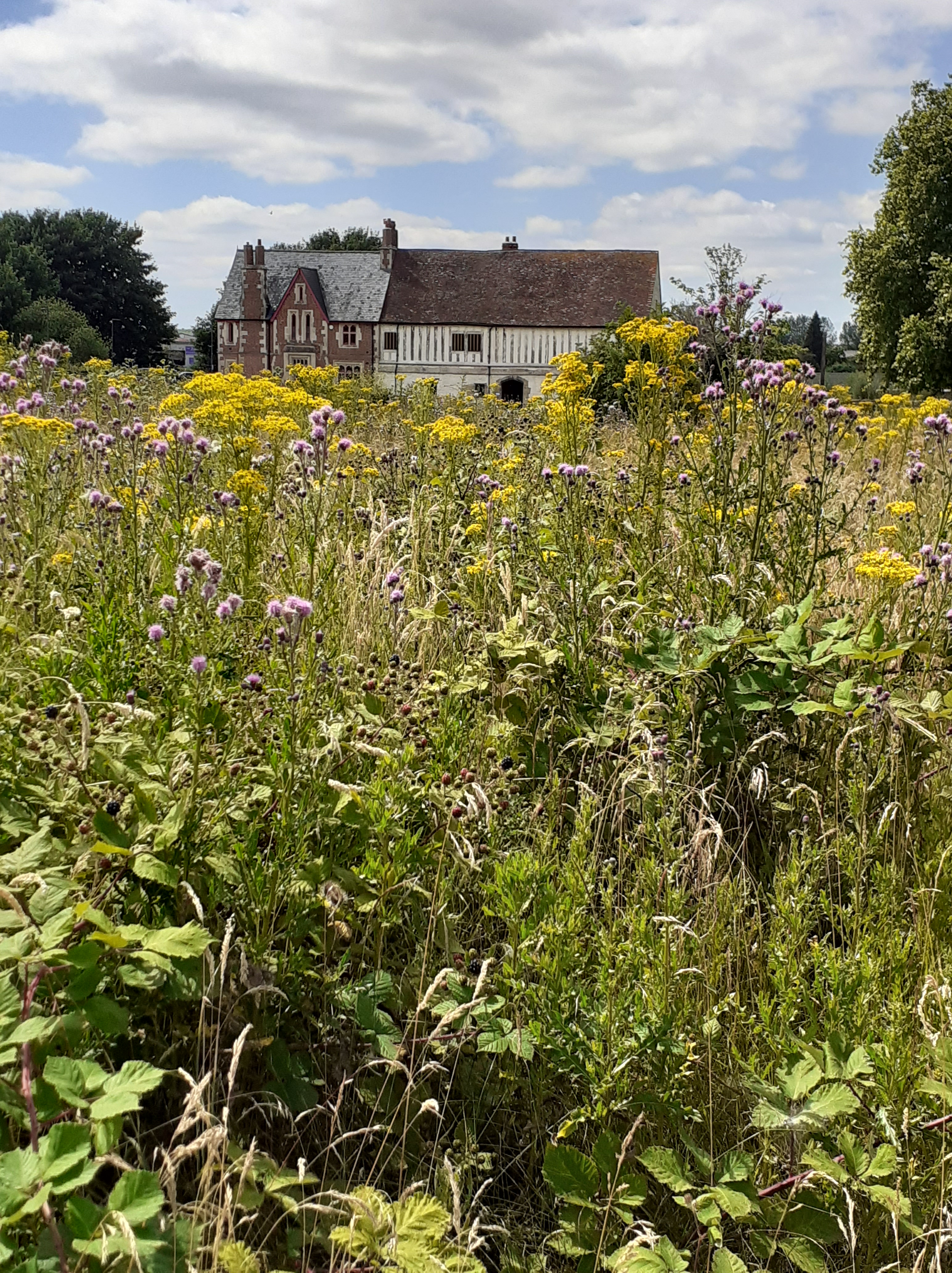
In my formative years, high summer presented me with a world of manicured green. Mown grass dominated both private and public spaces. Garden lawns, parks, tennis courts, cricket grounds, golf courses, bowling greens: all highly managed. Much water was lavished on their severely cropped verdure, given its enhanced tendency to dry up in hot weather.

This is still happening, but fashions have changed to a degree. The photos above and below show the grounds of the Llanthony Secunda priory in Gloucester. In line with new custom, space is now given to a limited urban rewilding. I am inspired by this small miracle of growth and abundance.

This is an odd summer for me. I am at ease in a congenial place. My wife Elaine and I have moved house successfully. I have stabilised after a period of illness. But this is a transitional period. We are not at our destination, and anticipate more upheaval in the second half of the year. I am divided between here-and-now enjoyment of my surroundings, and concern over possible futures, strategising next steps and feeling the tensions of uncertainty.

In the ABOUT section of this blog, I write of “an underlying peace and at-homeness in the present moment, which, when experienced clearly and spaciously, nourishes and illuminates my life”. That statement is a fruit of my inquiry – it wasn’t there at the beginning. That is the nature of contemplative inquiry: my understanding changes over time, in line with deepening experience.

I am finding that my peace and at-homeness have room for both my day-to-day contentment and my anxiety about possible futures, personal and collective. I don’t strip out my ‘future’-based concerns (themselves part of my present time experience) to tidy up my mental and emotional states. That seems like a superficial understanding of here-and-now acceptance. I find, rather, an invitation to embrace the turbulence too, as part of what is given. The peace arising from innermost being makes room for turbulence, for such peace is not just another passing state. In some hard-to-understand way, it has the capacity to be infinitely spacious, and present in the flux of time and events. All I have to do is trust this peace and let it in.

I do not think of myself as a person of faith. I am more of a ‘philosophical’ Druid rather than a religious one, though I don’t believe that we have to choose between the two. But trusting the peace of innermost being is certainly, in part, a matter of faith, where ‘faith’ involves harmonising with my deepest intuition rather than signing up to statements of belief.

OBOD liturgy includes the words: “deep within my innermost being may I find peace”. This resonates powerfully with me, but I have recently let go of the word ‘my’, because ‘innermost being’ no longer feels exactly personal – it seems, experientially, to be more like being resourced from a timeless, unboundaried dimension from which I am not separate. This realisation, if it is a realisation, is now at the core of my spirituality. I am reluctant to make metaphysical truth claims about it, but it is firmly implanted in my experience. The opportunity, now, is to give it the freedom to grow, within my inquiry and my life.

BEING IN PLACE

The first days of November were kind to me, with bright sunshine and temperatures good for walking. I have felt fitter and healthier than for awhile, and completed a 7 mile walk on 1 November without much sense of wear and tear. I felt alive in an everyday kind of way and appreciative of the spaces I moved through. My main focus was movement itself, and I took photographs only of places beyond my current ‘normal’ range. Nothing mystical: just the simple pleasure of being in place.

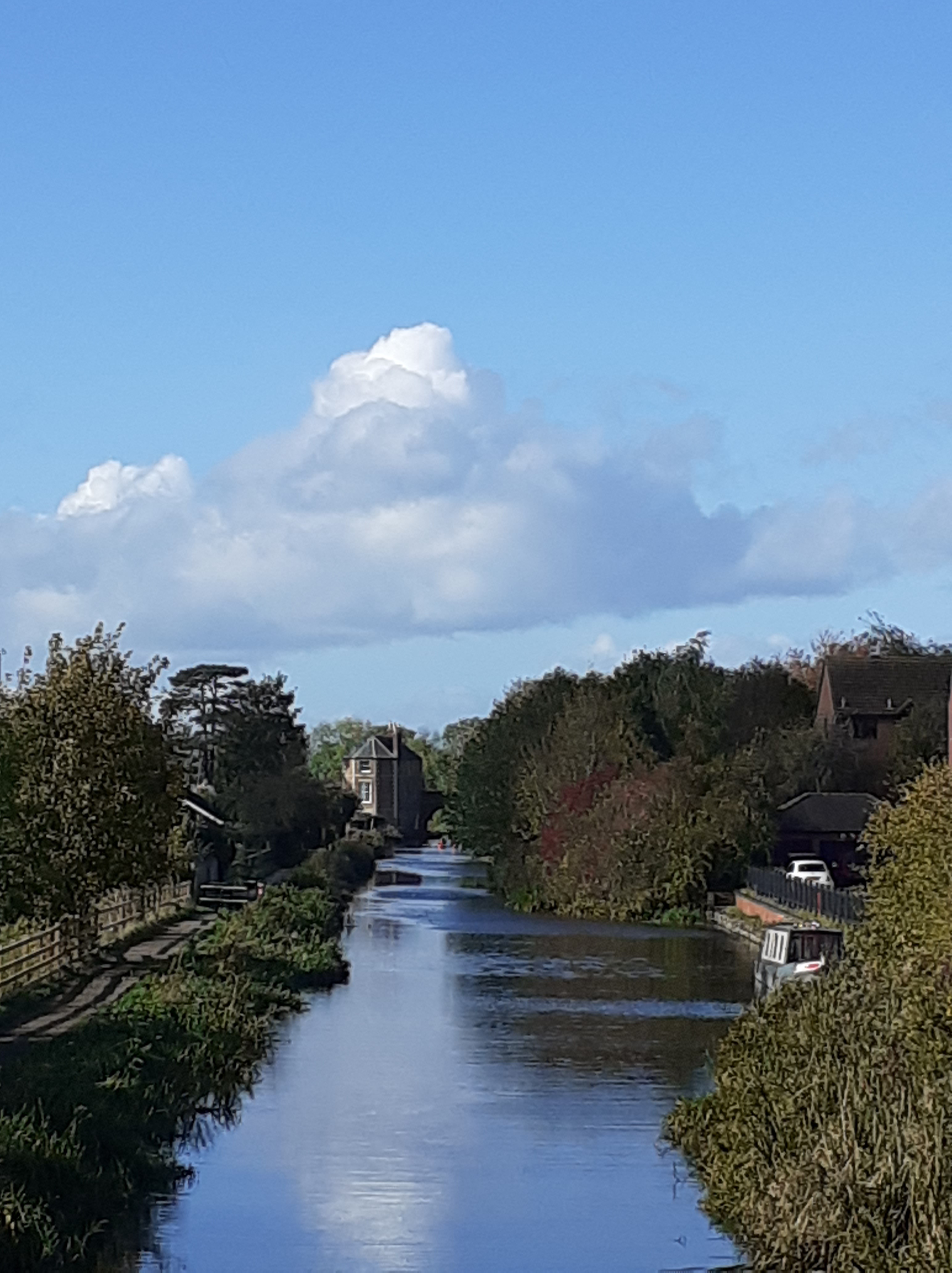
1 November gave me autumn at its best rather than any sign of winter. The canal had, in places, a kind of dappled intimacy, aided both by unmanicured foliage and architecture on a human scale. The quality of light was heart-lifting too, always significant for me.

There were also other spaces, more open, allowing an overview of the canal landscape. The picture below gives an indication of how much blue sky there was, on the day. It was a delight to be able to see so far, and so clearly. I realise how much my resilience, at times wobbly, is supported by simple experiences like this.

SPIRITUAL ‘KNOWING’

I like the way this presentation uses the word ‘knowing’ to point to our underlying condition. This usage is clearly separated from everyday knowledge of or about (something), or even of wisdom and understanding. It also avoids the term ‘consciousness’, which tends to invite metaphysical and scientific debates that lead us away from direct experience. ‘Awareness’ is a noun and so seems like a thing – we don’t generally talk about ‘awareing’. I personally like ‘being’ as an alternative, but it carries philosophical baggage and is not specific enough for the context of this presentation. Current usages within the Western Way of the term ‘gnosis’ do not generally reflect the view discussed here.

It may be true, as the Tao Te Ching says, that the Way that can be named is not the real Way. But we still need language, as a pointer, for that in us which needs to make sense of experience and to share it with others. Here, a skilful choice of words can make a difference, and I think this presentation models the skill. Dzogchen is a tradition within Tibetan Buddhism. ‘Rigpa’ is the Tibetan word used to describe ‘knowing’ in this sense.

HIGH SUMMER 2021

It is some time since the solstice. Where I live, the time between sunrise and sunset has shortened by about 20 minutes. Though the change is still slow, it is noticeable now. But I do not yet feel a pull towards Lughnasadh/Lammas. I took these pictures on 11 July, and this is its own time, a time of abundance and ripening. They give me the sense of a summer that has kept its promise and is managing to mature despite a year of patchy weather.

At this stage, the willows below, early to leaf, remain majestic in their abundance – whilst hinting at a tiredness that will manifest in late summer, when energy starts to withdraw, and turn inwards.

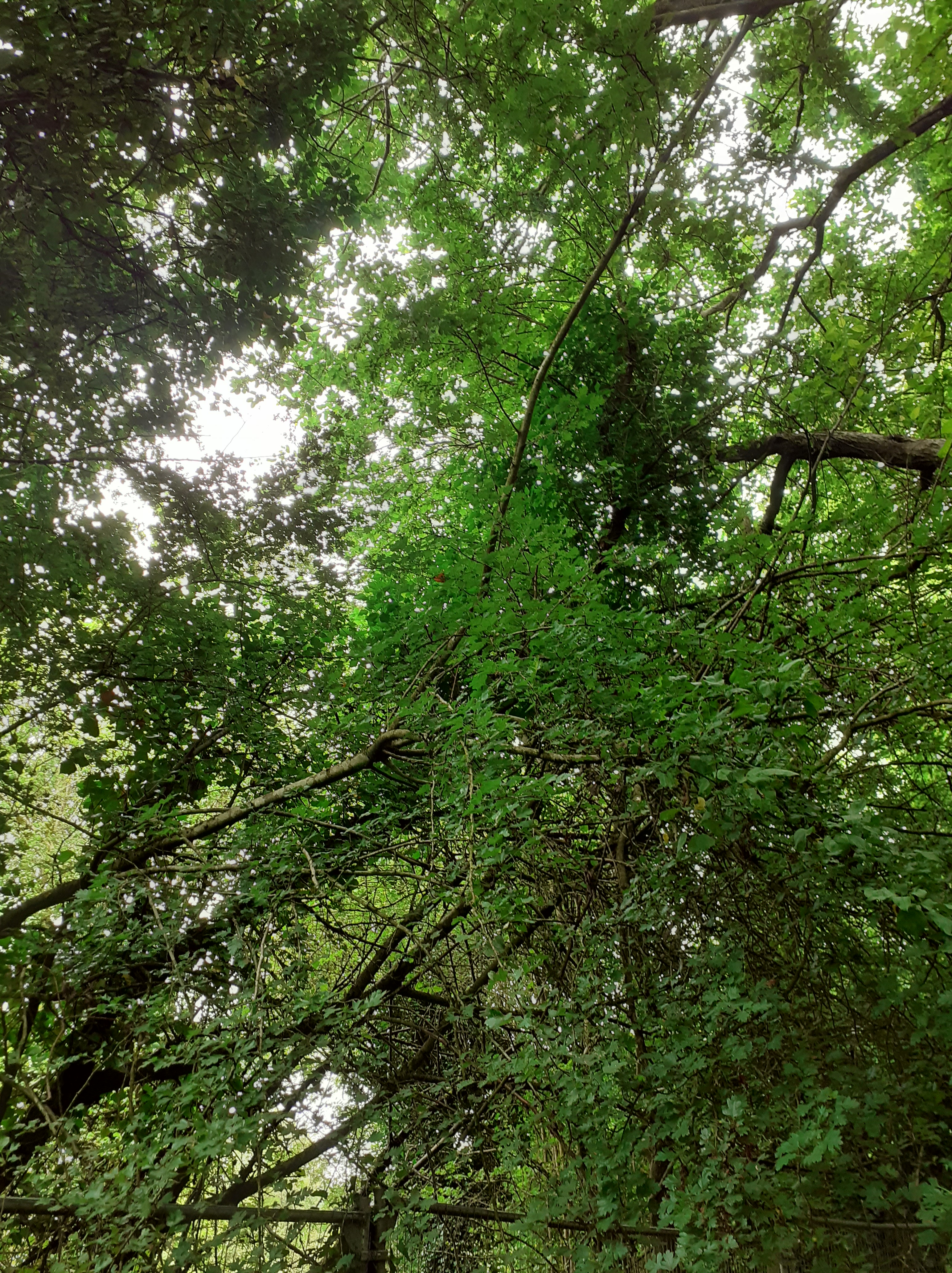
But this isn’t the case with the treescape as a whole. In the woods I continue to find the fresh green of a vigorous life energy. It is the time when I get the strongest sense of a canopy, even in a relatively small and modestly wooded space. It hints at the glories of old forest, even though it isn’t one.

Whilst there is a sense of flora moving into new stages of their cycle, the process is gradual. There is time and leisure for slow change. There is no sense of having to be perfectly one thing and then, immediately, perfectly another.

Above all. I notice subtle differences in shape and colour within a setting of predominantly green growth. My gaze is drawn by intricacies of variation, contrast and patterning within this always astonishing display of life, and its natural will to be and become.

In mid-July, life rests in its moment, with harvesting some way off.

PERCEIVING NATURE

“When you perceive nature only through the mind, through thinking, you cannot sense its aliveness, its beingness. You see the form only and you are unaware of the life within the form – the sacred mystery. Thought reduces nature to a commodity to be used in the pursuit of profit or knowledge or some other utilitarian purpose. The ancient forest becomes timber, the bird a research project, the mountain something to be mined or conquered” (1)

Since the beginning of March I have had a connection with Eckhart Tolle’s community (2). Over the next couple of months I will decide whether to make an ongoing commitment. Part of the process is to identify the points of compatibility with my Druidry so that both may support an integrated spiritual life. The view of nature is one point of compatibility, and there is a link to my sense of contemplative Druidry when Eckhart Tolle says: “When you perceive nature, let there be spaces for no-thought, no mind. When you approach nature, it will respond to you, and participate in the evolution of a human and planetary consciousness.” (1)

(1) Eckhart Tolle Stillness Speaks: Whispers of Now London: Hodder & Stoughton, 2003

(2) https://eckharttolle.com/

A MIDSUMMER DAY’S DREAM

This post is about a midsummer day’s dream in the the Scottish border country, a dream which included a certain kind of waking up. I have written about it before (1,2) but this is the first illustrated version. Fourteen years have passed since that day, which in many ways determined the form which my expression of Druidry would take.

I was near Melrose. The wild rose was one of many on the banks of the Tweed. In this photograph, I am on a riverside path, with my back to the river. I keenly noticed then, as I notice now, the difference between a wild rose and the more familiar cultivated ones. I love both. But I remember feeling a particular delight at the simplicity of the native flower, a sense of easy integration into habitat, and of a plant not committed to being red or white.

Looking more deeply, I have said in my earlier writing how I had a momentary experience in which, gazing at a rose, subject/object distinctions disappeared and it is as if time intersected with eternity. I have identified this with the Seeing experience more systematically explored by Douglas Harding and the community built up around his work (http://www.headless.org). This was the beginning my sense that direct experience of the world, manifesting through a form of nature mysticism, would be my way forward, eventually becoming a contemplative Druidry and the backbone of my contemplative inquiry. I experience this as a direct and simple route to stillness, presence, resting in being., and identifying with source.

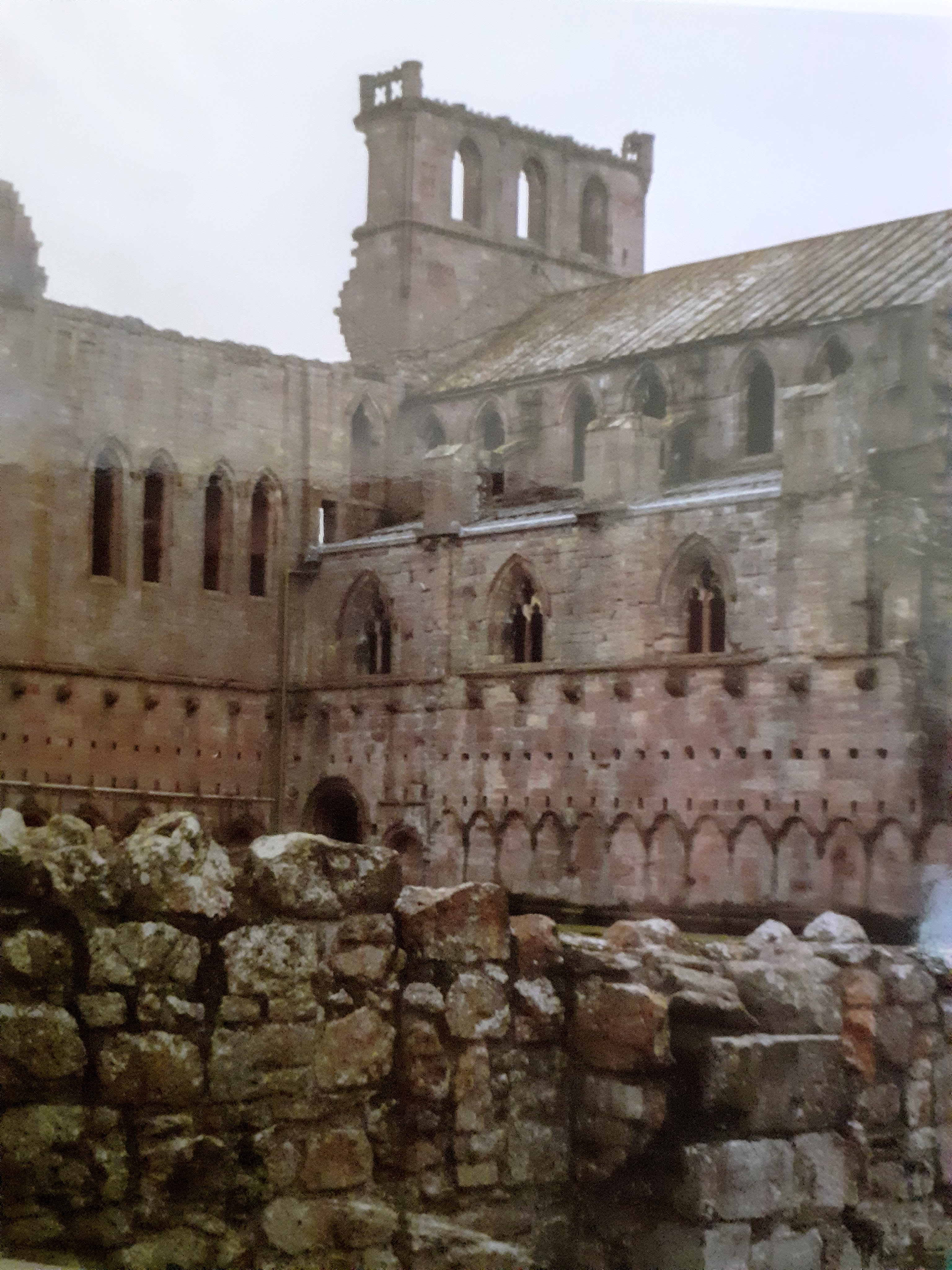
My walk amongst the wild roses had a prequel. Firstly, I had already spent time in the well-preserved ruins of Melrose Abbey. It was a building of Green Man carvings, but, sadly, neither the monks who occupied it nor the iconoclasts who abandoned it had access to the Gospel of Thomas (3) or the words:

“His disciples said to him:

‘When will the dead be at rest?’

‘When will the new world come?’

He answered them:

What you are waiting for has already come,

but you do not see it.” (3)

Here I see the abbey as a solid, material buildings, built with love and care. Even today, it belongs in its landscape, as much as the Tweed or the nearby Eildon Hills, with a semi-wild orchard of apple, pear and cherry trees. What I haven’t written before, in times when I was busy making distinctions between available paths, is that time and eternity intersect in this place too. But, on the day in question, I didn’t have that experience in the abbey grounds. I had it only among the wild roses, down by the river.

The Eildon Hills are also part of the same landscape, indeed a more primal one. But they are fairy hills and they can hide themselves. On that day, they hid from me. There was no invitation – or, rather command – from the Queen of Elfland, who had once ridden out to summon Thomas the Rhymer to her service:

“But you maun go wi’ me now Thomas

True Thomas ye maun go with me

For ye maun serve me seven years

Through weel or wae as may change to be.” (4)

At midsummer in 2007 I was looking for a spiritual home that offered both depth and simplicity. The grim half hidden hills were not appealing to me and I was closed to their magic, with an invitation or without one. I did not want to court danger by ascending into their conceivably treacherous mists. The low road by the river was the one for me.

It was a good decision, and good came of it. But I do also understand that on a different day, those hills could be seen in a different light. I do not now feel constrained to make a neat choice between a broad road, a narrow road and a bonny road. Two cycles of seven years on, well rooted in a nourishing life and practice, I find myself in a more open space, wondering what lessons this Otherworld might yet offer.

(1) James Nichol Contemplative Druidry: People, Practice and Potential Amazon/Kindle, 2014 See: https://www.amazon.co.uk/contemplative-druidry-people-practice-potential/dp/1500807206/

(2) https://contemplativeinquiry.blog/2019/07/16/seeing-contemplative-druidry/

(3) The Gospel of Thomas: the Gnostic Wisdom of Jesus (Translation from the Coptic, introduction and commentary by Jean-Yves LeLoup. English translation by Joseph Rowe. Foreword by Jacob Needleman) Rochester, VT: Inner Traditions, 2005

(4) R. J. Stewart The Underworld Initiation: A Journey Towards Psychic Transformation Wellingborough: The Aquarian Press, 1985

Earth Eclectic

music that celebrates Earth and speaks to the heart

Sarah Fuhro Star-Flower Alchemy

Follow the Moon's Cycle

Muddy Feet

Meeting nature on nature's terms

Rosher.Net

A little bit of Mark Rosher in South Gloucestershire, England

Becoming Part of the Land

A monastic polytheist's and animist’s journal

selkiewife

Selkie Writing…

Charlotte Rodgers

Images and words set against a backdrop of outsider art.

Prof Jem Bendell

living with metacrisis and collapse

Towint

The pagan path. The Old Ways In New Times

The Druids Garden

Spiritual journeys in tending the living earth, permaculture, and nature-inspired arts

The Blog of Baphomet

a magickal dialogue between nature and culture

This Simple Life

The gentle art of living with less

Musings of a Scottish Hearth Druid and Heathen

Thoughts about living, loving and worshiping as an autistic Hearth Druid and Heathen. One woman's journey.

Wheel of the Year Blog

An place to read and share stories about the celtic seasonal festivals

Walking the Druid Path

Just another WordPress.com site

anima monday

Exploring our connection to the wider world

Grounded Space Focusing

Become more grounded and spacious with yourself and others, through your own body’s wisdom

The Earthbound Report

Good lives on our one planet

Hopeless Vendetta

News for the residents of Hopeless, Maine