Contemplative Inquiry

This blog is about contemplative inquiry

Tag: Awen

AWEN

Recently I have been contemplating both my understanding and my experience of Awen. Above is a picture of my Awen pendant, a modern Druid badge of belonging. It is based on the three ray symbol developed by Iolo Morganwg (Edward Thomas 1747-1826). It also depicts the three drops from Cerridwen’s cauldron in the Taliesin myth. Hanes Taliesin, popularised in Charlotte Guest’s 19th CE English translation of the tale, is now a significant influence on modern Druids.

Ten years ago I published Contemplative Druidry (1), a book based on interviews with active Druids about the place of contemplation within today’s Druidry. It included a chapter on Awen, and revealed a lack of consensus about what Awen actually meant to the interviewees. I wrote: “Awen is classically seen in Druidry as the power of inspiration, and in particular the creative force for poetry and prophecy … Many of the participants in this work uphold the tradition in its conventional form. Others seek to extend the traditional meaning better to express their own experiences and aspirations. Some don’t connect with Awen experientially and treat it as a convention – mainly a shared chant which brings Druids together.”

Since that time (2014), the evolution of modern Druidry has continued apace. In recent years, the most inspirational definition of Awen I have encountered is one by Kristoffer Hughes, Chief of the Anglesey Druid Order and a native Welsh speaker. He describes Awen as (2): “the creative, transformative force of divine inspiration that sings in praise of itself; it is the eternal song that sings all things into existence, and all things call to Awen inwardly”. For him, the personified deity intimately linked with Awen is Cerridwen, for him a goddess of “angular, bending magic” whose cauldron is “a vessel of inspiration, a transformative device, a vessel of testing”.

In a sense Hughes is the Pagan inheritor of the Unitarian Iolo Morganwg, who reframed St. John’s “In the beginning was the Word” (3) as ‘In the beginning was the Song’ – “all the universe leapt together into existence of life, with the triumph of a song of joy … and the sound of the song travelled as far as God and His existence are” (4). Hughes sees Iolo as a model of Awen’s influence in the world: “He carried the seeds of Awen and profoundly influenced a future that he could not imagine … He is testament to Awen’s consistent stream and how it too changed its countenance to meet the needs of different people at different times”. The Romantic period Iolo lived into was “a cauldron of new ideas”, with a new era of bardic tradition in its infancy and “occult fascination among the learned of the time increasing in popularity” (2).

Looking beyond Druidry, I think of the words of Kabir, the Indian 15th century CE poet/singer and mystic: “If you want the truth, I’ll tell you the truth. Listen to the secret sound, the real sound, which is inside you” (5). Kabir was a Muslim who was also heavily influenced by Indian Tantric/Vedantic culture. In this culture, OM is the primal originative sound. AUM (so like Awen) is its feminine form, the creative energy or Shakti of the Cosmos giving shape and substance to the material world. For me it is as if the sound itself holds the power, waiting to be discovered, and transcending any specific cultural context. It seems somehow inherently resonant and inspiring; an anchor for empowering states.

In my current practice I work with Awen both as chant (Aah-ooo-wen) and as mantra (inbreath Aah, outbreath wen). I have done this on and off for many years, and I have fairly recently returned to ‘on’. When I work energetically, I seem to become porous to the world. I experience a lightness and a loosening of boundaries. Reality is not fixed and locked down. Into this space Awen can enter, and I find myself in a place of healing, peace and power. This doesn’t have a direct cause-effect link with creative work in the world, but it does mobilise my capacity for such work. This is now my experience of Awen.

(1) James Nichol Contemplative Druidry: People, Practice and Potential Amazon/KDP, 2014 (Foreword by Philip Carr-Gomm)

(2) Kristoffer Hughes Cerridwen: Celtic Goddess of Inspiration Woodbury, MN: Llewellyn Publications, 2021

(3) Holy Bible: King James Version Green World Classics edition, 2017

(4) J. Williams ab Ithel (editor) The Barddas of Iolo Morganwg: A Collection of Original Documents, Illustrative of the Theology, Wisdom, and Usages of the Bardo-Druidic System of the Isle of Britain Forgotten Books, 2007 (First published 1862, from notes and journals left by Iolo on his death at 79 years of age in 1826).

(5) Sally Kempton Meditation for the Love of It: Enjoying Your Own Deepest Experience Boulder, CO: Sounds True, 2011 (Foreword by Elizabeth Gilbert),
TALIESIN THE SHAPE SHIFTER

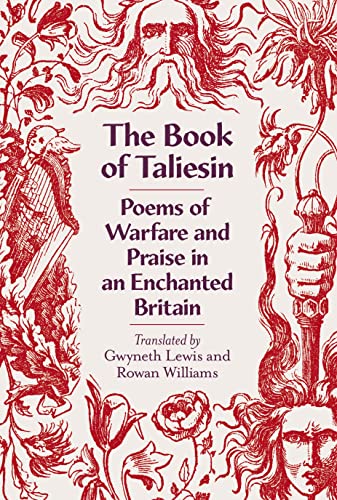
This is my third in a series of posts drawing on Gwyneth Lewis’ and Rowan Williams’ modern English version of The Book of Taliesin (1), an anthology of bardic poetry from medieval Wales. My first post introduced the book and offered extracts from A Song of the Wind (2). The second looked at the importance of ‘The Old North’ (territories in north-west England and southern Scotland that shared the same history, language and culture as the people of Wales) (3). This, final, post looks at the development of the Taliesin figure in the later middle ages. In particular, I focus on the anthology’s section entitled Legendary Poems and on the translators’ understandings of bardic poetry, shapeshifting and awen. I also look at their reasons for interpreting the Taliesin of these poems as “a kind of Christian shaman”.

In these poems, the use of shapeshifting language is presented as being a feature of competition between rival bards. “The Taliesin figure demonstrates his superiority … by spelling out at triumphant length the questions he can answer about which his rivals are ignorant, and by listing the various embodiments he has experienced”. The translators give an example of this in the opening of The Battle of the Trees.

“I was in many forms

Before my release:

I was a slim enchanted sword,

I believe in its play.

I was a drop in air,

The sparkling of stars,

A word inscribed,

A book in a priest’s hands,

A lantern shining

For a year and a half.

A bridge in crossing

Over threescore abers (= estuaries).

I was path, I was eagle,

I was a coracle at sea.

I was bubbles in beer,

I was a raindrop in a shower.

I was a sword in the hand;

I was a shield in battle.

I was a harp string,

Enchanted nine years

In water, foaming.

I was tinder in fire,

I was a forest ablaze”.

The editors comment: “these extraordinary poems reflect a sophisticated and complex understanding of poetic composition in which the concept of awen is central. It would be misleading to translate this idea of inspiration as ‘Muse’: it is better thought of as a state of altered consciousness in which the poet receives knowledge of matters beyond what can routinely be learned. According to Gerald of Wales’ description of the awenyddion, or inspired soothsayers, of the 12th century CE, the gift of awen produces the same kinds of extreme behaviour as are associated with spirit possession: loud shouting, trance and catalepsy, disconnected but also very elaborate speech, narrated experiences of supernatural encounters which trigger the exercise of this gift, and a subsequent inability to remember what was said under its influence”.

Poems like The Battle of the Trees may be “an attempt to reflect the style or register of such ecstatic states of consciousness”. However, the poems themselves may not be “transcriptions of specific compositions originating in altered states”. In cultures that have a “routine ritual space” for “ecstatic phenomena”, the irruption of the supernatural will follow a familiar pattern. “There will be expectations about both the actual expression and the transmission of what has been delivered”. If poetry is to be recognised as the authentic voice of ecstatic perception, “it must follow certain classical, normative exemplars of poetic ecstasy”. The Taliesin of these poems is a composite figure modelling how to speak as an awenydd. He demonstrates a particular way of being a poet and sounding like a poet of this kind.

Religious tensions appear in The Spoils of Annwfn. The bard rails against the ignorance of monks.

“And the monks herd together, a pack of dogs,

In the contest with those

Who have mastered the lore –

Whether wind takes one path,

Whether the sea is one water,

Whether fire’s unstoppable force is one spark.

The monks herd together, a pack of wolves,

In the contest with those who have mastered the lore –

They don’t know how darkness is severed from light,

They don’t know the course of the wind in its rushing,

Where the wind will lay waste, what land it strikes,

How many saints in the sky’s vault, and how many shrines.

I will praise the Prince, the Lord, the Great One.

Let me not be sad: Christ will repay me.”

The translators point out that the shapeshifter Taliesin of the 12th century CE, is “multifaceted” compared to the court bard of the 6th-9th centuries. The later literature links Taliesin “especially with stories involving the figure of the sorcerer Gwydion and the ‘children of Don'”. His status as dewin (sage or sorcerer) or occasionally derwyd (druid) is “so equal in importance to his standing as a poet that the two might more accurately be said to become inseparable”. But he is also shown, as in the extract above, dutifully commending his work to God and as “being familiar with theological questions, most notably those relating to the Incarnation, and with apocryphal traditions surrounding the biblical narratives”.

Lewis and Williams conclude that “this later Taliesin becomes a bridge figure between traditional Welsh lore and the cosmopolitan world of early medieval ecclesiastical learning”. The extract above reflects “a resentment of the new monastic foundations after the Norman Conquest, the Benedictine houses that sprang up in proximity to the new castles and settlements in the Welsh Marches (English/Welsh border counties). Monks from continental Europe are unlikely by this date to have been familiar with or sympathetic to the rather older style of clerical learning represented by the riddling and legendary elaborations of the Christian story found in the Irish or Anglo-Saxon texts of the early Middle Ages; Taliesin thus becomes a mouthpiece for this archaic Christian lore as well as the archetypal bard and seer”. This is why the translators characterise Taliesin in his shape-shifting period as a “Christian shaman”.

(1) Gwyneth Lewis and Rowan Williams The Book of Taliesin: Poems of Warfare and Praise in an Enchanted Britain Penguin Random House UK, 2020 (First published in hardback in Penguin Classics and 2019) Gwyneth Lewis was National Poet in Wales, 2005-6 and teaches at Middlebury College Vermont. Rowan Williams is a former Archbishop of Canterbury, subsequently Master of Magdalene College, Cambridge.

(2) https://contemplativeinquiry.blog/2023/08/07/

(3) https://contemplativeinquiry.blog/2023/08/10/

FINDING LOST GODS IN WALES

Professor Ronald Hutton’s fifth lecture in the Gresham College series on early Pagan history in Britain (1) is called Finding Lost Gods in Wales. Hutton’s main focus is on medieval Welsh literature. The language used is a 5th/6th century CE mutation of the Brythonic speech once used throughout Britain, further developed for literary purposes by court bards in the 6/7th century. Hutton describes it as “made for poetry” because of the concentration of meaning in the words. He gives as an example in a literal English translation:

‘Colour light waves spread boiling billows

‘Flood-tide river mouth on sea where nothing waits.’

He contrasts this with an English translation for English ears, demanding more words whilst sacrificing impact and immediacy.

‘Bright as the light that falls on the waves, where the boiling billows spread

That flashes a moment from the meeting of river flood and sea.’

This language was the public voice of a consciously dispossessed people, creating a new sense of Welsh Celtic nationhood in the 9th and 10th centuries, when the English, Scottish Gaels and Vikings had reduced their territory to less that 10% of Britain. It led to a flowering of Bardic culture throughout the medieval period.

Taliesin was celebrated as Wales’ greatest Bard. There is no certainty that he existed, though poems surviving from the 6th century have been attributed to him. There are no recorded statements of his pre-eminence before the 10th century. Later poets inspired by him continued to write in his name for a further 300 years. His link with Awen as the source of inspiration reveals the mystical roots of the whole Bardic tradition. But for instances or echoes of specifically Pagan motifs we are largely reliant on a small group of texts from the 11th -13th centuries: The Black Book of Carmarthen, The White Book of Rhydderch, the Red Book of Hergest, the Book of Taliesin and the Mabinogion, a collection of prose stories. (The full prose Hanes Taliesin is from a much later date.)

In contrast to Irish medieval literature, we do not find Goddesses, Gods or explicitly Pagan characters in these Welsh texts, even in the four branches of the Mabinogi, though these do seem to be set in Pagan times. Several characters have superhuman abilities, without being presented as Gods. However, we do have Annwn, an otherworldly realm of human-like beings who interact with ordinary humans. We also find shape-shifting abilities – people change into animal forms and back again; humans change their appearance; objects change their form.

There is certainly magic and magical poetry, as in the Preiddeu Annwn (The Lute of the Otherworld). This poem, though hostile to monks and their pretensions to scholarship, is overtly Christian. According to Hutton, poems of this kind delight in being difficult, allusive and packed with metaphor, references and wordplay. No one now can say with any certainty what they were originally intended to mean. But this, suggests Hutton, is a gift and invitation to the poets, story tellers and artists of later generations including our own.

On the specific question of deity, Hutton discusses Rhiannon, Cerridwen, Gwyn ap Nudd, and Arianrhod. None is described in this literature as divine and, according to Hutton, we do not find them in that role in Celtic antiquity.

Rhiannon is superhuman and comes from an enchanted world to find a husband of her own choosing. She stays the course despite horrible experiences. She has been thought of as a horse goddess, but this is not suggested in the Mabinogion and there is no indication of a horse Goddess in the archaeology of Iron Age Britain or in Romano-British inscriptions. She has also been seen as a Goddess of Sovereignty, but she does not confer sovereignty on either of her husbands, and there is no record of any sovereignty Goddess in Europe outside Ireland.

Cerridwen begins as a mother skilled in sorcery trying to empower her son but actually empowering a lowly servant boy instead. By the 13th century she has, through her association with Awen, become the muse of the Bards, giver of power and the laws of poetry. In 1809 the scholar Edward Davies made her the great Goddess of ancient Britain and many people have Iolo seen her in that light ever since.

In 11th and 12th century texts Gwyn ap Nudd was one of King Arthur’s warriors, imbued with a degree of magic power. By the 14th century, poets are making him a mighty power of darkness, enchantment and deception. In the 1880’s the scholar Sir John Rhys made him the Celtic God of the dead and leader of the Wild Hunt. This is largely how he is seen today.

In the fourth branch of the Mabinogi, Arianrhod is a powerful, beautiful and selfish enchantress with the capacity to make unbreakable curses. By the 13th and 14th centuries her magical powers are much increased. She can cast a rainbow about a court, and the Corona Borealis is called the Fortress or Arianrhod. In the 20th century she began to be seen as a Star Goddess.

Professor Hutton’s lecture includes a discussion of the Welsh Bardic revival at the end of the eighteenth century, inspired largely by Iolo Morgannwg, here presented as a mixed blessing given his willingness to forge ‘ancient’ documents to advance his cause. Hutton ends with a section on the legend placing Glastonbury as the site of King Arthur’s final refuge and eventual burial, and also the place in which the Holy Grail was buried. Both of these were concocted by the later medieval monks of Glastonbury Abbey as a potential source of patronage and a pilgrimage income. At the same time, post holes linked to a neolithic structure have recently been found near Chalice Well – which may well be a numinous site of great antiquity. Artefacts have also been recently found in the area, including the Abbey itself, from the early post-Roman period in which Arthur’s career has been set. We weave our stories from a mixture of fact, fiction, speculation and deep intuition. Being conscious of this circumstance may make them all the richer.

(1) https://www.youtube.com/watch?v=NTmIEE91D-k

See also: https://contemplativeinquiry.blog/2021/03/26/ for my review of Cerridwen Celtic Goddess of Inspiration by Kristoffer Hughes as an in-depth account of the Goddess and her evolution. He also discusses the Welsh Bardic tradition and the later work of Iolo Morgannwg

ME AND MY INQUIRY

My inquiry moves slowly. But it doesn’t stand still. So from time to time I update the ABOUT section of my blog. Sometimes I discuss my changes in a post. Occasionally it seems as if the blog has its own life and writes itself through me. I’m not sure that I would claim the word Awen here, but I can end up surprised at what appears.

This time there seems to be a settling, an emphasis on continuity. I recommit to a contemplative inquiry, grounded in modern Druidry and with the inquiry process itself as my core practice. I am now assuming that this will be lifelong. In the past I have tended to believe that the inquiry would eventually lead to a conclusion of some kind, or become redundant for other reasons. Another project would then emerge – or maybe I would retire from projects and put my feet up. That belief has gone, for my inquiry is no longer a ‘project’.

As I was writing this morning, I became conscious of the change. ‘My inquiry’, I wrote ‘has shifted from a focused experiential investigation into a more relaxed, at times meandering process that brings illumination, healing and peace’. I have always had, in the back of my mind, prestigious models of both academic and spiritual inquiry that do not encourage relaxed meandering. In the academic models, results like ‘illumination, healing and peace’ are beside the point. In the spiritual ones, they are mostly reckoned to be very hard-won. But there it is. I am moving into a life-lived-as-inquiry space by softening and reframing my idea of inquiry. I seek support and nourishment rather than new and different ‘results’. Looking at these words now, they seem obvious, not even new – but I’ve only just caught up. It does seem, experientially, as if the blog has become the voice (spirit?) of the inquiry and intervened to educate me. It’s an odd feeling.

Here is the new ABOUT text:

“I am James Nichol and I live in the city of Gloucester, England. My contemplative inquiry began in 2012. It is grounded in modern Druidry, though I have drawn on the enduring wisdom of many times and places. I am also influenced by the current turn towards an eco-spirituality that meets our own historical moment. The inquiry itself is my core practice. I see it as a lifelong journey. In my blog I include personal sharing, discursive writing, photographs, poetry, and book reviews.

“Over the years, my inquiry has shifted from a focused experiential investigation into a more relaxed, at times meandering process that nonetheless brings illumination, healing and peace. In the contemplative moment,  I am living presence in a field of living presence, at home in a living world. This is not dependent on belief or circumstance, but on the recognition of what is given, in joy and sorrow alike. I find that this simple recognition encourages a spirit of openness, the acceptance that nothing stays the same, an ethic of interdependence and a life of abundant simplicity.

“My book, Contemplative Druidry: People, Practice and Potential, was published in 2014. It includes a foreword, Deep Peace of the Quiet Earth, by Philip Carr-Gomm. There are major contributions in the main text from 14 other Druids offering diverse perspectives on the topic: https://www.amazon.co.uk/contemplative-druidry-people-practice-potential/dp/1500807206/

ALBAN ELFED: A TIME FOR RECEPTIVITY?

Blessings of the season! Where I live, the sun is descending but still has a certain power. We have entered the period of the Autumn Equinox, honoured by modern Druids in the festival of Alban Elfed. Traditionally, the emphasis has been on harvest, but Dana O’Driscoll (1) suggests ‘receptivity’ as a resonant theme, “because with receptivity, rather than cultivating an expectation of what we want and expect to come, we are open to what is and what comes our way”.

She relates her approach to the changes that the world is experiencing now. “It is a counter balance to the effort-reward cultural narrative that is tied to the Fall Equinox and themes of harvest. There is one enormous problem with the effort/reward theme on a larger cultural level. It belongs to a different age. It belongs to the Holocene, an 8,000-11,000 year period of stable climate that allowed humans to develop agriculture, allowed humans to have some predictability about their surroundings, and allowed us to develop symbolic understandings like those drawn upon for the modern wheel of the year. … But we are not in the Holocene any longer, both climate-wise and culturally; we’ve moved on to the Anthropocene … characterized by human-driven planetary changes which destabilize every aspect of our lives.”

I find the call to receptivity challenging. Part of me wants the late Holocene back, in a reformed version – socioeconomically, culturally, technologically. Part of me accepts that it has gone for good but doesn’t want to acknowledge the speed and severity of the transition. Currents of anger, fear and grief cry out for recognition. These are as much part of my life-world as are the climate crisis itself, initiatives for adaptation, and the forces undermining those initiatives. I somehow have to find a receptive space for all of the above, without being overwhelmed.

The good news is that my ‘receptivity’ seems to be sourced by a deep peace at the heart of experience, a peace that grows rather than diminishes with time. In my daily practice as a modern Druid I call for peace in the east, south, west, north, deep earth & underworld [below], and starry heavens [above]. Then I say: “I stand in the peace of the centre, the bubbling source from which I spring, and heart of living presence”. These words are vibrant with life for me however often I declaim them. I experience this deep peace as a fruit of my contemplative inquiry. Perhaps there is a harvest aspect here after all.

Certainly, to stand in such peace empowers my receptivity, linking it to other qualities like reverence, delight and awe. None of this changes the world. But it allows me to contemplate it with an underlying confidence, and to face its challenges in a more resourceful way. I am very happy to mark Alban Elfed as a feast of receptivity.

(1) https://thedruidsgarden.com/ – see Fall Equinox: a Spirit Walk and its internal reference to Equinox on Receptivity

NOTE: Pennsylvania-based Dana O’Driscoll is steeped in Druidry and the US homesteading movement. She is Grand Archdruid of the Ancient Order of Druids in America (AODA) and an OBOD Druid. She is a Mount Haemus scholar, lecturing on Channeling the Awen in 1912.

See also: https://contemplativeinquiry.blog/2021/06/09/book-review-sacred-actions/ )

For AODA, see: https://aoda.org/

IOLO MORGANWG: 3 RAYS OF AWEN

According to Kristoffer Hughes, the three ray symbol for Awen, as it appears today: “is mostly inspired by the efforts of one individual, a Welsh bard of the late eighteenth and early nineteenth centuries called Edward Williams, who took the bardic name of Iolo Morganwg*”.

Hughes goes on to tell us something of Iolo’s story: “I touch briefly on the Awen-filled story of this remarkable individual, for it sings loudly of the power of Awen to transform, not just an individual, but the future. His symbol for the Awen has become directly associated in Neopaganism with Cerridwen, making an exploration of his influence a valuable exercise in our understanding of Awen in the modern world.

“Iolo Morganwg was a stonemason from South Wales, an imaginative, poetic genius who made elaborate claims of ancient documents and wisdom that he had discovered and preserved for the world to see. Blighted by ill health, he was addicted to the narcotic laudanum for over fifty years of his life, spending most of his days in a drug-induced state, and yet poems in their thousands fell from his frenzied mind onto scraps of parchment. He composed elaborate poetry, inspired prose, but falsely claimed that some of the poems were written by ancient bards. … And yet through all of the accusations of forgery and deception, Iolo dreamed something into being that those in the different streams of Celtic spirituality today, both monotheistic and polytheistic, are descendants of. He dreamed a new mythology into being and planted seeds that would gestate a profound wisdom in the future.

“In a time of great social crisis, he dreamed an identity for the Welsh that took as its foundation that the bardic tradition of Wales was a direct line to the ancient Druids of Britain, who he perceived as the true ancestors of the Welsh. He longed for his people to connect to the might and power that the Romantic movement imagined the Druids to express. And, in doing so, he deliciously imagined a new identity that the Welsh could be proud of: he blended fact with fiction, legend with history, myth with reality. His bewildering array of notes and journals continue to baffle modern academics who strive to make sense of this enigmatic figure.”

Reflecting on Iolo’s story, Hughes concludes that, “in a profoundly logocentric world where new thoughts and ideas were expected to be substantiated by manuscripts, Iolo simply invented a past that we, as the Welsh, could be proud of . … He carried the seeds of Awen and profoundly influenced a future he could not have imagined. In the twenty-first century, those drawn to the Cerridwen and Taliesenic mysteries (2) who may artistically express, understand, or wear the symbol of the Awen all carry the dream of Iolo Morganwg. He is testament to the Awen’s consistent stream and how it too changed its countenance to meet the needs of different people at different times. The period he occupied was a cauldron of new ideas, with the new era of bardic tradition in its infancy and occult fascination among the learned of the time increasing in popularity”.

(1) Kristoffer Hughes Cerridwen: Celtic Goddess of Inspiration Woodbury, MN: Llewellyn Publications, 2021. See also my review at: https://contemplativeinquiry.blog/2021/03/26/book-review-cerridwen-celtic-goddess-of-inspiration/

(2) See also: John Matthews Taliesin: Shamanism and the Bardic Mysteries in Britain and Ireland London: Aquarian Press, 1991. It includes a complete English translation of the Hanes Taliesin (Story of Taliesin) and English translations of the major poems of Taliesin Pen Beirdd from The Book of Taliesin as well as other medieval Welsh and Irish material. In the Taliesin story, the three rays of Awen become three drops from the brew in Cerridwen’s cauldron).

*NOTE: Iolo Morganwg (=Ned of Glamorgan, his native county). In his own words, the Awen sign /|\ is “a symbol of God’s name from the beginning”. He goes on to say: “from the quality of this symbol proceed every form and sign of voice, and sound, and name, and condition”. It is when God pronounced his Name that “all the universe leapt together into existence of life, with the triumph of a song of joy. The same song was the first poem that was ever heard, and the sound of the song travelled as far as God and His existence are, and the way in which every other existence, springing in unity with Him, has travelled for ever and ever. And it sprang from inopportune nothing; that is to say, so sweetly and melodiously did God declare his name, that life vibrated through all existence, and through every existing materiality”. J. William Ab Ithel (editor) The Bardas of Iolo Morganwg: A Collection of Original Documents, Illustrative of the Theology, Wisdom, and Usages of the Bardo-Druidic System of the Isle of Britain Forgotten Books, 2007 http://www.forgottenbooks.org (First published 1862, from notes and journals left by Iolo on his death at 79 years of age in 1826).

TOWARDS THE SEASON OF HARVESTS: 2021

In the northern hemisphere we will soon be entering a quarter of harvests and waning light, starting with Lughnasadh/Lammas. In the south there will be the energy of rising light and growth. In the manner of the yin/yang symbol. a taste of that energy is present here too. As I approach Lughnasadh/Lammas this year, I am living largely day-at-a-time, and sense only the faintest outlines of what might be coming into my life. I intuit change, but not its nature, scale. or specific form.

So I look to harvesting possibilities that are within my power. I wrote recently that Druidry and the Eckhart Tolle Community are currently my key points spiritual reference. This invites a new synthesis and integration of spiritual practice and understanding. Druidry remains primary. It is the container. But there are two areas in which the Tolle work has strongly influenced me.

The first is through reframing my understanding of meditation. Instead of being a specialist activity, it has become the gateway to living from what Tolle calls ‘stillness’, ‘presence’ and the ‘Deep I’. These simple terms are pointers to a way of experiencing the world that cannot be accurately languaged but is easy to recognise if we are open to it. Meditation, here, is a state of openness and availability. It does not require extended time or any specific form.

I still value formal daily practice. It is a way of keeping fit in this domain. But while, in the past, I have seen meditation as a specific activity, I now see that anything can be a meditation if it is a gateway to stillness, presence, or the Deep I. Tolle tells a story about his early days as a teacher, when he would sometimes make presentations to the Theosophical Society in London. The first time he showed up with a set of notes virtually amounting to a script. His eyes were frequently on it and although he was received respectfully, many of his listeners’ eyes were glazing over. The next time he abandoned this approach, faced his listeners and simply waited, open and trusting, for the words to come. They did. He connected. Energy levels in the room were high, and the presentation was successful.

I’ve been taught versions of this lesson a number of times in my life, but I clearly needed to hear it again with a new and different language. For my second Tolle influence concerns ‘awen’. As a Druid I might want to use ‘awen’ in the context of Tolle’s story. But it doesn’t feel right. I love the awen chant and the awen symbol. I love the alchemy of the Hanes Taliesin and the way it points to possibilities of human transformation. But it belongs in a world that is not my own, that of Brythonic bardistry and seership. I feel more connected to my own experience when I use Eckhart Tolle’s language. It holds more possibilities for me. I do not count myself as among the awenyddion. But I can speak from stillness. I can speak from the Deep I.

SLOW HEALING BREATH: CHANTING HELPS TOO

“When Buddhist monks chant their most popular mantra Om Mani Padme Hum, each spoken phrase lasts six seconds, with six seconds to inhale before the chant starts again. The traditional chant of Om, the “sacred sound of the universe” in Jainism and other traditions, takes six seconds to sing, with a pause of about six seconds to inhale. The sa ta ma na chant, one of the best-known techniques in Kundalini Yoga, also takes six seconds to vocalize, followed by six seconds to inhale. Then there are the ancient Hindu hand and tongue poses called mudras. A technique called khechari, intended to help boost physical and spiritual health and overcome disease, involves placing the tongue above to soft palate so that it’s pointed towards the nasal cavity. The deep, slow breaths taken during this khechari each take six seconds.

“Japanese, African, Hawaiian, Native American, Buddhist, Taoist, Christian – these cultures and religions all had somehow developed the same prayer techniques, using the same breathing patterns. And they all likely benefitted from the same calming effect.

“In 2001, researchers at the University of Pavia in Italy gathered two dozen subjects, covered them with sensors to measure blood flow, heart rate and nervous system feedback and then had them all recite a Buddhist mantra as well as the original Latin version of the rosary, the Catholic prayer cycle of the Ave Maria, which is repeated half by a priest and half by the congregation. They were stunned to find that the average number of breaths for each cycle was ‘almost exactly’ identical, just a bit quicker than the pace of the Hindu, Taoist, and Native American prayers: 5.5 breaths a minute”. [I find the same when chanting the awen – aah-ooo-wen – in Druidry: JN]

“But what was even more stunning was what breathing like this did to the subjects. Whenever they followed this slow breathing pattern, blood flow to the brain increased and the systems in the body entered into a state of coherence, when the functions of heart, circulation and nervous system are coordinated to peak efficiency. The moment the subjects returned to spontaneous breathing or talking, their hearts would beat a little more erratically, and the integration of these systems would slowly fall apart. A few more slow and relaxed breaths, and it would return again.

“A decade after the Pavia tests, two renowned professors and doctors in New York, Patricia Gerbarg and Richard Brown, used the same breathing pattern on patients with anxiety and depression, minus the praying. Some of these patients had trouble breathing, so Gerbarg and Brown recommended that they start with an easier rhythm of three-second inhales with at least the same length exhale. As the patients got more comfortable, they breathed in and breathed out longer.

“It turned out that the most efficient breathing rhythm occurred when both the length of respirations and total breaths per minute were locked into a spooky symmetry: 5.5-second inhales followed by 5.5 second exhales, which works out almost exactly to 5.5 breaths a minute. This was the same as the pattern as the rosary. The results were profound, even when practised for just five to ten minutes a day”.

Extract from James Nestor Breath: The New Science of a Lost Art Riverhead Books: USA & Penguin Life, UK: 2020 (Kindle edition)

BOOK REVIEW: CERRIDWEN CELTIC GODDESS OF INSPIRATION

Highly recommended. Cerridwen: Celtic Goddess of Inspiration (1) is by Kristoffer Hughes, Chief of the Anglesey Druid Order (2) and a prominent figure in modern Druidry and Paganism. His aim in this book is to “provide you an in-depth exploration of Cerridwen, where she came from, the landscape and peoples that perpetuated her, and who she is today”.

Hughes, born in Anglesey and a first language Welsh speaker. is a scholar and practitioner of his inherited tradition. He has also embraced Druidry as an international movement within modern Paganism. He is at ease, too, with the Cerridwen of modern witchcraft. His whole stance is one of cultural generosity and active support for “appropriate appropriation”.

In its quest for Cerridwen, the book combines close reading of Bardic texts dated from the post-Roman period to early modernity; personal sharing of Hughes’ own path; and opportunities for experiential work. Like many people, my introduction to Cerridwen was through Charlotte Guest’s English version of the late-appearing Hanes Taliesin (Hughes provides his own version early in the book). This shows Cerridwen as a noblewoman skilled in the magical arts, not a Goddess. Like many people, I assumed that this was a demotion going back to the Roman period or the coming of Christianity. Hughes does not share this view. He cannot find Cerridwen among the goddesses of Celtic antiquity, but he welcomes her recent apotheosis within neo-Paganism and witchcraft. He is a devotee himself, and writes: “the New Age traditions, whilst inspired by the distant times, do not need or require to be authenticated by the past; it is a living, breathing spirituality … if it works, keep doing it, and the more you do it, the more life you breath into it”.

Hughes sketches out Cerridwen’s history in the early written material. Sometimes her presence is only implicit – glimpsed, perhaps, as the Annuvian sow (hwch) who guides the magician Gwydion to the base of the world tree in the fourth branch of the Mabinogion. Sometimes we find her lauded and identified as the Mam yr Awen (mother of the Awen). Later, after Wales’ loss of independence and the decay of the Bardic tradition, we find her stigmatised as an evil hag with her connection to Awen erased. But when we come to the Hanes Taliesin, her connection to Awen, and to the initiation of Taliesin (radiant brow) is plain and clear. Her best time is now, though her modern strength lies largely outside her country of origin.

For Hughes, Cerridwen (pronounced Ker ID ven) is a goddess “of angular, bending magic”, and her cauldron is “a vessel of inspiration, a transformative device, a vessel of testing”. This Cerridwen is “the divine conduit of transformative, creative, magical inspiration gleaned from the cauldron of Awen”. Awen itself is “the creative, transformative force of divine inspiration that sings in praise of itself; it is the eternal song that sings all things into existence, and all things call to Awen inwardly”. Gwion, who tastes the three drops distilled from the cauldron in Hanes Taliesin, after a series of further trials becomes Taliesin, “the outward expression of the power, magic and action of the Awen”, indicated by his radiant brow. The final section of the book, Stirring the Cauldron: Ritual and Practise, offers readers a chance to meet Cerridwen and work with her Bardic mysteries themselves.

As issues relevant to Cerridwen and what she stands for, the book looks at the meaning of annwfn and its denizens the andedion. ‘Underworld’ and ‘Otherworld’ are not quite accurate as descriptors, and the andedion, though different from us, are not best thought of as ‘supernatural’. Hughes also explains that medieval Wales, except to a limited extent in the border counties, did not share in the English and continental persecution of witches. Swyngyfaredd (enchantment/sorcery/magic) was part of life and its practitioners respected. This changed only with the early modern Anglicisation of culture. Hughes also includes a chapter on Iolo Morganwyg (Edward Williams, 1747-1826) and his ‘awen-filled legacy’. It was he who invented the awen symbol /|\ and much else in modern Druid and Bardic culture. He is often remembered as a literary forger because he presented his contributions as a rediscovery of lost texts. They nonetheless revitalised a dying culture at a time when sensibilities were changing again, and becoming more receptive to the value of old traditions.

With all these riches, Cerridwen: Celtic Goddess of Inspiration is a must-read for anyone with a serious interest in modern Druidry.

(1) Kristoffer Hughes Cerridwen: Celtic Goddess of Inspiration Woodbury, MN: Llewellyn Publications, 2021

(2) http://www.angleseydruidorder.co.uk/

SPRING CLARITY

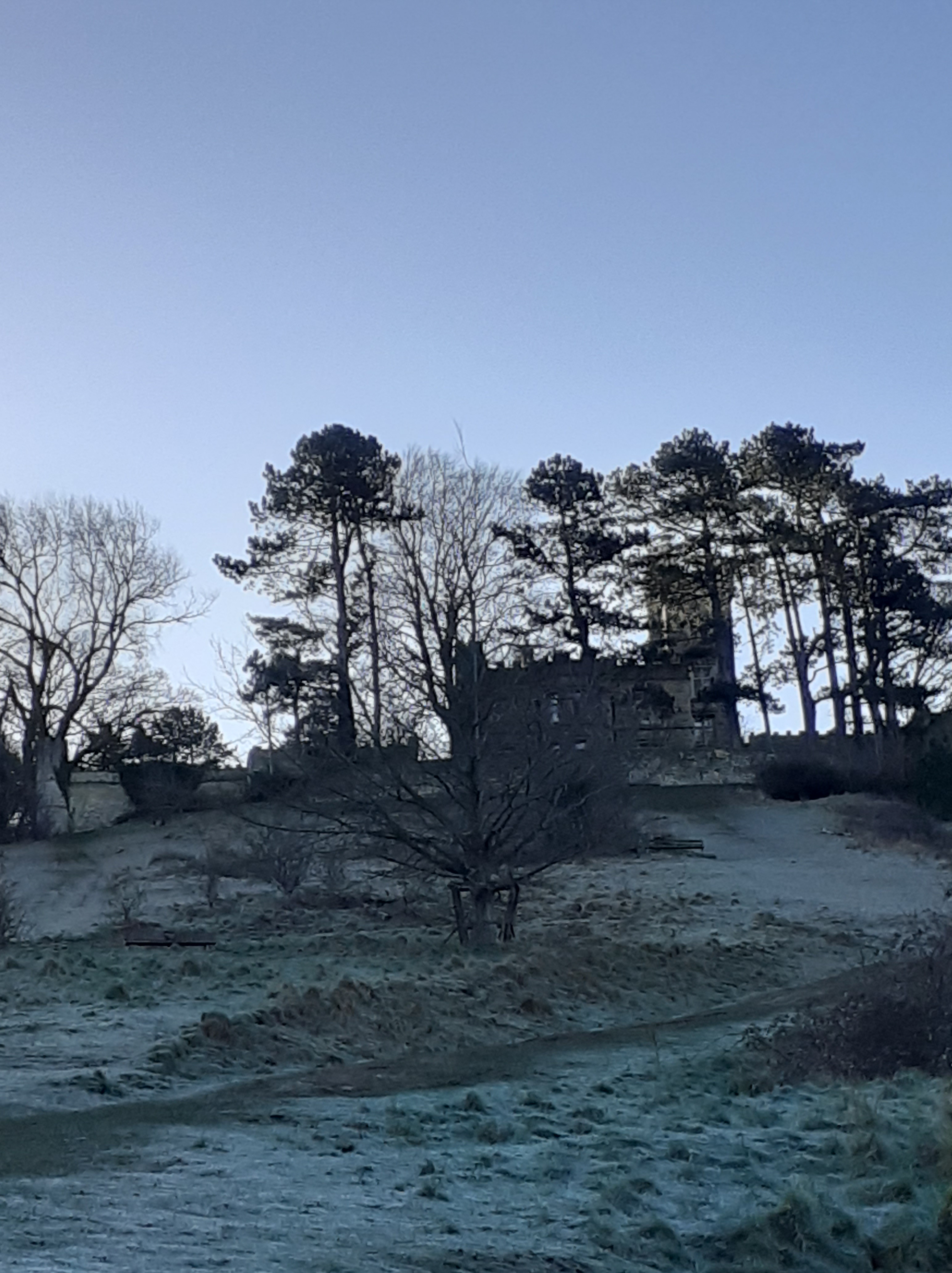
Looking out at the world, I see great variety. In one picture, above, I see a continuing wintry austerity. It is 26 February, somewhat before 9 am. I look up a hill on which the frost has yet to melt. It is daylight, with clear blue sky, but no direct sign of the sun. Light, indeed, but of a chilly kind. The trees have a stern look, reinforced by the battlements behind them – decorative though they might be on this nineteenth century folly of a fort.

The second picture, below, was taken a few minutes earlier, but lower down. There are no signs of frost. There wasn’t any, even on the ground where I was standing. here, I am physically closer to the trees and I feel closer to them. Sunlight is visible on their bark. The looks of these two pictures seem very different, even though they are not much separated in the world’s space and time. I am enchanted by small changes like this. I can lose myself in them.

On the morning of 26 February, there was still a tension between winter and spring characteristics. I do not feel that now, on 2 March, even though a return of frost is quite possible. The year has moved on and I seem to have moved with it. I feel re-invigorated. I feel clearer about the direction of my inquiry, now becoming a more focused contemplation on how I, as a human being, find “a balance between human and Being”, to use the words of Eckhart Tolle (1).

‘Being’ is a way to talk about the Divine, whilst keeping a distance from theistic language and its traditional associations. For Tolle, and I would say now for me, Being is found “in the still, alert presence of Consciousness itself, the Consciousness that you are. Human is form. Being is formless. Human and Being are not separate but interwoven”. This description deepens my existing “At-Homeness in the flowing moment”, identifying it unequivocally as the gateway to immersion in Being. I cannot state this as an objective truth claim. What I can say is that I am being truthful to my experience and deepest intuitions, and that there are many truthful people today and down the ages who have made sense, and continue to make sense of their experience in this way.

When I cast my Druid circle, asking for peace in the four horizontal directions, the below and the above, I finally turn to the centre as the seventh and final direction. Instead of saying, “may there be peace”, I say, “I stand in the peace of the centre, the bubbling source from which I spring, and heart of living presence”. I then chant the Awen. Peace, silence, stillness, emptiness, the space between thoughts, feelings and things – these in my experience do most to open me up to Being. Feelings of joy and lovingkindness are likely to enter in. The Headless Way community talk about our core, formless, identity – our true nature – as that of a clear awake space that is also ‘capacity for the world’. (2). Certainly for me, deepening into Being enriches the human dimension itself – with all of its relationships, activities and roles in 3D timebound reality. In older language, it brings heaven to earth. My contemplative inquiry continues, as a way of supporting this endeavour and sharing it, within the cultural framework of modern Druidry..

(1) Eckhart Tolle Oneness with All Life: Awaken to a Life of Purpose and Presence Penguin Random House UK, 2018 (First ed. published 2008)

(2) http://www.headless.org/

Earth Eclectic

music that celebrates Earth and speaks to the heart

Sarah Fuhro Star-Flower Alchemy

Follow the Moon's Cycle

Muddy Feet

Meeting nature on nature's terms

Rosher.Net

A little bit of Mark Rosher in South Gloucestershire, England

Becoming Part of the Land

A monastic polytheist's and animist’s journal

selkiewife

Selkie Writing…

Charlotte Rodgers

Images and words set against a backdrop of outsider art.

Prof Jem Bendell

living with metacrisis and collapse

Towint

The pagan path. The Old Ways In New Times

The Druids Garden

Spiritual journeys in tending the living earth, permaculture, and nature-inspired arts

The Blog of Baphomet

a magickal dialogue between nature and culture

This Simple Life

The gentle art of living with less

Musings of a Scottish Hearth Druid and Heathen

Thoughts about living, loving and worshiping as an autistic Hearth Druid and Heathen. One woman's journey.

Wheel of the Year Blog

An place to read and share stories about the celtic seasonal festivals

Walking the Druid Path

Just another WordPress.com site

anima monday

Exploring our connection to the wider world

Grounded Space Focusing

Become more grounded and spacious with yourself and others, through your own body’s wisdom

The Earthbound Report

Good lives on our one planet

Hopeless Vendetta

News for the residents of Hopeless, Maine