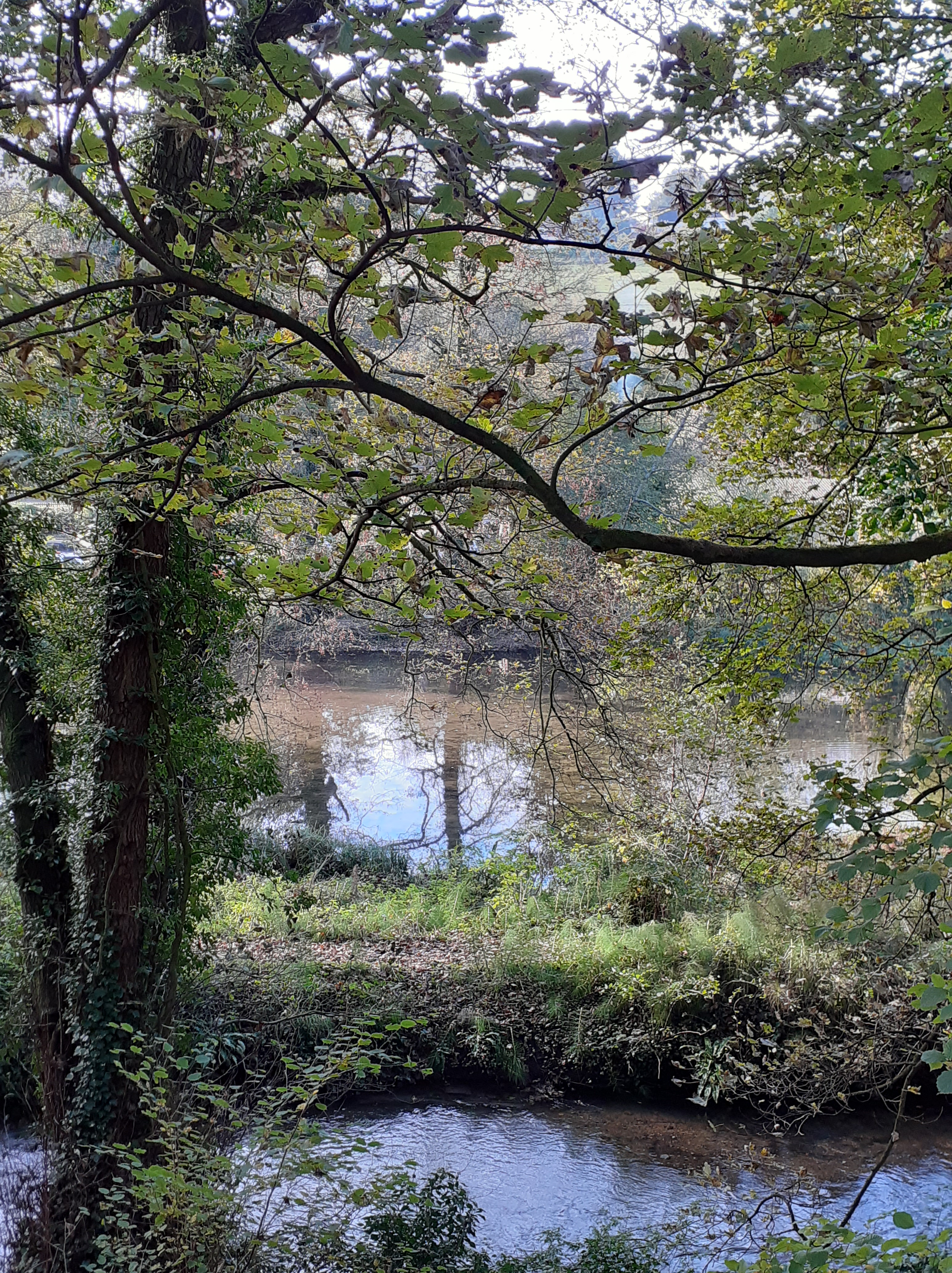
Contemplative Inquiry

This blog is about contemplative inquiry

Tag: Attention

SIMPLE PLEASURE IN AUTUMN LEAVES

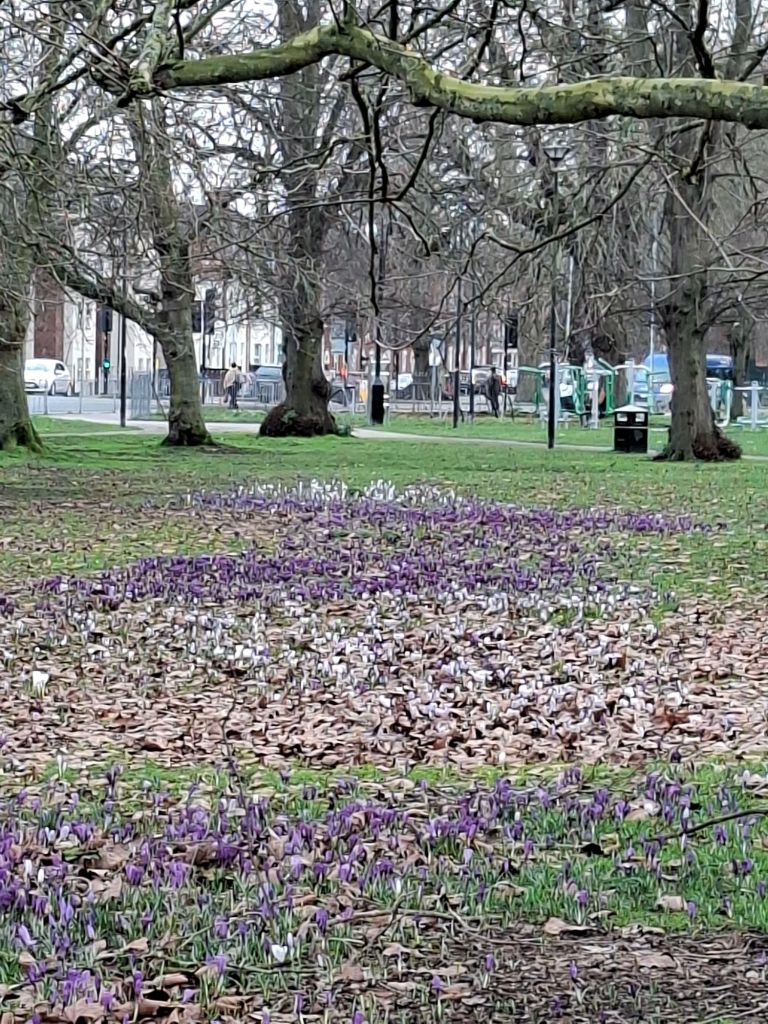
Recently, Elaine and I walked to our local park after a  considerable absence. We were both adequately bold and mobile at the same time. We found a park very different, at least visually, to the sad, dried-up space of late  August and its premature turn.

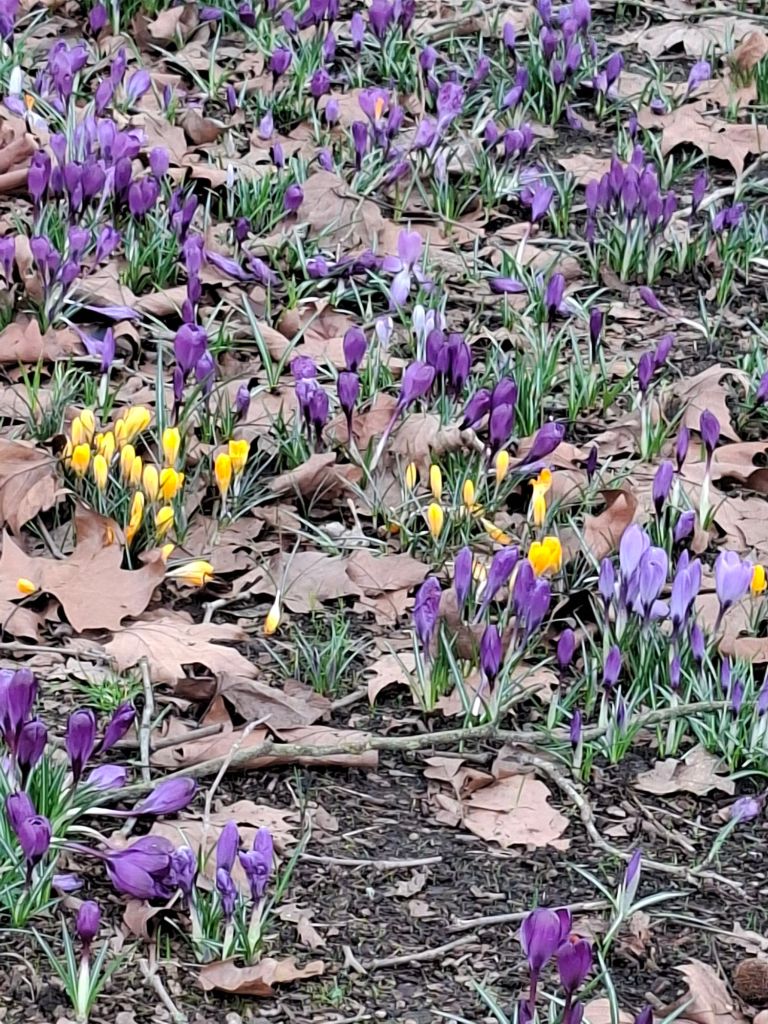
Here, above, is lush life against a background suggestive of mist. Close up, we enjoy the patterns and colours of the leaves. They seem fresh, radiant and alive.

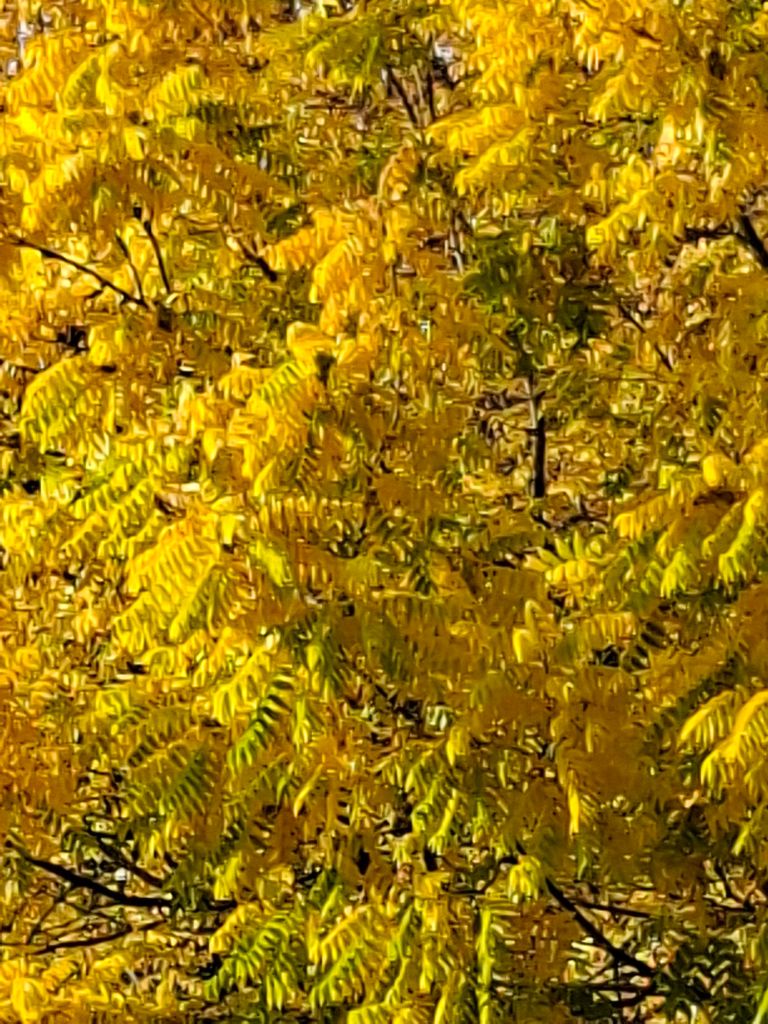
Below, the distinctive yellow of the tree of heaven, and its fern-like leaves, provide a powerful contrast that adds to our enjoyment.

Looking from a somewhat greater distance, below, I experience a sense of majesty in seeing the whole tree (right) leaning into blue sky. Its slightly closer neighbour (left) provides a subtle colour contrast with a deep green intermingled with brown leaves ready to fall.

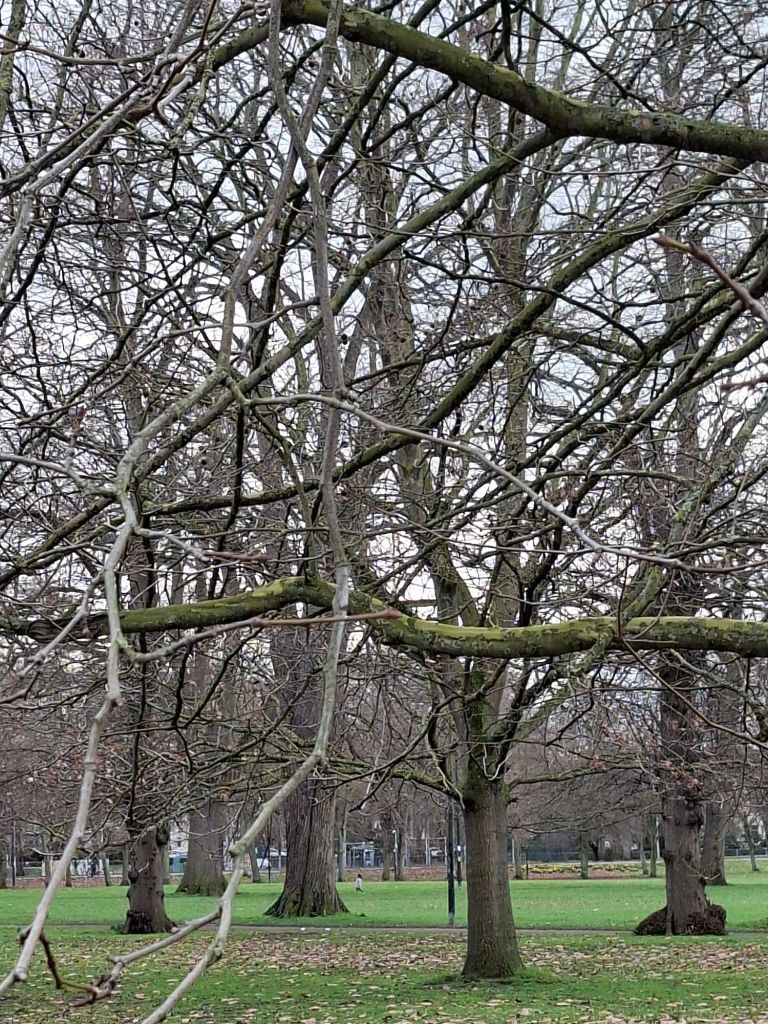
Below, I have stepped back further from the trees. My picture is of a clump of trees in the park. They are largish trees. The person walking past them is dwarfed. But I’m still enjoying leaves. I like the reddish brown emerging from residual green. I see Nature at work in a way that is both understated and beautiful. I know also that it can be a sheltering space within a generally flat and open park.

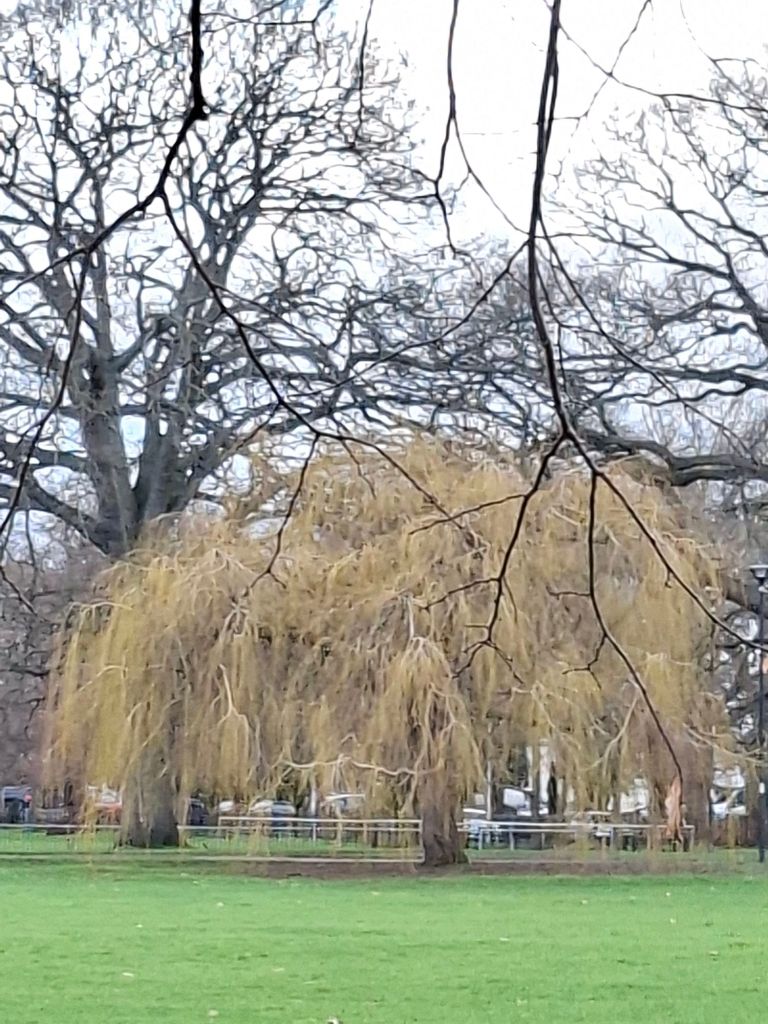
I still have a particular affection for willow, going back 20 years when I was studying Druidry. I was in Bristol and befriended a willow on the banks of the Bristol Avon, where it moves out from the old city towards the Clifton suspension bridge and the gorge. I became a literal tree hugger. It was part of a process that indeed changed my life. Hence my affection for willow. I am glad that there are willows in the Gloucester  City park.

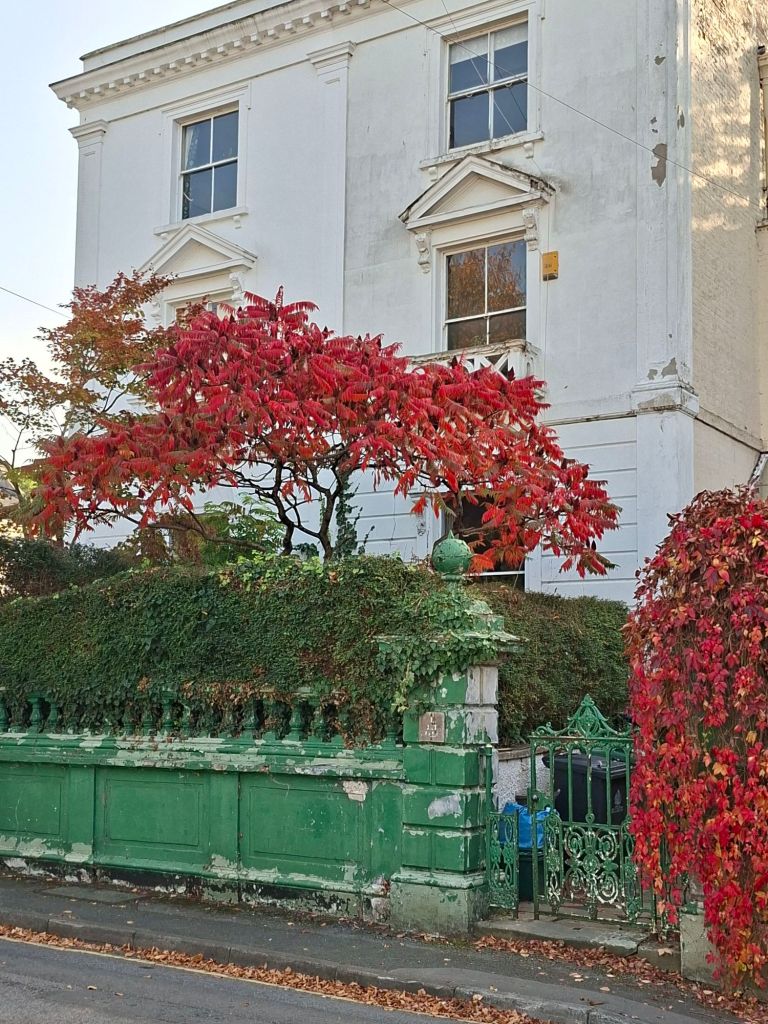
The road we took to and from the park offered leaves of autumnal red. I  believe that the tree in the front garden is a stagshorn sumac. When I walk past the tree I get a little distracted by the property’s obvious  need for a little tlc. Elaine however celebrates the opportunity taken by the Virginia creeper, as seen particularly in the second of the pictures below. It is great to see such abundance in this unpromising space.

For me, the great virtue of simple pleasures is their simplicity itself. Paying attention to the everyday  Nature around us can be deeply nurturing and involves little risk. Yet for some, it can be a portal to re-enchantment in a largely disenchanted world.

AN UNDERSTANDING OF ‘GNOSIS’

My last post was about working with ancient texts. Here I look at the term ‘gnosis’ in the Gospel of Thomas. I am indebted to the commentary of translator Jean-Yves Leloup. Here he reflects on logion 5, whose text I include  in a note below.

“Gnosis is not a system, not another ideology through which we are to interpret and understand the world. On the contrary, it means opening our eyes to what we are already looking at, right in front of us, not searching somewhere else.

”  … Things are not hidden in themselves; they are open – the veils hiding them are in the habits of our own vision, so crude, so overloaded with memories and assumptions about reality, distorting what is before us …

“Gnosis is a long-term work of recognition, of purity of attention so as really to see what is in front of us. The consequence of this attention is that we become what we see and what we love … If we look at chaos, we will reflect chaos. If we look at light, we will reflect light.” (1)

I am glad that this commentary provides more than scholarly exegesis. Leloup says in his introduction that he wants to offer “a meditation that arises from the tilled earth of our silence. It is my belief that it is from this ground, rather than from mental agitation, that these words can bear their fruit of light “. In this way Leloup dreams the myth onwards for our time, and passes the baton to his readers. Both a blessing, and a responsibility.

(1) Commentary on Logion 5, The Gospel of Thomas: The Gnostic Wisdom of Jesus Rochester, VT: Inner Traditions, 2005

(Text translated from the Coptic with commentary by Jean-Yves Leloup; foreword by Jacob Needleman. English translation by John Rowe  Original French edition published 1986).

The translated logion reads:

“Yeshua said:

Recognize what is in front of you, and what is hidden from you will be revealed.

There is nothing hidden that will not be revealed.”

NOTE: See also

CHILD OF THE NOW

‘A SLOW GREEN’

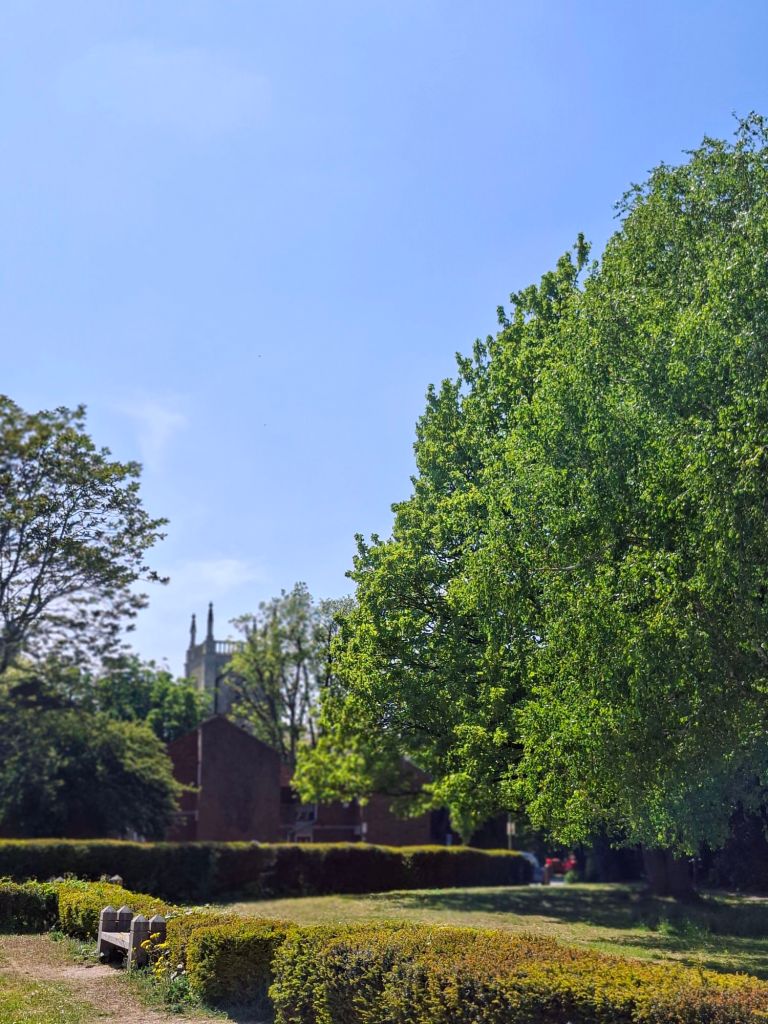
The church of St Mary de Lode, Gloucester, seems to sit among trees. The building salutes the sky without arrogantly trying to reach it. There is a bench towards the foreground of my picture.  I am standing in a friendly urban space, a green space. It is one of many made possible by the Churches and Priories of the old city.  This space is open to all.

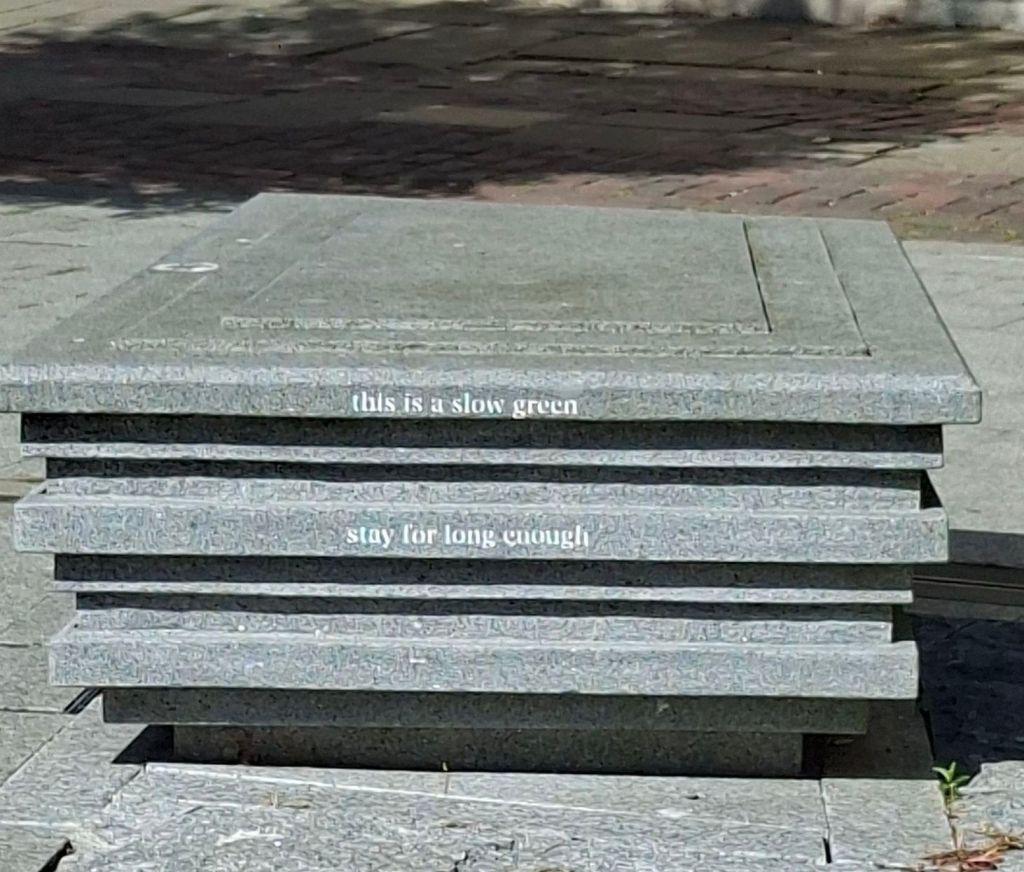
In another such space, on a granite seat close to my home, I recently noticed the words “this is a slow green, stay for long enough”. I have been savouring these words ever since.

They  draw me into an easy receptively, not least when the month is May and the day is warm. The riddle of ‘a slow green’ invites immersion and reverie rather than effortful attention or strategies for problem solving. ‘Stay for long enough’ is probably the wisest counsel. Let’s take the time we need gently to befriend such nurturing spaces when we are blessed to find them.

CONTEMPLATIVE INQUIRY: ‘A VULNERABILITY OF OPENNESS’

My contemplative inquiry requires a “vulnerability of openness” as part of its process (1). For it is based on personal experience rather than theoretical knowledge. If I want to build an ecology of awareness, language and conceptual thinking are not enough. I need to be attentive to the whole of my living experience, including my body’s wisdom, my feelings, my contemplative states and my imagination. I am a living presence in a field of living presences, in a more than human world. My inquiry is really about how best to be awake and flourishing in this field.

Vulnerability of openness is of course not the whole story. It is the yin aspect of an inquiry process that also has its yang. In a recent post (2) I wrote: “My walking time is still restricted. Perhaps because of this, familiar outdoor spaces have become exotic and magical to my eyes. My limiting circumstances are paradoxically making me more focused and attentive, enhancing my felt quality of life. I am readier to find joy in simple, passing experiences.”

This suggests that ‘magical’ experiences, even when apparently unwilled, are enhanced by focus and attention. Agency and will are part of the process too. Language and concepts allow me to bear witness to my unfolding experiences. But for me, without the vulnerability of openness at its root, the entire process is greatly diminished.

(1) Peter Reason (ed) Participation in Human Inquiry London: Sage, 1994

NB Participative inquiry involves groups working together in a collective research process.. But for Reason, the term ‘participation’ refers more fundamentally to human participation in the world: he uses it to challenge the widely assumed primacy of language and conceptual thinking in human experience.

(2) https://contemplativeinquiry.blog/2024/07/09/july-days/

JULY DAYS 2024

My walking time is still restricted. Perhaps because of this, familiar outdoor spaces have become exotic and magical to my eyes. My limiting circumstances are paradoxically making me more focused and attentive, enhancing my felt quality of life. I am readier to find joy in simple, passing experiences.

On my contemplative walks, the shapes and colours of trees move me deeply. Grasses and sky have a similar impact. I am very aware of these July days. I am very aware of summer. I am very aware of my place in the world as the year turns in my immediate neighbourhood.

A little further away, I stand on a canal bridge (below) and look back towards the city, which seems distant and small. Water and sky give me space and perspective. I let the elements of water and air nourish me at a time when I am largely grounded.

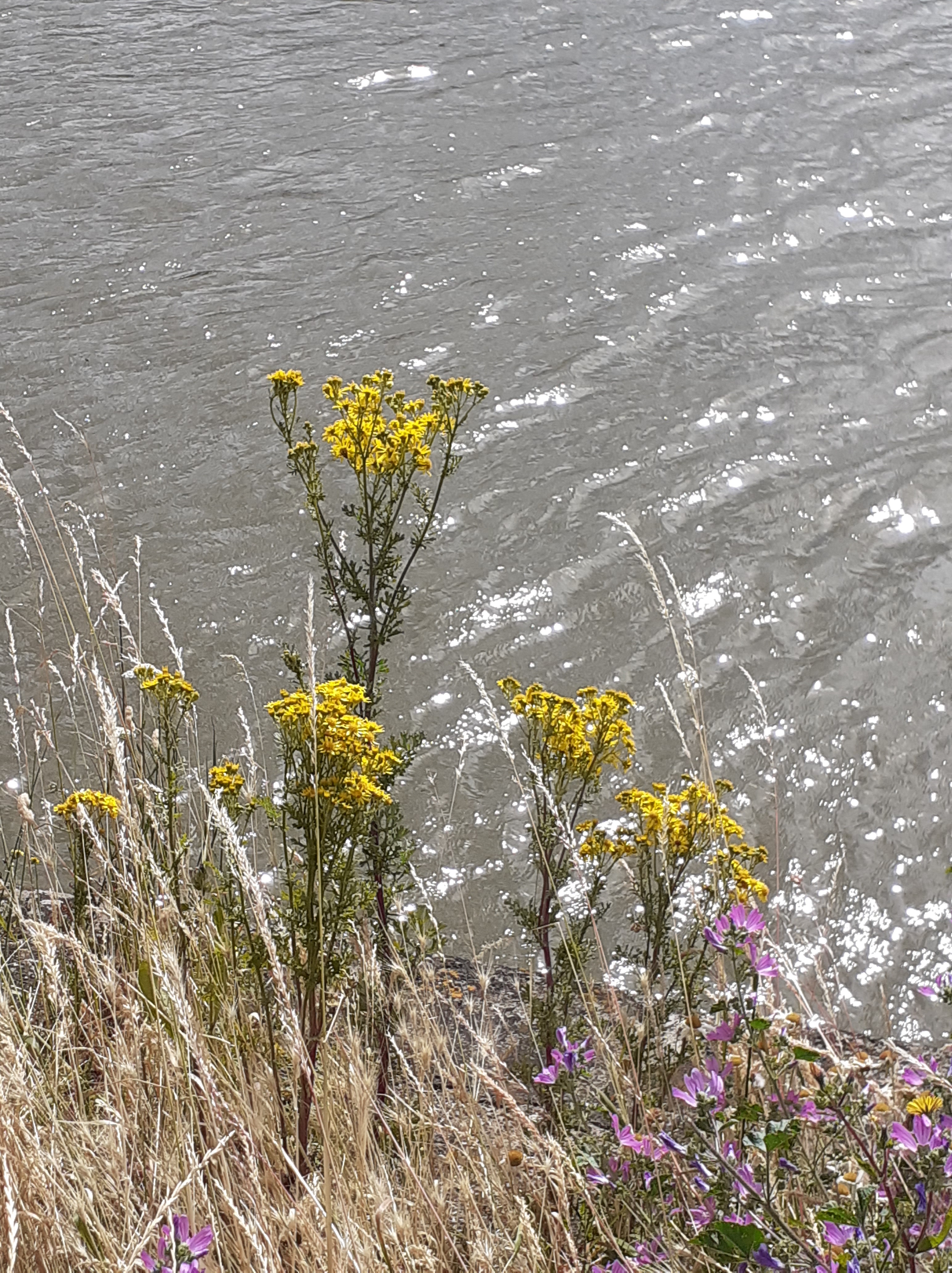
Close up at the water margin, I find light shining on the water. There is energy and movement here. The power of the sun is present in both a shifting luminosity on the water and the flowering resilience on the bank.

I shift into a meditation on the four classical elements – earth, water, air and fire – and how they work together to make the fifth (life, spirit) possible. Consciously engaged with the four, I can stand as the fifth, resourcing my individual life within a world of impermanence and interbeing.

BOOK REVIEW: STOLEN FOCUS

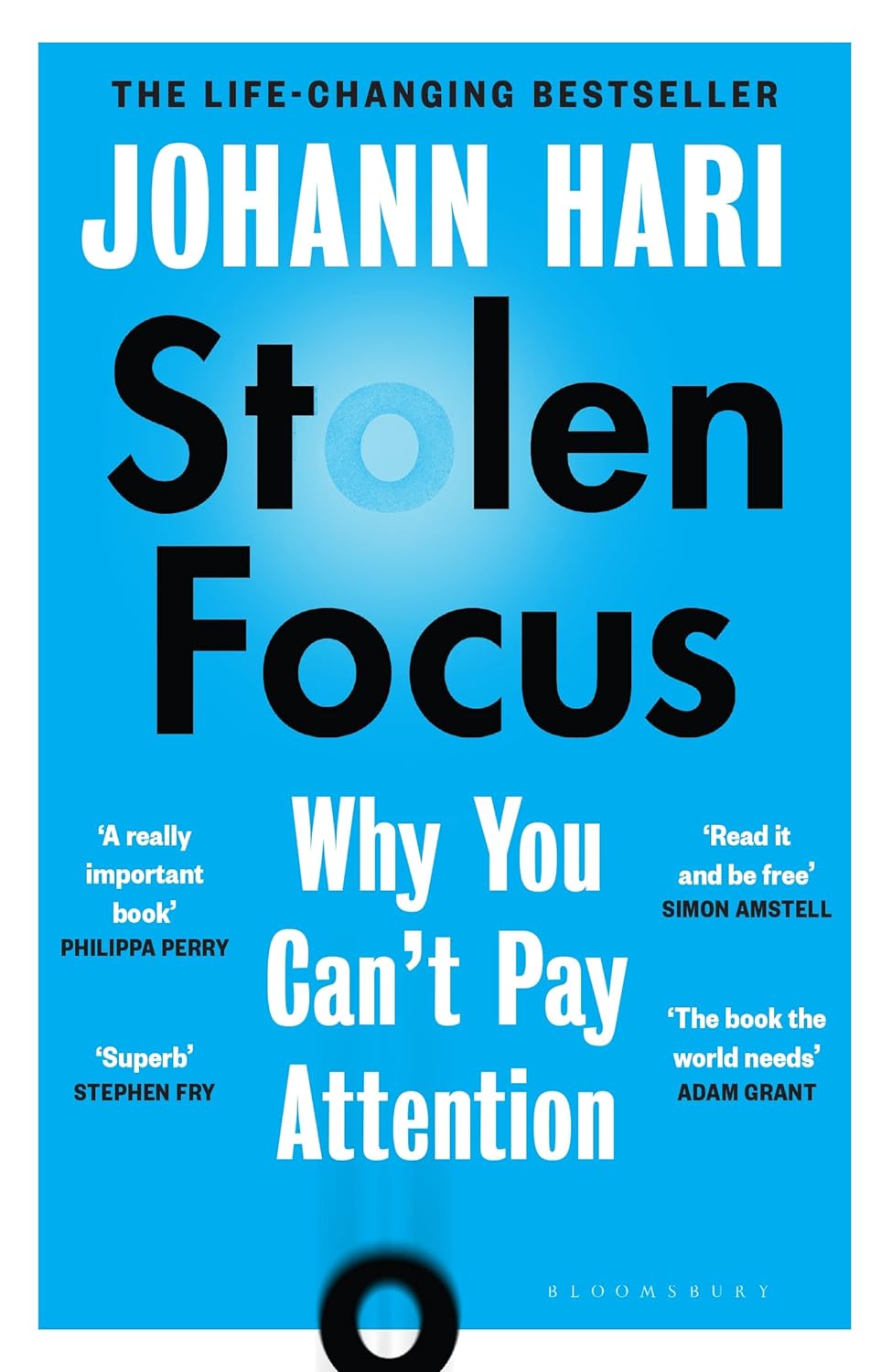
Highly recommended to anyone interested in states of attention, how culture shapes them, and the implications of this shaping. Johann Hari’s Stolen Focus: How You Can’t Pay Attention (1) shows that our diminished capacity to focus is a collective cultural issue and not just a matter of individual willpower. In this book, Hari identifies 12 causes of ‘stolen focus’, developing these themes partly through telling his personal story and partly through conversations with experts in the relevant areas of knowledge. The causes are:

1: Increase in Speed, Switching and Filtering. If we go too fast, and switch between tasks to rapidly, we overload our abilities, and they degrade.

2: Crippling of Flow States Fragmented focus interrupts flow. “Fragmentation makes you … shallower, angrier”, whereas “Flow makes you deeper … calmer”.

3: Rise in Physical and Mental Exhaustion The average amount of time a person sleeps is reducing, damaging our focus. If we stay awake for 19 hours straight we become as cognitively impaired as if drunk.

4: Collapse of Sustained Reading Fewer people are reading books, especially novels. Yet they train focus and encourage empathy. “Very few things worth saying can be explained in 280 characters.”

5: Disruption of Mind-Wandering, seen here not as a form of distraction but as a way of slowly making sense of the world that supports creativity and long-term decisions. Distractions undermine this process.

6: Tec That Can Trap and Manipulate You Big Tec’s business model depends on ‘engagement’ (eyes on screen) to facilitate exposure to advertising and the harvesting of personal data, to be used by the Tec companies themselves and also sold on to other would-be persuaders. Internet services are designed specifically to serve ‘engagement’ in this sense. Traffic is more readily stimulated by exposure to angry rather than calm content. Hence ‘surveillance capitalism’ engineers reactivity, anger and division.

7: Rise of ‘Cruel Optimism‘, a term for offering, in upbeat language, simplistic individual solutions to major social problems – like obesity and addiction. Internet addiction agitation and associated cognitive decline are looked at in the same way.

8: Surge in Stress and Triggering of Vigilance Research shows the top causes of stress for the working population of the USA to be “a lack of health insurance, the constant threat of lay-offs, lack of discretion and autonomy in decision-making, long working hours, low levels of organisational justice and unrealistic demands”. A cause of stolen focus is again linked to powerful external conditions..

9: Deteriorating Diets A widespread switch to supermarket bought processed foods has been “bad for our waistlines and our hearts” and is also “stealing large parts of our ability to pay attention”.

10 Rising Pollution We know that air pollution causes asthma and other breathing problems. There is also “growing evidence to suggest that this pollution is seriously damaging our ability to focus”.

11 ADHD and Our Response to It There has been a huge rise in diagnosed ADHD in school students in the last 30 years. It has been treated largely as a biological disorder, though this is now contested. Personal experiences and environmental conditions are being considered more seriously.

12 Confinement of Children – Physical and Psychological In the western world, children no longer roam free in their own world. Play is indoors and either supervised by adults or located on screens. Schools are largely concerned with preparing and drilling children for tests. This has serious consequences for both learning and focus.

In exploring ‘stolen focus’ and its causes, Johann Hari casts his net wide. In his conclusion, he talks about four levels of now-weakening attention: spotlight, when we focus on immediate actions; starlight, when we focus on projects and longer-term goals; daylight, which makes it possible to know what our longer-term goals are in the first place; and stadium lights, that let us see each other, hear each other, and work together to formulate and fight for common goals. Hari sees all of these lights being dimmed by stolen focus.

Hari advocates for an ‘attention rebellion’ in the manner of XR. Its three main demands would be: to ban surveillance capitalism, because people being “hacked and hooked” can’t focus’; to introduce a four-day week, because people who are chronically exhausted can’t pay attention; rebuild childhood around “letting kids play freely – in their neighbourhoods and at school” to promote a healthy ability to pay attention. He understands that this will be uphill work – the logic of economic growth demands more and more of our time devoted to producing and purchasing. Yet given the crises facing us, especially the climate crisis, we cannot afford the destruction of our attention and ability to think clearly.

This book is not just about big tec and social media. I like the range and quality of the information that Stolen Focus brings to the description and analysis of stolen focus. Hari is clear that self-help solutions – though they may help some people – are not enough. I believe that communities informed by deep ecology, spiritual and therapeutic insights can be oases of sanity and contribute to solutions. But without their being able to influence the mainstream, their impact is bound to be limited. Stolen Focus raises awareness very effectively. Whether or not an ‘attention rebellion’ is the right way forward,, Hari’s recommendations deserve to be taken seriously.

(1) Johann Hari Stolen Focus: Why You Can’t Pay Attention London: Bloomsbury Publishing, 2022 (Kindle edition 2023)

See also: https://contemplativeinquiry.blog/2024/06/13/stolen-focus-speed-switching-and-filtering/

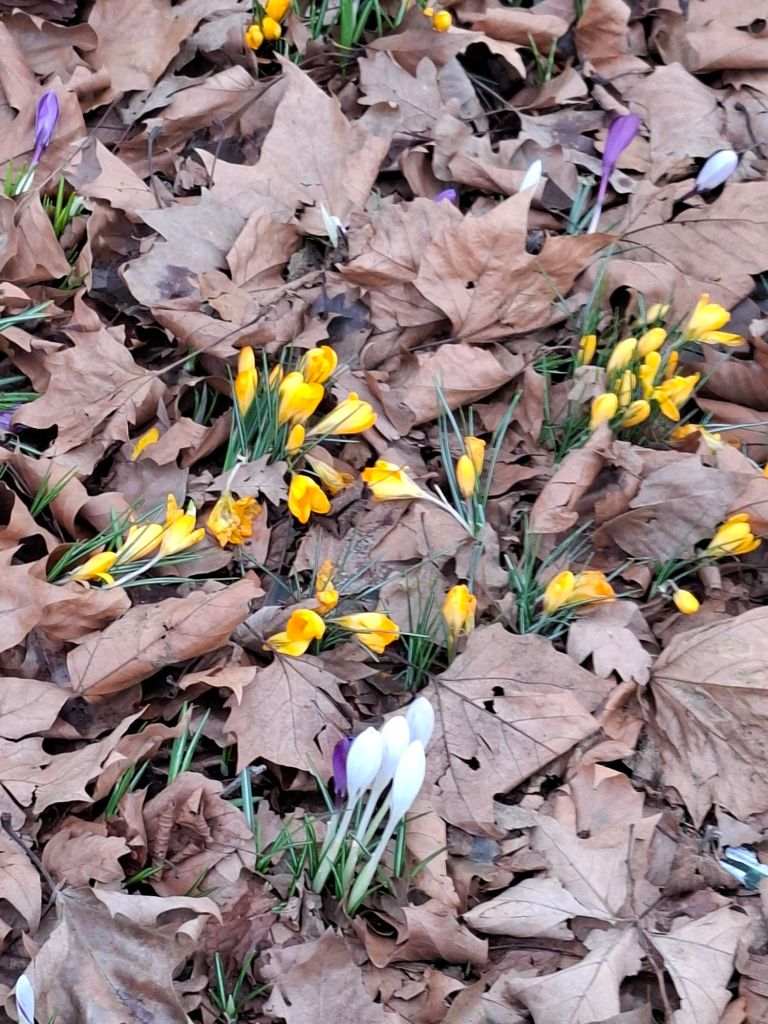
STOLEN FOCUS: SPEED, SWITCHING AND FILTERING

“I went to see the Mona Lisa in Paris, only to find that she is now permanently hidden behind a rugby scrum of people from everywhere on earth, all jostling their way to the front, only for them to immediately turn their backs on her, snap a selfie, and fight their way out again. On the day I was there, I watched the crowd from the side for more than an hour. Nobody – not one person – looked at the Mona Lisa for more than a few seconds.”

Johann Hari’s Stolen Focus: Why You Can’t Pay Attention (1) explores states of attention, how culture shapes them, and the implications of this shaping. I like Hari’s insistence that this is a collective issue and not just a matter of individual willpower. In this book, Hari identifies 12 causes of ‘stolen focus’. I plan to write a review of Stolen Focus soon. This post is about the first cause, which he describes as an increase in speed, switching and filtering.

Speed

According to Hari, modern culture overvalues speed. “People talk significantly faster now than they did in the 1950’s, and in just 20 years, people have started to walk 20% faster in cities” and “the original Blackberry advertising slogan was ‘anything worth doing is worth doing faster'”. But, argues Hari, “if you go too fast, you overload your abilities, and they degrade”. He reminds us that if we engage in deliberately slow practices, like yoga, or tai chi, or meditation … they improve our ability to pay attention by a significant amount.

Switching

Cognitive speeding has been made worse by the myth of multitasking, a term taken from 1960’s computing, when machines began to have more than one processor and could literally do two or more things at once. The human brain doesn’t have that capacity. It is naturally single-minded and isn’t going to change. So when we ‘multitask’, we are actually switching between different tasks, though we may not notice our switching.

The cost of switching is a degradation of our ability to focus, and a decline in our performance. Hewlett- Packard looked at the IQ of some of their workers in two situations. At first they tested their IQ when they were not being distracted or interrupted. Then they tested their IQ when they were receiving emails and phone calls. “The study found that ‘technological distraction’ – just getting email and calls – caused a drop in the workers’ IQ by an average of 10 points … twice the knock to your IQ that you get when you smoke cannabis”. Overall, if you spend your time switching a lot, the evidence suggests “you’ll be slower, you’ll make more mistakes, you’ll be less creative, and you’ll remember less of what you do”.

Filtering

“Think of your brain as a nightclub where, standing at the front of that club, there’s a bouncer. The bouncer’s job is to filter out most of the stimuli that are hitting you at any given moment – the traffic noise, the couple having an argument across the street, the cellphone ringing in the pocket of the person next to you – so that you can think coherently about one thing at a time.” The bouncer in our brain is the pre-frontal cortex, and it is becoming overwhelmed. There are too many stimuli and in many environments noise pollution in particular is interfering more insistently with the flow of our thoughts.

The crisis in attention that Hari outlines is a threat to our quality of life. It weakens our ability to think creatively or deeply. It tends to make us agitated as well as distracted. This is not a good place from which to build healthy relationships or solve complex problems at either the personal or the public level. I experience my contemplative inquiry as a valuable antidote to ‘stolen focus’. But it doesn’t get me everywhere, because loss of focus is a pervasive cultural problem. Beyond writing a review of the whole book, I intend to delve more deeply into the questions that Stolen Focus raises from a personal and a collective point of view.

(1) Johann Hari Stolen Focus: Why You Can’t Pay Attention London: Bloomsbury Publishing, 2022 (Kindle edition 2023)

See also https://contemplativeinquiry.blog/2024/06/17/book-review-stolen-focus/

A CONTEMPLATIVE PERSPECTIVE ON WISDOM

For me, wisdom can take many forms. Below, Eckhardt Tolle emphasises contemplative process over cognitive product. I don’t treat this as an exclusive definition of the word wisdom. But I have certainly been nourished by taking Tolle’s understanding to heart and learning how to let the process unfold.

“Wisdom is not a product of thought. The deep knowing that is wisdom arises through the simple act of giving someone or something your full attention. Attention is primordial intelligence, consciousness itself. It dissolves the barriers created by conceptual thought, and with this comes the recognition that nothing exists in and by itself. It joins the perceiver and the perceived in a unifying field of awareness. It is the healer of separation.” (1)

(1) Eckhardt Tolle Stillness Speaks Vancouver, Canada: Namaste Publishing, 2003

MIDSUMMER CELEBRATION 2022

The place is called Lower Parting, though it is actually a joining. The parting is 3km (just under two miles) up river. There, the River Severn divides into two channels, east and west, to flow around Alney Island. When taking the picture above, I was standing near the point where the channels meet again. It was around 9 a.m. on 22 June. I had not been there before.

Although every time and place is ultimately sacred, some times and places are easier for me to honour. In my experience this is partly a property of the times and places, partly down to culture and tradition, and partly to do with my own inner and outer availability.

On this occasion, I was within a midsummer period which for me lasts from a day or so before the solstice until around 25 June. I like to acknowledge the stasis (standstill) element within the solstice experience. It is not just about a point of time. Like its midwinter opposite and twin, my midsummer allows an extended pause before the wheel of the year turns. My walk on 22 June was an intentional celebration of the midsummer stasis, something between an outdoor walking meditation and a miniature festival pilgrimage. It was built around my first encounter with an intuited special place, now that I am fit enough once more to walk the required distance.

I can easily understand why people in many parts of the world have seen water, especially flowing water, as sacred. I am on a quiet part of a quiet island in the middle of Gloucester city. The wetland here is blissfully unfit for development, and now a nature reserve. I was able to stand here and look out at the joining of the waters, under a blue sky, and surrender to a benign spirit of place. I didn’t have to attend to my attention. In this extended, flowing, moment, nature was doing that for me. I found, here, a generous horizon, and a living peace that invites participation. I am glad and grateful to have discovered this place on this day.

In my tradition, at every seasonal festival, we are asked to think not only of the time we are celebrating, but also of its opposite. Walking back from Lower Parting, I see features in the landscape that help me. My pictures below do not evoke winter, but they do show light and shade within a single image. On planet Earth, the time of my summer is the time of someone else’s winter. These are both ways in which opposites complement each other in an interconnected world.

WISDOM’S HOUSE

Two people hold each other in mutual gaze. Both their mutuality and their individuality are very clear. The space between them defines a chalice, or grail. In stillness they are present to each other, within a dynamic field of I-Thou relationship. The gestalt is one of communion. Their world has come alive.

Eckhart Tolle speaks of a wisdom that is not the product of thought, and which comes with the ability to be still. “Just look and listen. No more is needed. Being still, looking and listening activates the non-conceptual intelligence within you. Let stillness direct your words and actions” (1).

He goes on: “wisdom is not the product of thought. The deep knowing that is wisdom arises through the simple act of giving someone or something your full attention. Attention is primordial intelligence, consciousness itself. It dissolves the barriers created by conceptual thought, and with it comes the recognition that nothing exists in and by itself. It joins the perceiver and the perceived in a unifying field of awareness. It is the healer of separation”.

I think of wisdom, in this sense, as the healer in the heart. Not the organ that continues to pump at a not-too-elevated rate when my blood oxygen declines, and therefore a resiliency factor for my physical health. It is, rather, the heart of awareness – personified again as it has been before by a Goddess of Wisdom. She came to me, at night, at a wakeful time when my breathing was particularly laboured and I felt like a freshly landed fish. She acted as a discreetly background presence, pointing me to the vision of a radiant grail, palpably emanating the energy and resources of all four elementary powers.

Pragmatically I felt empowered to weather a challenging experience. Beyond that, the Goddess invites me to let go of identification with the mind-made ‘little me’ as a limited and confining construct. The reward is an expansion into love, joy, creativity and inner peace. I have bounced back from my COPD flare-up in the last few days and will do what I can to rebuild my physical capacity. But the lesson, that healing is not the same as being physically fixed, and asks for a different kind of commitment, applies both in bad times and good.

(1) Eckhart Tolle Stillness Speaks Novato, CA, USA: New World Library & Vancouver, BC, Canada: Namaste Publishing, 2003

Earth Eclectic

music that celebrates Earth and speaks to the heart

Sarah Fuhro Star-Flower Alchemy

Follow the Moon's Cycle

Muddy Feet

Meeting nature on nature's terms

Rosher.Net

A little bit of Mark Rosher in South Gloucestershire, England

Becoming Part of the Land

A monastic polytheist's and animist’s journal

selkiewife

Selkie Writing…

Charlotte Rodgers

Images and words set against a backdrop of outsider art.

Prof Jem Bendell

living with metacrisis and collapse

Towint

The pagan path. The Old Ways In New Times

The Druids Garden

Spiritual journeys in tending the living earth, permaculture, and nature-inspired arts

The Blog of Baphomet

a magickal dialogue between nature and culture

This Simple Life

The gentle art of living with less

Musings of a Scottish Hearth Druid and Heathen

Thoughts about living, loving and worshiping as an autistic Hearth Druid and Heathen. One woman's journey.

Wheel of the Year Blog

An place to read and share stories about the celtic seasonal festivals

Walking the Druid Path

Just another WordPress.com site

anima monday

Exploring our connection to the wider world

Grounded Space Focusing

Become more grounded and spacious with yourself and others, through your own body’s wisdom

The Earthbound Report

Good lives on our one planet

Hopeless Vendetta

News for the residents of Hopeless, Maine