“Contrary to the current genetic determinism that sees increased longevity as a wasted aberrance created by civilisation, The Force of Character presents an explosive new thesis: the changes of old age, even the debilitating ones, have purposes and values ordained by the psyche. The older we become, the more our true natures emerge. Thus the final years have a very important purpose: the fulfilment and confirmation of character.” (1)
I have known and walked with James Hillman’s book for a number of years, but only recently have I felt it coming into its own in my life. Hillman, originally a pupil of Carl Jung, went on to found his own school of Archetypal Psychology – a psychology which remembers that ‘psyche’ first meant ‘soul’. He describes his own journey as about challenging what he sees as limiting beliefs that “clamp the mind and heart” (1) into positivistic science, bottom-line capitalism and religious fundamentalism.
I am growing old and experiencing frailties together with a beloved partner in the same position. What is happening in the depths of my psyche? I notice that I do not perceive a single entity here, but multiple aspects, including a dialogue between youth and age. Both have always been present. But their roles have changed. I now find myself seeking them out, engaging with them and listening to them.
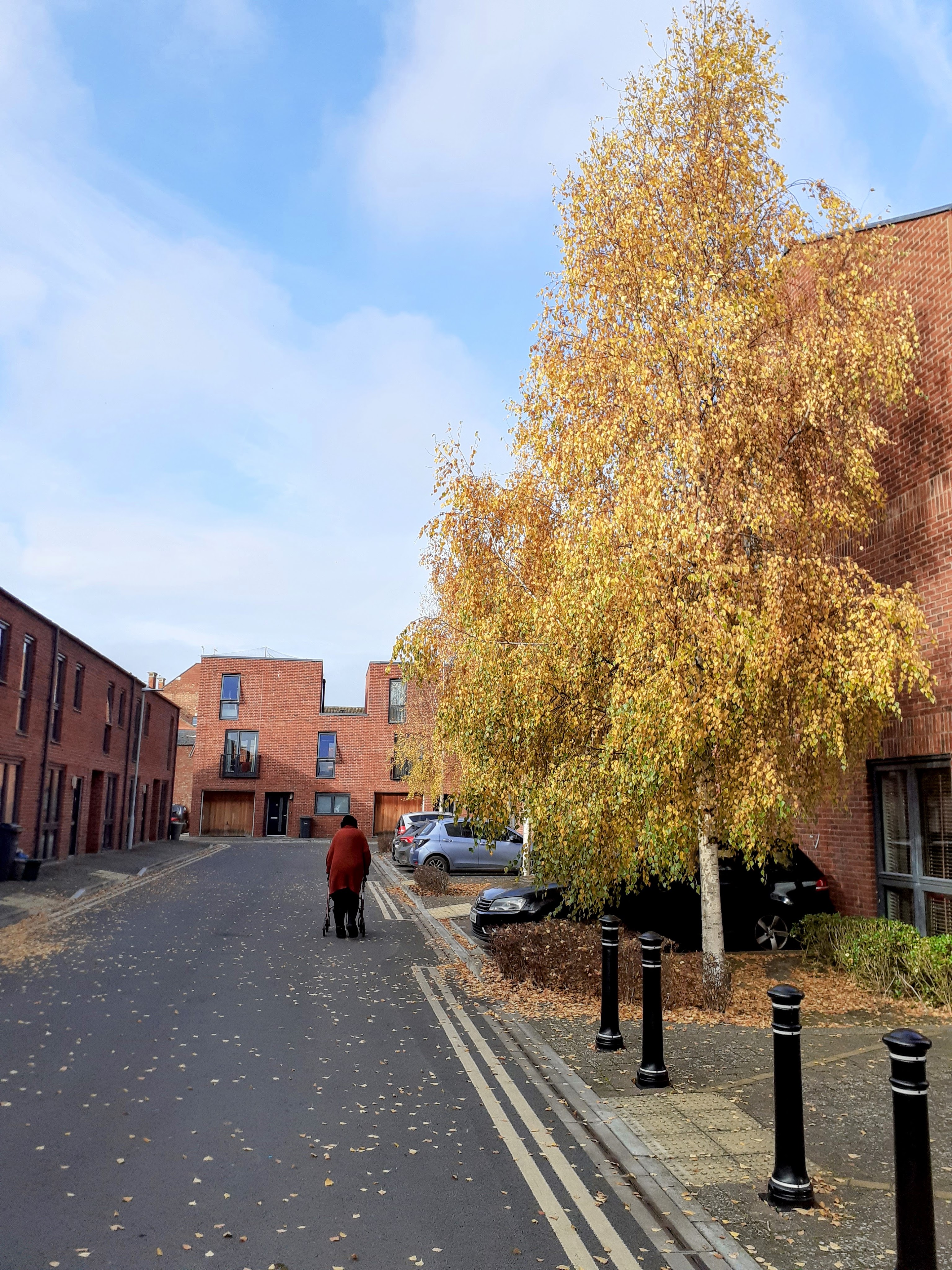
How do I recognise re-enchantment in my everyday life? Simply being open and alert to experiences as they come. On the morning of 10 November there was blue sky for a limited period. We walked around our Greyfriars Estate (once the site of a Franciscan Priory). There was a good-natured Remembrance Parade close-by: a custom beginning in 1919 after Word War I, when people hoped they had been through the war to end all wars. I am not very military minded but I’m glad we have this occasion all the same. I’ve made it to 75. A lot of the people we think about at this time didn’t make to 20 and they shouldn’t be forgotten. Honour was being paid to the dead, and an intentional act like that always changes the space.
Elaine and I however were at some distance from the event so that she could practice her walking. Whilst I was looking at some young birch trees with vigour still in their end-of-autumn leaves, Elaine carried on walking on her own. She didn’t need me hovering around her. It was the first time she’d walked outside on her own since her accident in Gran Canaria six months ago. I had witnessed a wonderful emancipation and, more than that, a fulfilment and confirmation of character.
(1) James Hillman The Force of Character and the Lasting Life Milsons Point, NSW: Random House Australia, 1999. First quote from back of cover blurb, second from main text.
This post looks at Animism as the guiding principal of my Druidry. The term itself comes from nineteenth century anthropology, and is somewhat problematic. Scholars from European and North American backgrounds , formed by a mix of Christian and secular ideas, were studying, and labelling, the traditional practices of other people. The people themselves were mostly in the process of becoming colonial subjects and living in cultures under stress. So ‘Animism’ started out as a top-down classification, which gave Animists a lowly position in the hierarchy of cultural and spiritual life. A stigma persists to this day.
Despite this dubious history, the word ‘Animism’ is now being turned around by people from the global north itself, spiritually hungry in our now palpably faltering 21st century world. Some years ago, research by Graham Harvey distinguished two positive uses of the term Animism among modern western Pagans. “Some Pagans identified Animism as a part of their religious practice or experience which involved encounters with tree-spirits, river-spirits or ancestor-spirits. This Animism was metaphysical. … Other Pagans seemed to use ‘Animism’ as a short-hand reference to their efforts to re-imagine and re-direct human participation in the larger-than-human, multi-species community. This Animism was relational, embodied, eco-activist and often ‘naturalist’ rather than metaphysical” (1).
My Animism draws primarily on the second of the two accounts above. But it is deepened by a Buddhist influence, especially that of the Vietnamese Zen Master Thich Nhat Hanh: “There is no absolute dividing line between living matter and inert matter. If we took the so-called inanimate elements out of you and me, we would not be able to live. We are made of non-human elements. This is what is taught in the Diamond Sutra, an ancient Buddhist text that could be considered the world’s first treatise on deep ecology. We cannot draw a hard distinction between human beings and other living beings, or between living beings and inert matter. There is vitality in everything. The entire cosmos is radiant with vitality. If we see the Earth as a block of matter lying outside of us, then we have not yet truly seen the Earth. The Earth is also alive” (2).
Thich Nhat Hanh follows an old tradition. In thirteenth century Japan, Zen Master Eihei Dogen had taught that enlightenment is just ‘intimacy with all things’. Elsewhere in his own text, Thich Nhat Hanh says: “Just as a wave doesn’t need to go looking for water, we don’t need to go looking for the ultimate. The wave is the water. You already are what you want to become. You are made of the sun, moon and stars. You have everything inside you”. Thich Nhat Hanh explains that a flower is made only of non-flower elements. We can say that the flower is empty of separate self-existence. But that doesn’t mean that the flower is not there. “When you perceive reality in this way, you will not discriminate against the garbage in favour of the rose” (2).
This Buddhist wisdom doesn’t seem to me to come directly out of the four noble truths or eightfold path. The Buddhists of south-east and east Asia were at ease with the traditional Animism of their cultures, and the views expressed above appear to me to be at least partly a cultural gift from the Animists. Japan, for example, was intensely influenced by Buddhism without any thought of displacing Shinto, and the traditions readily interwove.
It was otherwise in the west. Already, In the first century CE, the Roman philosopher Plutarch wrote of the death of Great Pan, after the time of Jesus but before the rise of Christianity. James Hillman comments: “With Pan dead, so was Echo; we could no longer capture consciousness through reflecting within our instincts. … The person of Pan the mediator, like an ether who invisibly enveloped all natural beings with personal meaning, with brightness, had vanished. Stones became only stones – trees, trees; things, places, animals no longer this god or that, but became ‘symbols’, or were said to ‘belong’ to one god or another. When Pan is alive, then nature is too – the owl’s hoot is Athena and the mollusc on the shore is Aphrodite … Whatever was eaten, smelled, walked upon or watched, all were sensuous presences of archetypal significance”.” (3).
James Hillman, after service as Director of Studies as the Jung Institute in Zurich, went on to develop his own form of archetypal psychology. He was a strong proponent of Panpsychism, a world view very similar to forms of Animism being articulated today. Panpsychism literally means the ensoulment of everything (from the Greek), though the sound ‘Pan’ also associates us with the god. At the same time this view broadly fits with the understanding of Zen Buddhist Thich Nhat Hanh, described above.
‘Animism’ is for me a word, not a thing, or a another religious banner to raise. It points to a wide range of experiences, understandings, and articulations. Pinned down to a single, dictionary definition, it would lose its power and energy. Yet Animism has become the word that best describes my way of being a modern Druid, both as view and as practice. I find it grounding and regenerative to have decisively adopted this word.
(1) Graham Harvey (ed.) The Handbook of Contemporary Animism London & New York: Routledge, 2014 (First published by Acumen in 2013)
(2) Thich Nhat Hanh The Art of Living London: Rider, 2017 (Rider is part of Penguin Random House)
(3) James Hillman The Essential James Hillman: A Blue fire London: Routledge, 1989 (Introduces and edited by Thomas Moore in collaboration with the author)


 Contemplative Inquiry