Contemplative Inquiry

This blog is about contemplative inquiry

Tag: Apple Tree

DEEP AUTUMN 2025

“All things ripen and rot that rose up at first,

And so the year runs away in yesterdays many,

And here winter wends again, as by the way of the world it ought,

Until the Michaelmas moon has winters boding brought.” (1)

Even today, deep autumn opens the door to winter. This was even more the case in the North Staffordshire and Derbyshire regions of 14th century England, where Sir Gawain and the Green Knight was written. Even in castles, people were less sheltered from the growing cold and damp than we are. So readers and listeners of the period are reminded that the coming of winter is both natually and divinely ordained.

Here and now, the sight of the apple harvest in its later stages (pictured above) seems quite different than in the early ones (2) – less bright, less novel, less shiny. Rotting apples lie on the ground, now fallen outside the wall of  Gloucester Cathedral’s orchard. From Nature’s exuberant perspective, this is all part of the plan.  Waste is built in.

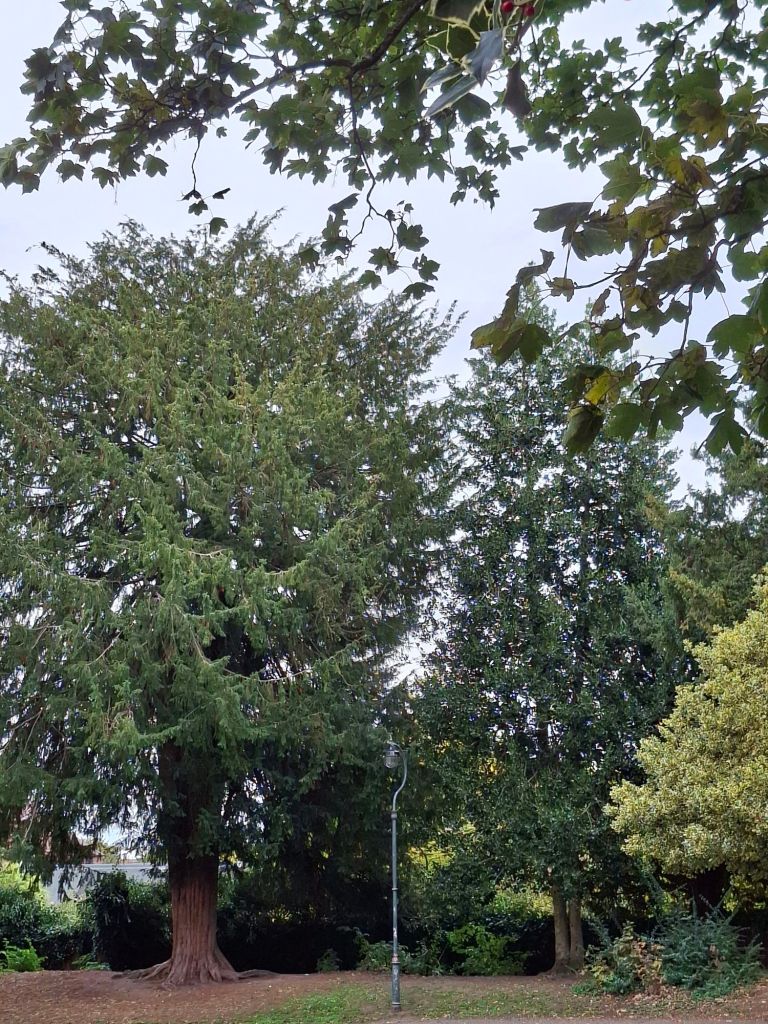
This time draws me further into the declining year. I am in the cathedral’s  grounds, now looking at a yew tree and its associations with death. I’m thinking of the approach of Samhain (aka Halloween/All Hallows) at the turn of the month. Once it marked the 3rd harvest of the year – the blood harvest, where animals were slaughtered in preparation for winter. Now it is more a time to remember our ancestors, and our dead more widely.

Yet the seasonal moment, and the yew, can also be linked to wisdom and transformative change in life. I launched my contemplative inquiry at Samhain 2011. Like many people, I find that this period can be a resonant and creative time.

Below the yew, I have included a section of the cathedral itself. I have old personal associations linking medieval Gothic architecture with the feeling-tone of the declining year. I am also aware that this building is linked to the trees I picture and discuss. Gloucester Cathedral was a monastery when Sir Gawain and the Green Knight was written but many of its features were already in place.
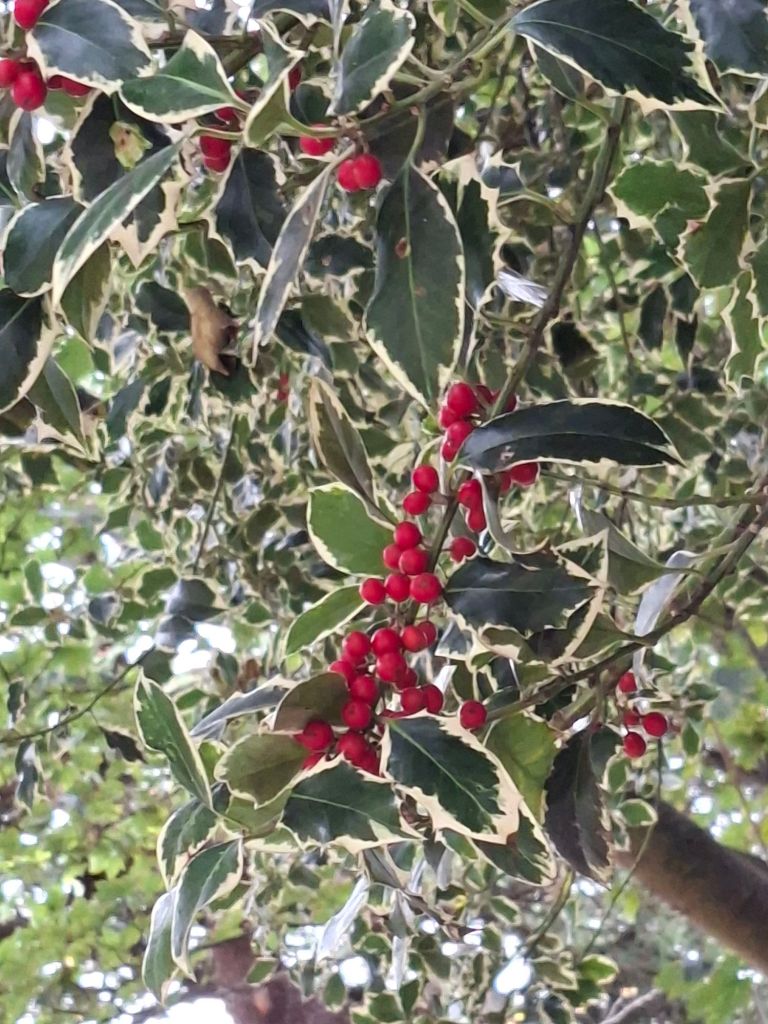
In the same space, I find both holly and ivy, with berries on the holly tree.  I immediately thought of the Christmas carol The Holly and the Ivy. It is an ancient folk carol, which interweaves Christian themes and others that belong with the land. The version which is now popular was collected by Cecil Sharp in 1909 in Gloucestershire from Mary  Clayton.

Many people think that the indigenous Pagan themes are the oldest, and that the central focus here is on the holly. The authors of The Green Man Tree Oracle say: “Holly’s connection with the Green Man is especially strong. In his guise as the Holly King – an ancient giant and symbol of fertility – the Green Man makes a notable appearance in the 14th century poem Gawain and d the Green Knight. Here he takes the form of a fearsome knight, who comes to King Arthur’s court to offer a midwinter challenge, carrying a club of holly and wearing a holly crown (as symbols of his true identity).” This challenge happens every year, where the Green Man/Holly King demands that we encounter him through our dealings with the natural world.

Elaine and I went to the Gloucester Cathedral Close and its surroundings on Saturday afternoon 18 October to outrun an  extended period of gloom, wind and rain. We are now in it, so the lessons of the trees in deep autumn, anticipating the coming of winter, are not lost on us. The dark of the year is on its way.
(1) J.R R. Tolkien (translation of anonymous texts) Sir Gawain and the Green Knight, Pearl, Sir Orfeo New York: Ballantine Books, 1980.

(2) https://contemplativeinquiry.blog/2025/08/22/ (3rd photo)

(3) John Matthews & Will Worthington The Green Man Tree Oracle: Ancient Wisdom from the Greenwood London: Connections, 2003

LATE AUGUST 2025: SETTLING INTO AUTUMN

It is evening and for me autumnal. The sky offers the water a soft light, seemingly pink and grey. The water reflects this back, adding its own hint of mist. It is a tranquil scene.

For the first time this year, I feel a tug towards the Equinox, just under a month away. These canal waters are gentle, but they are drawn from the River Severn, site of the Severn Bore (1). Perhaps the waters are nudging something  – maybe the water – in me.

A little later, facing into the declining sun (below) I see the sunset and its effects. I notice the concentrated power of the orb as it appears to reach the earth, and the way in which this energy disperses into the sky. The colour coding shifts from intense white to yellow to red-orange to an orange becoming increasingly grey. I live at latitude 52 north, and the sunset is getting earlier every day, now 8.15pm. Another autumnal feature.

Autumn is also the season of the fruit harvest. This year, many people are commenting that the fruit harvest is arriving early. Below, against the background of a clear blue daytime sky, an apple tree is fruiting. The tree is close to Gloucester Cathedral and may belong to it. Medieval Gloucester was a place of churches and priories. It was also a place of orchards, many of them cultivated by monks and friars. The picture points to natural and cultural continuity, though the  fruit are early this year. I am no longer at a point tension between seasons. I am already settled in autumn.

(1) The Severn Bore is a natural tide phenomenon occurring in the River Severn in England, where a large wave surges upstream. It’s caused by the Atlantic tide pushing into the Bristol Channel and funneling it into the narrowing Severn Estuary, creating a more powerful wave that can be up to two meters high and a speed of up to 21 km/h. The Bore travels up the Severn Estuary, from Awre to Gloucester, a distance of 25 miles. It is strongest in the equinoxes (especially spring) and a popular challenge for surfers, kayakers and paddleboarders.

COLOURS OF AUGUST, 2023

The haws are red and shiny on their hawthorn bushes. Blackberry remains tentative, its pale green fruit visible but still unripe. I see green leaves now leaning towards yellow. I am walking in a scrap of local woodland, bounded by a canal* on my left and housing some distance to my right. It is around 7.30 pm on 13 August, and I am opening up to the colours of late summer as they show themselves this year.

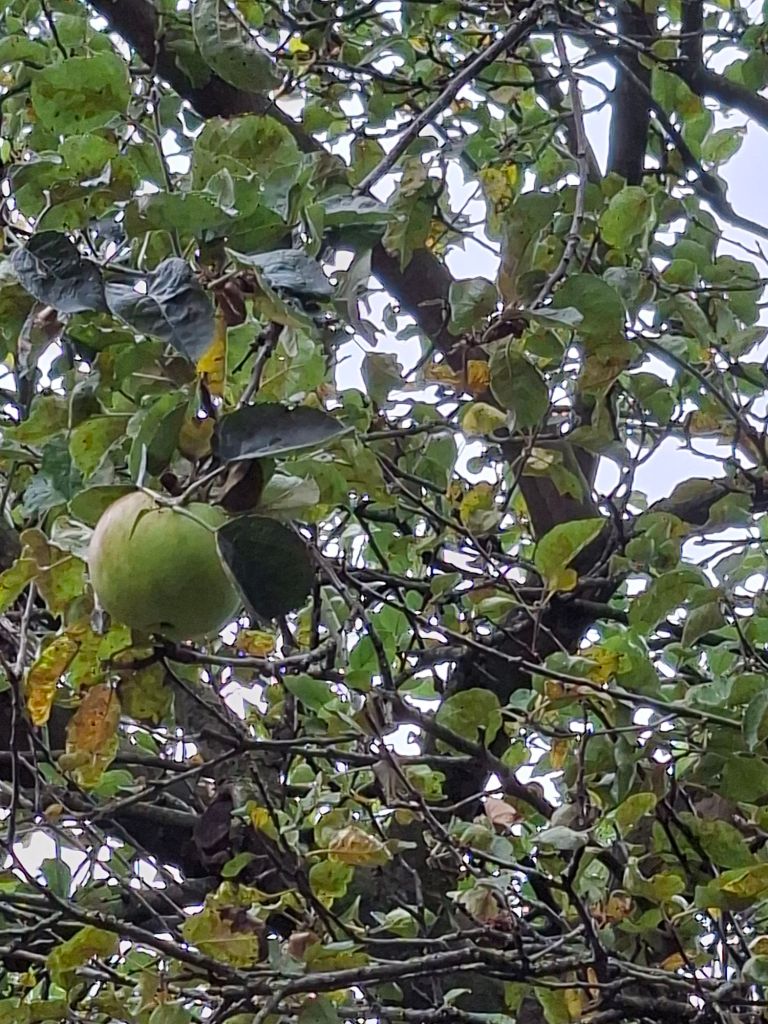
Looking up, I see a healthy crop of crab apples at different stages of ripening on their tree. The ripest apples are red, though their red is softer than that of the haws. The leaves of the apple tree are shinier than those in the background. I am aware of a light grey sky.

Nature in various forms finds a niche everywhere. This time has its own flowers, and again I see yellow. I am not the greatest botanist. and I cannot name with certainty these plucky if slightly battered blooms, saying hello from behind a fence. But I imagine them as poor relations of even the lesser celandine, and therefore almost certainly official weeds**. I hope and pray they remain safe here in these woods.

Below, looking at tangled leaves, I find a truly autumnal scene, in the yellowing and browning of leaves. It feels a bit early for this neighbourhood. The wheel of the year is still following its seasonal course, so far, but is becoming more erratic and unpredictable than in the past. I wonder about the future of the jet stream – and indeed the Gulf stream too. But in the moment, my heart opens and I love this pattern of plant life moving through its cycle and gradually, subtly, changing in appearance.

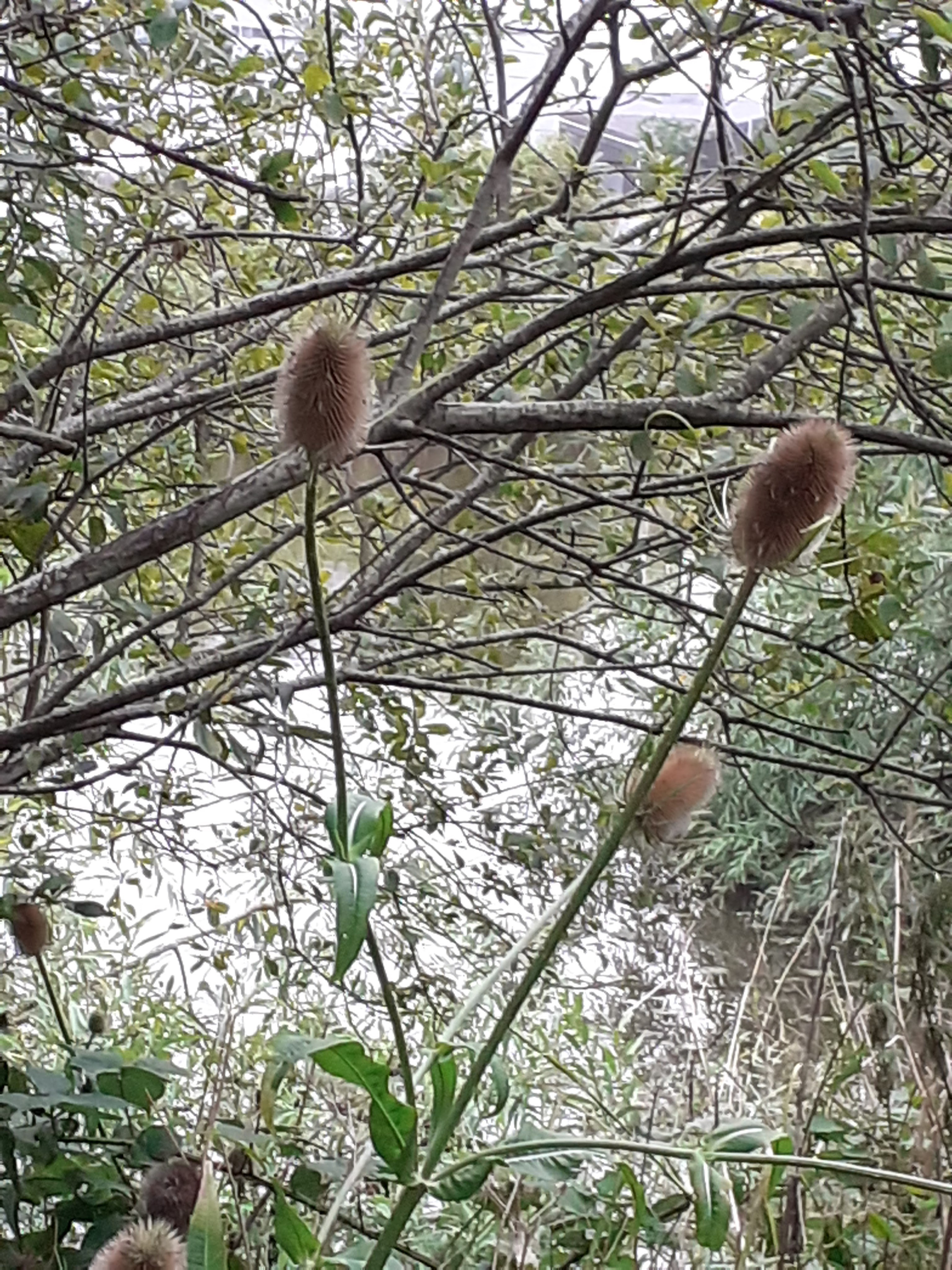
I photograph two teazel stalks, below, because I enjoy their shapes, because they are a further illustration of the browning theme, and also because of the visibility of the canal behind them. They don’t live in the canal, like bullrushes, but they like to be close. The image also includes an almost ghostly barge on the water below.

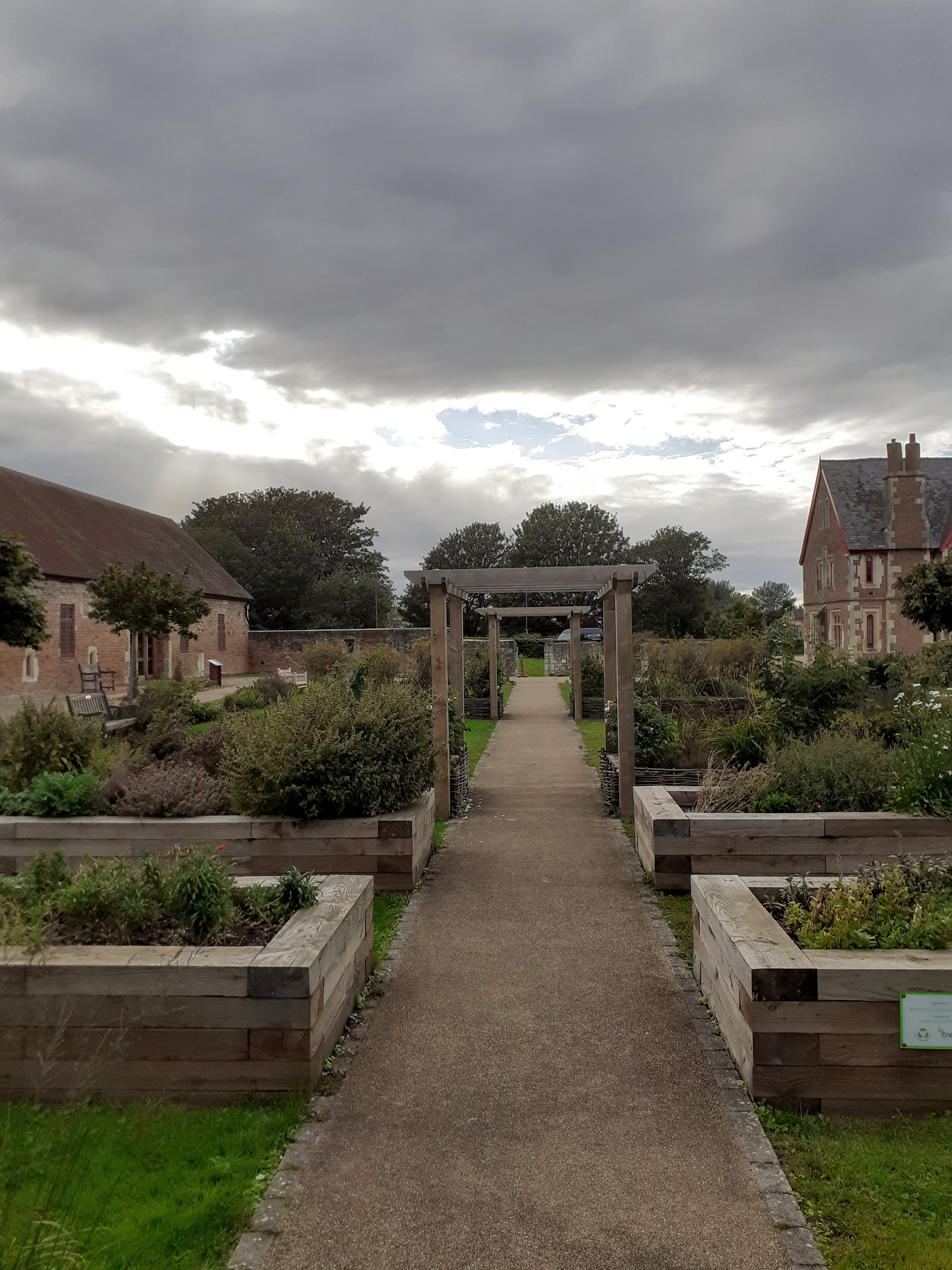
After leaving the woods, I am confronted (below) with the sky. I am facing west, across the Llanthony Priory gardens. I see dark stormy clouds, whose edgy brooding energy is somewhat modified by a blue opening in the distance. This dark grey, and the rain and storm it sometimes brings, have certainly been a feature of summer this year. There’s a strong contrast with last year at this time, when there was a heat wave, which for us still means C 30-35/F 86-95 with anything more being exceptional. In July 2022 part of the country briefly reached over C40/F 104 for the first time since records began. This year the grass is still green. Last year it burned up and the ground was parched and cracked.

Following the wheel of the year carefully, as it turns, is a valuable discipline for modern Druids, among others concerned with deep ecology (sacred ecology?) and the climate crisis. We don’t confine ourselves to celebrating our seasonal festivals, though we enjoy them too. For we now know experientially that the world is changing. The traditional rhythms of nature are not an eternal verity to rely on.

In some ways I find small personal observations emotionally more impactful than my limited knowledge of climate science and deep time geology. These are very helpful for context and framing, but personal experience is more immediate than these. It is also more deeply immediate, though less dramatic and disturbing, than reports of disaster elsewhere. Following the wheel of the year, we are doing more than making observations. We are celebrating and bearing witness to the life that surrounds us, offering our attention and energy to its continued flourishing. Blessings on the land.

*The Gloucester-Sharpness canal, England. Beyond the Gloucester docks, but not yet out of the city.

** A reader comments: “I think your mystery plant is ragwort, a much maligned ‘weed’ the destruction of which is encouraged by the UK government as it can be harmful to grazing animals yet is actually one of the best forage plants for pollinators”.

DEATH (THE APPLE WOMAN)

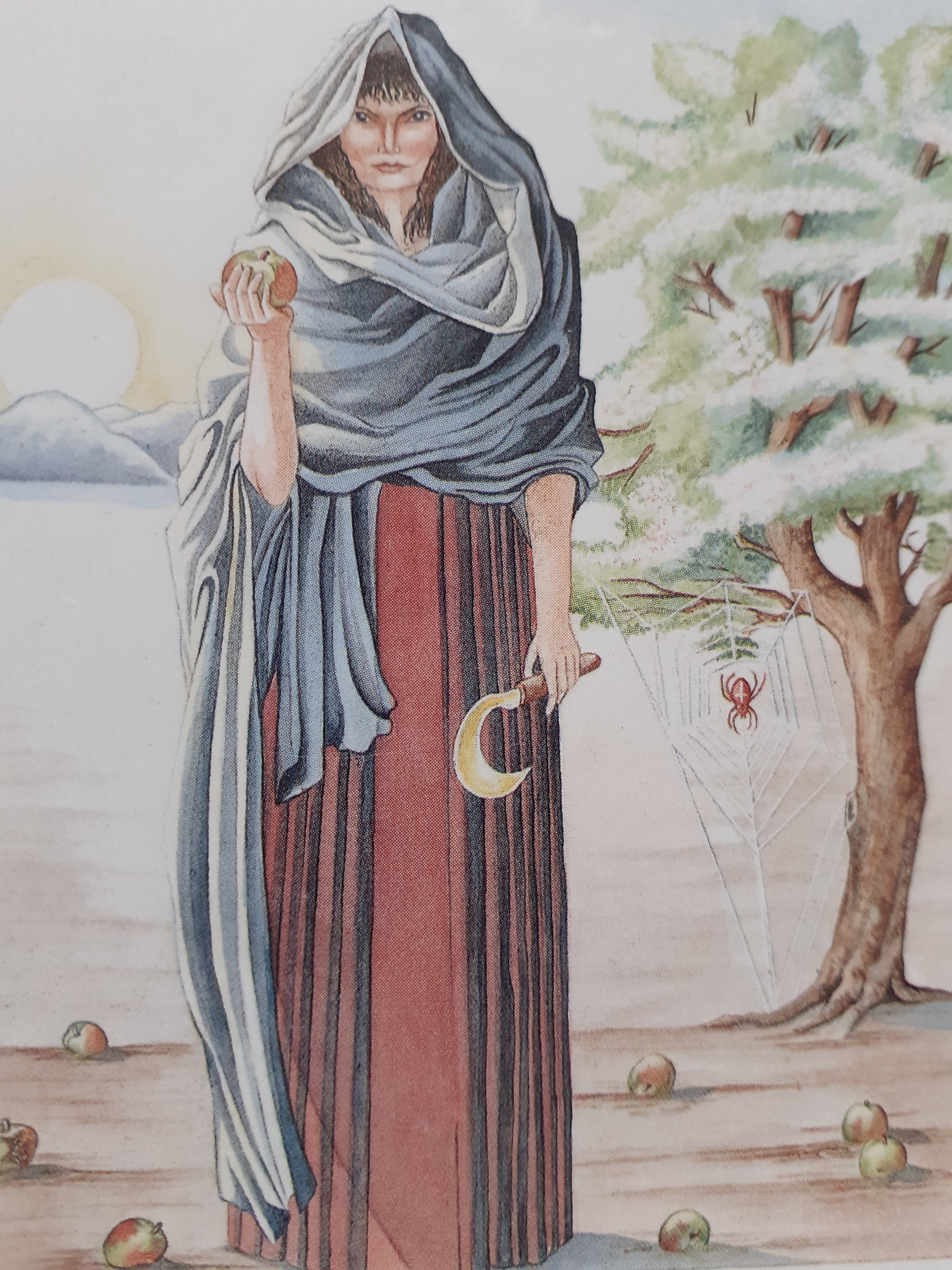
In the approach to Samhain, thoughts turn to death. In R. J. Stewart’s Merlin Tarot (1,2) the Death card has The Apple Woman as an alternate name.

Stewart explains that “the original image for Death is that of the taking or destroying Goddess”, for “who but the creatrix may truly destroy and withdraw created life?” He adds that, in Celtic tradition, she often appears as a female power offering magical fruit.

In his source text, Geoffrey of Monmouth’s Vita Merlini (Life of Merlin), we find a mysterious woman – ex-lover of Merlin – who lays out poisoned apples to entrap him. These apples, arranged “under a tree upon a pleasant green”, are eaten by Merlin’s boon companions: they are either killed or driven insane. Although Merlin escapes the apples, he does not escape his own later insanity in the Caledonian Forest, brought on by the traumatising Battle of Arfderydd.

For Stewart, the Apple Tree is one of the simplest expressions of the Tree of Life. “It is the Otherworld or Underworld Tree that reveals eternal potential, the fusion of ending and beginning in one paradoxical form”. The apples are the fruit of raw, untransformed power. Whereas Merlin’s companions snatch at the apples and eat them greedily, the legendary Thomas Rhymer volunteers to pick magic apples for the Fairy Queen, who recognises his gallantry by giving him the bread and wine that can nourish him. He wins the gift of prophecy and the tongue that cannot lie.

Both lover and killer, the Goddess of Death and Change is young and ancient, weaver and unweaver of a web that is the universe. She is destroyer of hope and giver of hope, for “in her hand she bears the fruit of perpetual life and rebirth, and the razor Sickle that cuts the tread of continuity”.

Stewart ends with this reflection: “perhaps Merlin’s sub-story of The Apple Woman simply means that adulthood is our most deluded period of life. We reject understanding and substitute self-image, habit and even dogma, in our convoluted attempts at survival; the hostility we experience is not that of the Goddess, but our own hostility reflected upon us. Reject love, risk poisoned apples – such fruits are deadly to the greedy and unprepared. But if we accept the fruit or any of its many transformations (such as bread and wine) from the Goddess, she blesses us with gifts of timeless understanding. These gifts may appear in the outer world as prophecy, attuning to the land; death itself is a timeless moment of understanding when all relative interactions cease. Ultimately, we are the fruit”.

(1) R. J. Stewart The Complete Merlin Tarot: Images, Insight and Wisdom from the Age of Merlin London: The Aquarian Press, 1992 . Illustrated by Miranda Grey ISBN 1 85538 091 9 No cards, but a full explanation and discussion of the system and its imagery.

(2) R. J Stewart The Merlin Tarot London: Element, 2003. Illustrated by Miranda Grey ISBN 000 716562 5 (First published by London: The Aquarian Press, 1992). Cards, handbook and notebook for record keeping.

HARVESTING IN MIXED WEATHER

This picture was taken early one morning, at a moment slightly defended from the heat of early August. I was walking through woods to shelter from the sun.

Those days, intense in their moment, have already receded into the past. After a period of somewhat lower temperatures, and of flashes and rumblings in the sky followed by modest rainfall, we found ourselves in a flash flood on Sunday evening. For a relatively brief period, the A46 (a main road, locally) turned into a fast-flowing river not far from our house. Guttering held, but needs attention.

It was as if, following a period of contest, water had succeeded fire as the prevailing element. Now, the situation is less clear cut. But we are in a cooler and wetter place than we were at the beginning of the month. Daylight hours are reducing. We are leaning in to autumn.

During this time I have been busy with my own harvesting. The meditations presented in my last three posts (1) complete a basic repertoire of formal solo practice in my renewed Druidry. I have been fruitfully indoors during both heat wave (beyond my comfort zone) and the return of rain. I have been inwardly focused.

In my own Innerworld wheel of the year, apple presides over the first three weeks or so of the post Lughnasadh/Lammas quarter. Apple, in many traditions, is a Goddess tree, associated with both wisdom and healing (2). It is linked to a visionary ability to see beyond the surface: perceptions grow wiser and the heart sees further than it might otherwise do.

In Irish myth, Lugh was sent to collect apples from a Tree of Light found in the Otherworld. In Britain, after the Battle of Camlann, Arthur was taken by three Celtic goddesses to be healed on the Isle of Avalon (=Island of Apples).

In a more everyday way, my meditations serve the same goals. The timing of my work on them wasn’t exactly planned. But it doesn’t surprise me that my commitment to living the wheel of the year has led to this result.

(1) Links to the meditations:

MEDITATION: LIVING PRESENCE

MEDITATION: WISDOM’S HOUSE

MEDITATION: ENERGY BODY

(2) See: John Matthews & Will Worthington The Green Man Tree Oracle: Ancient Wisdom from the Greenwood London: Conections, 2003

Earth Eclectic

music that celebrates Earth and speaks to the heart

Sarah Fuhro Star-Flower Alchemy

Follow the Moon's Cycle

Muddy Feet

Meeting nature on nature's terms

Rosher.Net

A little bit of Mark Rosher in South Gloucestershire, England

Becoming Part of the Land

A monastic polytheist's and animist’s journal

selkiewife

Selkie Writing…

Charlotte Rodgers

Images and words set against a backdrop of outsider art.

Prof Jem Bendell

living with metacrisis and collapse

Towint

The pagan path. The Old Ways In New Times

The Druids Garden

Spiritual journeys in tending the living earth, permaculture, and nature-inspired arts

The Blog of Baphomet

a magickal dialogue between nature and culture

This Simple Life

The gentle art of living with less

Musings of a Scottish Hearth Druid and Heathen

Thoughts about living, loving and worshiping as an autistic Hearth Druid and Heathen. One woman's journey.

Wheel of the Year Blog

An place to read and share stories about the celtic seasonal festivals

Walking the Druid Path

Just another WordPress.com site

anima monday

Exploring our connection to the wider world

Grounded Space Focusing

Become more grounded and spacious with yourself and others, through your own body’s wisdom

The Earthbound Report

Good lives on our one planet

Hopeless Vendetta

News for the residents of Hopeless, Maine