Contemplative Inquiry

This blog is about contemplative inquiry

Tag: Animism

HARVESTING INSIGHT

Noticing a single corn stalk under our neighbouring birch trees, I wonder whether the seed simply blew in or was planted by an unknown hand. If the latter, what was their intention? I realise that I will never know.

I do know how much I enjoy its presence in this space at this time. I experience it as a miracle inviting gratitude and it has marked the seasonal moment for me, this first harvest of a now declining year.

With increasing clarity I understand that I do not work well with personified and individualised images of the divine. Something seems subtly off, as if I am failing to sound my own authentic note in the Great Song of the world.

I believe that we are given different gifts in our encounters with the Cosmos, leading to legitimately different understandings. When I lean in to the notion of divine personality – even when using the term ‘Spirit’ in that sense – I am not fully living my own truth. I subtly disempower myself and weaken my connection.

For in my universe, when I rest in my own clarity, there is no separation between nature (including culture) and spirit. In the awkward activity of identification and labelling, I answer to terms like animist, panentheist and nondualist.

These words are approximations, with the power to be distracting and slightly depressing. I can find words that point to my experience well enough. But the explanatory words, the more formal and generalised terms, feel clumsy. There’s a necessary level of unknowing that these isms don’t recognise.

When consciously living in spirit, I am neither alone, as a single human person, nor am I with another being. I am simply in a different dimension of embodied awareness, supported and empowered by the bubbling source from which I spring. For me, Nature is more than the ‘nature’ of dualist spiritualities and of the scientific humanism that grew out of them.

As I harvest the learning, or relearning, of this lesson, I renew my commitment to practice and path, once again revising the beginning and end of the modern Druid’s prayer (1). I move from from ‘Grant, Spirit your protection, and in protection, strength … ‘ to ‘In spirit I find protection, and in protection, strength …’. I end with ‘and in the love of all existences, the love of this radiant Cosmos’ rather than ‘the love of God/Goddess/Spirit and all goodness’. These small changes formalise and anchor my understanding.  For me, they are an important affirmation, illuminating my path.

(1) Traditionally, this prayer runs:

Grant O God/Goddess/Spirit, your protection,

And in protection, strength,

And in strength, understanding,

And in understanding, knowledge,

And in knowledge, the knowledge of justice

And in the knowledge of justice, the love of it

And in the love of it, the love of all existences

And in the love of all existences, the love of God/Goddess/Spirit and all goodness”.

NB Providing the options of God/Goddess/Spirit is I think an OBOD (Order of Bards, Ovates and Druids) innovation. The original version, from the late 18th century, simply said ‘God’. Some modern Druids say ‘God and Goddess’.

FAITH

In my Druid circle, I associate the northern quarter with faith. The quality and context of faith are not defined. They could simply mean faith in the practice and path. My contemplative inquiry overall has tended towards a stance of ‘sacred agnosticism’ (1), in which faith is not emphasised. This has served me in many ways. I have avoided mixing up the idea of ‘faith’ with affiliation to authoritarian movements, mandated beliefs, or the surrender of self-responsibility and personal discernment. I have been alert to the metaphysical group think and consensus collusion that can show up in any spiritual movement (other kinds of movement too). I have done my best to gather and evaluate information skilfully, when developing principles about how to live ethically and gracefully in an increasingly scary world.

And yet … this is not the whole story, or I would feel spiritually malnourished. In recent months I have experienced a strong felt sense of the divine. When I describe myself as ‘living presence in a field of living presence in a more than human world’ – an animist identification – the identification now seems more than animist, though the animism is still there. I pray more congruently to the Goddess as Ancient Mother and talk, less anthropomorphically, about the ‘bubbling source from which I spring’. The Divine is beyond name, form or description – and some people prefer a specialist, capitalised use of rather abstract terms like Consciousness, Awareness, Void, Ground of Being. But the ones from my own practice are the ones that work for me. They come from the intuitive heart and the imagination. To me they offer a deeper knowing, though I am personally cautious about the use of the word gnosis. For me, it can reduce the sense of mystery,  banishing the creative role of faith itself.

I have become a provisional panentheist, experiencing intimations of a divine which is everywhere and no-where, and from which we are not separate. This partly reprises work I did in the earlier days of my inquiry using the framework of non-duality. Now I find panentheism a better term than non-duality for affirming both the divine and the world. The earth spirituality in the Druid tradition is in no way compromised by a panentheist perspective. If anything it is enhanced.

(1) See https://contemplativeinquiry.blog/2024/02/16/sacred-agnos

LIVING LIGHT

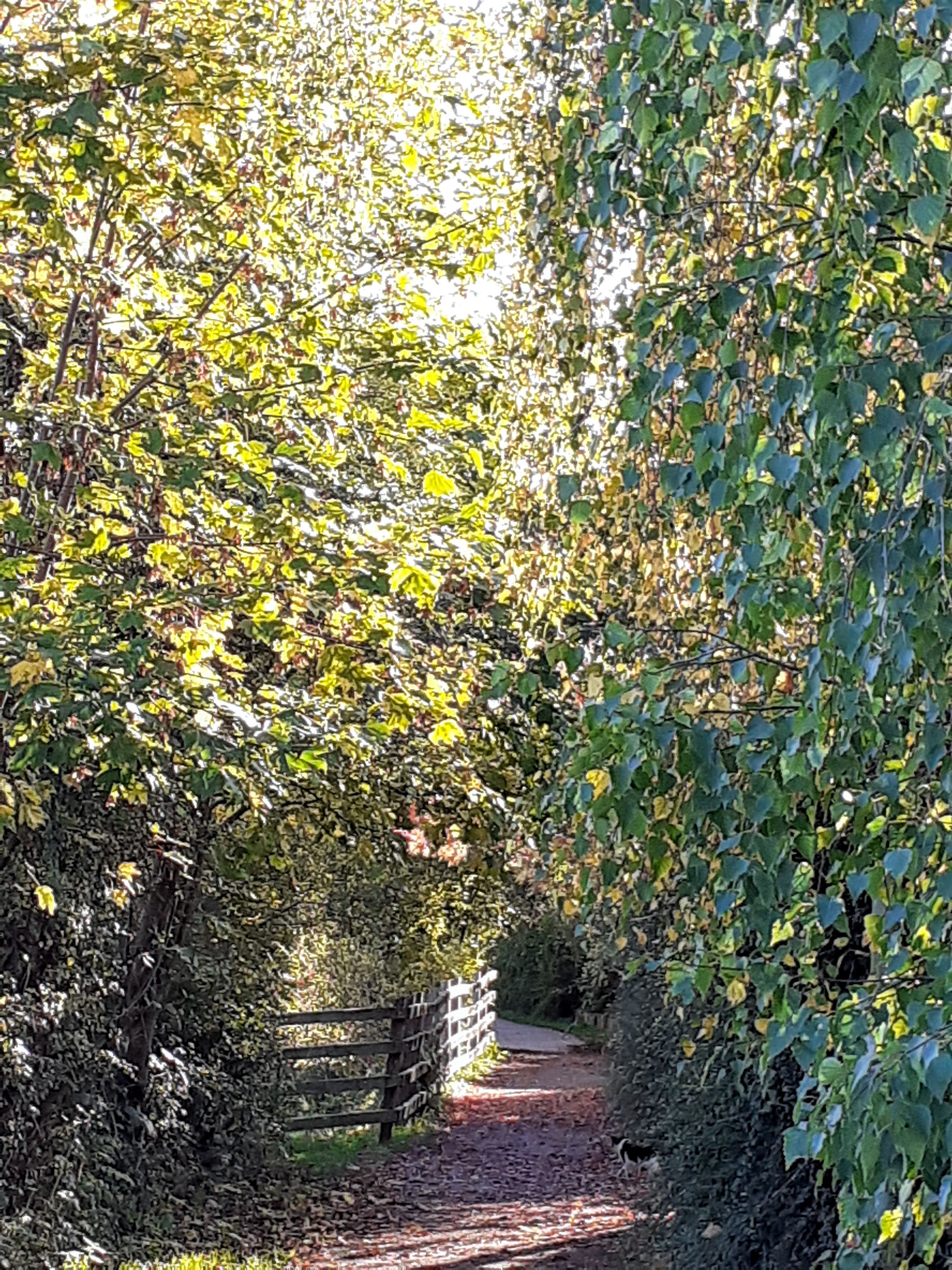
I am walking in woodland beside my local canal. These walks are infrequent now and all the more treasured. I notice how strong mid-afternoon light can be when the sky is clear, even on 22 October. Stepping energetically into its presence, I enter into a kind of communion. The light feels alive and I feel differently alive too – lifted, and touching into joy.

In the picture above, I feel as well as see the effects of the light on trees and water. In the picture below, I both feel and see the living light on leaves which themselves seem to greet me from their horizontal branch. I feel energised by this connection.

Looking up I see blue sky. I do not see the sun, but I can see its effects on the upper branches of trees. both subtle and magical. Looking down, I see a dance of light and shade, with the light present on a fence and on a pathway. A sense of the sacred pervades everything, and I feel blessed.

GREEN RESURRECTION

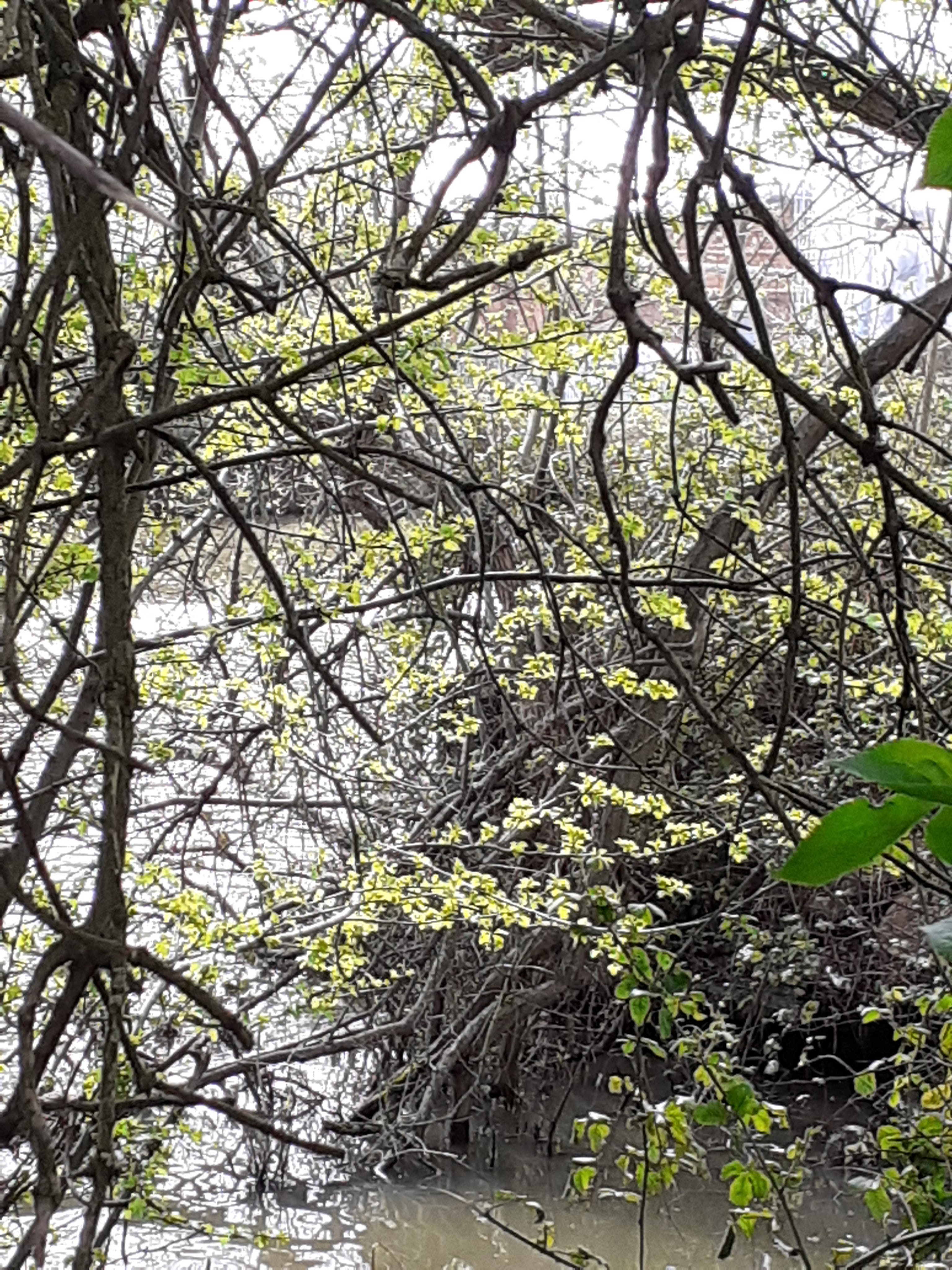
I am walking among trees, feeling refreshed and renewed after a long winter. This feeling is anchored by the return of leaves. I am present in, and to, the presence of new green. It comes every year, at slightly different times. I’m noticing the beginning of a beautiful verdant period. It’s re-appeared a little early this year and I experience this as a great blessing.

Where I live, the early spring has been wet and windy, often with dull skies. Nature has been alive and active throughout this period, but I have remained wintry in important respects. This weekend has changed me. I am aware of new green leaves and a strengthening sun. The latter may be visually dimmed by frequent of heavy cloud, but the leaves reassure me of its power in the rising year. Although we are still far from a full canopy in the woods, the life-force – in modern Druidry often called nwyfre – is strong. It’s a time for celebration.

BOOK REVIEW: UNSEEN BEINGS

Highly recommended. Unseen Beings: How We Forgot the World Is More Than Human (1) is about the many beings we humans have actively ‘unseen’ and the consequences of our human-centric lens. Author Erik Jampa Andersson describes his book as a diagnostic exploration of the roots of the climate crisis, itself an extreme consequence of a much wider malaise. Whereas the common view of ‘saving the planet’ tends to be one of ‘guarding the storehouse’, a better focus would be on ‘supporting the welfare of living beings’.

Andersson has a background in Tibetan Buddhism and Tibetan medicine. In the manner of Buddhism’s Four Noble Truths, and of his medical training, he divides his book into four parts: Diagnosis, Causes and Conditions, Prognosis, Treatment.

Diagnosis concerns “our ecological disease”. Andersson reminds us of what the climate crisis is, how far it has been allowed to go, and the “fanciful stories” with which we have soothed our fears: “full of human exceptionalism, divine protection, techno-fixes and post-apocalyptic salvation”. For Andersson, the foundational root cause is “the sundering of human and non-human beings, and our perceptual separation from ‘Nature’. He refers to “the poison of anthropocentricity”. He reviews the evidence for plant and fungal sentience and awareness as well as that of the animal kingdom. He concludes that Nature is not a place, but “a tightly knit community of interconnected beings, some seen, many unseen, all engaged in their own affairs and with their own experience of reality”. He describes this relational approach to the living world as “what most scholars now call ‘animism’ … neither a religion nor a system of belief, but a paradigm of more-than-human relationship”. He sees this stance toward the world as “our natural state”.

Causes and Conditions A mini-ice age some 13,000 years ago interrupted an early agricultural period in some places and prompted a series of innovations. The domestication of the horse was especially significant. Andersson sees a move away from our ‘natural state’ beginning at this time. But it is not fully evident to us until the age of written philosophy and scripture. The Greek philosophers Plato and Aristotle declare a hierarchy of sentience from plants up to animals and then humans at the top, uniquely endowed with a rational soul. In the Hebrew book of Genesis, God gives dominion over the Earth and its animals to man for his use. In the Western Christianity of the 13th century CE, Thomas Aquinas says that Christians have no duty of charity to non-humans because they are resources, not persons. In the 17th century CE, early in the West European led colonial era, Descartes holds public vivisections of dogs and other animals declaring that they are soulless automata and that their apparent distress is meaningless. In the mid 19th century CE, Darwin restores other beings as our ancestors and cousins, but but without much sense of kinship or empathy.

Prognosis Here Andersson introduces two concepts from Tibetan medicine: ‘provocation’ and ‘spirit illness’. The provocation of other sentient beings is a health risk. He discusses the origins of the recent Covid-19 pandemic in these terms, as human become ever more invasive of our remaining wild spaces. In cases of deforestation, pollution, and any disruption of air, water, soil and trees, there is a price to pay for the wounding of other spirits, whether seen by the eye, seen through a microscope and normally unseen but recognised by tradition. (‘Supernatural’ is an unhelpful word here – everyone is part of nature). In Tibetan tradition, the cultivation of a clear mind is highly prized and works within human psychology, but not for disruptive events like these. There is a need to make amends. Rituals are held in sensitive and damaged places. The damage caused in these circumstances and the resultant chronic collective disease can only be addressed by learning how to care for eachother, non-human beings and the planet itself.

Treatment Using the Buddhist 8-fold path as a structure, Andersson recommends ‘cultivating care’ over a system of rules and regulations aimed at a ‘sustainability’ which tries to restore the old status quo. We cultivate care of the Earth, one another and non-human beings. Hence: 1 right view is a return to our ‘natural state’, as described under Diagnosis; 2 right intention describes commitment to a path of rewilding and regeneration; 3 right speech is the use of “life-affirming language” (e.g. using ‘they’ as an alternative to ‘it’ for non-human beings); 4 right action is causing as little harm as possible to other beings; 5 right livelihood means adopting principles of authentic sustainability and non-exploitation; 6 right diligence is based on “the durability of the heart-felt ethic; 7 right mindfulness means “paying attention to nature’s vitality”; 8 right concentration involves imaging a new future with “authentic myth-making”.

Concerning 8 above, Andersson has been profoundly moved by the work of J. R. R. Tolkien from his later childhood onwards. As a result, he developed a high valuation of authentic myth-making and enchantment. In this realm, the non-human is essential. Tolkien had his own life-changing moment of enchantment when, as a student, he first read the Old English words: Eala earendel engla beorhtast, ofer middangeard monnum sended. (Hail Earendel brightest of angels, above the middle-earth sent unto men). Of this evocation of Venus arising as the morning star, in the old language, Tolkien later wrote: “there was something very remote and strange and beautiful about these words, if I could grasp it, far beyond ancient English”. For Andersson, authentic myth and authentic science work together in support of a redemptive animist vision. By contrast, the form of discourse to worry about is ‘fallacy’ – a complete dissociation from the truth. Andersson again quotes Tolkien: “if men were ever in a state in which they did not want to know or could not perceive truth (facts and evidence) then Fantasy would languish until they were cured. If they ever get into that state (it would not seem at all impossible) Fantasy will perish and become morbid delusion”. For Andersson, this too has become a symptom of our current ecological disease, making the need for honest and healthy communication all the more urgent.

For me, Andersson has made a valuable addition to a growing literature about the current crisis, whose most alarming symptom is climate breakdown. He goes to the root of the problem, offering a clear and coherent view about how to stand in the face of it. It is a well-researched, well-crafted and compassionate contribution to the genre.

(1) Erik Jampa Andersson Unseen Beings: How We Forgot the World is More Than Human Carlsbad, CA & New York City; London; Sydney; New Delhi: Hay House, 2023

I attach a links to conversations between the author and Andrew Harvey below. It adds considerably to what I can present in a review:

OUR CANINE TEACHERS

From the modern animist perspective of his Unseen Beings: How We Forgot the World Is More Than Human, Erik Jampa Andersson looks at what we owe to our canine friends.

“In our own evolution as a species, non-humans have often played crucial roles. Plants and animals weren’t always just our food and possessions – they were are mentors, companions, even our ancestors.

“There’s one non-human, in particular, whose profound impact on our human story warrants far more recognition … They were descended from the beasts of legend – formidable hunters who commanded vast swathes of land with ferocious might. In many of our myths and legends, they were immortalized as guardians of the underworld and crucial intermediaries between the human and non-human domains. Before we had ever tamed a horse, milked a cow, or sown a field of grain, we had befriended a dog.

“… It’s believed that humans and wolves were gradually drawn together during the perilously harsh conditions of the Last Glacial Maximum [20,000+ years ago: JN]. As our paths began to cross more and more frequently in our pursuit of mutual prey, what likely started as a timid sharing of spoils led to an unusual sense of kinship between the two predators. Wolves were drawn into the warmth of human encampments, and ultimately made themselves quite at home at the foot of our beds. They offered us vital protection, companionship, and a natural ‘security alarm’ in a wild and dangerous world, while we provided them with warmth, food, and evidently also emotional satisfaction.

“Studies of canine intelligence have repeatedly attested to dogs’ advanced capacity for memory, social cognition, inferential learning, and even comprehension (and possible use) of human language. But beyond their clear intelligence, what deserves significantly more attention is the very real impact dogs have had on our own evolutionary trajectory.

“Unlike predators who prefer to prey on weaker animals, wolves thrived as persistence hunters, successfully felling giant mammals by stalking them to exhaustion in well-organized packs. As territorial animals, they also went to the great trouble of staking out their own tribal domains, maintaining a distinctly pastoral lifestyle in complex social groups.

“Such practices were wholly foreign to early humans and other simians, but by the time our ancestors found their footing in the Eurasian wilderness, they had become rather formidable and territorial pack hunters themselves. Researchers suggest that these novel human behaviours were at least partially influenced by our burgeoning relationship with canines, who introduced us to their world, taught us their hunting tricks, and afforded us peace of mind by protecting our settlements against less amiable foes.

“The domestication of dogs was one of the key forces that led to the development of fully modern humans, impacting our relationship with one another and the world at large for many millennia to come”.

(1) Erik Jampa Andersson Unseen Beings: How We Forgot the World is More Than Human Carlsbad, CA & New York City; London; Sydney; New Delhi: Hay House, 2023

THE WISDOM OF COMPASSION

“Toward all beings maintain unbiased thoughts and speak unbiased words. Toward all beings give birth to thoughts and words of kindness instead of anger, compassion instead of harm, joy instead of jealousy, equanimity instead of prejudice, humility instead of arrogance, sincerity instead of deceit, compromise instead of stubbornness, assistance rather than avoidance, liberation instead of obstruction, kinship instead of animosity.” (1,2)

Humanism extends our circle of care to all humans, clearly a high bar in our current state of culture. Druidry, certainly an animist Druidry embracing deep ecology, asks us to extend it further – to all beings. At first glance, it seems like a complicated and demanding ask in a world where life lives off other life, and where cooperation and competition necessarily co-arise. Yet for some people this stance towards the world is (or becomes) natural.

The passage in my first paragraph offers guidance on the Bodhisattva path in Mahayana Buddhism. Followers of the path let go of any quest for personal liberation to work for the liberation of all beings. Sometimes this is understood as a postponement of personal liberation, but the deeper insight is that ‘personal’ liberation makes no sense. In an interconnected and interdependent cosmos, only the liberation of all counts as any liberation at all.

In the Diamond Sutra (3) the definition of ‘beings’, put into the mouth of the Buddha himself, is as broad and inclusive as possible: “however many species of living beings there are – whether born from eggs, from the womb, from moisture, or spontaneously; whether they have form or no form; whether they have perceptions or do not have perceptions, we must lead all these beings to the ultimate nirvana so that they can be liberated.” Then the Buddha adds: “And when this innumerable, immeasurable, infinite number of beings has become liberated, we do not in truth think that a single being has been liberated”.

Thich Nhat Hanh (3) understands this last statement as saying “a true practitioner helps all living beings in a natural and spontaneous way, without distinguishing the one who is helping from the one who is being helped. When our left hand is injured, our right hand takes care of it right away. It doesn’t stop to say: ‘I am taking care of you. You are benefitting from my compassion’. The right hand knows very well that the left hand is also the right hand. There is no distinction between them. This is the principle of interbeing – co-existence, or mutual interdependence. ‘This is because that is’.”

I am not a Buddhist. I do not share the classical Buddhist views of karma and reincarnation. I do not associate final physical death with the term ‘liberation’. But I am aware of not, ever, being on my own – even when being, in the world’s terms, solitary. Apparent boundaries between me and my world are too soft: relationships are happening all the time. With this sense of the world in mind, the words below, repeated from the first paragraph, seem like common sense.

“Toward all beings maintain unbiased thoughts and speak unbiased words. Toward all beings give birth to thoughts and words of kindness instead of anger, compassion instead of harm, joy instead of jealousy, equanimity instead of prejudice, humility instead of arrogance, sincerity instead of deceit, compromise instead of stubbornness, assistance rather than avoidance, liberation instead of obstruction, kinship instead of animosity.” (1,2)

(1) From the Perfection of Wisdom in Twenty-five Thousand Lines translated into English by Edward Conze, Large Sutra on Perfect Wisdom Berkeley, CA: University of California Press, 1975 and cited in (2), below

(2) Red Pine, The Diamond Sutra: the Perfection of Wisdom. Text and Commentaries translated from Sanskrit and Chinese Berkeley, CA: Counterpoint, 2001 See: https://www.counterpointpress.com

(3) Thich Nhat Hanh The Diamond That Cuts Through Illusion: Commentaries on the Prajnaparamita Diamond Sutra Berkeley, CA Parallax Press, 201

NOTE: Versions of the Diamond Sutra appeared as written texts in Sanskrit in the 2nd century C.E. and this version was translated from Sanskrit into Chinese in the early 5th century C.E. Works of this kind were used more for recitation and chanting in monastic settings than they were for silent reading.

THE GINKGO TREE

“Higher up, … in the middle of a small clearing, there stood a gigantic ginkgo tree. In the scheme of tiny streets, this was practically the one single unoccupied space, and of course this plot of land was only precisely as big as was necessary for the ancient tree to exist, for it to get both air and sunlight, for it to have enough strength to spread out roots beneath the earth.

Every other plant on the upward inclining streets of the quarter of Fukuine belonged to either something or someone: it was the property, ornament, and decoration, the carefully guarded and cared-for treasure of one or another family building, reaching out from tiny pristine courtyards with blooming or budding branches, the perennially green foliage emerging suddenly next to the eaves of the tiny, hidden gates, or the regularly repeating fence slats …

Only … the ginkgo tree that belonged to nothing and to no one stood by itself in the clearing as if there were’t even anything that it could be tethered to, as if it couldn’t even belong to anything, a kind of unbridled, wild, dangerous being rising high above every building and roof and tree, already with its full fresh crown in the unaccustomedly gentle early spring and with its multitude of peculiar, fan-shaped leaves, or rather leaves that much more resembled a heart cracked down the middle, sighing with the gentle wind.

This was the ginkgo, bearing within itself the numbed depths of innumerable geochronological ages, its thick trunk only able to bear a Shinto rope with its paper streamers, and below, the wild proliferation of a holly bush grown out from one of its sides; the ginkgo, accordingly, was the only one that rose from this peaceful world, and was well visible from below as well, like a kind of tower, because everything else ended up concealing the other things, one house hiding another, one street hidden by another.

Only it – this colossal, and, among all the other plants, frighteningly alien and unknowable ginkgo tree – ascended, and unmistakably, as if it had not arrived her directly from a hundred million years ago, the dark Cretaceous era from which it had originated, so that someone would have to notice it, someone looking up from below, from the direction of the train station, who, having arrived, and searching for the correct direction, would take a look around.”

Extract from: Laszlo Krasznahorkai A Mountain to the North, a Lake to the South, Paths to the West, a River to the East London: Tuskar Rock Press, 2023. Translated from the Hungarian by Ottilie Mulzet.

NB I have done some minor pruning (…) to keep the focus on the ginkgo. For the sake legibility in this blog format, I have also divided the extract into paragraphs which do not appear in the original text.

ANIMISM FOR OUR TIMES

This post looks at Animism as the guiding principal of my Druidry. The term itself comes from nineteenth century anthropology, and is somewhat problematic. Scholars from European and North American backgrounds , formed by a mix of Christian and secular ideas, were studying, and labelling, the traditional practices of other people. The people themselves were mostly in the process of becoming colonial subjects and living in cultures under stress. So ‘Animism’ started out as a top-down classification, which gave Animists a lowly position in the hierarchy of cultural and spiritual life. A stigma persists to this day.

Despite this dubious history, the word ‘Animism’ is now being turned around by people from the global north itself, spiritually hungry in our now palpably faltering 21st century world. Some years ago, research by Graham Harvey distinguished two positive uses of the term Animism among modern western Pagans. “Some Pagans identified Animism as a part of their religious practice or experience which involved encounters with tree-spirits, river-spirits or ancestor-spirits. This Animism was metaphysical. … Other Pagans seemed to use ‘Animism’ as a short-hand reference to their efforts to re-imagine and re-direct human participation in the larger-than-human, multi-species community. This Animism was relational, embodied, eco-activist and often ‘naturalist’ rather than metaphysical” (1).

My Animism draws primarily on the second of the two accounts above. But it is deepened by a Buddhist influence, especially that of the Vietnamese Zen Master Thich Nhat Hanh: “There is no absolute dividing line between living matter and inert matter. If we took the so-called inanimate elements out of you and me, we would not be able to live. We are made of non-human elements. This is what is taught in the Diamond Sutra, an ancient Buddhist text that could be considered the world’s first treatise on deep ecology. We cannot draw a hard distinction between human beings and other living beings, or between living beings and inert matter. There is vitality in everything. The entire cosmos is radiant with vitality. If we see the Earth as a block of matter lying outside of us, then we have not yet truly seen the Earth. The Earth is also alive” (2).

Thich Nhat Hanh follows an old tradition. In thirteenth century Japan, Zen Master Eihei Dogen had taught that enlightenment is just ‘intimacy with all things’. Elsewhere in his own text, Thich Nhat Hanh says: “Just as a wave doesn’t need to go looking for water, we don’t need to go looking for the ultimate. The wave is the water. You already are what you want to become. You are made of the sun, moon and stars. You have everything inside you”. Thich Nhat Hanh explains that a flower is made only of non-flower elements. We can say that the flower is empty of separate self-existence. But that doesn’t mean that the flower is not there. “When you perceive reality in this way, you will not discriminate against the garbage in favour of the rose” (2).

This Buddhist wisdom doesn’t seem to me to come directly out of the four noble truths or eightfold path. The Buddhists of south-east and east Asia were at ease with the traditional Animism of their cultures, and the views expressed above appear to me to be at least partly a cultural gift from the Animists. Japan, for example, was intensely influenced by Buddhism without any thought of displacing Shinto, and the traditions readily interwove.

It was otherwise in the west. Already, In the first century CE, the Roman philosopher Plutarch wrote of the death of Great Pan, after the time of Jesus but before the rise of Christianity. James Hillman comments: “With Pan dead, so was Echo; we could no longer capture consciousness through reflecting within our instincts. … The person of Pan the mediator, like an ether who invisibly enveloped all natural beings with personal meaning, with brightness, had vanished. Stones became only stones – trees, trees; things, places, animals no longer this god or that, but became ‘symbols’, or were said to ‘belong’ to one god or another. When Pan is alive, then nature is too – the owl’s hoot is Athena and the mollusc on the shore is Aphrodite … Whatever was eaten, smelled, walked upon or watched, all were sensuous presences of archetypal significance”.” (3).

James Hillman, after service as Director of Studies as the Jung Institute in Zurich, went on to develop his own form of archetypal psychology. He was a strong proponent of Panpsychism, a world view very similar to forms of Animism being articulated today. Panpsychism literally means the ensoulment of everything (from the Greek), though the sound ‘Pan’ also associates us with the god. At the same time this view broadly fits with the understanding of Zen Buddhist Thich Nhat Hanh, described above.

‘Animism’ is for me a word, not a thing, or a another religious banner to raise. It points to a wide range of experiences, understandings, and articulations. Pinned down to a single, dictionary definition, it would lose its power and energy. Yet Animism has become the word that best describes my way of being a modern Druid, both as view and as practice. I find it grounding and regenerative to have decisively adopted this word.

(1) Graham Harvey (ed.) The Handbook of Contemporary Animism London & New York: Routledge, 2014 (First published by Acumen in 2013)

(2) Thich Nhat Hanh The Art of Living London: Rider, 2017 (Rider is part of Penguin Random House)

(3) James Hillman The Essential James Hillman: A Blue fire London: Routledge, 1989 (Introduces and edited by Thomas Moore in collaboration with the author)

See also my recent post at https://contemplativeinquiry.blog/2023/07/02/animist-endarkenment which references Emma Restall Orr’s The Wakeful World: Animism, Mind and the Self in Nature

ANIMIST ENDARKENMENT

I have been re-visiting Emma Restall Orr’s ground-breaking work on animism, where she reframes this term for our times and emphasises its value to modern Druids. Much of her book explores the formal philosophy and metaphysics of animism and panpsychism. In this, more lyrical passage, she questions ‘permanent enlightenment’ and advocates freedom from “knowledge-based certainty” and dependency on knowing.

“To the animist, a state of permanent enlightenment is not considered natural. His senses inform him that, firstly, light is sustained by a balance of light and darkness, and, secondly, it is lived for the most part in neither darkness or light, but in varying degrees of twilight and shadow, of half knowing, believing, assuming and concluding.

“The aspiration for fluency and lucidity, another light-derived word, is firmly established in our culture though. Literally and figuratively, in darkness we are denied the safety of certainty. As the dusk comes and the light slips away like an outgoing tide, edges begin to dissolve. In darkness, our senses more easily blur, leaving us potentially deceived. If we are dependent upon knowing, this can leave us confused and fearful. The not-knowing is judged as ignorance; darkness is declared bad, and to be avoided as dangerous. As the deep wellspring of wickedness, any who embrace the darkness must be equally spurned.

“If, however, our aim is not a knowledge-based certainty, what the darkness provides is delicious and necessary release. In the dark, the separation created by edges is no longer relevant to our perception and reality, allowing entirely new parameters of freedom. … We need moments within which we can dissolve all we are and all we know, that we might find the nourishment for new inspiration and realisation”.

(1) Emma Restall Orr The Wakeful World: Animism, Mind and the Self in Nature Winchester, UK & Washington, USA: Moon Books, 2012

Earth Eclectic

music that celebrates Earth and speaks to the heart

Sarah Fuhro Star-Flower Alchemy

Follow the Moon's Cycle

Muddy Feet

Meeting nature on nature's terms

Rosher.Net

A little bit of Mark Rosher in South Gloucestershire, England

Becoming Part of the Land

A monastic polytheist's and animist’s journal

selkiewife

Selkie Writing…

Charlotte Rodgers

Images and words set against a backdrop of outsider art.

Prof Jem Bendell

living with metacrisis and collapse

Towint

The pagan path. The Old Ways In New Times

The Druids Garden

Spiritual journeys in tending the living earth, permaculture, and nature-inspired arts

The Blog of Baphomet

a magickal dialogue between nature and culture

This Simple Life

The gentle art of living with less

Musings of a Scottish Hearth Druid and Heathen

Thoughts about living, loving and worshiping as an autistic Hearth Druid and Heathen. One woman's journey.

Wheel of the Year Blog

An place to read and share stories about the celtic seasonal festivals

Walking the Druid Path

Just another WordPress.com site

anima monday

Exploring our connection to the wider world

Grounded Space Focusing

Become more grounded and spacious with yourself and others, through your own body’s wisdom

The Earthbound Report

Good lives on our one planet

Hopeless Vendetta

News for the residents of Hopeless, Maine