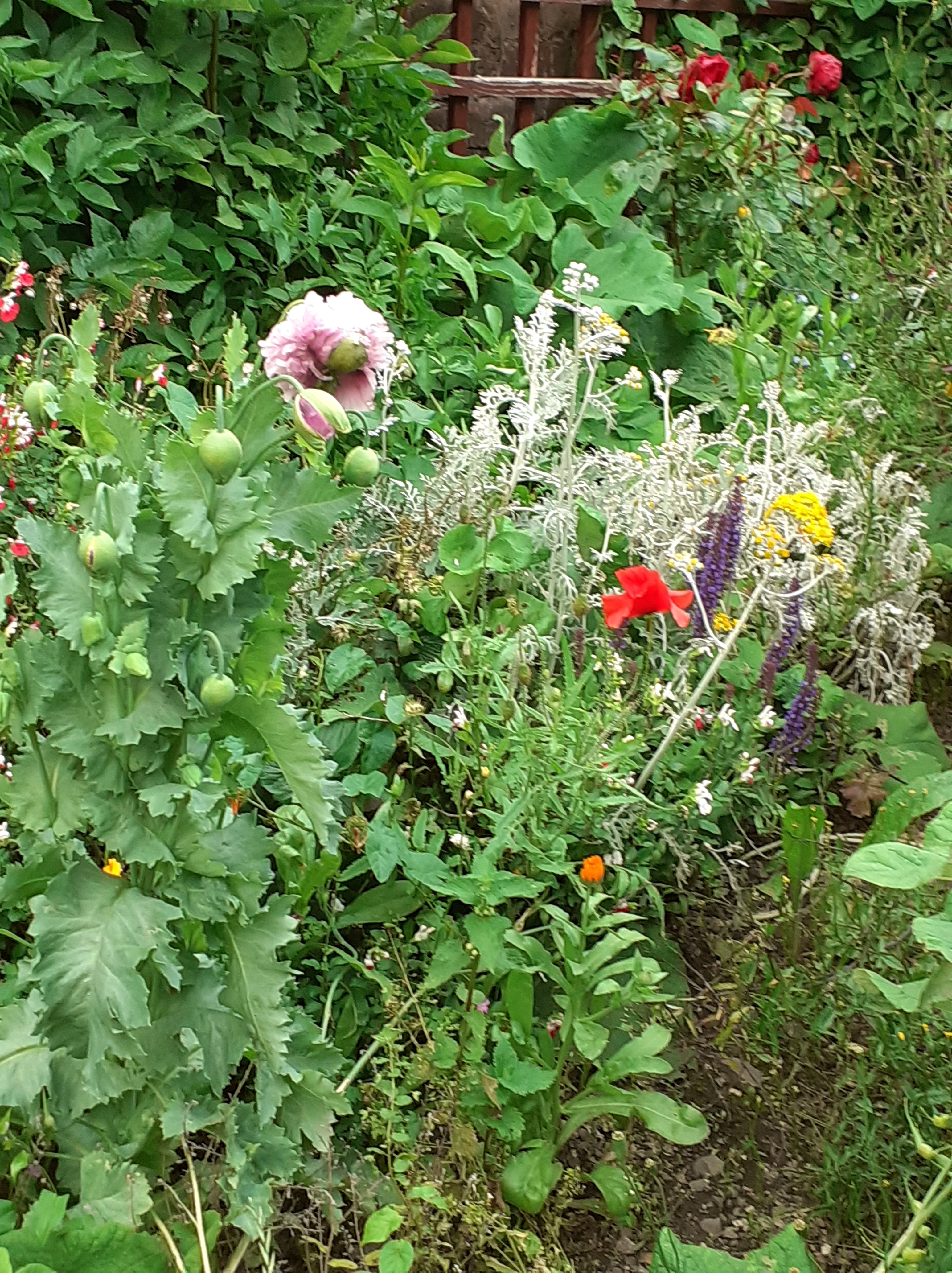
An evening walk on 10 June, around 7pm. We are approaching the summer solstice, Alban Hefin in OBOD Druidry. It is a late moment in the rising year. We are in a now familiar Georgian neighbourhood, where I often focus on sky and buildings. But here my attention is on the earth, and patches of green growth a little recessed from the kerbside. What draws me is a strong sense of light enabling life, relatively late in the day, touching the plants to ensure their thriving.
Flowering plants appeared quite late in this history of our planet, less than a hundred million years ago. Over time they helped to shape the habitat in which we have appeared and made our home. Seemingly fragile, they have, over time, exerted a tremendous collective power. It seems only right to honour them and recognise what they have done for us. May we preserve the habitat on which they and we depend.
This post is about a midsummer day’s dream in the the Scottish border country, a dream which included a certain kind of waking up. I have written about it before (1,2) but this is the first illustrated version. Fourteen years have passed since that day, which in many ways determined the form which my expression of Druidry would take.
I was near Melrose. The wild rose was one of many on the banks of the Tweed. In this photograph, I am on a riverside path, with my back to the river. I keenly noticed then, as I notice now, the difference between a wild rose and the more familiar cultivated ones. I love both. But I remember feeling a particular delight at the simplicity of the native flower, a sense of easy integration into habitat, and of a plant not committed to being red or white.
Looking more deeply, I have said in my earlier writing how I had a momentary experience in which, gazing at a rose, subject/object distinctions disappeared and it is as if time intersected with eternity. I have identified this with the Seeing experience more systematically explored by Douglas Harding and the community built up around his work (http://www.headless.org). This was the beginning my sense that direct experience of the world, manifesting through a form of nature mysticism, would be my way forward, eventually becoming a contemplative Druidry and the backbone of my contemplative inquiry. I experience this as a direct and simple route to stillness, presence, resting in being., and identifying with source.
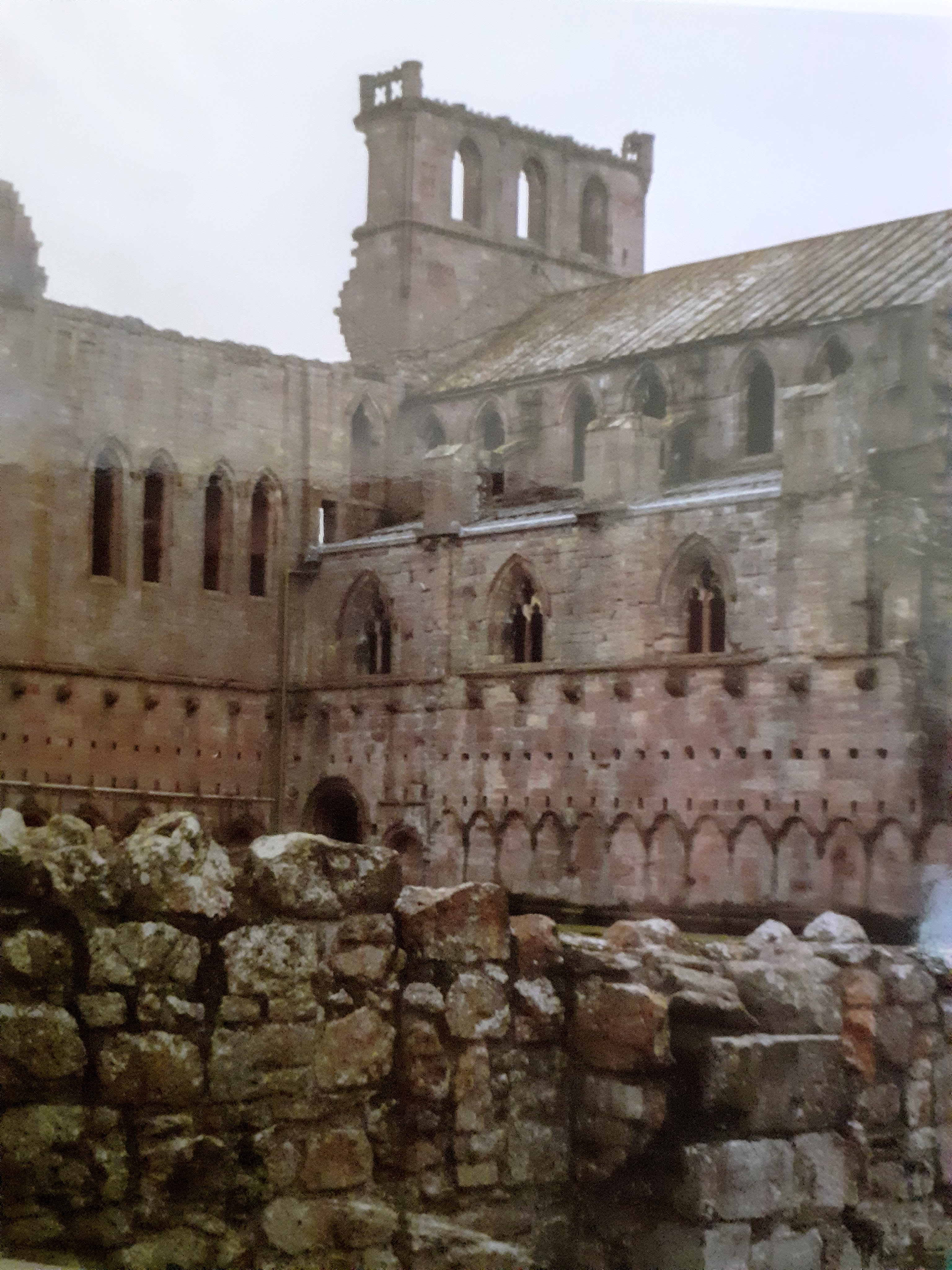
My walk amongst the wild roses had a prequel. Firstly, I had already spent time in the well-preserved ruins of Melrose Abbey. It was a building of Green Man carvings, but, sadly, neither the monks who occupied it nor the iconoclasts who abandoned it had access to the Gospel of Thomas (3) or the words:
“His disciples said to him:
‘When will the dead be at rest?’
‘When will the new world come?’
He answered them:
What you are waiting for has already come,
but you do not see it.” (3)
Here I see the abbey as a solid, material buildings, built with love and care. Even today, it belongs in its landscape, as much as the Tweed or the nearby Eildon Hills, with a semi-wild orchard of apple, pear and cherry trees. What I haven’t written before, in times when I was busy making distinctions between available paths, is that time and eternity intersect in this place too. But, on the day in question, I didn’t have that experience in the abbey grounds. I had it only among the wild roses, down by the river.
The Eildon Hills are also part of the same landscape, indeed a more primal one. But they are fairy hills and they can hide themselves. On that day, they hid from me. There was no invitation – or, rather command – from the Queen of Elfland, who had once ridden out to summon Thomas the Rhymer to her service:
“But you maun go wi’ me now Thomas
True Thomas ye maun go with me
For ye maun serve me seven years
Through weel or wae as may change to be.” (4)
At midsummer in 2007 I was looking for a spiritual home that offered both depth and simplicity. The grim half hidden hills were not appealing to me and I was closed to their magic, with an invitation or without one. I did not want to court danger by ascending into their conceivably treacherous mists. The low road by the river was the one for me.
It was a good decision, and good came of it. But I do also understand that on a different day, those hills could be seen in a different light. I do not now feel constrained to make a neat choice between a broad road, a narrow road and a bonny road. Two cycles of seven years on, well rooted in a nourishing life and practice, I find myself in a more open space, wondering what lessons this Otherworld might yet offer.
(3) The Gospel of Thomas: the Gnostic Wisdom of Jesus (Translation from the Coptic, introduction and commentary by Jean-Yves LeLoup. English translation by Joseph Rowe. Foreword by Jacob Needleman) Rochester, VT: Inner Traditions, 2005
(4) R. J. Stewart The Underworld Initiation: A Journey Towards Psychic Transformation Wellingborough: The Aquarian Press, 1985
As its crown forms his mask and its leafage his features;
‘I speak through the oak’, says the Green Man.
‘I speak through the oak says he'” (1)
In my wheel of the year tree mandala (2), oak covers the period from 16 June-8 July and thus includes Alban Hefin, the summer solstice. I am starting to bring it in. The oak has many associations – regal strength, for example – but for me the sense of the green man, the archetype of our oneness with the earth, speaking through the oak, is the most numinous. At Dodona in ancient Greece (3) an oak shrine was “guarded by priestesses who interpreted the future from the rustling of leaves on the great tree, the voice of the sacred spring that rose at its root and the behaviour of birds in its branches”. Celtic tradition describes a number of sacred oak trees, themselves roosting places for sacred birds. I like the sense that the oak does not stand alone and autonomous in these stories. For leaves to rustle, the wind is needed. Birds and springs may also participate in the ecology, of a distributed wisdom – a wisdom of interdependence, of interbeing. The oak’s great branches are matched by still greater roots, and therefore an underground network of communication and exchange that we now know sustains a mature forest (4).
The ogham name for oak, duir, means door in both Sanskrit and Gaelic (5). This can bespeak solidity and protection, for the oak can survive lightning. It was sacred to Taranis, the Celtic god of lightning and storms, to Thor in the Nordic pantheon. and to Zeus among the Greeks. But a door isn’t just defensive. It is there to be opened as well, with a sense of welcome and relationship. Dagda, father god of Ireland, was associated with the oak and never failed to give hospitality to those who asked for it.
For Druids (whose name means ‘oak wisdom’) oak was the central tree in their mysteries. There is a theme, in these mysteries, of communication between worlds, with a sensed Otherworld being less than a heart beat away. The power of the oak combines strength and sensitivity. My mandala links oak to the period in which the light has its greatest expression, and then gives way, at first very slowly, to its necessary descent into the dark. The tree bears witness as the wheel continues to turn.
(1) William Anderson Green Man: Archetype of Our Oneness with the Earth Harper Collins: London & San Francisco, 1990.
(2) This mandala is based on my personal experience of trees in the neighbourhood as well as traditional lore. Moving around the summer quarter from Beltane, 1 May, the positions and dates of the four trees are: Hawthorn, south-east, 1-23 May; Beech & Bluebell, south-south-east, 24 May – 15 June; Oak, south, 16 June – 8 July; Gorse, south-south-west, 9 – 31 July. The autumn quarter then starts with Apple at Lughnasadh/Lammas. For a complete list of the sixteen trees, see https://contemplativeinquiry.blog/2020/autumn-equinox-2020-hazel-salmon-awen/
(3) John Matthews & Will Worthington The Green Man Tree Oracle London: Connections, 2003.





 Contemplative Inquiry