Contemplative Inquiry

This blog is about contemplative inquiry

THE FIRST QUARTER

I began closely following the wheel of the year – not only the festivals – just before the winter solstice. I wrote then that “my current warm up process is already changing the way I think and feel about contemplative inquiry and will re-shape how I do it”*. How has the first quarter been?

I’ve been outside, taking pictures, concerned with visual images and the stories they tell. There’s been some tension between communing with nature and being a self-conscious observer, actively selecting images. But on the whole it works. Taking pictures slows down my walks, opening up opportunities for stillness and mindful micro movement. Special moments come by themselves – or not. In sharing my experience, the process offers the opportunity to show as well as tell.

The quarter has been very wet – the picture above, taken on 15 March – shows a continuing abundance – to the point of excess – of water. It is beautiful and entirely natural, but for me also part of a story of times out of joint, and the increasing impact of the climate crisis. The picture below, also taken on 15 March, adds to this story in two ways. One is the suggestion of dank fecundity in the abundance of moss on a branch. The second is the indication of a lost branch from the same tree. High winds have caused considerable destruction in the woods in my neighbourhood. In both pictures, there are cues for appreciation and tranquillity, whilst also an indication that significant other things are going on. My current approach to contemplative inquiry has helped me to notice this and pay greater attention to it than I might otherwise have done.

The second quarter of the year will be different. I have self-isolated in response to Covid-19 though I am still going out on walks. I am likely to double down on contemplative practice and inquiry at home. I strongly believe in contemplative practice as, among other things, a resiliency factor in personal wellbeing, enhancing my experienced quality of life. I will talk more about this in future posts.

SPRING, GRATITUDE AND COVID-19

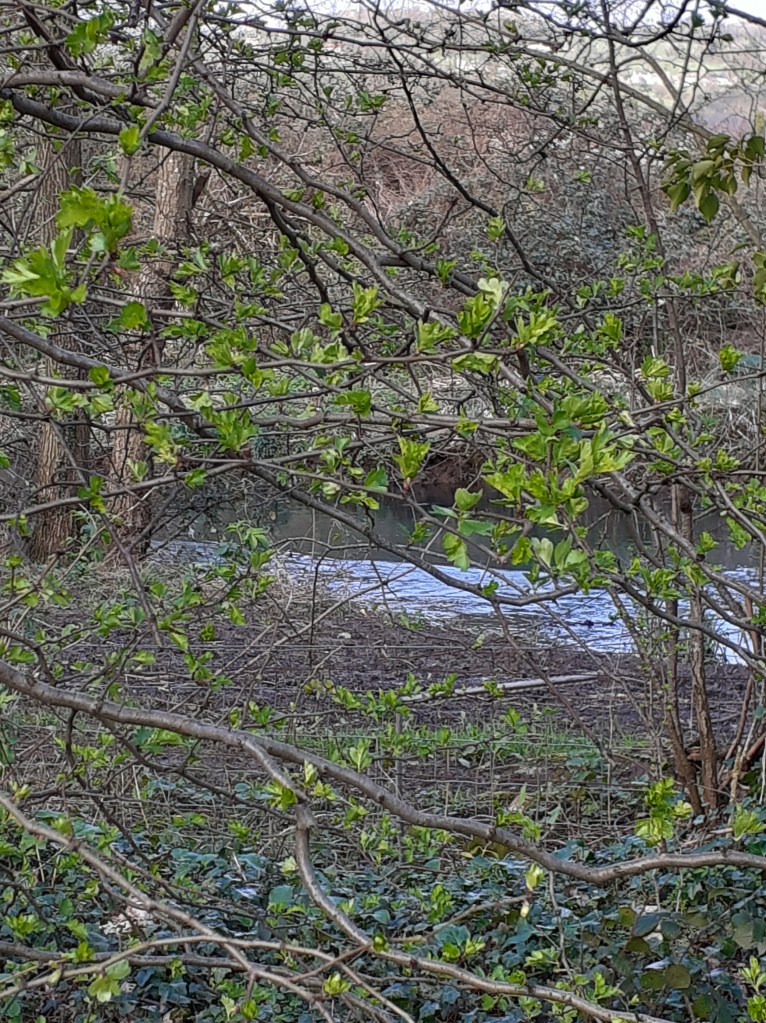
On Friday 13 March I tasted spring in its fullness. I was flooded with gratitude. Yet ‘gratitude’, especially in religious settings, was for a long time a tainted term in my life.

Growing up, I faced demands to be grateful whether I felt it or not. Over time I came to link this idea to formal performance and competitive public piety: being seen to be ‘good’. It also left my natural feelings of gratitude, when they came up, unrecognised and untended. In this stunted state I developed a cynicism about how language is used, rather than finding ways about how, authentically, to identify and cultivate my own sense of gratitude.

I am sad about this, because, even from a self-referential perspective, the capacity for gratitude is linked to wellbeing, happiness, self-acceptance and a sense of purpose in life. Psychological studies (1) show that gratitude is an active agent and not simply the result of already existing wellbeing. Exercises in gratitude work for many people, for much of the time. There are now considerable academic and self-help literatures on the subject.

Most spiritual traditions recommend gratitude, and for many of them this is linked to a sense of the divine, or some other ultimate point of reference. But this isn’t necessary. Gratitude is named as the third of thirteen principles in Atheopaganism (2), which is based on an entirely naturalistic, science-based cosmology. Here too, gratitude is seen as a habit that has to be learned and practised. The practice can alter both our internal dialogue and our behaviour. “It is good for ourselves, our relationships, our society and our world”.

I came late to gratitude, in the sense being discussed. But I’m a convert now. Being older has somehow helped. There was a decisive moment just under fifteen years ago, when I was 56 years. I was diagnosed with a cancer that might have killed me and I started to ask myself how I was going to maintain my quality of life remaining if I found myself on a downward slope.

I concluded that I would need to do what I could to count my blessings whilst I still lived. I recovered – with the insight still in place. I have built on that with greater awareness over the years, especially since beginning my contemplative inquiry. Now I’m nudged by the coronavirus and the same principles apply. I’m enjoying the experience of spring, usefully aware of my mortality, and grateful to be here, now.

(1) Rupert Sheldrake Science and Spiritual Practices Coronet, 2017

(2) Mark A. Green Atheopaganism: an Earth-Honoring Path Rooted in Science Green Daragon Publishing, 2019 (Foreword by John Halstead)

RESILIENCE AND REGENERATION

In my world, early March is a pre-equinoctial period of its own. In the emergence from winter, it manifests both resilience and regeneration. This year I have experienced an elephant’s ears plant (bergenia cordifolia) as an marker for resilience. This evergreen lives close to our back garden gate. It has been flowering, and it leaves have kept shiny, for most of 2020 so far. It has given me a lift every time I have walked past it, in all manner of weather. I feel grateful to it just for being there.

Why have I noticed it this year in particular? In the past I’ve taken this plant for granted. I’ve walked past without seeing it. I’ve only paid attention when the leaves need pruning, having strayed onto a path. Yet now this plant feels like a friend and nourishes me with its presence. It doesn’t just demonstrate its own resilience. It supports mine. I’ve been experiencing 2020 as tough and likely to stay that way, so I suppose that something in me has been looking for ways of feeling resilient. As a result, I’ve been able to notice something that’s been there all along, though largely neglected.

As well a resilience, I’ve been having a sense of regeneration, though the dynamics are a little different. One difference is that I expect to be leaning into regeneration at this time because it’s part of my wheel of the year narrative. I also expect it to be linked to the presence of willow trees (see picture below) because I befriended one many years ago. I have stayed in touch even after moving to a different town. The early re-greening of willow trees is part of my direct experience, and also part of my myth. It feels as if I am being taken by the hand and led towards the equinox.

I don’t want to get there prematurely. A patient, attentive journey emphasises the freshness and novelty of each year. I took the photograph below a couple of days ago on impulse, and it felt like a nudge into a process of renewal that I don’t want to undertake too quickly and don’t want to make assumptions about. Regeneration happens. Although I’m starting to feel my age, I’m still part of it. Let’s see how it goes in 2020.

REBLOG: FIRST LEAVES — DRUID LIFE

Reblog of a recent Druid Life post, about the turning of the Wheel in the Stroud district of the English Cotswolds, and the way it is being influenced by the climate crisis. “It feels too early. I’d expect the fruit trees to start flowering around now, but there are leaves unfurling on a number of trees as well – most notably the elders in the more sheltered spots. I can remember springs when there were very few leaves until April and one year, May. Spring did not […]

First leaves — Druid Life

ANIMISM IS A HARD-WORKING WORD

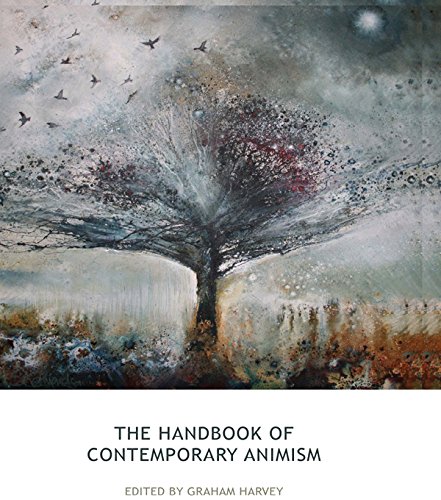
Introducing The Handbook of Contemporary Animism (2013)* editor Graham Harvey describes animism as “a hard-working word”. For him, “it identifies a range of interesting phenomena but also labels several distinct ways of understanding such matters”.

Harvey’s own interest was sparked by postdoctoral research among varied groups of Pagans, which brought him into contact with people who identified as animists. It seemed to him that the word was being used in two contrasting ways. “Some Pagans identified animism as the part of their religious practice or experience which involved encounters with tree-spirits, river-spirits or ancestor-spirits. This animism was metaphysical … Other Pagans seemed to use ‘animism’ as a shorthand reference to their efforts to re-imagine and re-direct human participation in the larger-than-human, multi-species community. This animism was relational, embodied, eco-activist and often ‘naturalist’ rather than metaphysical.”

Fast-forward seven years to now, and ‘animist’ is clearly an important identifier for considerable numbers of people. many of whom draw on both kinds of understanding distinguished by Harvey. Accelerating environmental degradation, species loss and the ever more obvious climate crisis have given the second understanding greater salience and urgency, even when not reinforced by the first.

The Handbook gives valuable information about the history and hinterland of a word that I and my spiritual community use. For ‘animism’ did not arise as a term for people to describe their own experience. It comes from 19th century anthropology, developed by people from a dominant culture (largely European/North American, with a mix of Christian and secular ideas) to study the traditional practices of other people, most of whom were in the process of becoming colonial subjects and living in cultures under stress. Even in the current collection, with its de-colonised anthropology and room for first nations voices, ‘animism’, however positively reframed, is still an awkward piece of labelling for some contributors. One says, “we just call it tradition”.

So ‘animism’ is not innocent. Yet despite this dubious history, it is clear that animism does have inspirational potential as a positive term in our faltering 21st century world. Regardless of where we stand in our metaphysics, any of us can work to re-imagine and re-direct our “participation in the larger-than-human, multi-species community” in a way that is “relational, embodied” and, if we so choose, “eco-activist”. How we do these things is up to us. I will look at the work of some of the individual contributors in future posts.

  • Graham Harvey (ed.) The Handbook of Contemporary Animism London & New York: Routledge, 2014 (First published by Acumen in 2013)

POEM: FIELD

They will not mesh, the very small and the large.

They will not converge.

On that side of the mirror, flickering fringes –

Superposition, quantum probabilities,

Shimmering light and dark; on this,

Nature has made its choice.

Time, space –

They will not bend both ways at once.

When the little ideas slip into bodies like clothes

They step through the mirror, enter

An irreducible level of noise –

Gravitational decoherence, dependent on mass.

Worlds, how sad we are to leave our dreaming behind.

So lovely we were then, so light, so playful.

But how compelling to have a body. In fact,

Irresistible.

From: Katrina Porteous Edge Hexham, Northumberland: Bloodaxe Books, 2019

Blurb note: “Edge contains three poem sequences, Field, Sun and the title sequence, which extend Porteous’s previous work on nature, place and time beyond the human scale. They take the reader from the micro quantum worlds underlying the whole Universe, to the macro workings of our local star, the potential for primitive life elsewhere in the solar system on moons such as Enceladus, and finally to the development of complex consciousness on our own planet. As scientific inquiry reveals the beauty and poetry of the Universe, Edge celebrates the almost-miraculous local circumstances which enable us to begin to understand it. All thre pieces were commissioned for performance in Life Science Centre Planetarium, Newcastle, between 2013 and 2016, with electronic music by Peter Zinovieff.”

SIGNS OF BLOSSOM

In my neighbourhood, there is a distinct mid-February period. Blossom, particularly cherry blossom, is developing. Whatever the weather I feel confidence in the coming of spring.

Humanly, I enjoy a shared experience of extended Valentine. When my partner Elaine and I decided to marry after a decade together, we chose 17 February (three days after Valentine) as our wedding date. So now a four day moment in the year celebrates ever-renewing relationship.

I imagine that most people who consciously live the wheel of the year include dates where a private significance flavours, extends, or indeed reframes a natural or tribal one. Mid February is such a time for me.

ENDANGERED AND EXTINCT

Val Hunt is a creative recycling artist, currently exhibiting at Stroud’s Museum in the Park. Her theme is ‘Endangered and Extinct’, and the work features – both poignantly and joyfully – a rich variety of flora and fauna. The sculptures have been made from a selection of throwaway materials, especially the artist’s favourite medium, drinks can metal. Recycling, with its somewhat utilitarian image, is turned into a form of celebration.

I dropped in to the museum whilst walking in the park, without prior knowledge of the exhibition. I had no preconceptions about it, and immediately liked the vividness and exuberance of the sculptures in a context that can easily take me into states of solemnity and distress. Instead, I found an affirmation of life and creativity – the very things that we are looking to preserve and protect. I had never imagined that drinks can metal could be so thoroughly transformed.

Val Hunt can be found at http://www.arthunt.co.uk and the museum, frequently the site of good exhibitions, is at http://www.museuminthepark.org.uk

WOODLAND HAIKU

This lone shape

emerging from under-wood:

Who am I?

LIGHT ON TREES

Bright light as a valley experience. Sunlight on trees. February 6, the day I took this picture, provided my first experience of intense sunlight this year. It got through to me even in a shady place. My eyes were dazzled and my head struck by an unexpected warmth.

I noticed mixed feelings. Yes, I celebrated the return of the light. Yes, it was a reference experience for the spring aspect of Imbolc in my part of the world. More visceral than snowdrops, the sun truly reached me and not just my nature-observant sensibilities. It was almost shocking.

Looking out, after that first moment, my world filled up with light on trees. I wondered if they too had any resistance to waking up and being visible and called upon to grow and change and open to the light more fully. I don’t know what it’s like to be a tree. Not really. Withdrawing my projections, I am turned back to my own responses. Parts of me have reservations about immersion in the light. Perhaps they have a wisdom of their own.

Earth Eclectic

music that celebrates Earth and speaks to the heart

Sarah Fuhro Star-Flower Alchemy

Follow the Moon's Cycle

Muddy Feet

Meeting nature on nature's terms

Rosher.Net

A little bit of Mark Rosher in South Gloucestershire, England

Becoming Part of the Land

A monastic polytheist's and animist’s journal

selkiewife

Selkie Writing…

Charlotte Rodgers

Images and words set against a backdrop of outsider art.

Prof Jem Bendell

living with metacrisis and collapse

Towint

The pagan path. The Old Ways In New Times

The Druids Garden

Spiritual journeys in tending the living earth, permaculture, and nature-inspired arts

The Blog of Baphomet

a magickal dialogue between nature and culture

This Simple Life

The gentle art of living with less

Musings of a Scottish Hearth Druid and Heathen

Thoughts about living, loving and worshiping as an autistic Hearth Druid and Heathen. One woman's journey.

Wheel of the Year Blog

An place to read and share stories about the celtic seasonal festivals

Walking the Druid Path

Just another WordPress.com site

anima monday

Exploring our connection to the wider world

Grounded Space Focusing

Become more grounded and spacious with yourself and others, through your own body’s wisdom

The Earthbound Report

Good lives on our one planet

Hopeless Vendetta

News for the residents of Hopeless, Maine