SEVEN IMAGES: LIGHT AND SHADE IN A GENTLY WANING YEAR



Bendigeidfran, Bran the Blessed, is a legendary King of the Britons. He is best known to us through the medieval Welsh text The Second Branch of the Mabinogi (1). The primary theme is hope betrayed, most chillingly by Efnysien, Bran’s “brother on his mother’s side”. A marriage feast ends in a series of disasters. But this is not the whole story.
The marriage is between Bran’s sister Branwen and Matholwch the King of Ireland, intended to bring the two kingdoms together in peace and amity. But Efnysien mutilates the Irish party’s horses at the celebration hosted by Bran. It is among the worst things he could do.
In one savage, impulsive act, Efnysien opens the space for an outpouring of resentment, suspicion and hostility – eventually, from both the Irish and the British people. Bran’s efforts to resolve the situation through explanation, consultation and negotiation end in failure. The level of compensation and apology he offers is too much for the British and too little for the Irish. The time comes when Branwen is seriously abused in Ireland. The absolute breakdown of trust between the two countries leads to a bitter, brutal war.
After the war, Bran returns from Ireland with seven surviving companions, his only victory being that he has got them home. Ireland is completely devastated. Bran has been wounded in the foot by a poisoned spear, probably a mortal wound. Bran makes a radical decision, leading to a period of healing and renewal for his companions and a new protective role for his country. “Bendigeidfran ordered his head to be cut off. ‘And take my head’, he said, ‘and carry it to the Gwynfryn in London (the White Mount, now the Tower of London) and bury it with its face towards France. And it will take you a long time; you will feast in Harlech for seven years, with the birds of Rhiannon singing to you. And you will find the head to be as good company as it ever was when it was on me. And you will stay for eighty years in Gwales in Penfro. And so long as you do not open the door to Aber Henfelin, facing Cornwall, you can remain there, and the head will not decay. But as soon as you open that door you can stay no longer. Make for London and bury the head. And now set off across the sea”.
Bran has never been an average human. Too big “to fit inside any house”, he wades across the sea to Ireland “carrying all the stringed instruments on his back”. Later, he bridges the River Liffey by lying down across the river: “hurdles were placed on him, and his men walked on top of him to the other side”. Bran is more than a physical giant. There is something numinous and otherworldly about him, built into his name Bendigeidfran, Bran the Blessed.
The term ‘blessed’ points to something other than it would in the life of a Celtic saint. Caitlin & John Matthews call Bran the Blessed a “titanic god of the Celts … a god of earth and mountain” (2). R. J. Stewart and Robin Williamson describe him as a “primal guardian deity” (3) enacting a role of sacred king traditionally concerned with music, poetry and bridging. In the narrative world of the The Second Branch, such roles are alluded to rather than fully described, but the world is full of magic and spiritually ambiguous, with formal religion little mentioned.
The decapitation of Bran is a magical act. It has two successive effects, both of them benign. The first is when the presence of the head enables an extended period of protected respite for Bran’s companions: the seven years when they feast and hear the birds of Rhiannon (4), and then eighty years as “the Assembly of the Noble Head”. During this time, they forget “all the sorrow they had themselves seen and suffered, [and] … any grief in the world”. Life is pleasurable and delightful and no one seems to age.
It has to end, for the story to continue. The western door is opened, by Heilyn son of Gwyn, driven by curiosity. Grief, loss and ageing return to the companions’ world. They hasten to London to complete their destined task. As long as the head remains buried, no enemy can conquer the kingdom. This is where The Second Branch story ends. Bran, through the agency of his buried head, is confirmed as enduring protector of the land.
There is a coda. It is said that King Arthur dug the head up in later days in the belief that no one but he should protect the country, and that subsequently the head was lost. In later days, the power of the head was transferred to the presence of resident ravens. Bran’s name means raven (also crow), which allows the ravens to take on his power. He is them. They are him. Ravens are kept in the Tower of London to this day, a practice insisted on by Charles II, concerned for the preservation of his country as a kingdom. During World War II the ravens fled after a bombing raid, and every effort was made to ensure that they were swiftly replaced. Seven ravens, the responsibility of Ravenmaster Chris Skaife, live in the Tower now. (5).
(1) The Mabinogion Oxford: the University Press, 2007. (Translated with an introduction by Sioned Davies)
(2) Caitlin & John Matthews The Western Way: A Practical Guide to the Western Mystery Tradition London: Arkana, 1985 (Foreword by Gareth Knight)
(3) R. J. Stewart & Robin Williamson Celtic Bards, Celtic Druids London: Blandford/Cassell plc, 1996 (Colour illustrations by Chris Down)
(4) https://contemplativeinquiry.blog/2017/8/4/a-bird-of-rhiannon
(5) https://www.hrp.org.uk/tower-of-london/whats-on/the-ravens

“Besides the countless particular miracles that we comprise, there is that supreme irregularity – the fact that anything exists at all. Most unnaturally, there is not just Nothing. How adroit for It to happen! How deserving of our congratulations It is, for having arranged its quite impossible existence! After that, what are a few billion universes more or less.”
These words are from Douglas Harding’s epilogue to The Hierarchy of Heaven & Earth (1) published on the recommendation of C. S. Lewis, distinguished scholar and Inkling. Lewis’ introduction places it among “philosophies that have some of the same qualities as works of art”, and he is reminded in that respect of Hermann Hesse’s Glass Bead Game.
Harding describes his work as “an unconventional attempt to discover, for myself and in my own way, what I am and what I amount to in the universe. What am I? That is the question. Let me answer it as honestly and simply as I can, forgetting the ready-made answers.”
Harding also has the courage to declare that he has not found an answer. Instead, he has entered a state of “amazed reverence” that reveals his whole inquiry as both “absurd” and “a needful absurdity”. He finds that “because all my roots are in the Undiscoverable, I also am undiscoverable: I will not bear inspection, and can never make head or tail of myself. Self-knowledge is the smouldering wick that is left after the light of wonder has been put out. … If this book quenches the feeblest flame of awe, of direct awareness, in myself or anyone else, then it were better never to have written it”.
Harding did not end his inquiry with The Hierarchy of Heaven & Earth. Instead, he went on to become a midwife of direct awareness, and The Headless Way (https://www.headless.org) was born. Where The Hierarchy of heaven & Earth is concerned with exuberant yet disciplined system building, Harding’s later work challenges each of us to ‘look for yourself’ using a set of experiments, now accessible on The Headless Way website. I reported an early, intensive experience of them on return from a four day retreat with the Headless Way in 2016 – https://contemplativeinquiry.blog/2016/07/28/look-for-yourself/ Interestingly, my wrap-around commentary, especially the post-workshop phase, would now be a little different from the one in that post, while my report of the direct experience remains the same. In my current practice, I particularly draw on a seven point version of the experiments presented in Head Off Stress (2).
I never met Douglas Harding in person – my discovery of the Headless Way is too recent. But his writing and recorded material show never-ending wonder at the miracle of existence. They also show his passion for facilitating a transformative recognition of who we really are, and then to live from that recognition.
“I certainly don’t find myself
on the brink of a bottomless abyss,
trying to make up my mind
whether to let go and take that dreadful plunge.
I am already clear of the brink
and free-falling,
and have never been otherwise.
To see this,
all I have to do is look for myself,
and fail to find myself, and find instead
the treasure that has no name
in the well
at the world’s end.”
(1) D. E. Harding The Hierarchy of Heaven & Earth London: The Shollond Trust, 2011 Introduction by C. S. Lewis. (Abridged edition – original edition published by Faber & Faber in 1952)
(2) D. E. Harding Head Off Stress: Beyond the Bottom Line London: The Shollond Trust, 2009 (Originally published by Arkana in 1990)
(3) Douglas Harding Everyday Seeing: daily meditations on the One within London: The Shollond Trust, 2019 (Quotations selected by Richard Land)

I am looking downwards into water, identifying patterns, on a surface that swirls and moves and changes. I have the same impulse to identify patterns in my contemplative life. In essence, contemplative experience is simple, still, and drawn from wordless depths. But there’s a surface swirl that’s more agitated, largely driven by worries over naming and explaining, clarifying where my inquiry sits within human communities, and accurately representing spiritual philosophies. Here too, I am giving the surface swirl the attention it seeks. I do not ask the swirl to stop swirling, because swirling is what it does. There is value in the swirl.
I centre myself in modern Druidry, but my self-presentation from 2012 as a ‘contemplative Druid’ is slightly misleading – too narrow. I champion the value of a contemplative current within Druidry, and I am happy to describe my blog as a contemplative inquiry. But I also have a strong commitment to the life of the world and opportunities for the flourishing of all beings, within both the constraints and the opportunities of our interconnectedness. I am concerned with our planet and its biosphere; with human history and culture; with ethics and engagement; with beauty as well as truth and goodness; and with issues of wounding and healing. They are part of my inquiry. I cannot separate them from my contemplative commitment.
I also celebrate the influence of ‘nondual’ currents outside Druidry. Nondual is a translation of advaita (not-two) in classical Sanskrit philosophy. It describes the divine/human relationship. Its original home is the Advaita Vedanta path in India, but there are nondualists in other world religions, including the Abrahamic ones: Sufi currents in Islam, Jewish Kabbalah, contemplative Christianity. In Christian terms, you would say that we are all essentially Christs – in a creation of one Light and many lamps. In some interpretations, nonduality does not apply only to humans, but to all lives in the cosmos. Some iterations of nonduality – Mahayana Buddhist and Taoist in particular – avoid the language of divinity, preferring terms like ‘true nature’ or the deliberately undefinable ‘Tao’.
I have engaged with current nondualist teachings for some years, most recently with the Eckhart Tolle community – https://www.eckharttolle.com. I have learned a lot from them. In this blog’s About section, I say: “My inquiry process overall has helped me to discover an underlying peace and at-homeness in the present moment, which, when experienced clearly and spaciously, nourishes and illuminates my life. It is not dependent on belief or circumstance, but on the ultimate acceptance that this is what is given”.
I could maintain this stance as a humanist or existentialist, but my deepest intuition is that the ‘present moment’ (or eternal now), fully experienced, links my passing personal identity to a cosmic one, a ground of being that is my true nature. Belief has come in: ‘willingness to follow one’s deepest intuition’ is one definition of faith, and I have surprised myself by becoming a person of faith in this sense. The purpose of continuing inquiry is to keep me open to new experiences, understandings, and connections, as well as teaching me how best to live from the peace and at-homeness of the centre.
My inquiry is a self-directed enterprise that welcomes input from multiple sources. But I draw on two main centres of community wisdom and support. The first is OBOD Druidry (https://www.druidry.org), with its embrace of the earth and its loyalty to the world of space and time, nature and culture. For many of us this includes the sense of a living cosmos and a divine ground. The second is the specifically nondualist Headless Way, based on the work of the late Douglas Harding (https://www.headless.org). I have started to think of myself as a Headless Druid, in a modern kind of way, whilst also aware of older traditions in which decapitation is indeed the gateway to a larger life:
‘It’s off with my head’, says the Green Man,
‘It’s off with my head’, says he.
Green Man becomes grown man in flames of the oak
As its crown forms his mask and its leafage his features;
‘I speak through the oak’, says the Green Man.
‘I speak through the oak’, says he.
William Anderson Green Man: Archetype of Our Oneness with the Earth Harper Collins: London & San Francisco, 1990.
See also: https://contemplativeinquiry.blog/2021/6/14/tree-mandala-oak and https://contemplativeinquiry.blog/2017/05/11/poem-green-man

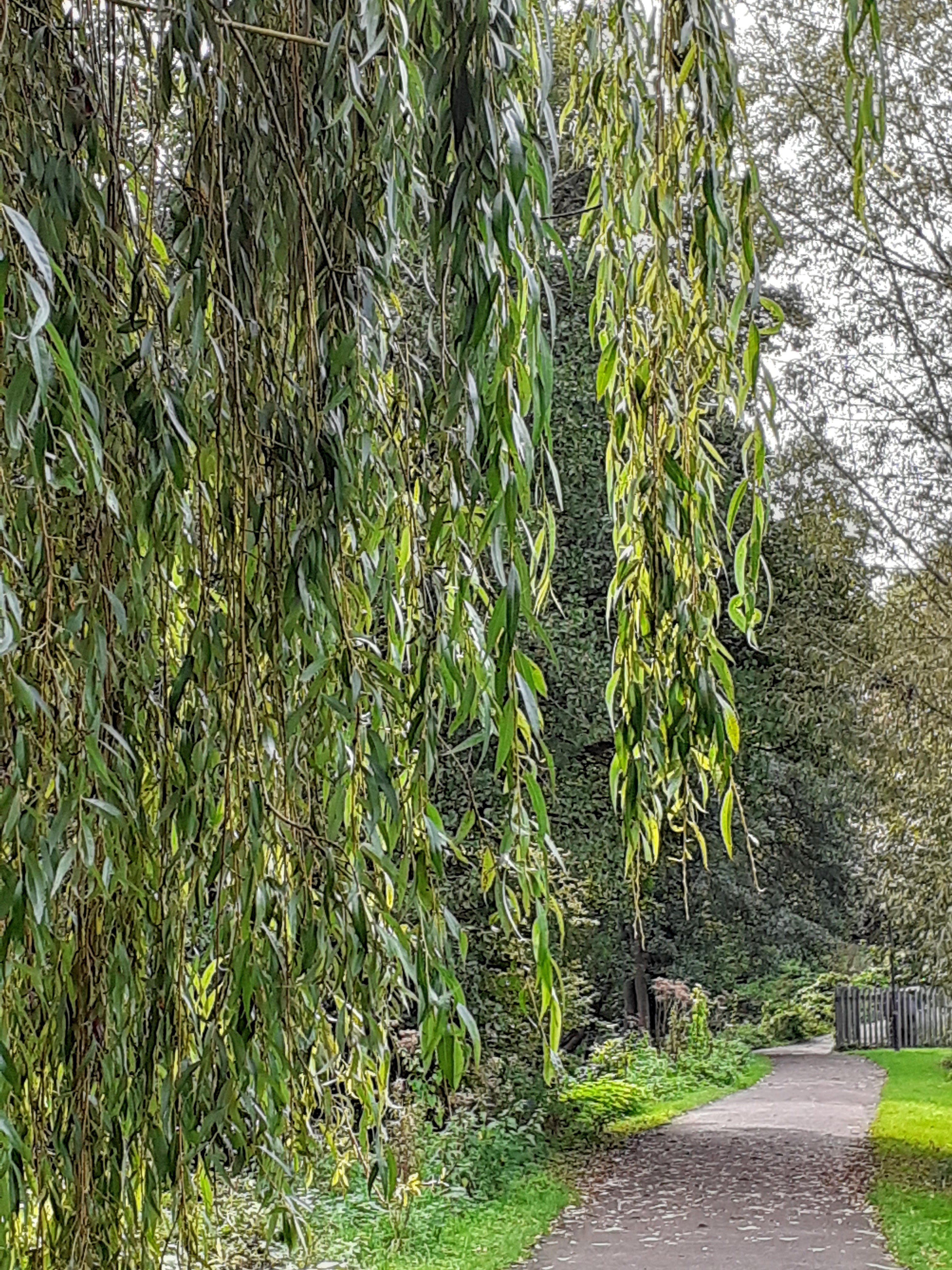
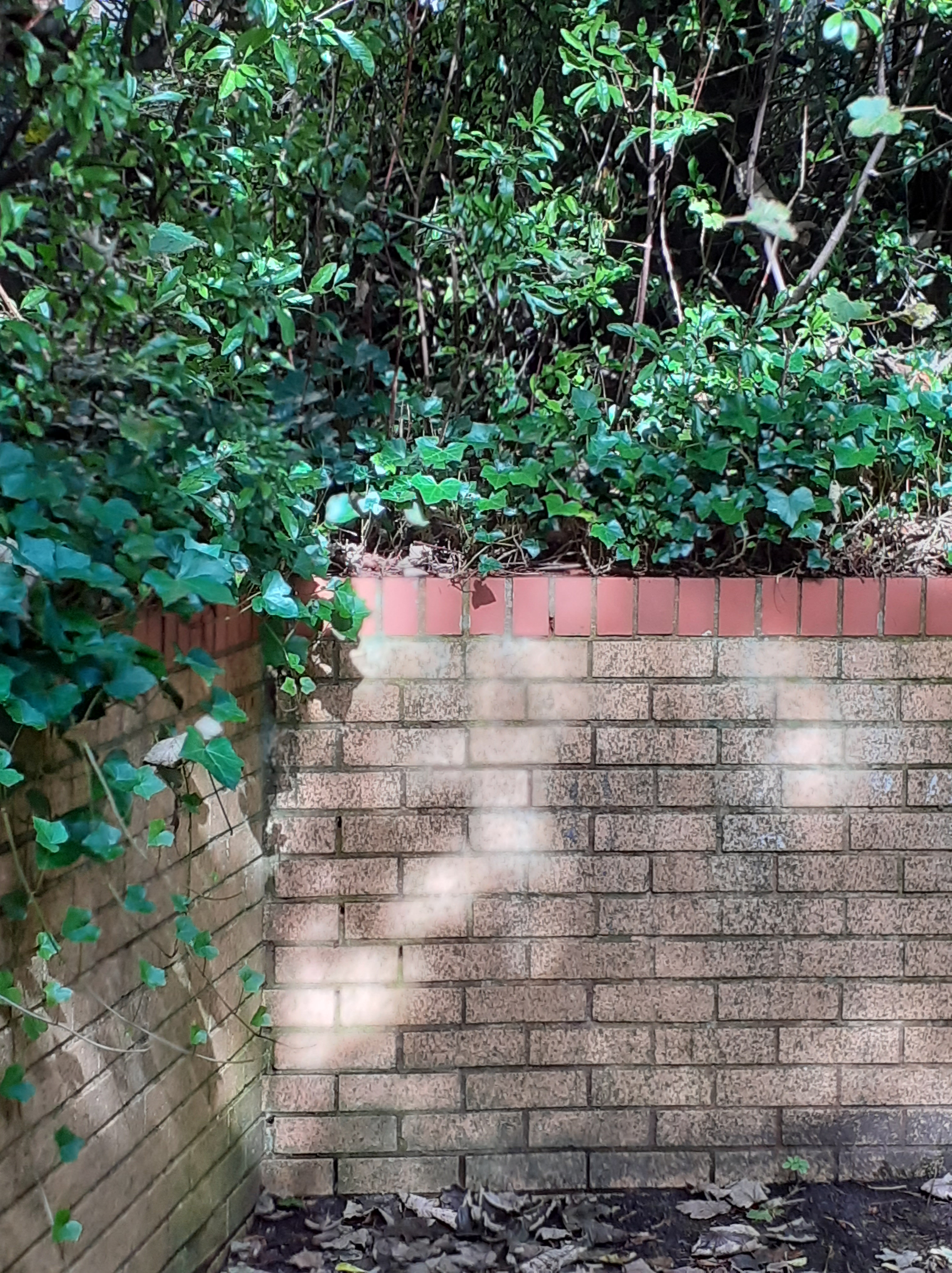
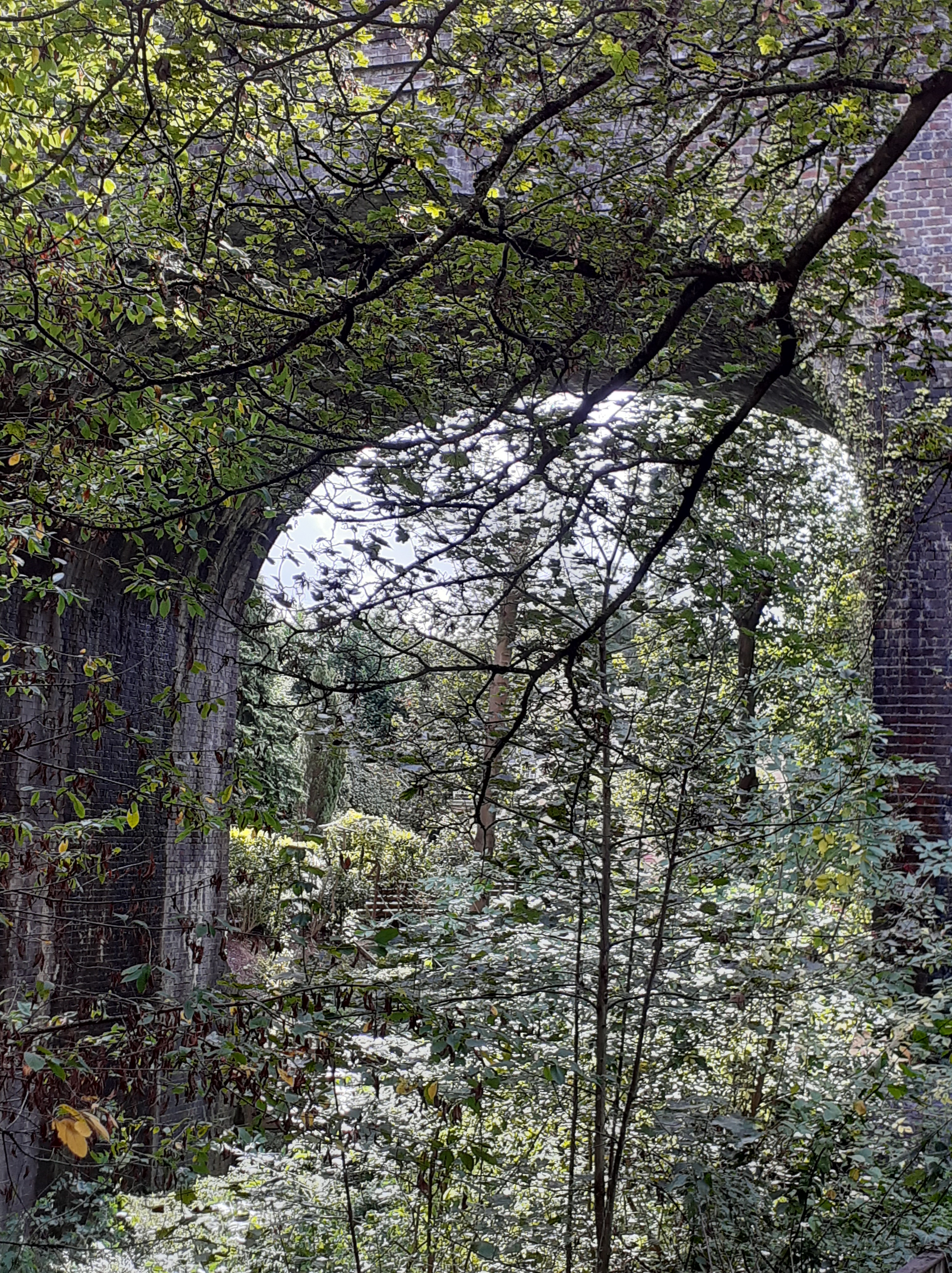
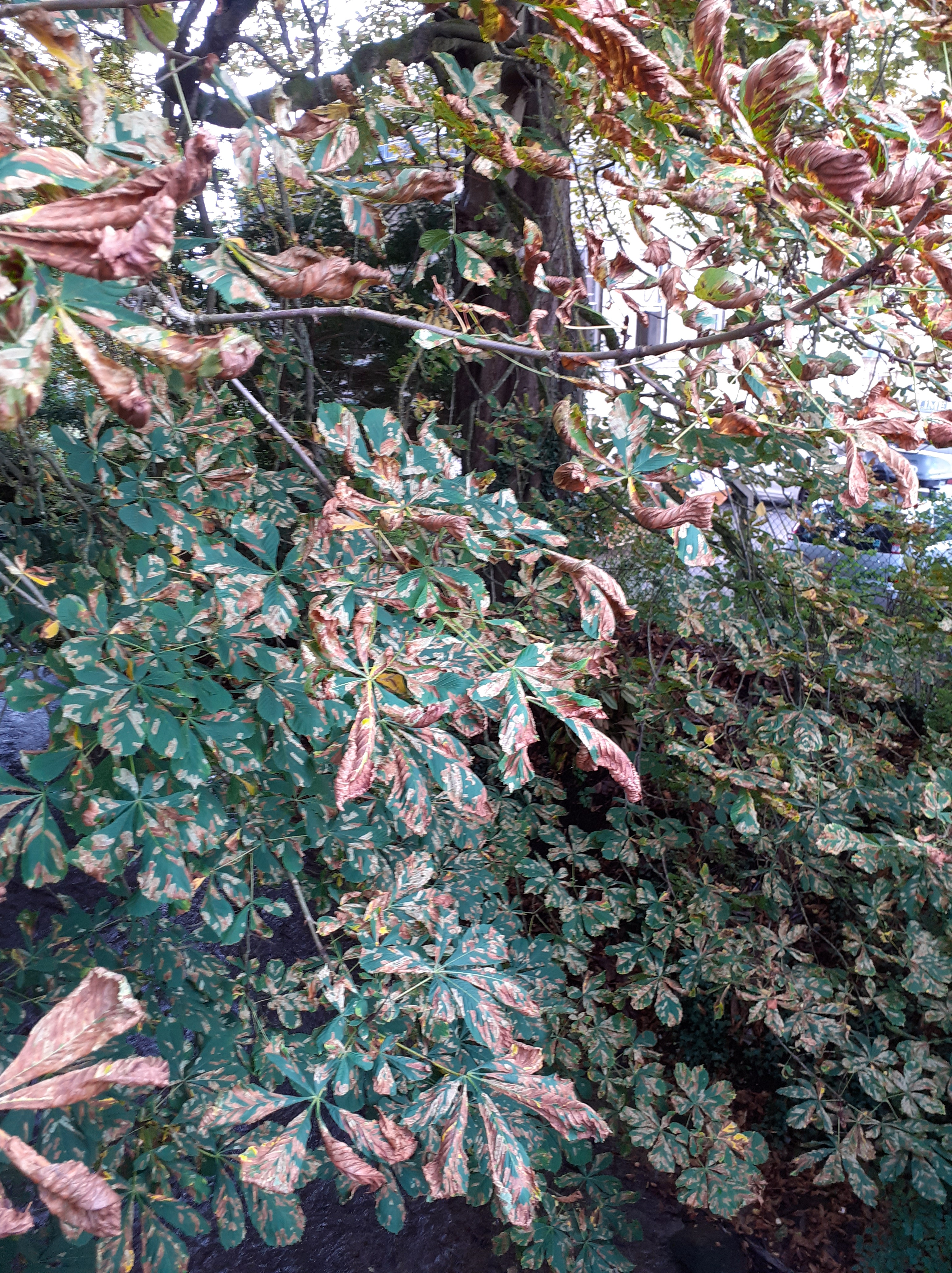
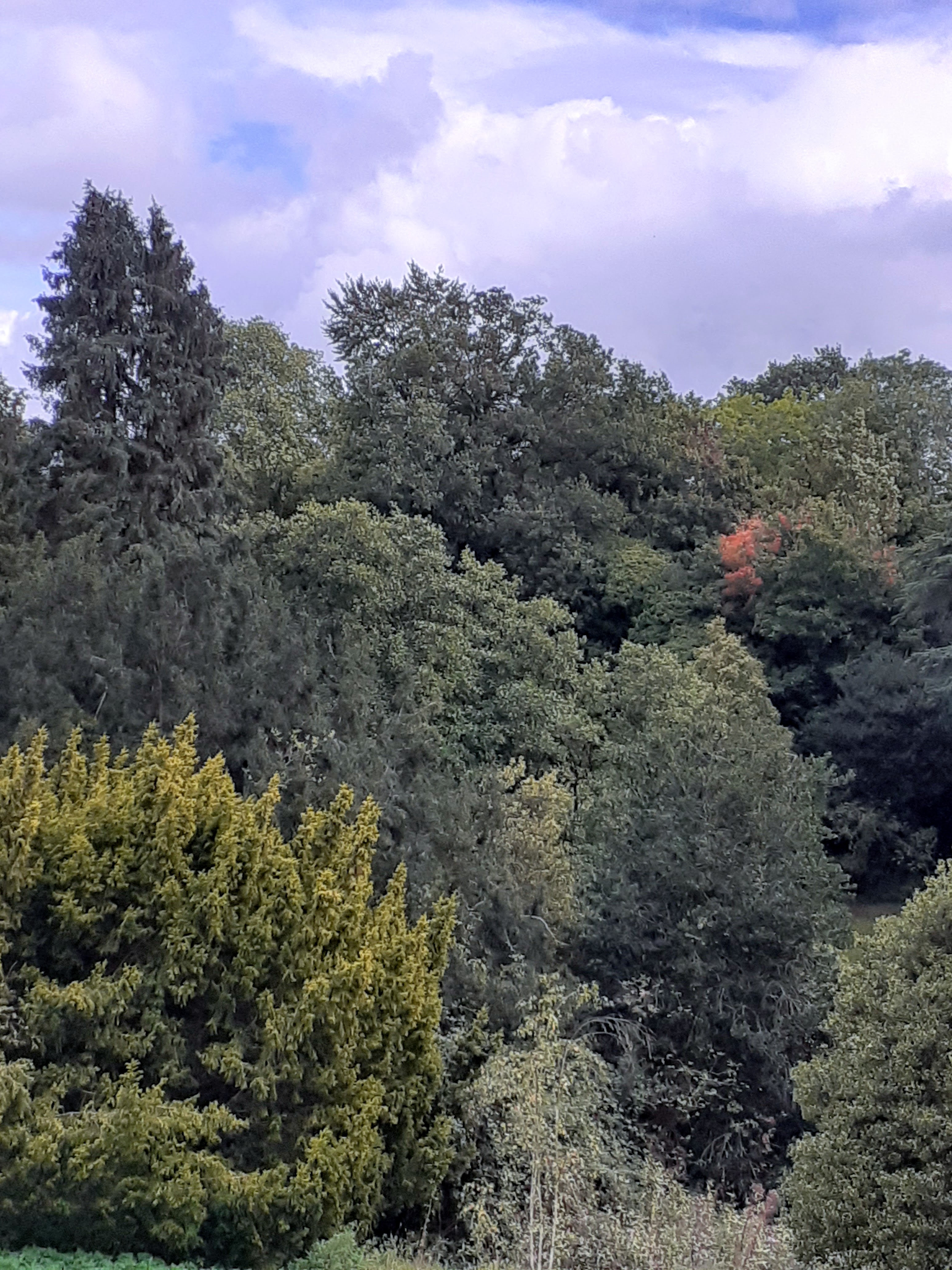
After the equinox comes a deepening of autumn. Light, colour, texture – my sense of the world is different. Images of this moment in the year shape my sense of time as well as of place. I savour the turning of the wheel. All time is transitional, yet every time has its own uniqueness.
Contemplating images like this is for me a way of sustaining what modern Druids sometimes call a re-enchantment with and of the world. Simple attention to the living world is a renewing experience, and protects the heart from what can seem like the half-life of a Wasteland culture. Opening to a living cosmos, I plead guilty, with pride, to the charge of Romanticism.
It is after 9 a.m. on Sunday 26 September, Locally I enjoy orange as a colour of ripening, rich and shiny with life, as the season of bearing fruit moves on.

There are trees whose leaves have already turned, but will stay on their branches for awhile, giving these woods a more mixed, autumnal appearance.

But there is still a preponderance of green, some of it surprisingly fresh. Here it provides a canopy of green light and shade.
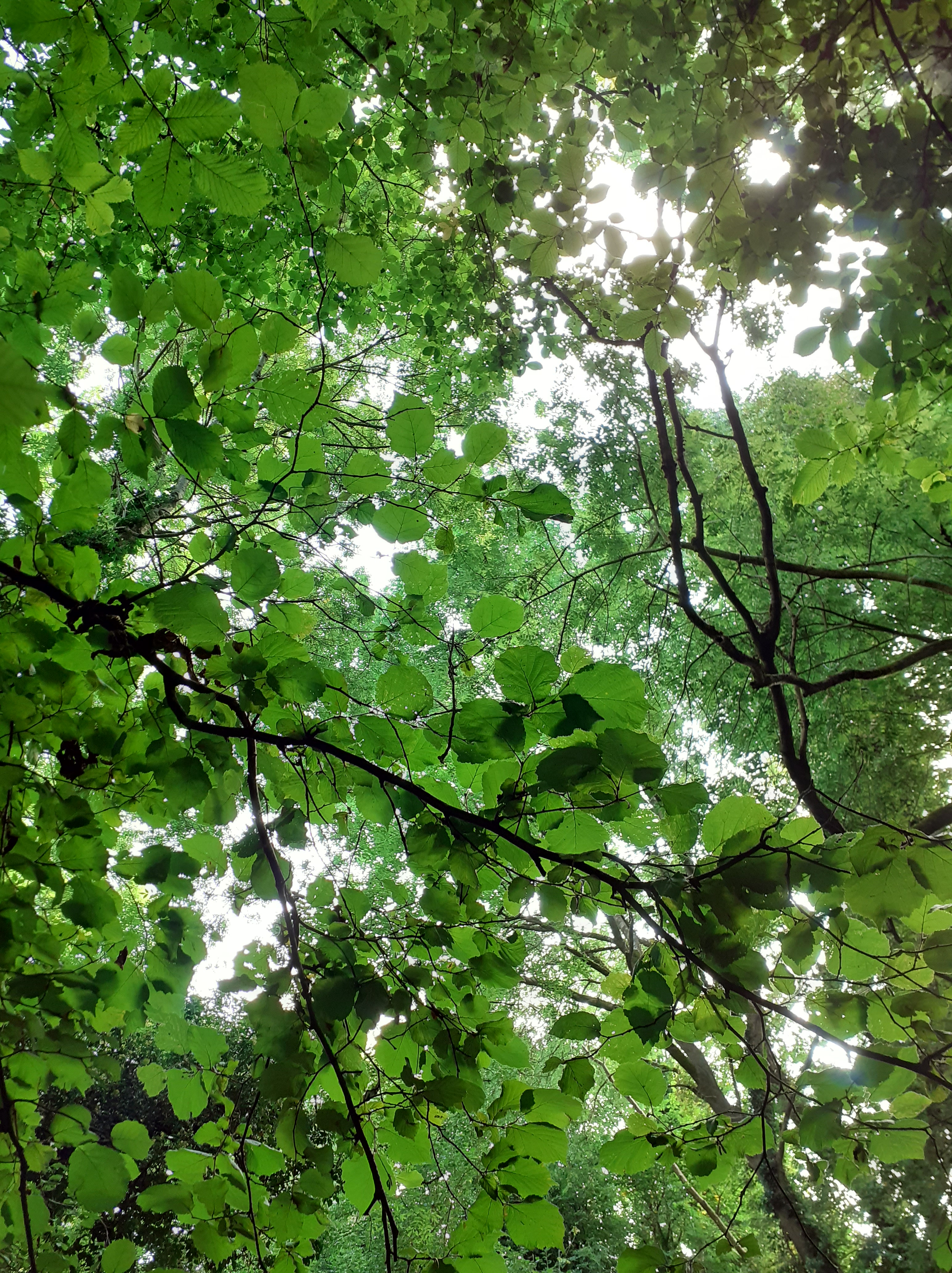
The season is also asserting a downward pull, towards the earth and dissolution – a process, however, still in its early stages. The broken fence seems almost to be sharing this, beginning a return to the land.

Then there is the undergrowth, with its mix of living and dead wood, living and dead leaves, and the soil that holds them. The evergreen leaves are defiantly vivid. Taking pictures, I celebrate the time of year.


“It may be that night will close over us in the end, but I believe that morning will come again. Morning always grows again out of the darkness, though maybe not for the people who saw the sun go down. We are the Lantern Bearers, my friend; for us to keep something burning, to carry what light we can forward into the darkness and the wind.” (1)
I am contemplating the role of ‘lantern bearer’. The Lantern Bearers is the last book in a trilogy set in different periods when some people thought of themselves as both Roman and British. This makes for cultural complexity and a need to make conscious personal choices. Aquila, the main character, is a young officer in the last auxiliary cavalry cohort remaining in the province at the time of the final withdrawal*. The mission is to maintain the lighthouse at the decaying fortified port of Rutupiae (Richborough near Sandwich, Kent) to guide ships and demonstrate a continuing presence on the ‘Saxon Shore’. On being told that his unit is to leave, Aquila deserts and hides.
When night falls, he lights the beacon for one last time. Then he goes home to his family farm. His commitment is to them and the land. It is an old military family, originally from Tuscany, but his father forgives him saying that he would have done the same. They have little to connect them to fallen Rome and even less to distant Constantinople and the orient.
After a brief and beautiful family reunion, Aquila loses everything, as his farm is attacked and destroyed, his father killed, he and his sister taken captive. Then come three years of thraldom (slavery) in Jutland; return to his homeland when his owners migrate permanently; escape; a bitter discovery that his sister has become reconciled to a forced marriage with a one of the hated invaders following the birth of a son; a journey to join Ambrosius Aurelianus and his new resistance army, its heartland already far to the west, in the mountains of modern Wales. Aquila becomes militarily effective, while still traumatised and emotionally frozen. He too accepts a loveless arranged marriage with the daughter of a local warlord as part of Ambrosius’ plan to bring the ‘Roman’ and ‘Celtic’ sections of his coalition closer together.
Over time, and long years of war with peaceful intervals, Aquila begins a process of healing and increasing insight. The conversation about ‘lantern bearers’ comes at the end of the book, when Aquila and the army doctor Eugenus are talking during a victory celebration. The young Artos (presented here as a beloved hero, though not quite the Arthur of legend) has won a major battle. But it is obvious to both Eugenus and Aquila that the invaders will not be thrown back to the sea or even held back in their current territories for very long. The imbalance of population and forces is too great, the Angles, Saxons and Jutes themselves in flight from other invaders further to the east. Despite knowing this, the last Roman British will not give up. They will continue to do what they can. They will be lantern bearers, trusting in the possibility of a legacy, holding onto the hope that something of value may be carried on, even into a distant future that they cannot even imagine.
I read The Lantern Bearers when I was 11 or 12 and it made a strong impression on me. Even then I thought that the lantern bearing philosophy wouldn’t work for a nuclear war. But I thought that it might work for anything less drastic and immediate. Now we have the climate crisis, which is global and much more serious than the fall of the western Roman Empire. Military operations are no part of any just solution.
They are not the only solution even in The Lantern Bearers. Brother Ninnias is a refugee monk and bee-keeper, sole survivor of a monastic community in what is now the invaders’ territory. He isn’t the stuff of which the masterful saints of the Celtic Church are made – equally willing to become martyrs or princes of the Church as the faith appears to demand. Indeed Ninnias’ formal practice is much decayed, as he stays with a community of destitute refugees, one of them, a healing presence who helps out where he can. His occasional meetings with Aquila are a crucial part of the soldier’s psycho-spiritual recovery, because he listens and understands without judgement, also helping Aquila to save his ‘Saxon’ nephew from a massacre of fleeing wounded enemies, and then return him to his mother with a reconciling message. Brother Ninnias is not much interested in the wider context of history and culture. He scarcely seems interested in his religion, as a Religion. Rather, to use the deeper language of his tradition, he helps to open spaces where grace can come in, wherever the moment of opportunity arises. He is a lantern bearer too, though after another manner.
I can take on the notion of lantern bearing – bearing witness, choosing consciously how to live, taking appropriate action, favourably influencing events as far as lies in my power. It helps me to feel more resourceful. My recent reading of The Lantern Bearers has been a gift to me from my younger self, across sixty years of chequered history.
(1) Rosemary Sutcliff The Lantern Bearers Oxford: the University Press, 1959 (Third of a trilogy – the others are The Eagle of the Ninth and The Silver Branch).
*Sutcliff places this in the 440’s, a generation after after the departure of the legions.
Illustration: the Hermit card from Philip and Stephanie Carr-Gomm The DruidCraft Tarot: Use the Magic of Wicca and Druidry to Guide Your Life London: Connections, 2004. Illustrated by Will Worthington.
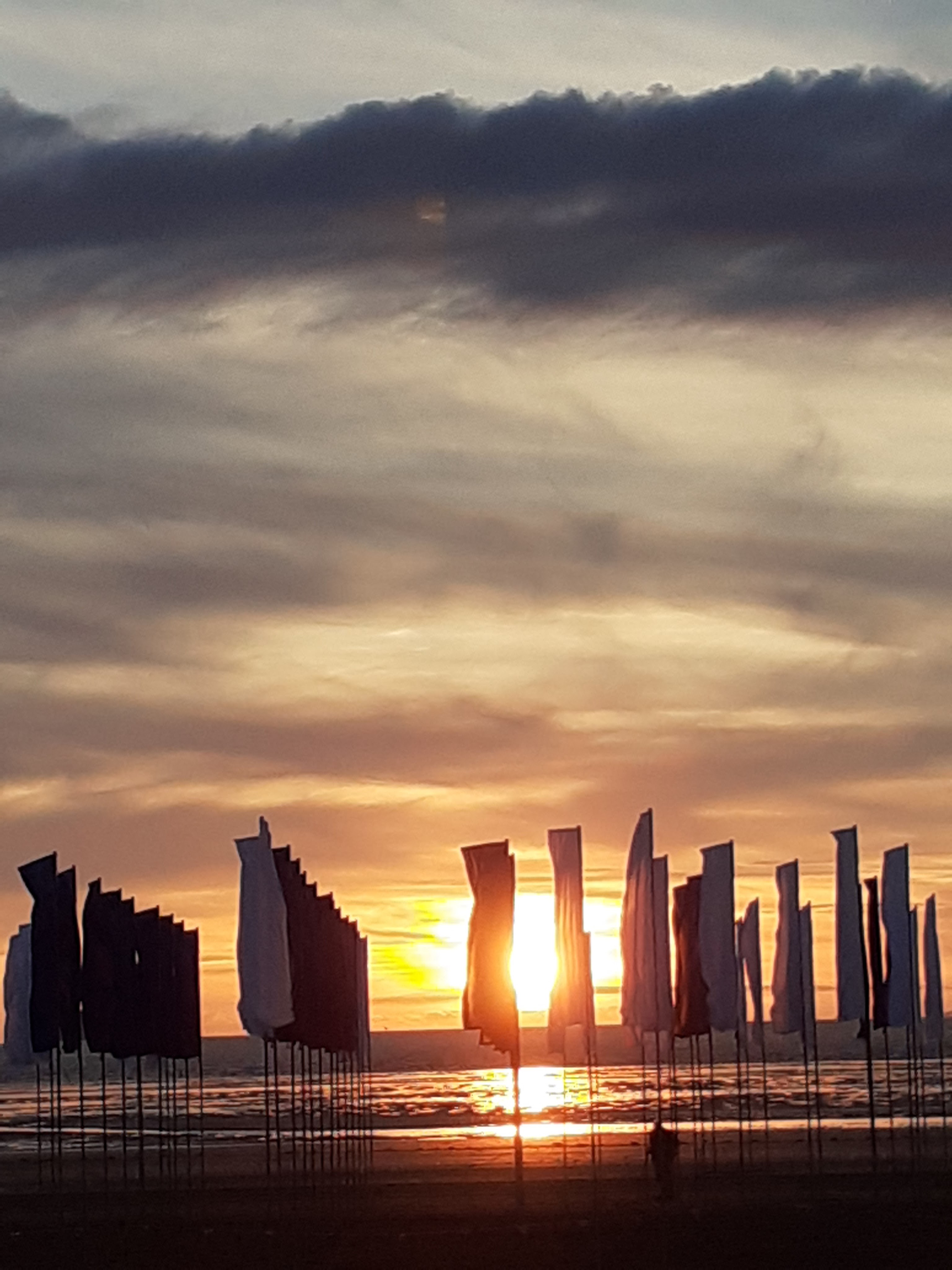
In Memoriam is a touring artwork by Bristol-based artist Luke Jerram. His installation, as shown on Weston beach on 16 September, is a temporary memorial for those lost to the COVID-19 pandemic, as well as a tribute to the NHS health and care workers who have been risking their lives during the crisis. I was in Weston with my wife Elaine at the time, and we explored the installation both separately and together.
The exhibition is made up of 100 flags, originally hospital bed sheets, planted in the sand. A bird’s eye view would show a blue cross against as white background. When I photographed the installation at sunset on 16 September, it felt numinous to me and slightly reminiscent, in its feeling-tone, of an ancient ritual site. I wonder if our distant ancestors had portable and perishable structures for enhancing ritual space as well as the great stone ones that remain part of our landscape. It seems likely.
Luke says of his work: “As we move towards the end of this pandemic in the UK, it feels like, as a nation, we need to come to terms with everything we’ve been through. With funerals limited in their capacity and places of worship closed, it’s been hard for many people to grieve properly. I hope this artwork will create a framed space and moment in time for personal and shared reflection”. http://www.memoriamartwork.com/about
The exhibition has been deliberately placed in the open air and in windy locations, inviting people to enter, contemplate and explore the artwork. The experience recorded above combined shape, colour, sound and movement – all at twilight, leaning in to the autumn equinox, in a meeting place of land sea and sky. For me, both the time and place made a difference, manifesting the power of liminal times and spaces wherever they are found.
My earlier, day-time experience of the installation had been different. Then, the scene felt defined and organised, with clear edges. A blue sky with light patches of cloud matched the flags. At the same time, the sense of a darker ground was evident, with shadows like freshly dug graves.
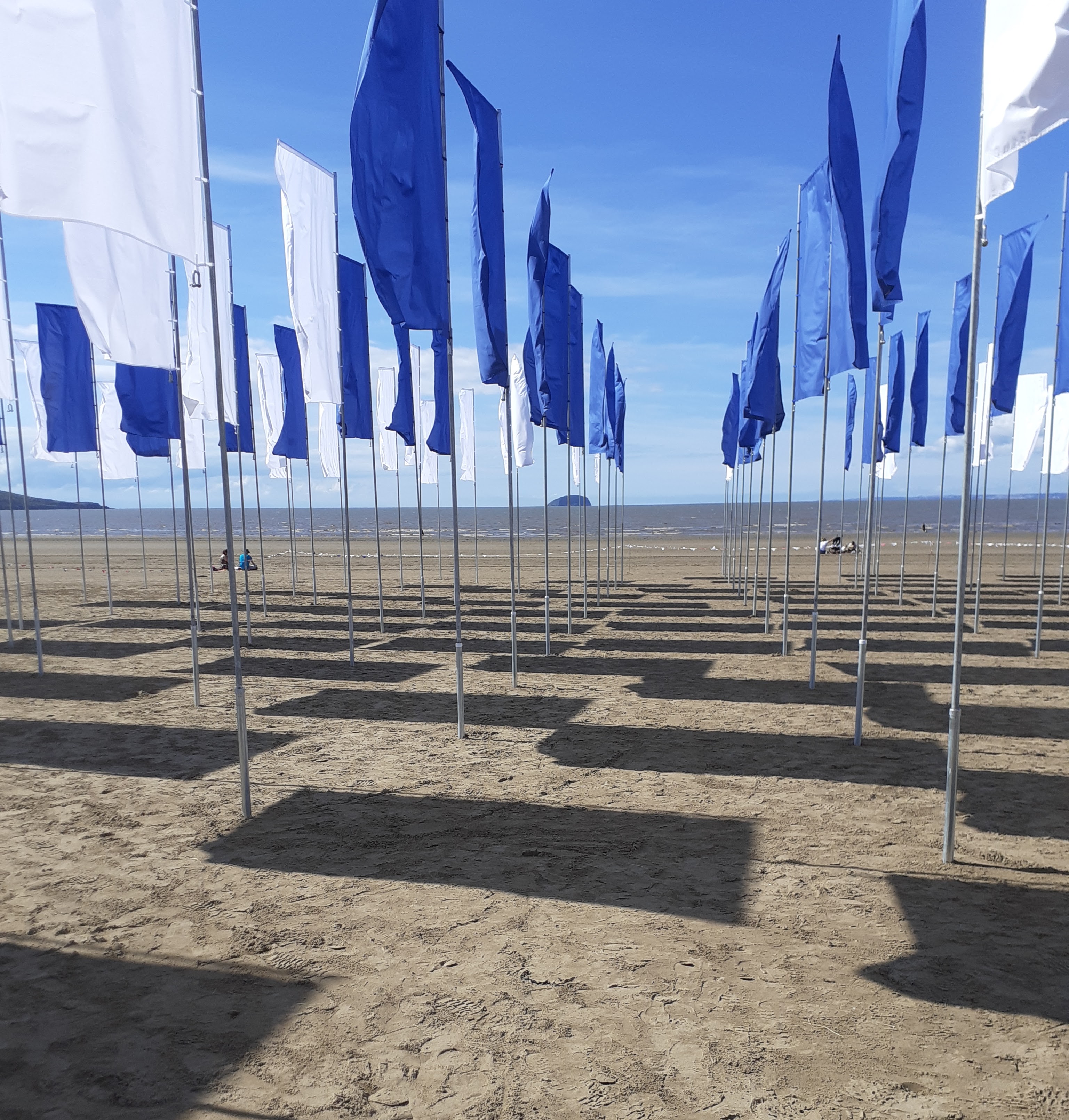
The flags installation has been touring the UK for about a year. It is due to move to Bristol on leaving Weston, where it forms part of a local health and arts festival. Weston and Bristol are its home, for it was commissioned by Culture Weston https://cultureweston.org.uk and the University Hospitals Bristol & Weston NHS Foundation Trust. It is also supported by the Without Walls street art consortium https://www.withoutwalls.uk.com and the Welcome Trust funded Weather Lives project based at the University of Durham.

This is North Woodchester, about two miles from my home in Stroud. The old church has gone, its neat and tidy Victorian replacement some little distance away. But its graveyard is still consecrated, and still maintained. Happily, it is not overly manicured. There is room for nature and imaginative freedom. It feels like a place of many dimensions. I have long enjoyed spending time here, and first wrote about it seven years ago (1).
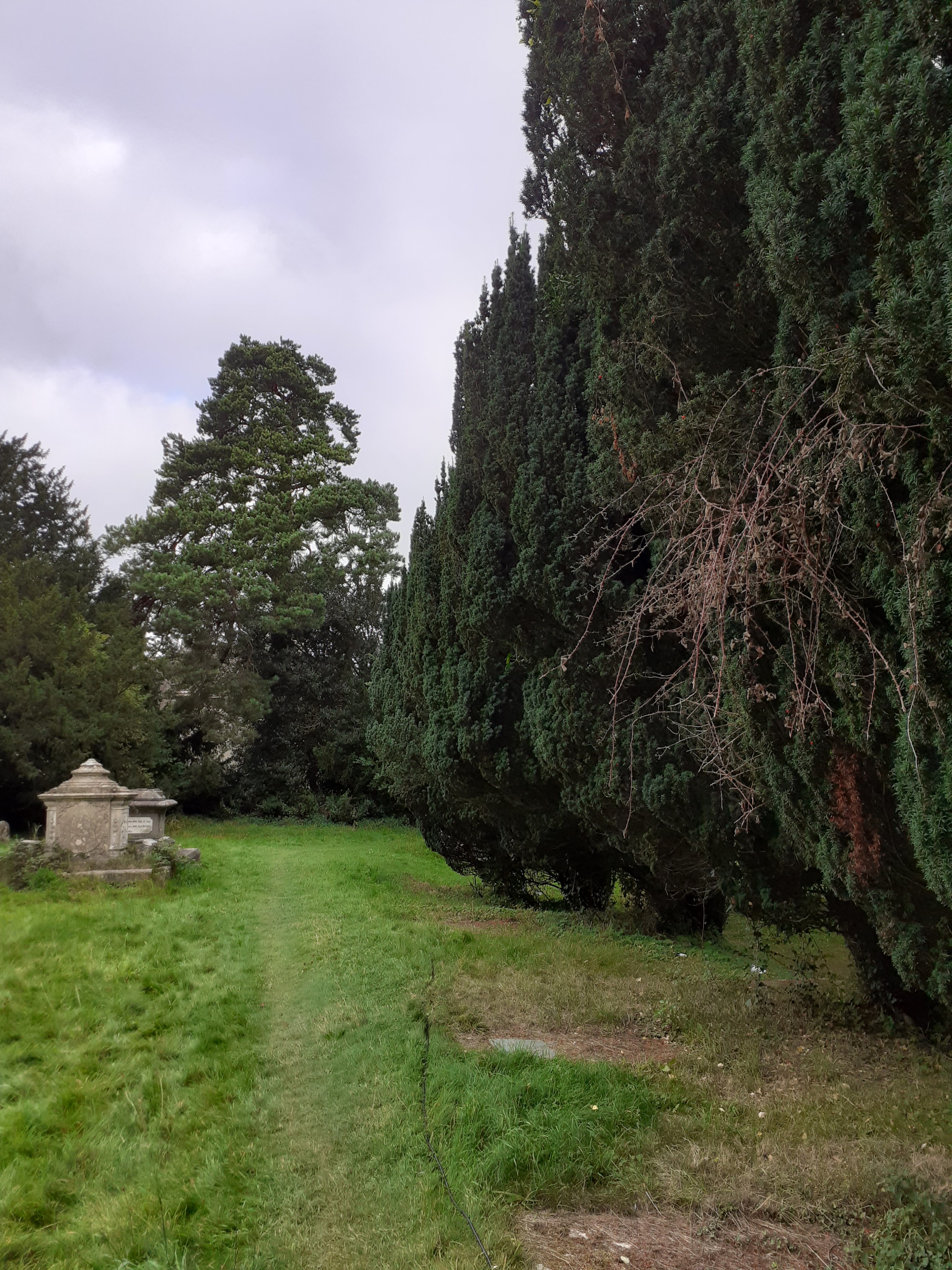
To the left of the path above, there is an extensive stretch of rough grass with nothing built over it. For there is another world below, a Romano-British mosaic made around 325 CE for the villa then on this site. The mosaic is now known as the Woodchester Orpheus. It originally covered the main reception room.
At that time, the city of Corinium (Cirencester) had about 20,000 inhabitants, making it the largest city in Britain apart from Londinium (London). The region was prosperous enough for Corinium to have a specialist workshop for making Orphic themed mosaics. Orpheus was popular with the Romano-British aristocracy of the day. He was, after all, an archetypal Bard. He could charm all forms of life, as shown in the Woodchester mosaic. He caused trees to dance and energised the very stones. He was a walker between the worlds, destined ultimately to become a talking head speaking prophecies. He spoke to a sensibility both Romanised and steeped in older Celtic tradition.

The mosaic was uncovered in 1793 by the Gloucestershire born antiquarian and engraver Samuel Lysons, His dig can be seen as an early move in the development of modern archaeology. The illustration above is his own, and he enjoyed a reputation for accuracy in an age notable for painstaking illustration.
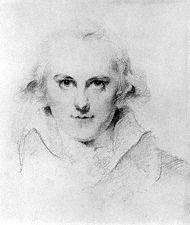
Archaeology was still far from being a science and the dig itself caused damage. But Lysons was a recognised pioneer, becoming a Fellow of the Royal Society and an antiquary professor at the Royal Academy. The mosaic continued to be uncovered and re-covered over the years – seven times since 1880, the last time in 1973. By then there were serious worries about the damage being caused, and there are no plans to reveal it again. A replica was made over a painstaking ten year period and for a while placed on public display at the nearby Prinknash Abbey. But it was sold overseas in 2010.
I like seeing the mosaic through Lysons’ eyes, because for me the experience as a whole involves multiple layers of history and culture. When I look at his illustration, I see something of the late Roman empire, with a hint of something wilder from Orpheus’s archaic Thracian home, and I enjoy the lens of the later eighteenth century, combining both rational and romantic elements in the manner of that time. I appreciate these different layers of cultural ancestry and their enduring influence. For me the early modern one has some predominance – in this half-deserted graveyard with its ruins, the sleeping dead, and the mythic art of the ancients buried under my feet.
Indeed my experience of the graveyard is not all about Orpheus. I sense a spirit of place that accommodates all of these influences in a natural way. It is a place at home with loss and death and ancient memory. My personal experience varies, and can be edgy at times. But I do not find it particularly spooky. For me, it is a suggestive, multi-dimensional space simply being itself and not greatly concerned with what I bring or how I respond.

There are corners of the graveyard that seem actively gentle. Below, we see a now disused gateway sitting among trees. Not yet decaying, it nonetheless feels that it is being reclaimed by the land, rather than asserting itself as part of a built environment. An autumnal sun warms all. This corner, at this time, is a simple place of peace.

(1) https://contemplativeinquiry.blog/2014/10/07/the-woodchester-orpheus/

Above, inside looking out. Below, outside looking in – with added reflections.

Below again, from a little further back, the full richness of a sunlit moment, in a particular time and place. For me, it becomes the image and feeling-tone of its day, and, later on, a soft thought in memory.

According to Kristoffer Hughes, the three ray symbol for Awen, as it appears today: “is mostly inspired by the efforts of one individual, a Welsh bard of the late eighteenth and early nineteenth centuries called Edward Williams, who took the bardic name of Iolo Morganwg*”.
Hughes goes on to tell us something of Iolo’s story: “I touch briefly on the Awen-filled story of this remarkable individual, for it sings loudly of the power of Awen to transform, not just an individual, but the future. His symbol for the Awen has become directly associated in Neopaganism with Cerridwen, making an exploration of his influence a valuable exercise in our understanding of Awen in the modern world.
“Iolo Morganwg was a stonemason from South Wales, an imaginative, poetic genius who made elaborate claims of ancient documents and wisdom that he had discovered and preserved for the world to see. Blighted by ill health, he was addicted to the narcotic laudanum for over fifty years of his life, spending most of his days in a drug-induced state, and yet poems in their thousands fell from his frenzied mind onto scraps of parchment. He composed elaborate poetry, inspired prose, but falsely claimed that some of the poems were written by ancient bards. … And yet through all of the accusations of forgery and deception, Iolo dreamed something into being that those in the different streams of Celtic spirituality today, both monotheistic and polytheistic, are descendants of. He dreamed a new mythology into being and planted seeds that would gestate a profound wisdom in the future.
“In a time of great social crisis, he dreamed an identity for the Welsh that took as its foundation that the bardic tradition of Wales was a direct line to the ancient Druids of Britain, who he perceived as the true ancestors of the Welsh. He longed for his people to connect to the might and power that the Romantic movement imagined the Druids to express. And, in doing so, he deliciously imagined a new identity that the Welsh could be proud of: he blended fact with fiction, legend with history, myth with reality. His bewildering array of notes and journals continue to baffle modern academics who strive to make sense of this enigmatic figure.”
Reflecting on Iolo’s story, Hughes concludes that, “in a profoundly logocentric world where new thoughts and ideas were expected to be substantiated by manuscripts, Iolo simply invented a past that we, as the Welsh, could be proud of . … He carried the seeds of Awen and profoundly influenced a future he could not have imagined. In the twenty-first century, those drawn to the Cerridwen and Taliesenic mysteries (2) who may artistically express, understand, or wear the symbol of the Awen all carry the dream of Iolo Morganwg. He is testament to the Awen’s consistent stream and how it too changed its countenance to meet the needs of different people at different times. The period he occupied was a cauldron of new ideas, with the new era of bardic tradition in its infancy and occult fascination among the learned of the time increasing in popularity”.
(1) Kristoffer Hughes Cerridwen: Celtic Goddess of Inspiration Woodbury, MN: Llewellyn Publications, 2021. See also my review at: https://contemplativeinquiry.blog/2021/03/26/book-review-cerridwen-celtic-goddess-of-inspiration/
(2) See also: John Matthews Taliesin: Shamanism and the Bardic Mysteries in Britain and Ireland London: Aquarian Press, 1991. It includes a complete English translation of the Hanes Taliesin (Story of Taliesin) and English translations of the major poems of Taliesin Pen Beirdd from The Book of Taliesin as well as other medieval Welsh and Irish material. In the Taliesin story, the three rays of Awen become three drops from the brew in Cerridwen’s cauldron).
*NOTE: Iolo Morganwg (=Ned of Glamorgan, his native county). In his own words, the Awen sign /|\ is “a symbol of God’s name from the beginning”. He goes on to say: “from the quality of this symbol proceed every form and sign of voice, and sound, and name, and condition”. It is when God pronounced his Name that “all the universe leapt together into existence of life, with the triumph of a song of joy. The same song was the first poem that was ever heard, and the sound of the song travelled as far as God and His existence are, and the way in which every other existence, springing in unity with Him, has travelled for ever and ever. And it sprang from inopportune nothing; that is to say, so sweetly and melodiously did God declare his name, that life vibrated through all existence, and through every existing materiality”. J. William Ab Ithel (editor) The Bardas of Iolo Morganwg: A Collection of Original Documents, Illustrative of the Theology, Wisdom, and Usages of the Bardo-Druidic System of the Isle of Britain Forgotten Books, 2007 http://www.forgottenbooks.org (First published 1862, from notes and journals left by Iolo on his death at 79 years of age in 1826).
music that celebrates Earth and speaks to the heart
Follow the Moon's Cycle
Meeting nature on nature's terms
A little bit of Mark Rosher in South Gloucestershire, England
A monastic polytheist's and animist’s journal
Selkie Writing…
Images and words set against a backdrop of outsider art.
living with metacrisis and collapse
The pagan path. The Old Ways In New Times
Spiritual journeys in tending the living earth, permaculture, and nature-inspired arts
a magickal dialogue between nature and culture
The gentle art of living with less
Thoughts about living, loving and worshiping as an autistic Hearth Druid and Heathen. One woman's journey.
An place to read and share stories about the celtic seasonal festivals
Just another WordPress.com site
Exploring our connection to the wider world
Become more grounded and spacious with yourself and others, through your own body’s wisdom
Good lives on our one planet
News for the residents of Hopeless, Maine
 Contemplative Inquiry