Contemplative Inquiry

This blog is about contemplative inquiry

EVERGREEN OVERVIEW

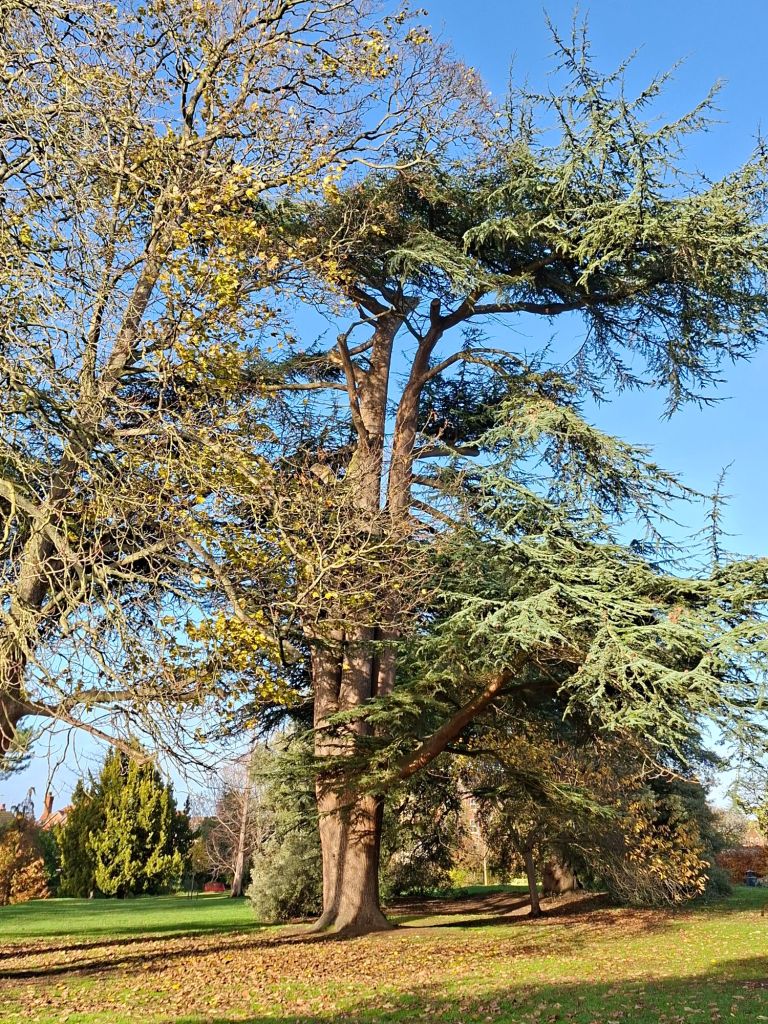
A Scots pine in Hillfield Gardens (1), 28 November, 10.32 am. It stands out both as a tall tree and an evergreen. It asks me to look up and pay attention to it, and beyond it, almost  losing sight of its deciduous neighbour. For me, this representative of the ‘eternal green’ has a commanding presence.

The Scots pine is one of the oldest trees native to Britain. It is also one of the trees associated with ogham lore (2), where the Scots pine is linked to the wisdom of overview. According to The Green Man Tree Oracle, ancient shamans of many traditions would literally climb to the top of a central tent pole or tree and “from this vantage point they could see clearly into the spirits’ inner world and come back with knowledge for the tribe or family they served” (2).

For me as for many people, the end of the calendar year is a time for reflection and taking stock. New year resolutions are a possible modern version of this process, but mine never really worked.  They were overprescriptive and a way of setting myself up to fail.

‘Overview’ asks for a less driven and more contemplative approach, one more connected with Spirit. This is a good reminder as I start to wonder about how I am going to navigate 2026: divining what my contributions and satisfactions might look like as the Wheel continues to turn.

(1) Re Hillfield Gardens, Gloucester, see https://contemplativeinquiry.blog/2024/11/22/

(2) John Matthews and Will Worthington The Green Man Tree Oracle: Ancient Wisdom from the Greenwood London: Connections, 2003

WINTER AFFIRMATION

cold and bright an azure sky

frames the slender masts

affirming light in winter.

APPROACHING SUNSET

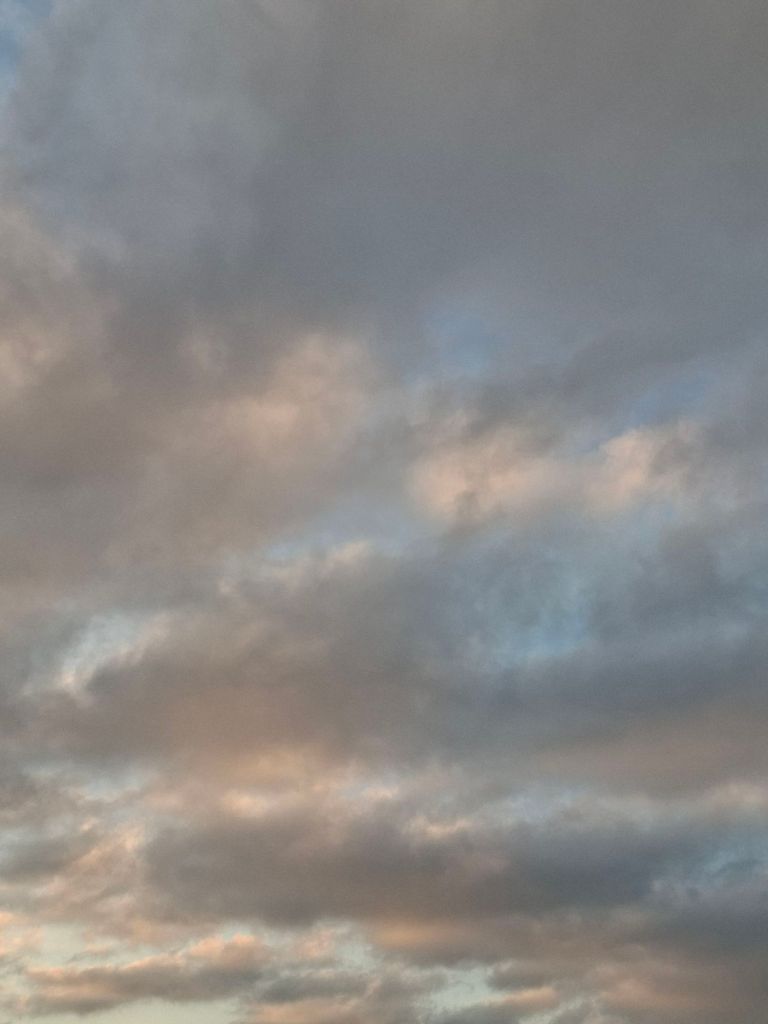
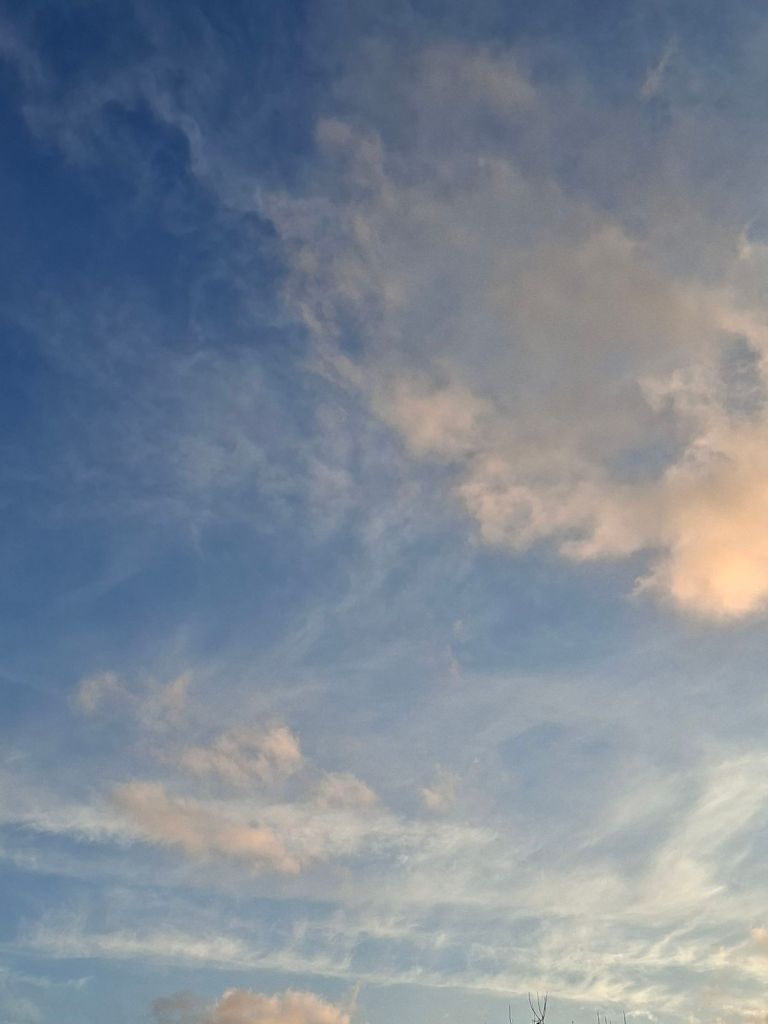
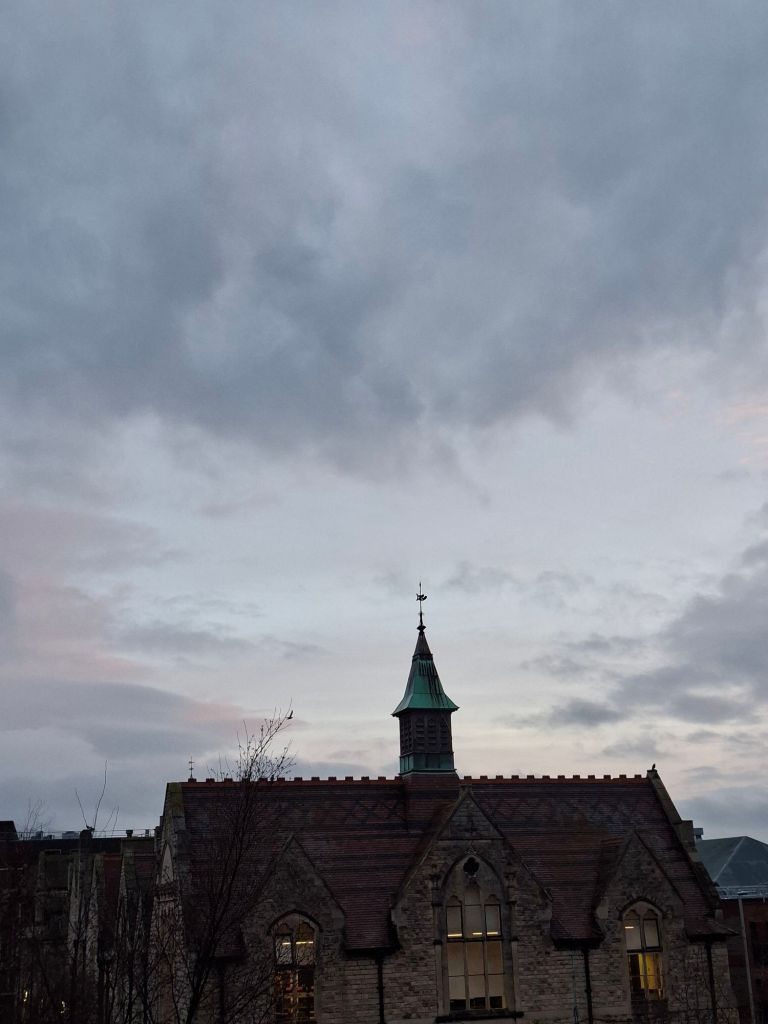
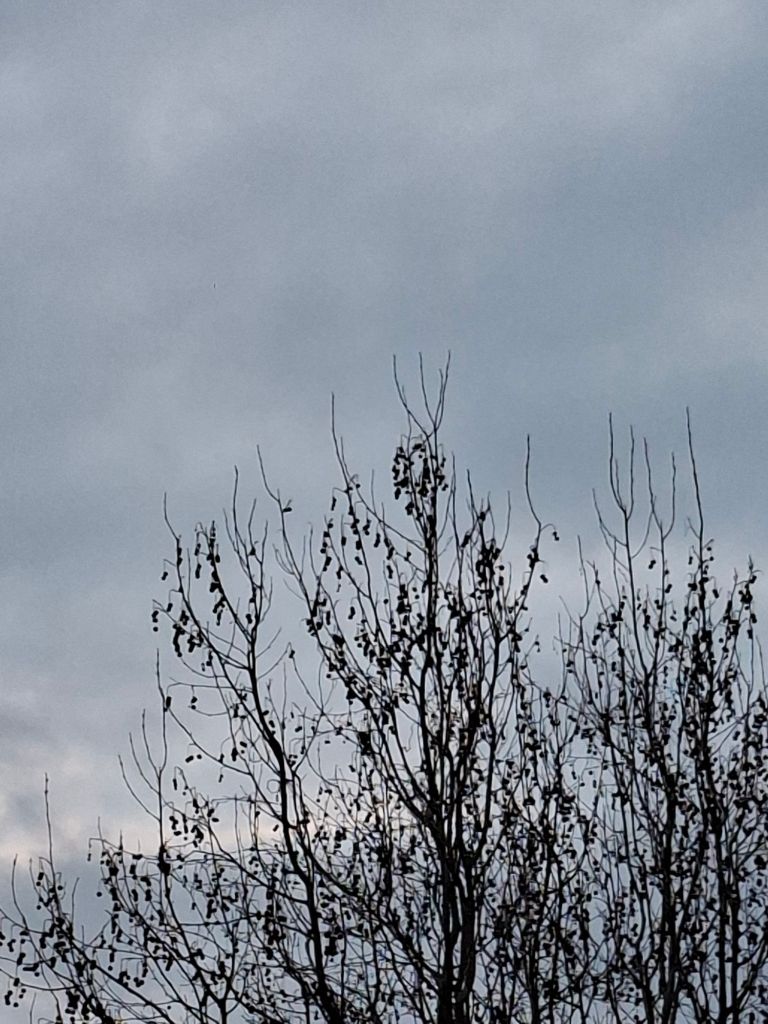
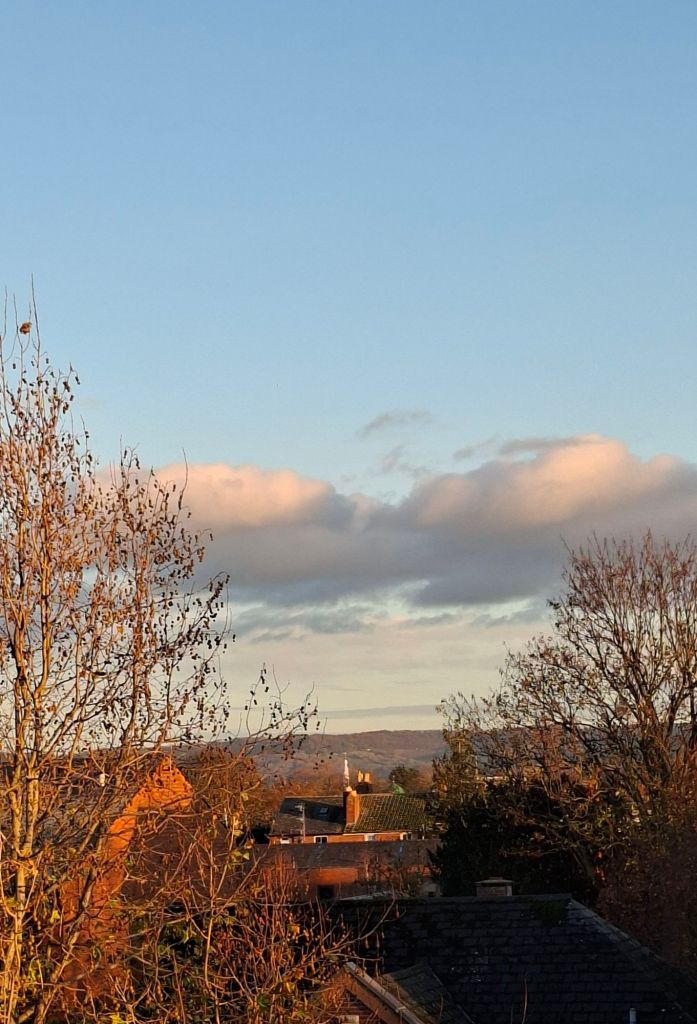
I have been carefully following the wheel of the year for 2025. Yet I can still be surprised by the moment in which I find myself. The pictures in this post were taken around 3.45 pm on 19 November. I was indoors, looking out, and strongly affected by the quality of light.

It was the light that, on an adequately clear day, precedes sunset. The sunset itself was less than half an hour away. I knew this of course. But I still felt surprised that this was happening so early, in the middle of the afternoon.

I enjoyed the scene itself. I liked the way that this combination of strong pre-dusk light and uncompromising shade was transforming my neighbourhood. At the same time it felt as though this transformation was too speedy for my comfort. Too relentless. In another month it will dark by 3.45 pm. Then, after a brief stasis, the whole process will start again as the light returns. Another year gone, and another year coming. At some level, I can hardly keep up, as time hurries me into an unknown future.

GLOUCESTER LANTERN PARADE: INTRODUCING WINTER

For me, the beginning of winter is marked by a local cultural event, rather than any natural one. This is the annual Gloucester Lantern Parade. This year it was on Saturday 15 November.

The parade began at 4.30 pm, after a carol service at Gloucester Cathedral. In the Anglican (Episcopalian) tradition, this is two weeks before the beginning of Advent. In the secular (shopping) year it marks the switching of the Christmas lights. In the Pagan year it is roughly two weeks after Samhain and five weeks before the Winter Solstice. I was happy to think of the three calendars at the same time. All point to the arrival of winter.

The parade theme this year was ‘Community in Nature’, and the lanterns were created by a coalition of local primary schools and community groups supported by professional artists. This year’s organisers invited us to “think about how coming together as a community is our superpower”.

The parade illuminated, however briefly, the city centre and the principal streets of the old town. As it moved through a dense crowd of onlookers, I could not even see the small bearer of the bird lantern in the picture above. This bird had become a lttle detached from its specific community though not from the community of the parade as a whole. It happily kept on going.

In a world that in many ways undermines community, it was good to see it affirmed, both through the event itself and in the chosen theme.

MIDDAY ON ALNEY ISLAND

Alney Island at midday on 9 November. Looking up, I encountered a bleak majesty of now skeletal trees.  Muted sunlight found its way through  the grey clouds. In contrast, the river at my side retained a full, lush beauty.

As I walked, the tranquility of the scene was compromised at times by anxiety. The island is a wetland. It had been raining. More rain was due. The paths were puddled and muddy. The grass was soft and wet, half hiding twigs, leaves and slippery earth. I am still not fully recovered from my fall and this walk was a deliberate escalation in challenge. When I reached Richard’s Wood I stumbled over a tree root and nearly fell. At the same time I was able to enjoy a rich carpet of leaves at this late period in the leaf fall.

Among the trees I contemplated branches as living sculpture. It was as if I had reached a destination. Generally the branches were still holding on to at least some leaves. There were even new ones, in this fecund space. Eventually, my encounter with the wood completed, I turned round and made my cautious way home.

END OF AUTUMN?

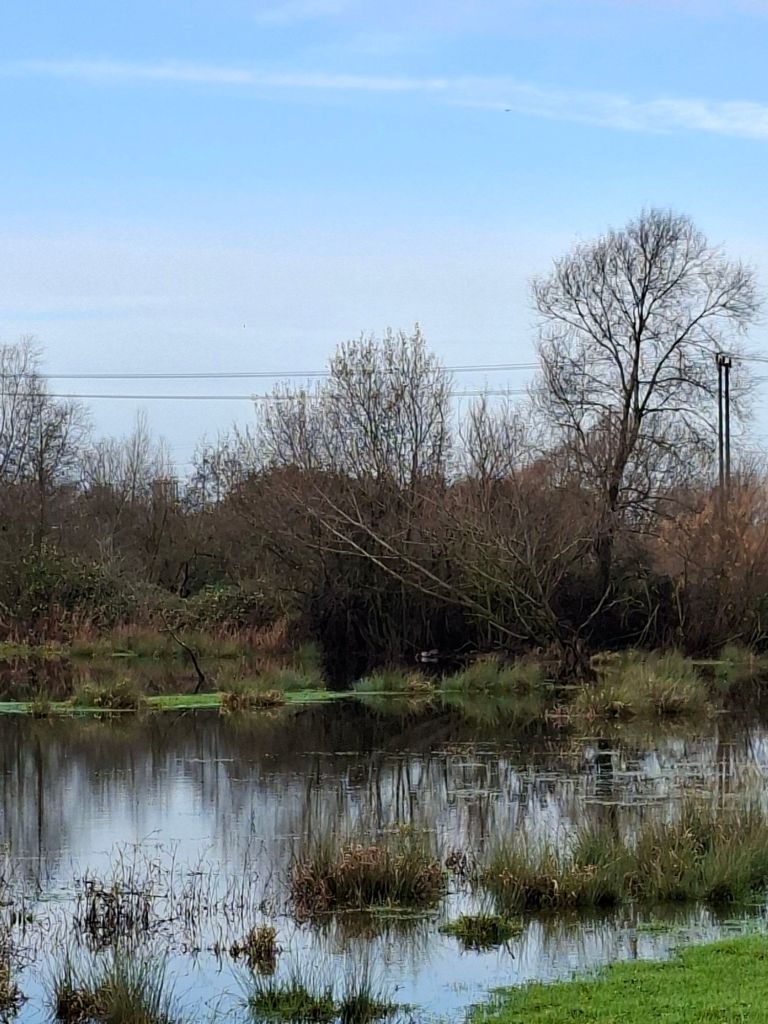
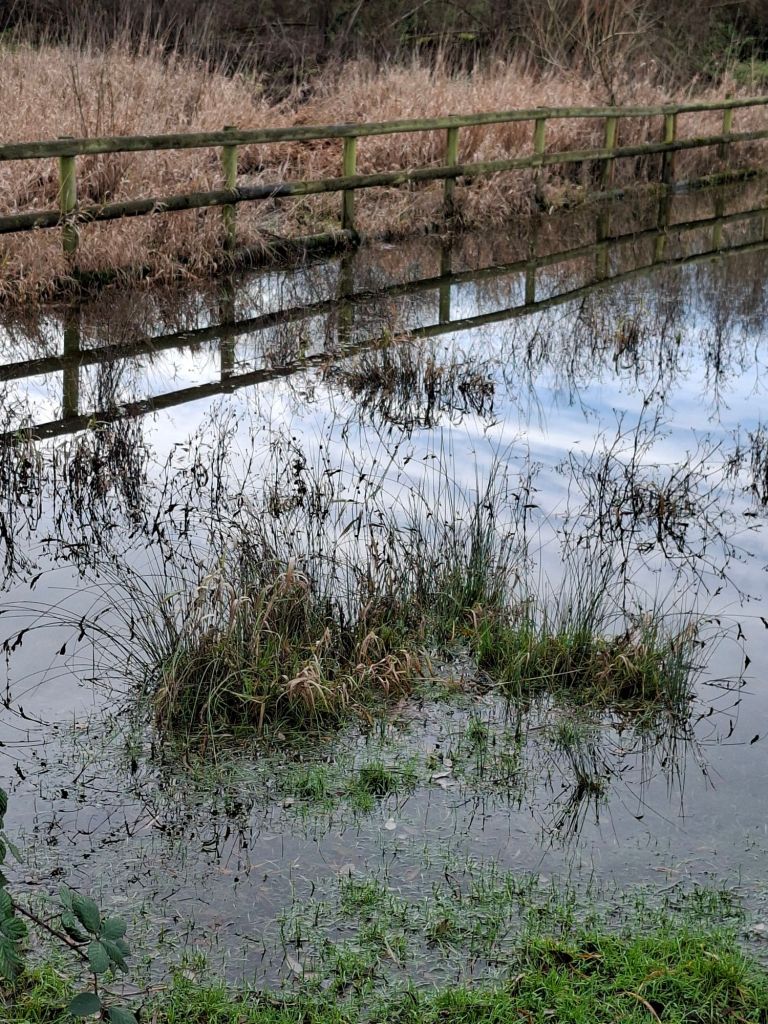
Where I live, autumn is becoming wintry.  But winter has not yet come. Many leaves have fallen yet the trees are not yet bare. Whether standing against a severe sky or leaning in to water, they still witness their own vitality.

Along the canal bank, there are places  where the green-gold beauty of autumn in this locality remains present, here on 5 November. I have a strong sense of continuing energy and life.

This feeling is most powerful for me when I  hear the wind blowing through the trees and see leaves holding on even as the branches sway. Soon enough, these leaves will fall. Here and now, they are very much part of their trees.

TOWARDS SAMHAIN: MORNING SUN

ambivalent morning sun

two hours from sunrise:

image for a dying year.

RETURN TO THE WATER MARGIN

For the first time since I fractured my shoulder in a heavy fall, I have walked beside the Gloucester canal. The period between 2pm and 4.30 on 28 October was particularly auspicious. Cool but clear. Blue sky and sunshine.

On this occasion, as I tentatively walked the paths, I found myself in a living world dominated by yellow and green. A fall was happening, but was not very advanced. I noticed my confidence in walking becoming  more consistent and reliable. I felt good. I was at ease in the woodland world.

The walk was part of my coming to terms with an advancing age, in which   the possibility of a damaging fall is priced in. I felt a little nostalgic for a distant past. At a time when I was impatiently looking forward to my fourth birthday I fell down a flight of stairs and simply got up again. I was pleased to have a story to tell my parents, but  couldn’t understand their alarm when I told it. 1953 is indeed another country.

However most of my attention, on this walk, was on the walk itself. Pragmatically, it needed to be, and I was also  increasingly held by the spirit of place and time on this benign late October day. I had a strong sense of here, now and home.

I had a goal of reaching a newly refurbished bridge for pedestrians and cyclists only. This would give me time to turn around and get home before sunset (roughly 4.45 now that the clocks have changed). A slowish two and a half hours is as much as I can manage as yet. From a recovery perspective, I feel on track.

HOMING LANDMARKS

I have now lived in Gloucester long enough to have a territorial sense of the city. When walking from a southerly direction, an elegant square and its garden signal my nearness to home. This signal is physical, emotional and psychic. My cognitive knowledge is secondary.

This signal is soon followed up by another, stronger one, closer to our apartment. Under looming grey clouds stands a tall, mature hornbeam. Once indoors, I will be able to look at it through our balcony windows – majestic even as it sheds its leaves.

The hornbeam is an iconic (I might almost say totemic) marker of ‘home’. Elaine and I do not individually own this tree and nor would we want to. But our city council does, with obligations towards it. That’s probably why it’s still there.

This sense of home and blessing: where does it come from? We are not migratory birds. But we used to be a bit more like them. Nomadic, but often within defined territories, however large, which we could get to know and love without the need for exclusive possession. There are people in the world who still try to live in this way but it is becoming increasingly difficult.

I speculate that part of my  bodymind finds this arrangement natural, even though culture here is (mostly) very different. The feeling tone of my walking varies dramatically with different levels of newness and familiarity. In the approach to home, signalled not only by distance but also by landmarks, this is particularly strong. Perhaps this is the residue of a long lost pattern of life.

DEEP AUTUMN 2025

“All things ripen and rot that rose up at first,

And so the year runs away in yesterdays many,

And here winter wends again, as by the way of the world it ought,

Until the Michaelmas moon has winters boding brought.” (1)

Even today, deep autumn opens the door to winter. This was even more the case in the North Staffordshire and Derbyshire regions of 14th century England, where Sir Gawain and the Green Knight was written. Even in castles, people were less sheltered from the growing cold and damp than we are. So readers and listeners of the period are reminded that the coming of winter is both natually and divinely ordained.

Here and now, the sight of the apple harvest in its later stages (pictured above) seems quite different than in the early ones (2) – less bright, less novel, less shiny. Rotting apples lie on the ground, now fallen outside the wall of  Gloucester Cathedral’s orchard. From Nature’s exuberant perspective, this is all part of the plan.  Waste is built in.

This time draws me further into the declining year. I am in the cathedral’s  grounds, now looking at a yew tree and its associations with death. I’m thinking of the approach of Samhain (aka Halloween/All Hallows) at the turn of the month. Once it marked the 3rd harvest of the year – the blood harvest, where animals were slaughtered in preparation for winter. Now it is more a time to remember our ancestors, and our dead more widely.

Yet the seasonal moment, and the yew, can also be linked to wisdom and transformative change in life. I launched my contemplative inquiry at Samhain 2011. Like many people, I find that this period can be a resonant and creative time.

Below the yew, I have included a section of the cathedral itself. I have old personal associations linking medieval Gothic architecture with the feeling-tone of the declining year. I am also aware that this building is linked to the trees I picture and discuss. Gloucester Cathedral was a monastery when Sir Gawain and the Green Knight was written but many of its features were already in place.

In the same space, I find both holly and ivy, with berries on the holly tree.  I immediately thought of the Christmas carol The Holly and the Ivy. It is an ancient folk carol, which interweaves Christian themes and others that belong with the land. The version which is now popular was collected by Cecil Sharp in 1909 in Gloucestershire from Mary  Clayton.

Many people think that the indigenous Pagan themes are the oldest, and that the central focus here is on the holly. The authors of The Green Man Tree Oracle say: “Holly’s connection with the Green Man is especially strong. In his guise as the Holly King – an ancient giant and symbol of fertility – the Green Man makes a notable appearance in the 14th century poem Gawain and d the Green Knight. Here he takes the form of a fearsome knight, who comes to King Arthur’s court to offer a midwinter challenge, carrying a club of holly and wearing a holly crown (as symbols of his true identity).” This challenge happens every year, where the Green Man/Holly King demands that we encounter him through our dealings with the natural world.

Elaine and I went to the Gloucester Cathedral Close and its surroundings on Saturday afternoon 18 October to outrun an  extended period of gloom, wind and rain. We are now in it, so the lessons of the trees in deep autumn, anticipating the coming of winter, are not lost on us. The dark of the year is on its way.

(1) J.R R. Tolkien (translation of anonymous texts) Sir Gawain and the Green Knight, Pearl, Sir Orfeo New York: Ballantine Books, 1980.

(2) https://contemplativeinquiry.blog/2025/08/22/ (3rd photo)

(3) John Matthews & Will Worthington The Green Man Tree Oracle: Ancient Wisdom from the Greenwood London: Connections, 2003

Earth Eclectic

music that celebrates Earth and speaks to the heart

Sarah Fuhro Star-Flower Alchemy

Follow the Moon's Cycle

Muddy Feet

Meeting nature on nature's terms

Rosher.Net

A little bit of Mark Rosher in South Gloucestershire, England

Becoming Part of the Land

A monastic polytheist's and animist’s journal

selkiewife

Selkie Writing…

Charlotte Rodgers

Images and words set against a backdrop of outsider art.

Prof Jem Bendell

living with metacrisis and collapse

Towint

The pagan path. The Old Ways In New Times

The Druids Garden

Spiritual journeys in tending the living earth, permaculture, and nature-inspired arts

The Blog of Baphomet

a magickal dialogue between nature and culture

This Simple Life

The gentle art of living with less

Musings of a Scottish Hearth Druid and Heathen

Thoughts about living, loving and worshiping as an autistic Hearth Druid and Heathen. One woman's journey.

Wheel of the Year Blog

An place to read and share stories about the celtic seasonal festivals

Walking the Druid Path

Just another WordPress.com site

anima monday

Exploring our connection to the wider world

Grounded Space Focusing

Become more grounded and spacious with yourself and others, through your own body’s wisdom

The Earthbound Report

Good lives on our one planet

Hopeless Vendetta

News for the residents of Hopeless, Maine