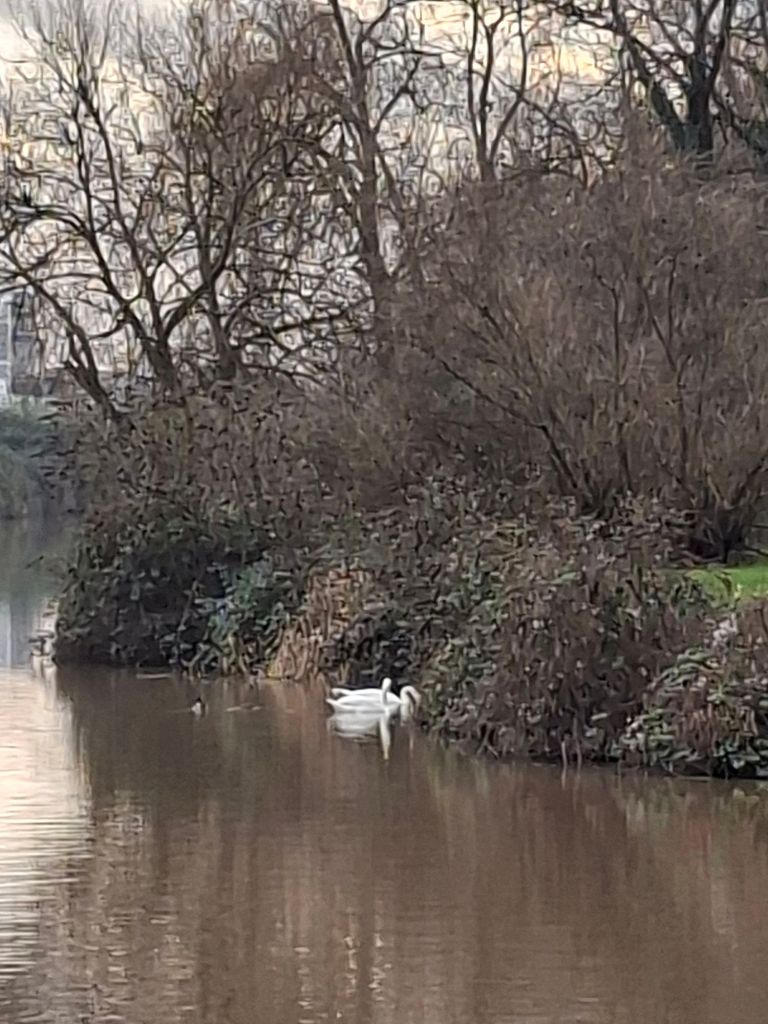
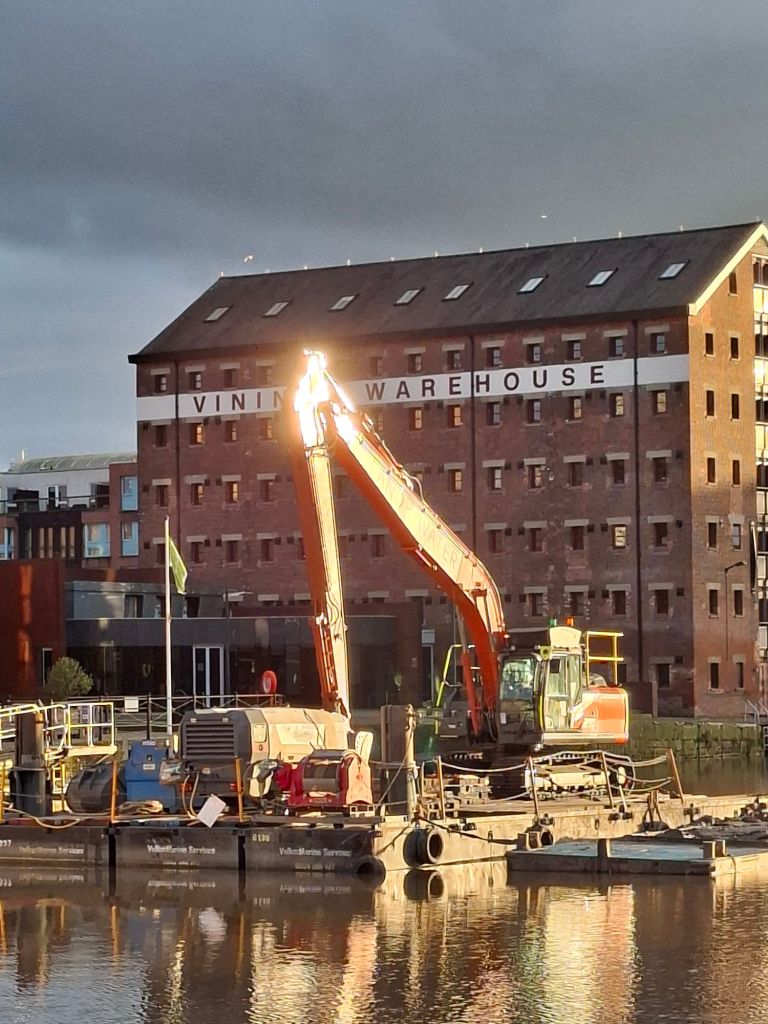
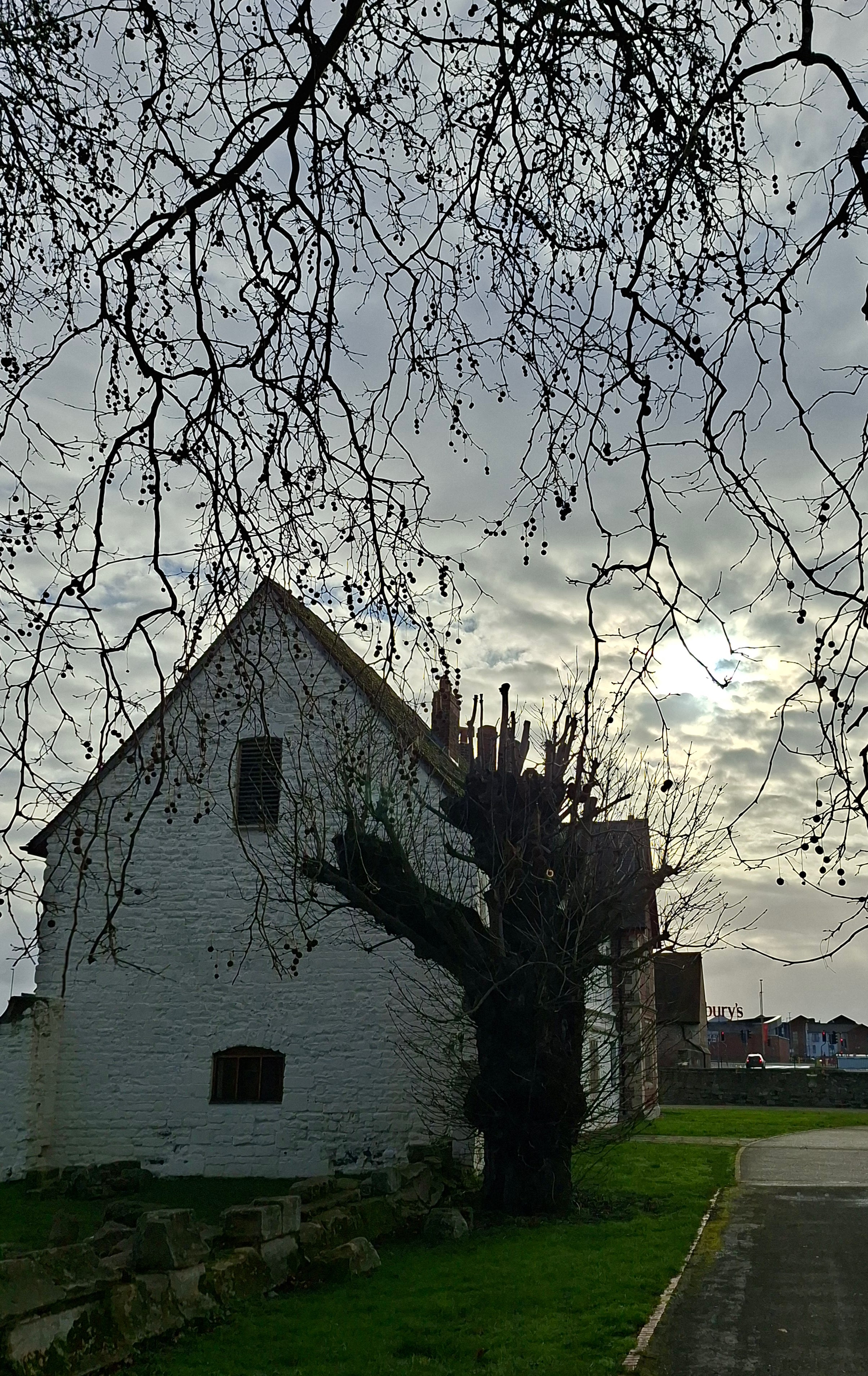
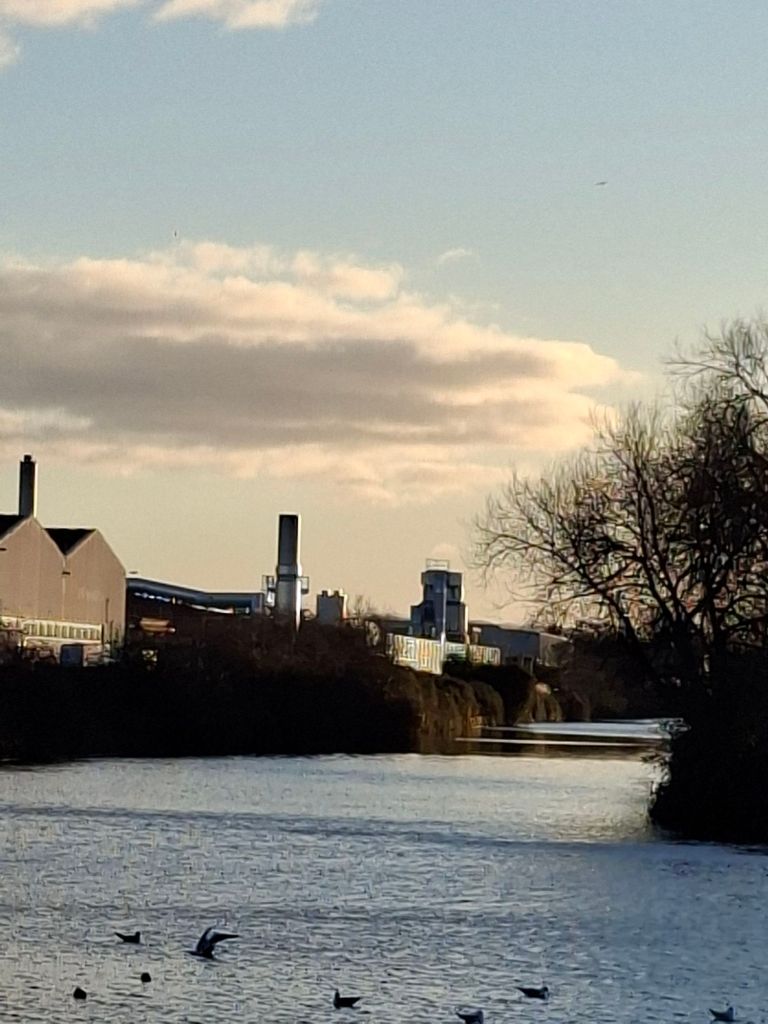
For the first time since I fractured my shoulder in a heavy fall, I have walked beside the Gloucester canal. The period between 2pm and 4.30 on 28 October was particularly auspicious. Cool but clear. Blue sky and sunshine.
On this occasion, as I tentatively walked the paths, I found myself in a living world dominated by yellow and green. A fall was happening, but was not very advanced. I noticed my confidence in walking becoming more consistent and reliable. I felt good. I was at ease in the woodland world.
The walk was part of my coming to terms with an advancing age, in which the possibility of a damaging fall is priced in. I felt a little nostalgic for a distant past. At a time when I was impatiently looking forward to my fourth birthday I fell down a flight of stairs and simply got up again. I was pleased to have a story to tell my parents, but couldn’t understand their alarm when I told it. 1953 is indeed another country.
However most of my attention, on this walk, was on the walk itself. Pragmatically, it needed to be, and I was also increasingly held by the spirit of place and time on this benign late October day. I had a strong sense of here, now and home.
I had a goal of reaching a newly refurbished bridge for pedestrians and cyclists only. This would give me time to turn around and get home before sunset (roughly 4.45 now that the clocks have changed). A slowish two and a half hours is as much as I can manage as yet. From a recovery perspective, I feel on track.
I have now lived in Gloucester long enough to have a territorial sense of the city. When walking from a southerly direction, an elegant square and its garden signal my nearness to home. This signal is physical, emotional and psychic. My cognitive knowledge is secondary.
This signal is soon followed up by another, stronger one, closer to our apartment. Under looming grey clouds stands a tall, mature hornbeam. Once indoors, I will be able to look at it through our balcony windows – majestic even as it sheds its leaves.
The hornbeam is an iconic (I might almost say totemic) marker of ‘home’. Elaine and I do not individually own this tree and nor would we want to. But our city council does, with obligations towards it. That’s probably why it’s still there.
This sense of home and blessing: where does it come from? We are not migratory birds. But we used to be a bit more like them. Nomadic, but often within defined territories, however large, which we could get to know and love without the need for exclusive possession. There are people in the world who still try to live in this way but it is becoming increasingly difficult.
I speculate that part of my bodymind finds this arrangement natural, even though culture here is (mostly) very different. The feeling tone of my walking varies dramatically with different levels of newness and familiarity. In the approach to home, signalled not only by distance but also by landmarks, this is particularly strong. Perhaps this is the residue of a long lost pattern of life.
And here winter wends again, as by the way of the world it ought,
Until the Michaelmas moon has winters boding brought.” (1)
Even today, deep autumn opens the door to winter. This was even more the case in the North Staffordshire and Derbyshire regions of 14th century England, where Sir Gawain and the Green Knight was written. Even in castles, people were less sheltered from the growing cold and damp than we are. So readers and listeners of the period are reminded that the coming of winter is both natually and divinely ordained.
Here and now, the sight of the apple harvest in its later stages (pictured above) seems quite different than in the early ones (2) – less bright, less novel, less shiny. Rotting apples lie on the ground, now fallen outside the wall of Gloucester Cathedral’s orchard. From Nature’s exuberant perspective, this is all part of the plan. Waste is built in.
This time draws me further into the declining year. I am in the cathedral’s grounds, now looking at a yew tree and its associations with death. I’m thinking of the approach of Samhain (aka Halloween/All Hallows) at the turn of the month. Once it marked the 3rd harvest of the year – the blood harvest, where animals were slaughtered in preparation for winter. Now it is more a time to remember our ancestors, and our dead more widely.
Yet the seasonal moment, and the yew, can also be linked to wisdom and transformative change in life. I launched my contemplative inquiry at Samhain 2011. Like many people, I find that this period can be a resonant and creative time.
Below the yew, I have included a section of the cathedral itself. I have old personal associations linking medieval Gothic architecture with the feeling-tone of the declining year. I am also aware that this building is linked to the trees I picture and discuss. Gloucester Cathedral was a monastery when Sir Gawain and the Green Knight was written but many of its features were already in place.
In the same space, I find both holly and ivy, with berries on the holly tree. I immediately thought of the Christmas carol The Holly and the Ivy. It is an ancient folk carol, which interweaves Christian themes and others that belong with the land. The version which is now popular was collected by Cecil Sharp in 1909 in Gloucestershire from Mary Clayton.
Many people think that the indigenous Pagan themes are the oldest, and that the central focus here is on the holly. The authors of The Green Man Tree Oracle say: “Holly’s connection with the Green Man is especially strong. In his guise as the Holly King – an ancient giant and symbol of fertility – the Green Man makes a notable appearance in the 14th century poem Gawain and d the Green Knight. Here he takes the form of a fearsome knight, who comes to King Arthur’s court to offer a midwinter challenge, carrying a club of holly and wearing a holly crown (as symbols of his true identity).” This challenge happens every year, where the Green Man/Holly King demands that we encounter him through our dealings with the natural world.
Elaine and I went to the Gloucester Cathedral Close and its surroundings on Saturday afternoon 18 October to outrun an extended period of gloom, wind and rain. We are now in it, so the lessons of the trees in deep autumn, anticipating the coming of winter, are not lost on us. The dark of the year is on its way.
(1) J.R R. Tolkien(translation of anonymous texts) Sir Gawain and the Green Knight, Pearl, Sir Orfeo New York: Ballantine Books, 1980.
Recently, Elaine and I walked to our local park after a considerable absence. We were both adequately bold and mobile at the same time. We found a park very different, at least visually, to the sad, dried-up space of late August and its premature turn.
Here, above, is lush life against a background suggestive of mist. Close up, we enjoy the patterns and colours of the leaves. They seem fresh, radiant and alive.
Below, the distinctive yellow of the tree of heaven, and its fern-like leaves, provide a powerful contrast that adds to our enjoyment.
Looking from a somewhat greater distance, below, I experience a sense of majesty in seeing the whole tree (right) leaning into blue sky. Its slightly closer neighbour (left) provides a subtle colour contrast with a deep green intermingled with brown leaves ready to fall.
Below, I have stepped back further from the trees. My picture is of a clump of trees in the park. They are largish trees. The person walking past them is dwarfed. But I’m still enjoying leaves. I like the reddish brown emerging from residual green. I see Nature at work in a way that is both understated and beautiful. I know also that it can be a sheltering space within a generally flat and open park.
I still have a particular affection for willow, going back 20 years when I was studying Druidry. I was in Bristol and befriended a willow on the banks of the Bristol Avon, where it moves out from the old city towards the Clifton suspension bridge and the gorge. I became a literal tree hugger. It was part of a process that indeed changed my life. Hence my affection for willow. I am glad that there are willows in the Gloucester City park.
The road we took to and from the park offered leaves of autumnal red. I believe that the tree in the front garden is a stagshorn sumac. When I walk past the tree I get a little distracted by the property’s obvious need for a little tlc. Elaine however celebrates the opportunity taken by the Virginia creeper, as seen particularly in the second of the pictures below. It is great to see such abundance in this unpromising space.
For me, the great virtue of simple pleasures is their simplicity itself. Paying attention to the everyday Nature around us can be deeply nurturing and involves little risk. Yet for some, it can be a portal to re-enchantment in a largely disenchanted world.
‘Being’ can be thought of in a number of ways. One is to say that it simply is what it is. I am. The flowers are. No need for complications. I sympathise with this approach.
Yet when nudged to look at a 2021 post of my own (1), I found the following words based on the work of Eckhart Tolle (2). “Human is form. Being is formless. Human and Being are not separate but interwoven.” A part of my work in contemplative inquiry is to find a balance between human and Being.
For me, ‘Being’ is a way to talk about the divine, whilst keeping a distance from theistic language and its traditional associations. Some people use ‘ground of being’ in this sense. Experientially, silence, stillness, emptiness – the space between thoughts, feeling and things – open me up to Being. Feelings of joy and lovingkindness are likely to enter in. I find that deepening into Being enriches the human dimension itself – with all of its relationships, roles and activities in 3D time bound reality. In older language, it brings heaven to earth.
I like this use of language for its plainness and simplicity. Ultimately its assumptions are a matter of faith within a larger framework of unknowing. It simply describes where I stand within my continuing inquiry. I have also enjoyed being reminded of this use of words by my past self. It’s a personal benefit of having this record.
Now in the fourth week after my shoulder fracture, I have ventured out on a contemplative walk.
I rested for awhile in the erstwhile physic garden of Llanthony Secunda Priory. It is a friendly space for me. Yet at first I felt very small. An alien energetic sky raced high above me towards an unknown horizon.
I wasn’t used to the outdoors. The garden stretched in front of me, defined by a long straight path. I experienced the world as a place of distance and extension. I felt alarmingly unsheltered, until I stilled myself and looked down.
The sight of Michaelmas daisies altered my state. Seasonal flowers and a living, shining green. Although I didn’t move to touch them, I felt like a toddler reaching out for a mother’s hand. I was held again within the wheel of the year. Autumn, the season of bearing fruit.
I looked out further and received rhe assurance of an old stone wall, and the majesty of mature trees. The trees might be turning. The wall might be part of a ruin. But they were still in place, still present in time, still offering a quiet companionship.
These changes in perspective allowed me to experience the garden afresh, more closely and intimately. It was easier to be in, and easier to connect with. Still unsheltered, but unalarmed, I knew that I belong.
My last post was about working with ancient texts. Here I look at the term ‘gnosis’ in the Gospel of Thomas. I am indebted to the commentary of translator Jean-Yves Leloup. Here he reflects on logion 5, whose text I include in a note below.
“Gnosis is not a system, not another ideology through which we are to interpret and understand the world. On the contrary, it means opening our eyes to what we are already looking at, right in front of us, not searching somewhere else.
” … Things are not hidden in themselves; they are open – the veils hiding them are in the habits of our own vision, so crude, so overloaded with memories and assumptions about reality, distorting what is before us …
“Gnosis is a long-term work of recognition, of purity of attention so as really to see what is in front of us. The consequence of this attention is that we become what we see and what we love … If we look at chaos, we will reflect chaos. If we look at light, we will reflect light.” (1)
I am glad that this commentary provides more than scholarly exegesis. Leloup says in his introduction that he wants to offer “a meditation that arises from the tilled earth of our silence. It is my belief that it is from this ground, rather than from mental agitation, that these words can bear their fruit of light “. In this way Leloup dreams the myth onwards for our time, and passes the baton to his readers. Both a blessing, and a responsibility.
(1) Commentary on Logion 5, The Gospel of Thomas: The Gnostic Wisdom of Jesus Rochester, VT: Inner Traditions, 2005
(Text translated from the Coptic with commentary by Jean-Yves Leloup; foreword by Jacob Needleman. English translation by John Rowe Original French edition published 1986).
The translated logion reads:
“Yeshua said:
Recognize what is in front of you, and what is hidden from you will be revealed.
There is nothing hidden that will not be revealed.”
I’ve made an inward turn in recent days. Partly to serve my recovery and partly in harmony with the season. I am working with sacred texts, specifically early Christian texts excluded from the New Testament. Works like The Gospel of Mary Magdalene, The Gospel of Philip and The Gospel of Thomas. These are sometimes described as ‘Gnostic’, but the value and accuracy of this term is now disputed.
This post is about how to read ancient texts and learn from them without treating them as infallible or having to agree with their contents. Below are four suggestions, paraphrased and adapted from the introduction to A New New Testament (1). This work combines traditional and recovered books, all thought to be written between 50 and 175 CE. They create a diverse whole which, collectively, cannot be turned into an orthodoxy.
This leaves the modern reader with the responsibility of making meaning and responding to the teachings of a movement that was dynamic and expanding but still vulnerable and far from the levers of power. I think there’s a good deal to be learnt here, presented in this way. I’m not a Christian, but Christianity is part of my heritage and does have meaning and relevance for me.
Here are the suggestions about how to read an ancient sacred text.
1 Read Personally
Read as if these documents matter deeply and immediately to you. Read as if the words might bring something to your relationships, your life in the world and your inner life. Where there are stories, enter into them and see how they feel. Where there is a letter, imagine that it was written to you. If the document is a poem or a song, see what feelings or memories it prompts.
Reading personally does not necessarily mean that you have to agree with the document or that its instructions need to be followed. Nor does it mean that you should try to wring meaning out of every sentence or word. Reading personally can involve gratitude for the beauty and wisdom of the document or a dislike for what is being said, sometimes both, even within the same text. Most of all, this kind of reading invites us to make active connections to our own lives. Without always finding solutions, we may identify things in our lives that we tend to ignore or repress.
2 Read Thoughtfully
Think about the time and social setting in which the document was written, who might have written it, and why. When these questions come up, stop to read other sources that reveal what what life was like in the first and second centuries Consult the introductions to the ancient texts and ponder why the particular document was written. Think about what kind of person might have written each document.
Muse about the similarities and differences between the circumstances of our world and those of the ancient world Notice how they affect what the particular document might have meant in the first century versus what, if anything, it might mean in our time.
3 Read Imaginatively
Open your memory, heart and imagination to these texts. Let them affect you. Let them surprise you. Let them trigger your curiosity. Open to worlds that are different to yours. Let images live in your mind or heart. Notice how you feel. What images or stories draw you? Which ones make you afraid? Which ones liberate joy?
4 Read Meditativelyor Prayerfully
Dwell on the words of the text that attract your attention. If certain words make you feel gratitude and warmth, go back over them and the ones around them again, lingering on them. Let them sink in. Similarly, if certain words are upsetting or offensive in the text, return to them and ask why they stir you up in this way.
Notice what ideas in the document hold you or make you feel loved. Do not read further until you have received those feelings those feelings or acknowledged their place in you. Whether the words hold, repel, inspire or confuse you, stay with them long enough to acknowledge their impact. Then let them go by giving thanks or releasing them into the universe Let this release be a larger reality beyond you.
(1) Hal Taussig (ed) A New NewTestament: A Bible for the Twenty-First Century Boston & New York: Mariner Books, 2013 (Foreword by John Dominic Crossan)
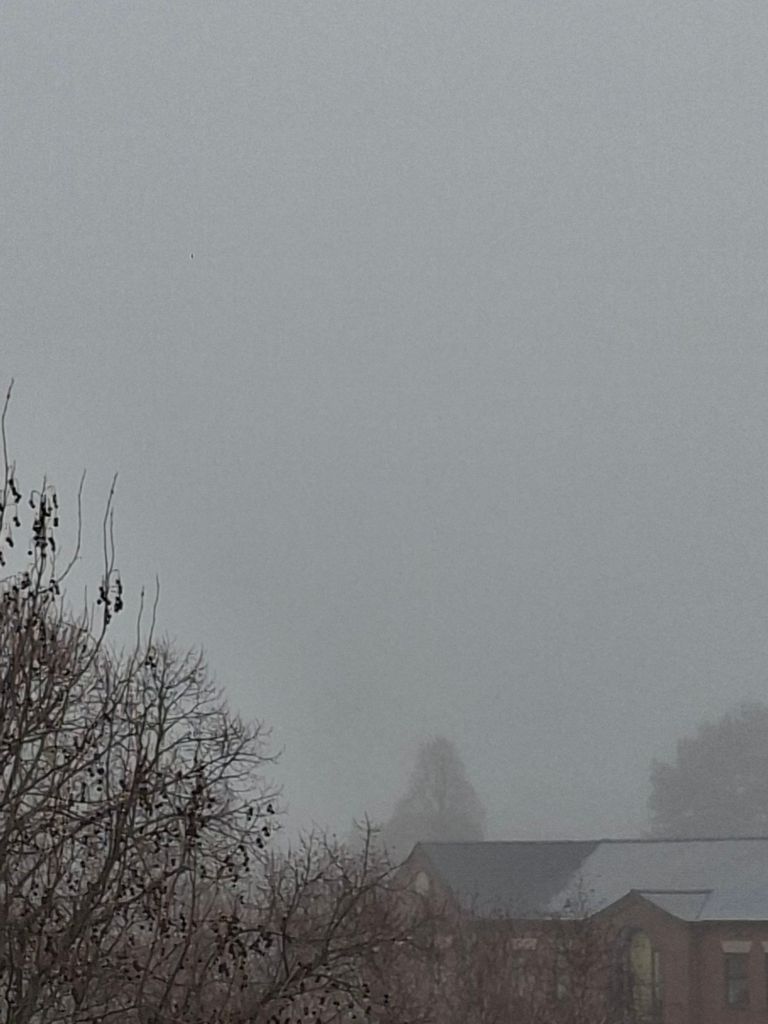
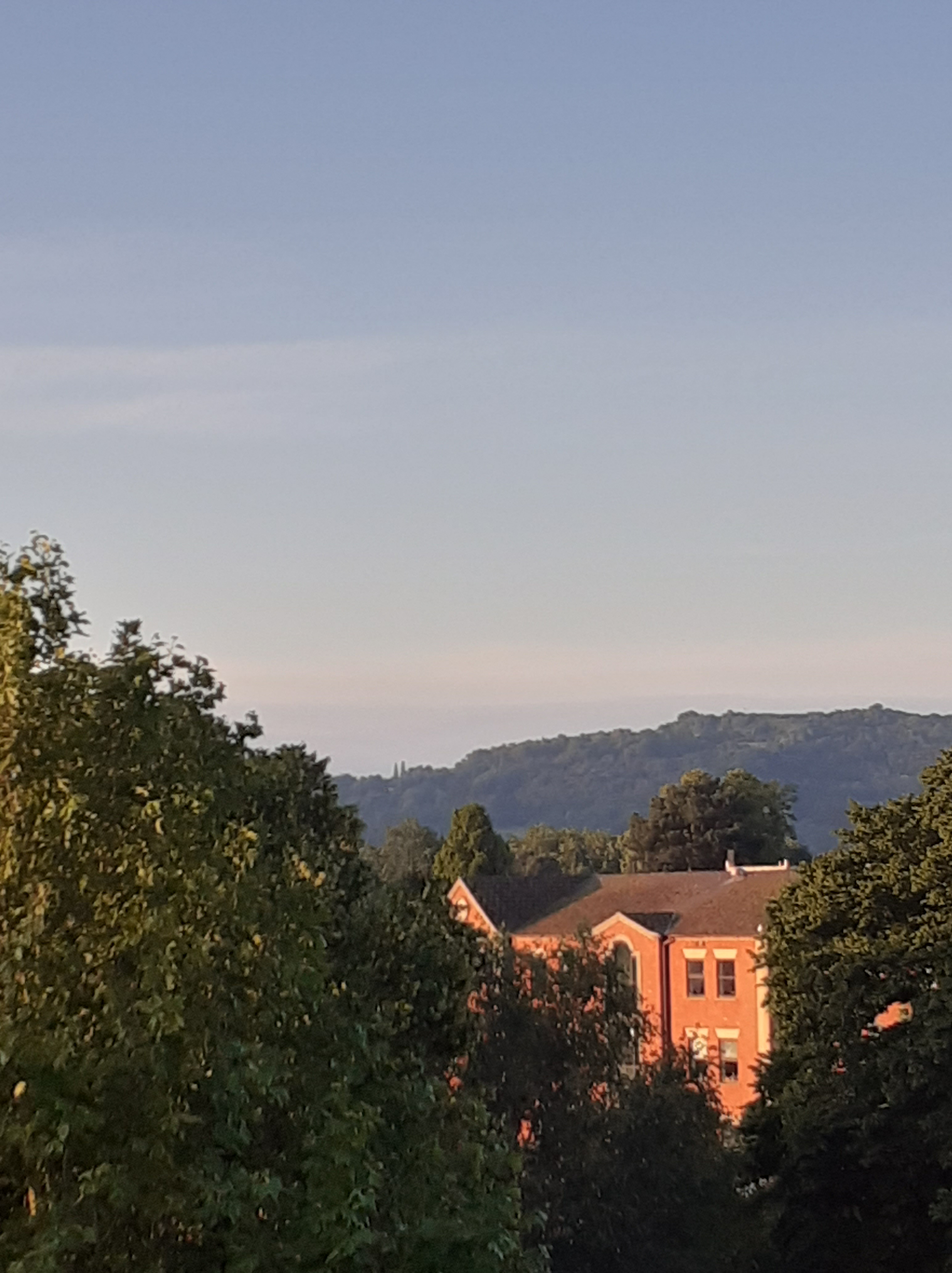
A familiar scene, in its equinoctial clothing. My experience of it is made different by a recent fall, in which I fractured my left humerus bone near the shoulder. I am left-handed, so it’s the ‘wrong’ side for a break. Happily my wrist and fingers remain flexible, and I don’t need surgery for the fracture. It could have been much worse.
Nonetheless Elaine, still depending on a rollator for walking, and I have to be resourceful and strategic in leaving and re-entering our apartment. Essentially I specialise in legs and she specialises in arms, though we each have some capacity in the other’s domain. We’re a team, after all. We work together. But we aren’t getting out much for the time being.
I look out a little wistfully and write a bit ouchilly. I feel limited and constrained. I also feel loved and supported. I’m a little foggy in my thinking, but I don’t see an episode like this as time off from my contemplative inquiry. All experiences are there to be acknowledged, moment by moment, day by day. Otherwise the practice becomes an alienated exercise, or performance, separated from the ups and downs of life. In reality, it sits ever-present within them.
I look within myself. I look across at Elaine. I also look out of window to connect with the world outside and its changes over the year. The grey sky is typical for this September, but blue sky is too. Variation is the overall story. It’s an inherently changeful and unsettled time. I’m intrigued by the way in which Robinswood Hill retains its green cover, when the town trees are in an advanced stage of turning. I’m alive.