
PAGAN IMAGERY IN ENGLISH FOLKSONG
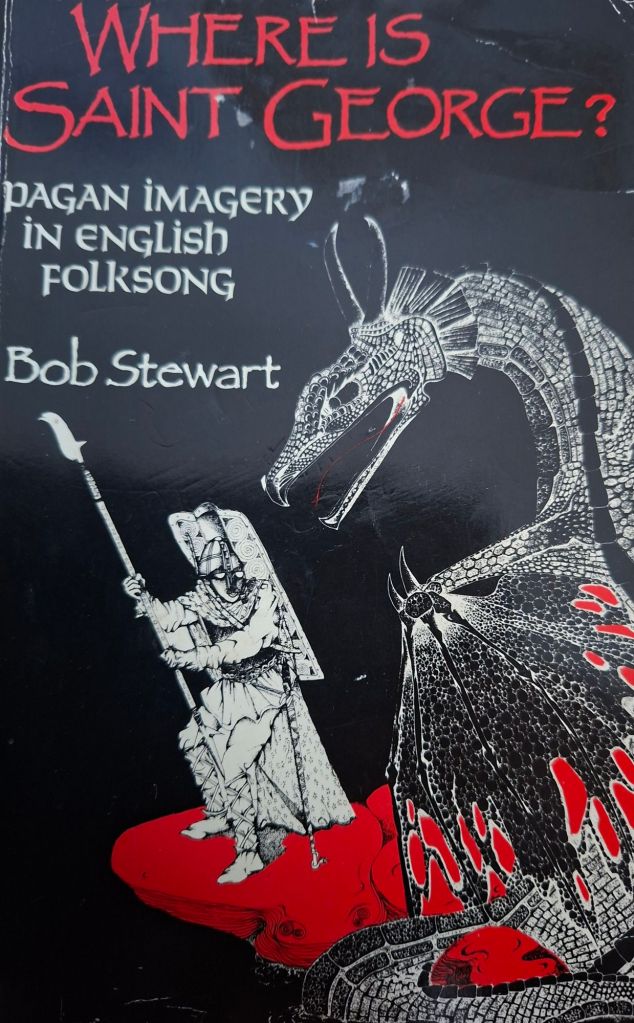
Bob Stewart’s Where is Saint George? has a wider context than England’s patron saint. Although he is discussed, the subtitle Pagan Imagery in English Folksong better describes the book as a whole. I will write a post about St. George at a later date. Here I talk about the overall theme of the book, which is to explore the the author’s thesis that there is an after echo of pre-Christian beliefs and practices in traditional English folk songs. I’ve chosen one song – Bruton Town – followed by a presentation of Bob Stewart’s commentary. I notice that when reading the song, my first impression was a strong sense of a disciplinary message about class and gender norms – also an old tradition.
In Bruton town there lived a farmer
he had three sons and a daughter dear,
by day and night they were contriving
to fill their parents’ hearts with fear.
One told his secret to none other
but to his brother this he said,
‘I think our servant courts our sister,
I think that they have a mind to wed.’
‘If he our servant courts our sister
that maid from such a shame I’ll save
I’ll put an end to all his courtship
and send him silent to his grave.’
A day of hunting was prepared
In thorny brakes where the briars grew,
and there’s they did this young man murder
and into the brake his fair body threw.
‘Oh welcome home my darling brothers
our servant dear is he behind?’
‘We’ve left him where we’ve been out hunting,
we’ve left him where no man can find.’
She went to bed crying and lamenting,
lamenting for her own true love,
She slept and dreamed that she saw him by her
all covered o’er in a gore of blood.
‘Do you wake up early tomorrow morning
and under the garden brake d’you go
and there you’ll find my body lying
t’was your own three brothers that laid me low.’
She woke up early the very next morning
and to the garden brake she did go.
‘Twas there she found her own dear jewel
In the same place where the briars do grow.
‘Now since my brothers have been so cruel
as to take your tender sweet life away,
one grave shall hold us both together
and along with you in death I’ll stay’.
Stewart comments: “This song – collected in Somerset by Cecil Sharpe – is one of the rare examples of folklore and literary tradition exchanging material, and finally returning to an oral currency. … the variants collected in the United States as well as the English West Country are preserved through the medium of the broadsheet.”
He also references a well established literary tradition drawing on this theme, including John Keats’ Isabella Or, The Pot of Basil and its model, Boccaccio’s Decameron. It is here the he makes a link to traditions of ritual murder. “A group of young men collectively murder a victim for the sake of a woman. She then digs up his body, and severs the head. This is kept and planted with the herb basil, the discovery of the murder having been initiated by the ghost of the dead victim in a dream. The images here seem to be sacrificial, with a group of men bearing collective responsibility for the murder, a concept well known from classical sources and from surviving European folk plays and dance-dramas”.
(1) Bob Stewart Pagan Imagery in English Folksong London: Blandford Press,1988. Cover illustration by Miranda Green
NB In his other works, the author is named as R. J. Stewart

 Contemplative Inquiry