
PARK TREES IN A DRY SEASON
by contemplativeinquiry

Yesterday evening I went to my local park and was struck by changes in the trees. I seemed to have walked into a premature autumn. Trees were shedding leaves. To me, the trees in the picture above appeared distressed. Looking at them again now, I wonder about disease as well as simple unseasonal shedding.

In the park, I found beauty too, with new colours becoming manifest. In my part of the world, the latter part of August has always included intimations of Autumn. But 2025 feels unusually dramatic and unusually early. Some trees, like the horse chestnut below, seem to be shedding their leaves particularly fast.


Other trees seemed to be weathering this period more easily, like these medlars now bearing their fruit – bringing autumn into August in an apparently unstressed way.

Standing back, I could see new patterns in the no longer quite so green Greenwood. They illustrate new conditions and are, for better or worse, harbingers of a new time. There will be more changes. I hope that the trees will continue to adapt and stay in place for many years to come. But nothing is certain, in this time of climate crisis and the rise of willed ignorance about its severity.

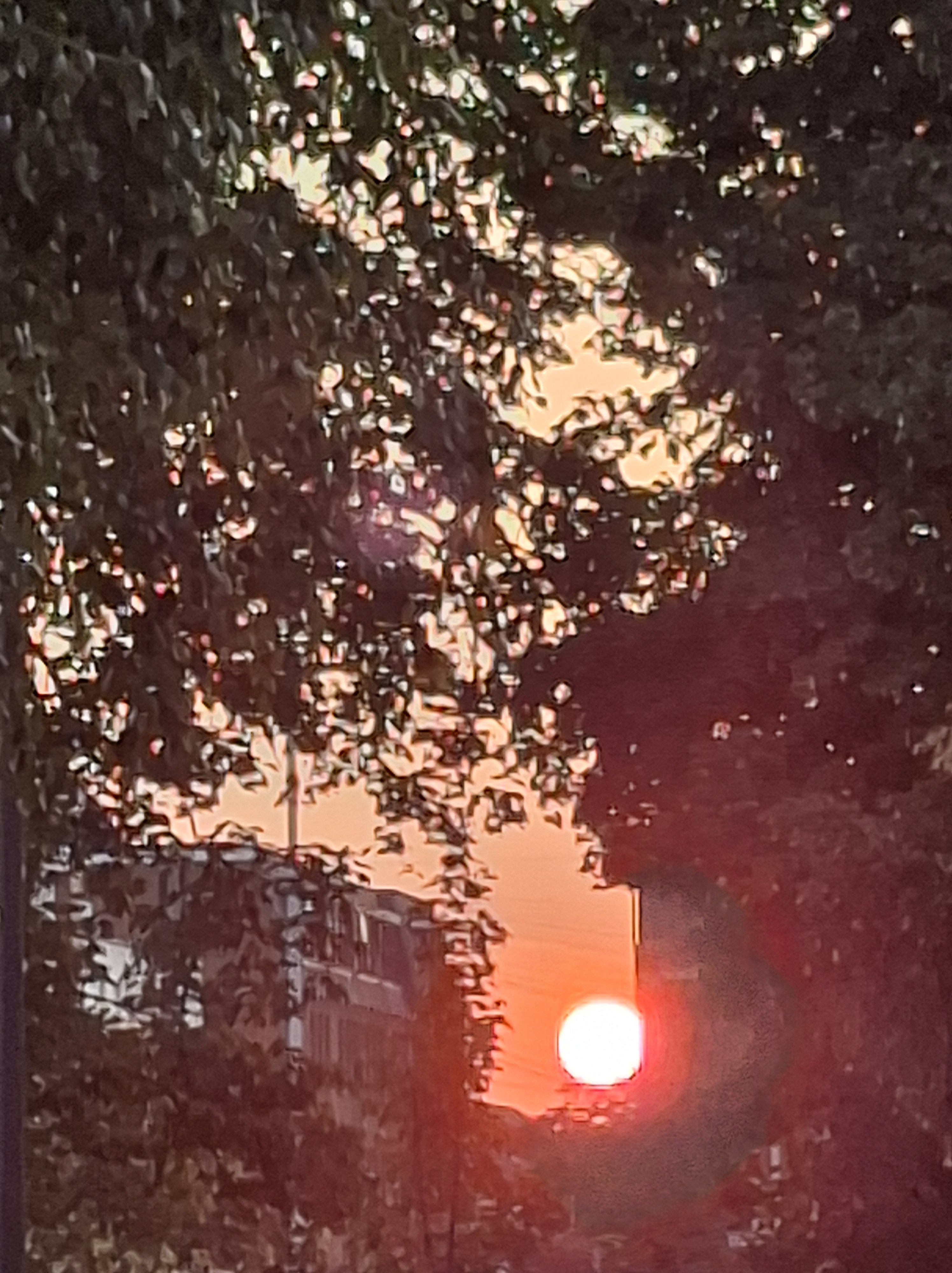
The sunsets continue to get earlier. I walked into one as I left the park. The sun asserted it’s power in a late stage of its descent. It’s been a hot summer as well as a dry one. I took this powerful, almost too powerful, late summer solar image with me as I walked back to my home.
 Contemplative Inquiry
These are very poignant photos, James. Here in mid-Wales (notoriously wet) it is just the same, the trees in our hedgerows have turned colour and the landscape is more reminiscent of October in places. Everything is crying out for water and even the deepest-rooted trees seem to be struggling. It is very worrying, I simply hope that nature can adapt to survive such change and stress and humans wake up to what is happening. On a happier note, we have just picked a bounty of beautiful blackberries from our hedges, they are very early but a blessing of the season nonetheless.
Thanks for this comment Lis. I didn’t fully realise that things were so parched in your part of the world. Great news about the blackberries!
Most of the trees in the photographs look like they are suffering with drought stress (not enough water), or some could possibly be due to damage further back on the branch/twig. If the tall trees in the second picture are conifers they look like they are in real trouble. The Horse Chestnut trees have, for some years now, suffered due to a larval form of a micro-moth which can now survive our milder winters. The larvae are leaf miners and the effect is that the leaves begin to look brown in places, usually from July onwards. The red flowering Horse Chestnuts don’t seem to be affected by this, at least so far. An interesting thing I have noticed is that Horse Chestnut trees very badly affected do sometimes begin to grow new leaves later in the year when they won’t be affected by the leaf-miners. I’ve noticed it on quite a few Horse Chestnut trees in my local area. One large tree on Highbury Fields re-grew about three quarters of its leaf canopy later on one year. In your picture of Horse Chestnut trees there may be some new leaves on the bottom edge of the canopy.
Many thanks for this comment Julie. In particular I didn’t know about the micro-moth larvae, and am grateful for the information.
The micro-moth is called Cameraria Ohridello. If we get a strong cold snap in the winter the trees do better the following summer. The micro-moth seems to over-winter in the leaf litter so trees in towns and cities tend to do a bit better as the fallen leaves are usually cleared away. This is the same with the Ash Dieback problem. The leaf miner is reported to be affecting Sycamores and Norway Maples but I can’t say I’ve noticed this in my local area yet.
Thanks again Julie. I’ll keep my eyes open!