
HERTHA AS EARTH MOTHER AND COSMIC GODDESS
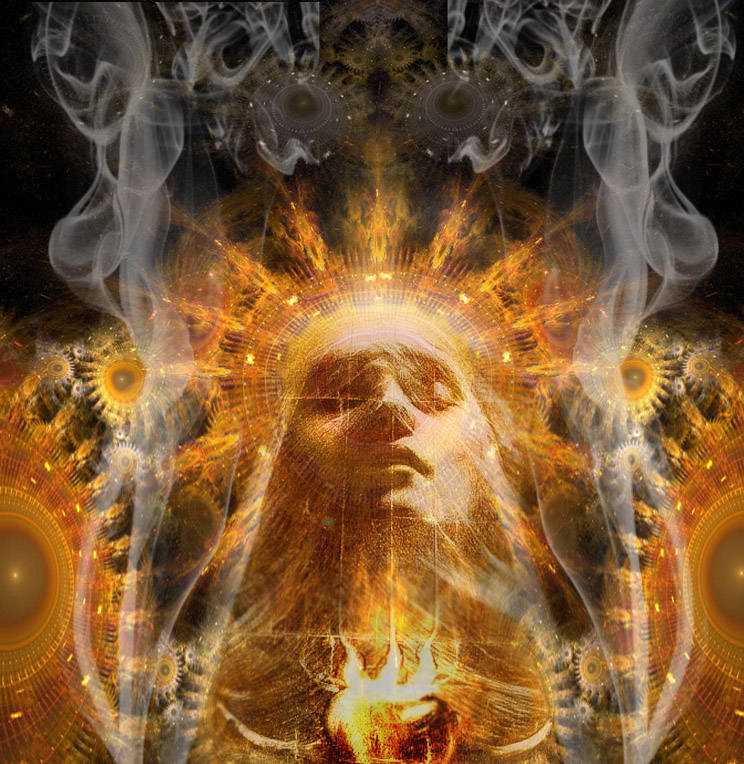
Hertha (Nerthus, Erth) was a Germanic Goddess of the Earth, associated with fertility, domestic animals and nature. She was believed to live in an island grove, whilst also touring the land in a cow drawn chariot to bring peace and joy to those who celebrated her. Our ancient information is derived from the Roman author Tacitus, in his Germania (1). Current accounts also link her to themes of rebirth, kinship, health, longevity and tradition. It is said that she can descend through the smoke of any fire to bring gifts. See: https://journeyingtothegoddess.wordpress.com/2012/12/25/goddess-hertha/
Algernon Charles Swinburne’s Victorian poetry is mentioned in two of Ronald Hutton’s Divinity lectures at Gresham College (2,3). In particular he describes the poem Hertha (3) as an important example of Pagan currents in Victorian British culture. Although widely seen then and (for some people) since as transgressive, Swinburne’s voice is confident and strong – as I hope these extracts show:
“I am that which began:
Out of me the years roll;
Out of me God and man;
I am equal and whole;
God changes, and man, and the form of them bodily;
I am the soul.
“Before ever land was,
Before ever the sea,
Or soft hair of the grass,
Or fair limbs of the tree,
Or the flesh-coloured fruit of my branches, I was, and thy soul was in me.
“First life on my sources
First drifted and swam;
Out of me are the forces
That save it or damn;
Out of me man and woman, and wild beast and bird; before God was, I am.”
As I read these verses, Swinburne’s Hertha is cosmic as well as local, universal as well as tribal. Swinburne clearly values Hertha’s specific name and lineage and he identifies Hertha with the World Tree in some verses. But he does not simply revive the old North European traditions. His Paganism models a new culture for a new time.
Although another 150 years have passed since Swinburne wrote this poem, I find it directly relatable. For me, it contains one of the most powerful affirmations of Panentheist Paganism I have heard: “I am the mouth that is kissed and the breath in the kiss, the search, and the sought, and the seeker, the soul and the body that is”. What better time than Beltane to celebrate Hertha and the 19th century seeding of Modern Paganism.
(1) Tacitus Agricola and Germania London: Penguin, 2009 (rev ed)
(2) The Modern Goddess and Where did Modern Paganism start? https://www.gresham.ac.uk/watch-now/
(3) Algernon Charles Swinburne Complete Poetical Works Delphi Classics, 2013 (Kindle edition)





 Contemplative Inquiry