Contemplative Inquiry

This blog is about contemplative inquiry

Month: January, 2025

BRIGHID AT IMBOLC: A SONG BY DAMH THE BARD

Imbolc/Candlemas is celebrated on either 1 or 2 February as part of the Celtic  wheel of the year. It signals the loosening of winter’s grip. Brighid, Goddess of poets, smith-work and healing is its patron. Damh the Bard is a prominent member of OBOD (1), best known for his music. A singer song writer revisioning ancient Bardic tradition for modern times, he has been an inspirational and much loved force in modern Druidry and Paganism. His lyrics for this song are below as presented on  YouTube.

There’s a tree by the well in the wood,

That’s covered in garlands,

Clooties and ribbons that drift,

In the cool morning air.

That’s where I met an old woman,

Who came from a far land.

Holding a flame o’er the well,

And chanting a prayer.

(Chorus) Goddess of fire, Goddess of healing,

Goddess of Spring, welcome again.

The told me she’d been a prisoner,

Trapped in a mountain,

Taken by the Queen of Winter,

At Summer’s end,

But in her prison, she heard the spell,

The people were chanting,

Three days of Summer,

And snowdrops are flowering again.

She spoke of the Cell of the Oak,

Where a fire is still burning,

Nineteen priestesses tend the Eternal Flame

Oh but of you, my Lady,

We are still learning,

Brighid, Brigantia,

The Goddess of many names.

Then I saw her reflection in the mirrored well,

And I looked deep in her face,

The old woman gone, a maiden now knelt in her place,

And from my pocket I pulled a ribbon,

And in honour of her maidenhood,

I tied it there to the tree by the well in the wood.

(1) Order of Bards, Ovates and Druids

OBOD | Order of Bards, Ovates & Druids | Druidry

See also: https://contemplativeinquiry.blog/2023/01/23/brigid-at-imbolc

MOMENTS OF CALM

We have had a lot of wind and rain in recent days. Saturday was an exception. The sky was clear, vividly blue. The air seemed cleansed and fresh. I stood at the back of St. Mary de Crypt, above, and understood the sensibility that reaches up, aspirationally, to heaven. I could empathise with the yearning that goes with that, looking for something clear and bright and pure. It’s as if such a sky might hold a promise of peace, a peace that was alive and able to nurture beauty.

I am also glad that, by the standards of medieval churches (including others within walking distance) this St. Mary’s is modest and balanced in its upwards aspiration. It aspires, but does not run away from the earth. The picture below shows it as solidly grounded, and not altogether dwarfing the buildings that have been its neighbours for many years. The church is still consecrated and holds services from time to time. But now it functions largely as a busy community centre with a strong continuing role in Gloucester’s life. A solid presence in the heart of the city.

Looking in on the city park, I welcomed the same clear blue sky. But my eye was mostly drawn to the trees that it framed. Although this is still a winter scene, the colour of the willow suggests a strong presence of male catkins and the cycle of growth and change that is under way.

Leaving the park I made my way to the still living garden of the ruined Llanthony Secunda Priory, once the monks’ physic garden. It still feels like a place of healing and the present version is well maintained.

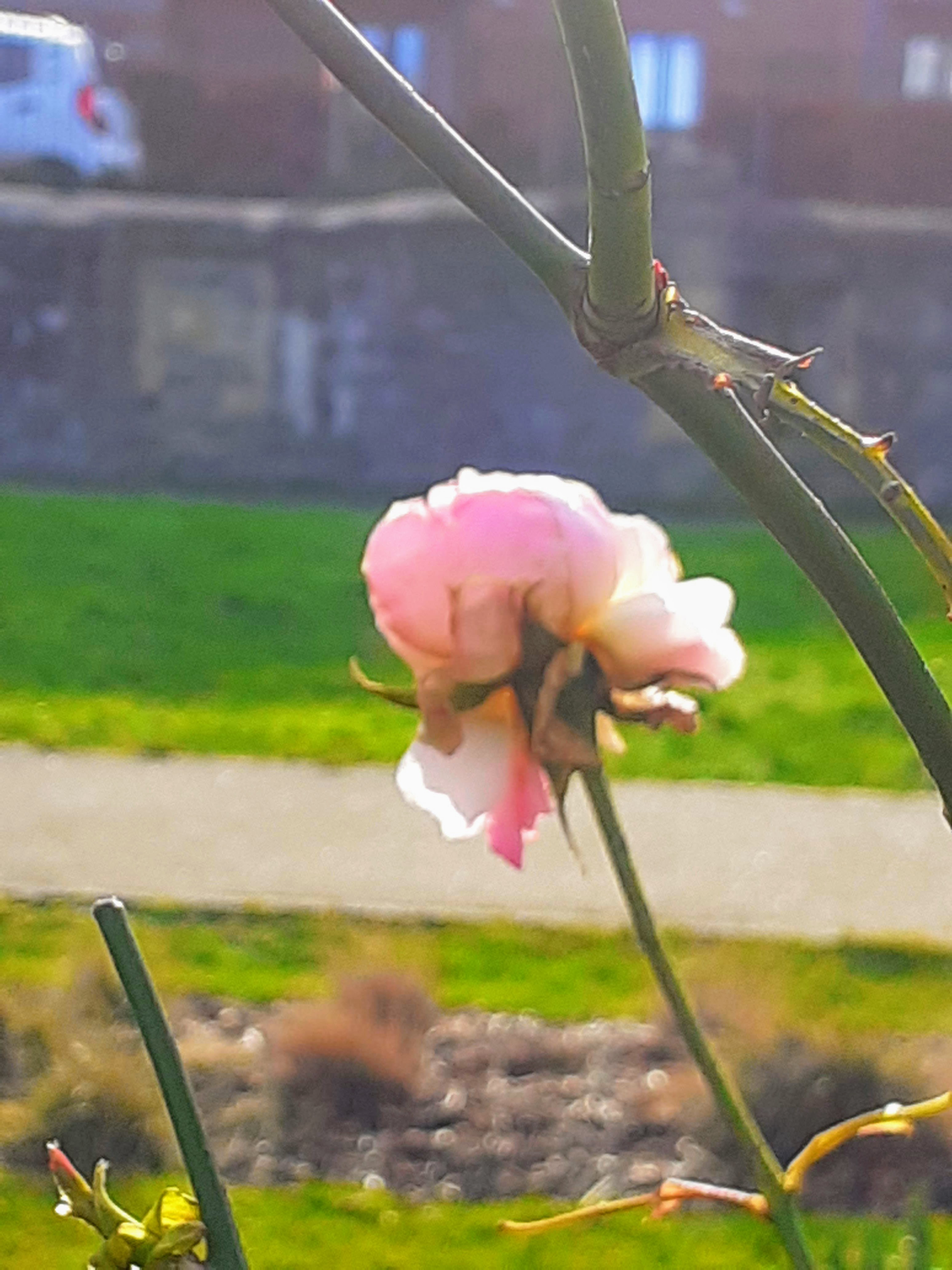
I was both surprised and delighted to see a rose in bloom. Roses have for a long time been a heart symbol for me, but I have generally associated them with summer and especially midsummer. I became aware of winter roses quite late last year and they were shop bought. I loved them but had some misgivings about their production. So I felt blessed to see one growing in the physic garden last Saturday. There’s no traditional link between Imbolc and roses that I know of. But seeing this rose in the ground, sunlight glinting on both petals and thorns, I had an Imbolc kind of feeling, as we approach the first festival of the rising year.

THE WAY OF THE HEART

Sufism is often referred to as the Way of the Heart. Hazrat Inayat Khan was a Sufi teacher and musician from Gujarat, India, who took his teaching to the West in the early 20th century. His combination of spiritual teaching, philosophy and music was normal in this culture and tradition. In his own life and work, Hazrat Inayat Khan created a Universal Sufi movement independent of its Islamic origins, though always inspired by them. Practitioners from his movement created the Dances for Universal Peace.

The image above is the Ace of Cups from Ayeda Husain’s The Sufi Tarot (1). Ayeda Hussain is a teacher in the Ineyatiyya, a global organisation dedicated to Universal Sufism as taught by Hazrat Inayat Khan. She sees Sufism and Tarot as two systems of healing and transformation that can be valuably brought together. She treats Tarot as a vehicle for spiritual teaching, going so far as to include contemplations and affirmations for each card.

Referring to her Ace of Cups, she says: ‘In Sufi poetry, the cup is the heart that must be emptied before the beloved can pour the Divine nectar into it. Just as a cup that is filled cannot be poured into, neither can a heart filled with limiting impressions. The work of the mystic then, is to clear impressions that clutter and cloud the heart, so that it may be able to receive. As the heart opens, we become aware of new offers and opportunities in both love and spiritual growth’.

I came to The Sufi Tarot by an indirect route. When I began working with my Ceile De (2) beads, I didn’t at first expect to use them for mantra meditation and I looked at a collection of fuinn (sacred chants) as an option for working with the beads. Fuinn tend to be brief and I thought that a single fonn might work for me. They are in Scottish Gaelic and frequently use heart language, as in:

Gun tigeadh, solas nan solas

(Goon tee-guch, sol-us nan sol-us)

Air mo chridhe

(Air mo chree)

This translates into English as Come light of lights, to my heart.

I found this fonn beautiful though somehow not right for my purpose. But the phrase air mo chridhe would not leave me. As soon as I heard it, in the old language, it needed no translation, and I felt I had known it forever.

What I did in my own practice, having decided on the Soham mantra for the beads, was to create a version of the modern Druid peace prayer as a love prayer.

Deep within my innermost being, may I find love.

Silently in the stillness of this space, may I nurture love.

Heartfully, in the wider web of life, my I live in love.

Now using this prayer, I felt the desire for friendly guidance in this work of the heart. I felt prompted to search for ‘Sufi Tarot’, and was surprised when came up immediately. When I received the pack, I was quickly reassured that I had had been given what I asked for. I look forward to this new thread within my contemplative inquiry.

(1) Ayeda Husain The Sufi Tarot Carlsbad, CA; New York, NY; London; Sydney; New Delhi: Hay House, 2022. Art team Nazish Abbas, Hassaan Aftab, Momina Khan

(2) https://contemplativeinquiry.blog/2025/01/14

LATE WINTER: REGENERATION

In the picture above, birch catkins are gaining strength. It is a bleak and cold early afternoon. The tree trunks sit in quiet latency. But new life is stirring all the same.

In the wheel of the year, winter is the season both of dying and regeneration. Late winter my be the coldest time of year, but the turn has been made and the days are already lengthening. Imbolc, which once marked the first lambing season of the year for our ancestors, is on its way.

Four years ago (1) I wrote a post in which I described the place of Birch (Beith) in the Irish Ogham alphabet, and its link with new beginnings and the need for careful preparation in any new endeavour. In Northern runic tradition Birch (Beorc, Berkana) is identified with the young Goddess, sexuality and birth, as well as beauty and creativity in general. At the time of writing I was working with a mandala of 16 trees in which Birch was my tree from 1-22 February. It continues to be an important tree in my life.

Now, my emphasis is different. I started by reflecting on a group of birch trees planted just outside our building. I can see them now  out of a balcony widow. There are five in this space, somewhat sheltered between two buildings. They are the nearest thing to a grove in this urban setting. They are still young and have only recently reached the second floor level where we live. They seem vulnerable, shallow-rooted. When we have high winds, I expect them to blow down. They bend a long way. But they haven’t broken or fallen yet.

They are our neighbours. Elaine and I walk among them often. They are a good place for her when she re-learns walking after her accident and its complications. She first noticed the catkins and pointed them out to me weeks ago, when they were tiny. The picture above, which I took today, shows how much they have managed to grow in these apparently unpromising winter weeks.

(1) https://contemplativeinquiry.blog/2021/02/01/birch-new-beginning/

WORKING WITH BEADS

Recently I wrote about the balanced cross (1), linking it to the paidirean (pahj-urinn) prayer beads of the Ceile De (Culdees), a modern monastic order based in Scotland. This post is about the beads and my work with them. Beads like this were part of the original Ceile De tradition and are known to have been used in the days of Columcille (St. Columba).

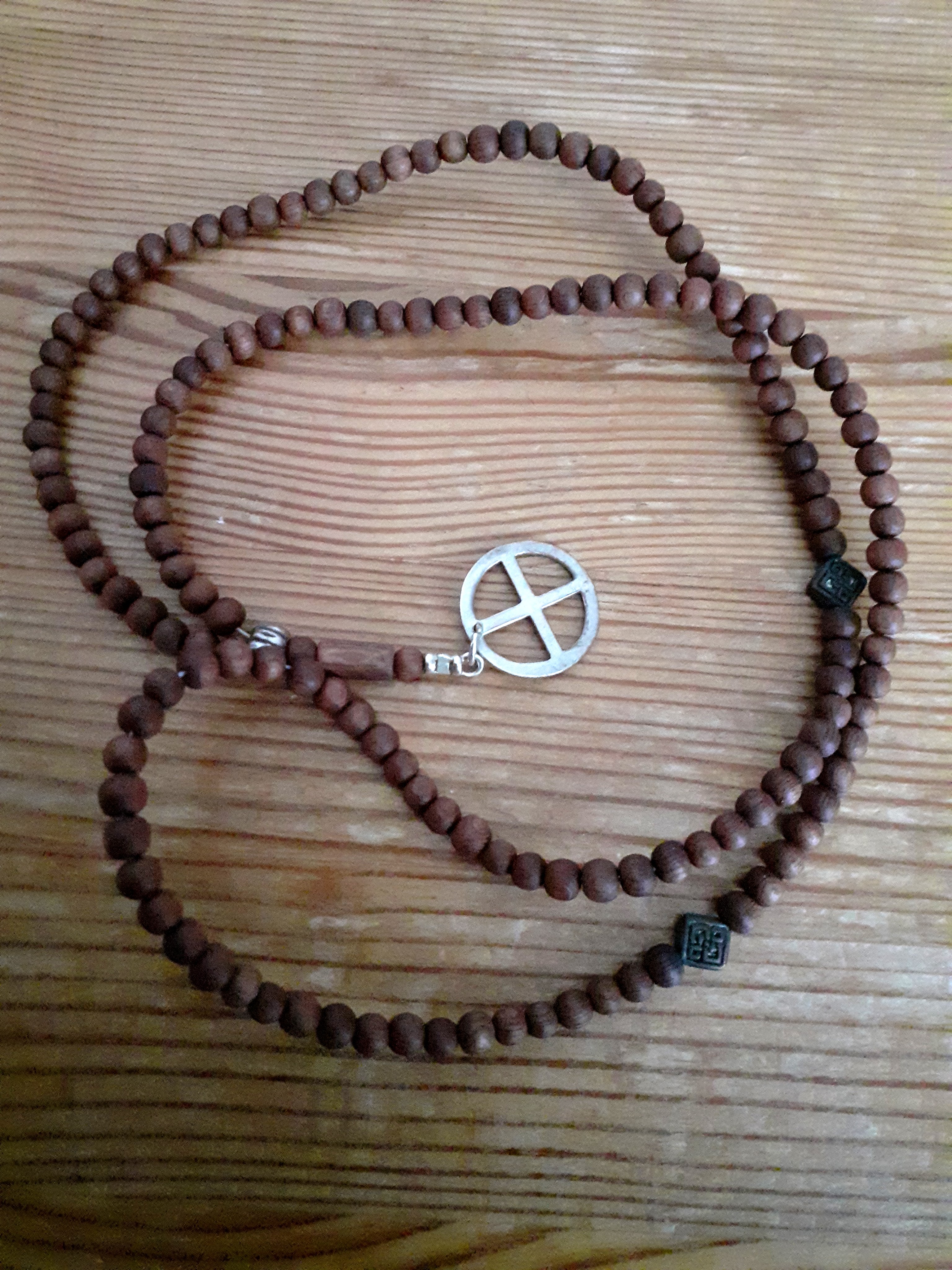
There are 150 beads, each about 5 mm wide.  They are made of unstained rosewood and were left immersed in rose damask oil for a month.  As well as scenting the beads, the oil gives the beads a pinkish colour. A cross hangs from the beads – at heart level when worn as a necklace.

Each Paidirean is ceremonially strung in Scotland by a Ceile De Order member.  The process takes two hours and involves prayer, meditation and continuous chanting during the stringing.  Then a blessing is spoken over the completed Paidirean which is anointed with water and with oil from a local holy well, used for at least 1500 years. The Paidirean is an object of power as well as beauty. 

I am not a member of the Ceile De, and when I acquired the Paidirean they knew that I would work with the beads in my own way. I bring together meditation and prayer. I work with the Soham mantra, with Satish Kumar’s understanding (2) that it means ‘you are, therefore I AM’. Whilst I am mindful to my breath, to the mantra and to the movements of the beads, mindfulness is a means and not the purpose of the practice.

The purpose is to make an offering to Spirit – an offering from one lamp to the light, one wave to the ocean. After some hesitation and experiment, I have adopted the word Spirit, rather than Goddess or God, to address the Divine. It is more universal and inclusive as, for me, befits a panentheist view. In making my offering, I am aware that Soham also works laterally, including relations between all beings within the web of life, just as the Druid prayer speaks of  ‘the love of all existences’. Ultimately, we are recognising the divinity in each other.

Spirit is not beyond us in some other realm. It is here, now, and everywhere.  When I work with the beads, I am making both an offering and an affirmation.

(1) https://contemplativeinquiry.blog/2025/01/04/the-balanced-cross

(2) Satish Kumar You Are therefore I AM: A Declaration of Dependence Totnes: Green Books, 2002

SIGNS OF LIFE IN A WINTER KINGDOM

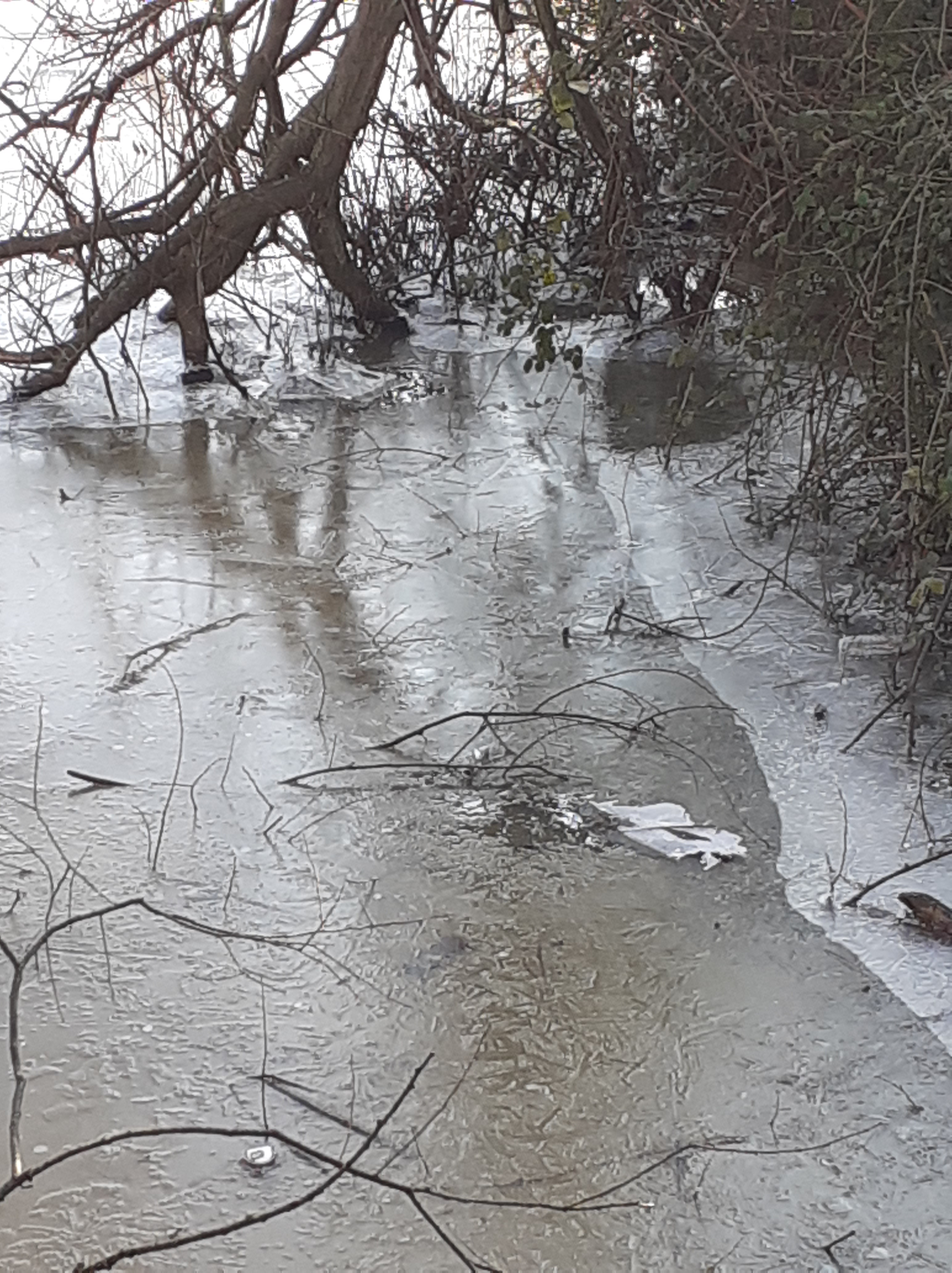
I am in a place and time of cold beauty.   Beside the Gloucester-Sharpness canal, the water margin looks like a scene of suspended animation.

It isn’t true. There are fish in the water, underneath the ice. Trees are preparing for spring, protected by their bark. In the picture below evidence of the sun is seen on a tree trunk and on the thawing waters of the canal.

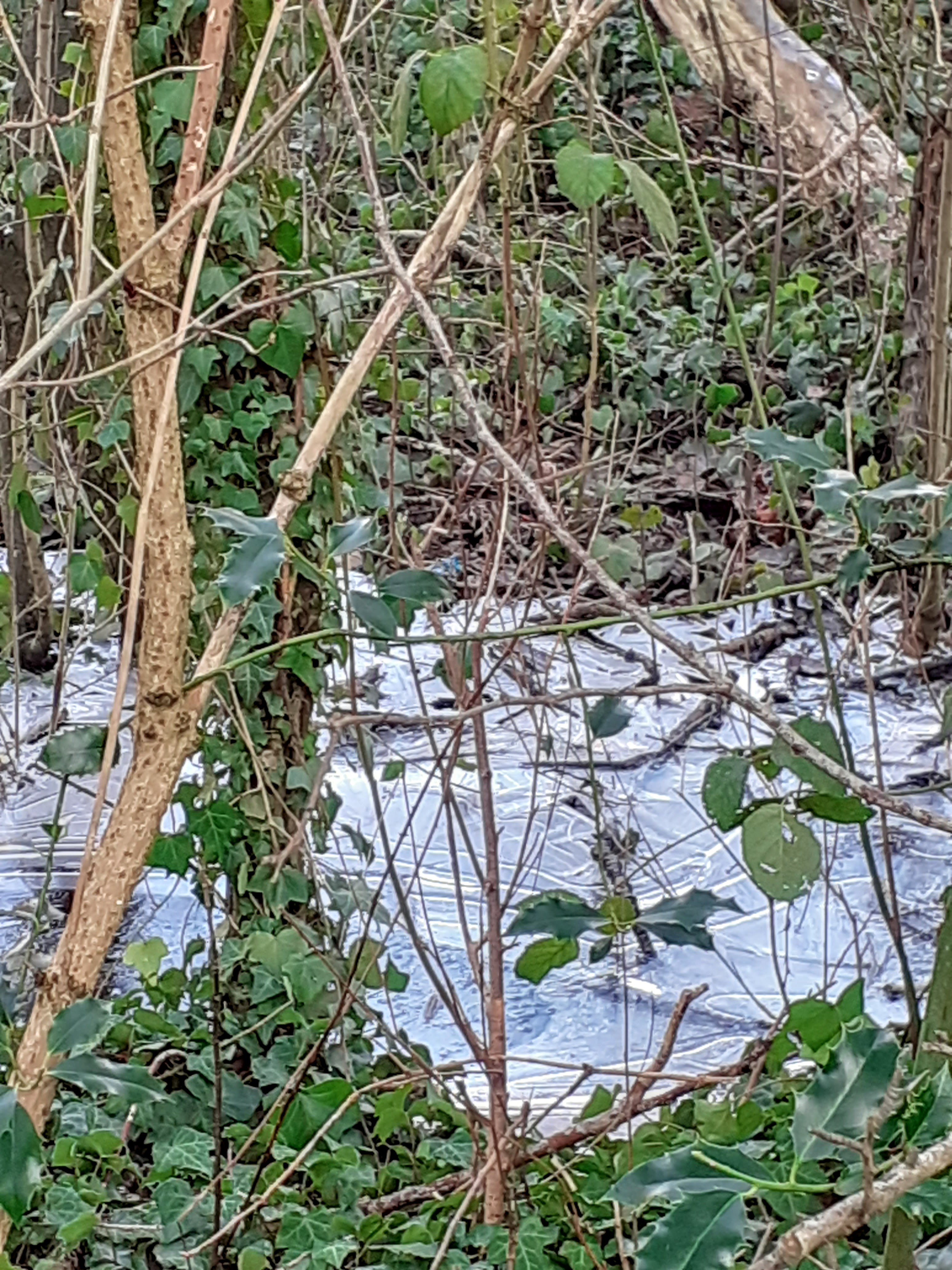
In woodlands beside the canal, I find an iced up inlet where the surrounding ivy lives up to its evergreen name. This small enclosed spot feels strongly alive, the frozen waters an adornment rather than a contrast.

Returning to the Docks, I notice that the seagulls aren’t acting as the confident, aggressively resourceful selves that I expect. The are neither at work, busily scavenging, or at play, gleefully flying or enjoying the water. They seem a bit bewildered by the thin ice that they are standing on.

On this walk I’m connecting rather than communing. I’m outwardly rather than inwardly focused, oriented to narrative and incident. There are different ways of observing and today I want to connect with the world and feel that I am part of it. I am endlessly fascinated with this small territory and the way it changes as the Wheel turns, and seasons come and go.

BLUE SKY, RETURNING SUN

When I walked out this morning, my fingers felt cold inside their gloves. Visually I enjoyed the interplay of strong light and strong shade. The sky overhead was blue. Without seeing it directly I felt the presence of the sun. When I did find it and stepped into its path I found it dazzling and warm. I hadn’t expected the warmth. When I checked the temperature I noticed that it was rising, though not by much.

This, for me, was the sign that the sun was back after the long Midwinter moment that marks the turn of the year where I live. It helped that we were free of fog, rain and snow. Whatever comes next, Ì can tell myself that I have lived to greet another rising year together with my wife Elaine. A moment to cherish and celebrate.

THE BALANCED CROSS

Twelve years ago (1) I wrote about the paidirean (pahj-urinn) prayer beads of the Ceile De or Culdee movement (2). In its current iteration this is a modern monastic order based in Scotland with a lay following in other parts of the world. It looks back to the early Celtic church once influential in Ireland, Scotland and north-east England. The post referenced above (1) describes my relationship with the beads at the time.

Now, coming back to this beautiful artifact, I am principally focused on the cross – an equal armed and circled silver cross that hangs from the beads – at heart level when worn as a necklace. This form of cross is an ancient symbol, sacred to many people in many cultures, often understood as a sun wheel, and not specific to Celtic Christianity. It is sometimes called the balanced, or peaceful, cross.

For me, this cross is a more fundamental image than the awen symbol, which I can also wear as a pendant, appropriately sitting at the level of my throat. The silver cross maps a whole imaginal world: four directions or winds – east, south, west, north; four powers – light, life, love, law; four elements- air, fire, water, earth; four guardians – hawk, stag, salmon, bear; four qualities – vision, purpose, wisdom, faith; four times of day – sunrise, midday, sunset, midnight; four seasons – spring and early growth, summer and ripening, autumn and bearing fruit, winter, dying and regeneration. Having a liturgy to this effect, casting a circle and calling for peace as a regular practice, marinate me in a certain way of spiritual life. Wearing this cross confirms and declares it.

In my light energy work, the disc becomes a radiant sphere that holds me. For there is a vertical dimension. Horizontally I hold my hands out palms raised and the energy flows out from heart through outstretched arms and to my hands. Vertically it flows in both directions from my heart to my feet and the earth and also to my brow and above my head. But the source of this radiance is the energy behind the heart and the still emptiness behind the energy. This flow is an open system. Energy also comes back. My energy sphere is porous to the world. I like the illustration on the bag below because it shows an empty circle at the centre. This does not feature on the pendant itself, but to me empathises the divine power at the centre from which I am not separate. It is good to reconnect with an carrier of healing and insight which I appeared to have left behind. I am grateful that it was still here for me when I was ready to reconnect.

(1) See: https://contemplativeinquiry.blog/2012/12/30/

(2) See: https://www.ceilede.co.uk

Earth Eclectic

music that celebrates Earth and speaks to the heart

Sarah Fuhro Star-Flower Alchemy

Follow the Moon's Cycle

Muddy Feet

Meeting nature on nature's terms

Rosher.Net

A little bit of Mark Rosher in South Gloucestershire, England

Becoming Part of the Land

A monastic polytheist's and animist’s journal

selkiewife

Selkie Writing…

Charlotte Rodgers

Images and words set against a backdrop of outsider art.

Prof Jem Bendell

living with metacrisis and collapse

Towint

The pagan path. The Old Ways In New Times

The Druids Garden

Spiritual journeys in tending the living earth, permaculture, and nature-inspired arts

The Blog of Baphomet

a magickal dialogue between nature and culture

This Simple Life

The gentle art of living with less

Musings of a Scottish Hearth Druid and Heathen

Thoughts about living, loving and worshiping as an autistic Hearth Druid and Heathen. One woman's journey.

Wheel of the Year Blog

An place to read and share stories about the celtic seasonal festivals

Walking the Druid Path

Just another WordPress.com site

anima monday

Exploring our connection to the wider world

Grounded Space Focusing

Become more grounded and spacious with yourself and others, through your own body’s wisdom

The Earthbound Report

Good lives on our one planet

Hopeless Vendetta

News for the residents of Hopeless, Maine