
Contemplative Inquiry

This blog is about contemplative inquiry

Month: September, 2024

NEWS OF A DEATH

When is ‘suicide’ something else? At the age of 80 Satish Kumar’s mother decided that her life was over and her duty done. She began a fast that lasted for five weeks before she died. Although suicide is stigmatised in most cultures, this was an honourable death in her Jain community in Rajasthan, India. Kumar, then already living in England, quotes the letter that gave him the news.

“At the age of eighty your mother felt that she had served the family and fulfilled all her duties and that now it was time for her to meet death. She decided to separate herself from her worn-out body by fasting. She believed that only death could bring new life and that she must die to live again. She went round the town, to family and friends, saying goodbye and asking forgiveness for any wrong she may have done. From the next day’s sunrise she took no more food or drink except a little boiled water. The news of your mother’s fast unto death spread by word of mouth. Monks came to bless her and be blessed, since it is considered to be brave and holy to die in this way – to embrace death rather than let it capture you unaware. Hundreds of people came to have her last darshan and to ask for forgiveness. She didn’t talk much but by her look acknowledged the receiving and giving of forgiveness. People sat outside singing songs and praying. After thirty-five days of fasting, your mother died.” (1)

I have written before about Jain ethics, in a review of Philip Carr-Gomm’s Seek Teachings from Everywhere (2). Both he and his Druid mentor Ross Nicholls had an interest in the Jain path with its values of ahimsa (non-violence/harm), aparigraha (non-attachment/possessiveness/acquisition) and anekant (non-absolutism/many-sidedness/multiple viewpoints). From a Jain perspective, Satish Kumar’s mother was in conformity with these principles when she chose death, with fasting (already a familiar practice) as her method. I value her story for its distinctive lens on a contentious subject. The depth of community support she received is for me the most moving aspect of this voluntary death. It became almost a celebration, and a kind of karmic harvesting for someone who believed that she “must die to live again”.

(1) Satish Kumar No Destination: Autobiography of a Pilgrim Cambridge: Green Books, 2014 (extended 4th edition – first edition 1992)

(2) See: https://contemplativeinquiry.blog/2019/10/02/book-review-seek-teachings-everywhere/

NOTE: “Satish Kumar (born 9 August 1936)[1] is an Indian British activist and speaker. He has been a Jain monk, nuclear disarmament advocate and pacifist.[3]Now living in England, Kumar is founder and Director of Programmes of the Schumacher College international center for ecological studies, and is Editor Emeritus of Resurgence & Ecologist magazine. His most notable accomplishment is the completion, together with a companion, E. P. Menon, of a peace walk of over 8,000 miles in June 1962 for two and a half years, from New Delhi to MoscowParisLondon, and Washington, D.C., the capitals of the world’s earliest nuclear-armed countries.[4][5] He insists that reverence for nature should be at the heart of every political and social debate.” (Wikipedia)

TWO VIEWS OF THE DIVINE

In 1986, at the age of 50, Satish Kumar (1) went on an extended pilgrimage of British sacred sites. When staying overnight as a guest of the Bishop of Lincoln, he initiated a dialogue on divinity. In this discussion, divinity is described as God, and masculine language is used throughout. (In other contexts Satish Kumar has been happy to use Goddess references and language.) My own practice is largely non-theistic, yet I am Pagan enough to have been jolted by this limitation. Diverse images, stories and beliefs about the divine continue to inform my heart, mind and imagination. The two views articulated here (both eco-friendly in their way) point to very different experiences and understandings of the divine, and of the world: dualist and non-dualist in formal terms.

“‘It is with great pleasure that I welcome you, Satish, to Lincoln and my house, the Bishop said. ‘Going on a pilgrimage is an ancient tradition, but walking for four months around Britain to its sacred places is not so common.’

“‘I am honoured to be your guest,’ I said. ‘I have been inspired and renewed by being within many churches and cathedrals, but increasingly I am finding all places sacred and the presence of the divine everywhere.”

“‘The Bishop heard my comment with thoughtful silence, and then said, ‘For us, God is above and beyond his creation. We aspire to reach God, but God and the world are not the same.’

“‘In the Hindu tradition the world is understood to be the dance of the God Shiva, and the yet the dance and the dancer cannot be separated. The world is not like a painting, a finished object which when complete is seen as separate from the painter. The universe is a living dance and God in in the heart of all beings and things. We do not separate God and the world.’

“The Bishop pondered and in a gentle voice said, ‘I believe that the world is God’s creation and therefore it is sacred. Human beings must act as responsible guardians and caring stewards. We must love the land and look after the earth in its glorious diversity. We have no right to plunder, pollute, exploit, destroy, kill or in anyway disrespect God’s creation. Like in a family, God is the Father and we are his children, and all members of the family should live in harmony with each other. God’s family includes the animals and the natural world. If we are sensitive and caring, we can live with nature rather than against it. The advance of science and technology requires that human beings live with greater sensitivity than ever before, since we are now equipped with extremely powerful and destructive tools. This destructive impulse is not part of God. God is good and good only.’

“‘For me, Divinity is neither good nor bad,’ I said. ‘It is like pure water and pure air. The human soul is also pure. Good and bad is a matter of perception. For example, from nature’s point of view creeping buttercups and nettles are fine wherever they are; they will grow where the soil is ripe for them. From the human perspective, however, a gardener struggles to remove the buttercups and nettles; he regards them as weeds, and complains when they overtake flowers. The rose and the thorn are part of the same plant – we cannot have one without the other. The analytical mind attempts to separate the good and evil, the decorative and ugly, the useful and non-useful, the weed and the flower. I have seen during my journey people pulling out foxgloves in one area and carefully planting them in another. If we are to live in harmony with God’s family, we need to love the wilderness, the weeds and the wet.'”

From: Satish Kumar No Destination: Autobiography of a Pilgrim Cambridge: Green Books, 2014 (extended 4th edition – first edition 1992)

(1) “Satish Kumar (born 9 August 1936)[1] is an Indian British activist and speaker. He has been a Jain monk, nuclear disarmament advocate and pacifist.[3]Now living in England, Kumar is founder and Director of Programmes of the Schumacher College international center for ecological studies, and is Editor Emeritus of Resurgence & Ecologist magazine. His most notable accomplishment is the completion, together with a companion, E. P. Menon, of a peace walk of over 8,000 miles in June 1962 for two and a half years, from New Delhi to MoscowParisLondon, and Washington, D.C., the capitals of the world’s earliest nuclear-armed countries.[4][5] He insists that reverence for nature should be at the heart of every political and social debate.” (Wikipedia)
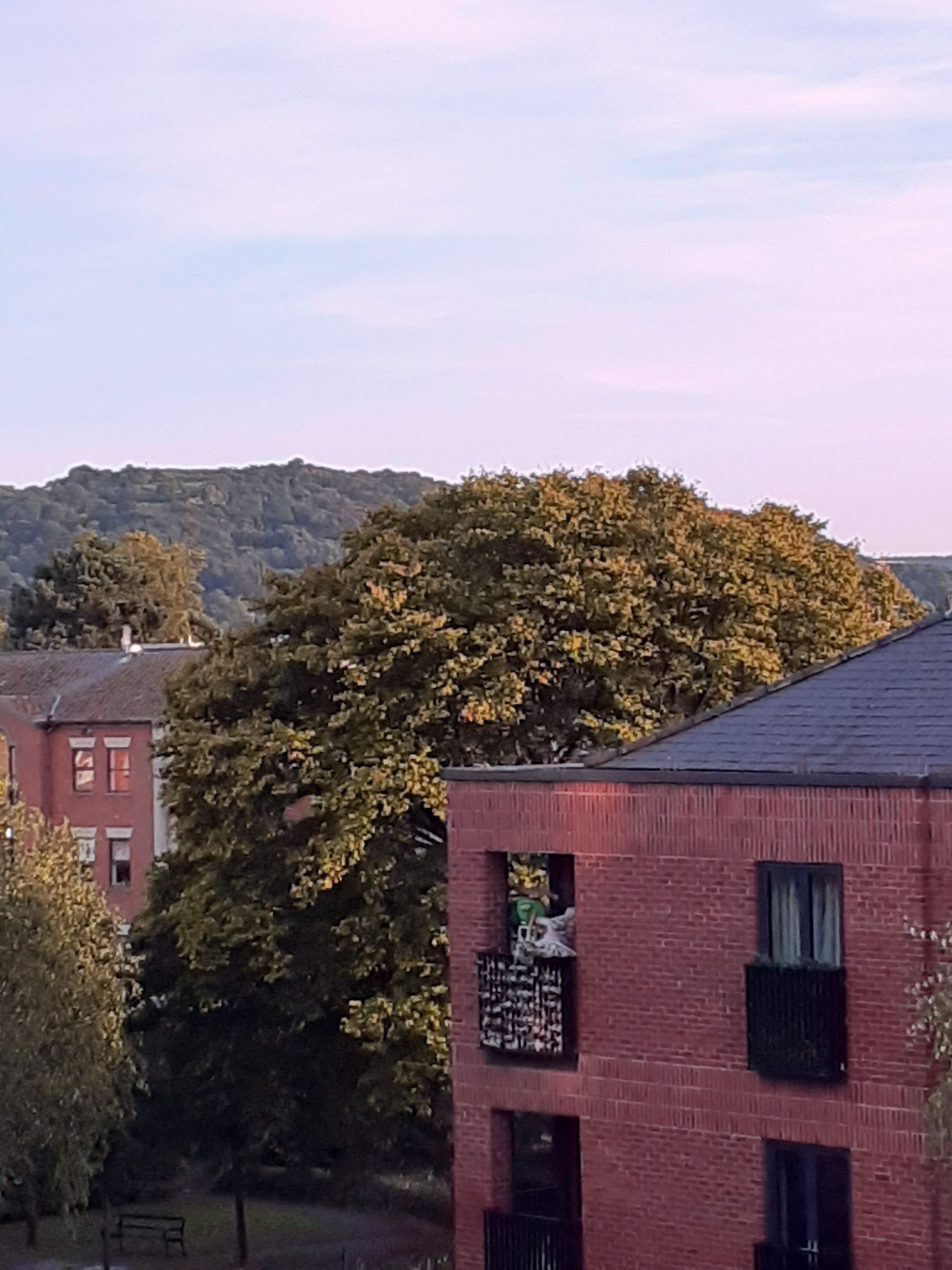
AFTER THE LIGHNING FLASH: A MISTY EQUINOX MORNING

Last Friday afternoon we were at the centre of a big storm. Lightning flashed dramatically just outside our windows. It was scary in the delicious way that can happen when linked to a subjective sense of safety. But we learned later in the day that one of the buildings in our estate had suffered a direct hit which the lightning conductors were unable to hold. There was a leak in the roof and water ran down the stair wells. I understand that the damage is not as severe as it might have been. But is certainly compromises any sense of immunity. It could have been worse and it could have been us.

Now it is Sunday 22 September, generally marked as the Autumn Equinox in these parts. I am in a familiar space (1) but experiencing it in another way. The current clock time is about 7.45 am (an hour after sunrise) and I’m looking out on a distinctly misty morning. The background wooded hills are very sketchy. True, there is clear light and shade in the foreground and I feel calm after a time of storm and rain. But they will likely be back soon. The mist and murk in the east suggest that anything could emerge from the most benign of spaces: the world reveals itself as volatile and shifting.

This is not an exclusively equinoctial phenomenon, but I have always linked the equinoxes – especially in autumn – with this kind of dynamic mutability. The Lightning Flash is a great archetypal symbol, not least for Druids. In antique theory, we are supposed to be able to summon them, though I’ve never tried it myself. I do know how to find the opportunity in disruptive change, though at this time of my life I have ceased to look for it. I much prefer the calm.

(1) See: https://contemplativeinquiry.blog/2024/09/17/poem-at-the-beginning-of-sunset

POEM: AT THE BEGINNING OF SUNSET

Looking out

from my apparently restricted life

I see the wide world,

expectant.

It is the beginning of sunset,

a critical moment

in the wheel of the day.

Facing east,

I have the sun behind me

still with some warmth –

but on the brink

(I know)

of accelerated descent.

My eastward vision embraces

pale blue sky

pink clouds

wooded hills,

and a residue of sunlight

on the majestic hornbeam

whose leaves have begun to turn.

Early autumn, early evening:

a whole world in seeming suspension

between one state and another.

The wheel turns

through both day and year.

States are not fixed

at any point in time.

Yet to notice the moment

with softened heart

and strengthened sight

makes that moment eternal.

Looking out

from my apparently restricted life,

I see the wide world,

expectant.

AN TUAGH: HELVEGEN

An Tuagh celebrate early Norse as well as Gaelic traditions in northern Scotland. Not only Orkney and Shetland, but also the Western Isles and part of the Scottish mainland were officially in Norway for over two centuries in the early middle ages. Above is the An Tuagh version of Helvegen, featuring the voice of Chris Corrigan.

In an An Tuagh Facebook post on 20 march 2024, and also in a note appended to their YouTube video, Corrigan explains: “Bards and Skalds of ancient times sang songs for others’ birthdays, weddings, funerals and everything in between. This song asks a then pertinent question. Who will sing me (the bard) over to the other side when it is my turn to pass over?” Corrigan’s post includes a personal dedication and Norwegian and English versions of the lyrics.

A chill in the air today reminded me of Helvegen. In April of this year I posted An Tuagh’s version of The Song of Amergin in Old Irish (1). Here I add a representation of the Norse aspect of Scottish tradition as well, though Helvegen is not itself an old song. It was written by Einar Selvik in modern Norwegian in 2013, but using traditional themes. It became widely known through its appearance in the Vikings TV drama series on Netflix.

(1) https://contemplativeinquiry.blog/2024/04/14/an-tuagh-song-of-amergin/

SWEET SUCCESS

The picture* shows Waterstones in Gloucester, not far from where Elaine and I live. It’s a well-stocked bookshop on two levels. The upstairs includes a cafe. Before Elaine’s hip fracture in April (1,2,3) and its attendant complications, we were frequent visitors. The cafe offers good coffee. It is a pleasant place to be. It hosts both a writers’ group and a book group that we have attended.

Waterstones has been out of bounds to Elaine, and effectively me, since April. Elaine was completely house-bound until the middle of August. Even then, we worried about whether her wheelchair would fit the door of the lift giving access to the upper floor. Would the formal ‘accessibility’ option lead to actual access? I measured the breadth both of Elaine’s wheelchair and the lift doorway. The distances were bothersomely similar, and this had a slightly inhibiting, effect. We didn’t want drama or disappointment.

But on Saturday, 8 September, we lost our hesitation. We wheeled boldly into the shop and put the lift to the test. Lining the chair up carefully, we ascended to the top floor. It was indeed a tight fit, but doable, which is what matters. We reached the cafe, and had our first coffee out together for a long time, happy in the familiar atmosphere of a favourite haunt, knowing too that we would be able to attend its meetings and events. A sweet success!

(1) https://contemplativeinquiry.blog/2024/06/27/elaine-knight-haiku/

(2) https://contemplativeinquiry.blog/2024/05/25/festive-moment/

(3) https://contemplativeinquiry.blog/2024/05/12/unsought-journey/

*Picture from Google Maps.

WHAT’S MY NAME?

It is September. I am thinking about my Druid name Muin (blackberry). The plant is flourishing as it always does when given half a chance. But the fruits are less plentiful now and fairly small: thin pickings for the wayside walker. In the human world, we have largely moved on to the making of jam and wine from our existing harvest.

Today, I am thinking about my psychic and imaginal connection to Muin, and why I am standing by this name. For me, a Druid name is neither an alter ego nor a simple add-on to my other names. It is the name that calls me into my Druid identity and practice. In this context, I ask myself: as Muin, who am I? what do I stand for? who might I become? As I asked these questions in an imaginatively opened state, these lines came up. In a way, I believe, Muin is talking to James, whilst being an aspect of him (me) and anyone else who wants to listen.

Muin is my name.

I am blackberry:

bramble, fruit and wine.

I have deep roots

unseen by the outward eye.

I run riot underground.

I am an ogham letter,

Linked to ancient knowledge,

And bearer of underworld wisdom.

I am a guardian,

My barriers and boundaries

Snare the unwary.

Protecting great treasures

They sharply test

The unprepared.

Lucifer fell on me,

Hurled from high heaven.

Rough landing indeed.

But the heaven-referenced war

Of this light-bearer outcast

Is not my concern.

I am fruit of the fair folk,

Crushed for your drink,

As an offering to you:

A gateway to Seership

If you dare accept me

At the right time.

I am blackberry:

bramble, fruit and wine.

Muin is my name.

Earth Eclectic

music that celebrates Earth and speaks to the heart

Sarah Fuhro Star-Flower Alchemy

Follow the Moon's Cycle

Muddy Feet

Meeting nature on nature's terms

Rosher.Net

A little bit of Mark Rosher in South Gloucestershire, England

Becoming Part of the Land

A monastic polytheist's and animist’s journal

selkiewife

Selkie Writing…

Charlotte Rodgers

Images and words set against a backdrop of outsider art.

Prof Jem Bendell

living with metacrisis and collapse

Towint

The pagan path. The Old Ways In New Times

The Druids Garden

Spiritual journeys in tending the living earth, permaculture, and nature-inspired arts

The Blog of Baphomet

a magickal dialogue between nature and culture

This Simple Life

The gentle art of living with less

Musings of a Scottish Hearth Druid and Heathen

Thoughts about living, loving and worshiping as an autistic Hearth Druid and Heathen. One woman's journey.

Wheel of the Year Blog

An place to read and share stories about the celtic seasonal festivals

Walking the Druid Path

Just another WordPress.com site

anima monday

Exploring our connection to the wider world

Grounded Space Focusing

Become more grounded and spacious with yourself and others, through your own body’s wisdom

The Earthbound Report

Good lives on our one planet

Hopeless Vendetta

News for the residents of Hopeless, Maine