I first registered Contemplative Inquiry on 28 August 2012 and WordPress have sent me 12th anniversary greetings. That’s a long-term project by my historic standards. True, the first two years were tentative and I took an 8 month break in 2018/9. But my contemplative inquiry, both as blog and as practice, now feels like a settled part of my life. I continue to ground it in a form of modern Druidry with, Janus-like, both pagan and universalist faces.
Through my inquiry, I came over the years to understand myself as, at heart, ‘living presence in a field of living presence in a more than human world’. This may sound like something of a formula, but it is at least my own formula, providing a compressed account of my experience and understanding, It is not connected to any particular belief system, and arose through a simple recognition of what seems to be given to us, in joy and sorrow alike.
When I open and deepen to living presence, a gestalt of self-and-world, not just self, reveals itself in a sometimes transfiguring way. It is not complicated to practice or experience. In consequence I have found myself nudged, however haltingly, towards a spirit of openness, an acceptance that nothing stays the same, an ethic of interdependence and a life of abundant simplicity.
I no longer think of the inquiry as a path or journey. It is more like a deepening, or maturation, in place. Looking back at early blog posts I find seeds of my current view right at the beginning of my inquiry. As early as 2 September 2012 I wrote about Satish Kumar’s experience (1,2) of outdoor walking meditation. It made a strong impression on me. The difference today is that I have internalised it and given it my own unique flavour. This year I celebrate a clearer understanding and a more confident voice. I am grateful both to influences like Satish Kumar and to the version of me who launched this inquiry twelve years ago..
After a grey and stormy day came a grey and calm sunset. Facing west, I looked up at the sky. I began to contemplate the clouds and the muted influence of the sun.
As this skyscape became my world, the solid earth became a distant rumour. Physical reality became porous, indefinite, and insubstantial. Dissolving into this space, I briefly became part of it, no longer an external observer. This experience was fleeting in time-bound reality but imprinted itself on my memory.
Then a seagull seemed to emerge out of nowhere, a dynamic edge of creative light shimmering about its newly-minted form. For me this moment was both grey and luminous, filled with subtle light.
The bird embodied a tremendous joy in flying, with an elegance not seen on the roof tops or the ground. It flew fast and I didn’t see it for long. After its disappearance I noticed how easy it was to enjoy a grey sunset that I might otherwise call gloomy.
Every year is unique and I wondered, then, whether the summer of 2024 was breaking up early in my neighbourhood. As I write, on a rainy morning two days later, this remains an open question.
The wheel continues to turn, and I find myself turning to the west, leaning into autumn, embracing this season for what it uniquely is. It is much more than a precursor to winter. Autumn has tended to be my favourite season and the one I find the most conducive to contemplative and visionary states.
In recent days, I have felt, as much as seen, the retreat of daylight in the evenings. It comes earlier and seems more decisive as the year advances. Mostly, indoors, it has led to a soft and gradual increase of dimness and shadow. I often find this pleasurable and delay resorting to artificial light.
But on Friday 16 August I was caught unawares. I had not been paying attention and it felt as if Night had truly fallen for the first time in my waning year, suddenly and assertively. It wasn’t even fully dark, yet I sensed that Night now ruled.
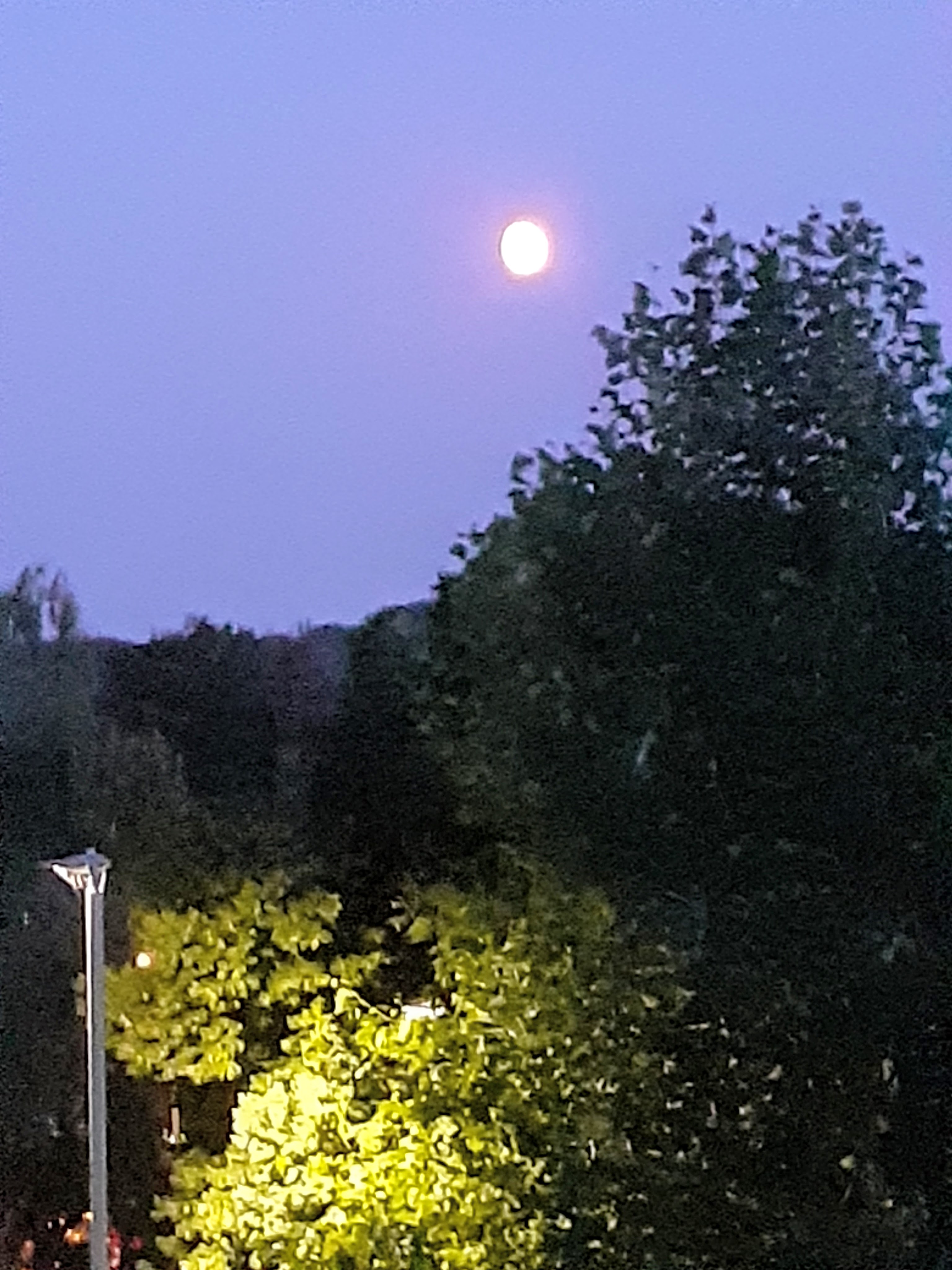
I felt that I was mobilising for a different life. A nocturnal life. To an extent, a lunar life. Standing on an east-facing balcony, I found deep twilight presided over a by a waxing gibbous moon – a super moon, close to the earth, only three days before full.
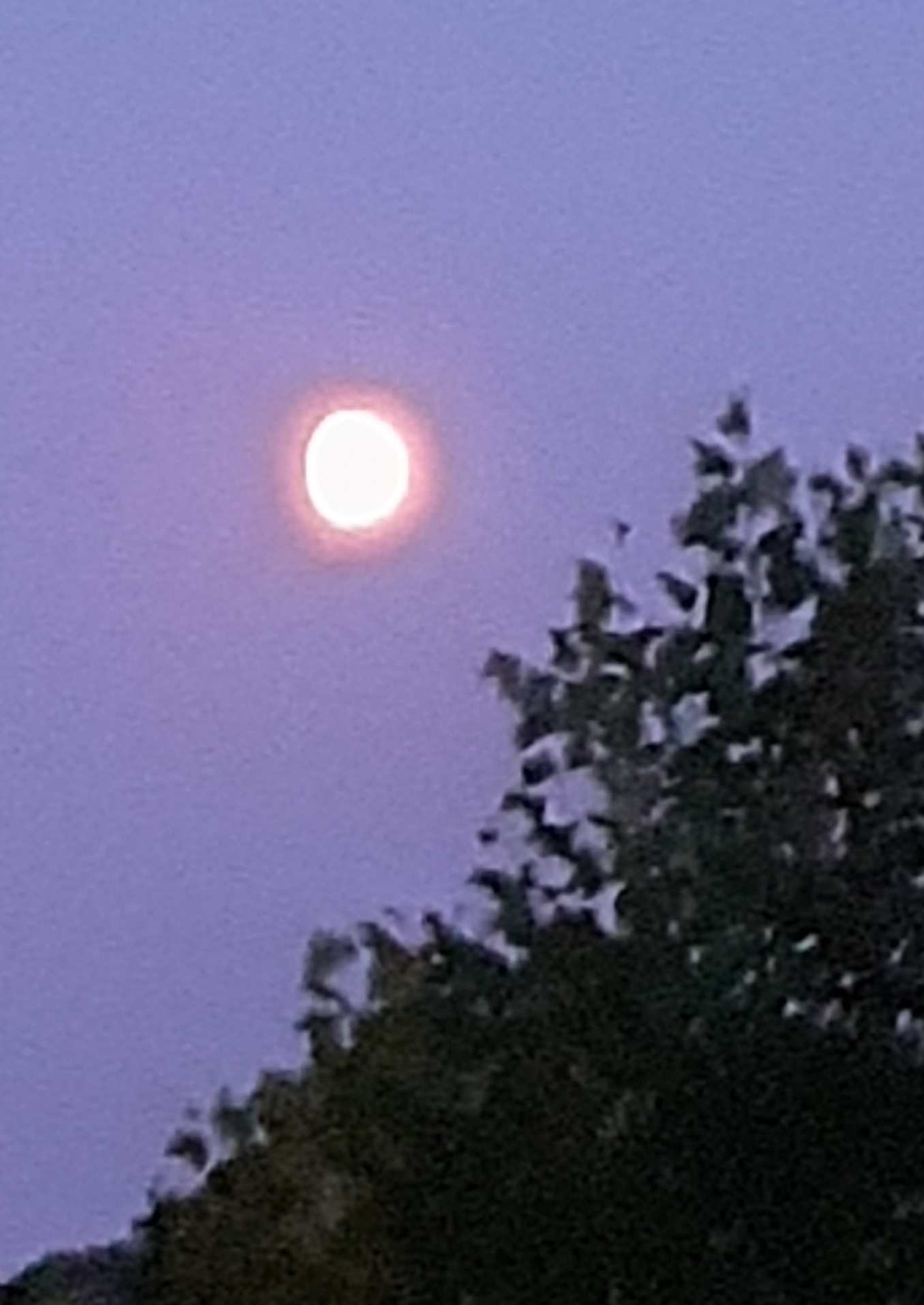
In the picture above, a street lamp seems to compete in brightness. But as I stood in my balcony it was the moon that drew my eye. Its influence was so much greater. The moon persuaded me to take the picture. Indeed I took a second picture (below) of the moon as the only light source. I needed the “radiance of moon” (1) to stand out clearly, in full contrast to the “light of sun”.
Night isn’t just about darkness. It’s about the world that emerges when the sunlight withdraws. Just over a month before the autumn equinox, I have tasted the ‘dark’ half of the year.
(1) From the St. Patrick’s Prayer/Cry of the Deer: “I arise today through the strength of heaven, light of sun, radiance of moon, splendour of fire, speed of lightning, swiftness of wind, depth of sea, stability of earth and firmness of rock”. I begin and end my regular morning practice with these words.
As the harvesters shout when their last leaf is cut;
‘I swim with the salmon says the Green Man,
‘I swim with the salmon’, says he.” (1)
‘I swim with the salmon’ is a bold, clear statement. It evokes powerful images that leap out of their place in the flow of William Anderson’s poem. Green Man as a whole takes us on a wheel-of-the-year journey beginning on 22 December, successively featuring thirteen trees for four weeks each. The hazel is the ninth tree, whose time runs from 3-30 August. As the poem indicates, this is a harvest period, and the last month that fully belongs to the summer. It is also a time when you may find Atlantic salmon swimming home to spawn, though spawning doesn’t begin until October.
In this post I celebrate salmon naturalistically, through an account of their extraordinary life cycle. I am especially aware of the River Tay in Scotland, mostly thanks to a 90 minute documentary The River: a Year in the Life of the Tay (2). My personal experience of the Tay is limited to visits to Dunkeld, Perth and Dundee, where I nonetheless fell in love with the river and its powerful energy.
Salmon begin their lives in mountain streams, as far upstream as their parents have been able to reach in their autumn/early winter spawning period. The new generation undergoes a remarkable series of transformations (3), hatching as alevin or sac fry when the water warms in spring, and growing into parr with camouflaging vertical stripes. They remain in the same environment for two or more years, by which time, as smolts, they have developed a bright silvery colour with scales that easily rub off. Driven by growth hormones, the 10% of smolts who survive to this stage experience the mutations necessary to become salt water fish and make their journey to the ocean.
They spend another two or more years in the North Sea, travelling north into Norwegian waters, becoming sexually mature, with a darkening of the silvery scales, before embarking on their homewards 120 mile journey up the river to its headwaters. They are much larger than they were when on their way out. The largest salmon ever caught in the Tay, in the 1920’s, was over five feet long.
To return to their own birth-place (remembering exactly where they come from) they have to navigate waters that include rapids and waterfalls, evade osprey and human anglers, and achieve the feats of leaping for which they are famous. “The salmon is able to jump upstream not by fighting against the current, but by utilizing its knowledge of the reverse current which flows beneath the surface current” (4). They are returning to their native headwaters in order to spawn and begin the cycle again. 98% of Atlantic salmon spawn only once and die soon afterwards: their adult bodies, equipped for a salt water life, never fully re-adapt to fresh water and this makes them vulnerable.
Swimming with the salmon is not for the faint-hearted. At the present time the population of Tay salmon is in severe decline (70% in the 30 years to 2019) although the river is relatively clean and is now managed to prevent over-fishing. The effects of the climate crisis in the Atlantic are the most likely cause for the decline of Tay salmon, as for Atlantic salmon in general. Yet even in decline they remain magnificent. Long before the Celtic Iron Age, during it, and for long afterwards, they were abundant in the rivers of Britain, Ireland, and other Atlantic maritime countries. With their complex shape-shifting capacity, their far-journeying years at sea, their uncanny homecoming knowledge and their extraordinary leaps, they seem marked out for another life, in human song and story. I would like to think that the salmon’s mythic reputation can help to save it in this interconnected world.
(2) The River: A Year in the Life of the Tay 90 minute documentary made for BBC4 in 2019. Presented by writer and naturalist Helen MacDonald. See: https://youtu.be/ZEmAXQIrDeg?si=wlaI0bNtM6YWevAf The film is well worth watching, covering the journeys of the salmon and much more.
(3) Salmon Wikipedia
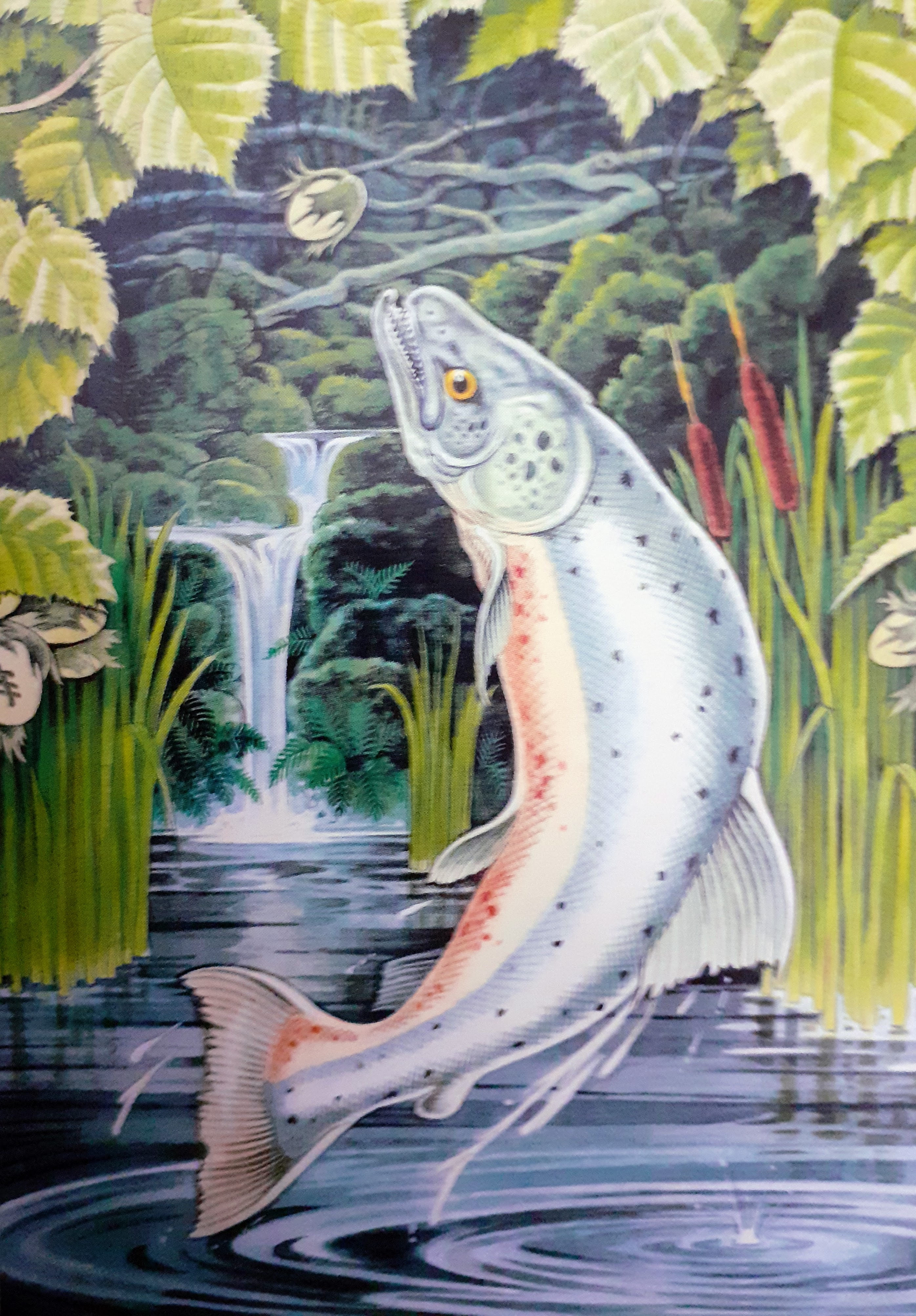
(4) Philp and Stephanie Carr-Gomm The Druid Animal Oracle: Walking with the Sacred Animals of the Druid Traditions Fireside: London, 1994 Illustrated by Will Worthington. The face of their salmon card is pictured at the top of this blog.
My contemplative inquiry requires a “vulnerability of openness” as part of its process (1). For it is based on personal experience rather than theoretical knowledge. If I want to build an ecology of awareness, language and conceptual thinking are not enough. I need to be attentive to the whole of my living experience, including my body’s wisdom, my feelings, my contemplative states and my imagination. I am a living presence in a field of living presences, in a more than human world. My inquiry is really about how best to be awake and flourishing in this field.
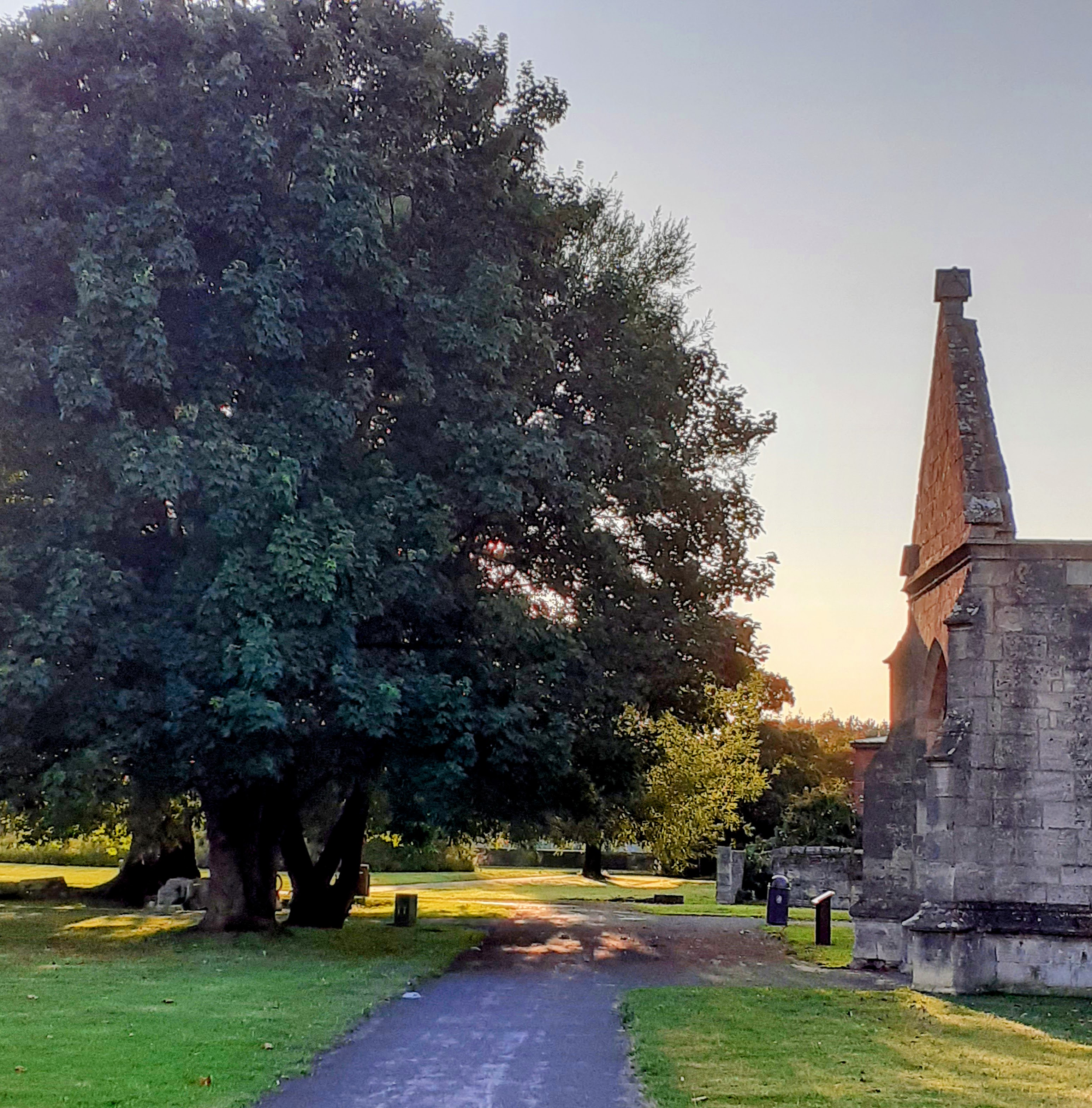
Vulnerability of openness is of course not the whole story. It is the yin aspect of an inquiry process that also has its yang. In a recent post (2) I wrote: “My walking time is still restricted. Perhaps because of this, familiar outdoor spaces have become exotic and magical to my eyes. My limiting circumstances are paradoxically making me more focused and attentive, enhancing my felt quality of life. I am readier to find joy in simple, passing experiences.”
This suggests that ‘magical’ experiences, even when apparently unwilled, are enhanced by focus and attention. Agency and will are part of the process too. Language and concepts allow me to bear witness to my unfolding experiences. But for me, without the vulnerability of openness at its root, the entire process is greatly diminished.
(1) Peter Reason (ed) Participation in Human Inquiry London: Sage, 1994
NB Participative inquiry involves groups working together in a collective research process.. But for Reason, the term ‘participation’ refers more fundamentally to human participation in the world: he uses it to challenge the widely assumed primacy of language and conceptual thinking in human experience.





 Contemplative Inquiry