Contemplative Inquiry

This blog is about contemplative inquiry

Month: January, 2024

HOW WE INTERPRET PAIN

Atul Gawande’s Being Mortal: Illness, Medicine and What Matters at the End (1) is about life when independent living is no longer an option, and also about the end-game. I intend to review the book fully in a later post. Here, I have extracted a passage about how we evaluate the experience of pain and suffering, and how they vary according the the stories we tell about ourselves and our lives. The author draws on his experience as a physician, a teacher and a family member.

“The brain gives us two ways to evaluate experiences like suffering – there is how we apprehend such experiences in the moment and how we look at them afterward – and the two ways are deeply contradictory. … People seem to have two different selves – an experiencing self who endures every moment equally and a remembering self who gives all the weight of judgement to two single points in time, the worst moment and the last one.

“The remembering self seems to stick to the Peak-End rule even when the ending is an anomaly”. In a hospital-based experiment (2) “just a few minutes without pain at the end of their medical procedure dramatically reduced the patients’ overall pain ratings even after they’d experienced more than half an hour of high level pain. ‘That wasn’t so terrible,’ they’d reported afterward. A bad ending skewed the pain scores upwards just as dramatically. …

“Research has also shown that the phenomenon applies just as readily to the way people rate pleasurable experiences. Everyone knows the experience of watching sports when a team, having performed beautifully for nearly the entire game, blows it at the end. We feel that the ending ruins the whole experience. Yet there’s a contradiction at the root of that judgement. The experiencing self had whole hours of pleasure and just a moment of displeasure, but the remembering self sees no pleasure at all.

“If the remembering (or anticipating) self and the experiencing self can come to radically different opinions about the same experience, then the difficult question is which one to listen to. …. In the end, people don’t view their life as merely the average of all of its moments – which, after all, is mostly nothing much plus some sleep. For human beings, life is meaningful because it is a story. A story has a sense of a whole, and its arc is determined by the significant moments, the ones where something happens. Measurements of people’s minute-by-minute levels of pleasure and pain miss this fundamental aspect of human experience. A seemingly happy life may be empty. A seemingly difficult life may be devoted to a great cause. We have purposes larger than ourselves. Unlike your experiencing self – which is absorbed in the moment – your remembering self is attempting to recognize not only the peaks of joy and valleys of misery but also how the story works out as a whole. That is profoundly affected by how things ultimately turn out.”

(1)Atul Gawande Being Mortal: Illness, Medicine and What Matters in the End London: Profile Books in association with Wellcome Collection, 2014 (UK edition)

(2) NOTE: Gawande describes research by Daniel Kahneman and Donald Redelmeier involving 287 hospital patients who underwent colonoscopy and kidney stone procedures while awake. The patients were given a device that let them rate their pain every sixty seconds on a scale of 1 (no pain) to 10 (intolerable pain), a system that provided a quantifiable measurement of a moment-by-moment experience of suffering. At the end the patients were also asked to rate the total amount of pain they experienced during the procedure. The procedures lasted anywhere from 4 minutes to more than an hour. The patients typically reported extended periods of low to moderate pain punctuated by moments of significant pain. A third of the colonoscopy patients and a quarter of the kidney stone patients had a pain score of 10 at least once during the procedure. Patients’ final ratings were not based on the whole experience and its duration but by what Kahneman called the ‘Peak-End rule’, an average of the pain experienced – the single worst moment of the procedure and the very end. This research is described in Daniel Kahneman’s book Thinking Fast and Slow.
UNFREEZING (SLOWLY) IN WINTER SUN

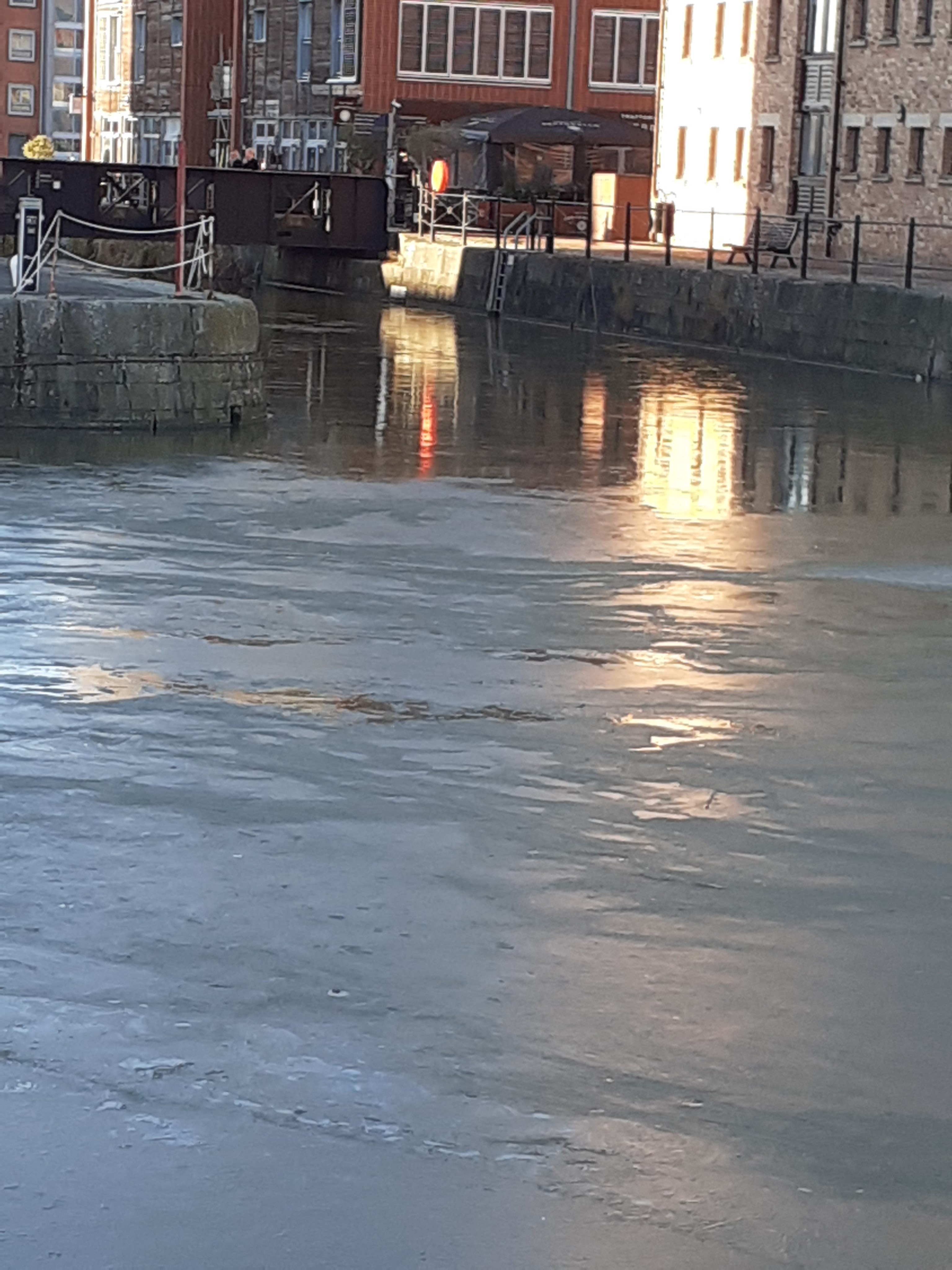
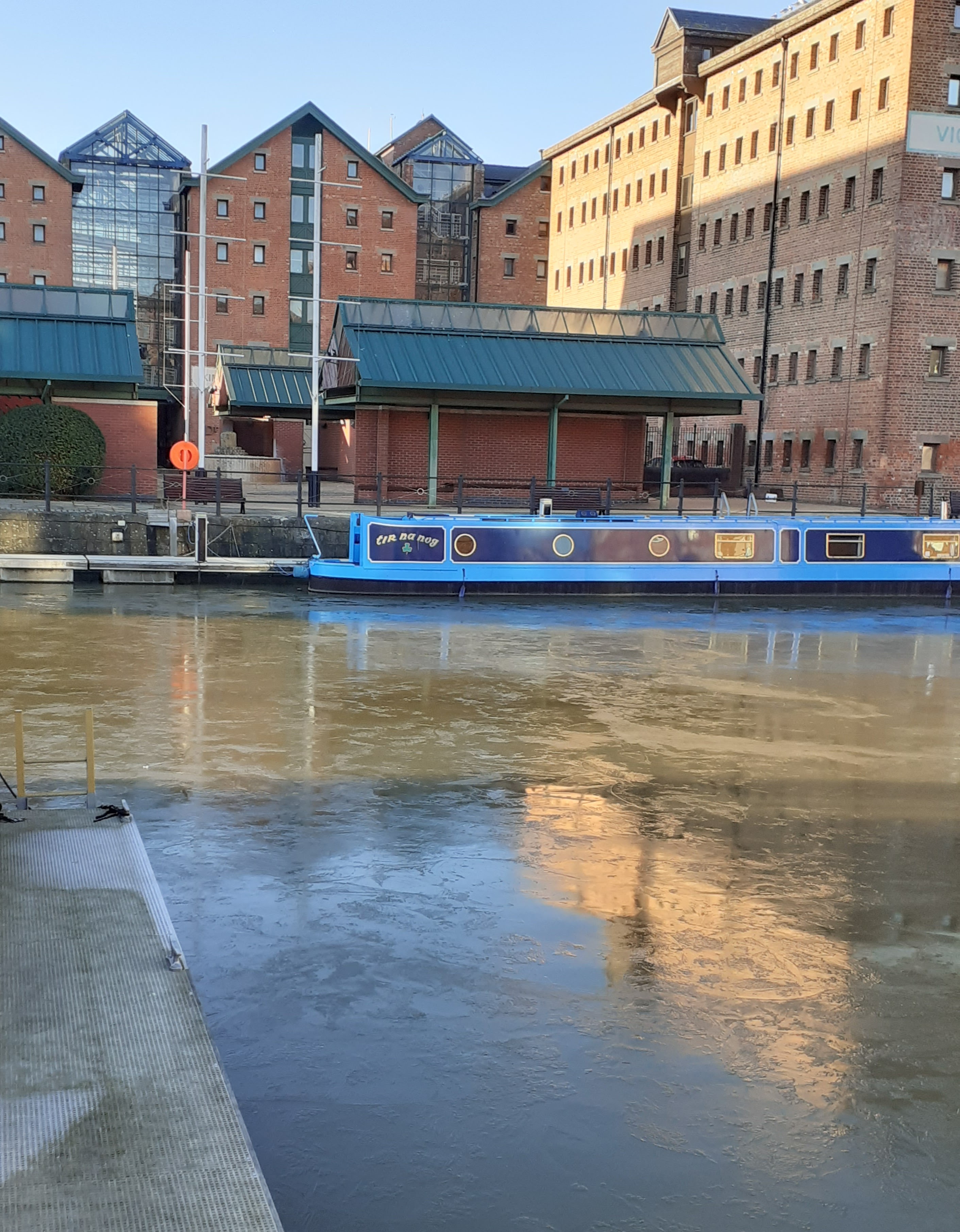
Yesterday – 3.30 pm or so – I was walking home swiftly from a shopping expedition. I was slowed down and halted by the water in Gloucester docks. It drew my eye and asked for a closer look. It had clearly been iced up in the previous cold night, and had been slowly melting in this bracing but above-zero day.

The sky is clear and I experience a strengthening sun now. I recollect that we are now several weeks beyond the solstice. The balance of light, shade, stillness and fluidity sends me into a more deeply meditative state, entirely trumping my original sense of domestic mission and wanting to be home.

Ice and water are made of the same stuff, manifesting in different ways. The patterns on the surface look still but tell a story of transformation – here, from fixed to free. Another drop in temperature could easily end and indeed reverse this process. In this space I see the same essence adopting different forms under different conditions. But here the change is gentle. The contemplative moment extends itself. I am open to the magic of nature. In such beauty, I find peace and stillness within my own being.

POEM: SUCH A LONG JOURNEY

We had a theory. It meant travelling westward.

At first, simple. We each had resources.

We lost most of them on the Straits of Hormuz;

our boatman betrayed us to pirates.

Perhaps that was the moment to turn back

after we’d bargained our release for gold and incense

leaving only a few coins sewn into an old hat.

But we had come so far

          and a theory

can become a story you would wander the world to tell.

We were in trouble, sometimes, misunderstood,

always there for each other – always walking westward,

taken on by an Ethiopian eunuch, even though by then

only one of us was fit to work – slipping away

by night when we sensed we were near.

He was a philosopher and carried his own coffin;

we raided it for myrrh. Took millings

from the edge of one of his ingots,

saved a last joss-stick. We had read our Isaiah.

And we had a theory

that a some place under a setting star

three gifts could be exchanged for peace

passing all understanding. What we ended up giving

were some much-needed hints on run-routes

for a family of refugees.

From the collection Losing Ithaca by Christopher Southgate Nottingham: Shoestring Press, 2023

In the Christian year, the twelve days of Christmas are over. 6 January is the festival commemorating the Epiphany, the manifestation of Christ to the the three Magi, the wise men from the east who came to pay homage to him. Their story is told in the Gospel of Matthew Chapter 2, verses 1-12.

Christopher Southgate is described as “a bio-chemist, a house-husband, a chaplain in university and mental health contexts, and a teacher of theology. He lives with his wife Sandy on the edge of Dartmoor and works at Exeter University”. Elaine and I attended an event at Gloucester Cathedral on the evening of 6 January this year, where he read a selection of his poems, naturally including this one.

The title references T. S. Eliot’s poem on the same theme, Journey of the Magi, but in other ways I find them very different. Southgate’s companions-with-a-theory have a considerably harder time than Eliot’s magisterial Magi. They arrive like refugees and meet with a family about to become refugees. Matthew describes King Herod’s efforts to eliminate any potential rival, as he sees it, to his throne, and the families’ consequent flight to Egypt.

I like the way in which Southgate shows how a somewhat transactional attempt at acquiring a “peace passing understanding” runs up against the realities of the world we live in. I also like the way he doesn’t invalidate the companions’ intent or their journey. They still had a gift to offer, sharing their experience and opening their hearts. Peace was present in that shared space.

2024: INQUIRY AT THE DAWN OF THE YEAR

It is 3 January 2024, around 8.30 am. I repeat my best wishes to all readers for 2024 from inside the new year, as it begins to unfold. I contemplate the sky, uncertain about what this new year may bring. At some level I feel open and uncluttered, free of over-determined intentions. It is as if I have surrendered to a current.

My Contemplative Inquiry, once a formal structured project, has gradually evolved into a simpler and more natural-seeming contemplative inquiry in no need of capitalisation. This inquiry is wired in, no longer in need of much external input or formalised internal effort. I am aware of owing a debt to the formal structured project, with its inputs and efforts, for it enabled this evolution to occur.

The result of the early, more formal, years is recorded in my ABOUT section. It was simultaneously a gnosis and the discovery of a place to stand that felt right and made sense. “My inquiry has been a pathway to greater understanding, healing and peace. In the contemplative moment,  I am living presence in a field of living presence, at home in a living world. This is not dependent on belief or circumstance, but on the recognition of what is given, joy and sorrow alike. I find that this simple recognition moves me towards a spirit of openness, a fuller acceptance that nothing stays the same, an ethic of interdependence and a life of abundant simplicity”. My inquiry today is about deepening, and living more congruently and confidently from this place. It is part of me now, and I foresee no end.

Earth Eclectic

music that celebrates Earth and speaks to the heart

Sarah Fuhro Star-Flower Alchemy

Follow the Moon's Cycle

Muddy Feet

Meeting nature on nature's terms

Rosher.Net

A little bit of Mark Rosher in South Gloucestershire, England

Becoming Part of the Land

A monastic polytheist's and animist’s journal

selkiewife

Selkie Writing…

Charlotte Rodgers

Images and words set against a backdrop of outsider art.

Prof Jem Bendell

living with metacrisis and collapse

Towint

The pagan path. The Old Ways In New Times

The Druids Garden

Spiritual journeys in tending the living earth, permaculture, and nature-inspired arts

The Blog of Baphomet

a magickal dialogue between nature and culture

This Simple Life

The gentle art of living with less

Musings of a Scottish Hearth Druid and Heathen

Thoughts about living, loving and worshiping as an autistic Hearth Druid and Heathen. One woman's journey.

Wheel of the Year Blog

An place to read and share stories about the celtic seasonal festivals

Walking the Druid Path

Just another WordPress.com site

anima monday

Exploring our connection to the wider world

Grounded Space Focusing

Become more grounded and spacious with yourself and others, through your own body’s wisdom

The Earthbound Report

Good lives on our one planet

Hopeless Vendetta

News for the residents of Hopeless, Maine