
COLOURS OF AUGUST, 2023
by contemplativeinquiry

The haws are red and shiny on their hawthorn bushes. Blackberry remains tentative, its pale green fruit visible but still unripe. I see green leaves now leaning towards yellow. I am walking in a scrap of local woodland, bounded by a canal* on my left and housing some distance to my right. It is around 7.30 pm on 13 August, and I am opening up to the colours of late summer as they show themselves this year.

Looking up, I see a healthy crop of crab apples at different stages of ripening on their tree. The ripest apples are red, though their red is softer than that of the haws. The leaves of the apple tree are shinier than those in the background. I am aware of a light grey sky.

Nature in various forms finds a niche everywhere. This time has its own flowers, and again I see yellow. I am not the greatest botanist. and I cannot name with certainty these plucky if slightly battered blooms, saying hello from behind a fence. But I imagine them as poor relations of even the lesser celandine, and therefore almost certainly official weeds**. I hope and pray they remain safe here in these woods.
Below, looking at tangled leaves, I find a truly autumnal scene, in the yellowing and browning of leaves. It feels a bit early for this neighbourhood. The wheel of the year is still following its seasonal course, so far, but is becoming more erratic and unpredictable than in the past. I wonder about the future of the jet stream – and indeed the Gulf stream too. But in the moment, my heart opens and I love this pattern of plant life moving through its cycle and gradually, subtly, changing in appearance.

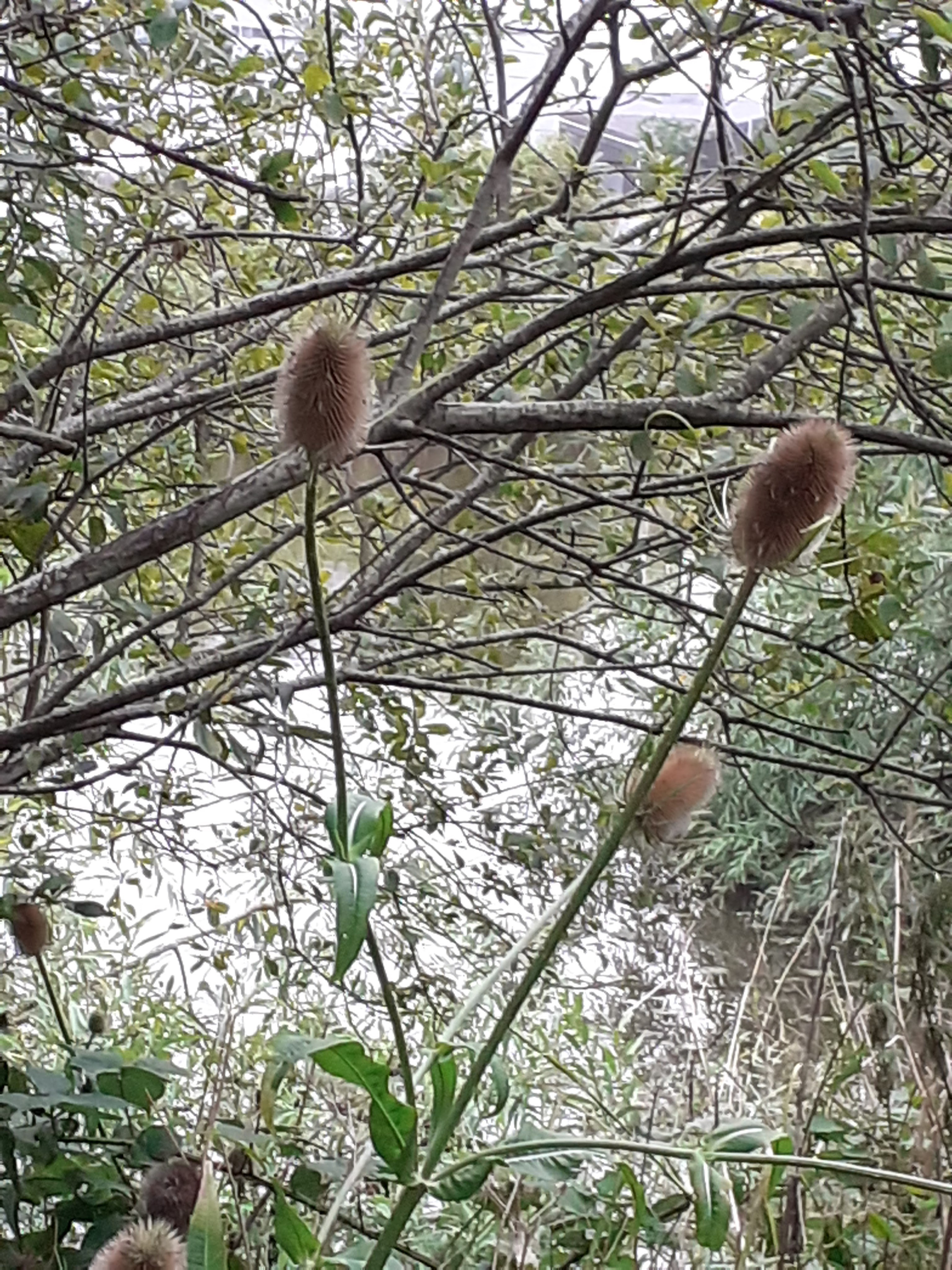
I photograph two teazel stalks, below, because I enjoy their shapes, because they are a further illustration of the browning theme, and also because of the visibility of the canal behind them. They don’t live in the canal, like bullrushes, but they like to be close. The image also includes an almost ghostly barge on the water below.
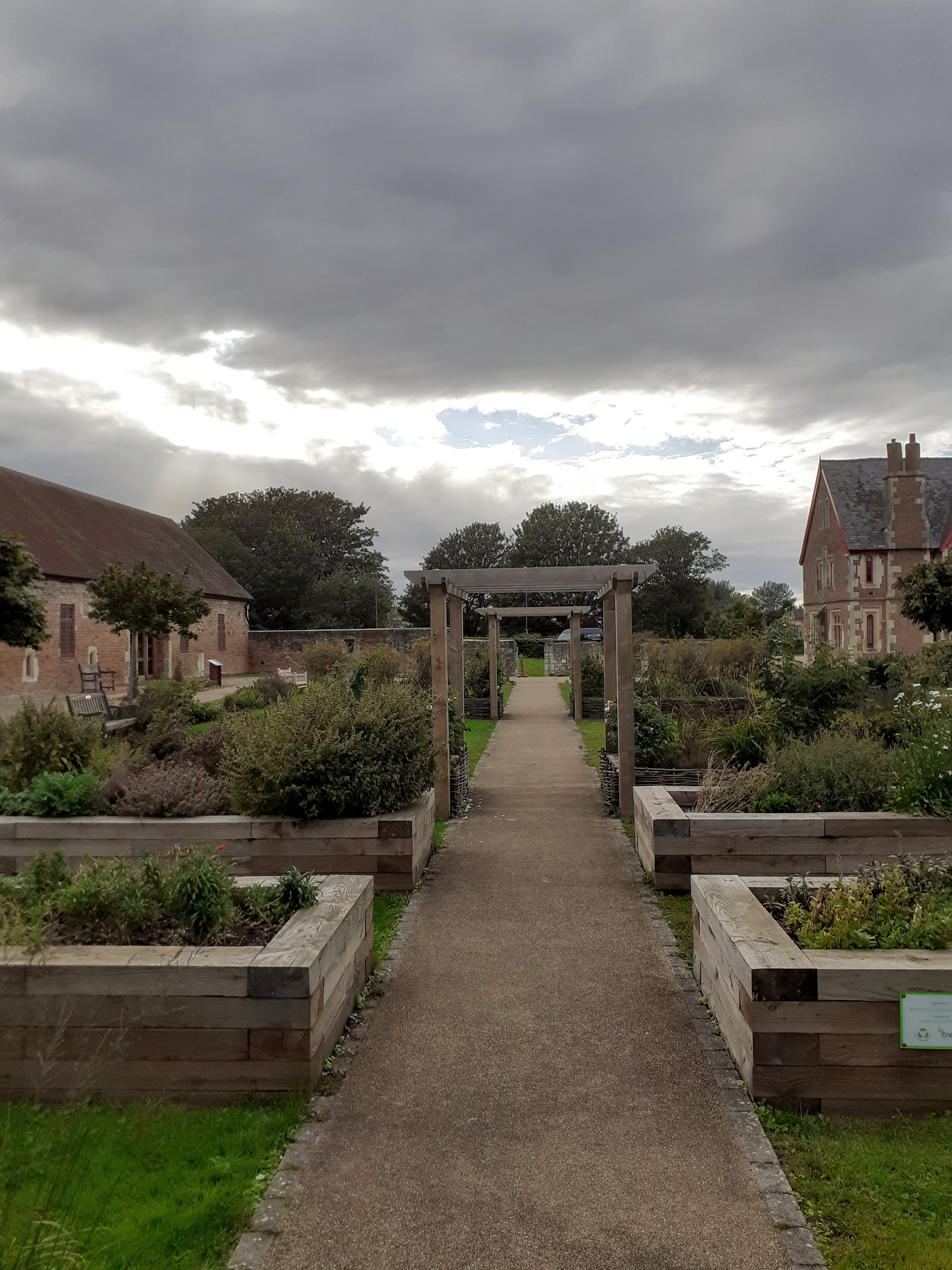
After leaving the woods, I am confronted (below) with the sky. I am facing west, across the Llanthony Priory gardens. I see dark stormy clouds, whose edgy brooding energy is somewhat modified by a blue opening in the distance. This dark grey, and the rain and storm it sometimes brings, have certainly been a feature of summer this year. There’s a strong contrast with last year at this time, when there was a heat wave, which for us still means C 30-35/F 86-95 with anything more being exceptional. In July 2022 part of the country briefly reached over C40/F 104 for the first time since records began. This year the grass is still green. Last year it burned up and the ground was parched and cracked.
Following the wheel of the year carefully, as it turns, is a valuable discipline for modern Druids, among others concerned with deep ecology (sacred ecology?) and the climate crisis. We don’t confine ourselves to celebrating our seasonal festivals, though we enjoy them too. For we now know experientially that the world is changing. The traditional rhythms of nature are not an eternal verity to rely on.
In some ways I find small personal observations emotionally more impactful than my limited knowledge of climate science and deep time geology. These are very helpful for context and framing, but personal experience is more immediate than these. It is also more deeply immediate, though less dramatic and disturbing, than reports of disaster elsewhere. Following the wheel of the year, we are doing more than making observations. We are celebrating and bearing witness to the life that surrounds us, offering our attention and energy to its continued flourishing. Blessings on the land.
*The Gloucester-Sharpness canal, England. Beyond the Gloucester docks, but not yet out of the city.
** A reader comments: “I think your mystery plant is ragwort, a much maligned ‘weed’ the destruction of which is encouraged by the UK government as it can be harmful to grazing animals yet is actually one of the best forage plants for pollinators”.
 Contemplative Inquiry
I love your distinction between a Druidic view of the wheel of the year and changes compared to the climate change overview – small is beautiful and far more pertinent to human lives ‘in the moment’ I believe – (whether it’s small local services like hospitals or individual emotions) – what you observe here is different to my locality where blackberries (brambles up her in Scotland) are ripe but hawthorn are green, where mushrooms are early and abundant this year and trees remain green but grass seeded earlier in July. The world will remain wondrous whether humans grace its surface or not – the Goddess abides… rather like The Big Lebowski…☺️
Thanks for this, and your endorsement of the local view, and how different what’ going on in your locality has differed from what’ going on in mine. I like your last sentence too.
This is a lovely post, James, you capture the beauty and atmosphere of the season perfectly. I agree totally that our personal observations and experiences, immersed in the life around us, are key to a full appreciation of the natural world and less toxic than so many worrying reports (although their content is important, of course). I think your mystery plant is ragwort, a much maligned ‘weed’ the destruction of which is encouraged by the UK government as it can be harmful to grazing animals yet which is actually one of the best forage plants for pollinators. It’s a good thing that particular plant is in a safe place!
Thanks for this comment Lis and the information about ragwort. Having looked it up and seen illustrations, I am sure you are right. It’s great to learn something new in this way. Appreciations!
Thank you again for this wonderful and inspiring post. I learn a lot from you in my efforts to be more mindful (as a druid as well).
Thanks for this supportive comment Raymond.