TREE AT MY WINDOW PICTURES
The cup I talked about in my previous post was made by Jitka Palmer – website http://www.jitkapalmer.co.uk/
Here are some images of the cup:

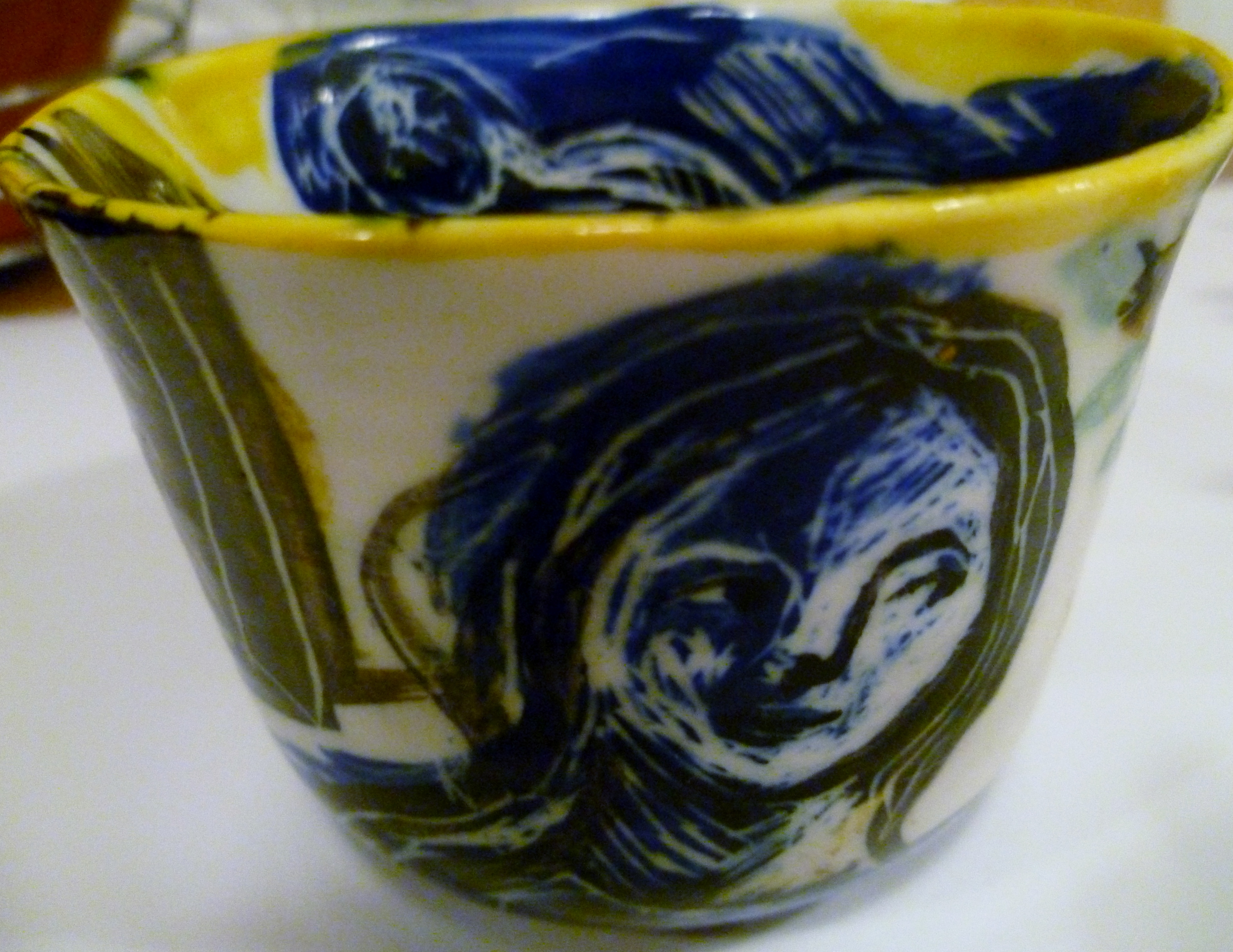
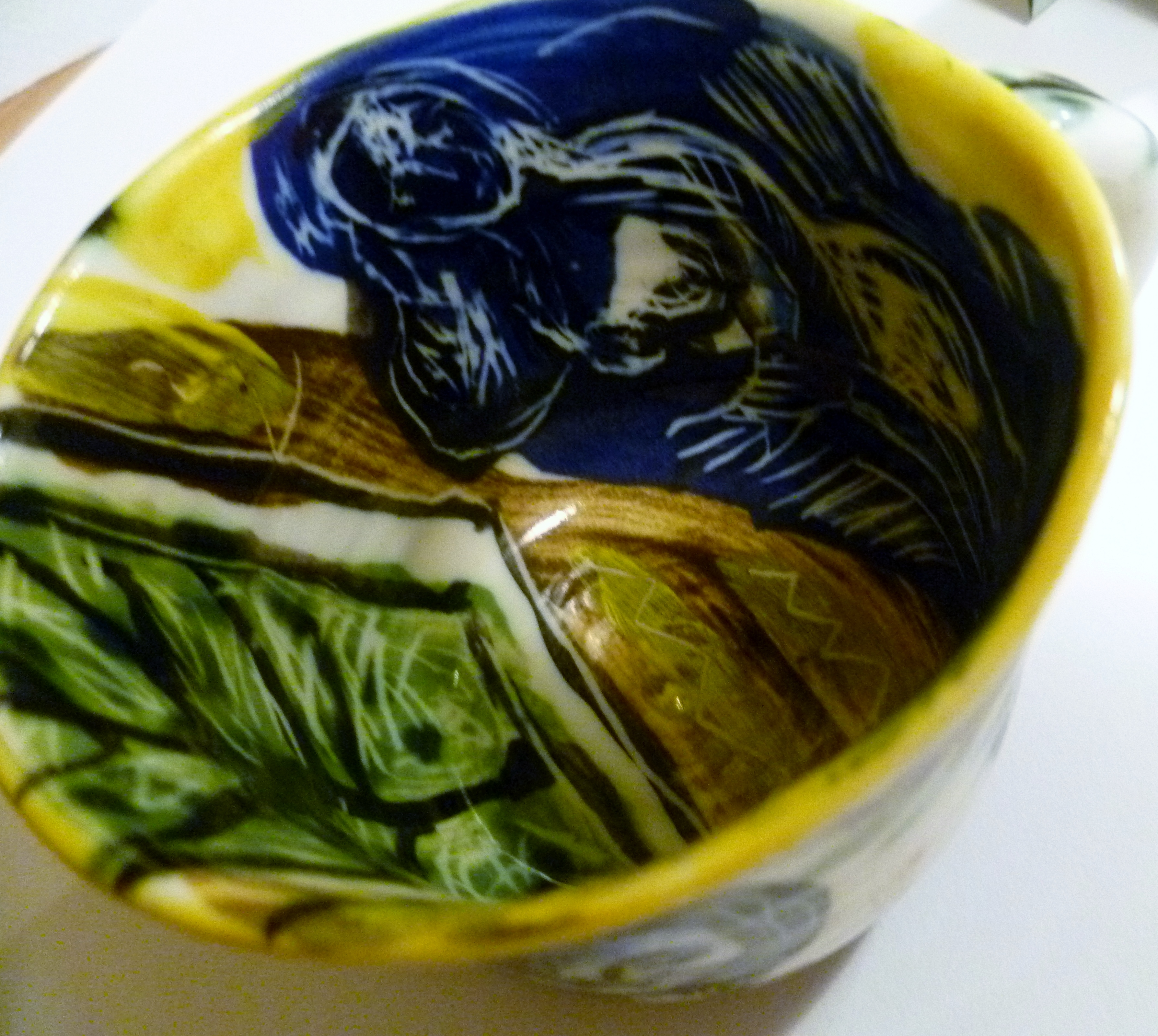

The cup I talked about in my previous post was made by Jitka Palmer – website http://www.jitkapalmer.co.uk/
Here are some images of the cup:
Last Saturday I went with my partner Elaine to an art trail in Bristol – a weekend event in which artists open their homes to the public to look at their work, and special street maps are made to help us find our way around. In one of life’s small magic moments, Elaine discovered a tea cup whose imagery really drew her, by a ceramicist (also sculptor and painter) we were visiting, and I bought it for her. It illustrates a poem by Robert Frost – Tree at My Window.
Tree at my window, window tree,
My sash is lowered when night comes on;
But never let there be curtain drawn
Between you and me.
Vague dream-head lifted out of the ground,
And thing next most diffuse to cloud,
Not all of your light tongues talking aloud
Could be profound.
But, tree, I have seen you taken and tossed,
And if you have seen me when I slept,
You have seen me when I was taken and swept
And all but lost.
That day she put our heads together,
Fate had her imagination about her,
Your head so much concerned with outer,
Mine with inner, weather.
Rosa Davis is a member of our local contemplative Druid group and a mentor for Bards and Ovates in OBOD (the Order of Bards, Ovates and Druids). She is also an artist who works in felt, and she has agreed to let me post one of her images. For our group, the contemplative path very much includes contemplative arts. For many of us it also includes subtle energetics and its poetry.

A weaver by trade but a poet-singer by calling, Kabir lived in fifteenth century India. His philosophy incorporated various beliefs of both Muslims and Hindus and later became one of the major influences behind Sikhism. Like Rumi, further to the west and generations earlier, he followed a devotional and ecstatic path, and like Rumi he was a bridge builder between traditions. The poem below expresses the spirit in his spirituality.
Have you heard the music that no fingers enter into?
Far inside the house
Entangled music – what is the sense of leaving your house?
Suppose you scrub your ethical skin until it shines,
But inside there is no music,
Then what?
Mohammed’s son pores over words, and points out this
And that,
But if his chest is not soaked with love,
Then what?
The Yogi comes along in his famous orange.
But if inside he is colourless, then what?
Kabir says: Every instant that the sun us risen,
If I stand in the temple, or on a balcony,
In the hot fields, or in a walled garden,
My own Lord is making love with me.
Kabir Ecstatic poems Boston, MA: Beacon Press, 1992 (The English translations are free enough for Robert Bly to call them ‘versions by Robert Bly’. There is an earlier set of translations published by MacMillan in New York in 1915 by Rabindranath Tagore assisted by Evelyn Underhill under the title Songs of Kabir – now republished by in the BiblioBazaar Reproduction Series. Whilst I don’t follow Bly in calling the English of the earlier work “useless”, I do find that Bly’s interpretation has more passion and power. The Bly work includes an insightful afterword Kabir and the transcendental Bly by John Stratton Hawley).
 The Awen Alone, by Joanna van der Hoeven, is an economically and elegantly written introduction to modern Druidry for readers with a serious interest in practising. I like the use of awen, Druidry’s subtle magic, as the key word in the title. In the way that the author uses the term, it gets us straight to the point of why we practice.
The introduction skilfully builds rapport by bringing us into the rhythm of a normal working day. Only it isn’t quite everybody’s normal – it’s a reframed normal for a re-enchanted world and an intentional relationship with it. Joanna starts, in a matter-of-fact way, with a “Hail to the Day and Days Sons; farewell to Night and her Daughters” and ends with “Farewell to Day and Day’s Sons; hail to night and her Daughters”. In between, there are grumbles about the price of ethical toiletries alongside an affirmation of their value; a commitment to emotional intelligence amidst the stresses of working life, a noticing of what is going on in the landscape whilst travelling and in the garden at home, a soft threshold prayer to Nemetona, Lady of the Sanctuary, and a period of formal meditation.
The messages I would get from this as an inquiring reader are the intended ones. Druid life is shown to be the same life as anyone else’s, albeit lived with a distinctive quality of wonder and attention. Moreover, it is entirely possible to live such a life without being part of a Druid community.
The book is carefully structured into three parts.
All of this work is well presented and gives a good overview of the way many Druids today think and practice. For me however, the really distinctive feature of this book is its discussion of awen. Awen is classically thought of as creative inspiration in a sudden, lightning flash form. But Joanna links awen, as inspiration, to the breath. The air we breathe is all around us. We take it in and give it back, a little bit changed. “The inspired Druid exhales the inspiration gained”. Awen is right here, in the web of what is, inherently present in the communication and relationships which make our interdependence work, enabling our creative choices and their results. For Joanna, awen is therefore linked also to our responsibility for personal awakening:
“Awake to our own energy and stretching out towards the energy of nature around us, we begin to see just what awen is. It is the opening of oneself … to see into the nature of all beings and indeed to see into the nature of simply being. … For awen to exist there must be relationship. We cannot be inspired unless we are open and we cannot be open unless we are in relationship, whether that is with the thunder, the blackbird or a god”. Joanna develops this theme further, seeing a cyclical process of giving and receiving at the heart of awen as we release ourselves “into the flow”. Ultimately we can be so attuned to “the threads that connect us all” that we can be inspired all the time – moving into the “bigger picture” of a compassionate and integrated life.
With this view of awen, at least as I understand it from reading the book, Joanna integrates her ‘Zen’ more fully into her Druidry. In the original Zen Druidry book, ground breaking as it was, I still had a sense of their being on parallel tracks. Thus The Awen Alone, although an introductory book, also offers an evolutionary step in the ‘Zen’ iteration of Druidry. For this reason it has importance not only to the inquirer and the newcomer, but to also to any Druid practitioner interested in the questions raised by this valuable work. Highly recommended.
Joanna van der Hoeven (2014) The Awen alone: walking the path of the solitary Druid Winchester: Moon Books
music that celebrates Earth and speaks to the heart
Follow the Moon's Cycle
Meeting nature on nature's terms
A little bit of Mark Rosher in South Gloucestershire, England
A monastic polytheist's and animist’s journal
Selkie Writing…
Images and words set against a backdrop of outsider art.
living with metacrisis and collapse
The pagan path. The Old Ways In New Times
Spiritual journeys in tending the living earth, permaculture, and nature-inspired arts
a magickal dialogue between nature and culture
The gentle art of living with less
Thoughts about living, loving and worshiping as an autistic Hearth Druid and Heathen. One woman's journey.
An place to read and share stories about the celtic seasonal festivals
Just another WordPress.com site
Exploring our connection to the wider world
Become more grounded and spacious with yourself and others, through your own body’s wisdom
Good lives on our one planet
News for the residents of Hopeless, Maine
 Contemplative Inquiry