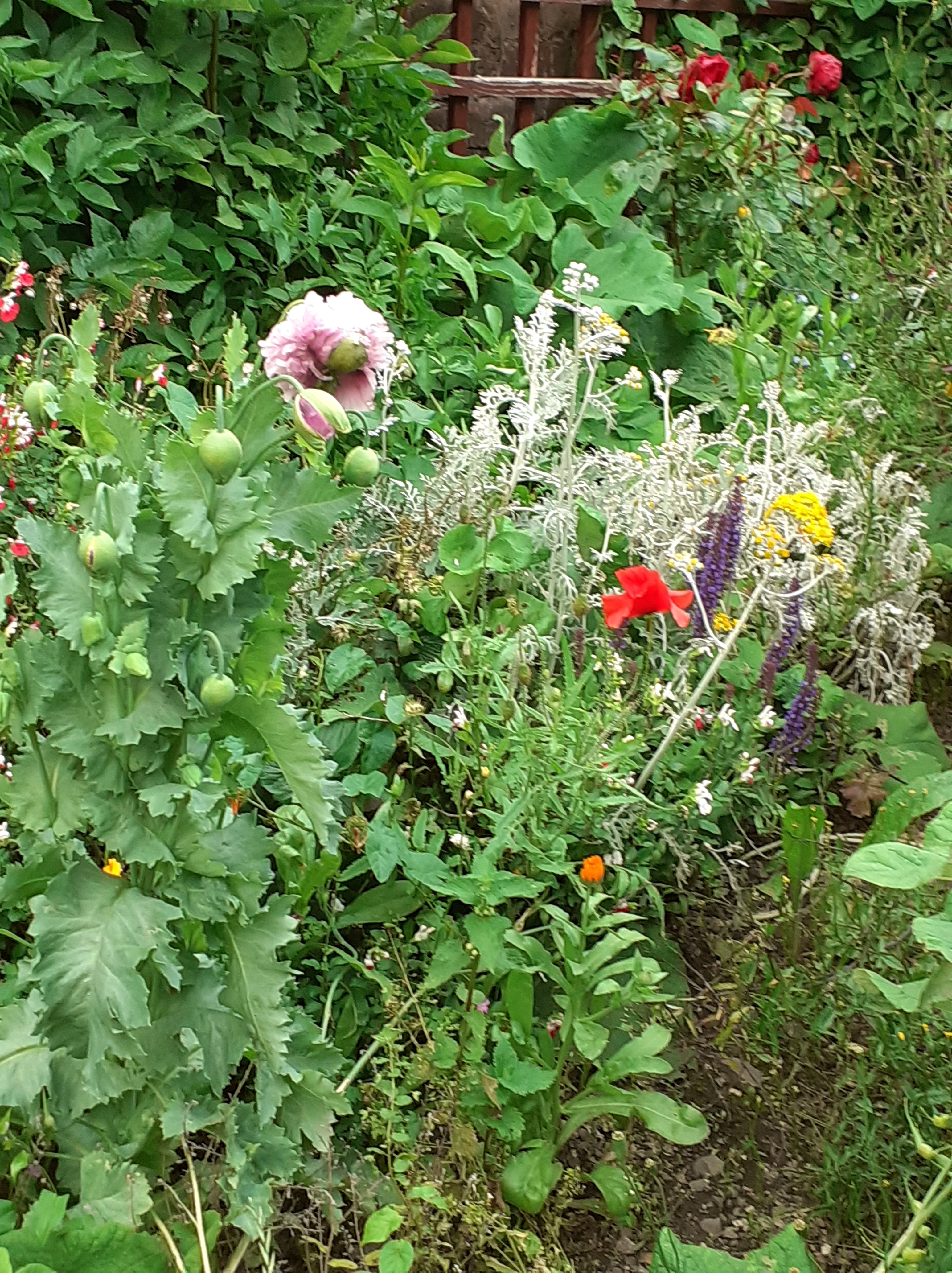
An evening walk on 10 June, around 7pm. We are approaching the summer solstice, Alban Hefin in OBOD Druidry. It is a late moment in the rising year. We are in a now familiar Georgian neighbourhood, where I often focus on sky and buildings. But here my attention is on the earth, and patches of green growth a little recessed from the kerbside. What draws me is a strong sense of light enabling life, relatively late in the day, touching the plants to ensure their thriving.
Flowering plants appeared quite late in this history of our planet, less than a hundred million years ago. Over time they helped to shape the habitat in which we have appeared and made our home. Seemingly fragile, they have, over time, exerted a tremendous collective power. It seems only right to honour them and recognise what they have done for us. May we preserve the habitat on which they and we depend.
As I look at these peonies, I delight in their lushness. But the word ‘poignant’ also comes to mind. Delight is mixed with sadness, and a sense of time slipping away. These are probably the last pictures of these peonies that I will take. They are in the back garden of our old home on the day it was emptied of our remaining possessions. Historically they have ushered in the first fullness of summer. They have confirmed a warm sense of home, year after year, as the wheel turns.
But now I am leaving a place Elaine and I called home for many years, at a time when the future remains uncertain on many levels. The stability of the wheel itself, or at least of its local manifestations, is palpably in question. You have to work perversely hard, now, to maintain an ignorance and denial of the climate crisis. Even here, in a cool temperate island.
I cannot dwell in sadness alone, potentially drawn down into a stuck and demobilised distress. The health and viriditas in my bodymind won’t allow it. I find myself staying open to a delight in what is given, here, in these seasonal images. The invitation to celebrate the bounty of nature in an everyday modest setting is very strong, and I respond. The nudge to make a record is likewise strong. Records and memory matter. They change any living moment to which they are invited. The opportunity to contemplate this image of peonies, knowing the context of the picture-taking, is a resource for future times.
In these parts, there is a week at the end of April – St. George’s Day to Beltane Eve – that I would describe as mature spring. The rising year is leaning in to summer, but not quite there. I came close to missing it this year, at least as an outdoors event. I have made a good, if slightly fluctuating, recovery from the COPD flare-up described in recent posts. I met this moment, on this day, in the open air. At every level I feel better for the experience.
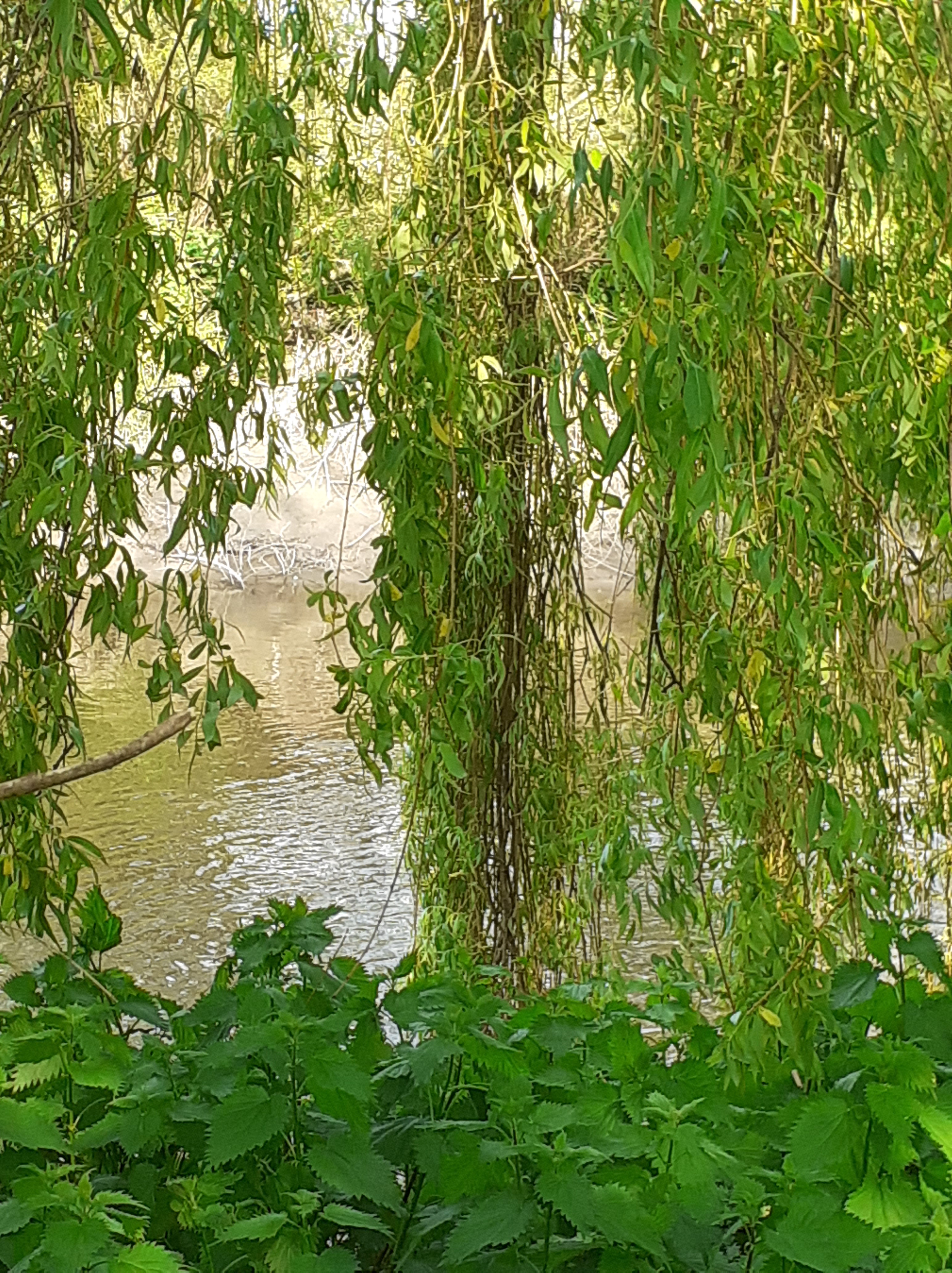
The location is Alney Island, now a nature reserve. The river Severn has divided into east and west channels, with Alney Island between them. Most of my pictures were taken near the (lesser) east channel, which flows into the Gloucester waterfront.
On 24 April 2022, I walked through this almost-city water margin. I was moved by its burgeoning growth, noticing the abundance of green in contrasting shades and forms. For awhile I had given up on going out during this delicious period. The experience, however fragile and transient both I and this space might be, was pure celebration. Taking pictures became an act of celebration, and also of giving thanks.
In my world, this is a time of laboured breath and limited capacity for walking. While medical investigations are underway, I am constrained in what I can do. But walking outside, taking slow deep breaths, and drinking plenty of water are medically and spiritually recommended. Today I went outside for the first time in some days, water bottle to hand, and a rhythm of slow, deep breathing established.
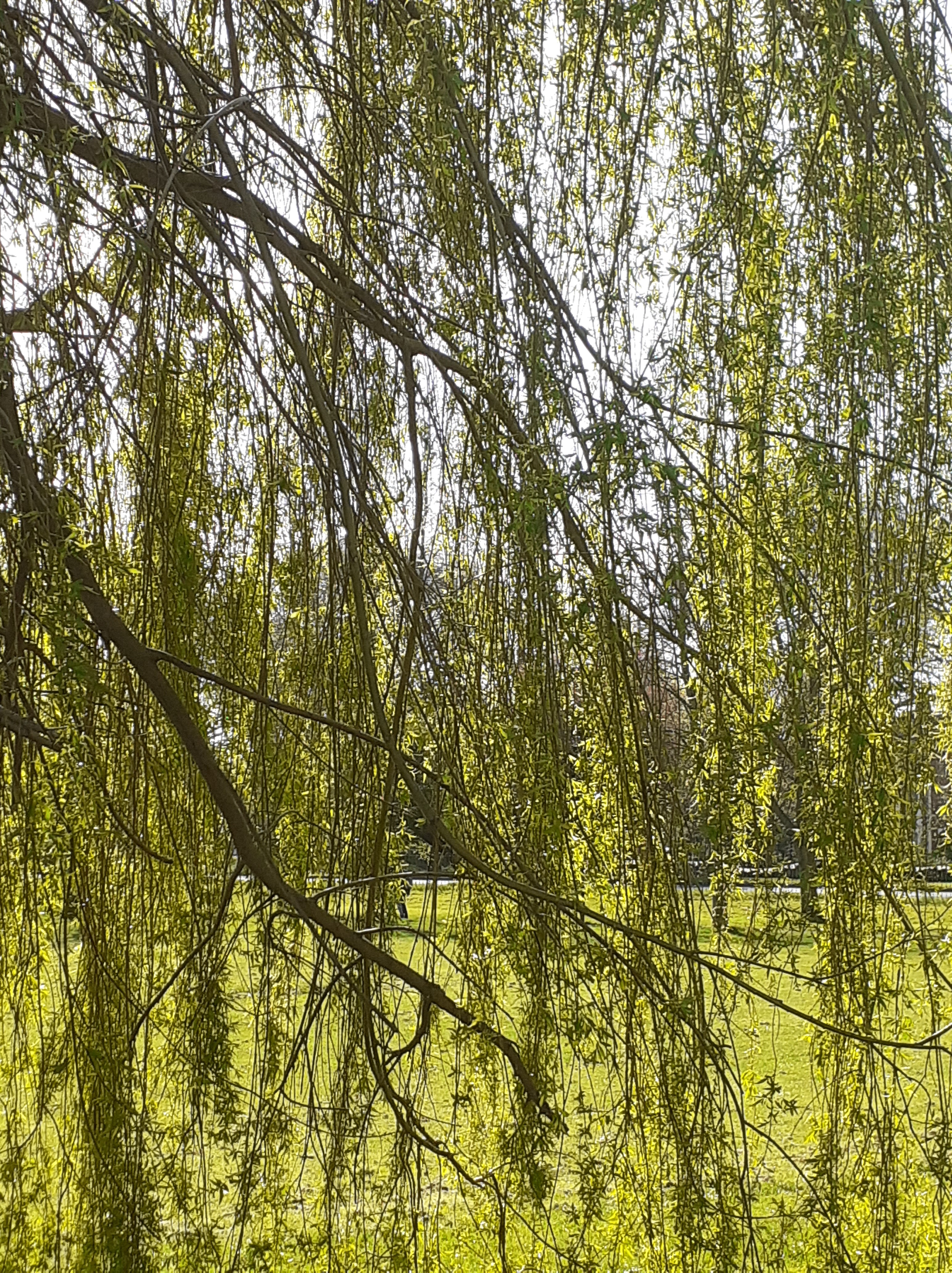
I walked in my neighbourhood and a nearby local park. The picture above is a treescape from that park. For me, it is images solidity and endurance alongside blue sky and spring growth. In itself, it occupies a unique niche in the web of life. I enjoy its company, and the opportunity to record its presence here.
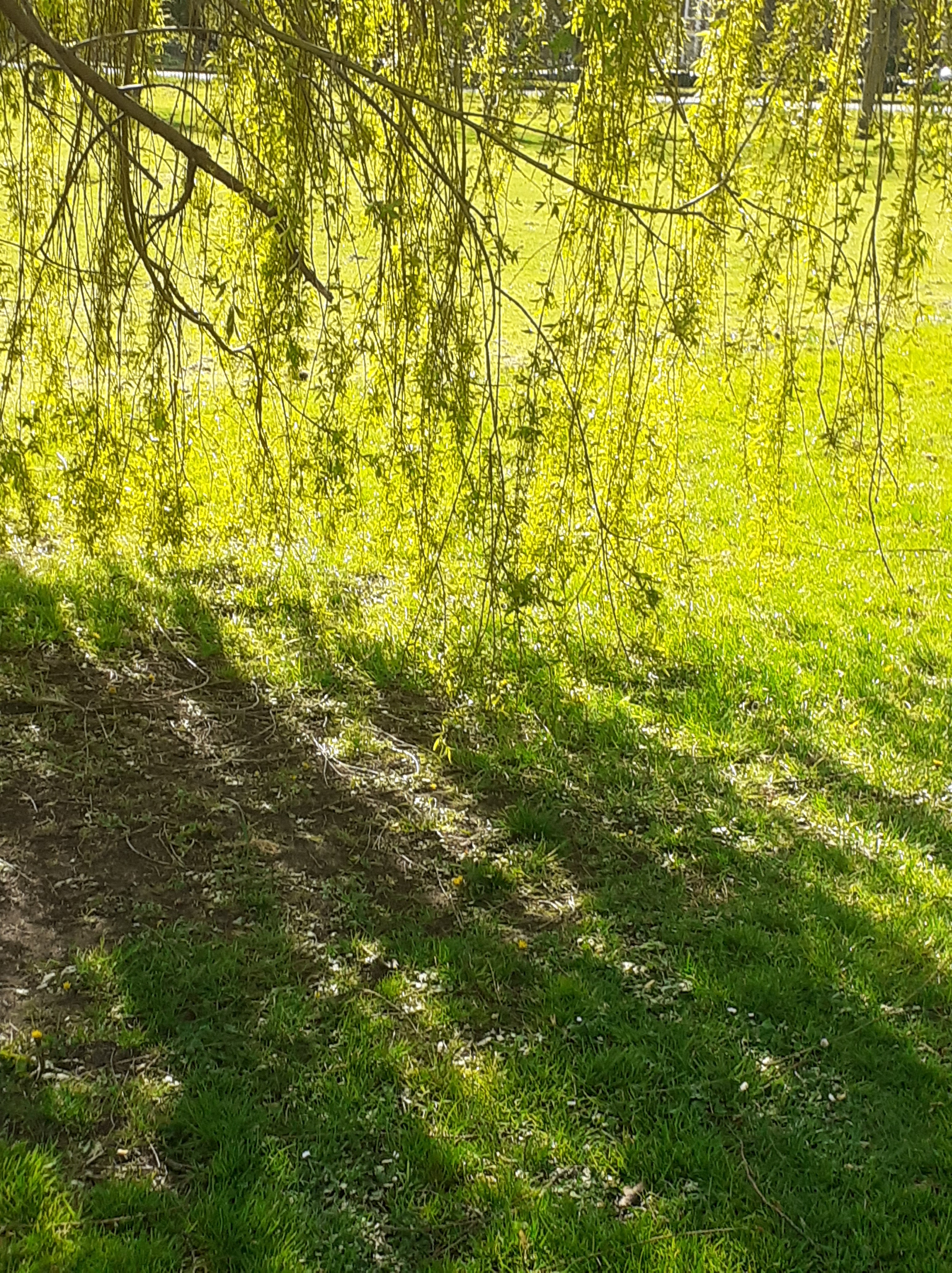
My world may seem, at least for the time being, to have shrunken. My own presence in it, and my perceptions when present to it, do not have to shrink along with the physical distance I can cover. A necessary slowing down contains it own opportunities. I have space and time to enjoy the willows here, their leaves, and the shadows of their leaves. I am constrained to take notice. I appreciate the experience of noticing. I am reminded that I am just outside the period assigned to willow in my personal tree mandala (1,2), but of course it is not too late to connect and commune. There are compensations nested in my unwanted condition.
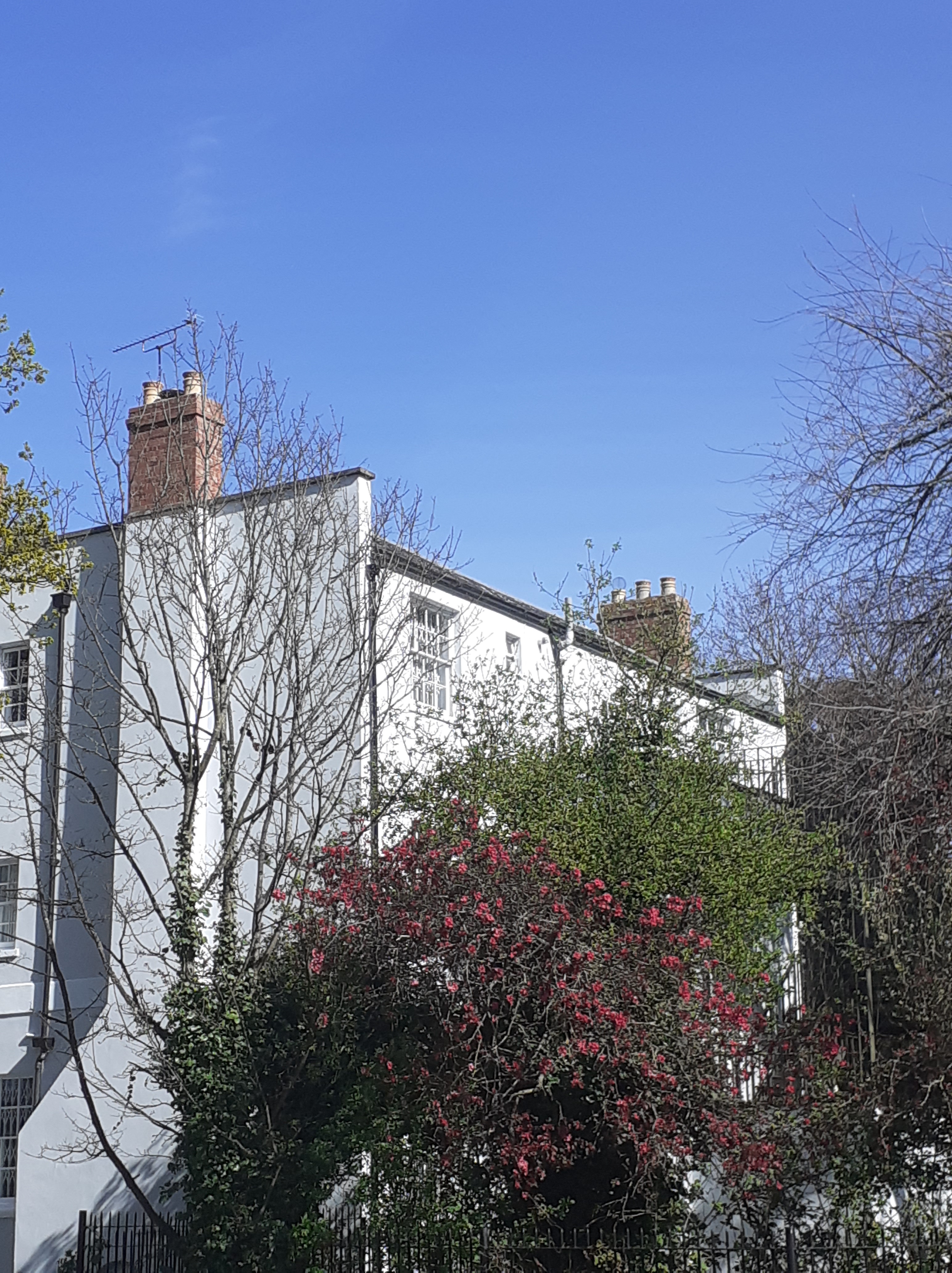
I find the houses and their surrounding plant life photogenic, not least under a blue April sky. The season has been advancing, the equinox now well past. Around me, I find an energetic acceleration towards summer. Hildegard von Bingen called this kind of natural power viriditas. I can recognise and enjoy it even when I’m lagging behind.
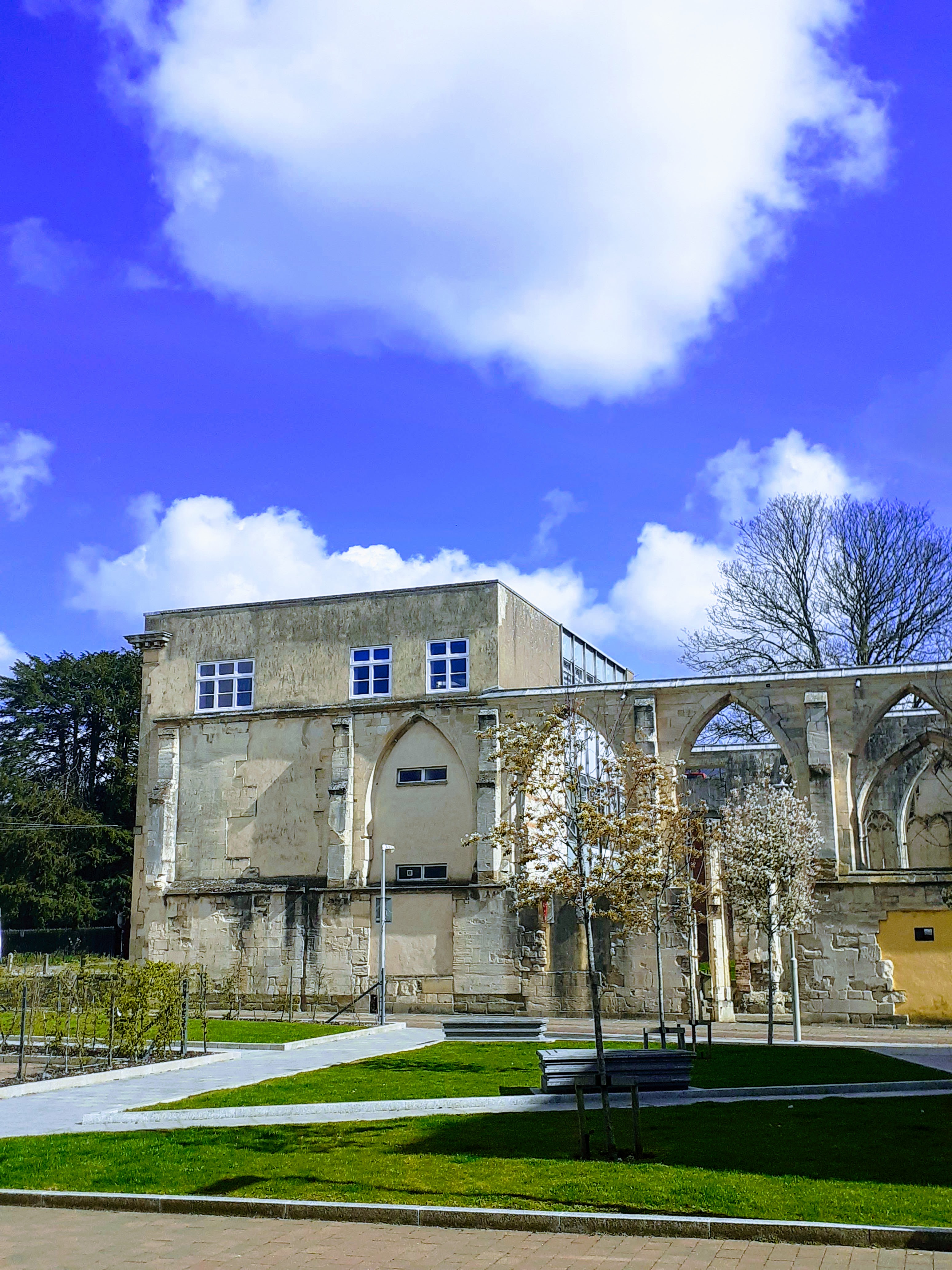
Very close to home I encounter the ruins of Gloucester’s Franciscan Priory, sadly with a nondescript mid C20th building tacked on behind them. They are a landmark for me on my return. I’m tired. I’ve about reached my limit. Although I’m sad that my walking distance is so limited, I feel blessed and nourished by what I find within the limitations. I am also glad to sit down and recognise feeling at once refreshed and exhausted.
(2) The mandala is based on my personal experience of trees in the neighbourhood as well as traditional lore. Moving around the spring quarter from 1 February, the positions and dates of the four trees for this quarter are: Birch, north-east, 1-22 February; Ash & Ivy, east-north-east, 23 February – 16 March; Willow, east, 17 March – 7 April; Blackthorn, east-south-east, 8 – 30 April. The summer quarter then starts with Hawthorn at Beltane. For a complete list of the sixteen trees, see https://contemplativeinquiry.blog/2020/autumn-equinox-2020-hazel-salmon-awen/
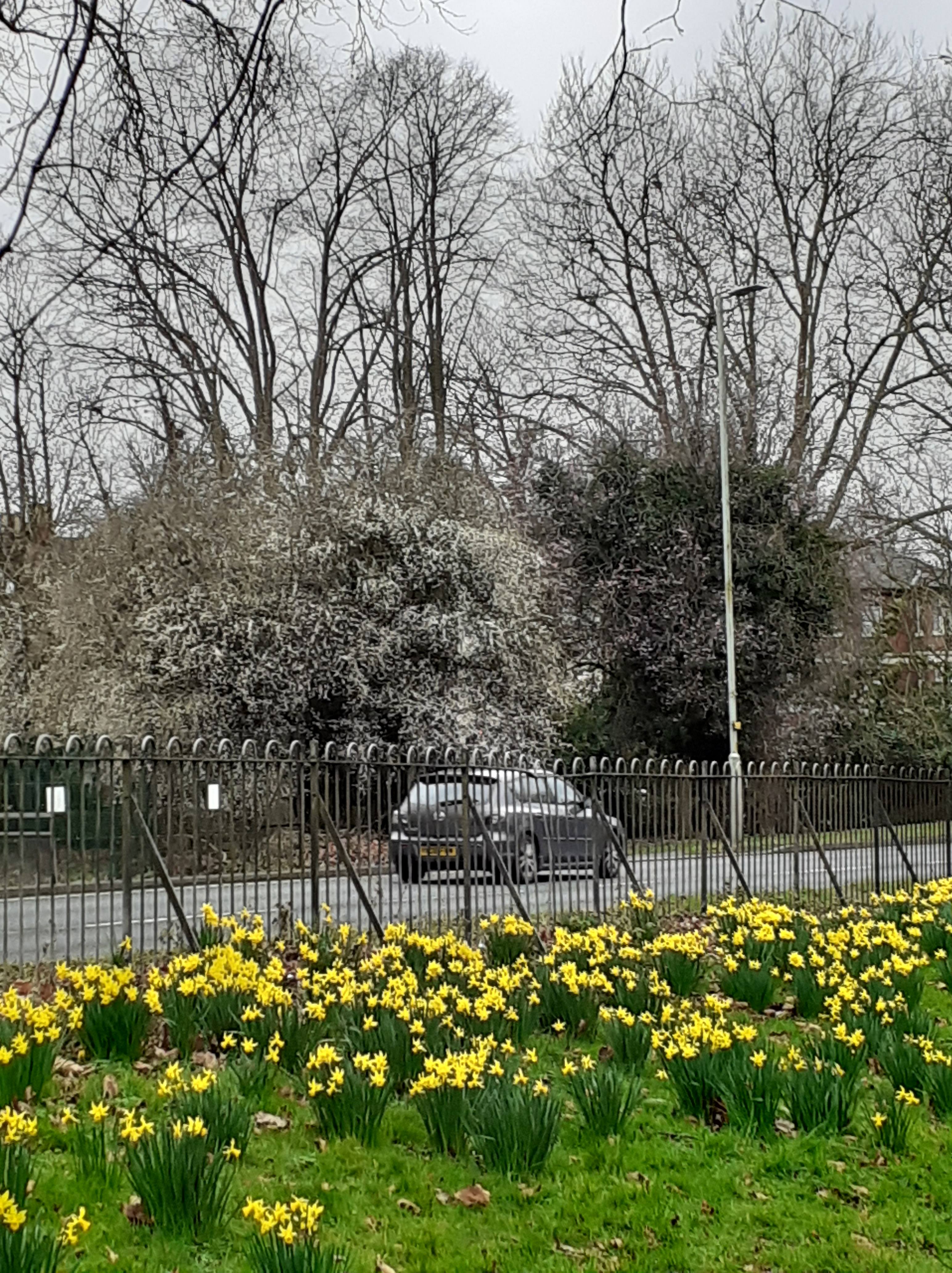
It is 1 March, a mixed day – bringing together grey sky, bare branches, emerging blossoms and vivid daffodils. It is chilly, and rain is likely, though not just yet. Daffodils (here the strongest sign of a changing year) are linked to St. David, the patron saint of Wales. 1 March is his feast day.
David lived during the sixth century CE, a flourishing time for Celtic Christianity. His defining early achievement was the founding of a Celtic monastic community at Glyn Rhosyn (the Vale of Roses) on the west headland of Pembrokeshire (Si Benfro) where St. David’s Cathedral now stands. He went on to become a Christian leader of great authority, and was eventually canonised in the twelfth century, a different historical period with the church under stronger Vatican control and Welsh identity under threat from the English. David became the patron saint of Wales and his day is celebrated in Wales with parades and other public events.
Gloucester is very much an English city, though not so very far from Wales. Today’s weather conditions would not be out of place there. My wife Elaine and I went out on a morning walk with a sense of the saint’s day and how both the day and the coming of March represent a shift in the year. I noticed, too, how I can honour a saint without thinking of sainthood as a model, or even remotely wanting to be one. I acknowledge that I am on different kind of path, less defined, less heroic, and less religious.
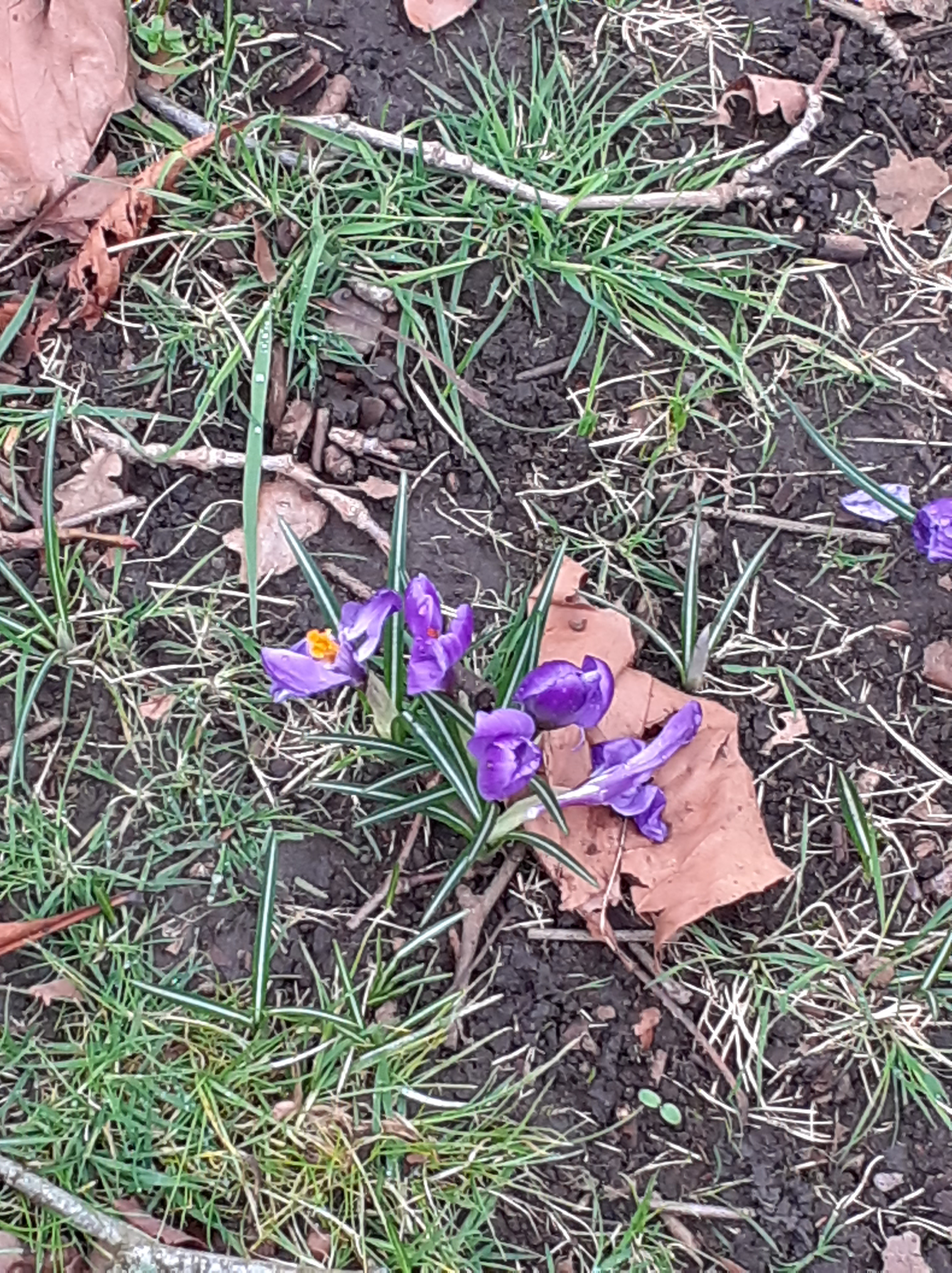
When out walking, I see how the ordinary world seems to transform in the light of a loving gaze. I am looking at the world as it is, not for signs of a creator’s hand or influence or expectations. For me, laid out below – at the micro level – I find grass, earth, twigs, purple crocus and dead leaves. They are simply themselves. All ordinary in an ordinary moment. But an ordinary moment, as we might conventionally call it, is an extraordinary event. It is a small miracle, in its naturalistic way, yet easy to access in a receptive frame of mind.
I do appreciate that a ‘receptive frame of mind’, as a private experience, is facilitated by favourable public conditions, like a well-managed public park. I may not be dependent on such external conditions, but they do make a difference. I am grateful for their current presence in an uncertain world.
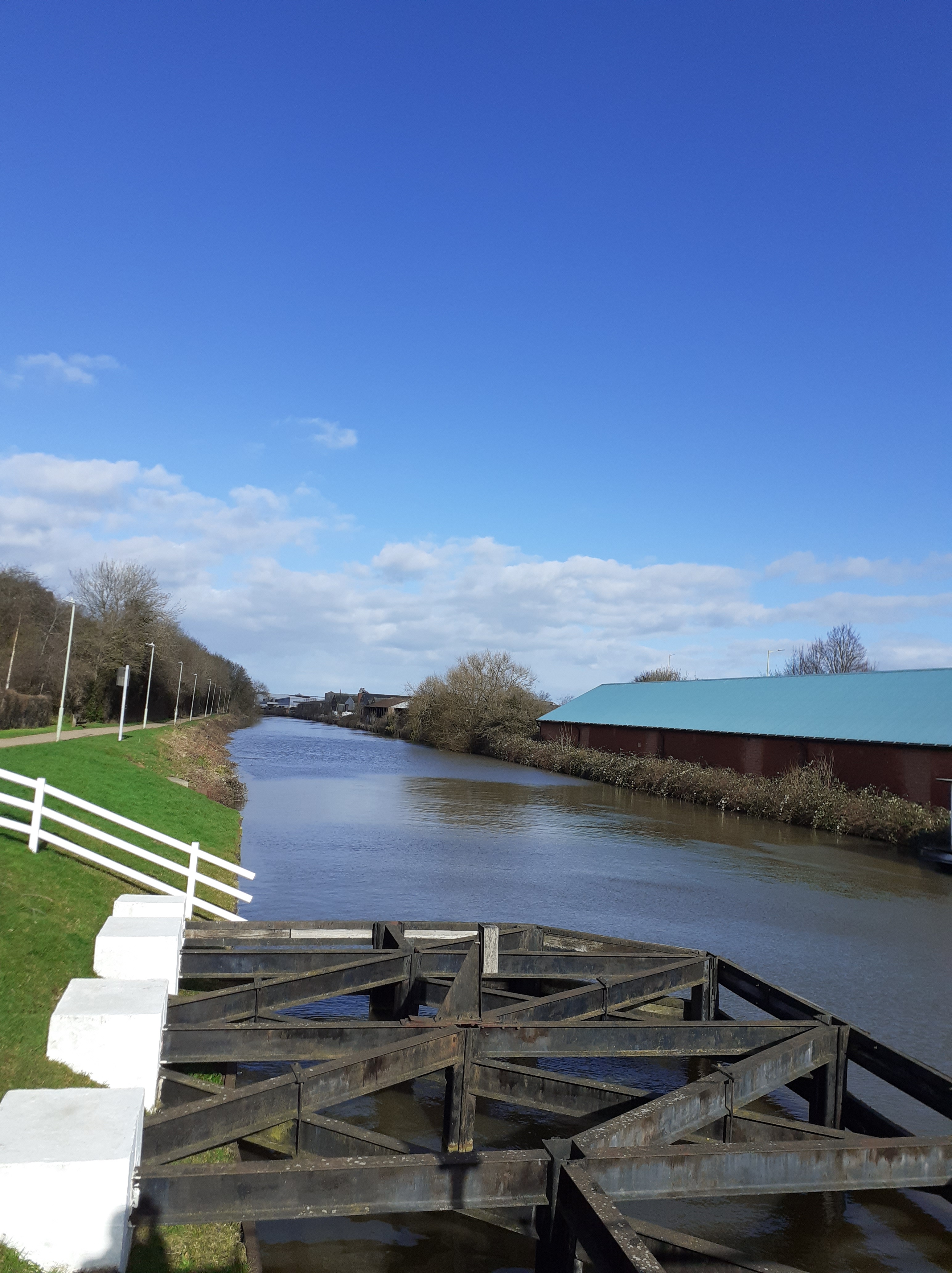
I was facing strong sunlight. I even felt warm. I risked taking a picture by angling down into the water. The water rewarded me with a patches of reflected light. I accepted a somewhat darkening effect in the photograph as a whole. The solar reality was brighter to my eyes, almost too much for them, flooding the path before me with intense light. When I looked back to where I had been, the light was gentler. My picture below shows a clear blue sky that I could confidently open up to include.
Though winter is not exactly over, I was experiencing an undoubtedly spring day. I was in a spring frame of mind, welcoming the change of season, as the wheel turns, and welcoming a still new landscape into my life. I have chosen this canal path as a place of regular walks and engagement. Over time, in the rising year, I will get to see and know it better. I seem to be a water margin Druid at heart, and I am finding possibilities in this new, more densely urban context. I find the energy of life everywhere I look – whether land, water, or sky.
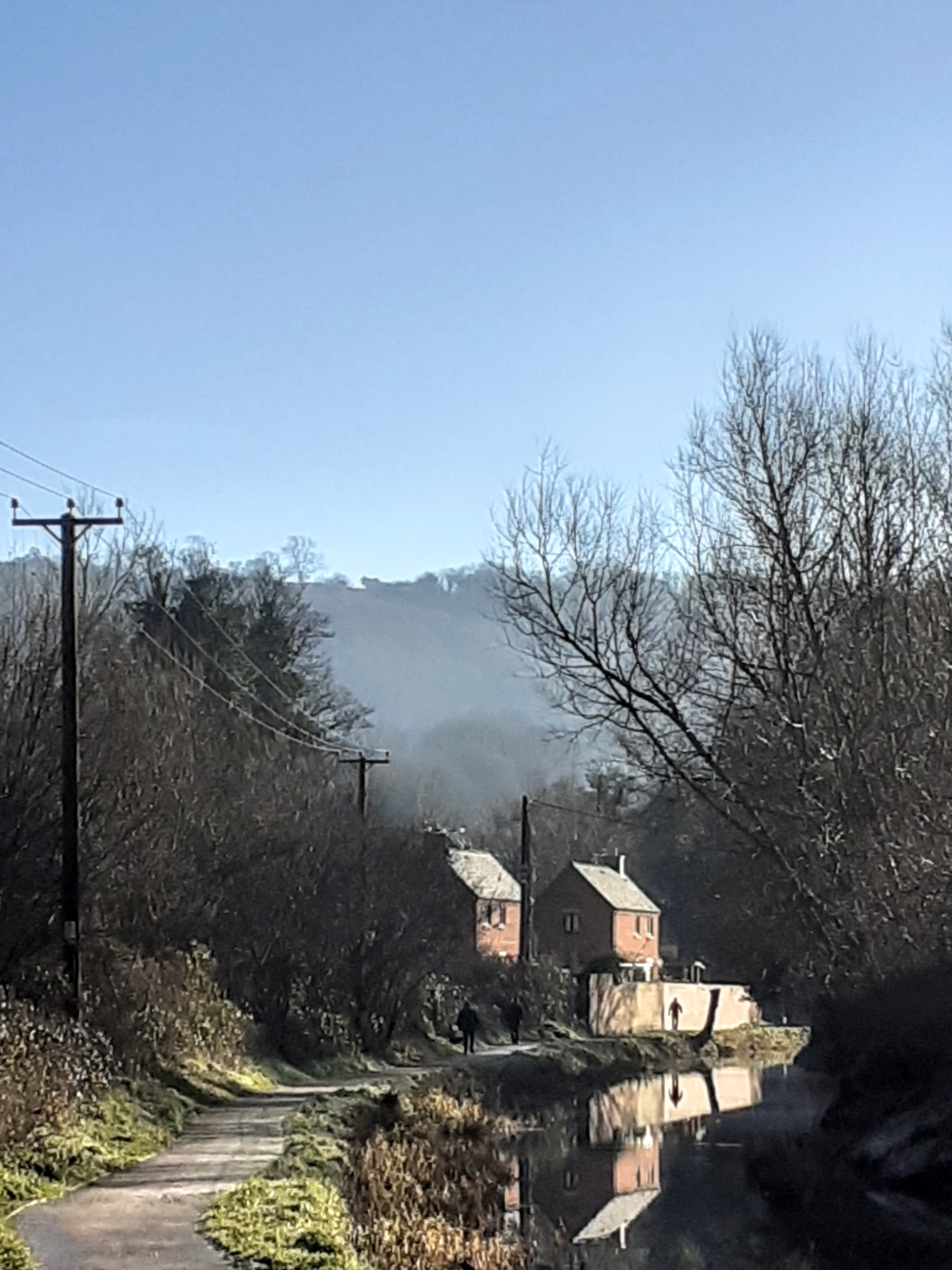
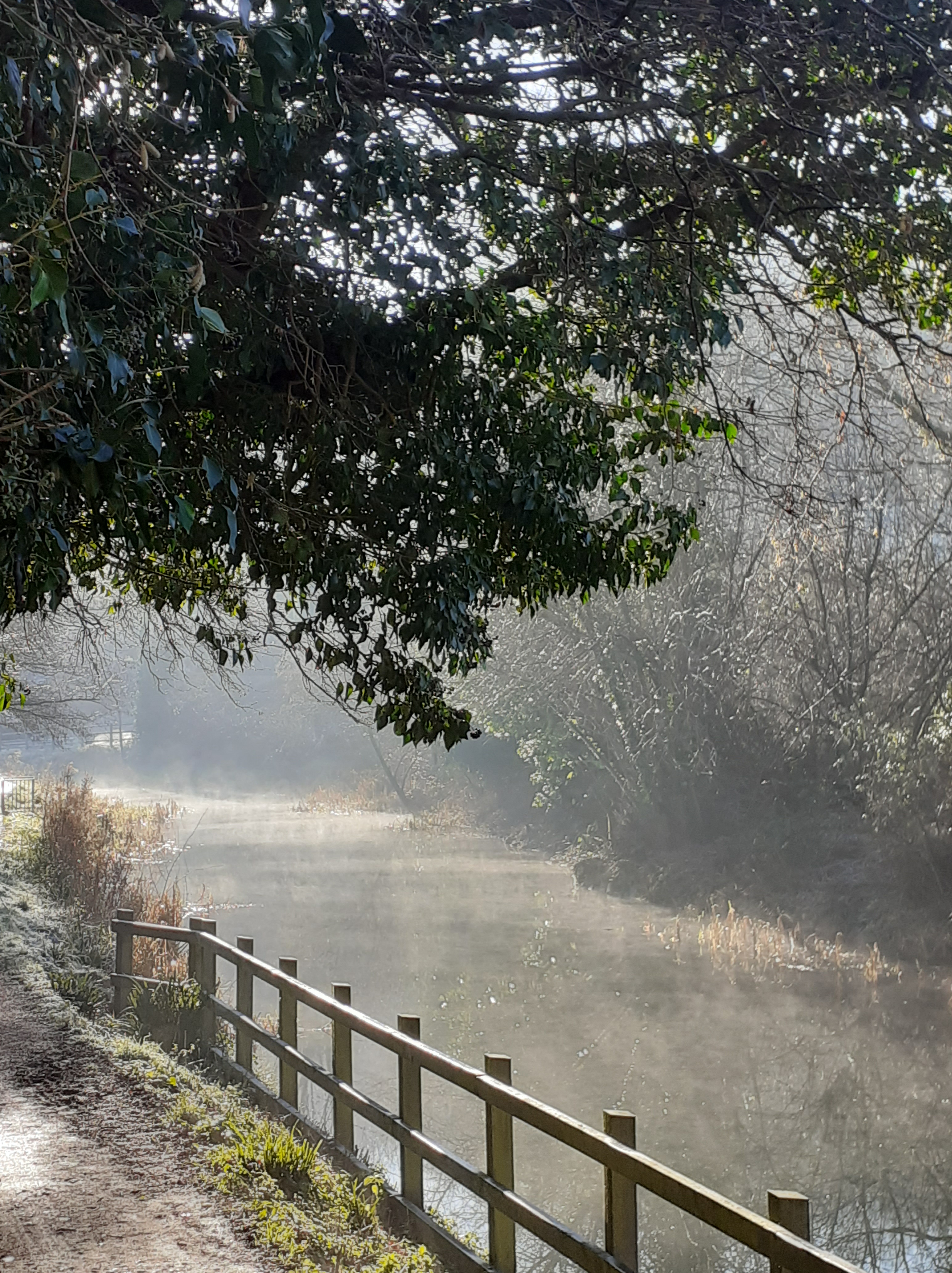
A winter morning walk with the temperature gently rising above freezing. Internally I’m here, now and at home, as the world changes around me. Walking outside becomes a meditation without effort or solemnity.
It feels good to be reminded, on the cusp of a house move, that at-homeness is portable, embracing variety and change. Light dances with shade. Mist gradually disperses into a blue sky. Still images can point to the process of growth, as with the red berries below, which startled me with their vividness when I saw them.
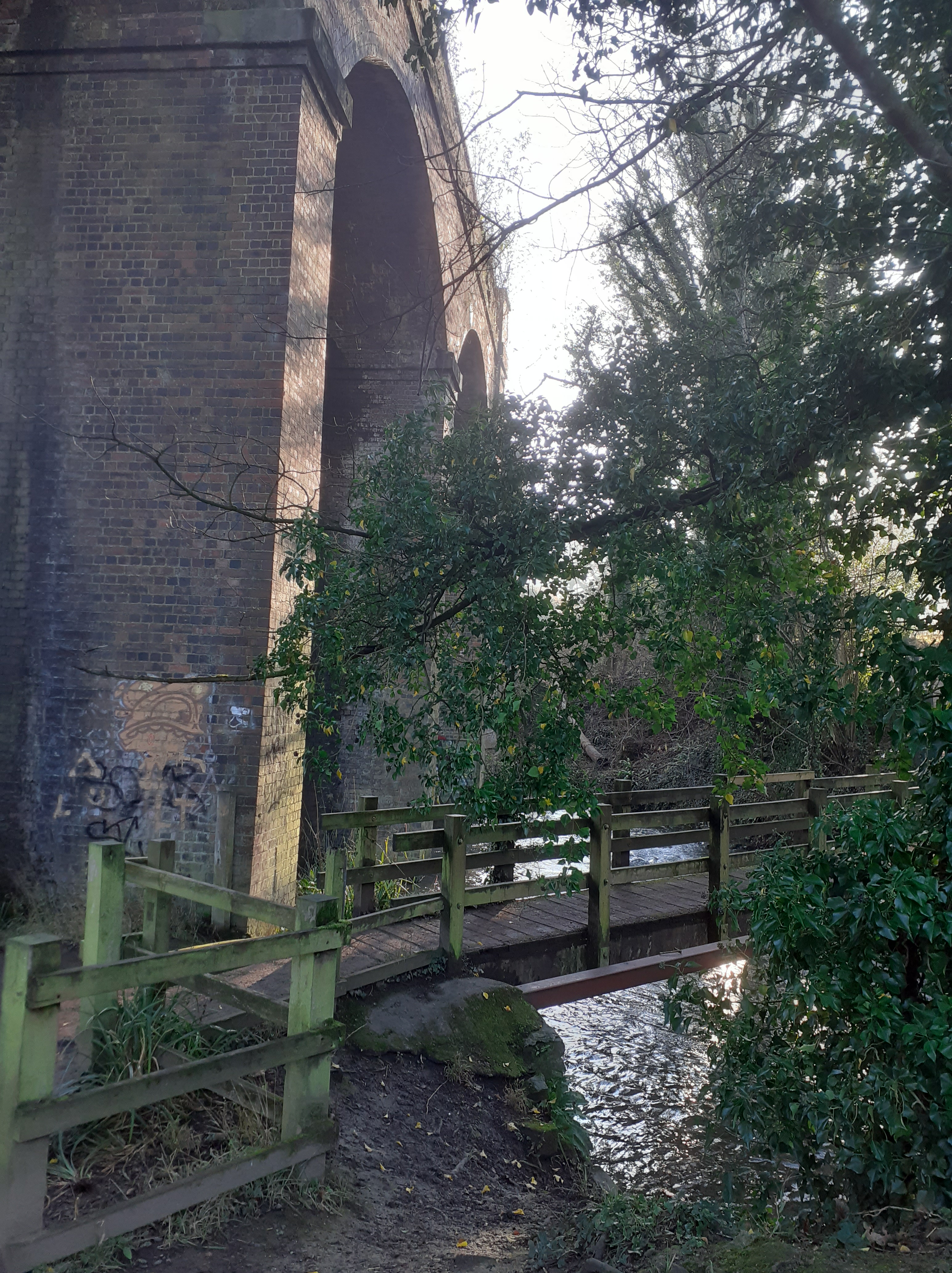
I find it a comforting, simple pleasure to observe the changes in familiar spaces throughout the day and the year. Because I am leaving the locality, I am delighting in the images I take away from this day’s walk – the land, the water, sunlight and mist; a quietly decaying building and its reflection; railway arches, a footbridge over a stream. Soon, a new landscape will take on its own familiarity.
Finally, I am moved by the light and shade on our garden path, such a good way to end a walk.
I will be moving house very soon. This will no longer be the view from my bedroom window. My gaze today is tinged with premature nostalgia.
This gaze shows continuity and slow, gradual change in the world outside. This world wears its winter look, with bare branches and extensive views. At other times of the year, both are covered by foliage. But the solstice darkness has already withdrawn from the mid-afternoon. Today is blessed with strong sunlight and blue sky. The year is turning again, now towards the light.
The house move feels more abrupt. I have lived here for longer than anywhere else in my adult life. Chiefly it has been the hallowed setting for my life with Elaine (1). Whilst living here, I completed my OBOD training, later beginning a self-directed exploration of contemplative Druidry, including a 4 year project within the Druid community (2). For a while, contemplative inquiry – within and beyond Druidry – became the guiding principle of my spirituality. Now it is more like an influential thread within my Druid practice.
I wonder what changes life in another location will make, as Elaine and I continue our journey together. There will be only a limited break from the past. We will be in the same county, though not the same town. But there will be differences too. The psychogeography will be different. The spirits of place will be different. The world beyond our windows will be new.
Bright Blessings to everyone at the turn of the calendar year. With some fears and greater hopes, I have crossed the threshold into 2022. I have welcomed it into my life and declared myself ready for the journey.
In a way, ‘2022’ is a fiction woven from our human experience of linear time and a cultural decision about numbers. But these things are thoroughly ingrained in me and feel like givens, completely natural. I remember clocking this, or signing up to the tribal custom, in the new year of 1957, when I was 7 years old and found myself remembering 1956 as a full, known year. It was the first time I had been conscious of such a thing. Now I was somewhere new and exciting (1957) though the feel of my bedclothes was familiar in the very dim early morning light. I remember this vividly and, truth be told, better than I remember waking up yesterday.
Flowing water is often used as an image for the passing of linear time. On my walk yesterday morning, I checked this out in nature and made two brief videos of a stream. Standing on the bridge at slightly different times, facing in opposite directions, I filmed a stream flowing both towards me and away from me. My feelings about the two were a little different.
The water coming towards me felt fresh and energised. I was curious about the patterns on the surface both from the flow itself and from the rain. I was drawn in, more meditatively, by the sound. I was also interested in what stories the water might hold. But I didn’t follow these up, out of concern for losing the immediate experience. Above all I, felt invigorated. I enjoyed this flow.
Flowing away was different. It wasn’t raining and I could hear – I think – sea gulls. They are certainly around. Again I enjoyed patterns in the water and the enlivening strength of the flow. But I was strongly aware of it moving away from me. Yes – it was reliably replenished … but for how much longer? And, in any case, a movement away is a movement away. Movements away carry a sense of loss. This isn’t just about my age. It is built into the experience of linear time. Things pass away into a temporal distance. Linear time is the mechanism that allows anything to ‘happen’ at all, but also the guarantor of impermanence. There’s a poignancy in this condition that I allow myself to experience and hold – not, here, seeking comfort in the eternal. I watch the power of a little stream, grateful for the miracle of existence, softly sad about its vulnerable brevity.
Late on Christmas morning, I went out for a midwinter walk. It was relatively warm outside (8C/46F). The world seemed static and still. Yet I had the sense of a new year quietly being born, somewhere under the surface. Ripples in the water seemed to me to confirm this.
The midwinter season that I observe in nature can be like that – superficial dullness masking dynamic transformation. Life is strong in this watery place. The wheel continues to turn. There may be harsh weeks ahead, but the overall movement of time is already leaning towards regeneration, rather than the seasonal dying of late autumn and early winter.
At times like this I sense the presence of an ancient cosmic motherhood that gives me hope for the coming year. May all beings be blessed.











 Contemplative Inquiry